UbD Economics Unit Template for M.Teach Secondary Teachers: Design
VerifiedAdded on 2023/04/25
|7
|2635
|118
Project
AI Summary
This assignment provides an Understanding by Design (UbD) unit template tailored for M.Teach secondary teachers focusing on Economics. It outlines Stage 1, which includes identifying desired results, established goals aligned with the Australian Curriculum, transfer goals for students, cross-curricular priorities, and general capabilities. The unit defines enduring understandings and essential questions to foster inquiry into economic concepts. It also specifies the knowledge and skills students will acquire, such as understanding resource utilization, production stages, and economic factors. Stage 2 details performance tasks and other evidence for assessment, including formative and summative assessments, self-assessment strategies, and various assessment types. Stage 3 presents the learning plan, focusing on engaging students, addressing individual needs, and creating a comprehensive learning environment. The assignment emphasizes analytical skills, essay writing, and the integration of political science and economic issues.
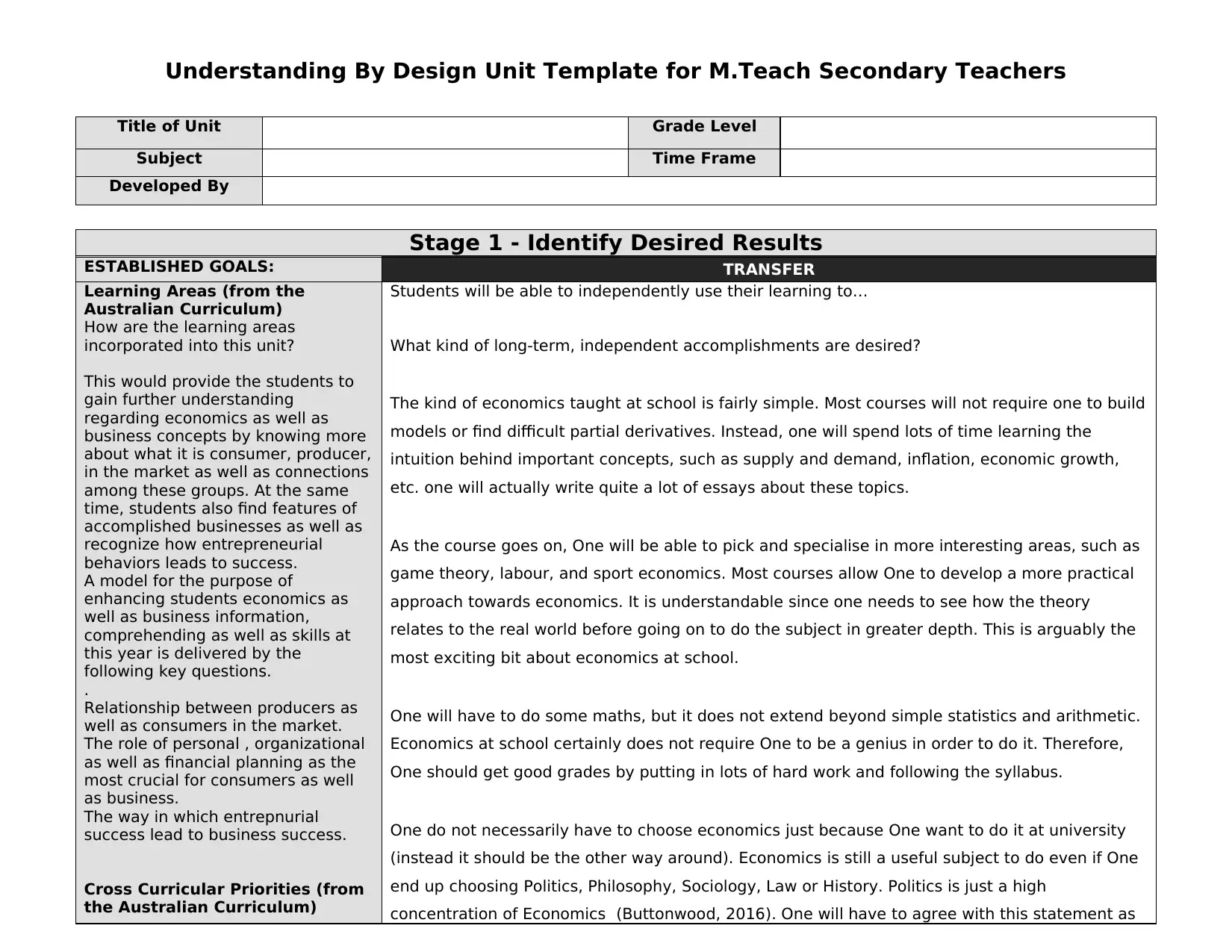
Understanding By Design Unit Template for M.Teach Secondary Teachers
Title of Unit Grade Level
Subject Time Frame
Developed By
Stage 1 - Identify Desired Results
ESTABLISHED GOALS: TRANSFER
Learning Areas (from the
Australian Curriculum)
How are the learning areas
incorporated into this unit?
This would provide the students to
gain further understanding
regarding economics as well as
business concepts by knowing more
about what it is consumer, producer,
in the market as well as connections
among these groups. At the same
time, students also find features of
accomplished businesses as well as
recognize how entrepreneurial
behaviors leads to success.
A model for the purpose of
enhancing students economics as
well as business information,
comprehending as well as skills at
this year is delivered by the
following key questions.
.
Relationship between producers as
well as consumers in the market.
The role of personal , organizational
as well as financial planning as the
most crucial for consumers as well
as business.
The way in which entrepnurial
success lead to business success.
Cross Curricular Priorities (from
the Australian Curriculum)
Students will be able to independently use their learning to…
What kind of long-term, independent accomplishments are desired?
The kind of economics taught at school is fairly simple. Most courses will not require one to build
models or find difficult partial derivatives. Instead, one will spend lots of time learning the
intuition behind important concepts, such as supply and demand, inflation, economic growth,
etc. one will actually write quite a lot of essays about these topics.
As the course goes on, One will be able to pick and specialise in more interesting areas, such as
game theory, labour, and sport economics. Most courses allow One to develop a more practical
approach towards economics. It is understandable since one needs to see how the theory
relates to the real world before going on to do the subject in greater depth. This is arguably the
most exciting bit about economics at school.
One will have to do some maths, but it does not extend beyond simple statistics and arithmetic.
Economics at school certainly does not require One to be a genius in order to do it. Therefore,
One should get good grades by putting in lots of hard work and following the syllabus.
One do not necessarily have to choose economics just because One want to do it at university
(instead it should be the other way around). Economics is still a useful subject to do even if One
end up choosing Politics, Philosophy, Sociology, Law or History. Politics is just a high
concentration of Economics (Buttonwood, 2016). One will have to agree with this statement as
Title of Unit Grade Level
Subject Time Frame
Developed By
Stage 1 - Identify Desired Results
ESTABLISHED GOALS: TRANSFER
Learning Areas (from the
Australian Curriculum)
How are the learning areas
incorporated into this unit?
This would provide the students to
gain further understanding
regarding economics as well as
business concepts by knowing more
about what it is consumer, producer,
in the market as well as connections
among these groups. At the same
time, students also find features of
accomplished businesses as well as
recognize how entrepreneurial
behaviors leads to success.
A model for the purpose of
enhancing students economics as
well as business information,
comprehending as well as skills at
this year is delivered by the
following key questions.
.
Relationship between producers as
well as consumers in the market.
The role of personal , organizational
as well as financial planning as the
most crucial for consumers as well
as business.
The way in which entrepnurial
success lead to business success.
Cross Curricular Priorities (from
the Australian Curriculum)
Students will be able to independently use their learning to…
What kind of long-term, independent accomplishments are desired?
The kind of economics taught at school is fairly simple. Most courses will not require one to build
models or find difficult partial derivatives. Instead, one will spend lots of time learning the
intuition behind important concepts, such as supply and demand, inflation, economic growth,
etc. one will actually write quite a lot of essays about these topics.
As the course goes on, One will be able to pick and specialise in more interesting areas, such as
game theory, labour, and sport economics. Most courses allow One to develop a more practical
approach towards economics. It is understandable since one needs to see how the theory
relates to the real world before going on to do the subject in greater depth. This is arguably the
most exciting bit about economics at school.
One will have to do some maths, but it does not extend beyond simple statistics and arithmetic.
Economics at school certainly does not require One to be a genius in order to do it. Therefore,
One should get good grades by putting in lots of hard work and following the syllabus.
One do not necessarily have to choose economics just because One want to do it at university
(instead it should be the other way around). Economics is still a useful subject to do even if One
end up choosing Politics, Philosophy, Sociology, Law or History. Politics is just a high
concentration of Economics (Buttonwood, 2016). One will have to agree with this statement as

Paraphrase This Document
Need a fresh take? Get an instant paraphrase of this document with our AI Paraphraser
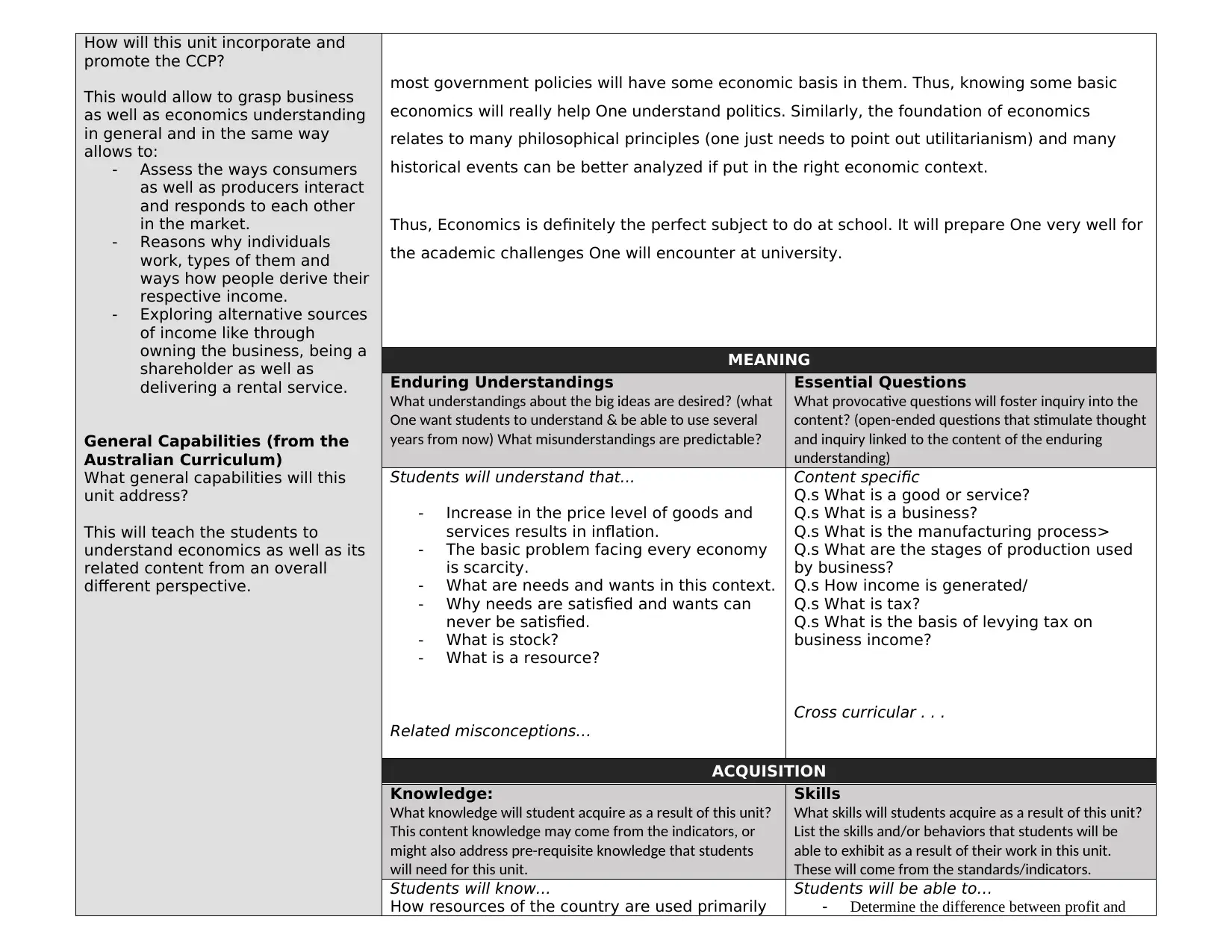
How will this unit incorporate and
promote the CCP?
This would allow to grasp business
as well as economics understanding
in general and in the same way
allows to:
- Assess the ways consumers
as well as producers interact
and responds to each other
in the market.
- Reasons why individuals
work, types of them and
ways how people derive their
respective income.
- Exploring alternative sources
of income like through
owning the business, being a
shareholder as well as
delivering a rental service.
General Capabilities (from the
Australian Curriculum)
What general capabilities will this
unit address?
This will teach the students to
understand economics as well as its
related content from an overall
different perspective.
most government policies will have some economic basis in them. Thus, knowing some basic
economics will really help One understand politics. Similarly, the foundation of economics
relates to many philosophical principles (one just needs to point out utilitarianism) and many
historical events can be better analyzed if put in the right economic context.
Thus, Economics is definitely the perfect subject to do at school. It will prepare One very well for
the academic challenges One will encounter at university.
MEANING
Enduring Understandings
What understandings about the big ideas are desired? (what
One want students to understand & be able to use several
years from now) What misunderstandings are predictable?
Essential Questions
What provocative questions will foster inquiry into the
content? (open-ended questions that stimulate thought
and inquiry linked to the content of the enduring
understanding)
Students will understand that...
- Increase in the price level of goods and
services results in inflation.
- The basic problem facing every economy
is scarcity.
- What are needs and wants in this context.
- Why needs are satisfied and wants can
never be satisfied.
- What is stock?
- What is a resource?
Related misconceptions…
Content specific
Q.s What is a good or service?
Q.s What is a business?
Q.s What is the manufacturing process>
Q.s What are the stages of production used
by business?
Q.s How income is generated/
Q.s What is tax?
Q.s What is the basis of levying tax on
business income?
Cross curricular . . .
ACQUISITION
Knowledge:
What knowledge will student acquire as a result of this unit?
This content knowledge may come from the indicators, or
might also address pre-requisite knowledge that students
will need for this unit.
Skills
What skills will students acquire as a result of this unit?
List the skills and/or behaviors that students will be
able to exhibit as a result of their work in this unit.
These will come from the standards/indicators.
Students will know...
How resources of the country are used primarily
Students will be able to…
- Determine the difference between profit and
promote the CCP?
This would allow to grasp business
as well as economics understanding
in general and in the same way
allows to:
- Assess the ways consumers
as well as producers interact
and responds to each other
in the market.
- Reasons why individuals
work, types of them and
ways how people derive their
respective income.
- Exploring alternative sources
of income like through
owning the business, being a
shareholder as well as
delivering a rental service.
General Capabilities (from the
Australian Curriculum)
What general capabilities will this
unit address?
This will teach the students to
understand economics as well as its
related content from an overall
different perspective.
most government policies will have some economic basis in them. Thus, knowing some basic
economics will really help One understand politics. Similarly, the foundation of economics
relates to many philosophical principles (one just needs to point out utilitarianism) and many
historical events can be better analyzed if put in the right economic context.
Thus, Economics is definitely the perfect subject to do at school. It will prepare One very well for
the academic challenges One will encounter at university.
MEANING
Enduring Understandings
What understandings about the big ideas are desired? (what
One want students to understand & be able to use several
years from now) What misunderstandings are predictable?
Essential Questions
What provocative questions will foster inquiry into the
content? (open-ended questions that stimulate thought
and inquiry linked to the content of the enduring
understanding)
Students will understand that...
- Increase in the price level of goods and
services results in inflation.
- The basic problem facing every economy
is scarcity.
- What are needs and wants in this context.
- Why needs are satisfied and wants can
never be satisfied.
- What is stock?
- What is a resource?
Related misconceptions…
Content specific
Q.s What is a good or service?
Q.s What is a business?
Q.s What is the manufacturing process>
Q.s What are the stages of production used
by business?
Q.s How income is generated/
Q.s What is tax?
Q.s What is the basis of levying tax on
business income?
Cross curricular . . .
ACQUISITION
Knowledge:
What knowledge will student acquire as a result of this unit?
This content knowledge may come from the indicators, or
might also address pre-requisite knowledge that students
will need for this unit.
Skills
What skills will students acquire as a result of this unit?
List the skills and/or behaviors that students will be
able to exhibit as a result of their work in this unit.
These will come from the standards/indicators.
Students will know...
How resources of the country are used primarily
Students will be able to…
- Determine the difference between profit and
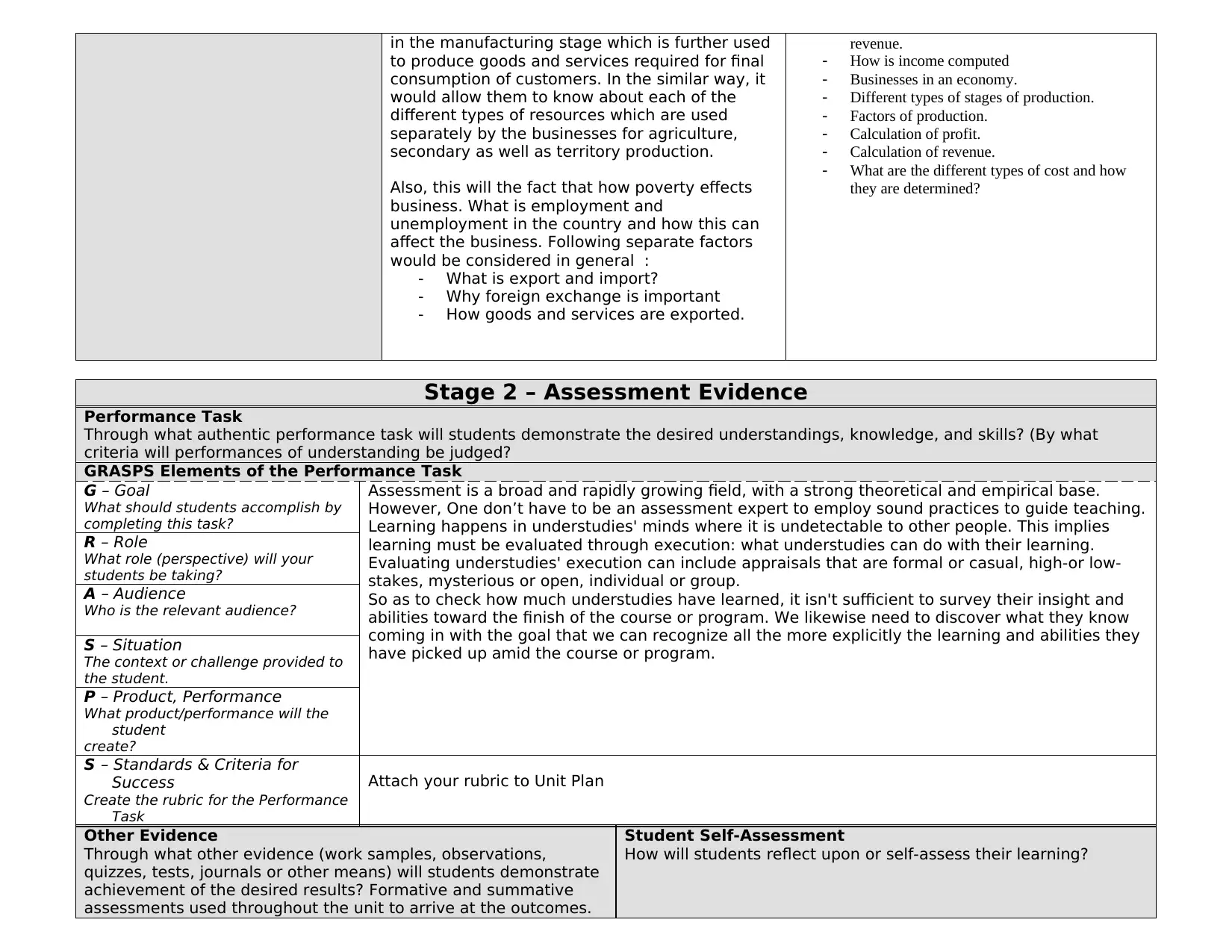
in the manufacturing stage which is further used
to produce goods and services required for final
consumption of customers. In the similar way, it
would allow them to know about each of the
different types of resources which are used
separately by the businesses for agriculture,
secondary as well as territory production.
Also, this will the fact that how poverty effects
business. What is employment and
unemployment in the country and how this can
affect the business. Following separate factors
would be considered in general :
- What is export and import?
- Why foreign exchange is important
- How goods and services are exported.
revenue.
- How is income computed
- Businesses in an economy.
- Different types of stages of production.
- Factors of production.
- Calculation of profit.
- Calculation of revenue.
- What are the different types of cost and how
they are determined?
Stage 2 – Assessment Evidence
Performance Task
Through what authentic performance task will students demonstrate the desired understandings, knowledge, and skills? (By what
criteria will performances of understanding be judged?
GRASPS Elements of the Performance Task
G – Goal
What should students accomplish by
completing this task?
Assessment is a broad and rapidly growing field, with a strong theoretical and empirical base.
However, One don’t have to be an assessment expert to employ sound practices to guide teaching.
Learning happens in understudies' minds where it is undetectable to other people. This implies
learning must be evaluated through execution: what understudies can do with their learning.
Evaluating understudies' execution can include appraisals that are formal or casual, high-or low-
stakes, mysterious or open, individual or group.
So as to check how much understudies have learned, it isn't sufficient to survey their insight and
abilities toward the finish of the course or program. We likewise need to discover what they know
coming in with the goal that we can recognize all the more explicitly the learning and abilities they
have picked up amid the course or program.
R – Role
What role (perspective) will your
students be taking?
A – Audience
Who is the relevant audience?
S – Situation
The context or challenge provided to
the student.
P – Product, Performance
What product/performance will the
student
create?
S – Standards & Criteria for
Success
Create the rubric for the Performance
Task
Attach your rubric to Unit Plan
Other Evidence
Through what other evidence (work samples, observations,
quizzes, tests, journals or other means) will students demonstrate
achievement of the desired results? Formative and summative
assessments used throughout the unit to arrive at the outcomes.
Student Self-Assessment
How will students reflect upon or self-assess their learning?
to produce goods and services required for final
consumption of customers. In the similar way, it
would allow them to know about each of the
different types of resources which are used
separately by the businesses for agriculture,
secondary as well as territory production.
Also, this will the fact that how poverty effects
business. What is employment and
unemployment in the country and how this can
affect the business. Following separate factors
would be considered in general :
- What is export and import?
- Why foreign exchange is important
- How goods and services are exported.
revenue.
- How is income computed
- Businesses in an economy.
- Different types of stages of production.
- Factors of production.
- Calculation of profit.
- Calculation of revenue.
- What are the different types of cost and how
they are determined?
Stage 2 – Assessment Evidence
Performance Task
Through what authentic performance task will students demonstrate the desired understandings, knowledge, and skills? (By what
criteria will performances of understanding be judged?
GRASPS Elements of the Performance Task
G – Goal
What should students accomplish by
completing this task?
Assessment is a broad and rapidly growing field, with a strong theoretical and empirical base.
However, One don’t have to be an assessment expert to employ sound practices to guide teaching.
Learning happens in understudies' minds where it is undetectable to other people. This implies
learning must be evaluated through execution: what understudies can do with their learning.
Evaluating understudies' execution can include appraisals that are formal or casual, high-or low-
stakes, mysterious or open, individual or group.
So as to check how much understudies have learned, it isn't sufficient to survey their insight and
abilities toward the finish of the course or program. We likewise need to discover what they know
coming in with the goal that we can recognize all the more explicitly the learning and abilities they
have picked up amid the course or program.
R – Role
What role (perspective) will your
students be taking?
A – Audience
Who is the relevant audience?
S – Situation
The context or challenge provided to
the student.
P – Product, Performance
What product/performance will the
student
create?
S – Standards & Criteria for
Success
Create the rubric for the Performance
Task
Attach your rubric to Unit Plan
Other Evidence
Through what other evidence (work samples, observations,
quizzes, tests, journals or other means) will students demonstrate
achievement of the desired results? Formative and summative
assessments used throughout the unit to arrive at the outcomes.
Student Self-Assessment
How will students reflect upon or self-assess their learning?
⊘ This is a preview!⊘
Do you want full access?
Subscribe today to unlock all pages.

Trusted by 1+ million students worldwide
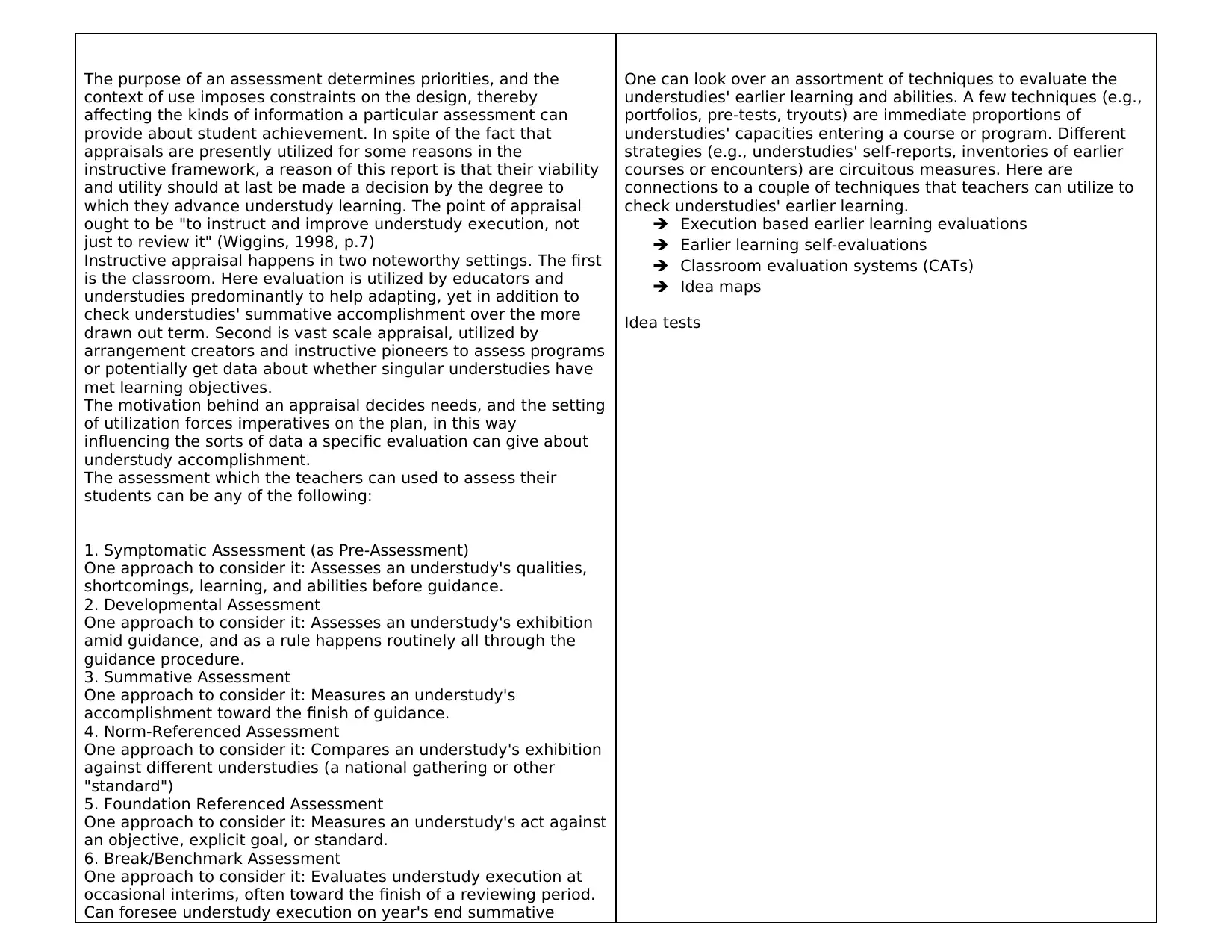
The purpose of an assessment determines priorities, and the
context of use imposes constraints on the design, thereby
affecting the kinds of information a particular assessment can
provide about student achievement. In spite of the fact that
appraisals are presently utilized for some reasons in the
instructive framework, a reason of this report is that their viability
and utility should at last be made a decision by the degree to
which they advance understudy learning. The point of appraisal
ought to be "to instruct and improve understudy execution, not
just to review it" (Wiggins, 1998, p.7)
Instructive appraisal happens in two noteworthy settings. The first
is the classroom. Here evaluation is utilized by educators and
understudies predominantly to help adapting, yet in addition to
check understudies' summative accomplishment over the more
drawn out term. Second is vast scale appraisal, utilized by
arrangement creators and instructive pioneers to assess programs
or potentially get data about whether singular understudies have
met learning objectives.
The motivation behind an appraisal decides needs, and the setting
of utilization forces imperatives on the plan, in this way
influencing the sorts of data a specific evaluation can give about
understudy accomplishment.
The assessment which the teachers can used to assess their
students can be any of the following:
1. Symptomatic Assessment (as Pre-Assessment)
One approach to consider it: Assesses an understudy's qualities,
shortcomings, learning, and abilities before guidance.
2. Developmental Assessment
One approach to consider it: Assesses an understudy's exhibition
amid guidance, and as a rule happens routinely all through the
guidance procedure.
3. Summative Assessment
One approach to consider it: Measures an understudy's
accomplishment toward the finish of guidance.
4. Norm-Referenced Assessment
One approach to consider it: Compares an understudy's exhibition
against different understudies (a national gathering or other
"standard")
5. Foundation Referenced Assessment
One approach to consider it: Measures an understudy's act against
an objective, explicit goal, or standard.
6. Break/Benchmark Assessment
One approach to consider it: Evaluates understudy execution at
occasional interims, often toward the finish of a reviewing period.
Can foresee understudy execution on year's end summative
One can look over an assortment of techniques to evaluate the
understudies' earlier learning and abilities. A few techniques (e.g.,
portfolios, pre-tests, tryouts) are immediate proportions of
understudies' capacities entering a course or program. Different
strategies (e.g., understudies' self-reports, inventories of earlier
courses or encounters) are circuitous measures. Here are
connections to a couple of techniques that teachers can utilize to
check understudies' earlier learning.
Execution based earlier learning evaluations
Earlier learning self-evaluations
Classroom evaluation systems (CATs)
Idea maps
Idea tests
context of use imposes constraints on the design, thereby
affecting the kinds of information a particular assessment can
provide about student achievement. In spite of the fact that
appraisals are presently utilized for some reasons in the
instructive framework, a reason of this report is that their viability
and utility should at last be made a decision by the degree to
which they advance understudy learning. The point of appraisal
ought to be "to instruct and improve understudy execution, not
just to review it" (Wiggins, 1998, p.7)
Instructive appraisal happens in two noteworthy settings. The first
is the classroom. Here evaluation is utilized by educators and
understudies predominantly to help adapting, yet in addition to
check understudies' summative accomplishment over the more
drawn out term. Second is vast scale appraisal, utilized by
arrangement creators and instructive pioneers to assess programs
or potentially get data about whether singular understudies have
met learning objectives.
The motivation behind an appraisal decides needs, and the setting
of utilization forces imperatives on the plan, in this way
influencing the sorts of data a specific evaluation can give about
understudy accomplishment.
The assessment which the teachers can used to assess their
students can be any of the following:
1. Symptomatic Assessment (as Pre-Assessment)
One approach to consider it: Assesses an understudy's qualities,
shortcomings, learning, and abilities before guidance.
2. Developmental Assessment
One approach to consider it: Assesses an understudy's exhibition
amid guidance, and as a rule happens routinely all through the
guidance procedure.
3. Summative Assessment
One approach to consider it: Measures an understudy's
accomplishment toward the finish of guidance.
4. Norm-Referenced Assessment
One approach to consider it: Compares an understudy's exhibition
against different understudies (a national gathering or other
"standard")
5. Foundation Referenced Assessment
One approach to consider it: Measures an understudy's act against
an objective, explicit goal, or standard.
6. Break/Benchmark Assessment
One approach to consider it: Evaluates understudy execution at
occasional interims, often toward the finish of a reviewing period.
Can foresee understudy execution on year's end summative
One can look over an assortment of techniques to evaluate the
understudies' earlier learning and abilities. A few techniques (e.g.,
portfolios, pre-tests, tryouts) are immediate proportions of
understudies' capacities entering a course or program. Different
strategies (e.g., understudies' self-reports, inventories of earlier
courses or encounters) are circuitous measures. Here are
connections to a couple of techniques that teachers can utilize to
check understudies' earlier learning.
Execution based earlier learning evaluations
Earlier learning self-evaluations
Classroom evaluation systems (CATs)
Idea maps
Idea tests
Paraphrase This Document
Need a fresh take? Get an instant paraphrase of this document with our AI Paraphraser
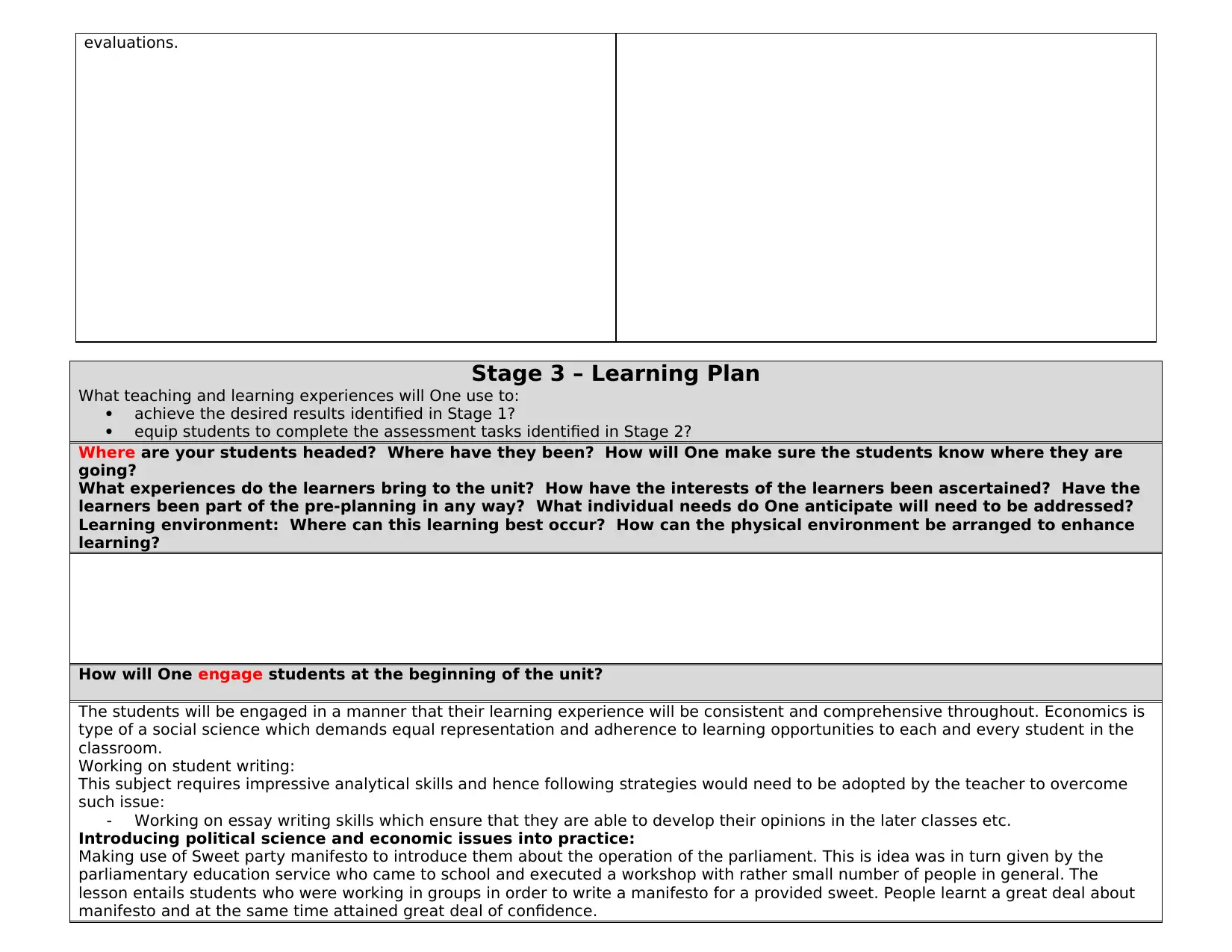
evaluations.
Stage 3 – Learning Plan
What teaching and learning experiences will One use to:
achieve the desired results identified in Stage 1?
equip students to complete the assessment tasks identified in Stage 2?
Where are your students headed? Where have they been? How will One make sure the students know where they are
going?
What experiences do the learners bring to the unit? How have the interests of the learners been ascertained? Have the
learners been part of the pre-planning in any way? What individual needs do One anticipate will need to be addressed?
Learning environment: Where can this learning best occur? How can the physical environment be arranged to enhance
learning?
How will One engage students at the beginning of the unit?
The students will be engaged in a manner that their learning experience will be consistent and comprehensive throughout. Economics is
type of a social science which demands equal representation and adherence to learning opportunities to each and every student in the
classroom.
Working on student writing:
This subject requires impressive analytical skills and hence following strategies would need to be adopted by the teacher to overcome
such issue:
- Working on essay writing skills which ensure that they are able to develop their opinions in the later classes etc.
Introducing political science and economic issues into practice:
Making use of Sweet party manifesto to introduce them about the operation of the parliament. This is idea was in turn given by the
parliamentary education service who came to school and executed a workshop with rather small number of people in general. The
lesson entails students who were working in groups in order to write a manifesto for a provided sweet. People learnt a great deal about
manifesto and at the same time attained great deal of confidence.
Stage 3 – Learning Plan
What teaching and learning experiences will One use to:
achieve the desired results identified in Stage 1?
equip students to complete the assessment tasks identified in Stage 2?
Where are your students headed? Where have they been? How will One make sure the students know where they are
going?
What experiences do the learners bring to the unit? How have the interests of the learners been ascertained? Have the
learners been part of the pre-planning in any way? What individual needs do One anticipate will need to be addressed?
Learning environment: Where can this learning best occur? How can the physical environment be arranged to enhance
learning?
How will One engage students at the beginning of the unit?
The students will be engaged in a manner that their learning experience will be consistent and comprehensive throughout. Economics is
type of a social science which demands equal representation and adherence to learning opportunities to each and every student in the
classroom.
Working on student writing:
This subject requires impressive analytical skills and hence following strategies would need to be adopted by the teacher to overcome
such issue:
- Working on essay writing skills which ensure that they are able to develop their opinions in the later classes etc.
Introducing political science and economic issues into practice:
Making use of Sweet party manifesto to introduce them about the operation of the parliament. This is idea was in turn given by the
parliamentary education service who came to school and executed a workshop with rather small number of people in general. The
lesson entails students who were working in groups in order to write a manifesto for a provided sweet. People learnt a great deal about
manifesto and at the same time attained great deal of confidence.
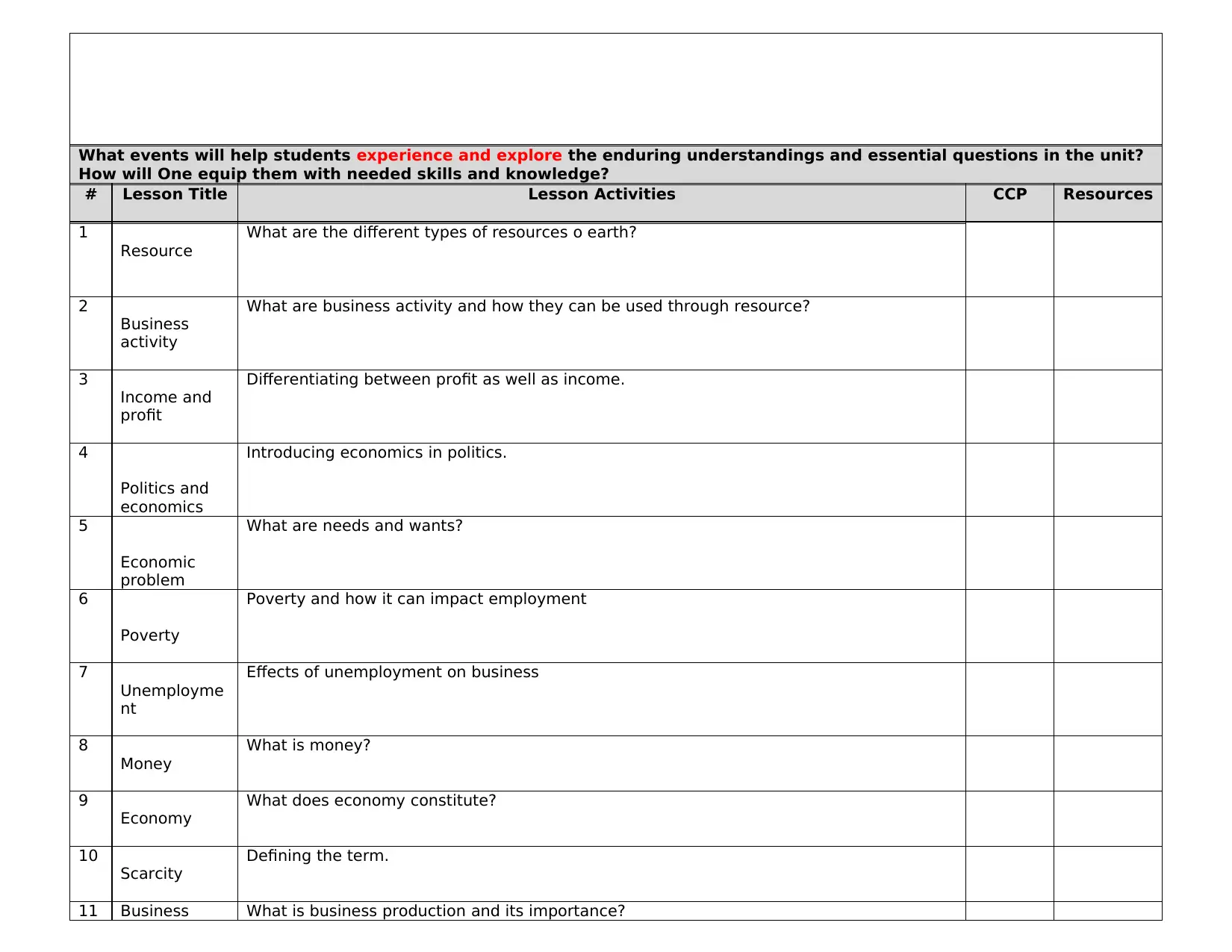
What events will help students experience and explore the enduring understandings and essential questions in the unit?
How will One equip them with needed skills and knowledge?
# Lesson Title Lesson Activities CCP Resources
1
Resource
What are the different types of resources o earth?
2
Business
activity
What are business activity and how they can be used through resource?
3
Income and
profit
Differentiating between profit as well as income.
4
Politics and
economics
Introducing economics in politics.
5
Economic
problem
What are needs and wants?
6
Poverty
Poverty and how it can impact employment
7
Unemployme
nt
Effects of unemployment on business
8
Money
What is money?
9
Economy
What does economy constitute?
10
Scarcity
Defining the term.
11 Business What is business production and its importance?
How will One equip them with needed skills and knowledge?
# Lesson Title Lesson Activities CCP Resources
1
Resource
What are the different types of resources o earth?
2
Business
activity
What are business activity and how they can be used through resource?
3
Income and
profit
Differentiating between profit as well as income.
4
Politics and
economics
Introducing economics in politics.
5
Economic
problem
What are needs and wants?
6
Poverty
Poverty and how it can impact employment
7
Unemployme
nt
Effects of unemployment on business
8
Money
What is money?
9
Economy
What does economy constitute?
10
Scarcity
Defining the term.
11 Business What is business production and its importance?
⊘ This is a preview!⊘
Do you want full access?
Subscribe today to unlock all pages.
Trusted by 1+ million students worldwide
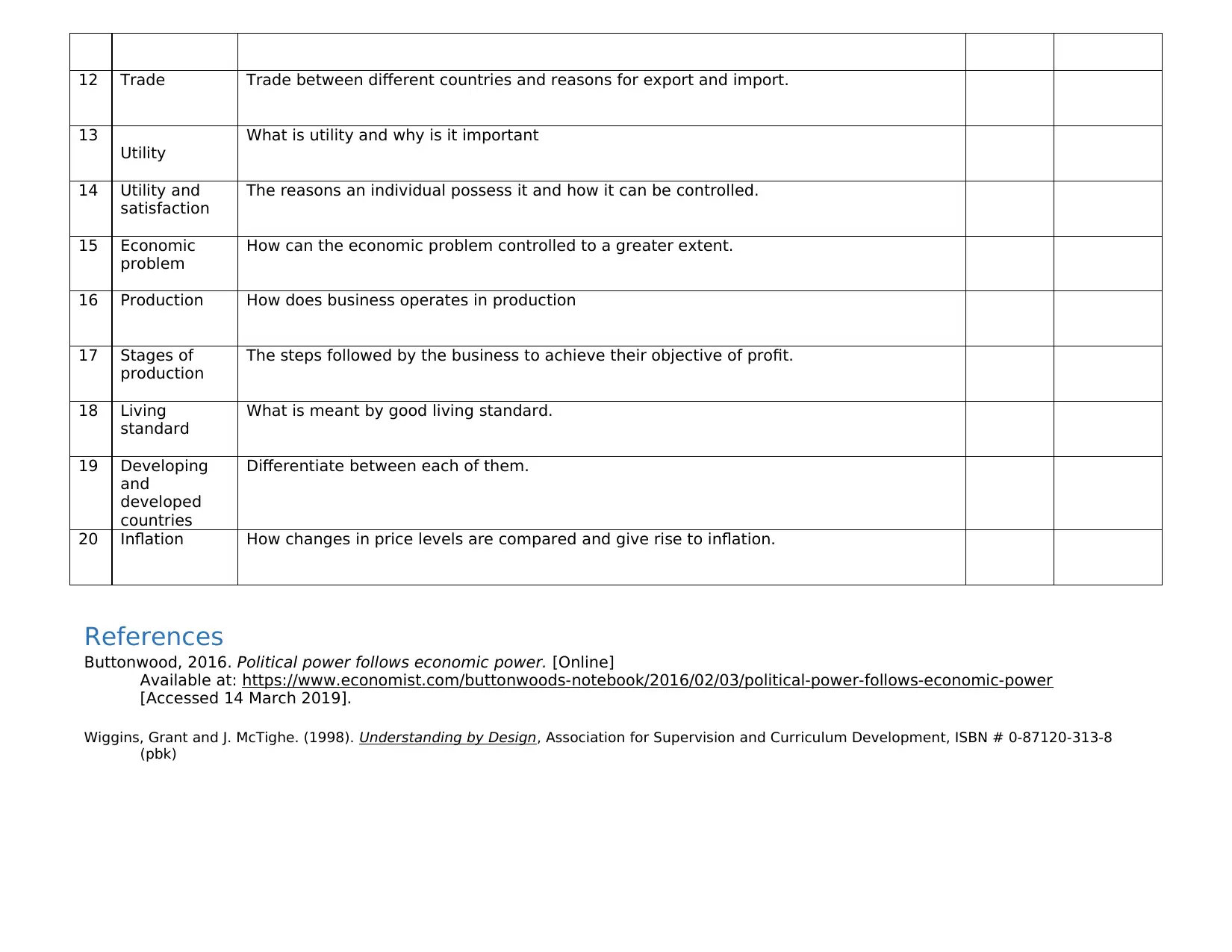
12 Trade Trade between different countries and reasons for export and import.
13
Utility
What is utility and why is it important
14 Utility and
satisfaction
The reasons an individual possess it and how it can be controlled.
15 Economic
problem
How can the economic problem controlled to a greater extent.
16 Production How does business operates in production
17 Stages of
production
The steps followed by the business to achieve their objective of profit.
18 Living
standard
What is meant by good living standard.
19 Developing
and
developed
countries
Differentiate between each of them.
20 Inflation How changes in price levels are compared and give rise to inflation.
References
Buttonwood, 2016. Political power follows economic power. [Online]
Available at: https://www.economist.com/buttonwoods-notebook/2016/02/03/political-power-follows-economic-power
[Accessed 14 March 2019].
Wiggins, Grant and J. McTighe. (1998). Understanding by Design, Association for Supervision and Curriculum Development, ISBN # 0-87120-313-8
(pbk)
13
Utility
What is utility and why is it important
14 Utility and
satisfaction
The reasons an individual possess it and how it can be controlled.
15 Economic
problem
How can the economic problem controlled to a greater extent.
16 Production How does business operates in production
17 Stages of
production
The steps followed by the business to achieve their objective of profit.
18 Living
standard
What is meant by good living standard.
19 Developing
and
developed
countries
Differentiate between each of them.
20 Inflation How changes in price levels are compared and give rise to inflation.
References
Buttonwood, 2016. Political power follows economic power. [Online]
Available at: https://www.economist.com/buttonwoods-notebook/2016/02/03/political-power-follows-economic-power
[Accessed 14 March 2019].
Wiggins, Grant and J. McTighe. (1998). Understanding by Design, Association for Supervision and Curriculum Development, ISBN # 0-87120-313-8
(pbk)

1 out of 7


Related Documents


Your All-in-One AI-Powered Toolkit for Academic Success.
+13062052269
info@desklib.com
Available 24*7 on WhatsApp / Email
![[object Object]](/_next/static/media/star-bottom.7253800d.svg)
Unlock your academic potential
Copyright © 2020–2026 A2Z Services. All Rights Reserved. Developed and managed by ZUCOL.