Human Resources Management at Uber: Theories and Recommendations
VerifiedAdded on 2020/03/16
|10
|2330
|69
Report
AI Summary
This report provides an in-depth analysis of Uber's human resources management, focusing on the application of agency theory and the resource-based view. It examines the conflicts arising from the agency relationship between Uber and its drivers, particularly concerning issues of control, behavior, and risk. The report highlights the importance of both tangible and intangible resources, such as drivers and the Uber app, in achieving competitive advantage. Furthermore, it explores the influence of institutional isomorphism on Uber's practices. The report concludes with recommendations for improving Uber's HR, including formalizing employment contracts, clarifying accountability, enhancing customer feedback mechanisms, and utilizing peer management strategies to reduce agency loss and enhance the overall efficiency of the organization. The analysis is based on an article from Business Insider Australia, dated June 30, 2017, which discusses Uber's settlements with drivers in Australia.
Report on
Human Resources in organizations
For the
Human Resources Manager
Prepared by
Name
Human Resources Advisor
Date
Human Resources in organizations
For the
Human Resources Manager
Prepared by
Name
Human Resources Advisor
Date

Paraphrase This Document
Need a fresh take? Get an instant paraphrase of this document with our AI Paraphraser
Executive Summary
Human resources management is important in ensuring that companies operate with minimal
disruptions. It also helps the company achieving organizational reputation and credibility. It can
attract or repel potential employees, depending on the approach that is taken. There are several
theories that have been posited on human resources management. These theories provide the
general philosophy that guides the different models that companies may embrace. These theories
include the agency, leader-member exchange, resource-based approaches amongst others. Some
companies may adopt models that are hybrids of these theories. Uber operates with the model
that appears to be that of agency in form but is ambiguous in substance. It is also influenced by
the resource-based theory which gives prominence to the organizational resources. In order to
appear legitimate, it is often under pressure from coercive factors that are external. In this
presentation, the different theories that are applicable are analyzed. This is followed thereafter
with recommendations on how Uber can improve its human resources management.
Human resources management is important in ensuring that companies operate with minimal
disruptions. It also helps the company achieving organizational reputation and credibility. It can
attract or repel potential employees, depending on the approach that is taken. There are several
theories that have been posited on human resources management. These theories provide the
general philosophy that guides the different models that companies may embrace. These theories
include the agency, leader-member exchange, resource-based approaches amongst others. Some
companies may adopt models that are hybrids of these theories. Uber operates with the model
that appears to be that of agency in form but is ambiguous in substance. It is also influenced by
the resource-based theory which gives prominence to the organizational resources. In order to
appear legitimate, it is often under pressure from coercive factors that are external. In this
presentation, the different theories that are applicable are analyzed. This is followed thereafter
with recommendations on how Uber can improve its human resources management.
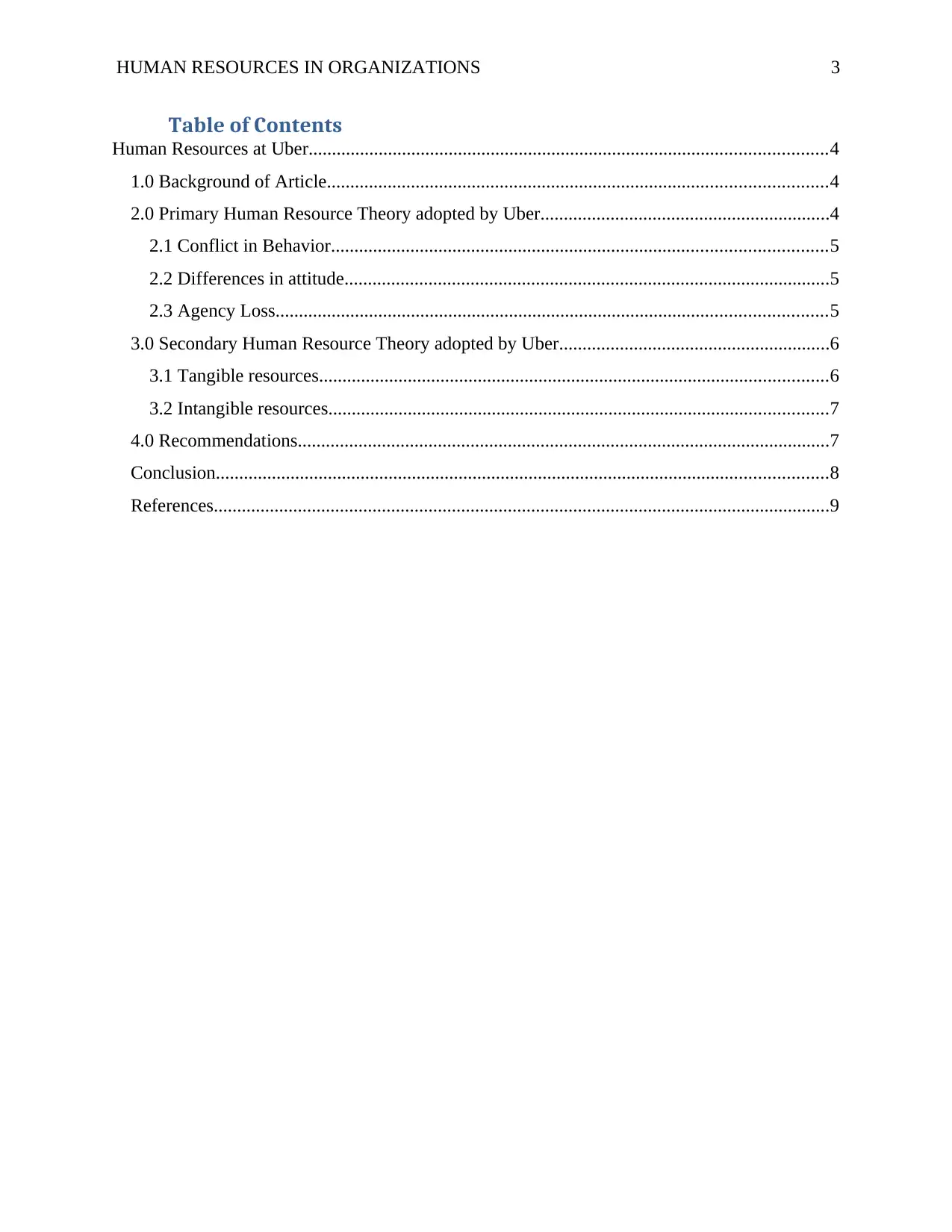
HUMAN RESOURCES IN ORGANIZATIONS 3
Table of Contents
Human Resources at Uber...............................................................................................................4
1.0 Background of Article...........................................................................................................4
2.0 Primary Human Resource Theory adopted by Uber..............................................................4
2.1 Conflict in Behavior..........................................................................................................5
2.2 Differences in attitude........................................................................................................5
2.3 Agency Loss......................................................................................................................5
3.0 Secondary Human Resource Theory adopted by Uber..........................................................6
3.1 Tangible resources.............................................................................................................6
3.2 Intangible resources...........................................................................................................7
4.0 Recommendations..................................................................................................................7
Conclusion...................................................................................................................................8
References....................................................................................................................................9
Table of Contents
Human Resources at Uber...............................................................................................................4
1.0 Background of Article...........................................................................................................4
2.0 Primary Human Resource Theory adopted by Uber..............................................................4
2.1 Conflict in Behavior..........................................................................................................5
2.2 Differences in attitude........................................................................................................5
2.3 Agency Loss......................................................................................................................5
3.0 Secondary Human Resource Theory adopted by Uber..........................................................6
3.1 Tangible resources.............................................................................................................6
3.2 Intangible resources...........................................................................................................7
4.0 Recommendations..................................................................................................................7
Conclusion...................................................................................................................................8
References....................................................................................................................................9
⊘ This is a preview!⊘
Do you want full access?
Subscribe today to unlock all pages.

Trusted by 1+ million students worldwide
HUMAN RESOURCES IN ORGANIZATIONS 4
Human Resources at Uber
Human resources management is important in organizations for a number of reasons. It is
the component within organizations that oversees the human capital. Its functions include
selection and recruiting employees, dealing with issues of compensation and staff development.
There are several theories that have been postulated on human resources management. The
different theories set up the foundational position from which the concept has developed. It
explains why different companies adopt approaches that fit their organizational structures. The
model that was adopted by Uber is that of agency which is heavily influenced by the resource-
based theory.
1.0 Background of Article
The article that will be used in this report is from the Business Insider Australia, dated June 30,
2017. It is captioned “Uber Australia is settling unfair dismissal cases, despite insisting drivers
are not employees.” The author of the article states that Uber in Australia is engaged in settling
cases instituted by former drivers who used to work for the company (Yoo, 2017). The company
insists the deactivated drivers were not employees but partners. Uber claims that those dismissed
were abusive or violent towards their customers. The effect of settling the cases instituted in
effect cancels the employment contracts between Uber and its drivers.
2.0 Primary Human Resource Theory adopted by Uber
The human resource theory adopted by Uber is that of Agency which creates the roles of
principal and agent. In this case, Uber is the principal while the drivers are the agents. The
drivers using the app provided by Uber are able to offer taxi ride services to their customers.
They provide their own cars and are given the latitude and flexibility to manage their schedules.
Uber provides minimal oversight to the conduct and behavior of its drivers and intervenes when
Human Resources at Uber
Human resources management is important in organizations for a number of reasons. It is
the component within organizations that oversees the human capital. Its functions include
selection and recruiting employees, dealing with issues of compensation and staff development.
There are several theories that have been postulated on human resources management. The
different theories set up the foundational position from which the concept has developed. It
explains why different companies adopt approaches that fit their organizational structures. The
model that was adopted by Uber is that of agency which is heavily influenced by the resource-
based theory.
1.0 Background of Article
The article that will be used in this report is from the Business Insider Australia, dated June 30,
2017. It is captioned “Uber Australia is settling unfair dismissal cases, despite insisting drivers
are not employees.” The author of the article states that Uber in Australia is engaged in settling
cases instituted by former drivers who used to work for the company (Yoo, 2017). The company
insists the deactivated drivers were not employees but partners. Uber claims that those dismissed
were abusive or violent towards their customers. The effect of settling the cases instituted in
effect cancels the employment contracts between Uber and its drivers.
2.0 Primary Human Resource Theory adopted by Uber
The human resource theory adopted by Uber is that of Agency which creates the roles of
principal and agent. In this case, Uber is the principal while the drivers are the agents. The
drivers using the app provided by Uber are able to offer taxi ride services to their customers.
They provide their own cars and are given the latitude and flexibility to manage their schedules.
Uber provides minimal oversight to the conduct and behavior of its drivers and intervenes when
Paraphrase This Document
Need a fresh take? Get an instant paraphrase of this document with our AI Paraphraser
HUMAN RESOURCES IN ORGANIZATIONS 5
specific issues are brought to its attention. There are two main problems associated with this
theory: differences in attitude between principal and agent and conflict in desires and behaviors.
2.1 Conflict in Behavior
Conflicts may arise in the relationship between the agent and principal. The agent may behave in
the manner that may not be representative of the core ideals and principles of the principal
(Shapiro, 2016, p. 406). In this context, the driver employed by Uber may decide to behave in a
manner that breaks the code of conduct prescribed by the company. Uber in this case states that
the drivers were either violent or abusive towards their customers. This goes against the
community guidelines set by the company and this can justify the dismissal of the driver. This is
on the basis that the driver is not an employee and once the terms of agency have been breached,
the agency is terminated.
2.2 Differences in attitude
The differences between the agent and principal primarily focus on the element of risk. This
difference is seen with the degree of risk each partner in the agency is willing to undertake.
Within the context of Uber, the drivers may be willing to engage in behavior that is risky in
competing for customers when competing with traditional taxi services and drivers. Others may
cross the professional boundary lines when soliciting for customers using their mobile devices.
What they may assume is ordinary and common in the course of doing business may constitute
as risk to Uber. The difference in attitude may be influenced by the outcomes of such behavior,
with Uber bearing greater liability than the driver.
2.3 Agency Loss
Agency loss refers to the concept that is used to determine whether the agent has breached the
interests of their principal. It shows the outcomes that are beneficial to the principal and are
harmful to the agent. When the agent acts consistently with the best of interest of the principal,
specific issues are brought to its attention. There are two main problems associated with this
theory: differences in attitude between principal and agent and conflict in desires and behaviors.
2.1 Conflict in Behavior
Conflicts may arise in the relationship between the agent and principal. The agent may behave in
the manner that may not be representative of the core ideals and principles of the principal
(Shapiro, 2016, p. 406). In this context, the driver employed by Uber may decide to behave in a
manner that breaks the code of conduct prescribed by the company. Uber in this case states that
the drivers were either violent or abusive towards their customers. This goes against the
community guidelines set by the company and this can justify the dismissal of the driver. This is
on the basis that the driver is not an employee and once the terms of agency have been breached,
the agency is terminated.
2.2 Differences in attitude
The differences between the agent and principal primarily focus on the element of risk. This
difference is seen with the degree of risk each partner in the agency is willing to undertake.
Within the context of Uber, the drivers may be willing to engage in behavior that is risky in
competing for customers when competing with traditional taxi services and drivers. Others may
cross the professional boundary lines when soliciting for customers using their mobile devices.
What they may assume is ordinary and common in the course of doing business may constitute
as risk to Uber. The difference in attitude may be influenced by the outcomes of such behavior,
with Uber bearing greater liability than the driver.
2.3 Agency Loss
Agency loss refers to the concept that is used to determine whether the agent has breached the
interests of their principal. It shows the outcomes that are beneficial to the principal and are
harmful to the agent. When the agent acts consistently with the best of interest of the principal,
HUMAN RESOURCES IN ORGANIZATIONS 6
the agency loss is minimal tending to zero. When the agent acts in their own interest,
disregarding the principals’ interest, agency loss is high. Xie (2017, p. 1) states that the agency
loss is also high when the principal does not have enough knowledge about the activities of the
agent. The lack of this information leads to agency loss.
Within the context of Uber, the company may not always know about the behavior of their
drivers. The local set up of Uber is minimal which works to reduce overhead costs. The best way
that the company gets feedback about errant behavior of its drivers is through the social media or
formal complaints instituted at the courts. The lack of close supervision of its drivers means that
the principal has very little information whether they are working in their best interest. The
disconnection in attitudes and interests between Uber and its drivers in Australia is what led to
the agency loss which triggered the court cases. Settling the cases was the final step of canceling
the agency relationship.
3.0 Secondary Human Resource Theory adopted by Uber
The other secondary that is seen to work at Uber is the resource-based approach. This theory
rests on the postulation that companies poses resources that are unique and which cannot be
easily imitated or substituted. The companies that own these resources are able to gain a
competitive advantage over their competitors (Tabares, Alvarez, & Urbano, 2015, p. 155). The
competitive advantage translates into more clients and customers as well as more profits. In this
theory, the resources are given the major role of achieving the organizational goals and
objectives. There are two main resources which are important: the tangible and intangible.
3.1 Tangible resources
In the case of Uber, the driver is the tangible and most important resource. The driver is the face
of the company and is tasked with ensuring that the expectations of the company are met in
terms of customer satisfaction. The driver is also important in that they add value to the company
the agency loss is minimal tending to zero. When the agent acts in their own interest,
disregarding the principals’ interest, agency loss is high. Xie (2017, p. 1) states that the agency
loss is also high when the principal does not have enough knowledge about the activities of the
agent. The lack of this information leads to agency loss.
Within the context of Uber, the company may not always know about the behavior of their
drivers. The local set up of Uber is minimal which works to reduce overhead costs. The best way
that the company gets feedback about errant behavior of its drivers is through the social media or
formal complaints instituted at the courts. The lack of close supervision of its drivers means that
the principal has very little information whether they are working in their best interest. The
disconnection in attitudes and interests between Uber and its drivers in Australia is what led to
the agency loss which triggered the court cases. Settling the cases was the final step of canceling
the agency relationship.
3.0 Secondary Human Resource Theory adopted by Uber
The other secondary that is seen to work at Uber is the resource-based approach. This theory
rests on the postulation that companies poses resources that are unique and which cannot be
easily imitated or substituted. The companies that own these resources are able to gain a
competitive advantage over their competitors (Tabares, Alvarez, & Urbano, 2015, p. 155). The
competitive advantage translates into more clients and customers as well as more profits. In this
theory, the resources are given the major role of achieving the organizational goals and
objectives. There are two main resources which are important: the tangible and intangible.
3.1 Tangible resources
In the case of Uber, the driver is the tangible and most important resource. The driver is the face
of the company and is tasked with ensuring that the expectations of the company are met in
terms of customer satisfaction. The driver is also important in that they add value to the company
⊘ This is a preview!⊘
Do you want full access?
Subscribe today to unlock all pages.
Trusted by 1+ million students worldwide
HUMAN RESOURCES IN ORGANIZATIONS 7
by coming on board with their own investment in the form of their vehicle. The driver
contributes significantly to the profitability of Uber by how productive they are in doing
business. The drivers can be seen and quantified in terms of how many hours they log in per day
and how many miles they cover. The vehicle that they own is part of the extended tangible
resource they also bring on board while working with Uber.
3.2 Intangible resources
The intangible resources are those which cannot be quantified easily and which are hard to touch
and see. These include the skills of the employees, the brand name and reputation. In the context
of Uber, its app constitutes part of its intangible resource. Drivers are given access to the
company app when they sign up with it. The app is a form of franchising that seeks to reduce the
dangers of moral hazard and adverse selection (Gillis, Combs, & Ketchen, 2014, p. 450). The
brand reputation as being the most cost-effective taxi service constitutes the intangible resource
of Uber. The tangible and intangibles should work together in order to produce the competitive
advantage at Uber. In this particular case, the alleged misbehavior of its drivers led Uber to
withdraw access by the drivers to its app.
4.0 Recommendations
There are four main recommendations that can be made in this case with regards to the
human resources management adopted by Uber. While the style adopted prima facie by Uber is
that of agency, in practice it breaks down to institutional isomorphism (Bailey, 2013, p. 108).
Institutional isomorphism states that companies may behave in the manner that navigates the laid
down rule and norms in order to appear as being legitimate. Uber can enter full employment
contracts with its drivers which are renewable every six months. This will formalize the agency
relationship and reduce agency loss.
by coming on board with their own investment in the form of their vehicle. The driver
contributes significantly to the profitability of Uber by how productive they are in doing
business. The drivers can be seen and quantified in terms of how many hours they log in per day
and how many miles they cover. The vehicle that they own is part of the extended tangible
resource they also bring on board while working with Uber.
3.2 Intangible resources
The intangible resources are those which cannot be quantified easily and which are hard to touch
and see. These include the skills of the employees, the brand name and reputation. In the context
of Uber, its app constitutes part of its intangible resource. Drivers are given access to the
company app when they sign up with it. The app is a form of franchising that seeks to reduce the
dangers of moral hazard and adverse selection (Gillis, Combs, & Ketchen, 2014, p. 450). The
brand reputation as being the most cost-effective taxi service constitutes the intangible resource
of Uber. The tangible and intangibles should work together in order to produce the competitive
advantage at Uber. In this particular case, the alleged misbehavior of its drivers led Uber to
withdraw access by the drivers to its app.
4.0 Recommendations
There are four main recommendations that can be made in this case with regards to the
human resources management adopted by Uber. While the style adopted prima facie by Uber is
that of agency, in practice it breaks down to institutional isomorphism (Bailey, 2013, p. 108).
Institutional isomorphism states that companies may behave in the manner that navigates the laid
down rule and norms in order to appear as being legitimate. Uber can enter full employment
contracts with its drivers which are renewable every six months. This will formalize the agency
relationship and reduce agency loss.
Paraphrase This Document
Need a fresh take? Get an instant paraphrase of this document with our AI Paraphraser
HUMAN RESOURCES IN ORGANIZATIONS 8
The company can also draft a form on accountability that discharges the company from
liability in the event that they breach the agency relationship (Bodreau, 2017, p.4). This will also
reduce agency loss and will reduce the conflict of interest between agent and principal. The
drivers will be more careful as they know the consequences of their actions with regards to the
company. Clear outcomes should be spelt out in terms of remedial and punitive actions that Uber
may take.
The company can also redesign its app so that its customers can give real time feedback
on their experiences with the drivers. The total logged feedback received about a driver can be
analyzed every month to gain knowledge about their behavior. Drivers whose behaviors are not
consistent with the values of Uber can be warned or their contracts canceled. This works or
reduces the agency loss by making the principal more knowledgeable about their drivers.
Uber can also make use of its community of drivers in peer management in management
using smart and soft power (Savaneviciene & Stankeviciute, 2017, p. 199). ). A driver who
shows consistency in behavior that is consistent with its values can be elevated as a peer leader.
The peer leader can handle the issues that should have been handled by a substantive human
resources department. Any concerns raised by the drivers can be channeled through the peer
leader. New drivers can be inducted into the accepted culture and values expected at Uber. This
will help to reduce the conflict of interests and divergent attitude.
Conclusion
Human resources management is important in managing the human capital in
organizations. There are different theories that guide companies in the approach they take with
regards to human resources practices. The approach taken by Uber in theory is that of agency
where the company is the principal and the drivers are the agents. In practice, the company also
The company can also draft a form on accountability that discharges the company from
liability in the event that they breach the agency relationship (Bodreau, 2017, p.4). This will also
reduce agency loss and will reduce the conflict of interest between agent and principal. The
drivers will be more careful as they know the consequences of their actions with regards to the
company. Clear outcomes should be spelt out in terms of remedial and punitive actions that Uber
may take.
The company can also redesign its app so that its customers can give real time feedback
on their experiences with the drivers. The total logged feedback received about a driver can be
analyzed every month to gain knowledge about their behavior. Drivers whose behaviors are not
consistent with the values of Uber can be warned or their contracts canceled. This works or
reduces the agency loss by making the principal more knowledgeable about their drivers.
Uber can also make use of its community of drivers in peer management in management
using smart and soft power (Savaneviciene & Stankeviciute, 2017, p. 199). ). A driver who
shows consistency in behavior that is consistent with its values can be elevated as a peer leader.
The peer leader can handle the issues that should have been handled by a substantive human
resources department. Any concerns raised by the drivers can be channeled through the peer
leader. New drivers can be inducted into the accepted culture and values expected at Uber. This
will help to reduce the conflict of interests and divergent attitude.
Conclusion
Human resources management is important in managing the human capital in
organizations. There are different theories that guide companies in the approach they take with
regards to human resources practices. The approach taken by Uber in theory is that of agency
where the company is the principal and the drivers are the agents. In practice, the company also
HUMAN RESOURCES IN ORGANIZATIONS 9
engages in institutional isomorphism in order to appear legitimate. The company can enter into
short-term contracts with its drivers which are renewable in order to reduce the agency loss and
this is helpful in reducing court cases instituted against the company.
engages in institutional isomorphism in order to appear legitimate. The company can enter into
short-term contracts with its drivers which are renewable in order to reduce the agency loss and
this is helpful in reducing court cases instituted against the company.
⊘ This is a preview!⊘
Do you want full access?
Subscribe today to unlock all pages.
Trusted by 1+ million students worldwide
HUMAN RESOURCES IN ORGANIZATIONS
10
References
Bailey, J. R. (2013). The Iron Cage and the Monkey's Paw: Isomorphism, Legitimacy, and the
Perils of a Rising Journal. Academy Of Management Learning & Education, 12(1), 108-
114. doi:10.5465/amle.2012.0248
Boudreau, J. (2017). Uber Is Finally Realizing HR Isn’t Just for Recruiting. Harvard Business
Review Digital Articles, 2-4.
Gillis, W. E., Combs, J. G., & Ketchen, D. J. (2014). Using Resource-Based Theory to Help
Explain Plural Form Franchising. Entrepreneurship: Theory & Practice, 38(3), 449-472.
doi:10.1111/etap.1200
Savaneviciene, A., & Stankeviciute, Z. (2017). Smart Power as a Pathway for Employing
Sustainable Human Resource Management. Engineering Economics, 28(2), 198-206.
Shapiro, S. P. (2016). STANDING IN ANOTHER'S SHOES: HOW AGENTS MAKE LIFE-
AND-DEATH DECISIONS FOR THEIR PRINCIPALS. Academy Of Management
Perspectives, 30(4), 404-427. doi:10.5465/amp.2013.0158
Tabares, A., Alvarez, C., & Urbano, D. (2015). Born Globals from the Resource-Based Theory:
a Case Study in Colombia. Journal of Technology Management & Innovation, 10(2),
154-165.
Xie, J. (2017). INFORMATION, RISK SHARING, AND INCENTIVES IN AGENCY
PROBLEMS. International Economic Review, 58(1), 157-182. doi:10.1111/iere.12212
Yoo, T. (2017). Uber Australia is settling unfair dismissal cases, despite insisting drivers are not
employees.
10
References
Bailey, J. R. (2013). The Iron Cage and the Monkey's Paw: Isomorphism, Legitimacy, and the
Perils of a Rising Journal. Academy Of Management Learning & Education, 12(1), 108-
114. doi:10.5465/amle.2012.0248
Boudreau, J. (2017). Uber Is Finally Realizing HR Isn’t Just for Recruiting. Harvard Business
Review Digital Articles, 2-4.
Gillis, W. E., Combs, J. G., & Ketchen, D. J. (2014). Using Resource-Based Theory to Help
Explain Plural Form Franchising. Entrepreneurship: Theory & Practice, 38(3), 449-472.
doi:10.1111/etap.1200
Savaneviciene, A., & Stankeviciute, Z. (2017). Smart Power as a Pathway for Employing
Sustainable Human Resource Management. Engineering Economics, 28(2), 198-206.
Shapiro, S. P. (2016). STANDING IN ANOTHER'S SHOES: HOW AGENTS MAKE LIFE-
AND-DEATH DECISIONS FOR THEIR PRINCIPALS. Academy Of Management
Perspectives, 30(4), 404-427. doi:10.5465/amp.2013.0158
Tabares, A., Alvarez, C., & Urbano, D. (2015). Born Globals from the Resource-Based Theory:
a Case Study in Colombia. Journal of Technology Management & Innovation, 10(2),
154-165.
Xie, J. (2017). INFORMATION, RISK SHARING, AND INCENTIVES IN AGENCY
PROBLEMS. International Economic Review, 58(1), 157-182. doi:10.1111/iere.12212
Yoo, T. (2017). Uber Australia is settling unfair dismissal cases, despite insisting drivers are not
employees.

1 out of 10


Related Documents


Your All-in-One AI-Powered Toolkit for Academic Success.
+13062052269
info@desklib.com
Available 24*7 on WhatsApp / Email
![[object Object]](/_next/static/media/star-bottom.7253800d.svg)
Unlock your academic potential
Copyright © 2020–2026 A2Z Services. All Rights Reserved. Developed and managed by ZUCOL.