Uber: Business Strategy Analysis (P1-P4) - Semester 2, College X
VerifiedAdded on 2023/01/05
|15
|5147
|92
Report
AI Summary
This report provides a comprehensive analysis of Uber's business strategy. It begins with an examination of the macro environment using PESTEL analysis, considering political, economic, social, technological, legal, and ecological factors, including the impact of the COVID-19 pandemic. The report then delves into stakeholder analysis, identifying key stakeholders like customers, employees, and investors. Next, it assesses Uber's internal environment and capabilities through the McKinsey 7S framework, analyzing strategy, structure, systems, shared values, style, staff, and skills. The report further applies Porter's Five Forces model to evaluate the competitive forces within the industry. Finally, it explores the application of various strategic theories, concepts, and models to interpret and devise Uber's strategic planning, culminating in a detailed overview of Uber's business operations, challenges, and strategic responses.
Business Strategy

Paraphrase This Document
Need a fresh take? Get an instant paraphrase of this document with our AI Paraphraser
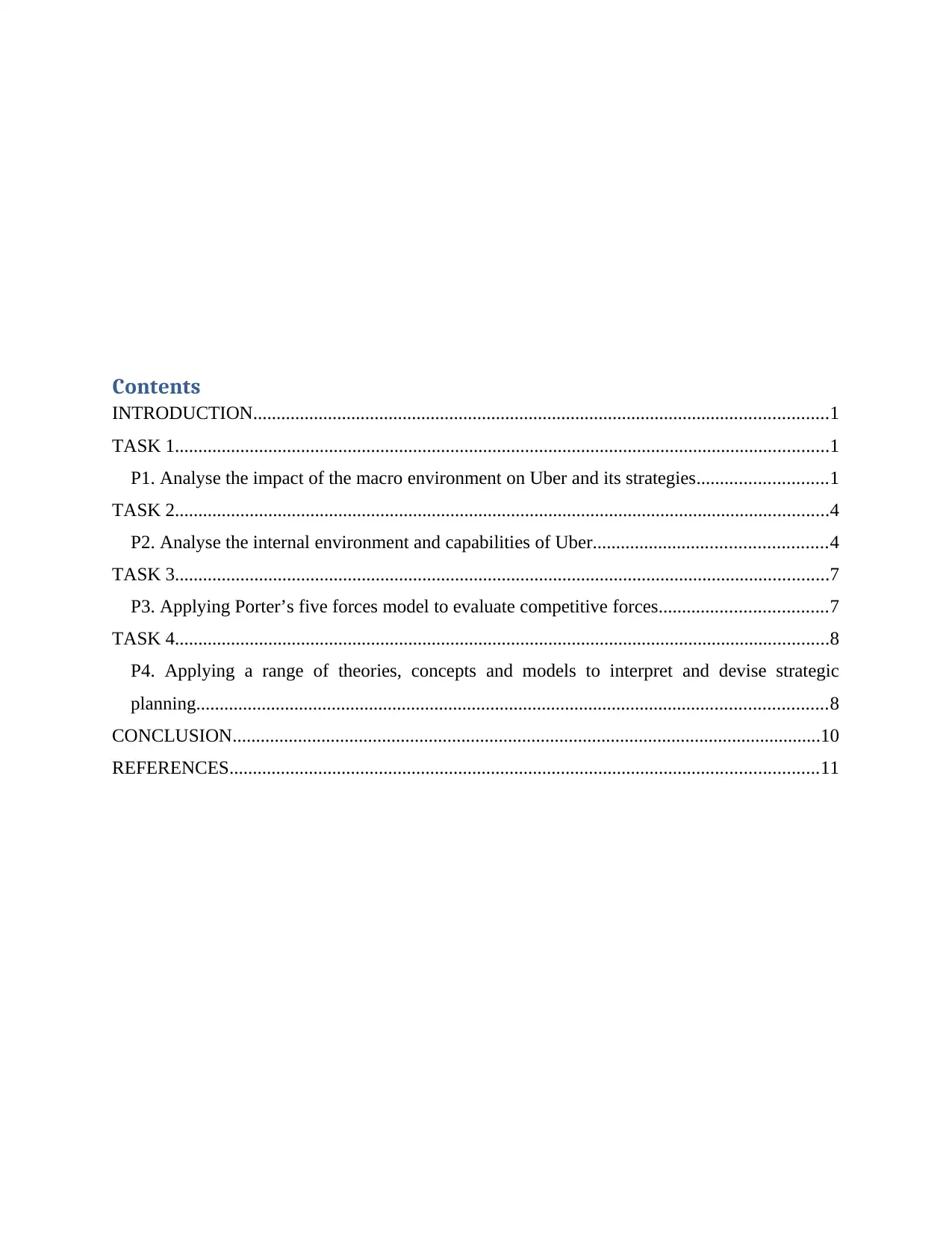
Contents
INTRODUCTION...........................................................................................................................1
TASK 1............................................................................................................................................1
P1. Analyse the impact of the macro environment on Uber and its strategies............................1
TASK 2............................................................................................................................................4
P2. Analyse the internal environment and capabilities of Uber..................................................4
TASK 3............................................................................................................................................7
P3. Applying Porter’s five forces model to evaluate competitive forces....................................7
TASK 4............................................................................................................................................8
P4. Applying a range of theories, concepts and models to interpret and devise strategic
planning.......................................................................................................................................8
CONCLUSION..............................................................................................................................10
REFERENCES..............................................................................................................................11
INTRODUCTION...........................................................................................................................1
TASK 1............................................................................................................................................1
P1. Analyse the impact of the macro environment on Uber and its strategies............................1
TASK 2............................................................................................................................................4
P2. Analyse the internal environment and capabilities of Uber..................................................4
TASK 3............................................................................................................................................7
P3. Applying Porter’s five forces model to evaluate competitive forces....................................7
TASK 4............................................................................................................................................8
P4. Applying a range of theories, concepts and models to interpret and devise strategic
planning.......................................................................................................................................8
CONCLUSION..............................................................................................................................10
REFERENCES..............................................................................................................................11
INTRODUCTION
Business strategy refers to the tactics and methods which are formulated and framed the
management of the establishment so that firm can run its business in effective and efficient form.
It can be a set of activities and moves that can be utilised by the organisation to get attention of
its consumers, strengthening performance, accomplishing goals and objectives of the business
enterprise in adequate manner. This written report is supported to Uber technologies, Inc.
commonaly known as Uber (Nagy and et. al., 2018). It is an American company that provide
vehicles for hire, food delivery, package delivery, couriers and freight transportation etc. This
venture was established in 2009 and is headquartered in San Francisco, California, US. This
document will discuss about the impact f macro and micro business environment on organisation
and its business plan of actions. Further, it will explain about competitive force and application
of concepts and models which help in acknowledging and interpretation of strategic planning of
company.
TASK 1
P1. Analyse the impact of the macro environment on Uber and its strategies
PESTEL analysis of Uber-
It is a tool or method that is utilised by the administration of any firm to acknowledge and
measure the influence of several factors that are outside the control of business venture on the
action and operations of the business. It is a most crucial technique for managerial determination
making that assists in early identification of growth options and assists in preventing any risk for
the establishment. Components outside to business venture but impacting the firm and its
strategies consider political, economic, social, technological, legal and ecological factors. The
description of this analysis in reference to Uber is as below:
Political- Uber has always suffered endless debates internationally. Political factors
influencing business consider government stability, bureaucracy, levels of corruption, impacts of
home market lobbying teams and others (Ukko and et. al., 2019). Most of the national authorities
are worried about the guideline of the sharing economy. Maximising of Uber has trouble making
effect on the business of traditional taxi service that direct to a maximisation in disapproval
towards them at various levels. In some nations, like South Africa, the firm affected as the
national authority seizing the Uber cars as the driver did not hold a taxi permit. In current
1
Business strategy refers to the tactics and methods which are formulated and framed the
management of the establishment so that firm can run its business in effective and efficient form.
It can be a set of activities and moves that can be utilised by the organisation to get attention of
its consumers, strengthening performance, accomplishing goals and objectives of the business
enterprise in adequate manner. This written report is supported to Uber technologies, Inc.
commonaly known as Uber (Nagy and et. al., 2018). It is an American company that provide
vehicles for hire, food delivery, package delivery, couriers and freight transportation etc. This
venture was established in 2009 and is headquartered in San Francisco, California, US. This
document will discuss about the impact f macro and micro business environment on organisation
and its business plan of actions. Further, it will explain about competitive force and application
of concepts and models which help in acknowledging and interpretation of strategic planning of
company.
TASK 1
P1. Analyse the impact of the macro environment on Uber and its strategies
PESTEL analysis of Uber-
It is a tool or method that is utilised by the administration of any firm to acknowledge and
measure the influence of several factors that are outside the control of business venture on the
action and operations of the business. It is a most crucial technique for managerial determination
making that assists in early identification of growth options and assists in preventing any risk for
the establishment. Components outside to business venture but impacting the firm and its
strategies consider political, economic, social, technological, legal and ecological factors. The
description of this analysis in reference to Uber is as below:
Political- Uber has always suffered endless debates internationally. Political factors
influencing business consider government stability, bureaucracy, levels of corruption, impacts of
home market lobbying teams and others (Ukko and et. al., 2019). Most of the national authorities
are worried about the guideline of the sharing economy. Maximising of Uber has trouble making
effect on the business of traditional taxi service that direct to a maximisation in disapproval
towards them at various levels. In some nations, like South Africa, the firm affected as the
national authority seizing the Uber cars as the driver did not hold a taxi permit. In current
1
⊘ This is a preview!⊘
Do you want full access?
Subscribe today to unlock all pages.

Trusted by 1+ million students worldwide
COVID pandemic situation, the business of this affected negatively due to lockdown situation.
As the people not use public vehicle in transport so the sales and revenue of this firm affect in
negative manner. Along with this, government policy also involve in this activity so companies
and individual also consider travelling related guidelines in it.
Economical- Sharing economy is supported to the physical and intellectual resources by
Uber. The sharing economy generated employment and job option for individual in large
numbers. The respective company offer taxi services and make an effective contribution in
increasing employment rate (González-Rodríguez and et. al., 2018). The growth of Uber has
been exceptionally speedy even when they have had an issue of low costs put up through the
normal taxi driver managing the inconceivable care they offer. Due to COVID 19 pandemic the
sales and profitability of the company decreased and reduced which also affect the economic
situation of respective venture in negative manner.
Social- One good thing about Uber is that consumer has mostly been happy about the
service offered through them. The cost has been less as compared to other taxis and this has
ensnared many. Awareness has been spreading by ads, social media and mostly by word of
mouth. The costs of the rides have also maximised especially in the urban areas that is good for
Uber only most of the times due to its usability. Cause to its accessibility individual has been
disposed to the respective highly.
Technological- Innovation is at the foundation of everything enormous in the 21st century
and improvement does not work without innovation. The ride sharing business for Uber has been
an incredible creation as well as an incredible experience for riders as well as drivers and this
could only have possible through the technological advancement and innovation. The respective
company has coordinated a few unique highlights into its application to give a extraordinary
encounter. Innovation is one of the important factors driving Uber’s quick development. Online
booking facility and online payment is one of the most crucial service in which the comoany
make effective use of technology and it positively affect the venture in term of high customer
base and high revenue.
Ecological- Sustainability has been a concern for most of the businesses thus Uber has also
provided essentialness to it. Traffic cognition and fuel consumption have enlarge, believed by
many. Uber green has been launched as its pilot project to take sustainability into consideration.
The Project takes riders requests of a green rise at a couple of buttons. Along with this, the
2
As the people not use public vehicle in transport so the sales and revenue of this firm affect in
negative manner. Along with this, government policy also involve in this activity so companies
and individual also consider travelling related guidelines in it.
Economical- Sharing economy is supported to the physical and intellectual resources by
Uber. The sharing economy generated employment and job option for individual in large
numbers. The respective company offer taxi services and make an effective contribution in
increasing employment rate (González-Rodríguez and et. al., 2018). The growth of Uber has
been exceptionally speedy even when they have had an issue of low costs put up through the
normal taxi driver managing the inconceivable care they offer. Due to COVID 19 pandemic the
sales and profitability of the company decreased and reduced which also affect the economic
situation of respective venture in negative manner.
Social- One good thing about Uber is that consumer has mostly been happy about the
service offered through them. The cost has been less as compared to other taxis and this has
ensnared many. Awareness has been spreading by ads, social media and mostly by word of
mouth. The costs of the rides have also maximised especially in the urban areas that is good for
Uber only most of the times due to its usability. Cause to its accessibility individual has been
disposed to the respective highly.
Technological- Innovation is at the foundation of everything enormous in the 21st century
and improvement does not work without innovation. The ride sharing business for Uber has been
an incredible creation as well as an incredible experience for riders as well as drivers and this
could only have possible through the technological advancement and innovation. The respective
company has coordinated a few unique highlights into its application to give a extraordinary
encounter. Innovation is one of the important factors driving Uber’s quick development. Online
booking facility and online payment is one of the most crucial service in which the comoany
make effective use of technology and it positively affect the venture in term of high customer
base and high revenue.
Ecological- Sustainability has been a concern for most of the businesses thus Uber has also
provided essentialness to it. Traffic cognition and fuel consumption have enlarge, believed by
many. Uber green has been launched as its pilot project to take sustainability into consideration.
The Project takes riders requests of a green rise at a couple of buttons. Along with this, the
2
Paraphrase This Document
Need a fresh take? Get an instant paraphrase of this document with our AI Paraphraser
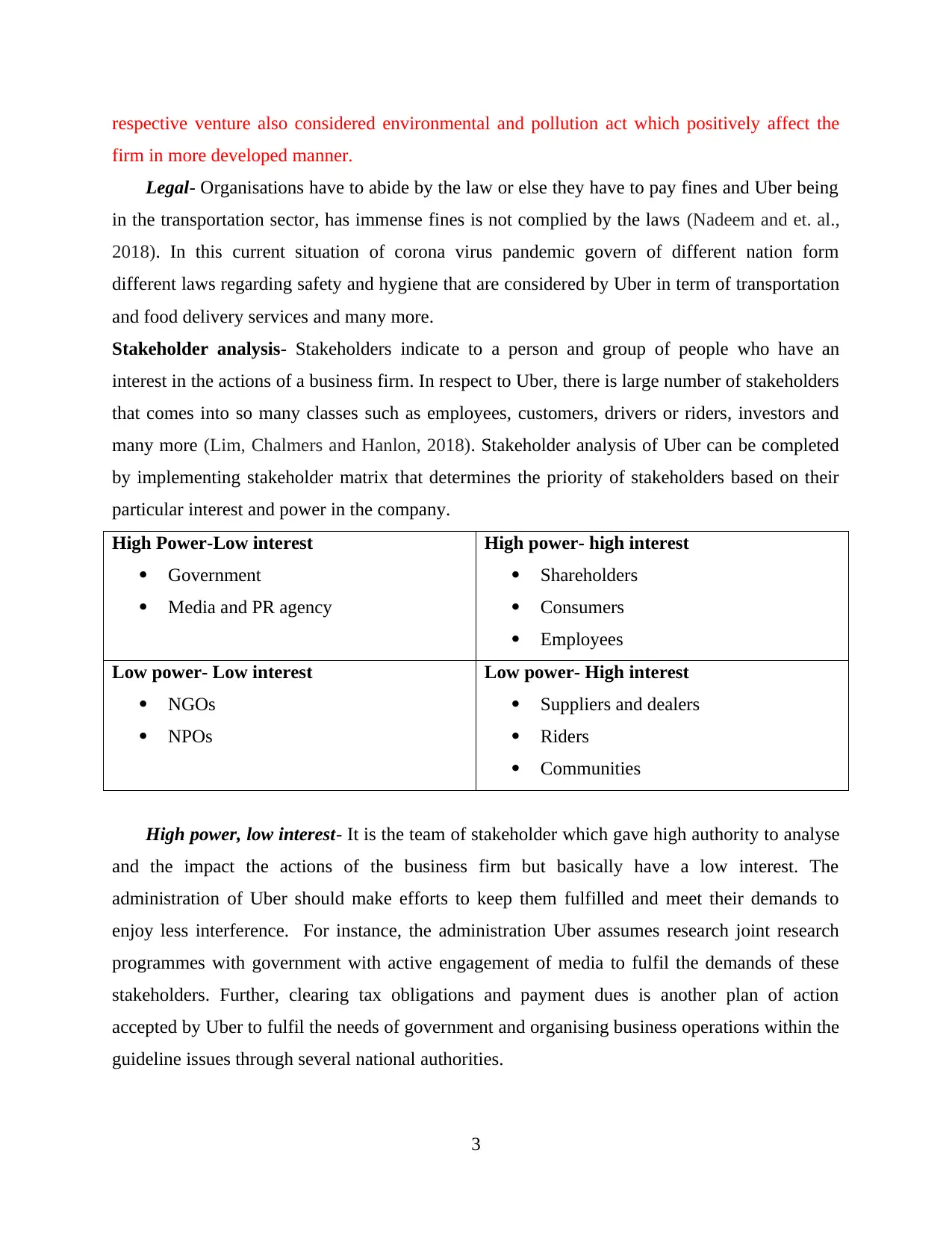
respective venture also considered environmental and pollution act which positively affect the
firm in more developed manner.
Legal- Organisations have to abide by the law or else they have to pay fines and Uber being
in the transportation sector, has immense fines is not complied by the laws (Nadeem and et. al.,
2018). In this current situation of corona virus pandemic govern of different nation form
different laws regarding safety and hygiene that are considered by Uber in term of transportation
and food delivery services and many more.
Stakeholder analysis- Stakeholders indicate to a person and group of people who have an
interest in the actions of a business firm. In respect to Uber, there is large number of stakeholders
that comes into so many classes such as employees, customers, drivers or riders, investors and
many more (Lim, Chalmers and Hanlon, 2018). Stakeholder analysis of Uber can be completed
by implementing stakeholder matrix that determines the priority of stakeholders based on their
particular interest and power in the company.
High Power-Low interest
Government
Media and PR agency
High power- high interest
Shareholders
Consumers
Employees
Low power- Low interest
NGOs
NPOs
Low power- High interest
Suppliers and dealers
Riders
Communities
High power, low interest- It is the team of stakeholder which gave high authority to analyse
and the impact the actions of the business firm but basically have a low interest. The
administration of Uber should make efforts to keep them fulfilled and meet their demands to
enjoy less interference. For instance, the administration Uber assumes research joint research
programmes with government with active engagement of media to fulfil the demands of these
stakeholders. Further, clearing tax obligations and payment dues is another plan of action
accepted by Uber to fulfil the needs of government and organising business operations within the
guideline issues through several national authorities.
3
firm in more developed manner.
Legal- Organisations have to abide by the law or else they have to pay fines and Uber being
in the transportation sector, has immense fines is not complied by the laws (Nadeem and et. al.,
2018). In this current situation of corona virus pandemic govern of different nation form
different laws regarding safety and hygiene that are considered by Uber in term of transportation
and food delivery services and many more.
Stakeholder analysis- Stakeholders indicate to a person and group of people who have an
interest in the actions of a business firm. In respect to Uber, there is large number of stakeholders
that comes into so many classes such as employees, customers, drivers or riders, investors and
many more (Lim, Chalmers and Hanlon, 2018). Stakeholder analysis of Uber can be completed
by implementing stakeholder matrix that determines the priority of stakeholders based on their
particular interest and power in the company.
High Power-Low interest
Government
Media and PR agency
High power- high interest
Shareholders
Consumers
Employees
Low power- Low interest
NGOs
NPOs
Low power- High interest
Suppliers and dealers
Riders
Communities
High power, low interest- It is the team of stakeholder which gave high authority to analyse
and the impact the actions of the business firm but basically have a low interest. The
administration of Uber should make efforts to keep them fulfilled and meet their demands to
enjoy less interference. For instance, the administration Uber assumes research joint research
programmes with government with active engagement of media to fulfil the demands of these
stakeholders. Further, clearing tax obligations and payment dues is another plan of action
accepted by Uber to fulfil the needs of government and organising business operations within the
guideline issues through several national authorities.
3
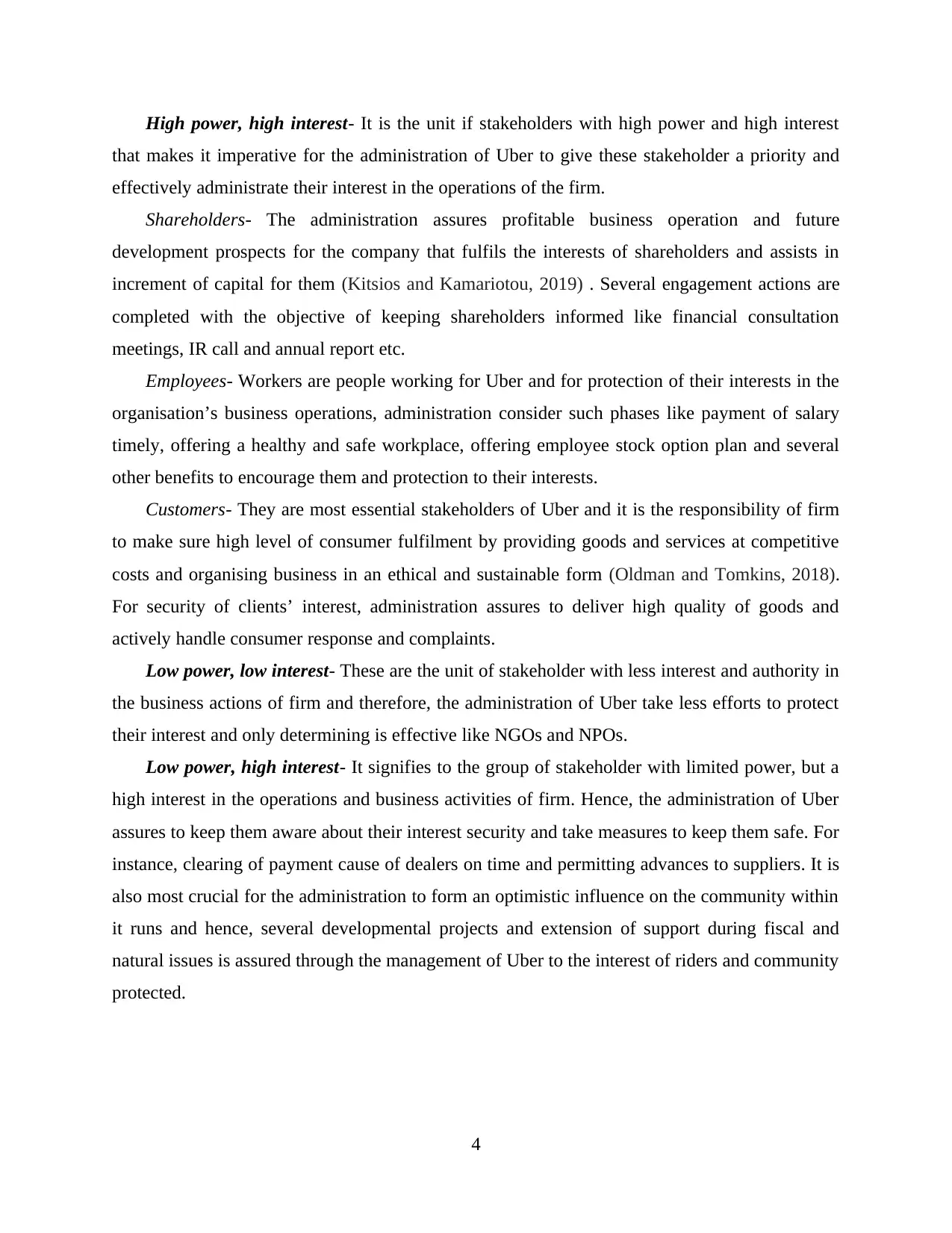
High power, high interest- It is the unit if stakeholders with high power and high interest
that makes it imperative for the administration of Uber to give these stakeholder a priority and
effectively administrate their interest in the operations of the firm.
Shareholders- The administration assures profitable business operation and future
development prospects for the company that fulfils the interests of shareholders and assists in
increment of capital for them (Kitsios and Kamariotou, 2019) . Several engagement actions are
completed with the objective of keeping shareholders informed like financial consultation
meetings, IR call and annual report etc.
Employees- Workers are people working for Uber and for protection of their interests in the
organisation’s business operations, administration consider such phases like payment of salary
timely, offering a healthy and safe workplace, offering employee stock option plan and several
other benefits to encourage them and protection to their interests.
Customers- They are most essential stakeholders of Uber and it is the responsibility of firm
to make sure high level of consumer fulfilment by providing goods and services at competitive
costs and organising business in an ethical and sustainable form (Oldman and Tomkins, 2018).
For security of clients’ interest, administration assures to deliver high quality of goods and
actively handle consumer response and complaints.
Low power, low interest- These are the unit of stakeholder with less interest and authority in
the business actions of firm and therefore, the administration of Uber take less efforts to protect
their interest and only determining is effective like NGOs and NPOs.
Low power, high interest- It signifies to the group of stakeholder with limited power, but a
high interest in the operations and business activities of firm. Hence, the administration of Uber
assures to keep them aware about their interest security and take measures to keep them safe. For
instance, clearing of payment cause of dealers on time and permitting advances to suppliers. It is
also most crucial for the administration to form an optimistic influence on the community within
it runs and hence, several developmental projects and extension of support during fiscal and
natural issues is assured through the management of Uber to the interest of riders and community
protected.
4
that makes it imperative for the administration of Uber to give these stakeholder a priority and
effectively administrate their interest in the operations of the firm.
Shareholders- The administration assures profitable business operation and future
development prospects for the company that fulfils the interests of shareholders and assists in
increment of capital for them (Kitsios and Kamariotou, 2019) . Several engagement actions are
completed with the objective of keeping shareholders informed like financial consultation
meetings, IR call and annual report etc.
Employees- Workers are people working for Uber and for protection of their interests in the
organisation’s business operations, administration consider such phases like payment of salary
timely, offering a healthy and safe workplace, offering employee stock option plan and several
other benefits to encourage them and protection to their interests.
Customers- They are most essential stakeholders of Uber and it is the responsibility of firm
to make sure high level of consumer fulfilment by providing goods and services at competitive
costs and organising business in an ethical and sustainable form (Oldman and Tomkins, 2018).
For security of clients’ interest, administration assures to deliver high quality of goods and
actively handle consumer response and complaints.
Low power, low interest- These are the unit of stakeholder with less interest and authority in
the business actions of firm and therefore, the administration of Uber take less efforts to protect
their interest and only determining is effective like NGOs and NPOs.
Low power, high interest- It signifies to the group of stakeholder with limited power, but a
high interest in the operations and business activities of firm. Hence, the administration of Uber
assures to keep them aware about their interest security and take measures to keep them safe. For
instance, clearing of payment cause of dealers on time and permitting advances to suppliers. It is
also most crucial for the administration to form an optimistic influence on the community within
it runs and hence, several developmental projects and extension of support during fiscal and
natural issues is assured through the management of Uber to the interest of riders and community
protected.
4
⊘ This is a preview!⊘
Do you want full access?
Subscribe today to unlock all pages.
Trusted by 1+ million students worldwide
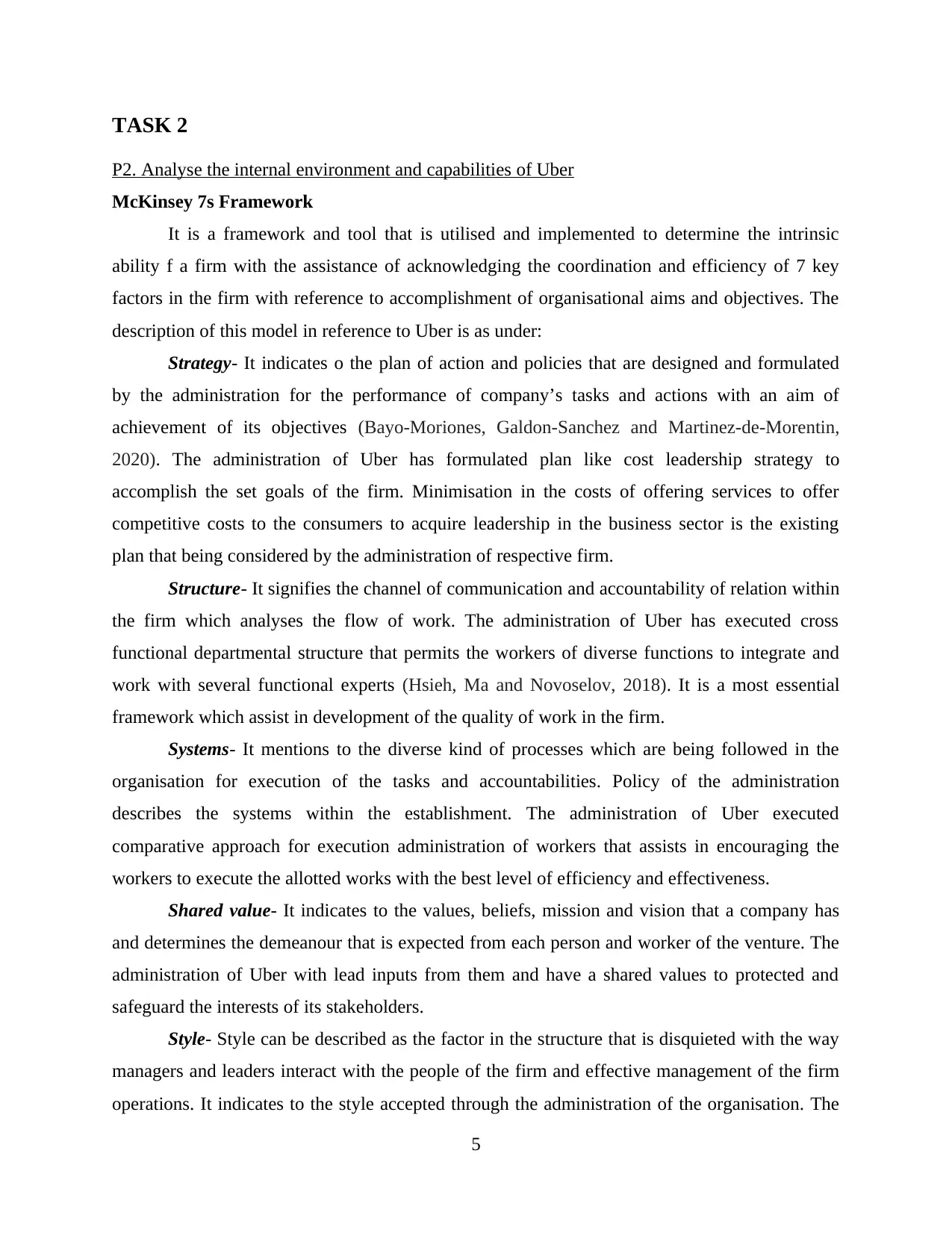
TASK 2
P2. Analyse the internal environment and capabilities of Uber
McKinsey 7s Framework
It is a framework and tool that is utilised and implemented to determine the intrinsic
ability f a firm with the assistance of acknowledging the coordination and efficiency of 7 key
factors in the firm with reference to accomplishment of organisational aims and objectives. The
description of this model in reference to Uber is as under:
Strategy- It indicates o the plan of action and policies that are designed and formulated
by the administration for the performance of company’s tasks and actions with an aim of
achievement of its objectives (Bayo-Moriones, Galdon-Sanchez and Martinez-de-Morentin,
2020). The administration of Uber has formulated plan like cost leadership strategy to
accomplish the set goals of the firm. Minimisation in the costs of offering services to offer
competitive costs to the consumers to acquire leadership in the business sector is the existing
plan that being considered by the administration of respective firm.
Structure- It signifies the channel of communication and accountability of relation within
the firm which analyses the flow of work. The administration of Uber has executed cross
functional departmental structure that permits the workers of diverse functions to integrate and
work with several functional experts (Hsieh, Ma and Novoselov, 2018). It is a most essential
framework which assist in development of the quality of work in the firm.
Systems- It mentions to the diverse kind of processes which are being followed in the
organisation for execution of the tasks and accountabilities. Policy of the administration
describes the systems within the establishment. The administration of Uber executed
comparative approach for execution administration of workers that assists in encouraging the
workers to execute the allotted works with the best level of efficiency and effectiveness.
Shared value- It indicates to the values, beliefs, mission and vision that a company has
and determines the demeanour that is expected from each person and worker of the venture. The
administration of Uber with lead inputs from them and have a shared values to protected and
safeguard the interests of its stakeholders.
Style- Style can be described as the factor in the structure that is disquieted with the way
managers and leaders interact with the people of the firm and effective management of the firm
operations. It indicates to the style accepted through the administration of the organisation. The
5
P2. Analyse the internal environment and capabilities of Uber
McKinsey 7s Framework
It is a framework and tool that is utilised and implemented to determine the intrinsic
ability f a firm with the assistance of acknowledging the coordination and efficiency of 7 key
factors in the firm with reference to accomplishment of organisational aims and objectives. The
description of this model in reference to Uber is as under:
Strategy- It indicates o the plan of action and policies that are designed and formulated
by the administration for the performance of company’s tasks and actions with an aim of
achievement of its objectives (Bayo-Moriones, Galdon-Sanchez and Martinez-de-Morentin,
2020). The administration of Uber has formulated plan like cost leadership strategy to
accomplish the set goals of the firm. Minimisation in the costs of offering services to offer
competitive costs to the consumers to acquire leadership in the business sector is the existing
plan that being considered by the administration of respective firm.
Structure- It signifies the channel of communication and accountability of relation within
the firm which analyses the flow of work. The administration of Uber has executed cross
functional departmental structure that permits the workers of diverse functions to integrate and
work with several functional experts (Hsieh, Ma and Novoselov, 2018). It is a most essential
framework which assist in development of the quality of work in the firm.
Systems- It mentions to the diverse kind of processes which are being followed in the
organisation for execution of the tasks and accountabilities. Policy of the administration
describes the systems within the establishment. The administration of Uber executed
comparative approach for execution administration of workers that assists in encouraging the
workers to execute the allotted works with the best level of efficiency and effectiveness.
Shared value- It indicates to the values, beliefs, mission and vision that a company has
and determines the demeanour that is expected from each person and worker of the venture. The
administration of Uber with lead inputs from them and have a shared values to protected and
safeguard the interests of its stakeholders.
Style- Style can be described as the factor in the structure that is disquieted with the way
managers and leaders interact with the people of the firm and effective management of the firm
operations. It indicates to the style accepted through the administration of the organisation. The
5
Paraphrase This Document
Need a fresh take? Get an instant paraphrase of this document with our AI Paraphraser
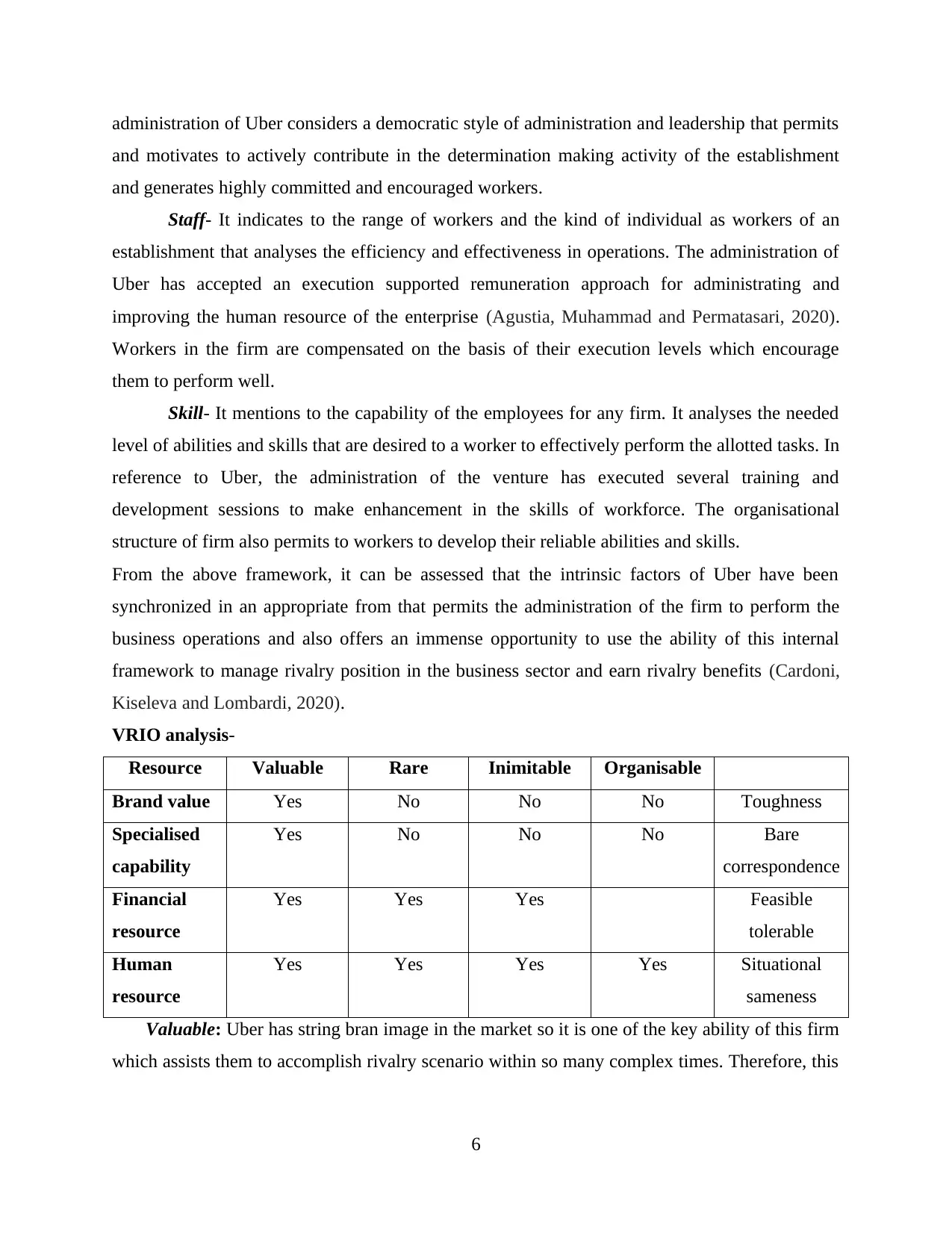
administration of Uber considers a democratic style of administration and leadership that permits
and motivates to actively contribute in the determination making activity of the establishment
and generates highly committed and encouraged workers.
Staff- It indicates to the range of workers and the kind of individual as workers of an
establishment that analyses the efficiency and effectiveness in operations. The administration of
Uber has accepted an execution supported remuneration approach for administrating and
improving the human resource of the enterprise (Agustia, Muhammad and Permatasari, 2020).
Workers in the firm are compensated on the basis of their execution levels which encourage
them to perform well.
Skill- It mentions to the capability of the employees for any firm. It analyses the needed
level of abilities and skills that are desired to a worker to effectively perform the allotted tasks. In
reference to Uber, the administration of the venture has executed several training and
development sessions to make enhancement in the skills of workforce. The organisational
structure of firm also permits to workers to develop their reliable abilities and skills.
From the above framework, it can be assessed that the intrinsic factors of Uber have been
synchronized in an appropriate from that permits the administration of the firm to perform the
business operations and also offers an immense opportunity to use the ability of this internal
framework to manage rivalry position in the business sector and earn rivalry benefits (Cardoni,
Kiseleva and Lombardi, 2020).
VRIO analysis-
Resource Valuable Rare Inimitable Organisable
Brand value Yes No No No Toughness
Specialised
capability
Yes No No No Bare
correspondence
Financial
resource
Yes Yes Yes Feasible
tolerable
Human
resource
Yes Yes Yes Yes Situational
sameness
Valuable: Uber has string bran image in the market so it is one of the key ability of this firm
which assists them to accomplish rivalry scenario within so many complex times. Therefore, this
6
and motivates to actively contribute in the determination making activity of the establishment
and generates highly committed and encouraged workers.
Staff- It indicates to the range of workers and the kind of individual as workers of an
establishment that analyses the efficiency and effectiveness in operations. The administration of
Uber has accepted an execution supported remuneration approach for administrating and
improving the human resource of the enterprise (Agustia, Muhammad and Permatasari, 2020).
Workers in the firm are compensated on the basis of their execution levels which encourage
them to perform well.
Skill- It mentions to the capability of the employees for any firm. It analyses the needed
level of abilities and skills that are desired to a worker to effectively perform the allotted tasks. In
reference to Uber, the administration of the venture has executed several training and
development sessions to make enhancement in the skills of workforce. The organisational
structure of firm also permits to workers to develop their reliable abilities and skills.
From the above framework, it can be assessed that the intrinsic factors of Uber have been
synchronized in an appropriate from that permits the administration of the firm to perform the
business operations and also offers an immense opportunity to use the ability of this internal
framework to manage rivalry position in the business sector and earn rivalry benefits (Cardoni,
Kiseleva and Lombardi, 2020).
VRIO analysis-
Resource Valuable Rare Inimitable Organisable
Brand value Yes No No No Toughness
Specialised
capability
Yes No No No Bare
correspondence
Financial
resource
Yes Yes Yes Feasible
tolerable
Human
resource
Yes Yes Yes Yes Situational
sameness
Valuable: Uber has string bran image in the market so it is one of the key ability of this firm
which assists them to accomplish rivalry scenario within so many complex times. Therefore, this
6
organisation has great market image so that they have development options to earn competitive
analysis by fulfilling its consumer or utilising unique abilities.
Rare: Specialised ability is not so rare cause of respective enterprise capable to utilise wide
range of technologies so that they are capable to promote their targeted methods easily. It
instantly impacts overall abilities and knowledge of entire manpower of the company.
Inimitable: Within Uber financial sources plays crucial roles because they are expensive
into imitate (Shuen, 2018). As per it, workers of respective company always offer their limited
facilities to each consumer and try to develop growth of business.
Organisable: Workforce always included as most crucial section of company as they
always assists administration to hire highly skilled individual with huge knowledge regarding
specific job profile. It assists organisation to make their determination effective so that it develop
overall efficiency and revenue of establishment.
TASK 3
P3. Applying Porter’s five forces model to evaluate competitive forces
Porter’s five force analysis
It is an strategic tool which can be used by the firm in term of analysing the competitive
position of the firm in particular market or industry. The description of it is in reference to Uber
is as under:
Threats of new entrants- Uber lacks protection from new ride sharing companies that
can negatively charge less for the same distance. The firm has less threat of new entrants as it
offer its services as low cost and there are several government laws which are consider by the
firm to operate in this business (De-Aguilera-Moyano, Castro-Higueras and Pérez-Rufí, 2019).
Uber’s policy is to provide their application software for free o willing consumers. This is an
immense force as it determines the company’s survival in the industry.
Bargaining power of suppliers- The respective firm owns no vehicle between its fleets.
In fact, Uber uses an outsourcing plan of action for its labour and resources to individuals who
meet the terms and conditions for utilisation of their maiden web application. It is also hard to
substitute specific drivers. Car owns are accorded the freedom to make selection among the firm
and competitors thus can negotiate for an effective attention to organisation’s expense. In
comparison to other forces, suppliers’ power is moderate in Uber.
7
analysis by fulfilling its consumer or utilising unique abilities.
Rare: Specialised ability is not so rare cause of respective enterprise capable to utilise wide
range of technologies so that they are capable to promote their targeted methods easily. It
instantly impacts overall abilities and knowledge of entire manpower of the company.
Inimitable: Within Uber financial sources plays crucial roles because they are expensive
into imitate (Shuen, 2018). As per it, workers of respective company always offer their limited
facilities to each consumer and try to develop growth of business.
Organisable: Workforce always included as most crucial section of company as they
always assists administration to hire highly skilled individual with huge knowledge regarding
specific job profile. It assists organisation to make their determination effective so that it develop
overall efficiency and revenue of establishment.
TASK 3
P3. Applying Porter’s five forces model to evaluate competitive forces
Porter’s five force analysis
It is an strategic tool which can be used by the firm in term of analysing the competitive
position of the firm in particular market or industry. The description of it is in reference to Uber
is as under:
Threats of new entrants- Uber lacks protection from new ride sharing companies that
can negatively charge less for the same distance. The firm has less threat of new entrants as it
offer its services as low cost and there are several government laws which are consider by the
firm to operate in this business (De-Aguilera-Moyano, Castro-Higueras and Pérez-Rufí, 2019).
Uber’s policy is to provide their application software for free o willing consumers. This is an
immense force as it determines the company’s survival in the industry.
Bargaining power of suppliers- The respective firm owns no vehicle between its fleets.
In fact, Uber uses an outsourcing plan of action for its labour and resources to individuals who
meet the terms and conditions for utilisation of their maiden web application. It is also hard to
substitute specific drivers. Car owns are accorded the freedom to make selection among the firm
and competitors thus can negotiate for an effective attention to organisation’s expense. In
comparison to other forces, suppliers’ power is moderate in Uber.
7
⊘ This is a preview!⊘
Do you want full access?
Subscribe today to unlock all pages.
Trusted by 1+ million students worldwide
Bargaining power of buyers- The forces also moderates as the company offer its services
as low cost and customers also do not necessarily need Uber services in a regular basis. In fact,
only particular situations such as lateness of work and a scheduled event make the consumer to
order its facilities.
Threats of substitutes- This force highly affect Uber as there are several organsiations
which also offer services like Uber. For example, Ola, Rapido, Lyft and many are offer
transportation services (Nagy and et. al., 2018). Along with this Zomato, Swiggy etc, are venture
which off food delivery services like Uber.
Competitive rivalry- This force also highly influence Uber as there are several venture
which offer services like Uber and create competition for it. Lyft is one of the key rival of Uber
and Ola, Rapido, Swiggy, Zomato etc, are other venture which also create competition by
offering transportation and food delivery services.
With the use of this concept, the firm can effectively do competitive analysis of its business
in particular business enterprise. Along with this, it can determine its competitors and risk which
it faced by its rivals and their substitute products and services.
TASK 4
P4. Applying a range of theories, concepts and models to interpret and devise strategic planning
Strategic planning
It is an act of a company which explain its plans, way of performing, decision making
and assignment of resources to pursue strategies, This planning process is done by the enterprise
to make growth in the business in term of maximising revenue and productivity. In Uber, the
management can execute Ansoff Matrix in form of development in the business.
Ansoff Matrix-
Market penetration- It is the first growth option and within it, the management of Uber
can make improvement in its business by using several promotional tools and change in pricing
strategies with the motive of increasing sales and profitability (Ukko and et. al., 2019). There is
no risk as the company offered its current services and products in existing market.
Product development- By adopting this option, the firm can make development in the
products and services by innovation within them. In Uber, this strategic option can be adopt in
tem of improving customer base and sales of the firm. Within it, risk is high in compare to
8
as low cost and customers also do not necessarily need Uber services in a regular basis. In fact,
only particular situations such as lateness of work and a scheduled event make the consumer to
order its facilities.
Threats of substitutes- This force highly affect Uber as there are several organsiations
which also offer services like Uber. For example, Ola, Rapido, Lyft and many are offer
transportation services (Nagy and et. al., 2018). Along with this Zomato, Swiggy etc, are venture
which off food delivery services like Uber.
Competitive rivalry- This force also highly influence Uber as there are several venture
which offer services like Uber and create competition for it. Lyft is one of the key rival of Uber
and Ola, Rapido, Swiggy, Zomato etc, are other venture which also create competition by
offering transportation and food delivery services.
With the use of this concept, the firm can effectively do competitive analysis of its business
in particular business enterprise. Along with this, it can determine its competitors and risk which
it faced by its rivals and their substitute products and services.
TASK 4
P4. Applying a range of theories, concepts and models to interpret and devise strategic planning
Strategic planning
It is an act of a company which explain its plans, way of performing, decision making
and assignment of resources to pursue strategies, This planning process is done by the enterprise
to make growth in the business in term of maximising revenue and productivity. In Uber, the
management can execute Ansoff Matrix in form of development in the business.
Ansoff Matrix-
Market penetration- It is the first growth option and within it, the management of Uber
can make improvement in its business by using several promotional tools and change in pricing
strategies with the motive of increasing sales and profitability (Ukko and et. al., 2019). There is
no risk as the company offered its current services and products in existing market.
Product development- By adopting this option, the firm can make development in the
products and services by innovation within them. In Uber, this strategic option can be adopt in
tem of improving customer base and sales of the firm. Within it, risk is high in compare to
8
Paraphrase This Document
Need a fresh take? Get an instant paraphrase of this document with our AI Paraphraser
penetration phase as the product is new and market is existing so it is not clear that people will
like new services and products.
Market development- This option of Ansoff matrix is risk for Uber, as by adopting this
option, the firm operate its business in different nation and market of the globe with its existing
services and products so it is not confirm that the current services of Uber will be able to fulfil
the need of people of different market.
Diversification- It is the last growth option and there is high risk. Because when the
management of Uber will adopt it, the products & services and market both are new so it is not
sure that individual of new market will like new products and services of respective services.
From the mentioned information, it can be analysed that the management of Uber can
accept market development option which will assist in maximising customer base and sales of
the company by expanding its business China (González-Rodríguez and et. al., 2018).
Bowman’s strategy clock- This model considers 8 strategic positions and the explanation
of them as under in perspective of Uber:
Low price and Low value added- There is not high rivalry for a business like Uber and the
product is not differentiated and the target audiences notice little value, although a low price.
Low price- By adopting it, the commerce can position them; here look to be the low cost
leaders in the marketplace. The competition amongst businesses with low price place is
essentially instance, often consisting price wars.
Hybrid- It consist some aspects of low price but also some merchandise differentiation. It is
an effective strategy and by using it Uber can particularly added value in new offering
consistently.
Differentiation- This strategic option is to provide consumers the highest extent of
perceived added value. By adopting this option, the firm can offer high quality product with
strong brand awareness and loyalty.
Focused differentiation- This positioning strategy adopted by luxury brand who aim to
accomplish premium process by highly targeted segmentation, promotion and distribution. The
administration of Uber can adopt this option in context of its new product.
Risky high Margins- This is a risk positioning strategy that the firm might argue is doomed
to failure eventually. With this strategy, the organisation can sets high process without offering
9
like new services and products.
Market development- This option of Ansoff matrix is risk for Uber, as by adopting this
option, the firm operate its business in different nation and market of the globe with its existing
services and products so it is not confirm that the current services of Uber will be able to fulfil
the need of people of different market.
Diversification- It is the last growth option and there is high risk. Because when the
management of Uber will adopt it, the products & services and market both are new so it is not
sure that individual of new market will like new products and services of respective services.
From the mentioned information, it can be analysed that the management of Uber can
accept market development option which will assist in maximising customer base and sales of
the company by expanding its business China (González-Rodríguez and et. al., 2018).
Bowman’s strategy clock- This model considers 8 strategic positions and the explanation
of them as under in perspective of Uber:
Low price and Low value added- There is not high rivalry for a business like Uber and the
product is not differentiated and the target audiences notice little value, although a low price.
Low price- By adopting it, the commerce can position them; here look to be the low cost
leaders in the marketplace. The competition amongst businesses with low price place is
essentially instance, often consisting price wars.
Hybrid- It consist some aspects of low price but also some merchandise differentiation. It is
an effective strategy and by using it Uber can particularly added value in new offering
consistently.
Differentiation- This strategic option is to provide consumers the highest extent of
perceived added value. By adopting this option, the firm can offer high quality product with
strong brand awareness and loyalty.
Focused differentiation- This positioning strategy adopted by luxury brand who aim to
accomplish premium process by highly targeted segmentation, promotion and distribution. The
administration of Uber can adopt this option in context of its new product.
Risky high Margins- This is a risk positioning strategy that the firm might argue is doomed
to failure eventually. With this strategy, the organisation can sets high process without offering
9
anything extra in term of perceived value. If the consumers continue to purchase at these high
prices then the strategy can assist in gaining more profit.
Monopoly pricing- By adopting this strategy, the firm can set price of product as per their
wish because the product is unique so they can set the cost according them to gain profit.
Loss of market share- This position is a method for disaster in any competitive market.
Setting a middle range or standard price for a product with low perceived value is unlikely to win
over many target audiences who will have much better options.
Overview of the company- Uber is an American venture which provides vehicles for hire, food
delivery, package delivery, couriers, freight transportation etc. This organisation was
incorporated in 2009 by Garrett Camp and Travis Kalanick and is headquarter in California US.
The firm operate its business in approx 80 nation and operate its business with the help of
estimated 26,900 people. It offers different products and services like mobile app, vehicle, food
delivery and many more.
Mission- The purpose of the firm is to make transportation like relevant s running water,
everywhere for everyone.
Vision- The goal of Uber is to make smarter transportation with fewer cars and greater access
(Nadeem and et. al., 2018). Infrastructure that safer, cheaper and more relevant as well as create
more job opportunities and higher earnings for drivers.
Objectives- The objective of Uber is as below:
To improve the revenue and market share of the firm by 5% within next 8 months by
expanding business in to new market.
To enhance the sales of the company by 3% within upcoming 10 months by offering
quality services in new marketplace.
Strategy-
STP model- It refers to the specific structure which refers the segmentation, targeting and
positioning of company. With the help of using this framework, organisation are able to make
their business effective by considering divers opportunities that included in this tool. In the
segmentation phase of this model, the manager of Uber can segmented the market on the basis of
geographic and demographic which considers city or urban area and basis of occupation and
income. After doing segmentation, respective venture required to target its potential consumers
across the world. For further development in this process, Uber analyse its commercial
10
prices then the strategy can assist in gaining more profit.
Monopoly pricing- By adopting this strategy, the firm can set price of product as per their
wish because the product is unique so they can set the cost according them to gain profit.
Loss of market share- This position is a method for disaster in any competitive market.
Setting a middle range or standard price for a product with low perceived value is unlikely to win
over many target audiences who will have much better options.
Overview of the company- Uber is an American venture which provides vehicles for hire, food
delivery, package delivery, couriers, freight transportation etc. This organisation was
incorporated in 2009 by Garrett Camp and Travis Kalanick and is headquarter in California US.
The firm operate its business in approx 80 nation and operate its business with the help of
estimated 26,900 people. It offers different products and services like mobile app, vehicle, food
delivery and many more.
Mission- The purpose of the firm is to make transportation like relevant s running water,
everywhere for everyone.
Vision- The goal of Uber is to make smarter transportation with fewer cars and greater access
(Nadeem and et. al., 2018). Infrastructure that safer, cheaper and more relevant as well as create
more job opportunities and higher earnings for drivers.
Objectives- The objective of Uber is as below:
To improve the revenue and market share of the firm by 5% within next 8 months by
expanding business in to new market.
To enhance the sales of the company by 3% within upcoming 10 months by offering
quality services in new marketplace.
Strategy-
STP model- It refers to the specific structure which refers the segmentation, targeting and
positioning of company. With the help of using this framework, organisation are able to make
their business effective by considering divers opportunities that included in this tool. In the
segmentation phase of this model, the manager of Uber can segmented the market on the basis of
geographic and demographic which considers city or urban area and basis of occupation and
income. After doing segmentation, respective venture required to target its potential consumers
across the world. For further development in this process, Uber analyse its commercial
10
⊘ This is a preview!⊘
Do you want full access?
Subscribe today to unlock all pages.
Trusted by 1+ million students worldwide

1 out of 15


Related Documents


Your All-in-One AI-Powered Toolkit for Academic Success.
+13062052269
info@desklib.com
Available 24*7 on WhatsApp / Email
![[object Object]](/_next/static/media/star-bottom.7253800d.svg)
Unlock your academic potential
Copyright © 2020–2026 A2Z Services. All Rights Reserved. Developed and managed by ZUCOL.