UBER: Impact of External Environment on Entrepreneurial Activities
VerifiedAdded on 2021/02/19
|11
|3134
|50
Report
AI Summary
This report provides a comprehensive analysis of UBER, examining the impact of external environmental factors on its entrepreneurial activities. It utilizes PESTLE analysis to assess the political, economic, social, technological, legal, and environmental influences on UBER's operations. The report also employs Porter's Five Forces framework to evaluate the competitive landscape, including the threat of new entrants, bargaining power of suppliers and buyers, the threat of substitutes, and rivalry among existing firms. Furthermore, it analyzes UBER's internal resources and capabilities using SWOT analysis and value chain analysis to identify strengths, weaknesses, opportunities, and threats, and to understand how the company can achieve a competitive advantage. The report highlights UBER's strategies, market positioning, and the factors that contribute to its success in the ride-sharing industry.
Strategy, Enterprise &
Innovation
Innovation

Paraphrase This Document
Need a fresh take? Get an instant paraphrase of this document with our AI Paraphraser
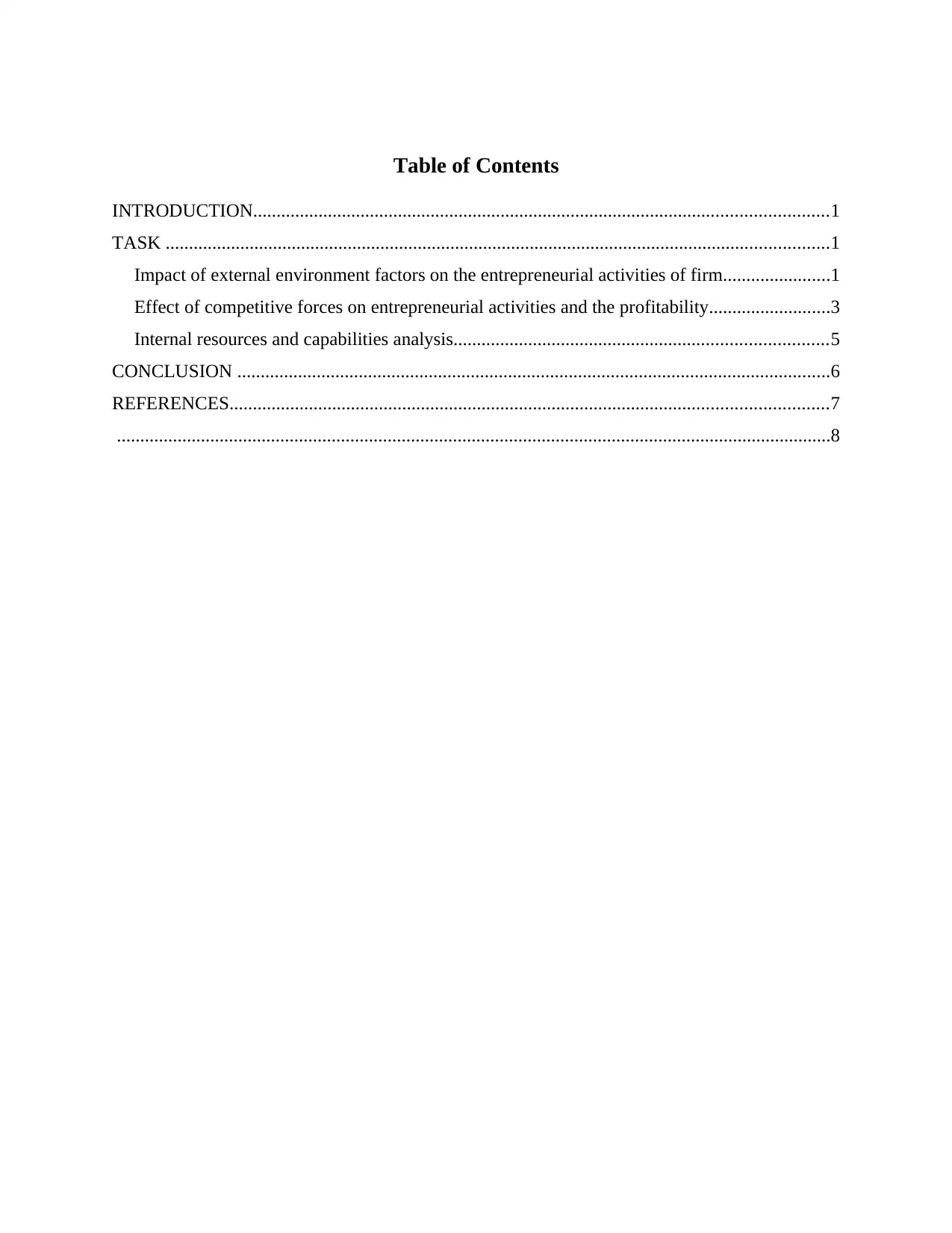
Table of Contents
INTRODUCTION...........................................................................................................................1
TASK ..............................................................................................................................................1
Impact of external environment factors on the entrepreneurial activities of firm.......................1
Effect of competitive forces on entrepreneurial activities and the profitability..........................3
Internal resources and capabilities analysis................................................................................5
CONCLUSION ...............................................................................................................................6
REFERENCES................................................................................................................................7
.........................................................................................................................................................8
INTRODUCTION...........................................................................................................................1
TASK ..............................................................................................................................................1
Impact of external environment factors on the entrepreneurial activities of firm.......................1
Effect of competitive forces on entrepreneurial activities and the profitability..........................3
Internal resources and capabilities analysis................................................................................5
CONCLUSION ...............................................................................................................................6
REFERENCES................................................................................................................................7
.........................................................................................................................................................8

⊘ This is a preview!⊘
Do you want full access?
Subscribe today to unlock all pages.

Trusted by 1+ million students worldwide
INTRODUCTION
In an organization, strategy and innovation play a crucial role in developing competitive
advantage at market place. As company is responsible for selecting appropriate strategy to
execute their business activities and at the same time also use innovative products and services.
With the help of these aspects, firm can enhance their market share and at the same time also
established competitive image at global level. In this regards, understand of business
environment is also important for sustain in market for longer period of time. For attaining the
same, organization analysis both internal and external factors of business to evaluate its actual
impact (Anna, Cahyadi and Yakin, 2018). By this company can reduce the chances of arising any
kind of predict situation on its image. Current report is based on UBER, is an American
multinational ride-sharing company operate their business in over the world with the aim of
generating larger profitability level. It includes various services such as peer-to-peer ride-
sharing, food delivery, bicycle sharing system to large number of customers. Company has been
criticized on the basis of its aggressive strategy in dealing with regulators and for its unlawful
practices. In addition of this, the main focus of this company is to generate larger profitability by
serving best riding services to its customers. For analysing company image in market place,
various tools such as SWOT, PESTLE and many more strategic tools are used that assist in
analysing its overall performance at market place.
TASK
Impact of external environment factors on the entrepreneurial activities of firm
Evaluating external factors is one of the important task for company to introduce their
positive brand image at market place. By understanding external factors, firm can improve their
performance and at the same time also increase the chances of attaining success at competitive
market place. In context of UBER, PESTLE analysis is used by company to analysis impact of
external environment (Bytyçi, 2015). Mainly, it is consider as a strategic tool that help in
analysing the potential impact of external factors of business activities and its long term growth
prospects. These can be understood by following points:
Political: It is one of the important factor that directly affect the business activities in
positive or negative way. Mainly, it includes government stability, level of corruption,
impact of home market lobbying groups. In the initial stage when UBER started its
1
In an organization, strategy and innovation play a crucial role in developing competitive
advantage at market place. As company is responsible for selecting appropriate strategy to
execute their business activities and at the same time also use innovative products and services.
With the help of these aspects, firm can enhance their market share and at the same time also
established competitive image at global level. In this regards, understand of business
environment is also important for sustain in market for longer period of time. For attaining the
same, organization analysis both internal and external factors of business to evaluate its actual
impact (Anna, Cahyadi and Yakin, 2018). By this company can reduce the chances of arising any
kind of predict situation on its image. Current report is based on UBER, is an American
multinational ride-sharing company operate their business in over the world with the aim of
generating larger profitability level. It includes various services such as peer-to-peer ride-
sharing, food delivery, bicycle sharing system to large number of customers. Company has been
criticized on the basis of its aggressive strategy in dealing with regulators and for its unlawful
practices. In addition of this, the main focus of this company is to generate larger profitability by
serving best riding services to its customers. For analysing company image in market place,
various tools such as SWOT, PESTLE and many more strategic tools are used that assist in
analysing its overall performance at market place.
TASK
Impact of external environment factors on the entrepreneurial activities of firm
Evaluating external factors is one of the important task for company to introduce their
positive brand image at market place. By understanding external factors, firm can improve their
performance and at the same time also increase the chances of attaining success at competitive
market place. In context of UBER, PESTLE analysis is used by company to analysis impact of
external environment (Bytyçi, 2015). Mainly, it is consider as a strategic tool that help in
analysing the potential impact of external factors of business activities and its long term growth
prospects. These can be understood by following points:
Political: It is one of the important factor that directly affect the business activities in
positive or negative way. Mainly, it includes government stability, level of corruption,
impact of home market lobbying groups. In the initial stage when UBER started its
1
Paraphrase This Document
Need a fresh take? Get an instant paraphrase of this document with our AI Paraphraser
business in market in 2009 there was no other competitors or taxi app. This is the reason
that beginning stage of company, there was no legislation related to such kind of services
in market or government as well (de Oliveira And et. al., 2016). It was negatively impact
on the company because there is no security over driver at the time of riding. If there is
an accident, the UBER driver at faulty or company as well.
Economic: UBER operate their business in sharing economy as it is based on intellectual
resources. As company is also affected by economic factors because sharing economy
has created huge number of employment on a large scale for number of drivers. It provide
benefits to company in context of reducing the cost of searching for taxis too. Along with
this, change in inflation rates, the interest rates, GDP and current stage of economic
cycle. All these factors are impact on company and its profitability level.
Social: This type of impact UBER are a reflect on the society that they operated in. As
customers of company enjoy its easy to access platform because it doesn't require
communication. Along with this, it is important for UBER to effectively manager their
respectable image in society as it gained through two factors such as prices and another
one is its quality of customers services (e Gestão, 2016). By providing best services to
consumers company easily established their competitive image at market place.
Technological: It is most important factor for company to improve their overall
performance as it also affect its entire activities. UBER has excellent technology that
provide smooth access and positive experience for customers and its drivers as well. This
will increase its profitability level because customers are happy with its services.
Therefore, technology is best factor driving UBER fast growth at market place. By using
best technology company also enhance their market image and customers base as well.
Legal: Every government has specified framework that impact on the company and its
services as well. In this regards, UBER face issues related to criticism, attempted ban in
different locations in over the world. Thus, it is crucial for UBER to follow all the laws
related to technical usage laws, labour and employee safety laws, copyright laws and
many more to maintain their positive image at market place (Doliveira And et. al., 2018).
Environmental: For every business organization, sustainability is become more
important. As it is related to risen towards the ride sharing service. In context of UBER,
they started a pilot project that known by Uber Green in which riders request a green ride
2
that beginning stage of company, there was no legislation related to such kind of services
in market or government as well (de Oliveira And et. al., 2016). It was negatively impact
on the company because there is no security over driver at the time of riding. If there is
an accident, the UBER driver at faulty or company as well.
Economic: UBER operate their business in sharing economy as it is based on intellectual
resources. As company is also affected by economic factors because sharing economy
has created huge number of employment on a large scale for number of drivers. It provide
benefits to company in context of reducing the cost of searching for taxis too. Along with
this, change in inflation rates, the interest rates, GDP and current stage of economic
cycle. All these factors are impact on company and its profitability level.
Social: This type of impact UBER are a reflect on the society that they operated in. As
customers of company enjoy its easy to access platform because it doesn't require
communication. Along with this, it is important for UBER to effectively manager their
respectable image in society as it gained through two factors such as prices and another
one is its quality of customers services (e Gestão, 2016). By providing best services to
consumers company easily established their competitive image at market place.
Technological: It is most important factor for company to improve their overall
performance as it also affect its entire activities. UBER has excellent technology that
provide smooth access and positive experience for customers and its drivers as well. This
will increase its profitability level because customers are happy with its services.
Therefore, technology is best factor driving UBER fast growth at market place. By using
best technology company also enhance their market image and customers base as well.
Legal: Every government has specified framework that impact on the company and its
services as well. In this regards, UBER face issues related to criticism, attempted ban in
different locations in over the world. Thus, it is crucial for UBER to follow all the laws
related to technical usage laws, labour and employee safety laws, copyright laws and
many more to maintain their positive image at market place (Doliveira And et. al., 2018).
Environmental: For every business organization, sustainability is become more
important. As it is related to risen towards the ride sharing service. In context of UBER,
they started a pilot project that known by Uber Green in which riders request a green ride
2
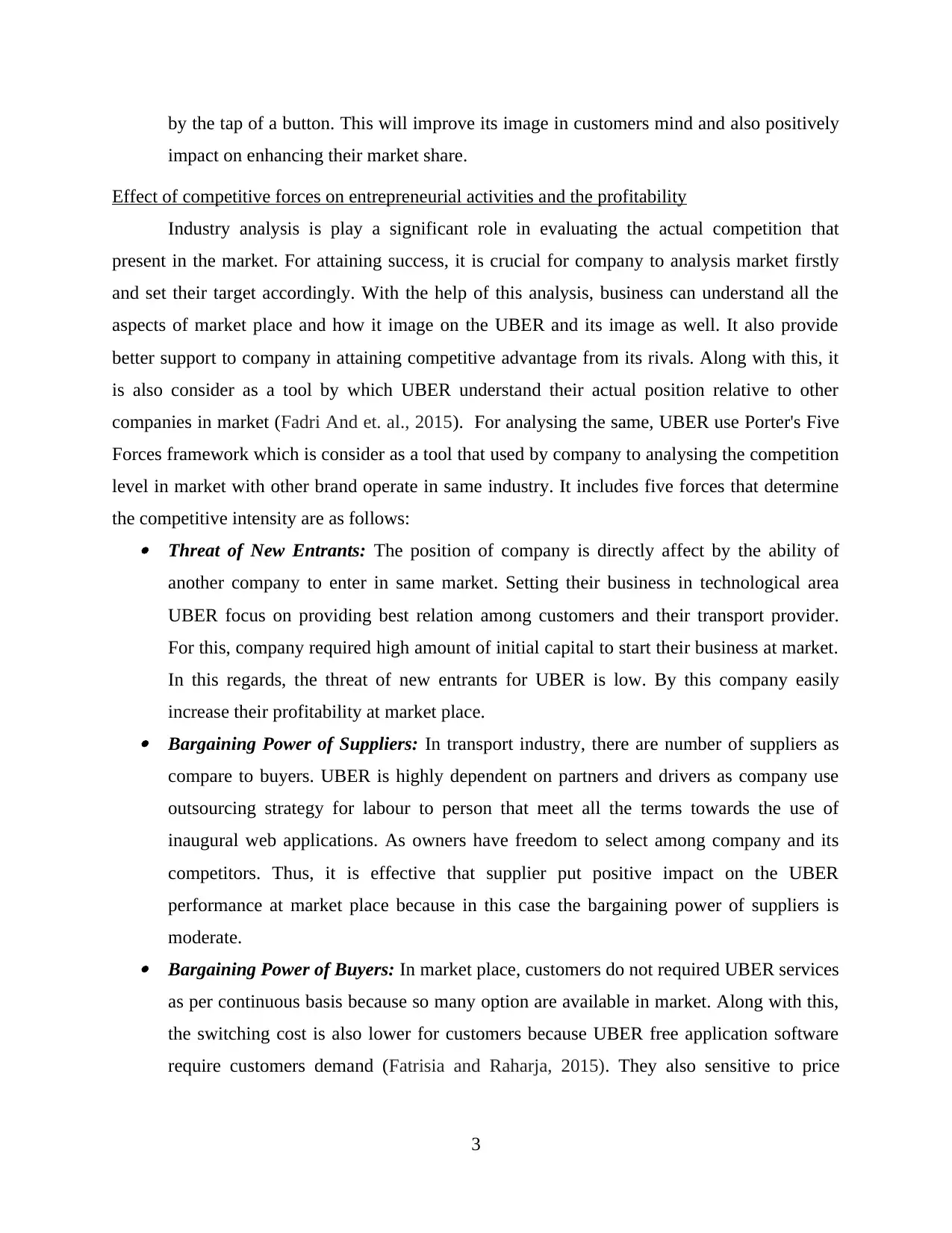
by the tap of a button. This will improve its image in customers mind and also positively
impact on enhancing their market share.
Effect of competitive forces on entrepreneurial activities and the profitability
Industry analysis is play a significant role in evaluating the actual competition that
present in the market. For attaining success, it is crucial for company to analysis market firstly
and set their target accordingly. With the help of this analysis, business can understand all the
aspects of market place and how it image on the UBER and its image as well. It also provide
better support to company in attaining competitive advantage from its rivals. Along with this, it
is also consider as a tool by which UBER understand their actual position relative to other
companies in market (Fadri And et. al., 2015). For analysing the same, UBER use Porter's Five
Forces framework which is consider as a tool that used by company to analysing the competition
level in market with other brand operate in same industry. It includes five forces that determine
the competitive intensity are as follows: Threat of New Entrants: The position of company is directly affect by the ability of
another company to enter in same market. Setting their business in technological area
UBER focus on providing best relation among customers and their transport provider.
For this, company required high amount of initial capital to start their business at market.
In this regards, the threat of new entrants for UBER is low. By this company easily
increase their profitability at market place. Bargaining Power of Suppliers: In transport industry, there are number of suppliers as
compare to buyers. UBER is highly dependent on partners and drivers as company use
outsourcing strategy for labour to person that meet all the terms towards the use of
inaugural web applications. As owners have freedom to select among company and its
competitors. Thus, it is effective that supplier put positive impact on the UBER
performance at market place because in this case the bargaining power of suppliers is
moderate. Bargaining Power of Buyers: In market place, customers do not required UBER services
as per continuous basis because so many option are available in market. Along with this,
the switching cost is also lower for customers because UBER free application software
require customers demand (Fatrisia and Raharja, 2015). They also sensitive to price
3
impact on enhancing their market share.
Effect of competitive forces on entrepreneurial activities and the profitability
Industry analysis is play a significant role in evaluating the actual competition that
present in the market. For attaining success, it is crucial for company to analysis market firstly
and set their target accordingly. With the help of this analysis, business can understand all the
aspects of market place and how it image on the UBER and its image as well. It also provide
better support to company in attaining competitive advantage from its rivals. Along with this, it
is also consider as a tool by which UBER understand their actual position relative to other
companies in market (Fadri And et. al., 2015). For analysing the same, UBER use Porter's Five
Forces framework which is consider as a tool that used by company to analysing the competition
level in market with other brand operate in same industry. It includes five forces that determine
the competitive intensity are as follows: Threat of New Entrants: The position of company is directly affect by the ability of
another company to enter in same market. Setting their business in technological area
UBER focus on providing best relation among customers and their transport provider.
For this, company required high amount of initial capital to start their business at market.
In this regards, the threat of new entrants for UBER is low. By this company easily
increase their profitability at market place. Bargaining Power of Suppliers: In transport industry, there are number of suppliers as
compare to buyers. UBER is highly dependent on partners and drivers as company use
outsourcing strategy for labour to person that meet all the terms towards the use of
inaugural web applications. As owners have freedom to select among company and its
competitors. Thus, it is effective that supplier put positive impact on the UBER
performance at market place because in this case the bargaining power of suppliers is
moderate. Bargaining Power of Buyers: In market place, customers do not required UBER services
as per continuous basis because so many option are available in market. Along with this,
the switching cost is also lower for customers because UBER free application software
require customers demand (Fatrisia and Raharja, 2015). They also sensitive to price
3
⊘ This is a preview!⊘
Do you want full access?
Subscribe today to unlock all pages.
Trusted by 1+ million students worldwide
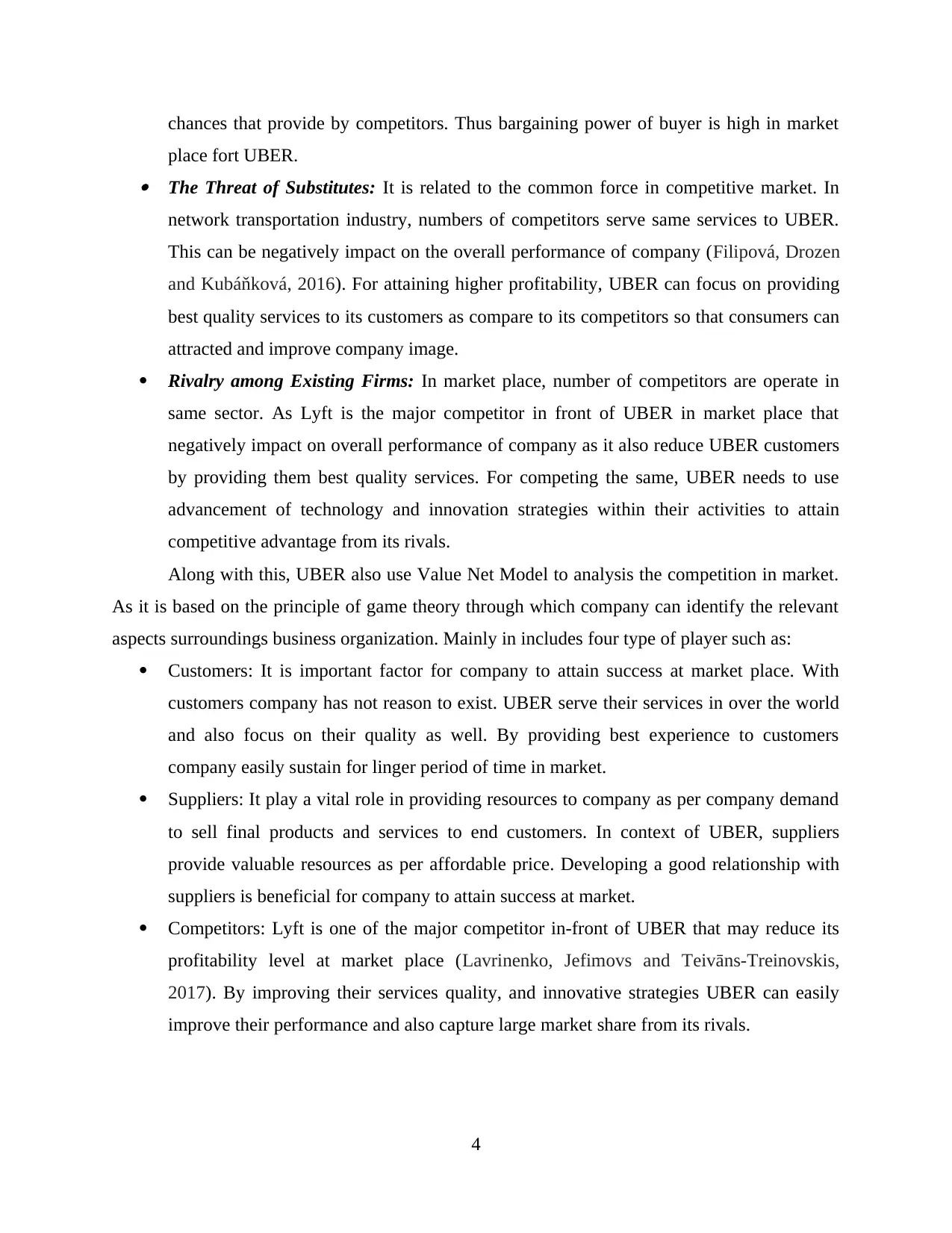
chances that provide by competitors. Thus bargaining power of buyer is high in market
place fort UBER. The Threat of Substitutes: It is related to the common force in competitive market. In
network transportation industry, numbers of competitors serve same services to UBER.
This can be negatively impact on the overall performance of company (Filipová, Drozen
and Kubáňková, 2016). For attaining higher profitability, UBER can focus on providing
best quality services to its customers as compare to its competitors so that consumers can
attracted and improve company image.
Rivalry among Existing Firms: In market place, number of competitors are operate in
same sector. As Lyft is the major competitor in front of UBER in market place that
negatively impact on overall performance of company as it also reduce UBER customers
by providing them best quality services. For competing the same, UBER needs to use
advancement of technology and innovation strategies within their activities to attain
competitive advantage from its rivals.
Along with this, UBER also use Value Net Model to analysis the competition in market.
As it is based on the principle of game theory through which company can identify the relevant
aspects surroundings business organization. Mainly in includes four type of player such as:
Customers: It is important factor for company to attain success at market place. With
customers company has not reason to exist. UBER serve their services in over the world
and also focus on their quality as well. By providing best experience to customers
company easily sustain for linger period of time in market.
Suppliers: It play a vital role in providing resources to company as per company demand
to sell final products and services to end customers. In context of UBER, suppliers
provide valuable resources as per affordable price. Developing a good relationship with
suppliers is beneficial for company to attain success at market.
Competitors: Lyft is one of the major competitor in-front of UBER that may reduce its
profitability level at market place (Lavrinenko, Jefimovs and Teivāns-Treinovskis,
2017). By improving their services quality, and innovative strategies UBER can easily
improve their performance and also capture large market share from its rivals.
4
place fort UBER. The Threat of Substitutes: It is related to the common force in competitive market. In
network transportation industry, numbers of competitors serve same services to UBER.
This can be negatively impact on the overall performance of company (Filipová, Drozen
and Kubáňková, 2016). For attaining higher profitability, UBER can focus on providing
best quality services to its customers as compare to its competitors so that consumers can
attracted and improve company image.
Rivalry among Existing Firms: In market place, number of competitors are operate in
same sector. As Lyft is the major competitor in front of UBER in market place that
negatively impact on overall performance of company as it also reduce UBER customers
by providing them best quality services. For competing the same, UBER needs to use
advancement of technology and innovation strategies within their activities to attain
competitive advantage from its rivals.
Along with this, UBER also use Value Net Model to analysis the competition in market.
As it is based on the principle of game theory through which company can identify the relevant
aspects surroundings business organization. Mainly in includes four type of player such as:
Customers: It is important factor for company to attain success at market place. With
customers company has not reason to exist. UBER serve their services in over the world
and also focus on their quality as well. By providing best experience to customers
company easily sustain for linger period of time in market.
Suppliers: It play a vital role in providing resources to company as per company demand
to sell final products and services to end customers. In context of UBER, suppliers
provide valuable resources as per affordable price. Developing a good relationship with
suppliers is beneficial for company to attain success at market.
Competitors: Lyft is one of the major competitor in-front of UBER that may reduce its
profitability level at market place (Lavrinenko, Jefimovs and Teivāns-Treinovskis,
2017). By improving their services quality, and innovative strategies UBER can easily
improve their performance and also capture large market share from its rivals.
4
Paraphrase This Document
Need a fresh take? Get an instant paraphrase of this document with our AI Paraphraser
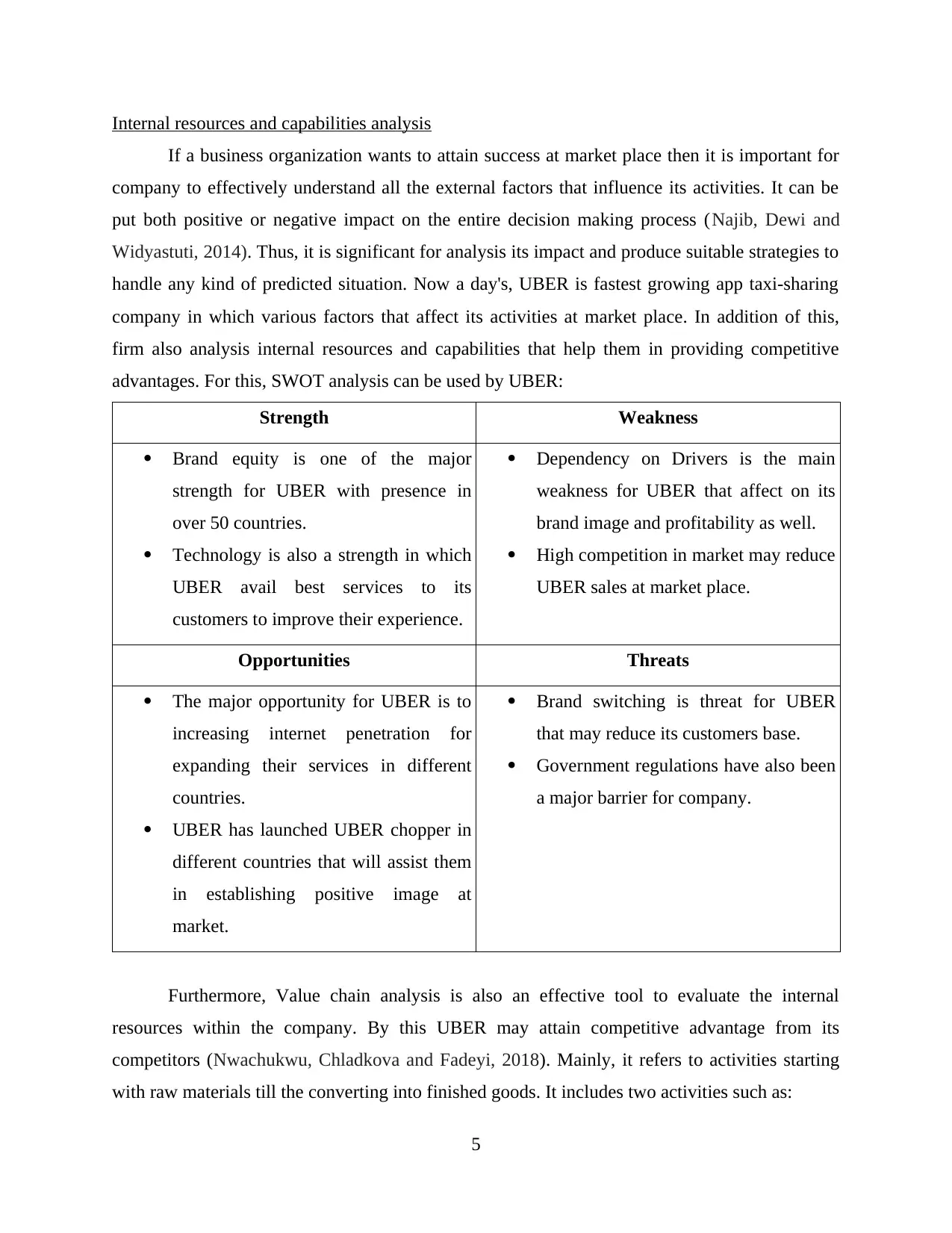
Internal resources and capabilities analysis
If a business organization wants to attain success at market place then it is important for
company to effectively understand all the external factors that influence its activities. It can be
put both positive or negative impact on the entire decision making process (Najib, Dewi and
Widyastuti, 2014). Thus, it is significant for analysis its impact and produce suitable strategies to
handle any kind of predicted situation. Now a day's, UBER is fastest growing app taxi-sharing
company in which various factors that affect its activities at market place. In addition of this,
firm also analysis internal resources and capabilities that help them in providing competitive
advantages. For this, SWOT analysis can be used by UBER:
Strength Weakness
Brand equity is one of the major
strength for UBER with presence in
over 50 countries.
Technology is also a strength in which
UBER avail best services to its
customers to improve their experience.
Dependency on Drivers is the main
weakness for UBER that affect on its
brand image and profitability as well.
High competition in market may reduce
UBER sales at market place.
Opportunities Threats
The major opportunity for UBER is to
increasing internet penetration for
expanding their services in different
countries.
UBER has launched UBER chopper in
different countries that will assist them
in establishing positive image at
market.
Brand switching is threat for UBER
that may reduce its customers base.
Government regulations have also been
a major barrier for company.
Furthermore, Value chain analysis is also an effective tool to evaluate the internal
resources within the company. By this UBER may attain competitive advantage from its
competitors (Nwachukwu, Chladkova and Fadeyi, 2018). Mainly, it refers to activities starting
with raw materials till the converting into finished goods. It includes two activities such as:
5
If a business organization wants to attain success at market place then it is important for
company to effectively understand all the external factors that influence its activities. It can be
put both positive or negative impact on the entire decision making process (Najib, Dewi and
Widyastuti, 2014). Thus, it is significant for analysis its impact and produce suitable strategies to
handle any kind of predicted situation. Now a day's, UBER is fastest growing app taxi-sharing
company in which various factors that affect its activities at market place. In addition of this,
firm also analysis internal resources and capabilities that help them in providing competitive
advantages. For this, SWOT analysis can be used by UBER:
Strength Weakness
Brand equity is one of the major
strength for UBER with presence in
over 50 countries.
Technology is also a strength in which
UBER avail best services to its
customers to improve their experience.
Dependency on Drivers is the main
weakness for UBER that affect on its
brand image and profitability as well.
High competition in market may reduce
UBER sales at market place.
Opportunities Threats
The major opportunity for UBER is to
increasing internet penetration for
expanding their services in different
countries.
UBER has launched UBER chopper in
different countries that will assist them
in establishing positive image at
market.
Brand switching is threat for UBER
that may reduce its customers base.
Government regulations have also been
a major barrier for company.
Furthermore, Value chain analysis is also an effective tool to evaluate the internal
resources within the company. By this UBER may attain competitive advantage from its
competitors (Nwachukwu, Chladkova and Fadeyi, 2018). Mainly, it refers to activities starting
with raw materials till the converting into finished goods. It includes two activities such as:
5
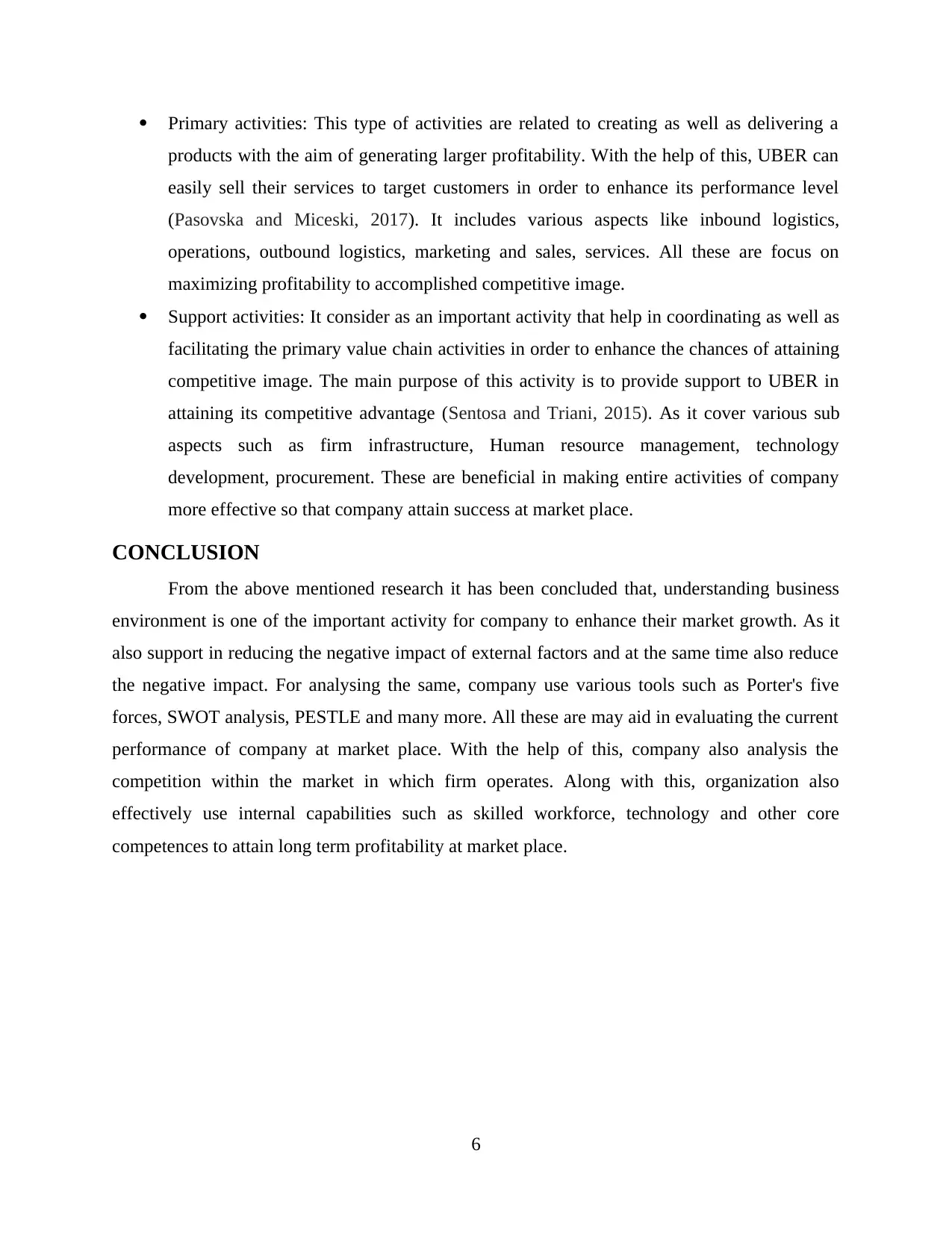
Primary activities: This type of activities are related to creating as well as delivering a
products with the aim of generating larger profitability. With the help of this, UBER can
easily sell their services to target customers in order to enhance its performance level
(Pasovska and Miceski, 2017). It includes various aspects like inbound logistics,
operations, outbound logistics, marketing and sales, services. All these are focus on
maximizing profitability to accomplished competitive image.
Support activities: It consider as an important activity that help in coordinating as well as
facilitating the primary value chain activities in order to enhance the chances of attaining
competitive image. The main purpose of this activity is to provide support to UBER in
attaining its competitive advantage (Sentosa and Triani, 2015). As it cover various sub
aspects such as firm infrastructure, Human resource management, technology
development, procurement. These are beneficial in making entire activities of company
more effective so that company attain success at market place.
CONCLUSION
From the above mentioned research it has been concluded that, understanding business
environment is one of the important activity for company to enhance their market growth. As it
also support in reducing the negative impact of external factors and at the same time also reduce
the negative impact. For analysing the same, company use various tools such as Porter's five
forces, SWOT analysis, PESTLE and many more. All these are may aid in evaluating the current
performance of company at market place. With the help of this, company also analysis the
competition within the market in which firm operates. Along with this, organization also
effectively use internal capabilities such as skilled workforce, technology and other core
competences to attain long term profitability at market place.
6
products with the aim of generating larger profitability. With the help of this, UBER can
easily sell their services to target customers in order to enhance its performance level
(Pasovska and Miceski, 2017). It includes various aspects like inbound logistics,
operations, outbound logistics, marketing and sales, services. All these are focus on
maximizing profitability to accomplished competitive image.
Support activities: It consider as an important activity that help in coordinating as well as
facilitating the primary value chain activities in order to enhance the chances of attaining
competitive image. The main purpose of this activity is to provide support to UBER in
attaining its competitive advantage (Sentosa and Triani, 2015). As it cover various sub
aspects such as firm infrastructure, Human resource management, technology
development, procurement. These are beneficial in making entire activities of company
more effective so that company attain success at market place.
CONCLUSION
From the above mentioned research it has been concluded that, understanding business
environment is one of the important activity for company to enhance their market growth. As it
also support in reducing the negative impact of external factors and at the same time also reduce
the negative impact. For analysing the same, company use various tools such as Porter's five
forces, SWOT analysis, PESTLE and many more. All these are may aid in evaluating the current
performance of company at market place. With the help of this, company also analysis the
competition within the market in which firm operates. Along with this, organization also
effectively use internal capabilities such as skilled workforce, technology and other core
competences to attain long term profitability at market place.
6
⊘ This is a preview!⊘
Do you want full access?
Subscribe today to unlock all pages.
Trusted by 1+ million students worldwide
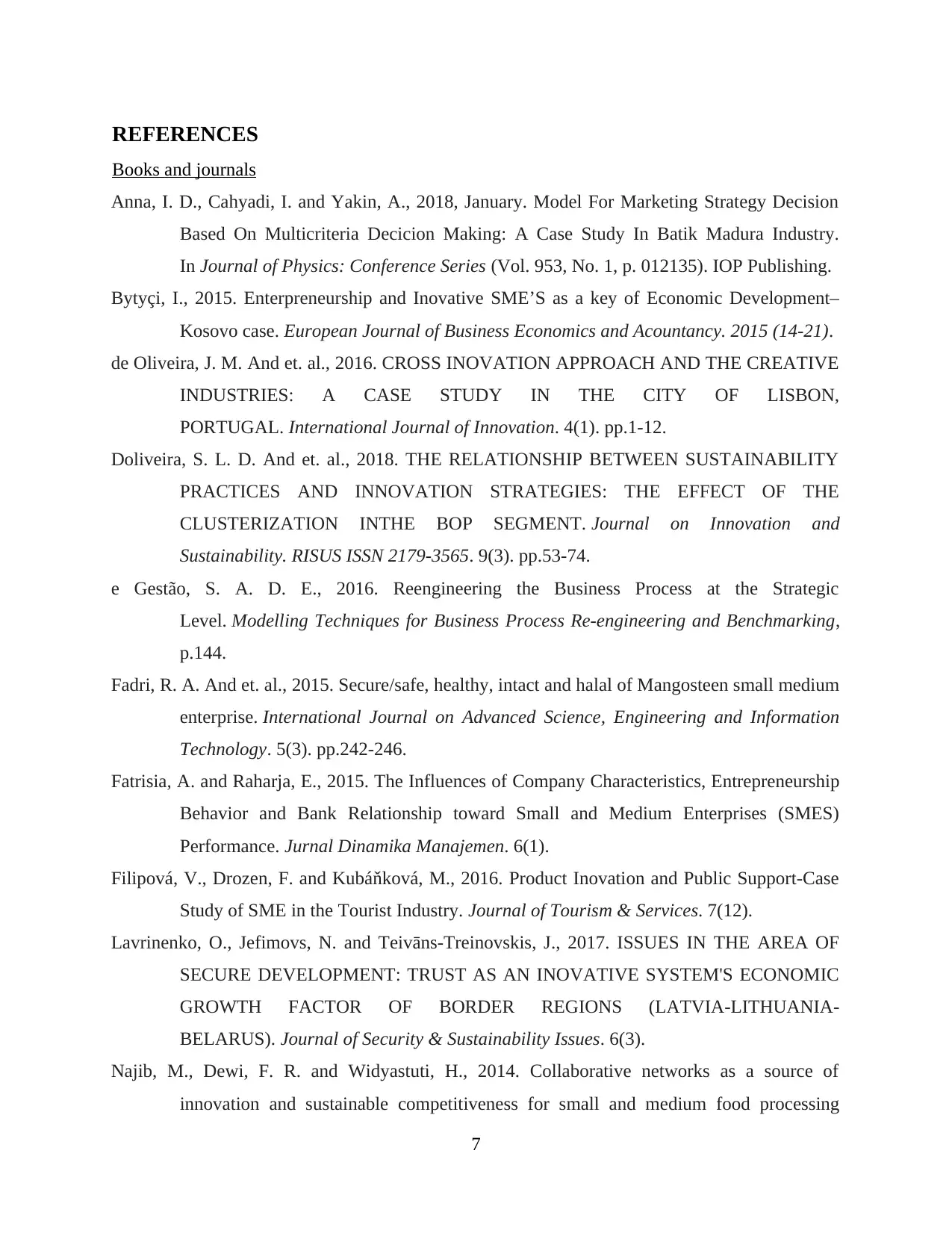
REFERENCES
Books and journals
Anna, I. D., Cahyadi, I. and Yakin, A., 2018, January. Model For Marketing Strategy Decision
Based On Multicriteria Decicion Making: A Case Study In Batik Madura Industry.
In Journal of Physics: Conference Series (Vol. 953, No. 1, p. 012135). IOP Publishing.
Bytyçi, I., 2015. Enterpreneurship and Inovative SME’S as a key of Economic Development–
Kosovo case. European Journal of Business Economics and Acountancy. 2015 (14-21).
de Oliveira, J. M. And et. al., 2016. CROSS INOVATION APPROACH AND THE CREATIVE
INDUSTRIES: A CASE STUDY IN THE CITY OF LISBON,
PORTUGAL. International Journal of Innovation. 4(1). pp.1-12.
Doliveira, S. L. D. And et. al., 2018. THE RELATIONSHIP BETWEEN SUSTAINABILITY
PRACTICES AND INNOVATION STRATEGIES: THE EFFECT OF THE
CLUSTERIZATION INTHE BOP SEGMENT. Journal on Innovation and
Sustainability. RISUS ISSN 2179-3565. 9(3). pp.53-74.
e Gestão, S. A. D. E., 2016. Reengineering the Business Process at the Strategic
Level. Modelling Techniques for Business Process Re-engineering and Benchmarking,
p.144.
Fadri, R. A. And et. al., 2015. Secure/safe, healthy, intact and halal of Mangosteen small medium
enterprise. International Journal on Advanced Science, Engineering and Information
Technology. 5(3). pp.242-246.
Fatrisia, A. and Raharja, E., 2015. The Influences of Company Characteristics, Entrepreneurship
Behavior and Bank Relationship toward Small and Medium Enterprises (SMES)
Performance. Jurnal Dinamika Manajemen. 6(1).
Filipová, V., Drozen, F. and Kubáňková, M., 2016. Product Inovation and Public Support-Case
Study of SME in the Tourist Industry. Journal of Tourism & Services. 7(12).
Lavrinenko, O., Jefimovs, N. and Teivāns-Treinovskis, J., 2017. ISSUES IN THE AREA OF
SECURE DEVELOPMENT: TRUST AS AN INOVATIVE SYSTEM'S ECONOMIC
GROWTH FACTOR OF BORDER REGIONS (LATVIA-LITHUANIA-
BELARUS). Journal of Security & Sustainability Issues. 6(3).
Najib, M., Dewi, F. R. and Widyastuti, H., 2014. Collaborative networks as a source of
innovation and sustainable competitiveness for small and medium food processing
7
Books and journals
Anna, I. D., Cahyadi, I. and Yakin, A., 2018, January. Model For Marketing Strategy Decision
Based On Multicriteria Decicion Making: A Case Study In Batik Madura Industry.
In Journal of Physics: Conference Series (Vol. 953, No. 1, p. 012135). IOP Publishing.
Bytyçi, I., 2015. Enterpreneurship and Inovative SME’S as a key of Economic Development–
Kosovo case. European Journal of Business Economics and Acountancy. 2015 (14-21).
de Oliveira, J. M. And et. al., 2016. CROSS INOVATION APPROACH AND THE CREATIVE
INDUSTRIES: A CASE STUDY IN THE CITY OF LISBON,
PORTUGAL. International Journal of Innovation. 4(1). pp.1-12.
Doliveira, S. L. D. And et. al., 2018. THE RELATIONSHIP BETWEEN SUSTAINABILITY
PRACTICES AND INNOVATION STRATEGIES: THE EFFECT OF THE
CLUSTERIZATION INTHE BOP SEGMENT. Journal on Innovation and
Sustainability. RISUS ISSN 2179-3565. 9(3). pp.53-74.
e Gestão, S. A. D. E., 2016. Reengineering the Business Process at the Strategic
Level. Modelling Techniques for Business Process Re-engineering and Benchmarking,
p.144.
Fadri, R. A. And et. al., 2015. Secure/safe, healthy, intact and halal of Mangosteen small medium
enterprise. International Journal on Advanced Science, Engineering and Information
Technology. 5(3). pp.242-246.
Fatrisia, A. and Raharja, E., 2015. The Influences of Company Characteristics, Entrepreneurship
Behavior and Bank Relationship toward Small and Medium Enterprises (SMES)
Performance. Jurnal Dinamika Manajemen. 6(1).
Filipová, V., Drozen, F. and Kubáňková, M., 2016. Product Inovation and Public Support-Case
Study of SME in the Tourist Industry. Journal of Tourism & Services. 7(12).
Lavrinenko, O., Jefimovs, N. and Teivāns-Treinovskis, J., 2017. ISSUES IN THE AREA OF
SECURE DEVELOPMENT: TRUST AS AN INOVATIVE SYSTEM'S ECONOMIC
GROWTH FACTOR OF BORDER REGIONS (LATVIA-LITHUANIA-
BELARUS). Journal of Security & Sustainability Issues. 6(3).
Najib, M., Dewi, F. R. and Widyastuti, H., 2014. Collaborative networks as a source of
innovation and sustainable competitiveness for small and medium food processing
7
Paraphrase This Document
Need a fresh take? Get an instant paraphrase of this document with our AI Paraphraser
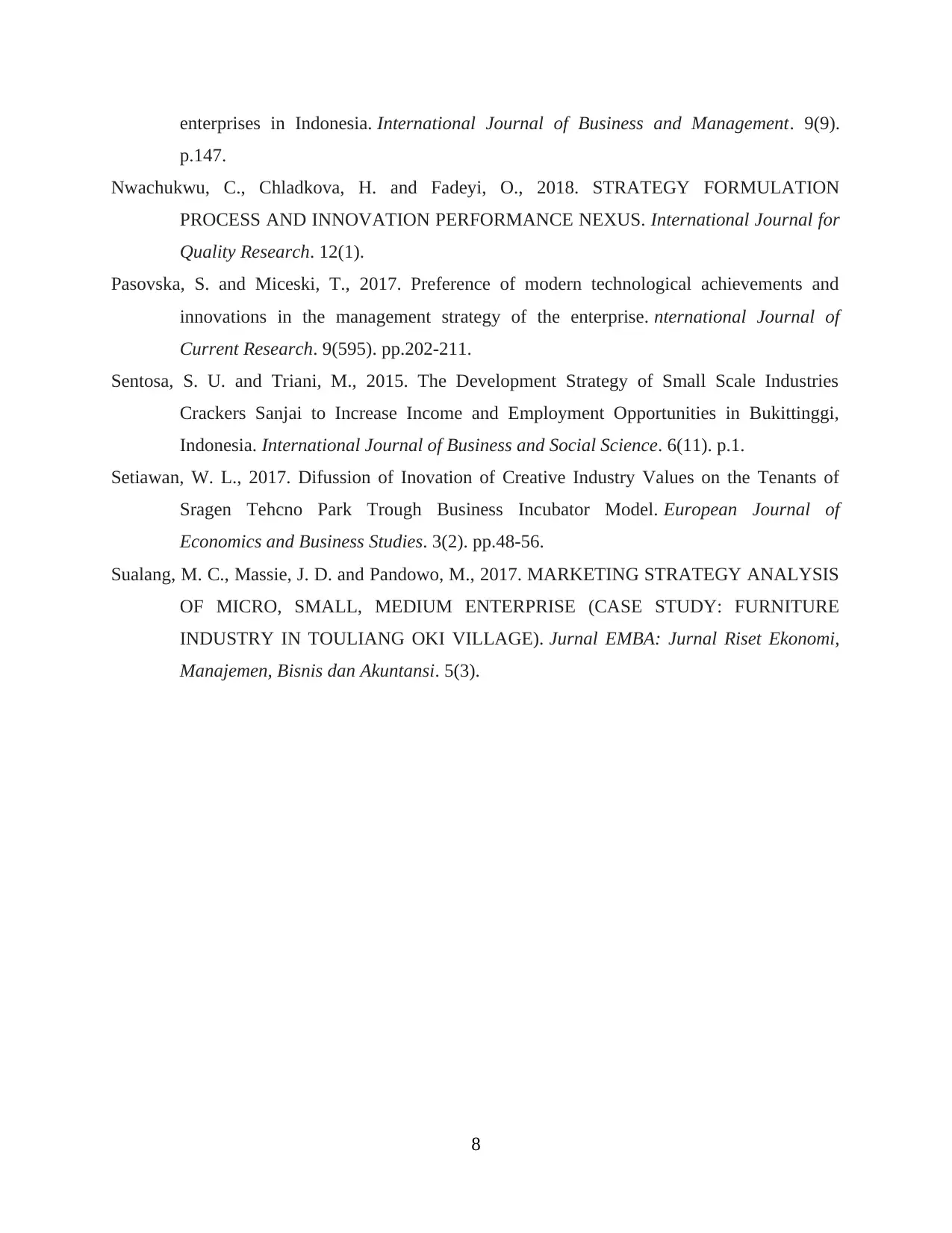
enterprises in Indonesia. International Journal of Business and Management. 9(9).
p.147.
Nwachukwu, C., Chladkova, H. and Fadeyi, O., 2018. STRATEGY FORMULATION
PROCESS AND INNOVATION PERFORMANCE NEXUS. International Journal for
Quality Research. 12(1).
Pasovska, S. and Miceski, T., 2017. Preference of modern technological achievements and
innovations in the management strategy of the enterprise. nternational Journal of
Current Research. 9(595). pp.202-211.
Sentosa, S. U. and Triani, M., 2015. The Development Strategy of Small Scale Industries
Crackers Sanjai to Increase Income and Employment Opportunities in Bukittinggi,
Indonesia. International Journal of Business and Social Science. 6(11). p.1.
Setiawan, W. L., 2017. Difussion of Inovation of Creative Industry Values on the Tenants of
Sragen Tehcno Park Trough Business Incubator Model. European Journal of
Economics and Business Studies. 3(2). pp.48-56.
Sualang, M. C., Massie, J. D. and Pandowo, M., 2017. MARKETING STRATEGY ANALYSIS
OF MICRO, SMALL, MEDIUM ENTERPRISE (CASE STUDY: FURNITURE
INDUSTRY IN TOULIANG OKI VILLAGE). Jurnal EMBA: Jurnal Riset Ekonomi,
Manajemen, Bisnis dan Akuntansi. 5(3).
8
p.147.
Nwachukwu, C., Chladkova, H. and Fadeyi, O., 2018. STRATEGY FORMULATION
PROCESS AND INNOVATION PERFORMANCE NEXUS. International Journal for
Quality Research. 12(1).
Pasovska, S. and Miceski, T., 2017. Preference of modern technological achievements and
innovations in the management strategy of the enterprise. nternational Journal of
Current Research. 9(595). pp.202-211.
Sentosa, S. U. and Triani, M., 2015. The Development Strategy of Small Scale Industries
Crackers Sanjai to Increase Income and Employment Opportunities in Bukittinggi,
Indonesia. International Journal of Business and Social Science. 6(11). p.1.
Setiawan, W. L., 2017. Difussion of Inovation of Creative Industry Values on the Tenants of
Sragen Tehcno Park Trough Business Incubator Model. European Journal of
Economics and Business Studies. 3(2). pp.48-56.
Sualang, M. C., Massie, J. D. and Pandowo, M., 2017. MARKETING STRATEGY ANALYSIS
OF MICRO, SMALL, MEDIUM ENTERPRISE (CASE STUDY: FURNITURE
INDUSTRY IN TOULIANG OKI VILLAGE). Jurnal EMBA: Jurnal Riset Ekonomi,
Manajemen, Bisnis dan Akuntansi. 5(3).
8

1 out of 11


Related Documents


Your All-in-One AI-Powered Toolkit for Academic Success.
+13062052269
info@desklib.com
Available 24*7 on WhatsApp / Email
![[object Object]](/_next/static/media/star-bottom.7253800d.svg)
Unlock your academic potential
Copyright © 2020–2026 A2Z Services. All Rights Reserved. Developed and managed by ZUCOL.