Business Project Proposal: Uber Eats' Success Factors in Australia
VerifiedAdded on 2023/06/08
|15
|2940
|195
Project
AI Summary
This business project proposal investigates the factors contributing to the success of Uber Eats in the Australian market. It begins with a background and situational analysis, highlighting the company's growth and market position. A literature review explores relevant theories such as the Tortoise Theory, Australian Business Cycle Theory, Technology Acceptance Model (TAM), and Innovation Diffusion Model, linking them to Uber Eats' strategies. The methodology section outlines the research philosophy (positivism), approach (deductive), and design (exploratory). Data collection methods include both quantitative and qualitative approaches, with a survey of 50 customers and interviews with three managers. The project synthesizes these elements to create a conceptual framework, emphasizing the importance of customer service, innovation, and catering to consumer cravings, such as instant food delivery. The proposal also includes a discussion of ethical considerations and provides a comprehensive list of references.

Running head: BUSINESS PROJECT
Proposal on the success of Uber Eats in Australia
Name of the student:
Name of the university:
Author note:
Proposal on the success of Uber Eats in Australia
Name of the student:
Name of the university:
Author note:

Paraphrase This Document
Need a fresh take? Get an instant paraphrase of this document with our AI Paraphraser
1
BUSINESS PROJECT
Table of contents
Background................................................................................................................................2
Situational analysis.....................................................................................................................2
Literature review........................................................................................................................3
Methodology..............................................................................................................................7
Research philosophy..............................................................................................................7
Research approach.................................................................................................................7
Research design......................................................................................................................7
Data collection.......................................................................................................................8
Sample size.............................................................................................................................8
Data analysis..........................................................................................................................9
Ethical Consideration.............................................................................................................9
References................................................................................................................................10
Appendix..................................................................................................................................12
BUSINESS PROJECT
Table of contents
Background................................................................................................................................2
Situational analysis.....................................................................................................................2
Literature review........................................................................................................................3
Methodology..............................................................................................................................7
Research philosophy..............................................................................................................7
Research approach.................................................................................................................7
Research design......................................................................................................................7
Data collection.......................................................................................................................8
Sample size.............................................................................................................................8
Data analysis..........................................................................................................................9
Ethical Consideration.............................................................................................................9
References................................................................................................................................10
Appendix..................................................................................................................................12
2
BUSINESS PROJECT
Background
Launched in August 2014, Uber Eats has achieved accolades and glory by emerging
as an online food ordering platform. Its headquarters is in San Francisco, California. The
parent company is Uber, dealing with transportation facilities. The first operation was carried
out with the launch of UberFRESH in the threshold of Santa Monica. It was in the second
half of 2015, when the service expanded to Barcelona, Chicago and New York (Ubereats.com
2018). According to the global ranking, Uber Eats is placed at 4073th position. In the country
wise ranking, Uber Eats gets the position of 2119th rank.
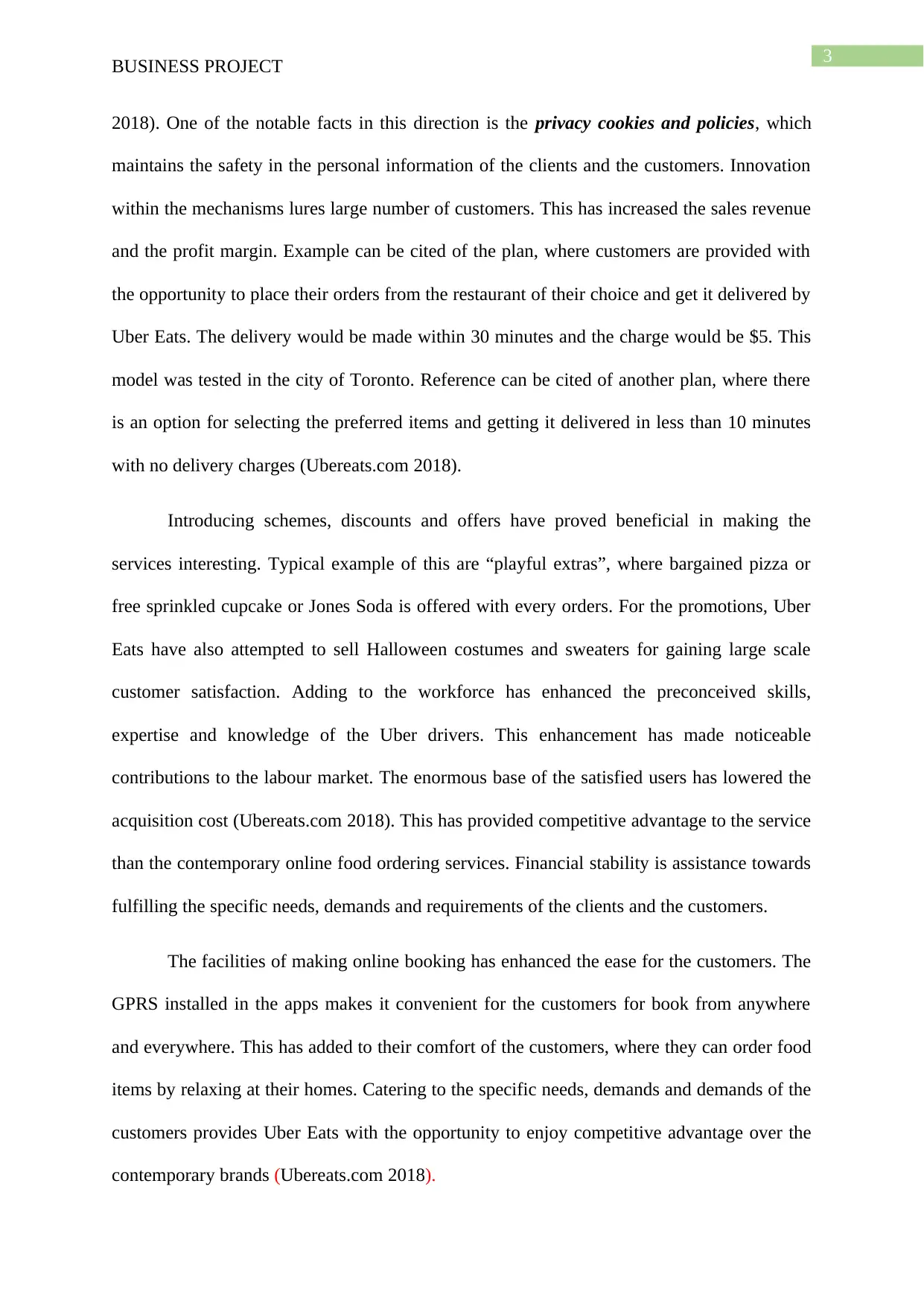
Figure: Trafficking of Uber Eats
(Source: Ubereats.com 2018)
The above figure depicts the trafficking of the audience into the services of Uber Eats.
12.56 million people visit the site, which is 8.17% of the total population of California.
Situational analysis
Online transactions gained popularity in 2016. Under such scenario, expanding the
business into the threshold of Australia in 2016 has increased the customers to 5000. As a
matter of specification, demand has increased for dishes like Hawaiian Japanese fusion dish
poke. The major drive behind this is the easy access to the online orders (Ubereats.com
BUSINESS PROJECT
Background
Launched in August 2014, Uber Eats has achieved accolades and glory by emerging
as an online food ordering platform. Its headquarters is in San Francisco, California. The
parent company is Uber, dealing with transportation facilities. The first operation was carried
out with the launch of UberFRESH in the threshold of Santa Monica. It was in the second
half of 2015, when the service expanded to Barcelona, Chicago and New York (Ubereats.com
2018). According to the global ranking, Uber Eats is placed at 4073th position. In the country
wise ranking, Uber Eats gets the position of 2119th rank.
Figure: Trafficking of Uber Eats
(Source: Ubereats.com 2018)
The above figure depicts the trafficking of the audience into the services of Uber Eats.
12.56 million people visit the site, which is 8.17% of the total population of California.
Situational analysis
Online transactions gained popularity in 2016. Under such scenario, expanding the
business into the threshold of Australia in 2016 has increased the customers to 5000. As a
matter of specification, demand has increased for dishes like Hawaiian Japanese fusion dish
poke. The major drive behind this is the easy access to the online orders (Ubereats.com
⊘ This is a preview!⊘
Do you want full access?
Subscribe today to unlock all pages.

Trusted by 1+ million students worldwide
3
BUSINESS PROJECT
2018). One of the notable facts in this direction is the privacy cookies and policies, which
maintains the safety in the personal information of the clients and the customers. Innovation
within the mechanisms lures large number of customers. This has increased the sales revenue
and the profit margin. Example can be cited of the plan, where customers are provided with
the opportunity to place their orders from the restaurant of their choice and get it delivered by
Uber Eats. The delivery would be made within 30 minutes and the charge would be $5. This
model was tested in the city of Toronto. Reference can be cited of another plan, where there
is an option for selecting the preferred items and getting it delivered in less than 10 minutes
with no delivery charges (Ubereats.com 2018).
Introducing schemes, discounts and offers have proved beneficial in making the
services interesting. Typical example of this are “playful extras”, where bargained pizza or
free sprinkled cupcake or Jones Soda is offered with every orders. For the promotions, Uber
Eats have also attempted to sell Halloween costumes and sweaters for gaining large scale
customer satisfaction. Adding to the workforce has enhanced the preconceived skills,
expertise and knowledge of the Uber drivers. This enhancement has made noticeable
contributions to the labour market. The enormous base of the satisfied users has lowered the
acquisition cost (Ubereats.com 2018). This has provided competitive advantage to the service
than the contemporary online food ordering services. Financial stability is assistance towards
fulfilling the specific needs, demands and requirements of the clients and the customers.
The facilities of making online booking has enhanced the ease for the customers. The
GPRS installed in the apps makes it convenient for the customers for book from anywhere
and everywhere. This has added to their comfort of the customers, where they can order food
items by relaxing at their homes. Catering to the specific needs, demands and demands of the
customers provides Uber Eats with the opportunity to enjoy competitive advantage over the
contemporary brands (Ubereats.com 2018).
BUSINESS PROJECT
2018). One of the notable facts in this direction is the privacy cookies and policies, which
maintains the safety in the personal information of the clients and the customers. Innovation
within the mechanisms lures large number of customers. This has increased the sales revenue
and the profit margin. Example can be cited of the plan, where customers are provided with
the opportunity to place their orders from the restaurant of their choice and get it delivered by
Uber Eats. The delivery would be made within 30 minutes and the charge would be $5. This
model was tested in the city of Toronto. Reference can be cited of another plan, where there
is an option for selecting the preferred items and getting it delivered in less than 10 minutes
with no delivery charges (Ubereats.com 2018).
Introducing schemes, discounts and offers have proved beneficial in making the
services interesting. Typical example of this are “playful extras”, where bargained pizza or
free sprinkled cupcake or Jones Soda is offered with every orders. For the promotions, Uber
Eats have also attempted to sell Halloween costumes and sweaters for gaining large scale
customer satisfaction. Adding to the workforce has enhanced the preconceived skills,
expertise and knowledge of the Uber drivers. This enhancement has made noticeable
contributions to the labour market. The enormous base of the satisfied users has lowered the
acquisition cost (Ubereats.com 2018). This has provided competitive advantage to the service
than the contemporary online food ordering services. Financial stability is assistance towards
fulfilling the specific needs, demands and requirements of the clients and the customers.
The facilities of making online booking has enhanced the ease for the customers. The
GPRS installed in the apps makes it convenient for the customers for book from anywhere
and everywhere. This has added to their comfort of the customers, where they can order food
items by relaxing at their homes. Catering to the specific needs, demands and demands of the
customers provides Uber Eats with the opportunity to enjoy competitive advantage over the
contemporary brands (Ubereats.com 2018).
Paraphrase This Document
Need a fresh take? Get an instant paraphrase of this document with our AI Paraphraser
4
BUSINESS PROJECT
Literature review
Business expansion alters the scope and arena of the companies and organizations.
This expansion lures the customers, which escalates the sales revenue and profit margin.
Exposure of strategic approach proves beneficial in achieving large scale customer
satisfaction. Theoretical consideration proves effective in terms of achieving positive results.
Mention can be made of the tortoise theory, which makes the businesspersons familiar with
the tactics for the coping up with competitions. This theory suggests that the companies and
organizations need to be flexible enough for adjusting within the competitive ambience
(Sakas, Vlachos and Nasiopoulos 2014). For this, observation power is the most crucial
element.
Business expansion is considered as one of an important aspect of strategy theory.
The theory suggests two areas, focusing on which can lead to positive outcomes in expanding
the scope and arena of business. These areas are internal growth and external growth. Internal
growth relates to adding to the workforce and adapting latest machines for the enhancing the
productivity in business. On the other hand, external growth is the partnerships, which
increases the operational scale for the companies and organizations (Buckley, Burton and
Mirza 2016).
Reference can be cited of the Australian Business Cycle Theory, where the critics
shed light on the variations within the market condition. The process can be described as
follows:
BUSINESS PROJECT
Literature review
Business expansion alters the scope and arena of the companies and organizations.
This expansion lures the customers, which escalates the sales revenue and profit margin.
Exposure of strategic approach proves beneficial in achieving large scale customer
satisfaction. Theoretical consideration proves effective in terms of achieving positive results.
Mention can be made of the tortoise theory, which makes the businesspersons familiar with
the tactics for the coping up with competitions. This theory suggests that the companies and
organizations need to be flexible enough for adjusting within the competitive ambience
(Sakas, Vlachos and Nasiopoulos 2014). For this, observation power is the most crucial
element.
Business expansion is considered as one of an important aspect of strategy theory.
The theory suggests two areas, focusing on which can lead to positive outcomes in expanding
the scope and arena of business. These areas are internal growth and external growth. Internal
growth relates to adding to the workforce and adapting latest machines for the enhancing the
productivity in business. On the other hand, external growth is the partnerships, which
increases the operational scale for the companies and organizations (Buckley, Burton and
Mirza 2016).
Reference can be cited of the Australian Business Cycle Theory, where the critics
shed light on the variations within the market condition. The process can be described as
follows:
5
BUSINESS PROJECT
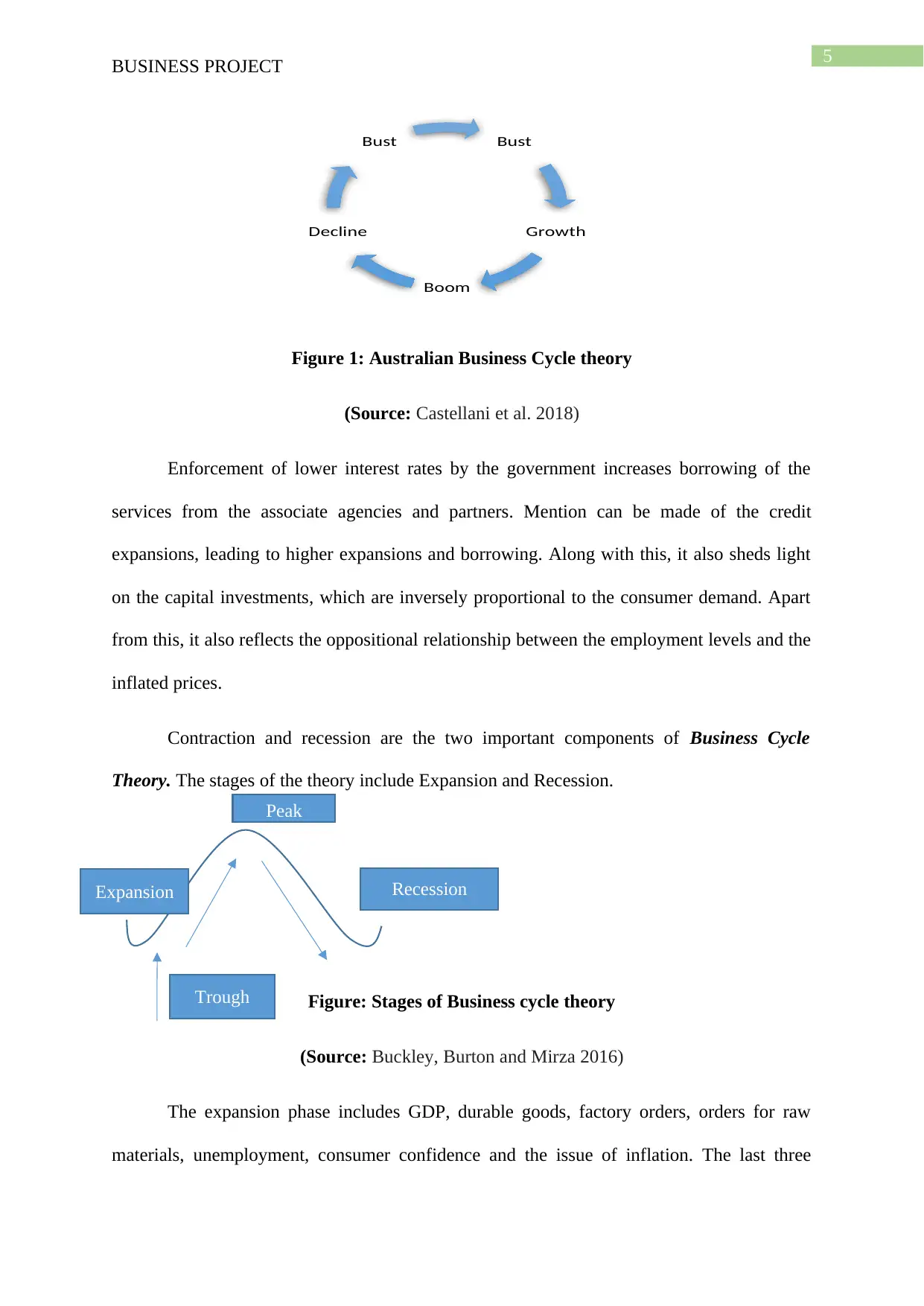
Figure 1: Australian Business Cycle theory
(Source: Castellani et al. 2018)
Enforcement of lower interest rates by the government increases borrowing of the
services from the associate agencies and partners. Mention can be made of the credit
expansions, leading to higher expansions and borrowing. Along with this, it also sheds light
on the capital investments, which are inversely proportional to the consumer demand. Apart
from this, it also reflects the oppositional relationship between the employment levels and the
inflated prices.
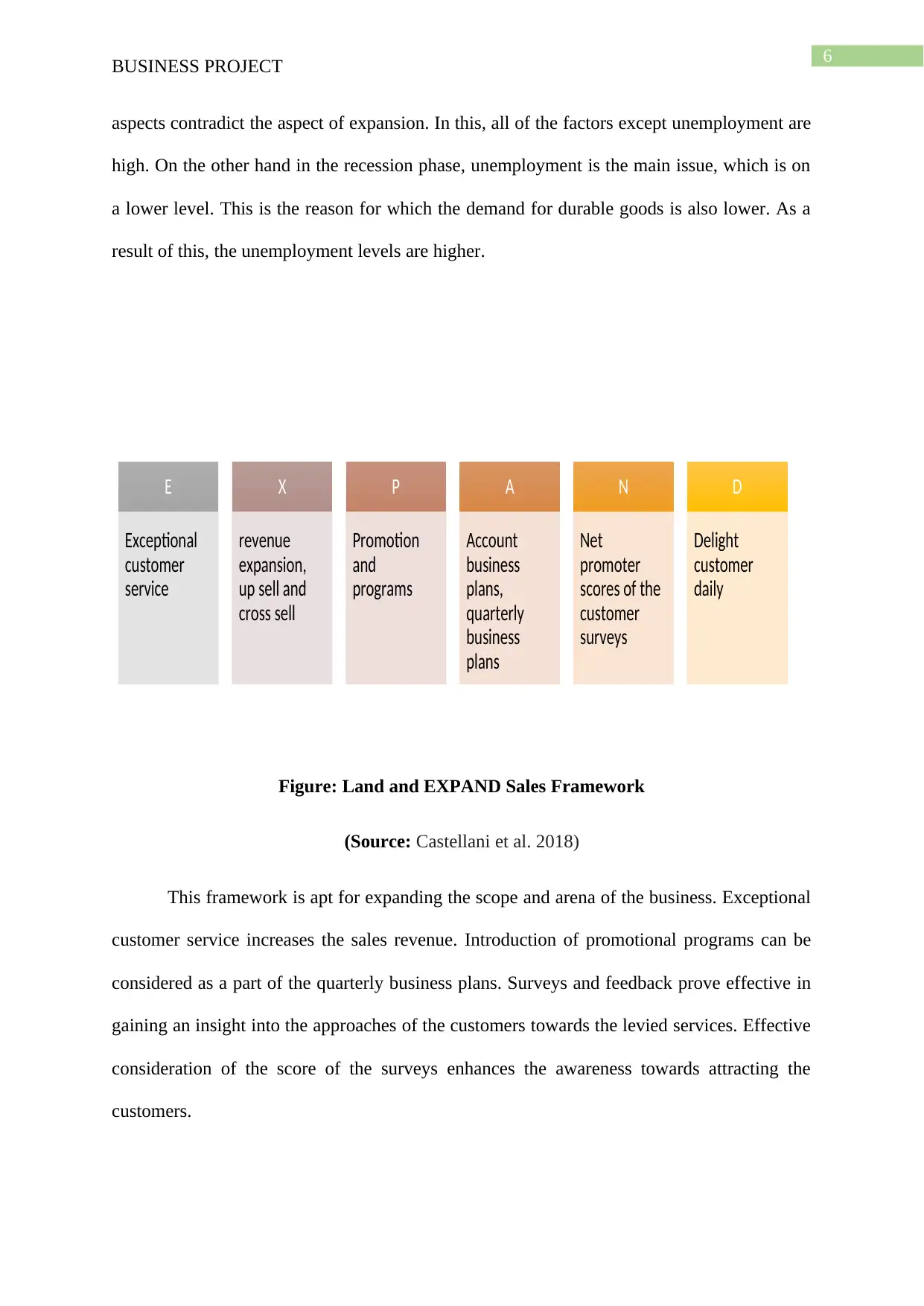
Contraction and recession are the two important components of Business Cycle
Theory. The stages of the theory include Expansion and Recession.
Figure: Stages of Business cycle theory
(Source: Buckley, Burton and Mirza 2016)
The expansion phase includes GDP, durable goods, factory orders, orders for raw
materials, unemployment, consumer confidence and the issue of inflation. The last three
Bust
Growth
Boom
Decline
Bust
Expansion Recession
Peak
Trough
BUSINESS PROJECT
Figure 1: Australian Business Cycle theory
(Source: Castellani et al. 2018)
Enforcement of lower interest rates by the government increases borrowing of the
services from the associate agencies and partners. Mention can be made of the credit
expansions, leading to higher expansions and borrowing. Along with this, it also sheds light
on the capital investments, which are inversely proportional to the consumer demand. Apart
from this, it also reflects the oppositional relationship between the employment levels and the
inflated prices.
Contraction and recession are the two important components of Business Cycle
Theory. The stages of the theory include Expansion and Recession.
Figure: Stages of Business cycle theory
(Source: Buckley, Burton and Mirza 2016)
The expansion phase includes GDP, durable goods, factory orders, orders for raw
materials, unemployment, consumer confidence and the issue of inflation. The last three
Bust
Growth
Boom
Decline
Bust
Expansion Recession
Peak
Trough
⊘ This is a preview!⊘
Do you want full access?
Subscribe today to unlock all pages.
Trusted by 1+ million students worldwide
6
BUSINESS PROJECT
aspects contradict the aspect of expansion. In this, all of the factors except unemployment are
high. On the other hand in the recession phase, unemployment is the main issue, which is on
a lower level. This is the reason for which the demand for durable goods is also lower. As a
result of this, the unemployment levels are higher.
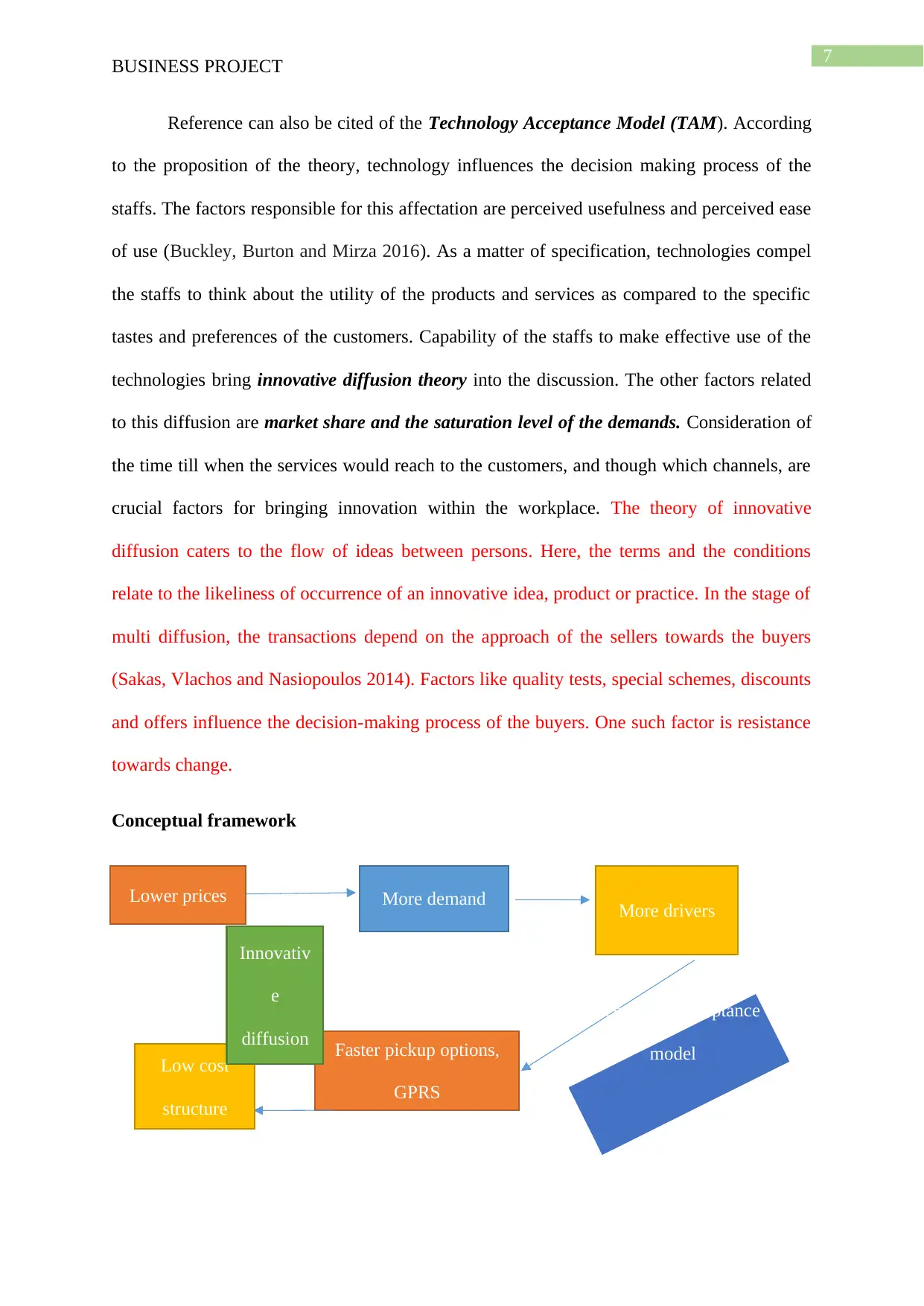
Figure: Land and EXPAND Sales Framework
(Source: Castellani et al. 2018)
This framework is apt for expanding the scope and arena of the business. Exceptional
customer service increases the sales revenue. Introduction of promotional programs can be
considered as a part of the quarterly business plans. Surveys and feedback prove effective in
gaining an insight into the approaches of the customers towards the levied services. Effective
consideration of the score of the surveys enhances the awareness towards attracting the
customers.
E
Exceptional
customer
service
X
revenue
expansion,
up sell and
cross sell
P
Promotion
and
programs
A
Account
business
plans,
quarterly
business
plans
N
Net
promoter
scores of the
customer
surveys
D
Delight
customer
daily
BUSINESS PROJECT
aspects contradict the aspect of expansion. In this, all of the factors except unemployment are
high. On the other hand in the recession phase, unemployment is the main issue, which is on
a lower level. This is the reason for which the demand for durable goods is also lower. As a
result of this, the unemployment levels are higher.
Figure: Land and EXPAND Sales Framework
(Source: Castellani et al. 2018)
This framework is apt for expanding the scope and arena of the business. Exceptional
customer service increases the sales revenue. Introduction of promotional programs can be
considered as a part of the quarterly business plans. Surveys and feedback prove effective in
gaining an insight into the approaches of the customers towards the levied services. Effective
consideration of the score of the surveys enhances the awareness towards attracting the
customers.
E
Exceptional
customer
service
X
revenue
expansion,
up sell and
cross sell
P
Promotion
and
programs
A
Account
business
plans,
quarterly
business
plans
N
Net
promoter
scores of the
customer
surveys
D
Delight
customer
daily
Paraphrase This Document
Need a fresh take? Get an instant paraphrase of this document with our AI Paraphraser
7
BUSINESS PROJECT
Reference can also be cited of the Technology Acceptance Model (TAM). According
to the proposition of the theory, technology influences the decision making process of the
staffs. The factors responsible for this affectation are perceived usefulness and perceived ease
of use (Buckley, Burton and Mirza 2016). As a matter of specification, technologies compel
the staffs to think about the utility of the products and services as compared to the specific
tastes and preferences of the customers. Capability of the staffs to make effective use of the
technologies bring innovative diffusion theory into the discussion. The other factors related
to this diffusion are market share and the saturation level of the demands. Consideration of
the time till when the services would reach to the customers, and though which channels, are
crucial factors for bringing innovation within the workplace. The theory of innovative
diffusion caters to the flow of ideas between persons. Here, the terms and the conditions
relate to the likeliness of occurrence of an innovative idea, product or practice. In the stage of
multi diffusion, the transactions depend on the approach of the sellers towards the buyers
(Sakas, Vlachos and Nasiopoulos 2014). Factors like quality tests, special schemes, discounts
and offers influence the decision-making process of the buyers. One such factor is resistance
towards change.
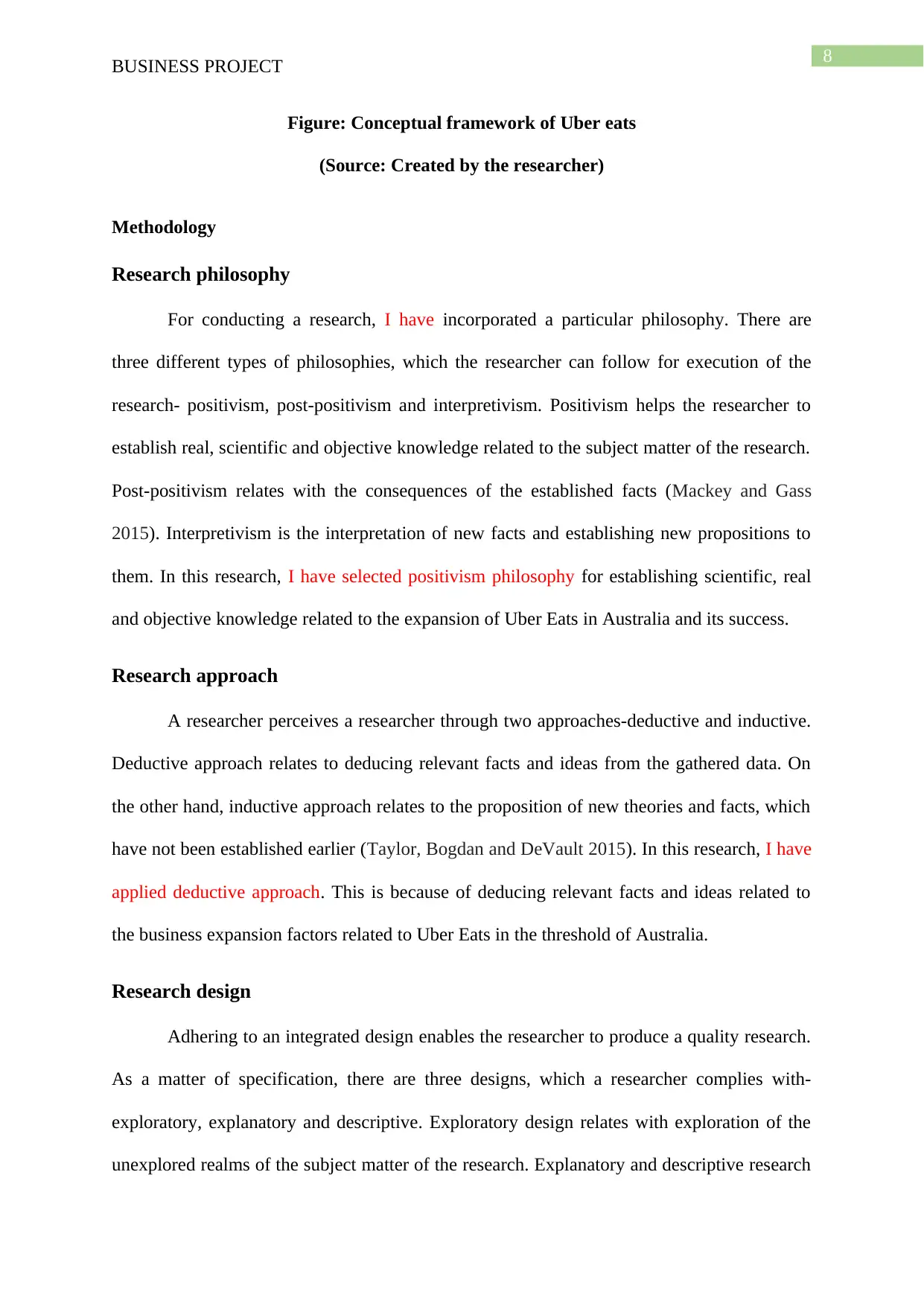
Conceptual framework
Lower prices More demand More drivers
Faster pickup options,
GPRS
Low cost
structure
Technology acceptance
model
Innovativ
e
diffusion
BUSINESS PROJECT
Reference can also be cited of the Technology Acceptance Model (TAM). According
to the proposition of the theory, technology influences the decision making process of the
staffs. The factors responsible for this affectation are perceived usefulness and perceived ease
of use (Buckley, Burton and Mirza 2016). As a matter of specification, technologies compel
the staffs to think about the utility of the products and services as compared to the specific
tastes and preferences of the customers. Capability of the staffs to make effective use of the
technologies bring innovative diffusion theory into the discussion. The other factors related
to this diffusion are market share and the saturation level of the demands. Consideration of
the time till when the services would reach to the customers, and though which channels, are
crucial factors for bringing innovation within the workplace. The theory of innovative
diffusion caters to the flow of ideas between persons. Here, the terms and the conditions
relate to the likeliness of occurrence of an innovative idea, product or practice. In the stage of
multi diffusion, the transactions depend on the approach of the sellers towards the buyers
(Sakas, Vlachos and Nasiopoulos 2014). Factors like quality tests, special schemes, discounts
and offers influence the decision-making process of the buyers. One such factor is resistance
towards change.
Conceptual framework
Lower prices More demand More drivers
Faster pickup options,
GPRS
Low cost
structure
Technology acceptance
model
Innovativ
e
diffusion
8
BUSINESS PROJECT
Figure: Conceptual framework of Uber eats
(Source: Created by the researcher)
Methodology
Research philosophy
For conducting a research, I have incorporated a particular philosophy. There are
three different types of philosophies, which the researcher can follow for execution of the
research- positivism, post-positivism and interpretivism. Positivism helps the researcher to
establish real, scientific and objective knowledge related to the subject matter of the research.
Post-positivism relates with the consequences of the established facts (Mackey and Gass
2015). Interpretivism is the interpretation of new facts and establishing new propositions to
them. In this research, I have selected positivism philosophy for establishing scientific, real
and objective knowledge related to the expansion of Uber Eats in Australia and its success.
Research approach
A researcher perceives a researcher through two approaches-deductive and inductive.
Deductive approach relates to deducing relevant facts and ideas from the gathered data. On
the other hand, inductive approach relates to the proposition of new theories and facts, which
have not been established earlier (Taylor, Bogdan and DeVault 2015). In this research, I have
applied deductive approach. This is because of deducing relevant facts and ideas related to
the business expansion factors related to Uber Eats in the threshold of Australia.
Research design
Adhering to an integrated design enables the researcher to produce a quality research.
As a matter of specification, there are three designs, which a researcher complies with-
exploratory, explanatory and descriptive. Exploratory design relates with exploration of the
unexplored realms of the subject matter of the research. Explanatory and descriptive research
BUSINESS PROJECT
Figure: Conceptual framework of Uber eats
(Source: Created by the researcher)
Methodology
Research philosophy
For conducting a research, I have incorporated a particular philosophy. There are
three different types of philosophies, which the researcher can follow for execution of the
research- positivism, post-positivism and interpretivism. Positivism helps the researcher to
establish real, scientific and objective knowledge related to the subject matter of the research.
Post-positivism relates with the consequences of the established facts (Mackey and Gass
2015). Interpretivism is the interpretation of new facts and establishing new propositions to
them. In this research, I have selected positivism philosophy for establishing scientific, real
and objective knowledge related to the expansion of Uber Eats in Australia and its success.
Research approach
A researcher perceives a researcher through two approaches-deductive and inductive.
Deductive approach relates to deducing relevant facts and ideas from the gathered data. On
the other hand, inductive approach relates to the proposition of new theories and facts, which
have not been established earlier (Taylor, Bogdan and DeVault 2015). In this research, I have
applied deductive approach. This is because of deducing relevant facts and ideas related to
the business expansion factors related to Uber Eats in the threshold of Australia.
Research design
Adhering to an integrated design enables the researcher to produce a quality research.
As a matter of specification, there are three designs, which a researcher complies with-
exploratory, explanatory and descriptive. Exploratory design relates with exploration of the
unexplored realms of the subject matter of the research. Explanatory and descriptive research
⊘ This is a preview!⊘
Do you want full access?
Subscribe today to unlock all pages.
Trusted by 1+ million students worldwide
9
BUSINESS PROJECT
design are similar in their functionalities. They require description and explanation of every
minute detail related with the subject matter of the research (Brannen 2017). In this research,
I chose explorative research design. This is in terms of exploring the unknown facts about
Uber Eats successive expansion into the threshold of Australia.
Data collection
The data required for a research is collected mainly through primary and secondary
method. Within this, there are subdivisions-quantitative and qualitative. In the primary
quantitative, surveys are conducted on the selected samples. In the qualitative, the managers
are interviewed for enhancing the knowledge on the subject matter. In the secondary method,
data is collected from websites, articles and other sources (Creswell and Creswell 2017). In
this, exclusion and inclusion criteria is followed. The sources, which have been published
more than 10 years are excluded. The sources published within 10 years are included for
establishing relevancy with the subject matter (Fusch and Ness 2015). In this research, I have
used both quantitative and quality methods for collecting the data.
Sample size
The whole population bears relation with the research. However, in order to cope up
with the time constraints, the researcher selects a stipulated sample size. This is done through
three criterias- simple, random and probability. Simple and random techniques are devoid of
any calculations. On the other hand, probability technique involves calculations for selecting
the samples (Barnham 2015). In this researcher, I have selected 50 customers for the survey
process, who have availed the services of Uber Eats. Along with this, I also interviewed 3
managers of Uber.
BUSINESS PROJECT
design are similar in their functionalities. They require description and explanation of every
minute detail related with the subject matter of the research (Brannen 2017). In this research,
I chose explorative research design. This is in terms of exploring the unknown facts about
Uber Eats successive expansion into the threshold of Australia.
Data collection
The data required for a research is collected mainly through primary and secondary
method. Within this, there are subdivisions-quantitative and qualitative. In the primary
quantitative, surveys are conducted on the selected samples. In the qualitative, the managers
are interviewed for enhancing the knowledge on the subject matter. In the secondary method,
data is collected from websites, articles and other sources (Creswell and Creswell 2017). In
this, exclusion and inclusion criteria is followed. The sources, which have been published
more than 10 years are excluded. The sources published within 10 years are included for
establishing relevancy with the subject matter (Fusch and Ness 2015). In this research, I have
used both quantitative and quality methods for collecting the data.
Sample size
The whole population bears relation with the research. However, in order to cope up
with the time constraints, the researcher selects a stipulated sample size. This is done through
three criterias- simple, random and probability. Simple and random techniques are devoid of
any calculations. On the other hand, probability technique involves calculations for selecting
the samples (Barnham 2015). In this researcher, I have selected 50 customers for the survey
process, who have availed the services of Uber Eats. Along with this, I also interviewed 3
managers of Uber.
Paraphrase This Document
Need a fresh take? Get an instant paraphrase of this document with our AI Paraphraser
10
BUSINESS PROJECT
Data analysis
The data collected for the research is analysed through primary and secondary
methods. These methods have subdivisions-quantitative and qualititative. In the primary
method, survey questions are prepared for analysing the responses of the samples.
Preparation of charts and graphs helps in conducting in-depth analysis. In the secondary
method, themes relevant to the subject matter of the research are prepared for analysing the
collected data (Alvesson and Sköldberg 2017). In this research, I have selected primary
quantitative method for analysing the collected data. Graphs and charts would enhance the
awareness of the researcher regarding their approaches towards business expansion of Uber
Eats into Australia.
Ethical Consideration
Adherence to research ethics prove beneficial in terms of gaining the trust, loyalty and
dependence of the respondents. In this research, I implemented Data Protection Act (1998)
for ensuring the safety and privacy of the responses of the samples. Here, I have assured the
respondents that their responses would be used only for the research purposes instead of
commercialization. I avoided using those sites, which needs subscription in order the
instances of plagiarism and collusion (Ormston et al. 2014).
BUSINESS PROJECT
Data analysis
The data collected for the research is analysed through primary and secondary
methods. These methods have subdivisions-quantitative and qualititative. In the primary
method, survey questions are prepared for analysing the responses of the samples.
Preparation of charts and graphs helps in conducting in-depth analysis. In the secondary
method, themes relevant to the subject matter of the research are prepared for analysing the
collected data (Alvesson and Sköldberg 2017). In this research, I have selected primary
quantitative method for analysing the collected data. Graphs and charts would enhance the
awareness of the researcher regarding their approaches towards business expansion of Uber
Eats into Australia.
Ethical Consideration
Adherence to research ethics prove beneficial in terms of gaining the trust, loyalty and
dependence of the respondents. In this research, I implemented Data Protection Act (1998)
for ensuring the safety and privacy of the responses of the samples. Here, I have assured the
respondents that their responses would be used only for the research purposes instead of
commercialization. I avoided using those sites, which needs subscription in order the
instances of plagiarism and collusion (Ormston et al. 2014).
11
BUSINESS PROJECT
References
Alvesson, M. and Sköldberg, K., 2017. Reflexive methodology: New vistas for qualitative
research. Sage.
Barnham, C., 2015. Quantitative and qualitative research: Perceptual
foundations. International Journal of Market Research, 57(6), pp.837-854.
Brannen, J., 2017. Mixing methods: Qualitative and quantitative research. Routledge.
Buckley, P. J., Burton, F., and Mirza, H. (Eds.). (2016). The strategy and organization of
international business. Springer.
Castellani, D., Narula, R., Nguyen, Q. T., Surdu, I., & Walker, J. T. (Eds.).
(2018). Contemporary Issues in International Business: Institutions, Strategy and
Performance. Springer
Creswell, J.W. and Creswell, J.D., 2017. Research design: Qualitative, quantitative, and
mixed methods approaches. Sage publications.
Fusch, P.I. and Ness, L.R., 2015. Are we there yet? Data saturation in qualitative
research. The qualitative report, 20(9), pp.1408-1416.
Mackey, A. and Gass, S.M., 2015. Second language research: Methodology and design.
Routledge.
Ormston, R., Spencer, L., Barnard, M. and Snape, D., 2014. The foundations of qualitative
research. Qualitative research practice: A guide for social science students and
researchers, 2, pp.52-55.
BUSINESS PROJECT
References
Alvesson, M. and Sköldberg, K., 2017. Reflexive methodology: New vistas for qualitative
research. Sage.
Barnham, C., 2015. Quantitative and qualitative research: Perceptual
foundations. International Journal of Market Research, 57(6), pp.837-854.
Brannen, J., 2017. Mixing methods: Qualitative and quantitative research. Routledge.
Buckley, P. J., Burton, F., and Mirza, H. (Eds.). (2016). The strategy and organization of
international business. Springer.
Castellani, D., Narula, R., Nguyen, Q. T., Surdu, I., & Walker, J. T. (Eds.).
(2018). Contemporary Issues in International Business: Institutions, Strategy and
Performance. Springer
Creswell, J.W. and Creswell, J.D., 2017. Research design: Qualitative, quantitative, and
mixed methods approaches. Sage publications.
Fusch, P.I. and Ness, L.R., 2015. Are we there yet? Data saturation in qualitative
research. The qualitative report, 20(9), pp.1408-1416.
Mackey, A. and Gass, S.M., 2015. Second language research: Methodology and design.
Routledge.
Ormston, R., Spencer, L., Barnard, M. and Snape, D., 2014. The foundations of qualitative
research. Qualitative research practice: A guide for social science students and
researchers, 2, pp.52-55.
⊘ This is a preview!⊘
Do you want full access?
Subscribe today to unlock all pages.
Trusted by 1+ million students worldwide

1 out of 15


Related Documents


Your All-in-One AI-Powered Toolkit for Academic Success.
+13062052269
info@desklib.com
Available 24*7 on WhatsApp / Email
![[object Object]](/_next/static/media/star-bottom.7253800d.svg)
Unlock your academic potential
Copyright © 2020–2026 A2Z Services. All Rights Reserved. Developed and managed by ZUCOL.