Uber's Management and Operations: A Comprehensive Report (Unit 4)
VerifiedAdded on 2023/01/03
|14
|4278
|53
Report
AI Summary
This report provides a comprehensive analysis of Uber's management and operations, focusing on the differences between the roles of leaders and managers within the company. It explores the application of various management theories, including classical, behavioral, and contingency theories, to Uber's operational context. The report examines the functions of managers and leaders in different situations, such as launching new products and managing cost reduction initiatives. It also delves into the different leadership styles employed by Uber, including authoritative and democratic approaches, and discusses the application of system leadership and situational leadership theories. The report highlights the significance of operations management in achieving business objectives and analyzes factors affecting operational decision-making within Uber. Overall, the report offers valuable insights into Uber's management strategies and operational practices.
Unit 4 – Management and
Operations
Operations

Paraphrase This Document
Need a fresh take? Get an instant paraphrase of this document with our AI Paraphraser
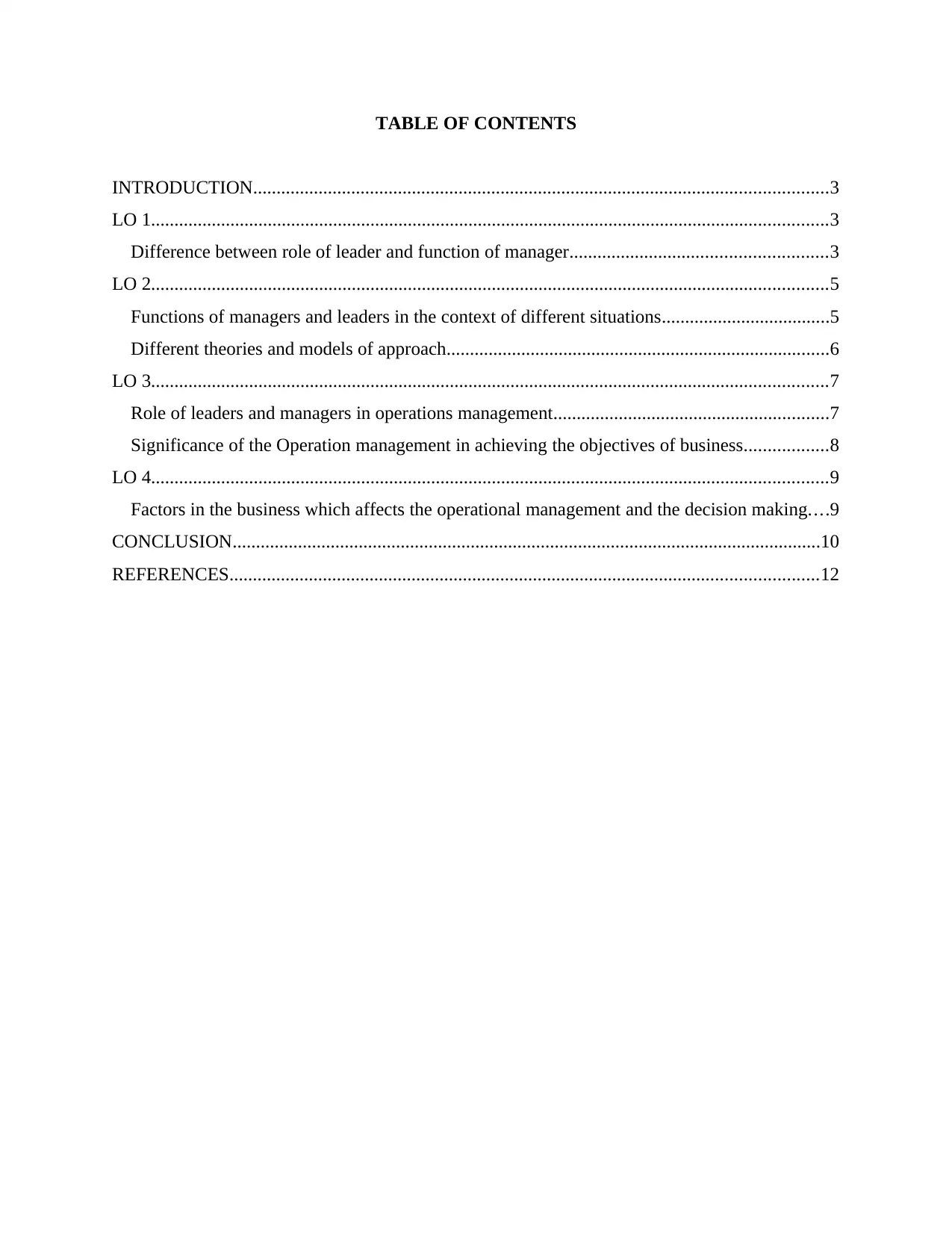
TABLE OF CONTENTS
INTRODUCTION...........................................................................................................................3
LO 1.................................................................................................................................................3
Difference between role of leader and function of manager.......................................................3
LO 2.................................................................................................................................................5
Functions of managers and leaders in the context of different situations....................................5
Different theories and models of approach..................................................................................6
LO 3.................................................................................................................................................7
Role of leaders and managers in operations management...........................................................7
Significance of the Operation management in achieving the objectives of business..................8
LO 4.................................................................................................................................................9
Factors in the business which affects the operational management and the decision making....9
CONCLUSION..............................................................................................................................10
REFERENCES..............................................................................................................................12
INTRODUCTION...........................................................................................................................3
LO 1.................................................................................................................................................3
Difference between role of leader and function of manager.......................................................3
LO 2.................................................................................................................................................5
Functions of managers and leaders in the context of different situations....................................5
Different theories and models of approach..................................................................................6
LO 3.................................................................................................................................................7
Role of leaders and managers in operations management...........................................................7
Significance of the Operation management in achieving the objectives of business..................8
LO 4.................................................................................................................................................9
Factors in the business which affects the operational management and the decision making....9
CONCLUSION..............................................................................................................................10
REFERENCES..............................................................................................................................12
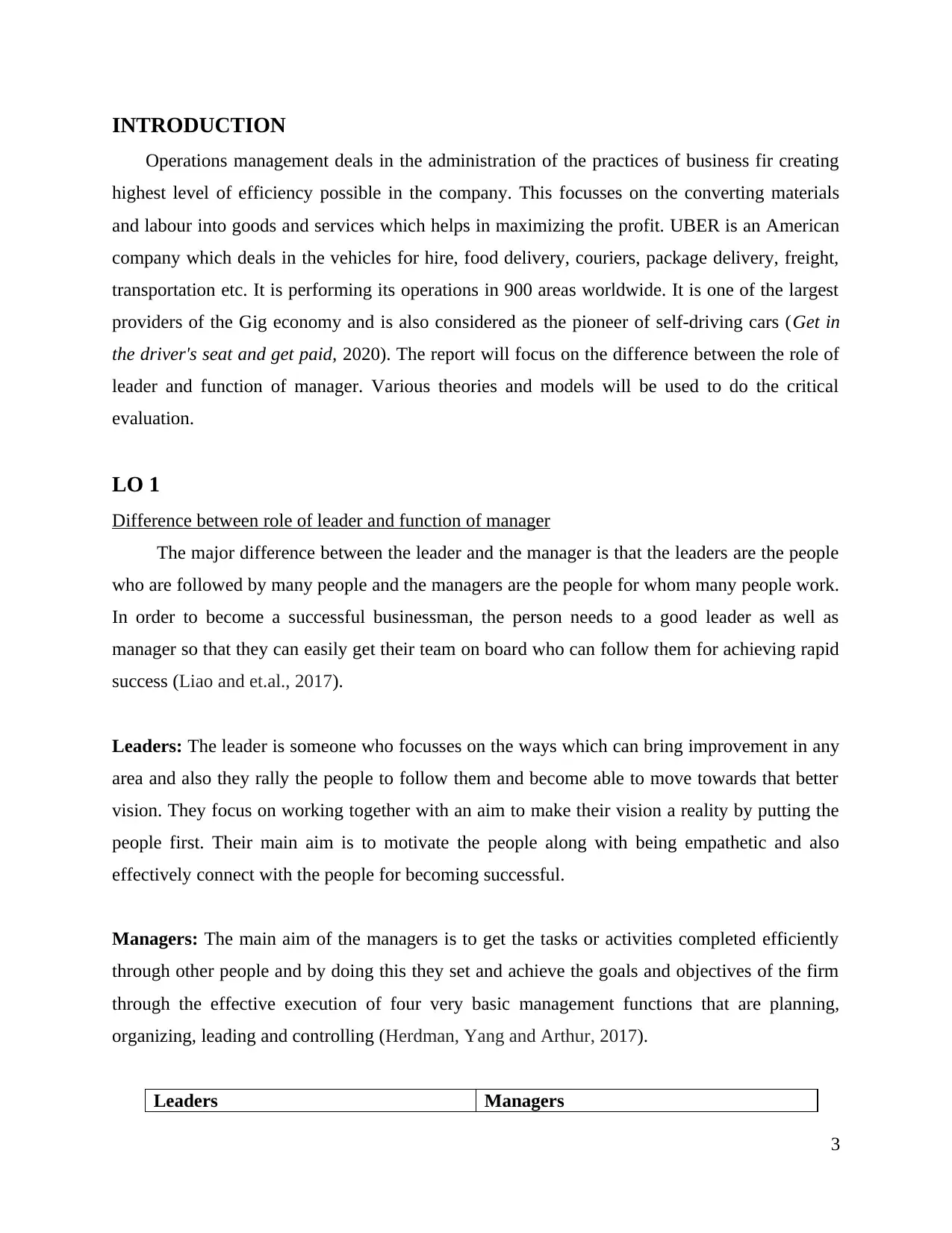
INTRODUCTION
Operations management deals in the administration of the practices of business fir creating
highest level of efficiency possible in the company. This focusses on the converting materials
and labour into goods and services which helps in maximizing the profit. UBER is an American
company which deals in the vehicles for hire, food delivery, couriers, package delivery, freight,
transportation etc. It is performing its operations in 900 areas worldwide. It is one of the largest
providers of the Gig economy and is also considered as the pioneer of self-driving cars (Get in
the driver's seat and get paid, 2020). The report will focus on the difference between the role of
leader and function of manager. Various theories and models will be used to do the critical
evaluation.
LO 1
Difference between role of leader and function of manager
The major difference between the leader and the manager is that the leaders are the people
who are followed by many people and the managers are the people for whom many people work.
In order to become a successful businessman, the person needs to a good leader as well as
manager so that they can easily get their team on board who can follow them for achieving rapid
success (Liao and et.al., 2017).
Leaders: The leader is someone who focusses on the ways which can bring improvement in any
area and also they rally the people to follow them and become able to move towards that better
vision. They focus on working together with an aim to make their vision a reality by putting the
people first. Their main aim is to motivate the people along with being empathetic and also
effectively connect with the people for becoming successful.
Managers: The main aim of the managers is to get the tasks or activities completed efficiently
through other people and by doing this they set and achieve the goals and objectives of the firm
through the effective execution of four very basic management functions that are planning,
organizing, leading and controlling (Herdman, Yang and Arthur, 2017).
Leaders Managers
3
Operations management deals in the administration of the practices of business fir creating
highest level of efficiency possible in the company. This focusses on the converting materials
and labour into goods and services which helps in maximizing the profit. UBER is an American
company which deals in the vehicles for hire, food delivery, couriers, package delivery, freight,
transportation etc. It is performing its operations in 900 areas worldwide. It is one of the largest
providers of the Gig economy and is also considered as the pioneer of self-driving cars (Get in
the driver's seat and get paid, 2020). The report will focus on the difference between the role of
leader and function of manager. Various theories and models will be used to do the critical
evaluation.
LO 1
Difference between role of leader and function of manager
The major difference between the leader and the manager is that the leaders are the people
who are followed by many people and the managers are the people for whom many people work.
In order to become a successful businessman, the person needs to a good leader as well as
manager so that they can easily get their team on board who can follow them for achieving rapid
success (Liao and et.al., 2017).
Leaders: The leader is someone who focusses on the ways which can bring improvement in any
area and also they rally the people to follow them and become able to move towards that better
vision. They focus on working together with an aim to make their vision a reality by putting the
people first. Their main aim is to motivate the people along with being empathetic and also
effectively connect with the people for becoming successful.
Managers: The main aim of the managers is to get the tasks or activities completed efficiently
through other people and by doing this they set and achieve the goals and objectives of the firm
through the effective execution of four very basic management functions that are planning,
organizing, leading and controlling (Herdman, Yang and Arthur, 2017).
Leaders Managers
3
⊘ This is a preview!⊘
Do you want full access?
Subscribe today to unlock all pages.

Trusted by 1+ million students worldwide
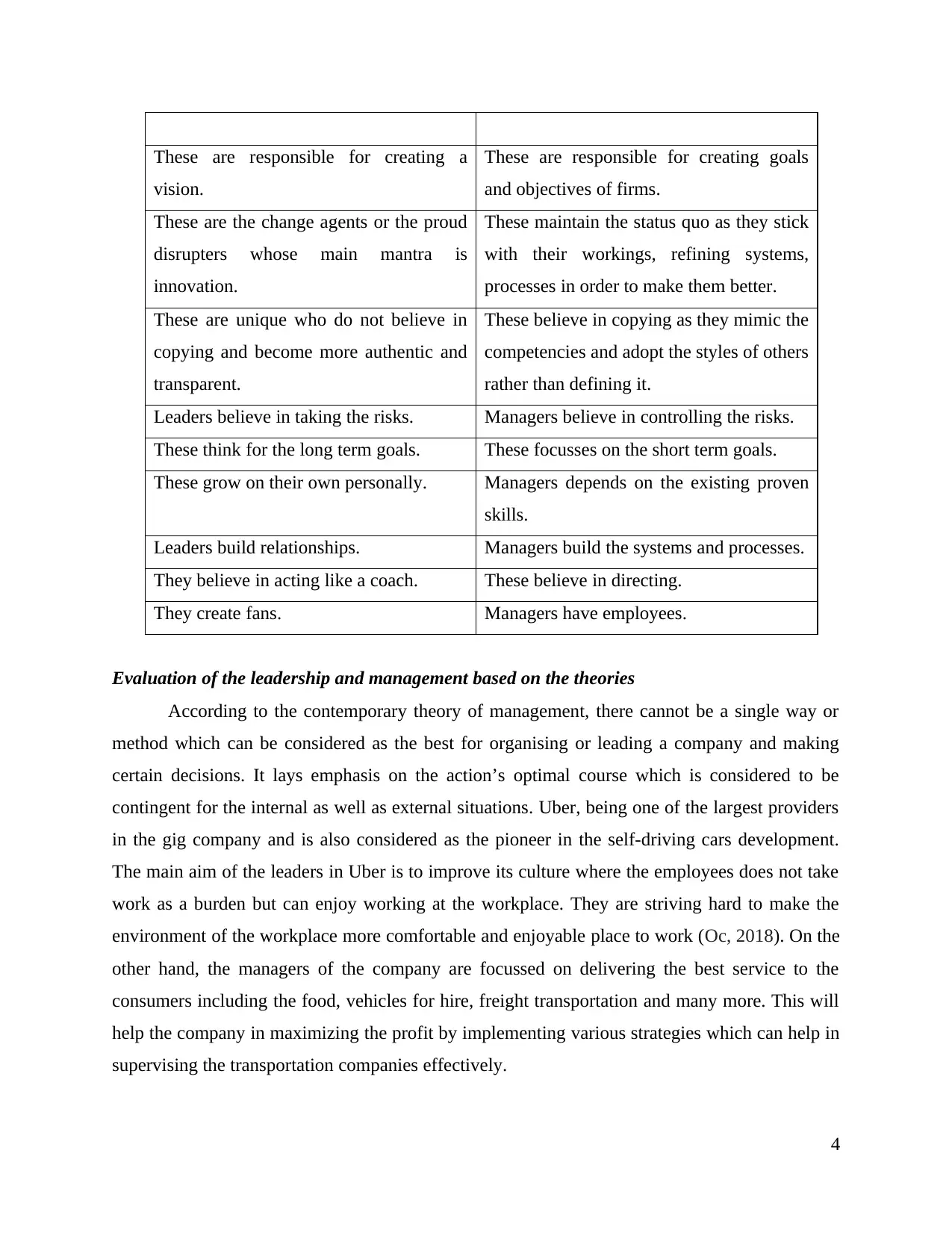
These are responsible for creating a
vision.
These are responsible for creating goals
and objectives of firms.
These are the change agents or the proud
disrupters whose main mantra is
innovation.
These maintain the status quo as they stick
with their workings, refining systems,
processes in order to make them better.
These are unique who do not believe in
copying and become more authentic and
transparent.
These believe in copying as they mimic the
competencies and adopt the styles of others
rather than defining it.
Leaders believe in taking the risks. Managers believe in controlling the risks.
These think for the long term goals. These focusses on the short term goals.
These grow on their own personally. Managers depends on the existing proven
skills.
Leaders build relationships. Managers build the systems and processes.
They believe in acting like a coach. These believe in directing.
They create fans. Managers have employees.
Evaluation of the leadership and management based on the theories
According to the contemporary theory of management, there cannot be a single way or
method which can be considered as the best for organising or leading a company and making
certain decisions. It lays emphasis on the action’s optimal course which is considered to be
contingent for the internal as well as external situations. Uber, being one of the largest providers
in the gig company and is also considered as the pioneer in the self-driving cars development.
The main aim of the leaders in Uber is to improve its culture where the employees does not take
work as a burden but can enjoy working at the workplace. They are striving hard to make the
environment of the workplace more comfortable and enjoyable place to work (Oc, 2018). On the
other hand, the managers of the company are focussed on delivering the best service to the
consumers including the food, vehicles for hire, freight transportation and many more. This will
help the company in maximizing the profit by implementing various strategies which can help in
supervising the transportation companies effectively.
4
vision.
These are responsible for creating goals
and objectives of firms.
These are the change agents or the proud
disrupters whose main mantra is
innovation.
These maintain the status quo as they stick
with their workings, refining systems,
processes in order to make them better.
These are unique who do not believe in
copying and become more authentic and
transparent.
These believe in copying as they mimic the
competencies and adopt the styles of others
rather than defining it.
Leaders believe in taking the risks. Managers believe in controlling the risks.
These think for the long term goals. These focusses on the short term goals.
These grow on their own personally. Managers depends on the existing proven
skills.
Leaders build relationships. Managers build the systems and processes.
They believe in acting like a coach. These believe in directing.
They create fans. Managers have employees.
Evaluation of the leadership and management based on the theories
According to the contemporary theory of management, there cannot be a single way or
method which can be considered as the best for organising or leading a company and making
certain decisions. It lays emphasis on the action’s optimal course which is considered to be
contingent for the internal as well as external situations. Uber, being one of the largest providers
in the gig company and is also considered as the pioneer in the self-driving cars development.
The main aim of the leaders in Uber is to improve its culture where the employees does not take
work as a burden but can enjoy working at the workplace. They are striving hard to make the
environment of the workplace more comfortable and enjoyable place to work (Oc, 2018). On the
other hand, the managers of the company are focussed on delivering the best service to the
consumers including the food, vehicles for hire, freight transportation and many more. This will
help the company in maximizing the profit by implementing various strategies which can help in
supervising the transportation companies effectively.
4
Paraphrase This Document
Need a fresh take? Get an instant paraphrase of this document with our AI Paraphraser
As per the classical management theory, the Uber workers also have some physical as well as
economic needs which must be fulfilled but that does not count in the job satisfaction and the
social needs. So, here the main responsibility of the leaders is to take the centralized decisions by
taking care of the needs of the employees so that they can remain motivated. On the other hand,
the managers need to supervise the employees to get the work done efficiently so that
productivity can be enhanced and their problems can be solved (Jacobsen and Staniok, 2020).
Under the behavioural theory of leadership, the leader of Uber has to develop some policies of
internal behaviour which can be followed by the rest of the employees and also the behaviour of
the leaders impacts all the operations directly. Managers have the responsibility to implement the
code of conduct including the safety and health, diversity, punctuality etc. Both works for
minimizing the risks and controlling the situations.
LO 2
Functions of managers and leaders in the context of different situations
Uber gives the majority of the credit of success to its managers and leaders as they help
in guiding which makes it one of the successful companies. Though, both the managers and the
leaders strives hard to achieve organisational success, satisfaction of the customers and also
achieving the goals and objective of the customers. But, they both have different ways. The
managers of Uber focus on developing the business strategies and the organisation’s future plans
whereas the leaders focus on implementing those plans according to the design (Asrar-ul-Haq
and Anwar, 2018). In different situations, the leaders and the managers play their roles in a
unique way which leads to the progress of the organisations like Uber:
Situation 1: The top management of Uber decides to launch a new product
In this case, the role of a leader would be focussed on developing the strategic policies
and the action plan by considering both the macro and micro environment of business. As in
order to launch a new product, it is must for the company to analyse the fluctuating demands of
the customers and the trends of the market. The leaders will have to decide the quality of the
products and services along with coordinating the processes and the operations like logistics,
sourcing, supply chain, finance, marketing, distribution and inspire the employees by guiding
and seek the other functional sectors. On the other hand, the function of the manager here is to
plan and organize the activities along with directing the employees, training & coaching them
5
economic needs which must be fulfilled but that does not count in the job satisfaction and the
social needs. So, here the main responsibility of the leaders is to take the centralized decisions by
taking care of the needs of the employees so that they can remain motivated. On the other hand,
the managers need to supervise the employees to get the work done efficiently so that
productivity can be enhanced and their problems can be solved (Jacobsen and Staniok, 2020).
Under the behavioural theory of leadership, the leader of Uber has to develop some policies of
internal behaviour which can be followed by the rest of the employees and also the behaviour of
the leaders impacts all the operations directly. Managers have the responsibility to implement the
code of conduct including the safety and health, diversity, punctuality etc. Both works for
minimizing the risks and controlling the situations.
LO 2
Functions of managers and leaders in the context of different situations
Uber gives the majority of the credit of success to its managers and leaders as they help
in guiding which makes it one of the successful companies. Though, both the managers and the
leaders strives hard to achieve organisational success, satisfaction of the customers and also
achieving the goals and objective of the customers. But, they both have different ways. The
managers of Uber focus on developing the business strategies and the organisation’s future plans
whereas the leaders focus on implementing those plans according to the design (Asrar-ul-Haq
and Anwar, 2018). In different situations, the leaders and the managers play their roles in a
unique way which leads to the progress of the organisations like Uber:
Situation 1: The top management of Uber decides to launch a new product
In this case, the role of a leader would be focussed on developing the strategic policies
and the action plan by considering both the macro and micro environment of business. As in
order to launch a new product, it is must for the company to analyse the fluctuating demands of
the customers and the trends of the market. The leaders will have to decide the quality of the
products and services along with coordinating the processes and the operations like logistics,
sourcing, supply chain, finance, marketing, distribution and inspire the employees by guiding
and seek the other functional sectors. On the other hand, the function of the manager here is to
plan and organize the activities along with directing the employees, training & coaching them
5
and also controlling the sales assistant so that the customer’s ease can be ensured. Here, the
manager will be expected to act as a guide and controller for all the activities which are related to
the new product which is going to be launched (Bratton, 2020). For example, Uber can facilitate
its drivers and the customers with new strategies and benefits. Though, it is has expanded its
services by using digital technology, it can use more advanced technologies so that it can be
convenient and easy for the customers to use its services. It also can become easy for the drivers
to perform their tasks. The managers can develop strategies in this case and the leaders can
motivate the employees to implement those strategies for achieving the goals.
Situation 2: Uber aims to bring the change by reducing its cost and managing this change
In this case, the role of the leader is to analyse and examine the activities of Uber so that
it becomes easy to fix the high cost operations for the cost reduction. The leader in the Uber
needs to develop partnership with the low cost suppliers, reduces the production or the cost of
distribution which helps in laying the vision for the company which can also help in achieving
the objectives. The store manager in the Uber would reduce the sales and the cost of service and
also they manage the remuneration and salaries of the employees so that they do not becomes
demotivated and dissatisfied. The role of the manager here is to examine the performance and
identify the lowest productive employees and takes the responsibility of eliminating those from
the job. Uber can reduce the fair charges for transportation so that all the classes of people can
afford the services and can be facilitated by the reduced cost services. The managers can decide
the fair charges and ensures that they are being followed by the drivers and the leaders can
motivate the drivers to take the same charges which are decided by the company.
Different theories and models of approach
The contingency theory refers to the fact that the leadership is not alone but it depends on
various situational factors including the nature of work, composition of group or the personality
of the leader and also states that no leadership is considered to be the best. In some of the sectors
of Uber, the few managers and leaders started following the authoritative leadership style
because most of the employees work productively. The UberEats which is responsible for the
food delivery specialises in the items of food having a high margin segment and the objectives of
the company are achieved timely because the employees work under the established orders and
6
manager will be expected to act as a guide and controller for all the activities which are related to
the new product which is going to be launched (Bratton, 2020). For example, Uber can facilitate
its drivers and the customers with new strategies and benefits. Though, it is has expanded its
services by using digital technology, it can use more advanced technologies so that it can be
convenient and easy for the customers to use its services. It also can become easy for the drivers
to perform their tasks. The managers can develop strategies in this case and the leaders can
motivate the employees to implement those strategies for achieving the goals.
Situation 2: Uber aims to bring the change by reducing its cost and managing this change
In this case, the role of the leader is to analyse and examine the activities of Uber so that
it becomes easy to fix the high cost operations for the cost reduction. The leader in the Uber
needs to develop partnership with the low cost suppliers, reduces the production or the cost of
distribution which helps in laying the vision for the company which can also help in achieving
the objectives. The store manager in the Uber would reduce the sales and the cost of service and
also they manage the remuneration and salaries of the employees so that they do not becomes
demotivated and dissatisfied. The role of the manager here is to examine the performance and
identify the lowest productive employees and takes the responsibility of eliminating those from
the job. Uber can reduce the fair charges for transportation so that all the classes of people can
afford the services and can be facilitated by the reduced cost services. The managers can decide
the fair charges and ensures that they are being followed by the drivers and the leaders can
motivate the drivers to take the same charges which are decided by the company.
Different theories and models of approach
The contingency theory refers to the fact that the leadership is not alone but it depends on
various situational factors including the nature of work, composition of group or the personality
of the leader and also states that no leadership is considered to be the best. In some of the sectors
of Uber, the few managers and leaders started following the authoritative leadership style
because most of the employees work productively. The UberEats which is responsible for the
food delivery specialises in the items of food having a high margin segment and the objectives of
the company are achieved timely because the employees work under the established orders and
6
⊘ This is a preview!⊘
Do you want full access?
Subscribe today to unlock all pages.
Trusted by 1+ million students worldwide
guidelines (Thompson and Glasø, 2018). Some of its sectors also follows a democratic
leadership style which helps in increasing the customer interaction and also gives the flexibility
to the employees so that they can deal with them. The democratic leadership style can be
followed by the leaders while leading the drivers by asking them about their experiences while
providing the services so that they can bring much improvement in the policies and strategies.
The fundamental principle of system leadership theory includes the policies of the
company, its formal and informal structure, procedures for the functions of leadership. The
mechanism which is used here starts with the conducting followed by communicating the
decisions and ends up to execution. It also makes use of skills and capacities that can be used by
the company as well as the individuals for catalysing, supporting and enabling the processes at
the change in the system level. Along with this, it also performs the function of encompassing
the collaborative leadership by building the coalition and the insights for mobilising action into
the systems and also bringing innovation in the decentralized networks (Sousa and Rocha, 2019).
Uber uses this approach or the method in order to select the employees and provide them good
trainings which mainly includes the sales assistant and the credit managers. This leadership has
proved much effective for the overall operations of the Uber.
There is another theory which is the situational theory of leadership states that there are
some leaders who tries to adapt various styles of leadership according to the changing situations
and also which helps in employees’ development level or the team members. There are basically
four leadership styles under this i.e., telling, participating, selling and delegating. The style of
telling is done in order to direct the employees about the tasks and also ways in which it can be
performed (Ayman and Lauritsen, 2018). Selling style is mainly implemented by the leaders as
thy sell their unique ideas to the employees and wants that the employees buy the idea from the
leaders. When the leader wishes to involve the employees in the decision-making process of the
company as they can come up with new and fresh ideas, the participating approach is used.
Uber is also trying to inculcate the new leadership style of the transformational leadership
as by following this, there can be positive and valuable change for the team members created by
the leaders which will help in developing the into leaders. When the discussion is to foster the
talented employees and make them the leaders and the team handlers then the successive
planning approaches of Uber is much extensive. By applying this, the drivers and the employees
7
leadership style which helps in increasing the customer interaction and also gives the flexibility
to the employees so that they can deal with them. The democratic leadership style can be
followed by the leaders while leading the drivers by asking them about their experiences while
providing the services so that they can bring much improvement in the policies and strategies.
The fundamental principle of system leadership theory includes the policies of the
company, its formal and informal structure, procedures for the functions of leadership. The
mechanism which is used here starts with the conducting followed by communicating the
decisions and ends up to execution. It also makes use of skills and capacities that can be used by
the company as well as the individuals for catalysing, supporting and enabling the processes at
the change in the system level. Along with this, it also performs the function of encompassing
the collaborative leadership by building the coalition and the insights for mobilising action into
the systems and also bringing innovation in the decentralized networks (Sousa and Rocha, 2019).
Uber uses this approach or the method in order to select the employees and provide them good
trainings which mainly includes the sales assistant and the credit managers. This leadership has
proved much effective for the overall operations of the Uber.
There is another theory which is the situational theory of leadership states that there are
some leaders who tries to adapt various styles of leadership according to the changing situations
and also which helps in employees’ development level or the team members. There are basically
four leadership styles under this i.e., telling, participating, selling and delegating. The style of
telling is done in order to direct the employees about the tasks and also ways in which it can be
performed (Ayman and Lauritsen, 2018). Selling style is mainly implemented by the leaders as
thy sell their unique ideas to the employees and wants that the employees buy the idea from the
leaders. When the leader wishes to involve the employees in the decision-making process of the
company as they can come up with new and fresh ideas, the participating approach is used.
Uber is also trying to inculcate the new leadership style of the transformational leadership
as by following this, there can be positive and valuable change for the team members created by
the leaders which will help in developing the into leaders. When the discussion is to foster the
talented employees and make them the leaders and the team handlers then the successive
planning approaches of Uber is much extensive. By applying this, the drivers and the employees
7
Paraphrase This Document
Need a fresh take? Get an instant paraphrase of this document with our AI Paraphraser
can be facilitated as their opinions will be valued in bringing change in the organisations because
they are the one who can help in implementing the change.
LO 3
Role of leaders and managers in operations management
The leaders and managers in the companies play a major role in managing the operations. Uber
also identifies a major role of leaders and managers in the management of its various operations
which can be described as follows:
Six-Sigma: This process mainly lays emphasis on the efforts of the team in order to complete the
task and managing the performance throughout. Here, the managers of Uber develop a plan so
that they can make use of the resources globally (Legood, Thomas and Sacramento, 2016). The
leaders make use of this strategy for enhancing the team bonding and also must ensure that the
employees are performing well.
Total Quality Management (TQM): In order to ensure the efficiency of the process of
production, most of the multinationals use the TQM. The main aim of this approach is to bring
improvement in the quality of product and service so that they can meet up the fluctuating
demands of the target customers. The investment done in this process is comparatively very low.
Just in time inventory: Here, the role of the managers and leaders is the same to motivate the
employees so that they can give their best performance which helps in providing product and
services of better quality which increases the customer base and meeting up the demands. The
leaders and managers of Uber must insure that the company is able to provide quality service to
the customers in terms of transportations and the food products.
Kaizen (Process of continuous improvement): This theory means change for good which
mainly refers to the continuous improvement process. Uber applies this theory for enhancing the
efficiency of the production. The managers here strive hard for developing the effectiveness and
efficiency in order to improve the product (Salehzadeh, 2017). The employees are facilitated by
the leaders of Uber as they provide the employees the opportunity to work in a flexible
workplace where the motivation and encouraging the product which helps in producing the better
product for fulfilling the satisfaction of the customers. It must be ensured that good changes are
8
they are the one who can help in implementing the change.
LO 3
Role of leaders and managers in operations management
The leaders and managers in the companies play a major role in managing the operations. Uber
also identifies a major role of leaders and managers in the management of its various operations
which can be described as follows:
Six-Sigma: This process mainly lays emphasis on the efforts of the team in order to complete the
task and managing the performance throughout. Here, the managers of Uber develop a plan so
that they can make use of the resources globally (Legood, Thomas and Sacramento, 2016). The
leaders make use of this strategy for enhancing the team bonding and also must ensure that the
employees are performing well.
Total Quality Management (TQM): In order to ensure the efficiency of the process of
production, most of the multinationals use the TQM. The main aim of this approach is to bring
improvement in the quality of product and service so that they can meet up the fluctuating
demands of the target customers. The investment done in this process is comparatively very low.
Just in time inventory: Here, the role of the managers and leaders is the same to motivate the
employees so that they can give their best performance which helps in providing product and
services of better quality which increases the customer base and meeting up the demands. The
leaders and managers of Uber must insure that the company is able to provide quality service to
the customers in terms of transportations and the food products.
Kaizen (Process of continuous improvement): This theory means change for good which
mainly refers to the continuous improvement process. Uber applies this theory for enhancing the
efficiency of the production. The managers here strive hard for developing the effectiveness and
efficiency in order to improve the product (Salehzadeh, 2017). The employees are facilitated by
the leaders of Uber as they provide the employees the opportunity to work in a flexible
workplace where the motivation and encouraging the product which helps in producing the better
product for fulfilling the satisfaction of the customers. It must be ensured that good changes are
8
applied in the company so that the products and services can be improved to satisfy the
customers.
Significance of the Operation management in achieving the objectives of business
The operation management plays a major role in the business to manage the various
operations which are performed. The value and importance of the operational management in
order to achieve the objectives of the Uber are as follows:
Efficiency of production: This became the main area where the cost minimization can be done.
Uber must make the proper cost calculation which will help in avoiding the high costing but
efficiency of the product needs to be ensured.
Maximization of profit: This becomes the main goal of the companies and this can only be
achieved by increasing the customer base by doing maximum sales and managing the operation
management. Uber can do this by attracting the customers through attractive offers and the
promotions.
Customers satisfaction: In order to make a business successful, its customers must be satisfied
and happy. This clearly examine that the key of success lies in the satisfaction of the customers.
In this, company needs to provide the customers the products and services with the demand.
Capacity management: There must be proper management of the capital investment which is
measured by the operation management. It highlights on the use of capital and resources in the
various working processes. This also ensures that the unused capital is not wasted and also safety
can be expected in the future.
Improvement in the quality of product: Uber pays much attention to its product quality and
the maintenance. The companies are trying to improve the quality of the product as well as it can
make the products better and more preferable to the customers, which is the main aim of the
transportation companies.
9
customers.
Significance of the Operation management in achieving the objectives of business
The operation management plays a major role in the business to manage the various
operations which are performed. The value and importance of the operational management in
order to achieve the objectives of the Uber are as follows:
Efficiency of production: This became the main area where the cost minimization can be done.
Uber must make the proper cost calculation which will help in avoiding the high costing but
efficiency of the product needs to be ensured.
Maximization of profit: This becomes the main goal of the companies and this can only be
achieved by increasing the customer base by doing maximum sales and managing the operation
management. Uber can do this by attracting the customers through attractive offers and the
promotions.
Customers satisfaction: In order to make a business successful, its customers must be satisfied
and happy. This clearly examine that the key of success lies in the satisfaction of the customers.
In this, company needs to provide the customers the products and services with the demand.
Capacity management: There must be proper management of the capital investment which is
measured by the operation management. It highlights on the use of capital and resources in the
various working processes. This also ensures that the unused capital is not wasted and also safety
can be expected in the future.
Improvement in the quality of product: Uber pays much attention to its product quality and
the maintenance. The companies are trying to improve the quality of the product as well as it can
make the products better and more preferable to the customers, which is the main aim of the
transportation companies.
9
⊘ This is a preview!⊘
Do you want full access?
Subscribe today to unlock all pages.
Trusted by 1+ million students worldwide
Management of inventory: The management of operations ensure that there must be best use of
the inventories. Uber must use the TQM inventory strategy which helps in saving the resources
and well as money which leads to the effective production.
LO 4
Factors in the business which affects the operational management and the decision making
These some of the factors are as follows:
Global competition: This is the major factor which is affecting the operation management and
the decision making of Uber (Turner and Baker, 2018). It has many broader varieties of products
which attracts large number of customers and also this helped in gaining the competitive
advantage among its competitors. This competition also impacts the customer base of Uber.
Security of material and capital: In the operation management, the two most important things
are the raw materials and the capital. There must be systematic and close observation so that they
can be secured and also there can be proper utilization of the materials.
Social responsibilities: Along with bringing the innovation, the companies must adhere to
various social policies and must perform some activities of the social program to the local
community which can help in maintaining good relationships with the customers and the society.
These social issues can help in ensuring that these are able to improve or damage the conditions
of business.
Expanding technology advancement: In order to make the operations easier and convenient for
the employees, then the technology is must. This technology advancement helps in expanding
the target new market, customer base etc., The companies like Uber need to make the decision of
technological advancement and must make the best use of it.
Business ethical: Uber tries to follow each and every ethics of the primary business by
maintaining the code of ethics so adverse condition cannot hamper the policies of business.
10
the inventories. Uber must use the TQM inventory strategy which helps in saving the resources
and well as money which leads to the effective production.
LO 4
Factors in the business which affects the operational management and the decision making
These some of the factors are as follows:
Global competition: This is the major factor which is affecting the operation management and
the decision making of Uber (Turner and Baker, 2018). It has many broader varieties of products
which attracts large number of customers and also this helped in gaining the competitive
advantage among its competitors. This competition also impacts the customer base of Uber.
Security of material and capital: In the operation management, the two most important things
are the raw materials and the capital. There must be systematic and close observation so that they
can be secured and also there can be proper utilization of the materials.
Social responsibilities: Along with bringing the innovation, the companies must adhere to
various social policies and must perform some activities of the social program to the local
community which can help in maintaining good relationships with the customers and the society.
These social issues can help in ensuring that these are able to improve or damage the conditions
of business.
Expanding technology advancement: In order to make the operations easier and convenient for
the employees, then the technology is must. This technology advancement helps in expanding
the target new market, customer base etc., The companies like Uber need to make the decision of
technological advancement and must make the best use of it.
Business ethical: Uber tries to follow each and every ethics of the primary business by
maintaining the code of ethics so adverse condition cannot hamper the policies of business.
10
Paraphrase This Document
Need a fresh take? Get an instant paraphrase of this document with our AI Paraphraser
Legal considerations: Uber must need to be concerned about the legal rules and regulations in
the various areas like tax, import-export, tariffs, vat and many other governmental policies
(Singh, 2020). Any disobedience can hinder the progress of the company by hampering the
business condition.
Social responsibilities: It is must for each and every company for performing some social
welfare which can benefit the local community and maintaining good relationship with the
society. Uber can adapt the policies regarding the Corporate social responsibilities as it can
provide free service to the pregnant women or disabled or some very poor people. this can affect
the operations as well as the decision making of leaders and managers. These must be kept in
mind as these can improve or damage the business condition of the company.
Sustainability practices: As Uber provides the majority of its services in transportation
industry, it must ensure that the vehicles do not emit much harmful gases which can destroy the
environment. All the environment-friendly policies must be adapted by the company. Leaders
and managers must make the decisions to regulate the emission of harmful gases emitted from
the vehicles used for providing public services of transportation.
Therefore, the above mentioned factors affect the decision making by the leaders and the
managers and also the operational management.
CONCLUSION
The above report focussed on the Uber company and the role of managers and leaders in it.
It can be concluded that both the leadership and management of Uber has contributed a lot to the
success of the company. Managers are the main players or the key employees who manage the
company in the direction of the pre-determined objectives. Leaders responsibility is to inspire the
employees and set the business objectives, goals and policies and helps the company to lead the
way to productivity. Leadership and management must go in hand instead of being two different
aspects. The difference between the role of leader and the function of manager was discussed
using various theories and models like situational, contingency etc. This was followed by
mentioning the role of leader and function of manager in different situational contexts like
launching of new product, change management etc. Various key approaches to the operation’s
management along with the role of leader and manager was highlighted. The report also focussed
11
the various areas like tax, import-export, tariffs, vat and many other governmental policies
(Singh, 2020). Any disobedience can hinder the progress of the company by hampering the
business condition.
Social responsibilities: It is must for each and every company for performing some social
welfare which can benefit the local community and maintaining good relationship with the
society. Uber can adapt the policies regarding the Corporate social responsibilities as it can
provide free service to the pregnant women or disabled or some very poor people. this can affect
the operations as well as the decision making of leaders and managers. These must be kept in
mind as these can improve or damage the business condition of the company.
Sustainability practices: As Uber provides the majority of its services in transportation
industry, it must ensure that the vehicles do not emit much harmful gases which can destroy the
environment. All the environment-friendly policies must be adapted by the company. Leaders
and managers must make the decisions to regulate the emission of harmful gases emitted from
the vehicles used for providing public services of transportation.
Therefore, the above mentioned factors affect the decision making by the leaders and the
managers and also the operational management.
CONCLUSION
The above report focussed on the Uber company and the role of managers and leaders in it.
It can be concluded that both the leadership and management of Uber has contributed a lot to the
success of the company. Managers are the main players or the key employees who manage the
company in the direction of the pre-determined objectives. Leaders responsibility is to inspire the
employees and set the business objectives, goals and policies and helps the company to lead the
way to productivity. Leadership and management must go in hand instead of being two different
aspects. The difference between the role of leader and the function of manager was discussed
using various theories and models like situational, contingency etc. This was followed by
mentioning the role of leader and function of manager in different situational contexts like
launching of new product, change management etc. Various key approaches to the operation’s
management along with the role of leader and manager was highlighted. The report also focussed
11
on the importance of operations management in achieving the business objectives. Lastly various
factors were discussed that impacts the operational management and the decision making by
leaders and managers.
12
factors were discussed that impacts the operational management and the decision making by
leaders and managers.
12
⊘ This is a preview!⊘
Do you want full access?
Subscribe today to unlock all pages.
Trusted by 1+ million students worldwide

1 out of 14


Related Documents


Your All-in-One AI-Powered Toolkit for Academic Success.
+13062052269
info@desklib.com
Available 24*7 on WhatsApp / Email
![[object Object]](/_next/static/media/star-bottom.7253800d.svg)
Unlock your academic potential
Copyright © 2020–2026 A2Z Services. All Rights Reserved. Developed and managed by ZUCOL.