Uber Marketing Strategy: Analyzing Environment and Developing Plan

Verified

Added on  2023/06/15

|4
|559
|139
Report
AI Summary
This report provides a marketing analysis of Uber, focusing on its internal and external environmental factors, and recommends strategic improvements. The internal factors affecting Uber include less skilled workers and a potentially negative work environment, while external factors involve intense competition from companies like Ola and Lyft, as well as fluctuations in supply and demand due to economic and environmental changes. The report suggests that Uber needs to implement stronger marketing strategies to combat competition, provide training to employees to enhance their skills and customer service, and continue recent developments such as flexible shifts, improved fair systems, and ride-sharing schemes like Uber Pool and Uber X to maintain customer satisfaction and market presence. This analysis aims to provide a comprehensive understanding of Uber's current situation and offer actionable recommendations for a more robust marketing plan. Desklib provides similar solved assignments.
Document Page
Running head: MARKETING
Marketing
Name of the Student
Name of the University
Author note
tabler-icon-diamond-filled.svg

Paraphrase This Document

Need a fresh take? Get an instant paraphrase of this document with our AI Paraphraser
Document Page
1MARKETING
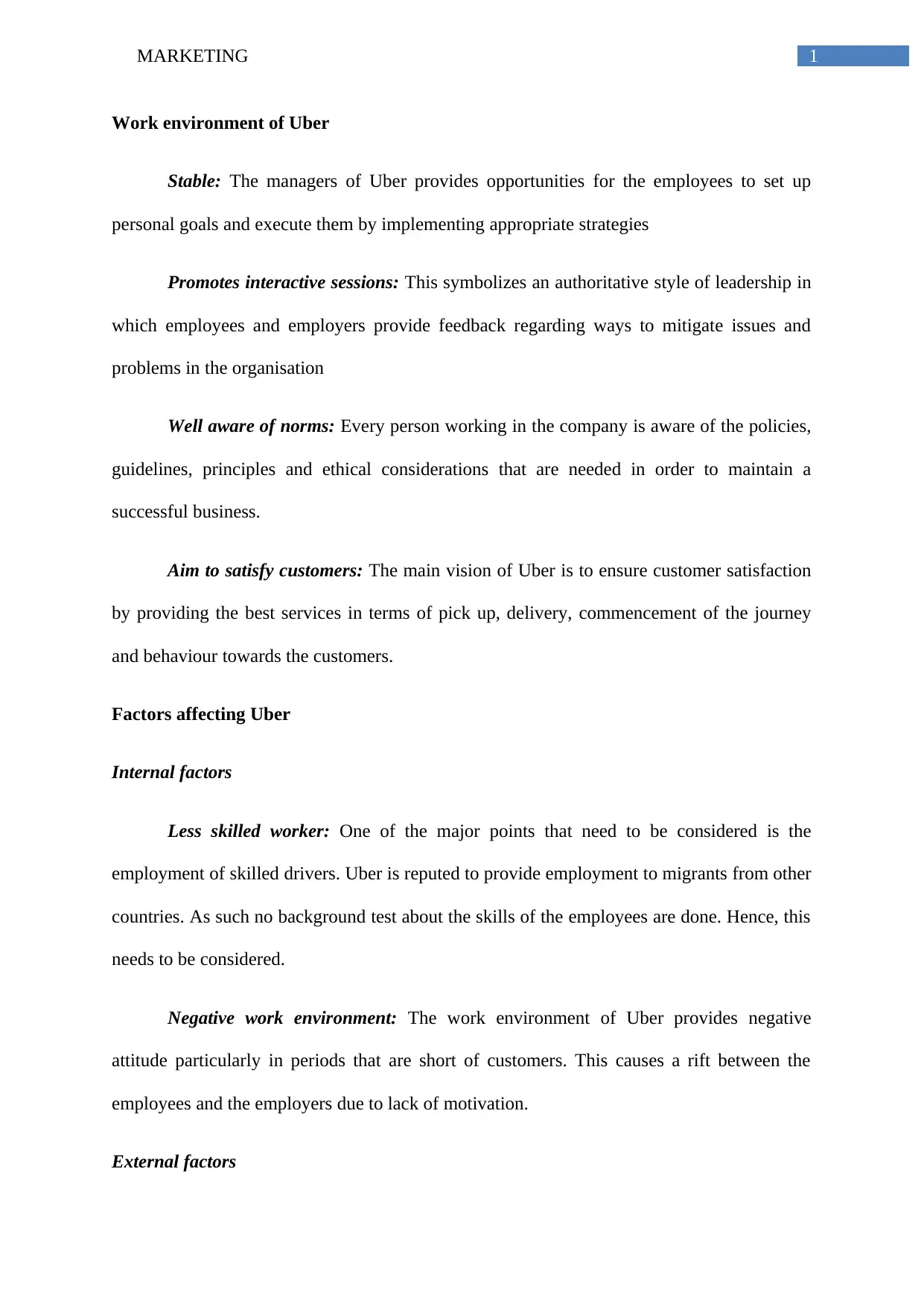
Work environment of Uber
Stable: The managers of Uber provides opportunities for the employees to set up
personal goals and execute them by implementing appropriate strategies
Promotes interactive sessions: This symbolizes an authoritative style of leadership in
which employees and employers provide feedback regarding ways to mitigate issues and
problems in the organisation
Well aware of norms: Every person working in the company is aware of the policies,
guidelines, principles and ethical considerations that are needed in order to maintain a
successful business.
Aim to satisfy customers: The main vision of Uber is to ensure customer satisfaction
by providing the best services in terms of pick up, delivery, commencement of the journey
and behaviour towards the customers.
Factors affecting Uber
Internal factors
Less skilled worker: One of the major points that need to be considered is the
employment of skilled drivers. Uber is reputed to provide employment to migrants from other
countries. As such no background test about the skills of the employees are done. Hence, this
needs to be considered.
Negative work environment: The work environment of Uber provides negative
attitude particularly in periods that are short of customers. This causes a rift between the
employees and the employers due to lack of motivation.
External factors
Document Page
2MARKETING
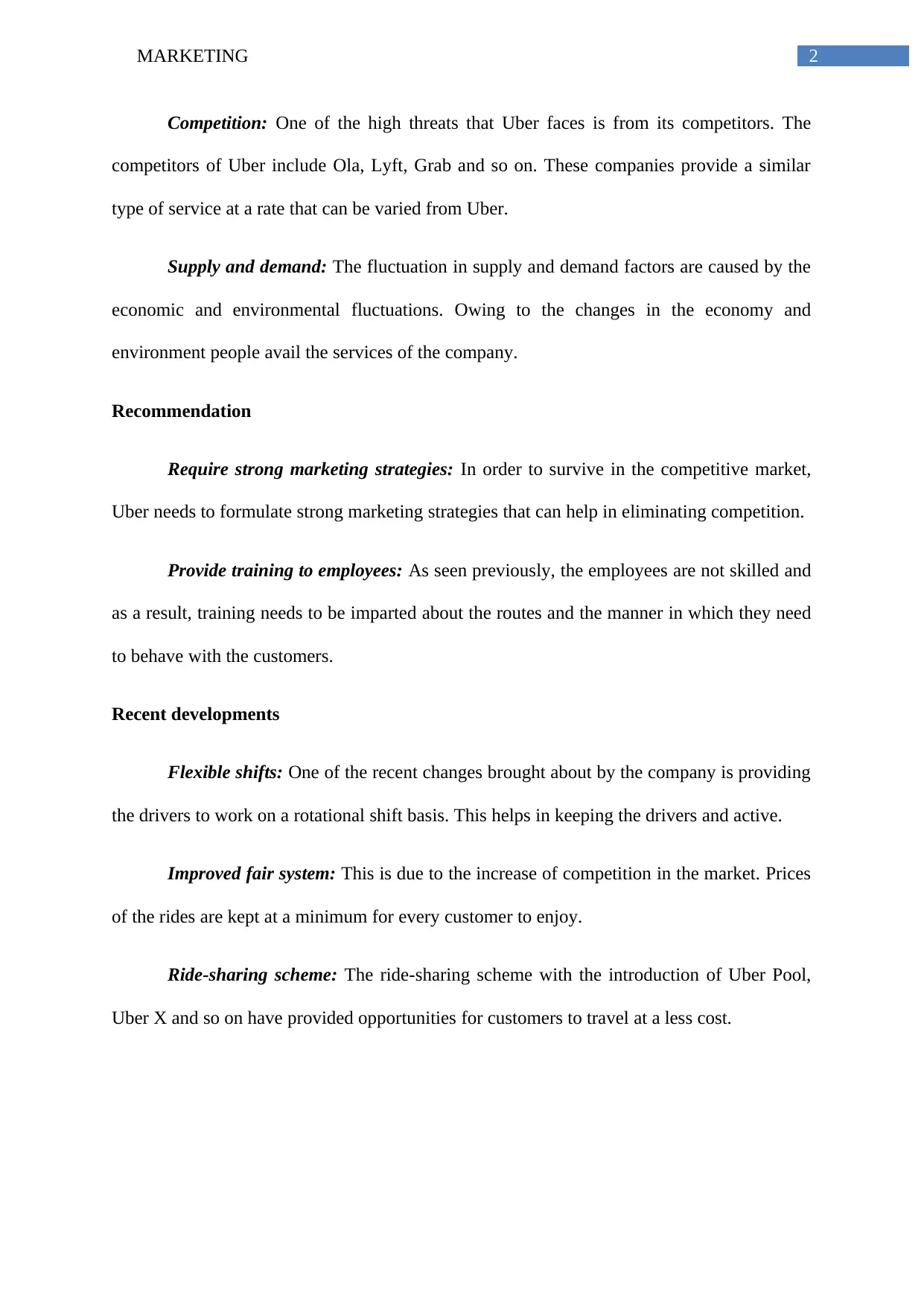
Competition: One of the high threats that Uber faces is from its competitors. The
competitors of Uber include Ola, Lyft, Grab and so on. These companies provide a similar
type of service at a rate that can be varied from Uber.
Supply and demand: The fluctuation in supply and demand factors are caused by the
economic and environmental fluctuations. Owing to the changes in the economy and
environment people avail the services of the company.
Recommendation
Require strong marketing strategies: In order to survive in the competitive market,
Uber needs to formulate strong marketing strategies that can help in eliminating competition.
Provide training to employees: As seen previously, the employees are not skilled and
as a result, training needs to be imparted about the routes and the manner in which they need
to behave with the customers.
Recent developments
Flexible shifts: One of the recent changes brought about by the company is providing
the drivers to work on a rotational shift basis. This helps in keeping the drivers and active.
Improved fair system: This is due to the increase of competition in the market. Prices
of the rides are kept at a minimum for every customer to enjoy.
Ride-sharing scheme: The ride-sharing scheme with the introduction of Uber Pool,
Uber X and so on have provided opportunities for customers to travel at a less cost.
Document Page
3MARKETING
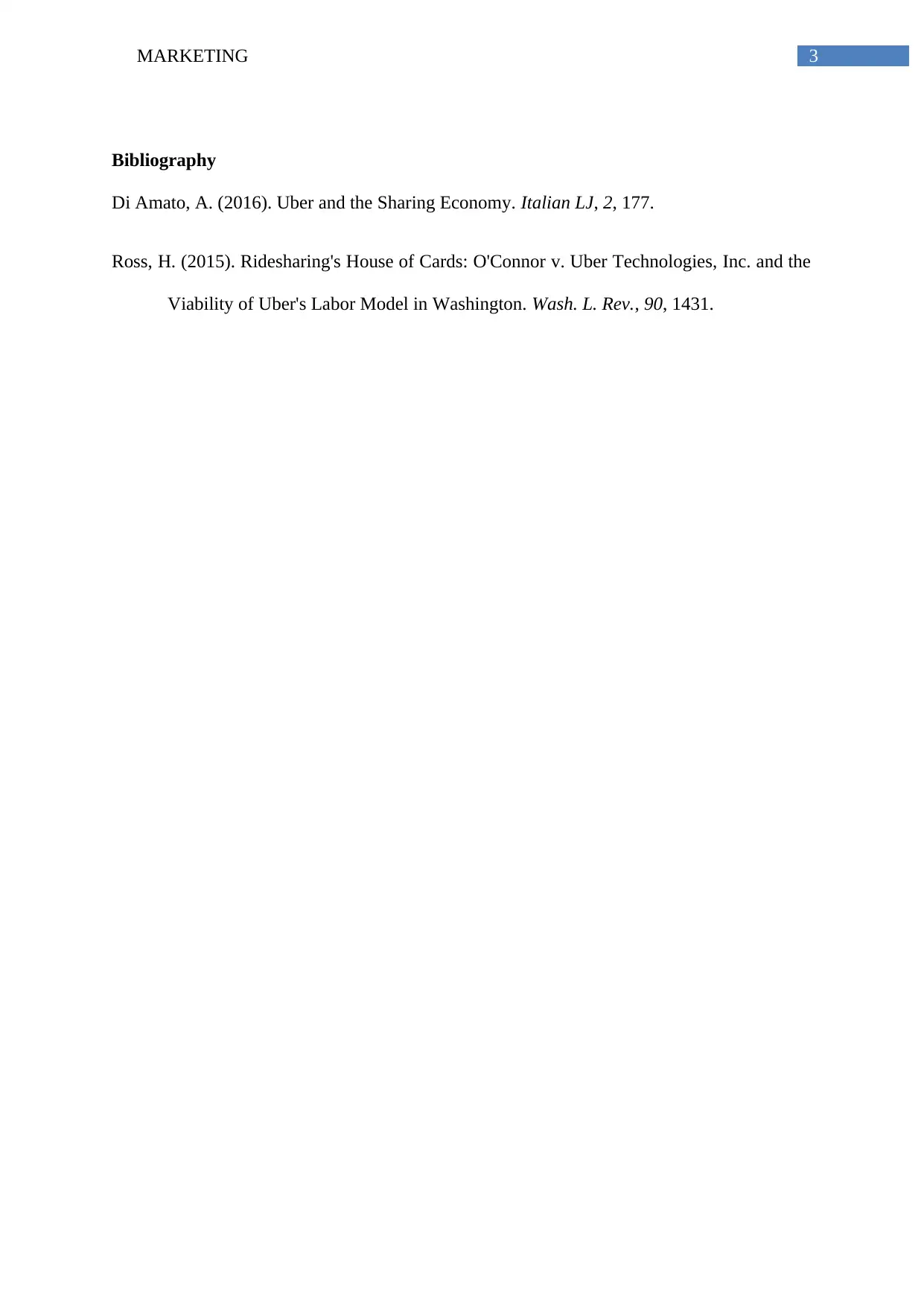
Bibliography
Di Amato, A. (2016). Uber and the Sharing Economy. Italian LJ, 2, 177.
Ross, H. (2015). Ridesharing's House of Cards: O'Connor v. Uber Technologies, Inc. and the
Viability of Uber's Labor Model in Washington. Wash. L. Rev., 90, 1431.
chevron_up_icon
1 out of 4
circle_padding
hide_on_mobile
zoom_out_icon
[object Object]