Strategic Management Analysis Report: Uber's Performance
VerifiedAdded on 2020/06/03
|15
|4175
|91
Report
AI Summary
This report provides a detailed strategic management analysis of Uber, a highly successful startup in the transportation industry. It begins with an executive summary and an introduction highlighting the importance of strategic planning for business success. The report examines Uber's business environment, including key success factors and the influence of micro and macro factors. It utilizes tools like PESTLE and Porter's Five Forces analyses to assess the competitive landscape and external elements affecting the company. The report further appraises Uber's organizational strategy using the business canvas model and value chain analysis to evaluate its internal activities, resources, and capabilities. Strategic issues are identified, particularly concerning competition and new market entrants, and strategic proposals are offered to overcome these challenges, including recommendations for innovation and adaptation to maintain a leading market position. The analysis emphasizes the need for effective strategic management to ensure Uber's continued growth and success in a dynamic and competitive market.
Strategic management

Paraphrase This Document
Need a fresh take? Get an instant paraphrase of this document with our AI Paraphraser
Executive summary
UBER is known as one the most successful start ups with a high growth in a short time
period. The report analyses various external and internal factors that are influencing the
performance of the company, it is determined that there are many competitors of UBER offering
similar services to customers. All the micro and macro factors affecting the business have to be
considered before planning any strategy. Managers have to implement appropriate theories and
models to analyze the same. There it is essential for the company to focus on developing an
effective strategic management. The assignment focus on strategic management within an
organisation, Effective strategic planning is mandatory for the success of every business. The
study will analyze. Uber company to identify the use of strategic management and its
importance. For this it is important for the managers to understand the prevailing business
environment. The current strategies are identified and evaluate to determine the changes required
in developing beneficial plans for the company.
UBER is known as one the most successful start ups with a high growth in a short time
period. The report analyses various external and internal factors that are influencing the
performance of the company, it is determined that there are many competitors of UBER offering
similar services to customers. All the micro and macro factors affecting the business have to be
considered before planning any strategy. Managers have to implement appropriate theories and
models to analyze the same. There it is essential for the company to focus on developing an
effective strategic management. The assignment focus on strategic management within an
organisation, Effective strategic planning is mandatory for the success of every business. The
study will analyze. Uber company to identify the use of strategic management and its
importance. For this it is important for the managers to understand the prevailing business
environment. The current strategies are identified and evaluate to determine the changes required
in developing beneficial plans for the company.
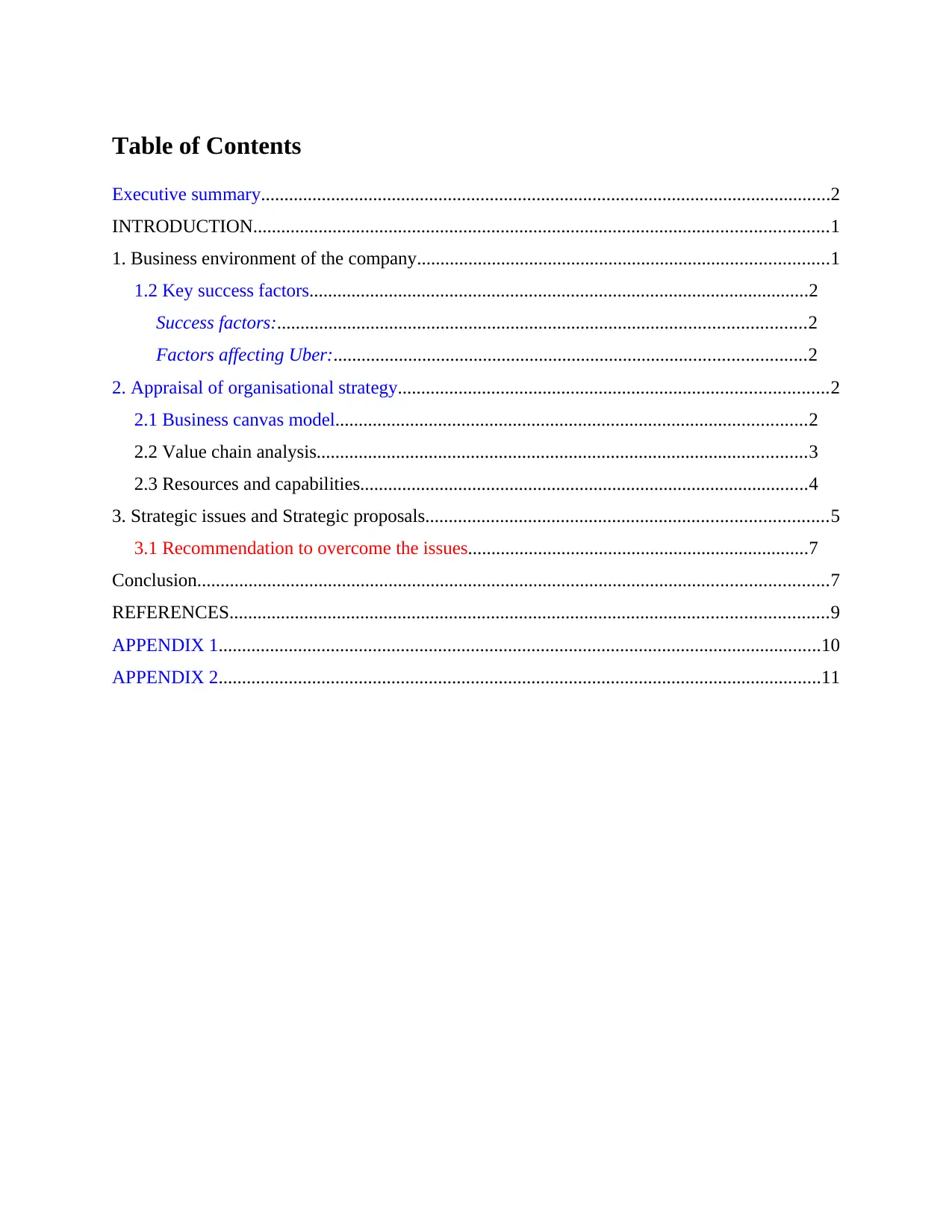
Table of Contents
Executive summary..........................................................................................................................2
INTRODUCTION...........................................................................................................................1
1. Business environment of the company........................................................................................1
1.2 Key success factors...........................................................................................................2
Success factors:.................................................................................................................2
Factors affecting Uber:.....................................................................................................2
2. Appraisal of organisational strategy............................................................................................2
2.1 Business canvas model.....................................................................................................2
2.2 Value chain analysis.........................................................................................................3
2.3 Resources and capabilities................................................................................................4
3. Strategic issues and Strategic proposals......................................................................................5
3.1 Recommendation to overcome the issues.........................................................................7
Conclusion.......................................................................................................................................7
REFERENCES................................................................................................................................9
APPENDIX 1.................................................................................................................................10
APPENDIX 2.................................................................................................................................11
Executive summary..........................................................................................................................2
INTRODUCTION...........................................................................................................................1
1. Business environment of the company........................................................................................1
1.2 Key success factors...........................................................................................................2
Success factors:.................................................................................................................2
Factors affecting Uber:.....................................................................................................2
2. Appraisal of organisational strategy............................................................................................2
2.1 Business canvas model.....................................................................................................2
2.2 Value chain analysis.........................................................................................................3
2.3 Resources and capabilities................................................................................................4
3. Strategic issues and Strategic proposals......................................................................................5
3.1 Recommendation to overcome the issues.........................................................................7
Conclusion.......................................................................................................................................7
REFERENCES................................................................................................................................9
APPENDIX 1.................................................................................................................................10
APPENDIX 2.................................................................................................................................11
⊘ This is a preview!⊘
Do you want full access?
Subscribe today to unlock all pages.

Trusted by 1+ million students worldwide
INTRODUCTION
Effective strategic planning is mandatory for the success of every business. For this it is
important for the managers to understand the prevailing business environment. All the micro and
macro factors affecting the business have to be considered before planning any strategy.
Managers have to implement appropriate theories and models to analyse the same. In this
assignment the factors affecting the growth 'UBER' company has been elaborated. This will
assist in the suitable planning of strategies for the success of business. Strategic management
department is responsible to effectively execute the steps as per the planning.
1. Business environment of the company
In December 2017 the company’s self-driving group internal document was revealed and
it brought to the light of the day the first Uber stats that displayed how far it’d come towards
having fully-autonomous cars. Uber’s test cars drove 20,000+ miles, number of miles driven
independently were going up but test drivers had to take over a car basically every mile. Its
services are used by 40 millions riders in a single month with an investment of $50 per month as
estimated in year 2017. Its share in United States ride hailing market was 84% in the beginning
of the year 2017 which was dropped down to 77% in the month of may because of the rising
trend in the competitors of the company. It was analysed that the company has suffered the loss
of $ 2.8 billion. There are various factors that affects the performance and profitability of the
company. In order to identify these factors PESTLE analysis can be done for the industry. This
will help to get the knowledge of driving and the resisting force which affects the company. The
PESTLE analyses is used to identify various external elements that are affecting an
organization's activities or functions as well as its performance. The Political and legal factors
such as laws, regulations or legislation affects Uber to modify its pricing, growth and other
strategies. The Porter's five forces analysis states that the industry is intensely competitive, in-
spite of having various barriers to compete and entry in the sector. For example – Uber itself has
developed a situation which made it hard for other companies to enter into the market still there
are wide rage of competitors who have started their business with local investments. There are
various forces such as bargaining power of customers and suppliers which influence Uber's
performance in the long run.
1
Effective strategic planning is mandatory for the success of every business. For this it is
important for the managers to understand the prevailing business environment. All the micro and
macro factors affecting the business have to be considered before planning any strategy.
Managers have to implement appropriate theories and models to analyse the same. In this
assignment the factors affecting the growth 'UBER' company has been elaborated. This will
assist in the suitable planning of strategies for the success of business. Strategic management
department is responsible to effectively execute the steps as per the planning.
1. Business environment of the company
In December 2017 the company’s self-driving group internal document was revealed and
it brought to the light of the day the first Uber stats that displayed how far it’d come towards
having fully-autonomous cars. Uber’s test cars drove 20,000+ miles, number of miles driven
independently were going up but test drivers had to take over a car basically every mile. Its
services are used by 40 millions riders in a single month with an investment of $50 per month as
estimated in year 2017. Its share in United States ride hailing market was 84% in the beginning
of the year 2017 which was dropped down to 77% in the month of may because of the rising
trend in the competitors of the company. It was analysed that the company has suffered the loss
of $ 2.8 billion. There are various factors that affects the performance and profitability of the
company. In order to identify these factors PESTLE analysis can be done for the industry. This
will help to get the knowledge of driving and the resisting force which affects the company. The
PESTLE analyses is used to identify various external elements that are affecting an
organization's activities or functions as well as its performance. The Political and legal factors
such as laws, regulations or legislation affects Uber to modify its pricing, growth and other
strategies. The Porter's five forces analysis states that the industry is intensely competitive, in-
spite of having various barriers to compete and entry in the sector. For example – Uber itself has
developed a situation which made it hard for other companies to enter into the market still there
are wide rage of competitors who have started their business with local investments. There are
various forces such as bargaining power of customers and suppliers which influence Uber's
performance in the long run.
1
Paraphrase This Document
Need a fresh take? Get an instant paraphrase of this document with our AI Paraphraser
1.2 Key success factors
The Pestle and five forces helped in identifying various success and negative factors
affecting Uber.
Success factors:
1. All the functions starting from the Geo-location to direction, notifications, payments, etc.
are done through the single app. This is one of the important driving factor for the growth
of Uber
2. The company now offers cheap and easily accessible transportation services to their
customers as they are looking for convenient method of taxi services.
Factors affecting Uber:
1. Low fuel prices – It is a major factor that can affect Uber's profitability, lower fuel prices
increases the choices of buying more cars that affect the preference of using cab services
2. Government is more likely to support local businesses and this lack in support Uber with
respect to its scalar and size.
2. Appraisal of organisational strategy
2.1 Business canvas model
A business model presents how an organisation or business attends to develop value by
creating core organisation activities through the combination of various components. A business
model canvas is a technique that determines how these elements are arranged in a visualized
way. It can be clearly observed that the major customer segments are passengers and drivers, it
also has various channels such as social media marketing, mobile apps to public relation.
Competitive advantages of Uber
Uber is not restricted, like you said, by the taxi medallion system. They have an endless
'fleet' of cars, to run which, they do not have to invest millions of dollars.
Uber does not want to keep full-time drivers, and take care of them. Even taxi drivers and
organizations can sign up and sign out at their suitability, just like anyone else.
2
The Pestle and five forces helped in identifying various success and negative factors
affecting Uber.
Success factors:
1. All the functions starting from the Geo-location to direction, notifications, payments, etc.
are done through the single app. This is one of the important driving factor for the growth
of Uber
2. The company now offers cheap and easily accessible transportation services to their
customers as they are looking for convenient method of taxi services.
Factors affecting Uber:
1. Low fuel prices – It is a major factor that can affect Uber's profitability, lower fuel prices
increases the choices of buying more cars that affect the preference of using cab services
2. Government is more likely to support local businesses and this lack in support Uber with
respect to its scalar and size.
2. Appraisal of organisational strategy
2.1 Business canvas model
A business model presents how an organisation or business attends to develop value by
creating core organisation activities through the combination of various components. A business
model canvas is a technique that determines how these elements are arranged in a visualized
way. It can be clearly observed that the major customer segments are passengers and drivers, it
also has various channels such as social media marketing, mobile apps to public relation.
Competitive advantages of Uber
Uber is not restricted, like you said, by the taxi medallion system. They have an endless
'fleet' of cars, to run which, they do not have to invest millions of dollars.
Uber does not want to keep full-time drivers, and take care of them. Even taxi drivers and
organizations can sign up and sign out at their suitability, just like anyone else.
2

The fact that their group does not have any competition, they reside a niche market. Sure
there are taxi companies, which are slow down by endless litigation, but there is no
second Uber.
For this the managers have to understand the business environment properly (Birkinshaw,
2014). For this one can take help of various theories and the model. Porters five force analysis of
the company is done for this which is described in this assignment. With the help of this growth
factor can be easily analysed. This will also help in the development of business strategies by
identification of strengths and weaknesses.
2.2 Value chain analysis
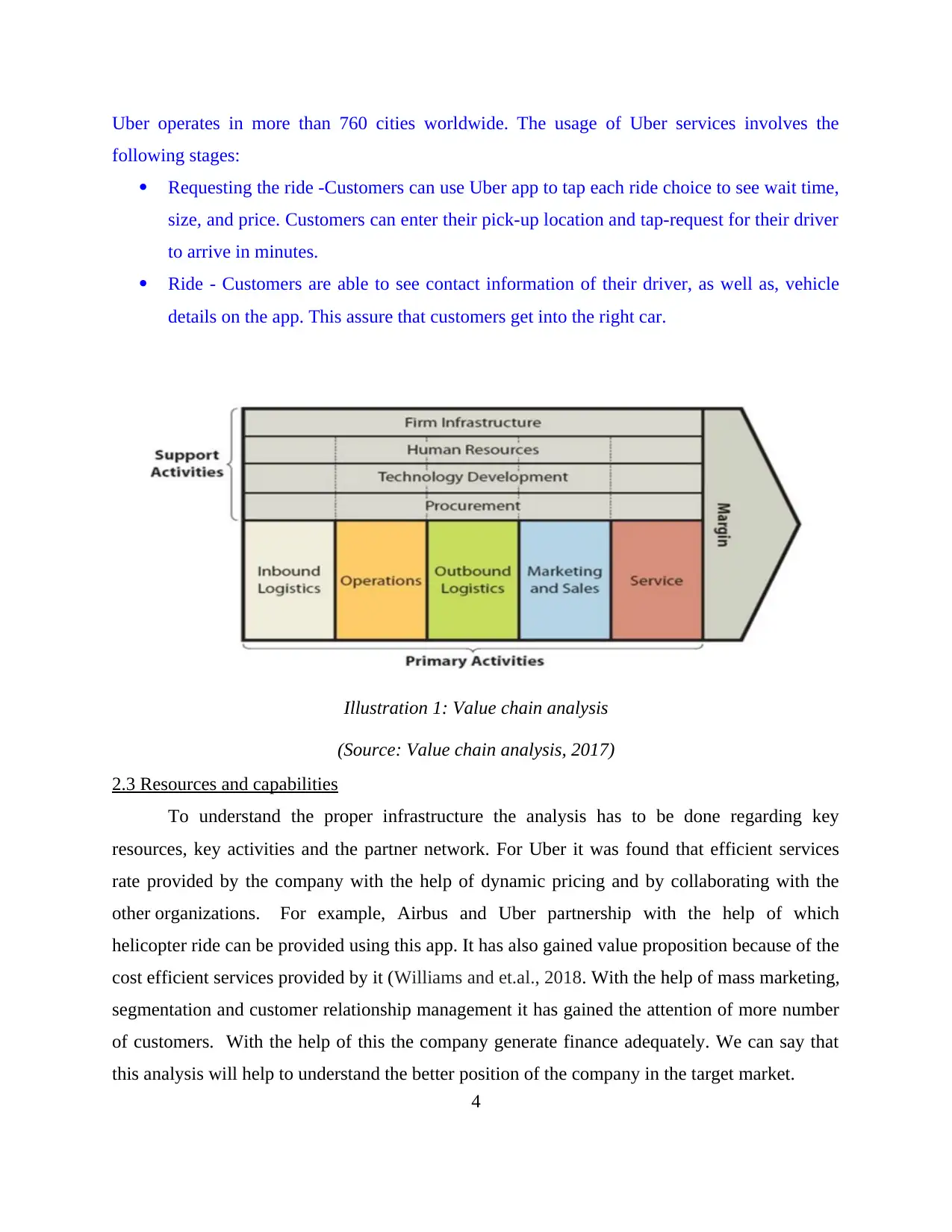
Value chain analysis can be done for a company to make strategies properly. It is also a
kind of tool to evaluate the internal activities of the firm. This will help to recognize the valuable
activities which can be improved to gain the competitive advantage. With the help of porter's
value chain value one can analyze the primary activities, such as, inbound and outbound
logistics, operations, marketing, sales, services etc. along with the support activities, such as,
firm infrastructure, procurement methods, human resource management and the use of
technology. The reflection of all these activities in the total cost has to be evaluated. Cost drivers
and the relationship between these activities has to be analysed. One has to identify the areas
where cost can be reduced (Johnson, 2014 ). After analyzing these factors for the Uber it was
evaluated that to beat the other competitors it has to work more. Hailing a taxi is problematic for
the individuals. For this Uber is serving the customers at its best. Many other services are also
provided by the Uber, such as, UberPool (Where customer can share the cost with other
passengers), UberRush (courier service) etc.
Uber Outbound Logistics
Outbound logistics in value chain analysis is associated with warehousing and distribution of
products. Outbound logistics does not fully utilize to service sector such as ride-hailing due to
inseparability of delivery and consumption of services. Uber run in more than 760 cities world-
wide and internet-based nature of its business model is a major source of value for the global taxi
technology company
Uber Operations
3
there are taxi companies, which are slow down by endless litigation, but there is no
second Uber.
For this the managers have to understand the business environment properly (Birkinshaw,
2014). For this one can take help of various theories and the model. Porters five force analysis of
the company is done for this which is described in this assignment. With the help of this growth
factor can be easily analysed. This will also help in the development of business strategies by
identification of strengths and weaknesses.
2.2 Value chain analysis
Value chain analysis can be done for a company to make strategies properly. It is also a
kind of tool to evaluate the internal activities of the firm. This will help to recognize the valuable
activities which can be improved to gain the competitive advantage. With the help of porter's
value chain value one can analyze the primary activities, such as, inbound and outbound
logistics, operations, marketing, sales, services etc. along with the support activities, such as,
firm infrastructure, procurement methods, human resource management and the use of
technology. The reflection of all these activities in the total cost has to be evaluated. Cost drivers
and the relationship between these activities has to be analysed. One has to identify the areas
where cost can be reduced (Johnson, 2014 ). After analyzing these factors for the Uber it was
evaluated that to beat the other competitors it has to work more. Hailing a taxi is problematic for
the individuals. For this Uber is serving the customers at its best. Many other services are also
provided by the Uber, such as, UberPool (Where customer can share the cost with other
passengers), UberRush (courier service) etc.
Uber Outbound Logistics
Outbound logistics in value chain analysis is associated with warehousing and distribution of
products. Outbound logistics does not fully utilize to service sector such as ride-hailing due to
inseparability of delivery and consumption of services. Uber run in more than 760 cities world-
wide and internet-based nature of its business model is a major source of value for the global taxi
technology company
Uber Operations
3
⊘ This is a preview!⊘
Do you want full access?
Subscribe today to unlock all pages.
Trusted by 1+ million students worldwide
Uber operates in more than 760 cities worldwide. The usage of Uber services involves the
following stages:
Requesting the ride -Customers can use Uber app to tap each ride choice to see wait time,
size, and price. Customers can enter their pick-up location and tap-request for their driver
to arrive in minutes.
Ride - Customers are able to see contact information of their driver, as well as, vehicle
details on the app. This assure that customers get into the right car.
2.3 Resources and capabilities
To understand the proper infrastructure the analysis has to be done regarding key
resources, key activities and the partner network. For Uber it was found that efficient services
rate provided by the company with the help of dynamic pricing and by collaborating with the
other organizations. For example, Airbus and Uber partnership with the help of which
helicopter ride can be provided using this app. It has also gained value proposition because of the
cost efficient services provided by it (Williams and et.al., 2018. With the help of mass marketing,
segmentation and customer relationship management it has gained the attention of more number
of customers. With the help of this the company generate finance adequately. We can say that
this analysis will help to understand the better position of the company in the target market.
4
Illustration 1: Value chain analysis
(Source: Value chain analysis, 2017)
following stages:
Requesting the ride -Customers can use Uber app to tap each ride choice to see wait time,
size, and price. Customers can enter their pick-up location and tap-request for their driver
to arrive in minutes.
Ride - Customers are able to see contact information of their driver, as well as, vehicle
details on the app. This assure that customers get into the right car.
2.3 Resources and capabilities
To understand the proper infrastructure the analysis has to be done regarding key
resources, key activities and the partner network. For Uber it was found that efficient services
rate provided by the company with the help of dynamic pricing and by collaborating with the
other organizations. For example, Airbus and Uber partnership with the help of which
helicopter ride can be provided using this app. It has also gained value proposition because of the
cost efficient services provided by it (Williams and et.al., 2018. With the help of mass marketing,
segmentation and customer relationship management it has gained the attention of more number
of customers. With the help of this the company generate finance adequately. We can say that
this analysis will help to understand the better position of the company in the target market.
4
Illustration 1: Value chain analysis
(Source: Value chain analysis, 2017)
Paraphrase This Document
Need a fresh take? Get an instant paraphrase of this document with our AI Paraphraser
In this way the company is trying to stand out in the target market. Various discount
schemes are also offered by the company. For all these efficient services, sound recruitment has
to be done by the managers. Adequate training program can assist in the same. Healthy
relationships with the employees can make the performance of the company more effective.
Licensing has to be done to work as per the norms set by the government (Reim and et.al., 2015)
. Unfair competition has to be demolished. It has to adopt the policy of gender equality by hiring
women drivers to beat the competitive environment. Company has incurred huge cost to
implement advanced technologies . Company has to take care of all the factors which are
providing resistance in its growth to rise in the target market.
3. Strategic issues and Strategic proposals
Uber is one of the leading transportation or logistic network in the world, it operates in
more than 635 cities in the whole world. People can easily access the services provided by the
firm through mobile application and websites. There were more than 40 million riders within a
single month and covering 84% of market share in UK at the beginning of 2017. There are a lot
of issues faced by Uber in the current market situation, the company has achieved a huge success
and great position in the market (Moutinho and Vargas-Sanchez, 2018). The company has
successfully managed to operate its business in around 58 markets all around the world, the
company provides effective services to the passengers with comfortable rides at reasonable
prices. On the other hand, Uber also got exposed to many challenges and issues while operating
in the logistics industry. The major issues faced by Uber are as described below -
New models or New entrants – The company's major issue or challenge is the entry of
new companies or similar service providers in the market. There are a lot of competitors
in the market that are providing similar services related to logistics, this develops a high
competition which is important to be considered in order to gain competitive advantages
and leading position in the market place(Slack, 2015). The Uber needs to develop
effective innovations and modification in their services or products to ensure that it
attract more and more customers within the market. It’s not only the new entrants that
affect the performance of Uber but the implementation of new policies such as Drivers
with license can drive the taxi etc., also have a great impact on the functioning of the
company. The various new companies have entered in to the market for providing logistic
5
schemes are also offered by the company. For all these efficient services, sound recruitment has
to be done by the managers. Adequate training program can assist in the same. Healthy
relationships with the employees can make the performance of the company more effective.
Licensing has to be done to work as per the norms set by the government (Reim and et.al., 2015)
. Unfair competition has to be demolished. It has to adopt the policy of gender equality by hiring
women drivers to beat the competitive environment. Company has incurred huge cost to
implement advanced technologies . Company has to take care of all the factors which are
providing resistance in its growth to rise in the target market.
3. Strategic issues and Strategic proposals
Uber is one of the leading transportation or logistic network in the world, it operates in
more than 635 cities in the whole world. People can easily access the services provided by the
firm through mobile application and websites. There were more than 40 million riders within a
single month and covering 84% of market share in UK at the beginning of 2017. There are a lot
of issues faced by Uber in the current market situation, the company has achieved a huge success
and great position in the market (Moutinho and Vargas-Sanchez, 2018). The company has
successfully managed to operate its business in around 58 markets all around the world, the
company provides effective services to the passengers with comfortable rides at reasonable
prices. On the other hand, Uber also got exposed to many challenges and issues while operating
in the logistics industry. The major issues faced by Uber are as described below -
New models or New entrants – The company's major issue or challenge is the entry of
new companies or similar service providers in the market. There are a lot of competitors
in the market that are providing similar services related to logistics, this develops a high
competition which is important to be considered in order to gain competitive advantages
and leading position in the market place(Slack, 2015). The Uber needs to develop
effective innovations and modification in their services or products to ensure that it
attract more and more customers within the market. It’s not only the new entrants that
affect the performance of Uber but the implementation of new policies such as Drivers
with license can drive the taxi etc., also have a great impact on the functioning of the
company. The various new companies have entered in to the market for providing logistic
5
services to the people which have negatively affected the profitability of Uber. The
market share of Uber has affected due to the increase in competition, people are ready to
switch the company by a brand which provides similar services at a lower price.
Fears for safety – Uber also got affected various negative activities or practices by their
drivers. Many rape cases are already filed against Uber driver in various countries, these
cases have created a negative image of the firm in the market. The customers mainly
women started feeling unsafe in the taxi or cabs which greatly affected the firm's
reputation or brand image. The safety concern has remarkably affected Uber's
performance and profitability, the safety of passengers is one of the major challenge Uber
is facing currently. Due to this the firm also started taking effective measure which can
ensure the safety of drivers as well as passenger. Safety issues are heavily affecting the
Uber's business in the current market (HillJones and Schilling, 2014).
Lack of technology – Uber also lacks technological elements, there are various other
options or service providers that uses innovative technologies and techniques such as
applications, software etc. which attracts the customers in the market. Uber needs to
improve its technology in order tom meet the current trends and demand in the market.
The Uber need improvement in their application which faces issues and lags, the user
interface is quite simple and has bored the people.
Increased cost of operations – Another factor that is negatively affecting Uber is the
increase in operating cost. The Uber is operating a huge number of taxis all around the
world which involves a huge amount of finance or capital. The price of petrol is
increasing day by day that is increasing the cost of operation of the firm and leads to low
profitability. The human resources such as the cab drivers started demanding more wages
or pay which is another issue faced by the firm.
Legal consequences – The firm is highly exposed to legal issues or consequences due the
illegal practices of the drivers. There are many legal cases which are filed against Uber
regarding harassment, rapes and bad behavior by the drivers. People are not satisfied with
the safety provided to the passengers and these legal issues have badly damaged the
brand image in the market. The various legal issues also affected position of firm within
6
market share of Uber has affected due to the increase in competition, people are ready to
switch the company by a brand which provides similar services at a lower price.
Fears for safety – Uber also got affected various negative activities or practices by their
drivers. Many rape cases are already filed against Uber driver in various countries, these
cases have created a negative image of the firm in the market. The customers mainly
women started feeling unsafe in the taxi or cabs which greatly affected the firm's
reputation or brand image. The safety concern has remarkably affected Uber's
performance and profitability, the safety of passengers is one of the major challenge Uber
is facing currently. Due to this the firm also started taking effective measure which can
ensure the safety of drivers as well as passenger. Safety issues are heavily affecting the
Uber's business in the current market (HillJones and Schilling, 2014).
Lack of technology – Uber also lacks technological elements, there are various other
options or service providers that uses innovative technologies and techniques such as
applications, software etc. which attracts the customers in the market. Uber needs to
improve its technology in order tom meet the current trends and demand in the market.
The Uber need improvement in their application which faces issues and lags, the user
interface is quite simple and has bored the people.
Increased cost of operations – Another factor that is negatively affecting Uber is the
increase in operating cost. The Uber is operating a huge number of taxis all around the
world which involves a huge amount of finance or capital. The price of petrol is
increasing day by day that is increasing the cost of operation of the firm and leads to low
profitability. The human resources such as the cab drivers started demanding more wages
or pay which is another issue faced by the firm.
Legal consequences – The firm is highly exposed to legal issues or consequences due the
illegal practices of the drivers. There are many legal cases which are filed against Uber
regarding harassment, rapes and bad behavior by the drivers. People are not satisfied with
the safety provided to the passengers and these legal issues have badly damaged the
brand image in the market. The various legal issues also affected position of firm within
6
⊘ This is a preview!⊘
Do you want full access?
Subscribe today to unlock all pages.
Trusted by 1+ million students worldwide
the market, many of the legal cases are still pending against Uber which may further
affect the firm's reputation and goodwill (Ginter, Duncan and Swayne, 2018).
Limited Payment options – Uber operated in around 50 countries presently, but still
there some countries where they have cash only payment system. This is a major
drawback or issue faced by the firm as well as passengers. This is a major weakness for
the firm as customers or passengers faces problem with regards to the payment. There is a
huge need for the flexibility in the payment options in order to provide effective and easy
services to the people. There are other service providers to are achieving competitive
advantages by offering flexible payment options to the passengers such as card payment
option etc.
3.1 Recommendation to overcome the issues
New model or new face - Much of the argument around how Uber and similar apps run
comes down to an important disagreement about what kind of business they represent.
Fears for safety - One criticism black-cab drivers have levelled against Uber is the
supposed untrustworthiness of its drivers
To be successful in the future, developers and backers of ride-hailing apps should
consider their technology and partnering potential today. Competition for the next generation
will consist technology leaders and transportation suppliers that can assist efficient traffic
routing, real-time analysis of affiliated sensor data, and autonomous vehicles. Customers will
expect more streamlined mobile experiences, including integration with mobile shopping,
communication, payment, and transportation platform
Conclusion
The report concluded that Uber is a successful and leading transportation network
company in the world. The firm report determined the various factors that affect the competitive
position of Uber in the market place. To conclude we can say that Uber is known for the efficient
transportation facilities provided by it. It has to work more to beat the competitors posed by the
rivalry. Company has to leverage all the pros and cons to attain sustainability. It can work in
collaboration with other organizations to serve more services to the customers. Proper strategic
7
affect the firm's reputation and goodwill (Ginter, Duncan and Swayne, 2018).
Limited Payment options – Uber operated in around 50 countries presently, but still
there some countries where they have cash only payment system. This is a major
drawback or issue faced by the firm as well as passengers. This is a major weakness for
the firm as customers or passengers faces problem with regards to the payment. There is a
huge need for the flexibility in the payment options in order to provide effective and easy
services to the people. There are other service providers to are achieving competitive
advantages by offering flexible payment options to the passengers such as card payment
option etc.
3.1 Recommendation to overcome the issues
New model or new face - Much of the argument around how Uber and similar apps run
comes down to an important disagreement about what kind of business they represent.
Fears for safety - One criticism black-cab drivers have levelled against Uber is the
supposed untrustworthiness of its drivers
To be successful in the future, developers and backers of ride-hailing apps should
consider their technology and partnering potential today. Competition for the next generation
will consist technology leaders and transportation suppliers that can assist efficient traffic
routing, real-time analysis of affiliated sensor data, and autonomous vehicles. Customers will
expect more streamlined mobile experiences, including integration with mobile shopping,
communication, payment, and transportation platform
Conclusion
The report concluded that Uber is a successful and leading transportation network
company in the world. The firm report determined the various factors that affect the competitive
position of Uber in the market place. To conclude we can say that Uber is known for the efficient
transportation facilities provided by it. It has to work more to beat the competitors posed by the
rivalry. Company has to leverage all the pros and cons to attain sustainability. It can work in
collaboration with other organizations to serve more services to the customers. Proper strategic
7
Paraphrase This Document
Need a fresh take? Get an instant paraphrase of this document with our AI Paraphraser
planning must be done for the same. The report also determined the various issues faced by Uber
in the current market conditions.
8
in the current market conditions.
8
REFERENCES
Books and Journals
Armstrong, G.,and et.al., 2015. Marketing: an introduction. Pearson Education.
Slack, N., 2015. Operations strategy. John Wiley & Sons, Ltd.
Birkinshaw, J., 2014. Do we still need managers?. Business Strategy Review. 25(2). pp.6-6.
Goleman, D., 2017. Leadership That Gets Results (Harvard Business Review Classics). Harvard
Business Press.
Bocken, N.M.,and et.al., 2014. A literature and practice review to develop sustainable business
model archetypes. Journal of cleaner production. 65.pp.42-56.
Drucker, P.F., 2017. The Theory of the Business (Harvard Business Review Classics). Harvard
Business Press.
Sia, S.K.,and et.al., 2016. How DBS Bank Pursued a Digital Business Strategy. MIS Quarterly
Executive.15(2).
Reim, W.,and et.al., 2015. Product–Service Systems (PSS) business models and tactics–a
systematic literature review. Journal of Cleaner Production. 97. pp.61-75.
Williams, R.I., and et.al., 2018. Family Firm Goals and their Effects on Strategy, Family and
Organization Behavior: A Review and Research Agenda. International Journal of
Management Reviews. 20(S1).
Johnson, P.F., 2014. Purchasing and supply management. McGraw-Hill Higher Education.
Reim, W.,and et.al., 2015. Product–Service Systems (PSS) business models and tactics–a
systematic literature review
Hill, C.W., Jones, G.R. and Schilling, M.A., 2014. Strategic management: theory: an integrated
approach. Cengage Learning.
Moutinho, L. and Vargas-Sanchez, A. eds., 2018. Strategic Management in Tourism, CABI
Tourism Texts. Cabi.
Ginter, P.M., Duncan, J. and Swayne, L.E., 2018. The Strategic Management of Healthcare
Organizations. John Wiley & Sons.
Slack, N., 2015. Operations strategy. John Wiley & Sons, Ltd.
Online
9
Books and Journals
Armstrong, G.,and et.al., 2015. Marketing: an introduction. Pearson Education.
Slack, N., 2015. Operations strategy. John Wiley & Sons, Ltd.
Birkinshaw, J., 2014. Do we still need managers?. Business Strategy Review. 25(2). pp.6-6.
Goleman, D., 2017. Leadership That Gets Results (Harvard Business Review Classics). Harvard
Business Press.
Bocken, N.M.,and et.al., 2014. A literature and practice review to develop sustainable business
model archetypes. Journal of cleaner production. 65.pp.42-56.
Drucker, P.F., 2017. The Theory of the Business (Harvard Business Review Classics). Harvard
Business Press.
Sia, S.K.,and et.al., 2016. How DBS Bank Pursued a Digital Business Strategy. MIS Quarterly
Executive.15(2).
Reim, W.,and et.al., 2015. Product–Service Systems (PSS) business models and tactics–a
systematic literature review. Journal of Cleaner Production. 97. pp.61-75.
Williams, R.I., and et.al., 2018. Family Firm Goals and their Effects on Strategy, Family and
Organization Behavior: A Review and Research Agenda. International Journal of
Management Reviews. 20(S1).
Johnson, P.F., 2014. Purchasing and supply management. McGraw-Hill Higher Education.
Reim, W.,and et.al., 2015. Product–Service Systems (PSS) business models and tactics–a
systematic literature review
Hill, C.W., Jones, G.R. and Schilling, M.A., 2014. Strategic management: theory: an integrated
approach. Cengage Learning.
Moutinho, L. and Vargas-Sanchez, A. eds., 2018. Strategic Management in Tourism, CABI
Tourism Texts. Cabi.
Ginter, P.M., Duncan, J. and Swayne, L.E., 2018. The Strategic Management of Healthcare
Organizations. John Wiley & Sons.
Slack, N., 2015. Operations strategy. John Wiley & Sons, Ltd.
Online
9
⊘ This is a preview!⊘
Do you want full access?
Subscribe today to unlock all pages.
Trusted by 1+ million students worldwide

1 out of 15


Related Documents


Your All-in-One AI-Powered Toolkit for Academic Success.
+13062052269
info@desklib.com
Available 24*7 on WhatsApp / Email
![[object Object]](/_next/static/media/star-bottom.7253800d.svg)
Unlock your academic potential
Copyright © 2020–2026 A2Z Services. All Rights Reserved. Developed and managed by ZUCOL.