Analyzing Uber Technologies Inc: Strategy, Competencies, Challenges
VerifiedAdded on 2022/08/29
|8
|1850
|14
Report
AI Summary
This report examines the corporate strategy of Uber Technologies Inc., focusing on the reasons for its success, its core competencies, and the government-related challenges it faces. Uber's simplified business model and cost leadership strategy are identified as key factors contributing to its success, along with its customer-centric principles and distinctive marketing approaches. The company's core competencies include its ability to expand and access diverse markets, provide special offers, and leverage its production and marketing skills. Employee competencies, such as vision, execution, and innovation, also play a crucial role. However, Uber faces government issues related to advertising regulations, driver licensing, minimum wage acts, and environmental protection. Recommendations are provided to address these issues, including establishing a sustainability plan, conducting regular financial audits, increasing driver wages, and enforcing stricter licensing requirements. The report concludes that by addressing these challenges and leveraging its core competencies, Uber can maintain stability and continue to expand its business in the international market. Desklib provides access to similar solved assignments and past papers for students.
RUNNING HEAD: CORPORATE STRATEGY 0
UBER TECHNOLOGIES, INC.
Paraphrase This Document
Need a fresh take? Get an instant paraphrase of this document with our AI Paraphraser

CORPORATE STRATEGY 1
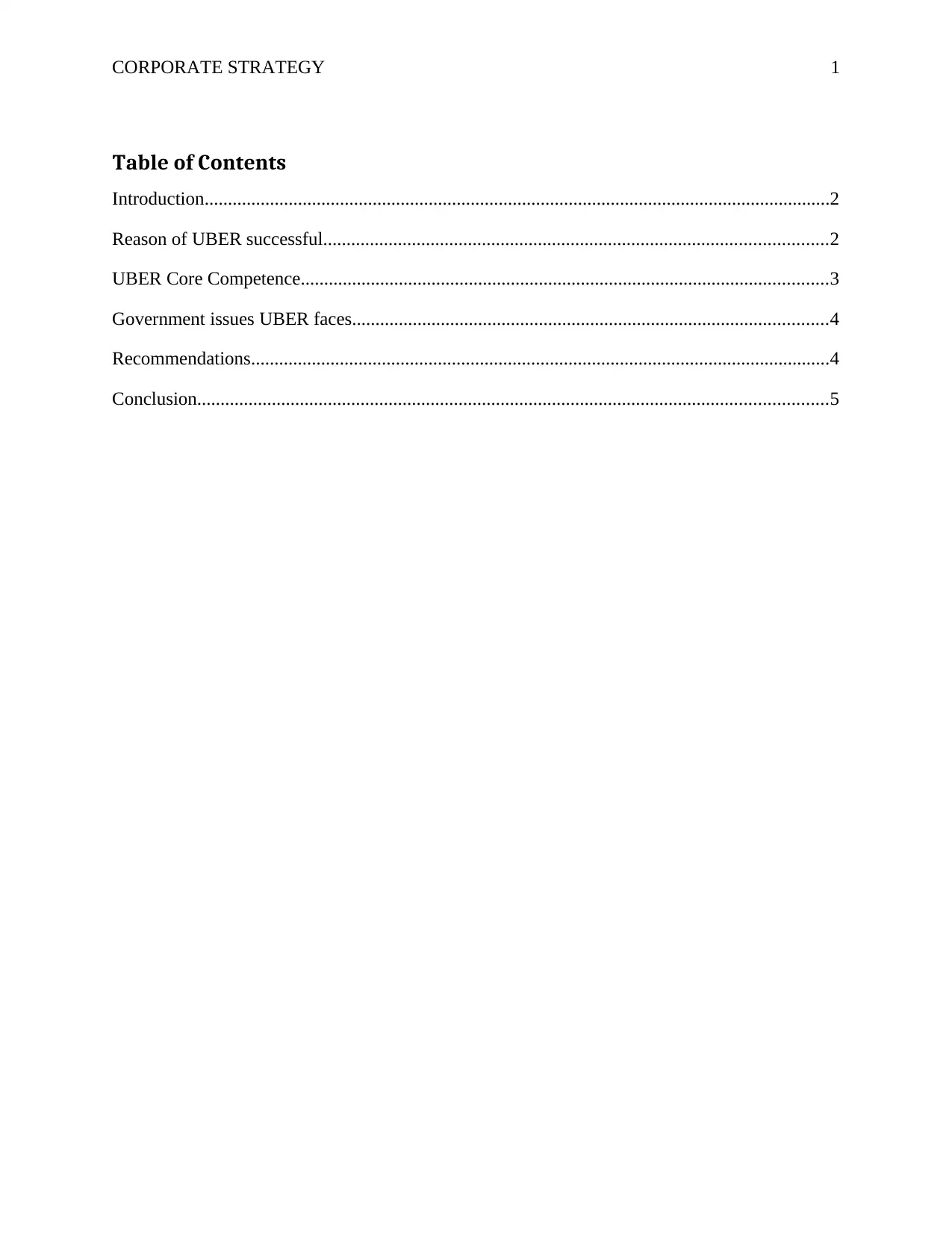
Table of Contents
Introduction......................................................................................................................................2
Reason of UBER successful............................................................................................................2
UBER Core Competence.................................................................................................................3
Government issues UBER faces......................................................................................................4
Recommendations............................................................................................................................4
Conclusion.......................................................................................................................................5
Table of Contents
Introduction......................................................................................................................................2
Reason of UBER successful............................................................................................................2
UBER Core Competence.................................................................................................................3
Government issues UBER faces......................................................................................................4
Recommendations............................................................................................................................4
Conclusion.......................................................................................................................................5

CORPORATE STRATEGY 2
Introduction
UBER Technologies is an American multinational ride-hailing company offering services that
include peer-to-peer ridesharing, ride service hailing, food delivery, and a micro-mobility system
with electric bikes and scooters (Cramer & Krueger, 2016). The estimation describes that UBER
generated more than $11 billion revenue in the year 2019 in the Maldives. Therefore in 2015,
UBER is one of the high profile new companies because of adopting various strategies and due
to several distinctive competencies (Das et al., 2017). In this report, the reason for UBER
successful, core competencies of the company and government challenges which company face
is discussed. The report also discusses the recommendation and strategies which company can
adopt to overcome the issue.
Reason for UBER successful
There are various reasons through which the UBER become successful one of the main reason
for achieving so much success in every region is the simplified business model (Smith, 2016).
This company simplifies the procedure of getting an order that is rider does not have to phone,
search, etc. This also decreases the uncertainty because the rider gets the complete information
about the driver which solves the problem of thinking that what kind of driver and car will arrive
(Dudley et al., 2017). The other is the company also simplify the procedure of payment and
adopt the cost leadership strategy that is price and cost are less in comparison to their
competitors.
The other reasons for being successful are the principles of the company in which two of them
allow the company to earn more profits and raise the loyalty among the customers. The first
principle is to keep the needs and demands of the consumers on a priority that is UBER solves
the overall problem of the consumers by providing the services at lower prices with quality and
convenience in which rider can make payments through mobile phones (Teece, 2018). The
estimation describes that this leads in increasing the customers as it is one of the companies
which has more consumers in a short period which results in increasing the drivers that is in
2015, the company has 327,000 drivers (Cook et al., 2019). The next principal of the company
which attracts a large number of customers is providing safety to the consumer that is UBER
Introduction
UBER Technologies is an American multinational ride-hailing company offering services that
include peer-to-peer ridesharing, ride service hailing, food delivery, and a micro-mobility system
with electric bikes and scooters (Cramer & Krueger, 2016). The estimation describes that UBER
generated more than $11 billion revenue in the year 2019 in the Maldives. Therefore in 2015,
UBER is one of the high profile new companies because of adopting various strategies and due
to several distinctive competencies (Das et al., 2017). In this report, the reason for UBER
successful, core competencies of the company and government challenges which company face
is discussed. The report also discusses the recommendation and strategies which company can
adopt to overcome the issue.
Reason for UBER successful
There are various reasons through which the UBER become successful one of the main reason
for achieving so much success in every region is the simplified business model (Smith, 2016).
This company simplifies the procedure of getting an order that is rider does not have to phone,
search, etc. This also decreases the uncertainty because the rider gets the complete information
about the driver which solves the problem of thinking that what kind of driver and car will arrive
(Dudley et al., 2017). The other is the company also simplify the procedure of payment and
adopt the cost leadership strategy that is price and cost are less in comparison to their
competitors.
The other reasons for being successful are the principles of the company in which two of them
allow the company to earn more profits and raise the loyalty among the customers. The first
principle is to keep the needs and demands of the consumers on a priority that is UBER solves
the overall problem of the consumers by providing the services at lower prices with quality and
convenience in which rider can make payments through mobile phones (Teece, 2018). The
estimation describes that this leads in increasing the customers as it is one of the companies
which has more consumers in a short period which results in increasing the drivers that is in
2015, the company has 327,000 drivers (Cook et al., 2019). The next principal of the company
which attracts a large number of customers is providing safety to the consumer that is UBER
⊘ This is a preview!⊘
Do you want full access?
Subscribe today to unlock all pages.

Trusted by 1+ million students worldwide

CORPORATE STRATEGY 3
makes compulsory regulation for the driver to submit their necessary documents and the
company also does criminal background verification of the drivers, so that customer safety will
be maintained by the company.
The distinctive marketing strategy of UBER also increases the loyalty of the customers and also
raises the reputation of the company that is a company that mainly provides various special
offers to the customers which include that 50% off for 3 rides etc (Smith, 2016). The company
also offer a loyalty program every two years to provide more offer and to retain loyal consumers.
UBER also adopts the "Omi-Channel approach" in this company offers various facilities to the
consumers such as seamless payments, not giving tips, providing rating to the drivers and quality
services which includes better cars (Teece, 2018). To remain successful in every region company
make a partnership that is in the current year UBER makes a partnership with Facebook
Messenger so that rider can also book their ride through the application of messaging.
UBER Core Competence
The core competencies of the UBER are the values and approaches of the company that is to
expand and get access in each and different varieties of a marketplace that is it can be accessed
from anywhere and everywhere by the individual and business (Calo & Rosenblat, 2017). The
other competencies are the special offer and customer’s benefits which are provided by the
company that is a company usually offers varieties of an offer to the customers; this is the reason
which supports the company to become different (Malin & Chandler, 2016). The major
competency of the company is that the services are imitated and rare to adopt by the competitors
because of the production skills and marketing skills of the company.
The employee's competencies are one of the important core competencies of the company which
include vision, execution, quality obsession, communication, and innovation. The competent and
better quality also made the employee distinctive through which the company can keep the needs
and demands of the customers on priority (Das et al., 2017). The vision of the company is also
the core competency of the company which supports UBER to take competitive advantage which
includes that company provides quality transportation with safer and cheaper this can also
generate more employment opportunities and also increase employee satisfaction by providing
makes compulsory regulation for the driver to submit their necessary documents and the
company also does criminal background verification of the drivers, so that customer safety will
be maintained by the company.
The distinctive marketing strategy of UBER also increases the loyalty of the customers and also
raises the reputation of the company that is a company that mainly provides various special
offers to the customers which include that 50% off for 3 rides etc (Smith, 2016). The company
also offer a loyalty program every two years to provide more offer and to retain loyal consumers.
UBER also adopts the "Omi-Channel approach" in this company offers various facilities to the
consumers such as seamless payments, not giving tips, providing rating to the drivers and quality
services which includes better cars (Teece, 2018). To remain successful in every region company
make a partnership that is in the current year UBER makes a partnership with Facebook
Messenger so that rider can also book their ride through the application of messaging.
UBER Core Competence
The core competencies of the UBER are the values and approaches of the company that is to
expand and get access in each and different varieties of a marketplace that is it can be accessed
from anywhere and everywhere by the individual and business (Calo & Rosenblat, 2017). The
other competencies are the special offer and customer’s benefits which are provided by the
company that is a company usually offers varieties of an offer to the customers; this is the reason
which supports the company to become different (Malin & Chandler, 2016). The major
competency of the company is that the services are imitated and rare to adopt by the competitors
because of the production skills and marketing skills of the company.
The employee's competencies are one of the important core competencies of the company which
include vision, execution, quality obsession, communication, and innovation. The competent and
better quality also made the employee distinctive through which the company can keep the needs
and demands of the customers on priority (Das et al., 2017). The vision of the company is also
the core competency of the company which supports UBER to take competitive advantage which
includes that company provides quality transportation with safer and cheaper this can also
generate more employment opportunities and also increase employee satisfaction by providing
Paraphrase This Document
Need a fresh take? Get an instant paraphrase of this document with our AI Paraphraser

CORPORATE STRATEGY 4
high income to drivers. Therefore the company focuses on the needs of both consumers and
employees which made UBER different and provide support in gaining competitive advantage.
These competencies are sufficient for UBER to take competitive advantage because the
estimation describes that consumers get more attracted to the cheaper prices and quality services
(Jordan, 2017). Therefore, the cost-distinctive strategy can help the company to expand and to
increase their profits in the long run. The mission and vision of the company allow UBER to
provide convenience to the customers which results in increasing acceptance by the organization,
individuals, etc (Teece, 2018). The competencies are appropriate and adequate to gain
competition and to attract a large number of customers.
Government issues UBER faces
UBER faces various government issues that in some of the regional government does file
charges for advertising their services. Therefore the government also takes action against the
drivers of UBER because of not having a license. The compulsory regulation was also made that
is government develops the Minimum Wage Act for UBER (Teece, 2018). Through this
company gets influenced and affected to adopt the policies and make wages and compensation
accordingly this policy is developed because of various complaints of drivers for getting lower
wages. Therefore the estimation describes that in future the company has to pay more taxes to
the government (Cook et al., 2019). The government regulatory act to safeguard the environment
develops Environment Protection Act which made it compulsory for the UBER to adopt their
functions by reducing pollution so that sustainability will be maintained.
The government also made necessary documentation for UBER so that activities will be
conducted by documentation of the operations, roles and responsibilities (Kavadias et al., 2016).
UBER also face challenges to operate their operations up to the certain limit that is a government
made necessary auditing of the financial accounting reports. The government also made a code
of conduct and documents which company has to check and receive from the drivers so that
safety will be maintained (Cramer & Krueger, 2016).
high income to drivers. Therefore the company focuses on the needs of both consumers and
employees which made UBER different and provide support in gaining competitive advantage.
These competencies are sufficient for UBER to take competitive advantage because the
estimation describes that consumers get more attracted to the cheaper prices and quality services
(Jordan, 2017). Therefore, the cost-distinctive strategy can help the company to expand and to
increase their profits in the long run. The mission and vision of the company allow UBER to
provide convenience to the customers which results in increasing acceptance by the organization,
individuals, etc (Teece, 2018). The competencies are appropriate and adequate to gain
competition and to attract a large number of customers.
Government issues UBER faces
UBER faces various government issues that in some of the regional government does file
charges for advertising their services. Therefore the government also takes action against the
drivers of UBER because of not having a license. The compulsory regulation was also made that
is government develops the Minimum Wage Act for UBER (Teece, 2018). Through this
company gets influenced and affected to adopt the policies and make wages and compensation
accordingly this policy is developed because of various complaints of drivers for getting lower
wages. Therefore the estimation describes that in future the company has to pay more taxes to
the government (Cook et al., 2019). The government regulatory act to safeguard the environment
develops Environment Protection Act which made it compulsory for the UBER to adopt their
functions by reducing pollution so that sustainability will be maintained.
The government also made necessary documentation for UBER so that activities will be
conducted by documentation of the operations, roles and responsibilities (Kavadias et al., 2016).
UBER also face challenges to operate their operations up to the certain limit that is a government
made necessary auditing of the financial accounting reports. The government also made a code
of conduct and documents which company has to check and receive from the drivers so that
safety will be maintained (Cramer & Krueger, 2016).

CORPORATE STRATEGY 5
Recommendations
The different issues which UBER face from the government should be addressed because this
can support the company to maintain stability and to can ethically conduct their activities.
Therefore, the company can establish a new sustainability plan by reducing carbon emissions. So
that it can protect the environment and can also increase the customer satisfaction level (Malin &
Chandler, 2016). The company can also make the necessary audit of financial reports yearly and
provide an increase in the wages and financial benefits of the drivers so that professional
employees get attracted to the company. To increase safety the company license for the taxi
drivers should make compulsory and proper documents and verification is done. This can help
UBER to maintain the government compulsory regulation in the company (Kavadias et al.,
2016).
Conclusion
From the above, it is concluded that UBER “simplified business model” and “cost- distinctive
strategy” support the company to become successful and through this company expand its
business in the international market. The values and skills of the employees are the distinctive
core competencies of the company through which the company takes a competitive advantage.
The company also focuses on the requirements of the consumers as well as employees which are
considered appropriate for becoming first-mover advantage of the opportunity. However, UBER
also suffers from government challenges which include adopting compulsory environment
regulation, employee rights, and license. To overcome this UBER can change the policies for
sustainability and can make necessary regulations for the drivers in the company.
Recommendations
The different issues which UBER face from the government should be addressed because this
can support the company to maintain stability and to can ethically conduct their activities.
Therefore, the company can establish a new sustainability plan by reducing carbon emissions. So
that it can protect the environment and can also increase the customer satisfaction level (Malin &
Chandler, 2016). The company can also make the necessary audit of financial reports yearly and
provide an increase in the wages and financial benefits of the drivers so that professional
employees get attracted to the company. To increase safety the company license for the taxi
drivers should make compulsory and proper documents and verification is done. This can help
UBER to maintain the government compulsory regulation in the company (Kavadias et al.,
2016).
Conclusion
From the above, it is concluded that UBER “simplified business model” and “cost- distinctive
strategy” support the company to become successful and through this company expand its
business in the international market. The values and skills of the employees are the distinctive
core competencies of the company through which the company takes a competitive advantage.
The company also focuses on the requirements of the consumers as well as employees which are
considered appropriate for becoming first-mover advantage of the opportunity. However, UBER
also suffers from government challenges which include adopting compulsory environment
regulation, employee rights, and license. To overcome this UBER can change the policies for
sustainability and can make necessary regulations for the drivers in the company.
⊘ This is a preview!⊘
Do you want full access?
Subscribe today to unlock all pages.

Trusted by 1+ million students worldwide

CORPORATE STRATEGY 6
References
Calo, R. & Rosenblat, A., 2017. The taking economy: Uber, information, and power. Colum. L.
Rev., 117, pp.1623-27.
Cook, J., Patel, R. & O’Rourke, J.S., 2019. Uber technologies, Inc.: Accountability in corporate
culture. Journal of Organizational Behavior , pp.33-50.
Cramer, J. & Krueger, A.B., 2016. Disruptive change in the taxi business: The case of Uber.
Economic Review, 106(5), pp.177-82.
Das, S.P., Bhatt, D. & Path, S., 2017. Transformation Of Urban Transportation-Strategic
Perspective A Case Of Uber Technologies, Inc. International, Journal of Research in Business
Management , 5(3), pp.69-73.
Dudley, G., Banister, D. & Schwanen, T., 2017. The rise of Uber and regulating the disruptive
innovator. The political quarterly, 88(3), pp.492-99.
Jordan, J.M., 2017. Challenges to large-scale digital organization: the case of Uber. Journal of
Organization Design , 6(1), p.11.
Kavadias, S., Ladas, K. & Loch, C., 2016. The transformative business model. Harvard business
review , 94(10), pp.91-98.
Malin, B.J. & Chandler, C., 2016. Free to work anxiously: Splintering precarity among drivers
for Uber and Lyft. Communication, Culture & Critique, 2, p.10.
Smith, J.W., 2016. The Uber-all economy of the future. The Independent Review, 20(3), pp.383-
90.
Teece, D.J., 2018. Business models and dynamic capabilities. Long Range Planning, 51(1),
pp.40-49.
References
Calo, R. & Rosenblat, A., 2017. The taking economy: Uber, information, and power. Colum. L.
Rev., 117, pp.1623-27.
Cook, J., Patel, R. & O’Rourke, J.S., 2019. Uber technologies, Inc.: Accountability in corporate
culture. Journal of Organizational Behavior , pp.33-50.
Cramer, J. & Krueger, A.B., 2016. Disruptive change in the taxi business: The case of Uber.
Economic Review, 106(5), pp.177-82.
Das, S.P., Bhatt, D. & Path, S., 2017. Transformation Of Urban Transportation-Strategic
Perspective A Case Of Uber Technologies, Inc. International, Journal of Research in Business
Management , 5(3), pp.69-73.
Dudley, G., Banister, D. & Schwanen, T., 2017. The rise of Uber and regulating the disruptive
innovator. The political quarterly, 88(3), pp.492-99.
Jordan, J.M., 2017. Challenges to large-scale digital organization: the case of Uber. Journal of
Organization Design , 6(1), p.11.
Kavadias, S., Ladas, K. & Loch, C., 2016. The transformative business model. Harvard business
review , 94(10), pp.91-98.
Malin, B.J. & Chandler, C., 2016. Free to work anxiously: Splintering precarity among drivers
for Uber and Lyft. Communication, Culture & Critique, 2, p.10.
Smith, J.W., 2016. The Uber-all economy of the future. The Independent Review, 20(3), pp.383-
90.
Teece, D.J., 2018. Business models and dynamic capabilities. Long Range Planning, 51(1),
pp.40-49.
Paraphrase This Document
Need a fresh take? Get an instant paraphrase of this document with our AI Paraphraser

CORPORATE STRATEGY 7
1 out of 8
Related Documents
Your All-in-One AI-Powered Toolkit for Academic Success.
+13062052269
info@desklib.com
Available 24*7 on WhatsApp / Email
Unlock your academic potential
Copyright © 2020–2025 A2Z Services. All Rights Reserved. Developed and managed by ZUCOL.