BMGT2002S - Future Organizations: Solving Workplace Problems
VerifiedAdded on 2024/06/11
|19
|5176
|378
Essay
AI Summary
This essay addresses organizational behavior challenges faced by expatriates in Singapore, focusing on individual, group, and organizational levels. For Mr. Martin Pasquier's sluggishness, Locke's Goal-Setting Theory and Vroom's Expectancy Theory (Valence) are proposed, suggesting specific, challenging goals and valued rewards. For Ms. Sweetdel Flor's communication breakdowns, the use of both oral and written communication, combined with Lewin's Democratic Leadership style, is recommended to foster better collaboration and understanding. Addressing Richard's problem of staff shortages and employee turnover at Platonic, the essay advocates for a robust Recruitment and Selection process followed by comprehensive Employee Retention strategies. The analysis draws upon various organizational behavior theories and practical examples to provide actionable solutions for each identified challenge. Desklib provides a platform for students to access similar solved assignments and study resources.
UNIVERSITY COLLEGE DUBLIN
Bachelor of Business Studies (BBS39)
Module: The Future of Organisations and Work - TFOW (BMGT2002S)
Essay Title: Individual Assignment
Submitted by: Lin, Zavier Clifford Chua
Student Number: 22211966
Lecturers: Dr. Eric Clinton & Mr. Dipan K Mehta
Submission Due Date: 20 September 2023
Word Count: 2277
I declare that all materials included in this essay/report/project/dissertation are the end result
of my own work and that due acknowledgment has been given in the bibliography and
references to ALL sources be they printed, electronic, or personal.
Signed: __________
Date of Submission: 18 September 2023
1
Bachelor of Business Studies (BBS39)
Module: The Future of Organisations and Work - TFOW (BMGT2002S)
Essay Title: Individual Assignment
Submitted by: Lin, Zavier Clifford Chua
Student Number: 22211966
Lecturers: Dr. Eric Clinton & Mr. Dipan K Mehta
Submission Due Date: 20 September 2023
Word Count: 2277
I declare that all materials included in this essay/report/project/dissertation are the end result
of my own work and that due acknowledgment has been given in the bibliography and
references to ALL sources be they printed, electronic, or personal.
Signed: __________
Date of Submission: 18 September 2023
1

Paraphrase This Document
Need a fresh take? Get an instant paraphrase of this document with our AI Paraphraser
Table Of Contents
Part 1......................................................................................................................................... 3
1.0 Introduction........................................................................................................................ 3
2.0 Individual Challenge.......................................................................................................... 3
2.1 Mr. Martin Pasquier’s problem of being sluggish at work.............................................. 3
2.2 Locke’s Goal-Setting Theory.......................................................................................... 3
2.3 Vroom's Expectancy Theory (Valence)........................................................................... 4
3.0 Group Challenge.................................................................................................................4
3.1 Ms. Sweetdel Flor’s Communication Breakdowns Problem.......................................... 4
3.2 Using Oral and Written Communication.........................................................................4
3.3 Lewin’s Leadership Style Theory (Democratic Leadership).......................................... 5
4.0 Organization Challenge..................................................................................................... 6
4.1 Richard’s Problem with the company's lack of staff and employee turnover................. 6
4.2 Recruitment and Selection.............................................................................................. 6
4.3 Employee Retention........................................................................................................ 7
5.0 Conclusion........................................................................................................................... 8
6.0 Reference List..................................................................................................................... 9
Part 2....................................................................................................................................... 12
Appendix 1: Transcript 1..................................................................................................... 14
Appendix 2: Transcript 2..................................................................................................... 15
Appendix 3: Transcript 3..................................................................................................... 17
Appendix 4: Academic Integrity......................................................................................... 19
2
Part 1......................................................................................................................................... 3
1.0 Introduction........................................................................................................................ 3
2.0 Individual Challenge.......................................................................................................... 3
2.1 Mr. Martin Pasquier’s problem of being sluggish at work.............................................. 3
2.2 Locke’s Goal-Setting Theory.......................................................................................... 3
2.3 Vroom's Expectancy Theory (Valence)........................................................................... 4
3.0 Group Challenge.................................................................................................................4
3.1 Ms. Sweetdel Flor’s Communication Breakdowns Problem.......................................... 4
3.2 Using Oral and Written Communication.........................................................................4
3.3 Lewin’s Leadership Style Theory (Democratic Leadership).......................................... 5
4.0 Organization Challenge..................................................................................................... 6
4.1 Richard’s Problem with the company's lack of staff and employee turnover................. 6
4.2 Recruitment and Selection.............................................................................................. 6
4.3 Employee Retention........................................................................................................ 7
5.0 Conclusion........................................................................................................................... 8
6.0 Reference List..................................................................................................................... 9
Part 2....................................................................................................................................... 12
Appendix 1: Transcript 1..................................................................................................... 14
Appendix 2: Transcript 2..................................................................................................... 15
Appendix 3: Transcript 3..................................................................................................... 17
Appendix 4: Academic Integrity......................................................................................... 19
2
Part 1
1.0 Introduction
“Obstacles are excuses for losers but a challenge for winners”. A quote by Marijane Meaker
(Overall Motivation, 2021) states that in today’s generation obstacles such as
misunderstandings, challenges, and conflicts are unavoidable actions in the workplace.
Behavioral Organization is defined as the study of how an individual, group, and structure
behave inside an organization (Robbins and Judge, 2023) with this the paper aims to evaluate
and provide behavioral organization solutions for 3 expatriates working in Singapore who are
encountering individual, group, and organizational challenges in the workplace.
2.0 Individual Challenge
2.1 Mr. Martin Pasquier’s problem of being sluggish at work
Martin Pasquier is a 39-year-old male from France, working as an advisor for Botify an
action-oriented start-up company, he is encountering problems of being sluggish and the lack
of determination to work, because due to the fact that the main headquarters and the decision
maker are far from Singapore. After analyzing Mr. Martin’s problem, the company should use
2 theories namely Locke’s Goal-Setting and Adam’s Equity focused on Valence for Mr.
Martin and his team in Singapore to avoid certain stagnantness.
2.2 Locke’s Goal-Setting Theory
Goals are what makes a person motivated and organized to finish a certain task (Riopel,
2019). Locke’s Goal-Setting Theory is a theory that shows what are effective goal-setting
ways, to have an effective goal-setting the company must show what specific goal they want
to achieve, the goal should be challenging but not too hard, followed by a commitment from
the team members, goals should be public and seen by people, and finally team members
should accept feedback for improvement (Tocino-Smith, 2019). Take a scenario, where
Botify CEOs in France could set a sales goal of 150,000 SGD in 3 months for Martin’s team.
Since Botify is just a start-up company the goal could challenging as it should be done in a
short span of time but at the same time could be accomplished, so Mr. Martin should
encourage his team to work together and not slack off to finish the goal on time, adding to it
Mr. Martin should always report to CEO and check what his members have already done.
3
1.0 Introduction
“Obstacles are excuses for losers but a challenge for winners”. A quote by Marijane Meaker
(Overall Motivation, 2021) states that in today’s generation obstacles such as
misunderstandings, challenges, and conflicts are unavoidable actions in the workplace.
Behavioral Organization is defined as the study of how an individual, group, and structure
behave inside an organization (Robbins and Judge, 2023) with this the paper aims to evaluate
and provide behavioral organization solutions for 3 expatriates working in Singapore who are
encountering individual, group, and organizational challenges in the workplace.
2.0 Individual Challenge
2.1 Mr. Martin Pasquier’s problem of being sluggish at work
Martin Pasquier is a 39-year-old male from France, working as an advisor for Botify an
action-oriented start-up company, he is encountering problems of being sluggish and the lack
of determination to work, because due to the fact that the main headquarters and the decision
maker are far from Singapore. After analyzing Mr. Martin’s problem, the company should use
2 theories namely Locke’s Goal-Setting and Adam’s Equity focused on Valence for Mr.
Martin and his team in Singapore to avoid certain stagnantness.
2.2 Locke’s Goal-Setting Theory
Goals are what makes a person motivated and organized to finish a certain task (Riopel,
2019). Locke’s Goal-Setting Theory is a theory that shows what are effective goal-setting
ways, to have an effective goal-setting the company must show what specific goal they want
to achieve, the goal should be challenging but not too hard, followed by a commitment from
the team members, goals should be public and seen by people, and finally team members
should accept feedback for improvement (Tocino-Smith, 2019). Take a scenario, where
Botify CEOs in France could set a sales goal of 150,000 SGD in 3 months for Martin’s team.
Since Botify is just a start-up company the goal could challenging as it should be done in a
short span of time but at the same time could be accomplished, so Mr. Martin should
encourage his team to work together and not slack off to finish the goal on time, adding to it
Mr. Martin should always report to CEO and check what his members have already done.
3
⊘ This is a preview!⊘
Do you want full access?
Subscribe today to unlock all pages.

Trusted by 1+ million students worldwide
Lastly, Mr. Martin and his team should be prepared for any feedback from the leaders which
would encourage and help them improve. Overall, a clear and physically challenging goal
could help Mr. Martin change from sluggish to active.
2.3 Vroom's Expectancy Theory (Valence)
Receiving a reward after accomplishing a task gives people a sense of happiness, and relief,
and can serve as a boost to the workplace environment plus a motivation to work harder in
the future (Manzoor, Wei, and Asif, 2021). Vroom’s Expectancy Theory is defined as an
employee's behavior toward completing a certain task based on the reward given to them, the
expectancy theory has 3 variables consisting of expectancy, instrumentality, and valence.
Botify should use valence out of the 3 variables to encourage Mr. Martin and his team,
Valence is defined as the valuation of a reward that would satisfy their effort (Channell 2021).
For example, for the goal to get 150,000 SGD sales in 3 months, Botify CEOs could give
rewards such as a raise in salaries and days off with pay for employees who could complete
the goal faster than the required time, This reward will then be acknowledged by Mr. Martin
and his team as they would be working for a reward, which then will lead them to work hard
and be motivated. To conclude Botify CEOs should give rewards that are beneficial to Mr.
Martin and his team, so even if the headquarters is far they would have something or a goal to
work hard for.
3.0 Group Challenge
3.1 Ms. Sweetdel Flor’s Communication Breakdowns Problem
Sweetdel Flor is a 37-year-old female from the Philippines, working as a client satisfaction
specialist for the client-first company HTJ.Tax. Upon interviewing Ms. Sweetdel, she stated
that the company experiences communication breakdowns now and then which leads to
delays and misunderstandings of projects. After understanding Ms. Sweetdel's problem, the
company should solve the problem using Oral together with Written Communication and
have the leaders adapt Lewin’s Leadership Style Theory focused on Democratic leadership to
improve group communication.
4
would encourage and help them improve. Overall, a clear and physically challenging goal
could help Mr. Martin change from sluggish to active.
2.3 Vroom's Expectancy Theory (Valence)
Receiving a reward after accomplishing a task gives people a sense of happiness, and relief,
and can serve as a boost to the workplace environment plus a motivation to work harder in
the future (Manzoor, Wei, and Asif, 2021). Vroom’s Expectancy Theory is defined as an
employee's behavior toward completing a certain task based on the reward given to them, the
expectancy theory has 3 variables consisting of expectancy, instrumentality, and valence.
Botify should use valence out of the 3 variables to encourage Mr. Martin and his team,
Valence is defined as the valuation of a reward that would satisfy their effort (Channell 2021).
For example, for the goal to get 150,000 SGD sales in 3 months, Botify CEOs could give
rewards such as a raise in salaries and days off with pay for employees who could complete
the goal faster than the required time, This reward will then be acknowledged by Mr. Martin
and his team as they would be working for a reward, which then will lead them to work hard
and be motivated. To conclude Botify CEOs should give rewards that are beneficial to Mr.
Martin and his team, so even if the headquarters is far they would have something or a goal to
work hard for.
3.0 Group Challenge
3.1 Ms. Sweetdel Flor’s Communication Breakdowns Problem
Sweetdel Flor is a 37-year-old female from the Philippines, working as a client satisfaction
specialist for the client-first company HTJ.Tax. Upon interviewing Ms. Sweetdel, she stated
that the company experiences communication breakdowns now and then which leads to
delays and misunderstandings of projects. After understanding Ms. Sweetdel's problem, the
company should solve the problem using Oral together with Written Communication and
have the leaders adapt Lewin’s Leadership Style Theory focused on Democratic leadership to
improve group communication.
4
Paraphrase This Document
Need a fresh take? Get an instant paraphrase of this document with our AI Paraphraser
3.2 Using Oral and Written Communication
The importance of communication is not a secret to everyone, communication boosts a team's
productivity, engagement, and cooperation (Musheke and Phiri, 2021). Oral communication
is defined as a verbal way of communicating thoughts and ideas with your team members,
while written communication is any written document handed to team members. HTJ.Tax
team leaders could use both oral and written communication as a way to engage with team
members. Having proper oral communication with team members would benefit both parties
positively—for instance, HTJ. Tax Leaders' could arrange group meetings and team dinners
(Denomme, 2021) where they can answer problems and give precise instructions. By doing
so, members of the team would be motivated to get the job done straightforwardly and
accordingly (Prachi, n.d). Additionally, written communication could be used by HTJ.Tax
leaders as a collaborative tool for oral communication, Due to being written it could be
passed easily and quickly to emails, private messages, and group chats (SoME, 2022). For
Example, after having oral communication with team members, the leaders could summarize
and write a report about the highlights of the meeting, This action would appreciated by the
members for they would have a template to look back on if misunderstandings arise during
the execution stage. To summarize, HTJ.Tax leaders should communicate with team members
with the use of oral and written communication to avoid delaying of projects and
misunderstandings.
3.3 Lewin’s Leadership Style Theory (Democratic Leadership)
Having great leadership in a team would boost and inspire team members to do tasks
accordingly and synchronize, it also serves as the catalyst for whether an organization will
succeed (Madanchian, Hussein, Noordin, and Taherdoost, 2023). Lewin’s Leadership Style
Theory can indicate a person’s ability to lead, how they act toward team members, and how
they can avoid conflict within a team, There are 3 leadership styles namely autocratic,
democratic, and Laissez-Faire (LPP, 2022) in the case of Ms. Sweetdel, HTJ.Tax Leaders
should use a Democratic style also known as participative leadership which means 50-50
contributions from the team leader and team members, every member has the ability to
express their opinion (Cherry, 2023). HTJ.Tax could use the democratic style in scenarios like
giving out campaigns in public places or how to assist a client with a certain problem, The
team leaders could first decide what and who would do certain areas, followed by any
feedback from the team members and finally, the team leader would summarize his thoughts
5
The importance of communication is not a secret to everyone, communication boosts a team's
productivity, engagement, and cooperation (Musheke and Phiri, 2021). Oral communication
is defined as a verbal way of communicating thoughts and ideas with your team members,
while written communication is any written document handed to team members. HTJ.Tax
team leaders could use both oral and written communication as a way to engage with team
members. Having proper oral communication with team members would benefit both parties
positively—for instance, HTJ. Tax Leaders' could arrange group meetings and team dinners
(Denomme, 2021) where they can answer problems and give precise instructions. By doing
so, members of the team would be motivated to get the job done straightforwardly and
accordingly (Prachi, n.d). Additionally, written communication could be used by HTJ.Tax
leaders as a collaborative tool for oral communication, Due to being written it could be
passed easily and quickly to emails, private messages, and group chats (SoME, 2022). For
Example, after having oral communication with team members, the leaders could summarize
and write a report about the highlights of the meeting, This action would appreciated by the
members for they would have a template to look back on if misunderstandings arise during
the execution stage. To summarize, HTJ.Tax leaders should communicate with team members
with the use of oral and written communication to avoid delaying of projects and
misunderstandings.
3.3 Lewin’s Leadership Style Theory (Democratic Leadership)
Having great leadership in a team would boost and inspire team members to do tasks
accordingly and synchronize, it also serves as the catalyst for whether an organization will
succeed (Madanchian, Hussein, Noordin, and Taherdoost, 2023). Lewin’s Leadership Style
Theory can indicate a person’s ability to lead, how they act toward team members, and how
they can avoid conflict within a team, There are 3 leadership styles namely autocratic,
democratic, and Laissez-Faire (LPP, 2022) in the case of Ms. Sweetdel, HTJ.Tax Leaders
should use a Democratic style also known as participative leadership which means 50-50
contributions from the team leader and team members, every member has the ability to
express their opinion (Cherry, 2023). HTJ.Tax could use the democratic style in scenarios like
giving out campaigns in public places or how to assist a client with a certain problem, The
team leaders could first decide what and who would do certain areas, followed by any
feedback from the team members and finally, the team leader would summarize his thoughts
5
and team members thoughts. Doing this process would not only eliminate confusion but will
also gain the trust of team members. In Conclusion, a democratic style of leadership will
benefit both the employee and the company, Ms. Sweetdel could give her insights at the very
beginning of the project to gain feedback and avoid confusion during the projection
execution.
4.0 Organization Challenge
4.1 Richard’s Problem with the Company's Lack of Staff and Employee Turnover
Richard is a 47-year-old male from England working as a chief revenue for the company
Platonic a start-up company. Upon Interviewing Mr. Richard he stated that the company has a
lack of staff in the workplace, which led to people working in different departments and
would eventually leave the company. After understanding Mr. Richard’s problem, the
company Platonic could use the Recruitment and Selection Process followed by the
Employee Retention Process out of the nine HRM processes to solve sudden resignation and
lack of staff.
4.2 Recruitment and Selection
Recruiting is always essential to a company’s success whether externally or internally.
Recruiting and Selecting the correct employees to their respective departments is not an easy
task, but once done the company will be on the right track (Negrin, Slaughter, Dahlke, and
Olson, 2022). The recruitment and Selection process is defined as a process where companies
observe, attract, and select suitable people for the workplace. (Personio, 2023), Effective
recruitment and selection reduces employee problems, saves time and money, and lessens
staff resignations (Stanley, 2021). The company platonic can use these 7 steps below to have
an effective recruitment and selection process (Ghodasara, 2023).
6
also gain the trust of team members. In Conclusion, a democratic style of leadership will
benefit both the employee and the company, Ms. Sweetdel could give her insights at the very
beginning of the project to gain feedback and avoid confusion during the projection
execution.
4.0 Organization Challenge
4.1 Richard’s Problem with the Company's Lack of Staff and Employee Turnover
Richard is a 47-year-old male from England working as a chief revenue for the company
Platonic a start-up company. Upon Interviewing Mr. Richard he stated that the company has a
lack of staff in the workplace, which led to people working in different departments and
would eventually leave the company. After understanding Mr. Richard’s problem, the
company Platonic could use the Recruitment and Selection Process followed by the
Employee Retention Process out of the nine HRM processes to solve sudden resignation and
lack of staff.
4.2 Recruitment and Selection
Recruiting is always essential to a company’s success whether externally or internally.
Recruiting and Selecting the correct employees to their respective departments is not an easy
task, but once done the company will be on the right track (Negrin, Slaughter, Dahlke, and
Olson, 2022). The recruitment and Selection process is defined as a process where companies
observe, attract, and select suitable people for the workplace. (Personio, 2023), Effective
recruitment and selection reduces employee problems, saves time and money, and lessens
staff resignations (Stanley, 2021). The company platonic can use these 7 steps below to have
an effective recruitment and selection process (Ghodasara, 2023).
6
⊘ This is a preview!⊘
Do you want full access?
Subscribe today to unlock all pages.
Trusted by 1+ million students worldwide
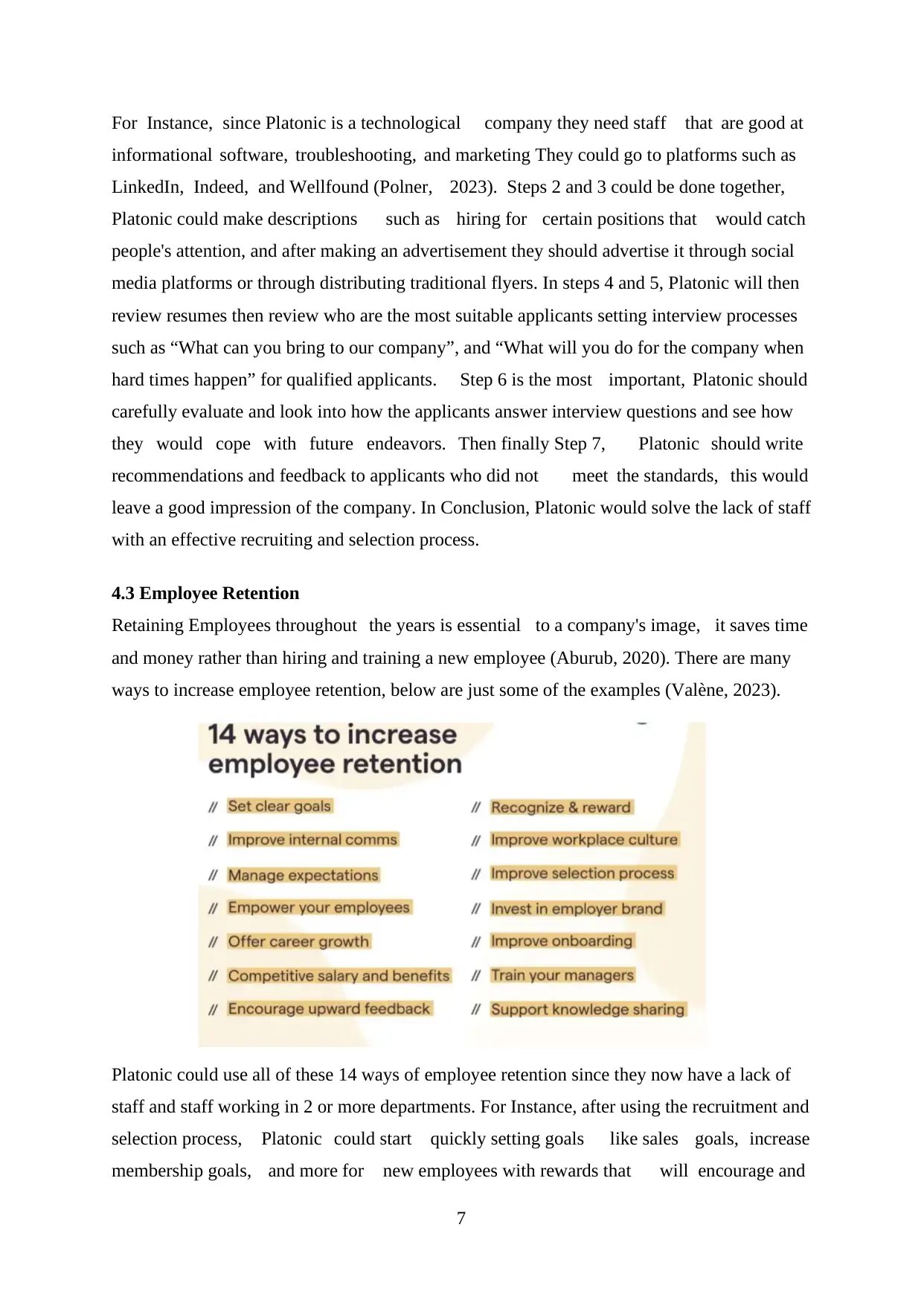
For Instance, since Platonic is a technological company they need staff that are good at
informational software, troubleshooting, and marketing They could go to platforms such as
LinkedIn, Indeed, and Wellfound (Polner, 2023). Steps 2 and 3 could be done together,
Platonic could make descriptions such as hiring for certain positions that would catch
people's attention, and after making an advertisement they should advertise it through social
media platforms or through distributing traditional flyers. In steps 4 and 5, Platonic will then
review resumes then review who are the most suitable applicants setting interview processes
such as “What can you bring to our company”, and “What will you do for the company when
hard times happen” for qualified applicants. Step 6 is the most important, Platonic should
carefully evaluate and look into how the applicants answer interview questions and see how
they would cope with future endeavors. Then finally Step 7, Platonic should write
recommendations and feedback to applicants who did not meet the standards, this would
leave a good impression of the company. In Conclusion, Platonic would solve the lack of staff
with an effective recruiting and selection process.
4.3 Employee Retention
Retaining Employees throughout the years is essential to a company's image, it saves time
and money rather than hiring and training a new employee (Aburub, 2020). There are many
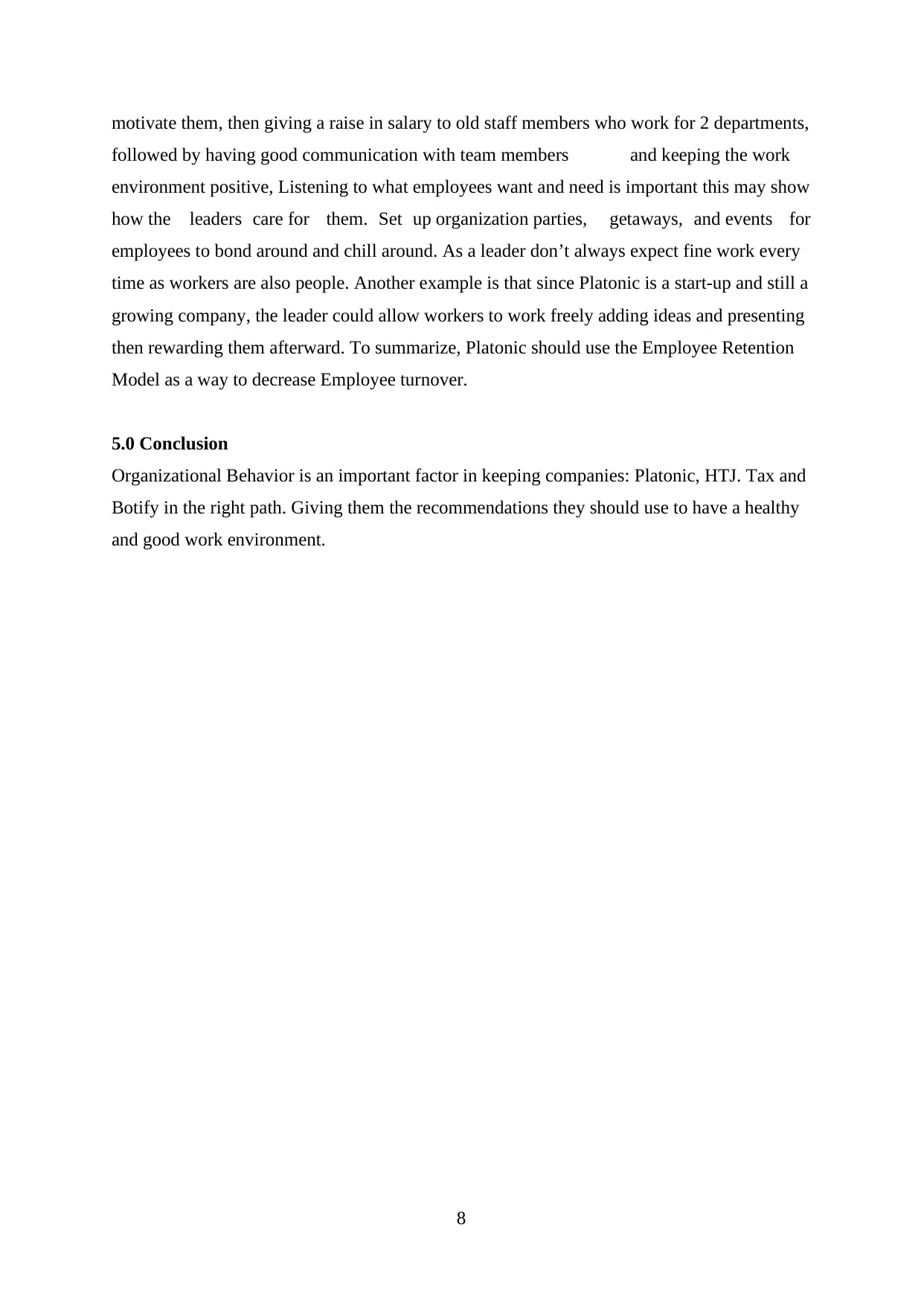
ways to increase employee retention, below are just some of the examples (Valène, 2023).
Platonic could use all of these 14 ways of employee retention since they now have a lack of
staff and staff working in 2 or more departments. For Instance, after using the recruitment and
selection process, Platonic could start quickly setting goals like sales goals, increase
membership goals, and more for new employees with rewards that will encourage and
7
informational software, troubleshooting, and marketing They could go to platforms such as
LinkedIn, Indeed, and Wellfound (Polner, 2023). Steps 2 and 3 could be done together,
Platonic could make descriptions such as hiring for certain positions that would catch
people's attention, and after making an advertisement they should advertise it through social
media platforms or through distributing traditional flyers. In steps 4 and 5, Platonic will then
review resumes then review who are the most suitable applicants setting interview processes
such as “What can you bring to our company”, and “What will you do for the company when
hard times happen” for qualified applicants. Step 6 is the most important, Platonic should
carefully evaluate and look into how the applicants answer interview questions and see how
they would cope with future endeavors. Then finally Step 7, Platonic should write
recommendations and feedback to applicants who did not meet the standards, this would
leave a good impression of the company. In Conclusion, Platonic would solve the lack of staff
with an effective recruiting and selection process.
4.3 Employee Retention
Retaining Employees throughout the years is essential to a company's image, it saves time
and money rather than hiring and training a new employee (Aburub, 2020). There are many
ways to increase employee retention, below are just some of the examples (Valène, 2023).
Platonic could use all of these 14 ways of employee retention since they now have a lack of
staff and staff working in 2 or more departments. For Instance, after using the recruitment and
selection process, Platonic could start quickly setting goals like sales goals, increase
membership goals, and more for new employees with rewards that will encourage and
7
Paraphrase This Document
Need a fresh take? Get an instant paraphrase of this document with our AI Paraphraser
motivate them, then giving a raise in salary to old staff members who work for 2 departments,
followed by having good communication with team members and keeping the work
environment positive, Listening to what employees want and need is important this may show
how the leaders care for them. Set up organization parties, getaways, and events for
employees to bond around and chill around. As a leader don’t always expect fine work every
time as workers are also people. Another example is that since Platonic is a start-up and still a
growing company, the leader could allow workers to work freely adding ideas and presenting
then rewarding them afterward. To summarize, Platonic should use the Employee Retention
Model as a way to decrease Employee turnover.
5.0 Conclusion
Organizational Behavior is an important factor in keeping companies: Platonic, HTJ. Tax and
Botify in the right path. Giving them the recommendations they should use to have a healthy
and good work environment.
8
followed by having good communication with team members and keeping the work
environment positive, Listening to what employees want and need is important this may show
how the leaders care for them. Set up organization parties, getaways, and events for
employees to bond around and chill around. As a leader don’t always expect fine work every
time as workers are also people. Another example is that since Platonic is a start-up and still a
growing company, the leader could allow workers to work freely adding ideas and presenting
then rewarding them afterward. To summarize, Platonic should use the Employee Retention
Model as a way to decrease Employee turnover.
5.0 Conclusion
Organizational Behavior is an important factor in keeping companies: Platonic, HTJ. Tax and
Botify in the right path. Giving them the recommendations they should use to have a healthy
and good work environment.
8
6.0 Reference List
Overall Motivation (2021) 65 best challenges quotes on success in life,
OverallMotivation. Available at:
https://www.overallmotivation.com/quotes/challenges-quotes/ (Accessed: 23 August
2023).
Robbins, S. and Judge, T. (2023) Organizational Behavior.19th ed. London: Pearson
Education.
Negrin, K., Slaughter, S., Dahlke, S., & Olson, J. (2022) Successful Recruitment to
Qualitative Research: A Critical Reflection. Available at:
https://doi.org/10.1177/160940692211195 (Accessed 7 September 2023).
Aburub, B.S. (2020) ‘Employee retention & engagement solution’, Open Journal
of Business and Management, 08(06), pp. 2805–2837. Available at:
doi:10.4236/ojbm.2020.86173 (Accessed 7 September 2023).
Riopel, L. (2019) The importance, benefits, and value of goal setting,
PositivePsychology.com. Available at:
https://positivepsychology.com/benefits-goal-setting/#google_vignette (Accessed: 5
September 2023).
Tocino-Smith, J. (2019) What is Locke’s goal setting theory of motivation?,
PositivePsychology.com. Available at:
https://positivepsychology.com/goal-setting-theory/#google_vignette(Tocino-Smith,
2019) (Accessed: 5 September 2023).
Manzoor, F., Wei, L. and Asif, M. (2021) ‘Intrinsic rewards and employee’s
performance with the mediating mechanism of employee’s motivation’, Frontiers in
Psychology, 12(2021). Available at: doi:10.3389/fpsyg.2021.563070. (Accessed: 7
September 2023).
9
Overall Motivation (2021) 65 best challenges quotes on success in life,
OverallMotivation. Available at:
https://www.overallmotivation.com/quotes/challenges-quotes/ (Accessed: 23 August
2023).
Robbins, S. and Judge, T. (2023) Organizational Behavior.19th ed. London: Pearson
Education.
Negrin, K., Slaughter, S., Dahlke, S., & Olson, J. (2022) Successful Recruitment to
Qualitative Research: A Critical Reflection. Available at:
https://doi.org/10.1177/160940692211195 (Accessed 7 September 2023).
Aburub, B.S. (2020) ‘Employee retention & engagement solution’, Open Journal
of Business and Management, 08(06), pp. 2805–2837. Available at:
doi:10.4236/ojbm.2020.86173 (Accessed 7 September 2023).
Riopel, L. (2019) The importance, benefits, and value of goal setting,
PositivePsychology.com. Available at:
https://positivepsychology.com/benefits-goal-setting/#google_vignette (Accessed: 5
September 2023).
Tocino-Smith, J. (2019) What is Locke’s goal setting theory of motivation?,
PositivePsychology.com. Available at:
https://positivepsychology.com/goal-setting-theory/#google_vignette(Tocino-Smith,
2019) (Accessed: 5 September 2023).
Manzoor, F., Wei, L. and Asif, M. (2021) ‘Intrinsic rewards and employee’s
performance with the mediating mechanism of employee’s motivation’, Frontiers in
Psychology, 12(2021). Available at: doi:10.3389/fpsyg.2021.563070. (Accessed: 7
September 2023).
9
⊘ This is a preview!⊘
Do you want full access?
Subscribe today to unlock all pages.
Trusted by 1+ million students worldwide
Channell, M. (2021) Vroom’s expectancy theory: How to motivate staff and increase
performance, TSW Training. Available at:
https://www.tsw.co.uk/blog/leadership-and-management/vrooms-expectancy-theory/
(Accessed: 7 September 2023).
Musheke, M.M. and Phiri, J. (2021) ‘The effects of effective communication on
organizational performance based on the systems theory’, Open Journal of Business
and Management, 09(02), pp. 659–671. Available at: doi:10.4236/ojbm.2021.92034.
(Accessed 1 September 2023).
Denomme, D. (2021) Take online courses. earn college credit. Research Schools,
Degrees & Careers, Study.com | Take Online Courses. Earn College Credit. Research
Schools, Degrees & Careers. Available at:
https://study.com/academy/lesson/what-is-written-communication-in-business-definitio
n-types-examples.html (Accessed: 12 September 2023).
Prachi, J. (no date) MSG Management Study Guide, Oral Communication - Meaning,
Advantages and Limitations. Available at:
https://www.managementstudyguide.com/oral-communication.htm (Accessed: 12
September 2023).
SoME, T. (2022) The importance of effective written communication skills - some
education, The Importance of Effective Written Communication Skills - SoME
Education Blog. Available at:
https://www.some.education/blog/effective-written-communication-and-its-importance
# (Accessed: 8 September 2023).
Madanchian, M. et al. (2017) ‘Leadership effectiveness measurement and its effect on
organization outcomes’, Procedia Engineering, 181, pp. 1043–1048. Available at:
doi:10.1016/j.proeng.2017.02.505 (Accessed: 4 September 2023).
Leadership (2022) Lewin’s leadership theory explained: Leadership and Performance
Partners, Leadership & Performance Partners. Available at:
https://leadershipandperformance.com.au/leadership-development/lewins-leadership-th
eory-explained/ (Accessed: 12 September 2023).
10
performance, TSW Training. Available at:
https://www.tsw.co.uk/blog/leadership-and-management/vrooms-expectancy-theory/
(Accessed: 7 September 2023).
Musheke, M.M. and Phiri, J. (2021) ‘The effects of effective communication on
organizational performance based on the systems theory’, Open Journal of Business
and Management, 09(02), pp. 659–671. Available at: doi:10.4236/ojbm.2021.92034.
(Accessed 1 September 2023).
Denomme, D. (2021) Take online courses. earn college credit. Research Schools,
Degrees & Careers, Study.com | Take Online Courses. Earn College Credit. Research
Schools, Degrees & Careers. Available at:
https://study.com/academy/lesson/what-is-written-communication-in-business-definitio
n-types-examples.html (Accessed: 12 September 2023).
Prachi, J. (no date) MSG Management Study Guide, Oral Communication - Meaning,
Advantages and Limitations. Available at:
https://www.managementstudyguide.com/oral-communication.htm (Accessed: 12
September 2023).
SoME, T. (2022) The importance of effective written communication skills - some
education, The Importance of Effective Written Communication Skills - SoME
Education Blog. Available at:
https://www.some.education/blog/effective-written-communication-and-its-importance
# (Accessed: 8 September 2023).
Madanchian, M. et al. (2017) ‘Leadership effectiveness measurement and its effect on
organization outcomes’, Procedia Engineering, 181, pp. 1043–1048. Available at:
doi:10.1016/j.proeng.2017.02.505 (Accessed: 4 September 2023).
Leadership (2022) Lewin’s leadership theory explained: Leadership and Performance
Partners, Leadership & Performance Partners. Available at:
https://leadershipandperformance.com.au/leadership-development/lewins-leadership-th
eory-explained/ (Accessed: 12 September 2023).
10
Paraphrase This Document
Need a fresh take? Get an instant paraphrase of this document with our AI Paraphraser
Cherry, K. (2023) 6 leadership styles and Frameworks, Verywell Mind. Available at:
https://www.verywellmind.com/leadership-styles-2795312 (Accessed: 8 September
2023).
Personio (2023) Recruitment and Selection Process: Best Practices & Overview,
Personio Blog. Available at:
https://www.personio.com/hr-lexicon/recruitment-and-selection/ (Accessed: 8
September 2023).
Stanley, N. (2021) Why effective recruitment is so important, 24 May. Available at:
https://blog.myhr.works/en-au/why-effective-recruitment-is-important (Accessed: 08
September 2023).
Polner, E. (2023) The 9 best job search websites of 2023, The Balance. Available at:
https://www.thebalancemoney.com/top-best-job-websites-2064080 (Accessed: 12
September 2023).
Valène, J. (2023) ‘6 steps to build your employees value proposition’, Employee Value
Proposition: The Complete Guide to Building a Great EVP, 20 January. Available at:
https://haiilo.com/blog/6-steps-to-build-your-employees-value-proposition/ (Accessed:
12 September 2023).
Ghodasa, A. (2023) 7 Steps in Recruitment Process: A Guide to Hire a Top Talent.
Available at:
https://www.ismartrecruit.com/blog-recruitment-process-guide-for-recruiters
(Accessed: 12 September 2023).
11
https://www.verywellmind.com/leadership-styles-2795312 (Accessed: 8 September
2023).
Personio (2023) Recruitment and Selection Process: Best Practices & Overview,
Personio Blog. Available at:
https://www.personio.com/hr-lexicon/recruitment-and-selection/ (Accessed: 8
September 2023).
Stanley, N. (2021) Why effective recruitment is so important, 24 May. Available at:
https://blog.myhr.works/en-au/why-effective-recruitment-is-important (Accessed: 08
September 2023).
Polner, E. (2023) The 9 best job search websites of 2023, The Balance. Available at:
https://www.thebalancemoney.com/top-best-job-websites-2064080 (Accessed: 12
September 2023).
Valène, J. (2023) ‘6 steps to build your employees value proposition’, Employee Value
Proposition: The Complete Guide to Building a Great EVP, 20 January. Available at:
https://haiilo.com/blog/6-steps-to-build-your-employees-value-proposition/ (Accessed:
12 September 2023).
Ghodasa, A. (2023) 7 Steps in Recruitment Process: A Guide to Hire a Top Talent.
Available at:
https://www.ismartrecruit.com/blog-recruitment-process-guide-for-recruiters
(Accessed: 12 September 2023).
11
Part 2
Step 1: Description
After finishing the TFOW module, I learned that an obstacle is always on the block in every
success. We were tasked to do an individual report that involved public speech and reporting,
We then were given a lot of time to interview and start writing. I expected it to be hard as I
was hesitating to approach random people to interview. But Mr. Dispan pushed and told us to
eventually do it so we would not rush it towards the deadline. Some of the recommendations
I learned were to have good oral and written communication with people, help and guide
people around you. These are the few things I have learned in the TFOW Module
Step 2: Feelings
During the Starting week of TFOW, we met our Foreign Lecturer Mr. Eric. I found him
interesting as he always comes to class in a strict and orderly manner, and he does not tolerate
people who are late for class. I expected that I would not understand a lot of terms and
definitions, I expected that the module would be hard, and I expected the assignment would
be hard to do. But with the help of Mr. Dipan everything was smooth, he explained it so well
and made the module as fun as possible, He interacted with each one of us and made sure we
understood everything clearly. I thank Mr. Dipan for pushing us to the Maximum.
Stage 3: Evaluation
During the Interviewing and Writing part of the paper, I found it interesting as the expatriates
enjoyed answering the questions they were all friendly and willing to help me, and the
problem that was said to me was a realization that I should prepare for a competitive
workplace. The part that I didn’t like was when Mr. Eric would show Video Slides that were
not really clear to understand, but I still appreciate the 1 week with him and how he shared
his journey.
Stage 4: Analysis
I feel like the interview and writing of the essay went well because. First of all, there is a
goal, just like in Chapter 7 which talked about Locke’s Goal-Setting Theory The deadline
was the goal that motivated me. Secondly, The pushing of Mr. Dipan the way he discussed
the slides, and how he told us that this certain chapter could be used as a recommendation.
Also the Need of Achievement, where I planned to do well in this module.
12
Step 1: Description
After finishing the TFOW module, I learned that an obstacle is always on the block in every
success. We were tasked to do an individual report that involved public speech and reporting,
We then were given a lot of time to interview and start writing. I expected it to be hard as I
was hesitating to approach random people to interview. But Mr. Dispan pushed and told us to
eventually do it so we would not rush it towards the deadline. Some of the recommendations
I learned were to have good oral and written communication with people, help and guide
people around you. These are the few things I have learned in the TFOW Module
Step 2: Feelings
During the Starting week of TFOW, we met our Foreign Lecturer Mr. Eric. I found him
interesting as he always comes to class in a strict and orderly manner, and he does not tolerate
people who are late for class. I expected that I would not understand a lot of terms and
definitions, I expected that the module would be hard, and I expected the assignment would
be hard to do. But with the help of Mr. Dipan everything was smooth, he explained it so well
and made the module as fun as possible, He interacted with each one of us and made sure we
understood everything clearly. I thank Mr. Dipan for pushing us to the Maximum.
Stage 3: Evaluation
During the Interviewing and Writing part of the paper, I found it interesting as the expatriates
enjoyed answering the questions they were all friendly and willing to help me, and the
problem that was said to me was a realization that I should prepare for a competitive
workplace. The part that I didn’t like was when Mr. Eric would show Video Slides that were
not really clear to understand, but I still appreciate the 1 week with him and how he shared
his journey.
Stage 4: Analysis
I feel like the interview and writing of the essay went well because. First of all, there is a
goal, just like in Chapter 7 which talked about Locke’s Goal-Setting Theory The deadline
was the goal that motivated me. Secondly, The pushing of Mr. Dipan the way he discussed
the slides, and how he told us that this certain chapter could be used as a recommendation.
Also the Need of Achievement, where I planned to do well in this module.
12
⊘ This is a preview!⊘
Do you want full access?
Subscribe today to unlock all pages.
Trusted by 1+ million students worldwide

1 out of 19


Your All-in-One AI-Powered Toolkit for Academic Success.
+13062052269
info@desklib.com
Available 24*7 on WhatsApp / Email
![[object Object]](/_next/static/media/star-bottom.7253800d.svg)
Unlock your academic potential
Copyright © 2020–2026 A2Z Services. All Rights Reserved. Developed and managed by ZUCOL.