UCLAN Microbiology Lab: Identification of Unknown Microorganisms

Verified

Added on  2023/04/20

|8
|1804
|438
Practical Assignment
AI Summary
This microbiology practical assignment focuses on the identification of unknown organisms from bacterial cultures using various methods. The experiments involve growing cultures on selective media like blood agar, performing Gram staining to differentiate between Gram-positive and Gram-negative bacteria, and conducting Analytical Profile Index (API) tests for species identification. The practical details the materials and methods used, including serial dilutions, inoculation techniques, and microscopic observations. Results from staining and API tests are analyzed to identify potential bacterial strains, with a discussion on possible errors and limitations of the methods. The apprehended organism was Streptococcus. The report concludes by referencing relevant studies and sources, providing a comprehensive overview of the process of bacterial identification in a laboratory setting. Desklib offers a variety of solved assignments and study tools for students.
Document Page
Running head: MICROBIOLOGY
Topic: MICROBIOLOGY
Name of the Student:
Name of the University:
Author Note:
tabler-icon-diamond-filled.svg

Paraphrase This Document

Need a fresh take? Get an instant paraphrase of this document with our AI Paraphraser
Document Page
1MICROBIOLOGY
Introduction
The following studies are conducted with the primary aim of identification of
unknown organisms from the given bacterial cultures. From the materials and methods of the
following practices, determination of microorganism and their ability of growing on various
selective media will be determined. Such ability of growth often acts as an indication of the
vivid properties pertaining to physiology and morphology of the organisms which include
gram negative as well as gram positive organisms. Some organisms also have shown the
property of changing their shapes under various conditions thus showing the phenomenon of
pleiotropy which is absent in the samples taken. Colony morphology is another important
characteristic which will be determined from the following experiments. These practical also
deal with determination of the gram character of the organisms pertaining to microscopy.
Bacterial cultures are usually different according to their biochemical properties as well as
cellular shapes. Biochemical properties is another area of determination of the
microorganisms which will be gradually determined with the help of various tests. Analytical
profile index have been used for the identification of the bacteria. It is a classification of
microorganism which is based on various experiments allowing quick identification. The
system facilitates the identification of bacterial species which are clinically relevant. This
system has been developed first by Pierre Janine and mainly is a miniaturized version
inclusive of identification of a number of Streptococci. It allows the identification of various
gram negative bacteria. For identification of the microorganisms they have been grown in
blood agar which is an enriched medium ideal or bacterial growth .The use of blood agar
helps in the process of hemolysis which is important for the subsequent steps an d it increases
the growth of various Streptococci apart from the growth on catalase The most cultures for
identification of streptococcus has been oral and throat cultures (Speller erg and Brandt.
2016). Moreover, fastidious bacteria are not known for growing in required media blood agar
Document Page
2MICROBIOLOGY
which is usually known for the growth of Streptococci strains. Aerobic or anaerobic bacteria
are also a major source of differential growth in medium in this context (Dionne et al. 2016).
Blood is usually inhibitor for the growth of organisms like Hemophilic as well as Neisseria.
The given blood agar should be heated in order to inactivate the inhibitors and for the releases
of essential growth factors although excess heating converts it to chocolate agar where the
growth of Streptococci like strains will be encouraged (microbeonline.com, 2019). Thus the
various process like growth of culture medium in differential as well as staining procedure
followed by API test for Streptococci have been performed for the growth of the given
bacteria and their subsequent identification of organisms (biomerieux-usa.com, 2019).
Moreover easy surface checking (ESC) has been done with swab range inclusive of a number
of sampling devices which are used for mainly examining the microbiological surface of the
aforementioned microorganisms,. These kind of tests are mainly used for the pharmaceutical
and food industries. They give accurate results and convenient to use at room temperatures.
In the given practical Streptococcus species have been apprehended as the identifiable
organisms which are mainly found in infections pertaining to tooth decay as they are common
inhabitants of the oral cavity (Aziza et al. 2016).
Materials and methods
The whole practical was done in four phases and the results were recorded within 4
days after observing the results.
For the first day, experiments were performed regarding growth of the organisms in
various media to check in which media the growth of microorganisms were seen. It was
implemented using blood agar as it is a differential media allowing the growth of organisms
like Streptococci which has been apprehended as the observable strains. Growth of the
organism is essential for separating the bacteria among the rest of the bacterial cultures. The
dilution stock has been taken and dilutions have been done in reference to the mother culture.
Document Page
3MICROBIOLOGY
Dilutions of 10000 has been done for the bacterial cultures. After serial dilutions to the
required amount, 0.1ml has been taken and streaked on plates containing differential media.
Then they were kept in the incubator at normal temperature and related conditions.
For the second day, observations were done after 24 hours of growth of the
aforementioned organism in culture plates. After identification by streaking of the unknown
organism in culture plates for the differential growth of the organism, staining was done.
Staining methods have been employed primarily for the differentiation between gram positive
as well as gram negative organisms. For gram staining, first the slides were heat dried and
sterilised with alcohol. Then bacterial smears were done followed by heat fixing which was
followed by application of the crystal violet considered as the primary stain. This has been
followed by the addition of gram iodine for removal of the excess stain form the organism
which has been followed by the use of counterstain, saffranin. The results depend on the kind
of stain taken by the organism. If the stain is red then it confirms the presence of gram
negative other than that of gram positive organisms where violet stains are taken. Then the
results were observed under the microscope at 40X and 100 X magnification.
For the third day tests for API has been done for the identification of the unknown
organisms based on the results of the previous day. There are 20 strips for the inoculations of
various organisms. After the identification of the given organism, streptococci in this case,
and the type of haemolysis has to be noted on the result sheet. Then after picking a colony
which is well isolated from others, suspension is done in 0.3 ml of sterile work. Columbia
sheep blood agar plate is used and aseptically a swab is taken on the entire surface, then
incubation of the plate is done for two hours. Since apprehended organisms of Streptococci
grow at a much faster rate, enterococci and streptococci colonies are taken after 24 hours of
incubations only. Sometimes, two plates are used for obtaining a sustained growth.
tabler-icon-diamond-filled.svg

Paraphrase This Document

Need a fresh take? Get an instant paraphrase of this document with our AI Paraphraser
Document Page
4MICROBIOLOGY
For the fourth and final day, observations were made regarding the growth on API
and the tests done for the differentiation of bacteria. It has been seen that the bacteria has
grown well in blood agar which is a confirmative test for organisms like Streptococci after
normal incubation for more than 24 hours in the incubator.
Observations
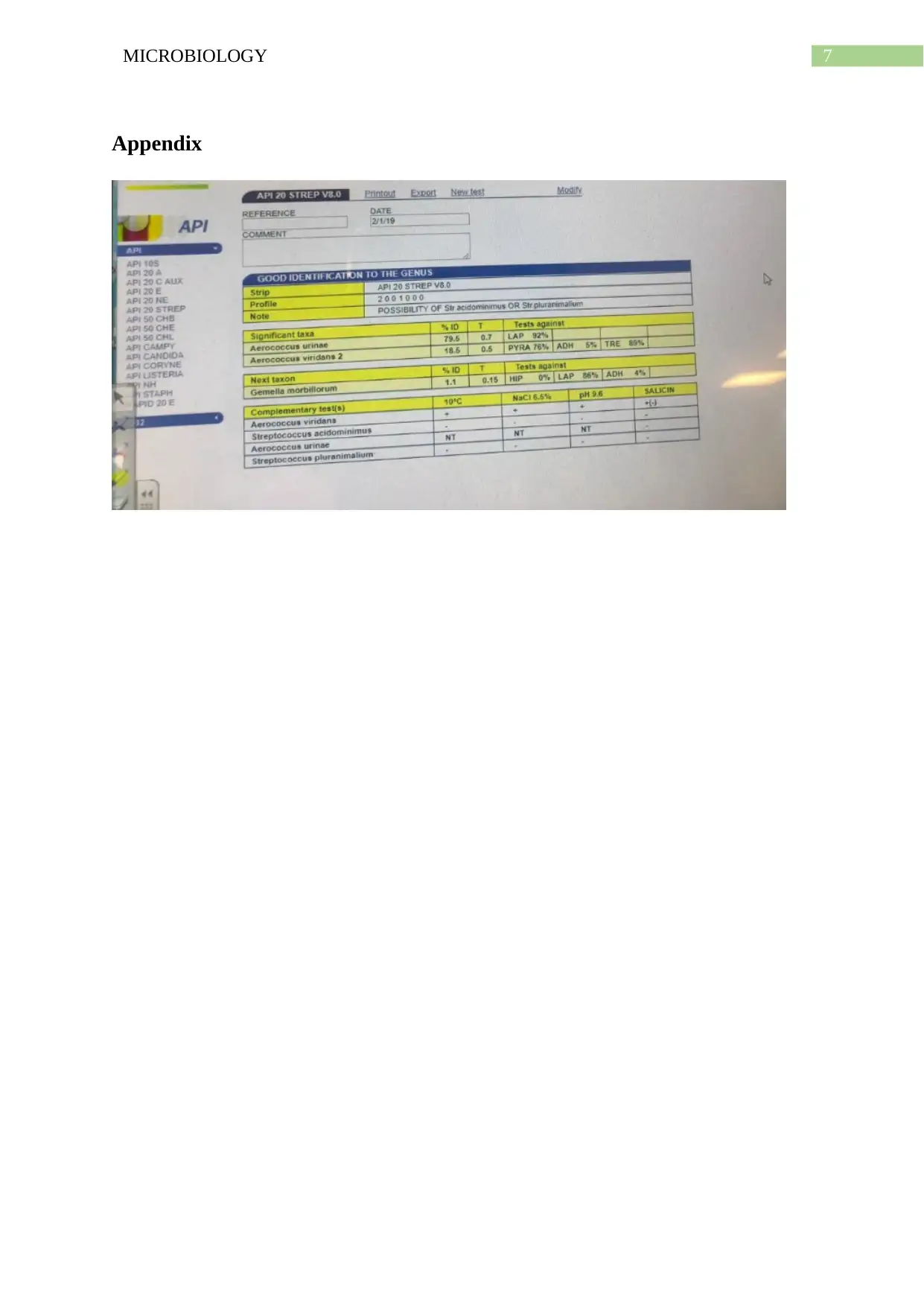
Staining experiments have shown the organism to be gram negative from the results
of the staining procedures taking up counter strain as well as from the morphologies seen
from the microscope. From the reports of the API test similarity has been shown between the
strains of Aerococcus showing 79.5as well as 18.6% respectively. There has seen 5% of ADH
as seen from the API reports. Aerococcus strains are the only two strains of significance as
seen from the reports. According to the reports of the complementary tests it can see that
areococcus viridans strains have shown positive growth in 6.5% of NaCl. More it has been
proved to show a prevalence of pH of more than 9. Moreover streptococcus acid minus
species have shown absence in Nalco and a significant change in pH long wither absence of
growth in Salicin. The tests from the results of Streptococcus pluranimalium has shown
similarity with the strains of the other species of Streptococcus showing absence in all the
possible strains and media like Nail and Salicylic. From the strips of 20 substrates used for
the various identification of diverse organisms it can be seen that that there as a positive
indication for ADH which shows a bright red colour. Others vials have not shown any
distinct change in colour and are rather colourless.
Results
From the observations it can be seen that since the organisms has grown
positively in media containing differential media like blood agar apprehending that the given
organism may be Streptococci. Gram staining methods show the results that the apprehended
organism are gram negative as they given positive affirmations for strains including gram
Document Page
5MICROBIOLOGY
negative organism. Moreover, it has also be seen that the API tests which has been conducted
show the prevalence of the organism mainly belonging to the strains of Streptococci.
Moreover two colonies of the strains of streptococci has the shown the positive results. It has
been found that the strains might not have been identified as streptococcus due to a variety of
reasons. Staining method might have gone wrong due to over application of the primary
strain which might have eclipsed the stain by saffranin. Moreover there might be
contamination while obtaining a pure culture which might lead to incorrect results. API tests
might have gone wrong if contaminations were there which might be present due to improper
lab conditions and faulty sterilization methods. Errors might also occur if the organism do not
stay in the strips for the API tests for long period enough to give a proper result.
Document Page
6MICROBIOLOGY
References
Aziza, A., Agbayani, S., Zakary, S., Shaker, M., Endear, N. and Leaf, S., 2015. In vitro effect
of zingier officinal extract on growth of Streptococcus mutants and Streptococcus
sanguine. International journal of dentistry, 2015.
Biomerieux-usa.com 2019. API®. [Online] bioMérieux. Available at:
https://www.biomerieux-usa.com/clinical/api [Accessed 8 Feb. 2019].
Dione, N., Khelaifia, S., La Scola, B., Lagier, J.C. and Raoult, D., 2016. A quasi-universal
medium to break the aerobic/anaerobic bacterial culture dichotomy in clinical
microbiology. Clinical Microbiology and Infection, 22(1), pp.53-58.
microbeonline.com 2019. Blood Agar: Composition, Preparation, Uses and Types of
Haemolysis -. [Online] Microbeonline.com. Available at: https://microbeonline.com/blood-
agar-composition-preparation-uses-and-types-of-hemolysis/ [Accessed 8 Feb. 2019].
Spellerberg, B. and Brandt, C., 2016. Laboratory Diagnosis of Streptococcus pyogenes
(group A streptococci).
tabler-icon-diamond-filled.svg

Paraphrase This Document

Need a fresh take? Get an instant paraphrase of this document with our AI Paraphraser
Document Page
7MICROBIOLOGY
Appendix
chevron_up_icon
1 out of 8
circle_padding
hide_on_mobile
zoom_out_icon
[object Object]