Comprehensive Analysis of the UK Aviation Safety Policy and Strategy
VerifiedAdded on 2022/08/09
|14
|3102
|35
Report
AI Summary
This report provides a detailed analysis of the UK Aviation Safety Policy, examining its structure, strategies, and impact on the aviation industry. It begins with a description of the policy and its objectives, followed by an application of various strategic frameworks such as the Ansoff Matrix, PESTEL analysis, Boston Matrix, Porter's Five Forces, Mintzberg's 5Ps, Bowman's Strategic Clock, and Blue Ocean Strategy. The report evaluates the policy's strengths, weaknesses, and competitive position within the industry, considering factors like market penetration, product development, political, economic, sociological, technological, legal, and environmental influences. Core competencies, including safety, flexibility, and teamwork, are also discussed. The analysis concludes with insights into the policy's effectiveness and recommendations for future development, emphasizing the importance of security and safety in the aviation sector.
Running head: AVIATION POLICY AND STRATEGY
Aviation Policy and Strategy: UK Aviation Safety Policy
Name of the Student
Name of the University
Author’s Note:
Aviation Policy and Strategy: UK Aviation Safety Policy
Name of the Student
Name of the University
Author’s Note:

Paraphrase This Document
Need a fresh take? Get an instant paraphrase of this document with our AI Paraphraser
1
AVIATION POLICY AND STRATEGY
Aviation Policy and Strategy
Aviation or air transport are the major activities that surround the entire mechanical
flight as well as the aircraft industry. This particular industry provides the only rapid
worldwide transportation network that eventually makes it quite important and significant for
the globalized business. It is also responsible for generating economic growth, facilitation of
international trade or tourism and also for creation of jobs (Albers et al. 2017). As a result,
safety and security of aviation is highly mandatory, since it keeps the passenger at ease
during flying. For this purpose, it is required to implement few policies and strategies, which
would ensure high security without much complexity. The following essay outlines about a
popular and significant aviation policy, called UK aviation safety policy.
1. Description of the UK Aviation Safety Policy
The UK State Safety Programme or SSP subsequently sets out the process of UK
approaches towards aviation safety. It has been set up for protecting different people from
several aviation security threats and also for maintenance of the UK as one of the most
secured aviation systems within the world (See Appendix). This specific policy is committed
for reinforcing the position of the United Kingdom as the globalized leader for security of
aviation. Moreover, it continuously improves aviation safety with the help of collaborative
working even with the international partners.
2. Ansoff Matrix
The Ansoff matrix is also referred to as the product or market expansion grid. It is a
specific tool that is being utilized by different organizations for the core purpose of analysing
and planning their subsequent strategies for maximum growth and development.
AVIATION POLICY AND STRATEGY
Aviation Policy and Strategy
Aviation or air transport are the major activities that surround the entire mechanical
flight as well as the aircraft industry. This particular industry provides the only rapid
worldwide transportation network that eventually makes it quite important and significant for
the globalized business. It is also responsible for generating economic growth, facilitation of
international trade or tourism and also for creation of jobs (Albers et al. 2017). As a result,
safety and security of aviation is highly mandatory, since it keeps the passenger at ease
during flying. For this purpose, it is required to implement few policies and strategies, which
would ensure high security without much complexity. The following essay outlines about a
popular and significant aviation policy, called UK aviation safety policy.
1. Description of the UK Aviation Safety Policy
The UK State Safety Programme or SSP subsequently sets out the process of UK
approaches towards aviation safety. It has been set up for protecting different people from
several aviation security threats and also for maintenance of the UK as one of the most
secured aviation systems within the world (See Appendix). This specific policy is committed
for reinforcing the position of the United Kingdom as the globalized leader for security of
aviation. Moreover, it continuously improves aviation safety with the help of collaborative
working even with the international partners.
2. Ansoff Matrix
The Ansoff matrix is also referred to as the product or market expansion grid. It is a
specific tool that is being utilized by different organizations for the core purpose of analysing
and planning their subsequent strategies for maximum growth and development.
2
AVIATION POLICY AND STRATEGY
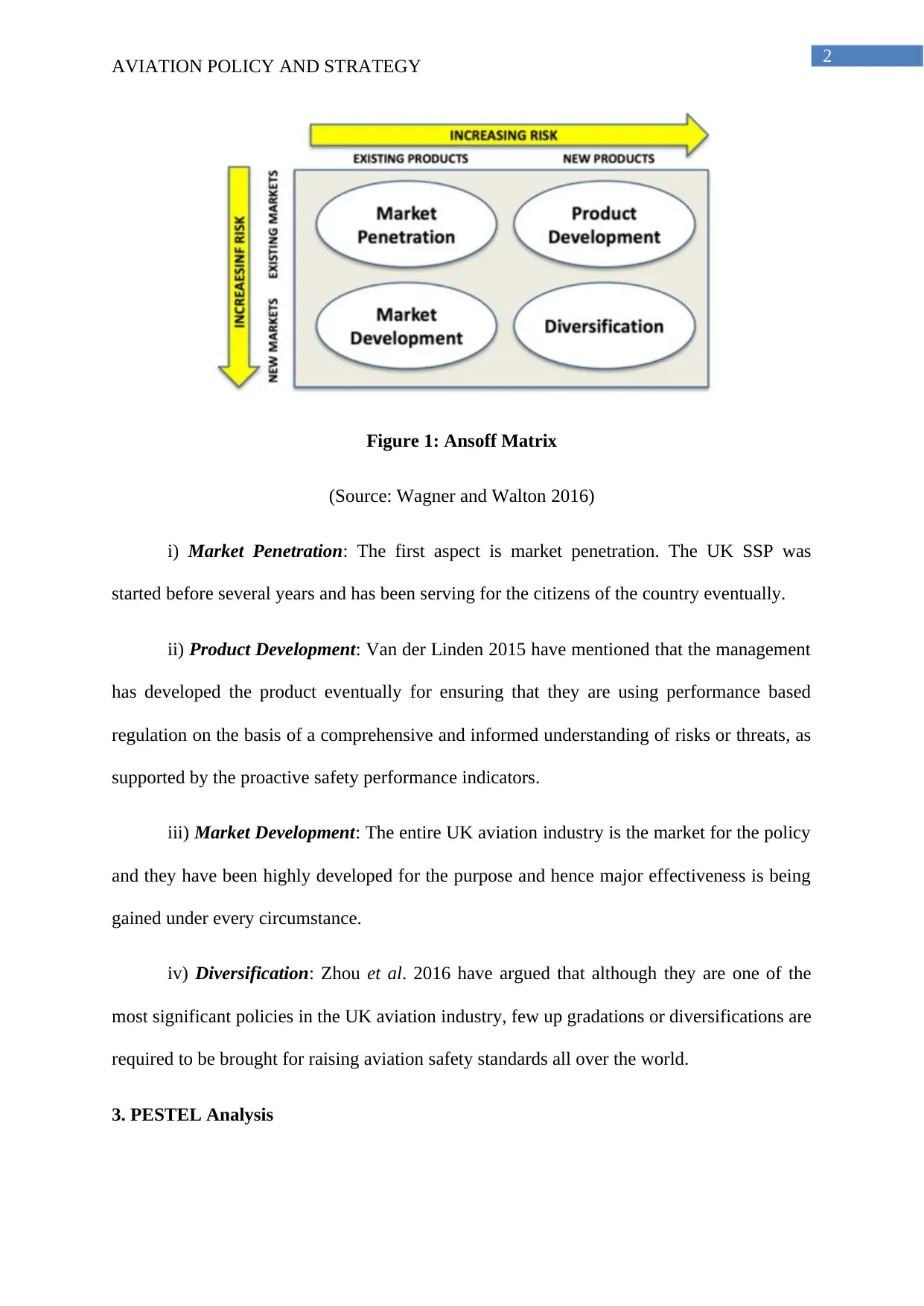
Figure 1: Ansoff Matrix
(Source: Wagner and Walton 2016)
i) Market Penetration: The first aspect is market penetration. The UK SSP was
started before several years and has been serving for the citizens of the country eventually.
ii) Product Development: Van der Linden 2015 have mentioned that the management
has developed the product eventually for ensuring that they are using performance based
regulation on the basis of a comprehensive and informed understanding of risks or threats, as
supported by the proactive safety performance indicators.
iii) Market Development: The entire UK aviation industry is the market for the policy
and they have been highly developed for the purpose and hence major effectiveness is being
gained under every circumstance.
iv) Diversification: Zhou et al. 2016 have argued that although they are one of the
most significant policies in the UK aviation industry, few up gradations or diversifications are
required to be brought for raising aviation safety standards all over the world.
3. PESTEL Analysis
AVIATION POLICY AND STRATEGY
Figure 1: Ansoff Matrix
(Source: Wagner and Walton 2016)
i) Market Penetration: The first aspect is market penetration. The UK SSP was
started before several years and has been serving for the citizens of the country eventually.
ii) Product Development: Van der Linden 2015 have mentioned that the management
has developed the product eventually for ensuring that they are using performance based
regulation on the basis of a comprehensive and informed understanding of risks or threats, as
supported by the proactive safety performance indicators.
iii) Market Development: The entire UK aviation industry is the market for the policy
and they have been highly developed for the purpose and hence major effectiveness is being
gained under every circumstance.
iv) Diversification: Zhou et al. 2016 have argued that although they are one of the
most significant policies in the UK aviation industry, few up gradations or diversifications are
required to be brought for raising aviation safety standards all over the world.
3. PESTEL Analysis
⊘ This is a preview!⊘
Do you want full access?
Subscribe today to unlock all pages.

Trusted by 1+ million students worldwide
3
AVIATION POLICY AND STRATEGY
i) Political: Kim, Jo and Shin 2015 have stated that the specific political environment,
where the aviation industry is operating is extremely regulated and ensures high safety to
both to the employees and customers. It is because of the fact the UK aviation industry
eventually operates in a safe environment and the policy of UK SSP is highly effective.
ii) Economic: The UK aviation industry is under certain economic downfall and
hence the economic factor is highly significant for the business. The SSP policy can ensure
greater consolidation amongst the aviation sectors, since they leverage the overall efficiency
from the economies of scale.
iii) Sociological: The emergence of new features towards safety and security has
made sure that the sociological aspects of the UK aviation industry (Lumpé 2016). The
profile of the passengers has changed with more economically minded employees for
fulfilling the demands.
iv) Technological: Different technological aspects are being considered on top
priority, so that each and every aspect related to issue with technology management is
resolved. Such security is required for ensuring high aviation safety with the program in the
UK.
v) Legal: Mediratta, Ahluwalia and Yeo 2016 have argued that the UK aviation
industry is following all types of laws and regulations that are needed to be fulfilled for
increasingly maintaining success in the aviation industry without much complexity. The
policy is being created after proper execution of legal strategies.
vi) Environmental: Since it is the part of the UK aviation industry, the policy is being
created after maintenance of environmental aspects and fulfilling corporate social
responsibility.
4. Boston Matrix
AVIATION POLICY AND STRATEGY
i) Political: Kim, Jo and Shin 2015 have stated that the specific political environment,
where the aviation industry is operating is extremely regulated and ensures high safety to
both to the employees and customers. It is because of the fact the UK aviation industry
eventually operates in a safe environment and the policy of UK SSP is highly effective.
ii) Economic: The UK aviation industry is under certain economic downfall and
hence the economic factor is highly significant for the business. The SSP policy can ensure
greater consolidation amongst the aviation sectors, since they leverage the overall efficiency
from the economies of scale.
iii) Sociological: The emergence of new features towards safety and security has
made sure that the sociological aspects of the UK aviation industry (Lumpé 2016). The
profile of the passengers has changed with more economically minded employees for
fulfilling the demands.
iv) Technological: Different technological aspects are being considered on top
priority, so that each and every aspect related to issue with technology management is
resolved. Such security is required for ensuring high aviation safety with the program in the
UK.
v) Legal: Mediratta, Ahluwalia and Yeo 2016 have argued that the UK aviation
industry is following all types of laws and regulations that are needed to be fulfilled for
increasingly maintaining success in the aviation industry without much complexity. The
policy is being created after proper execution of legal strategies.
vi) Environmental: Since it is the part of the UK aviation industry, the policy is being
created after maintenance of environmental aspects and fulfilling corporate social
responsibility.
4. Boston Matrix
Paraphrase This Document
Need a fresh take? Get an instant paraphrase of this document with our AI Paraphraser
4
AVIATION POLICY AND STRATEGY
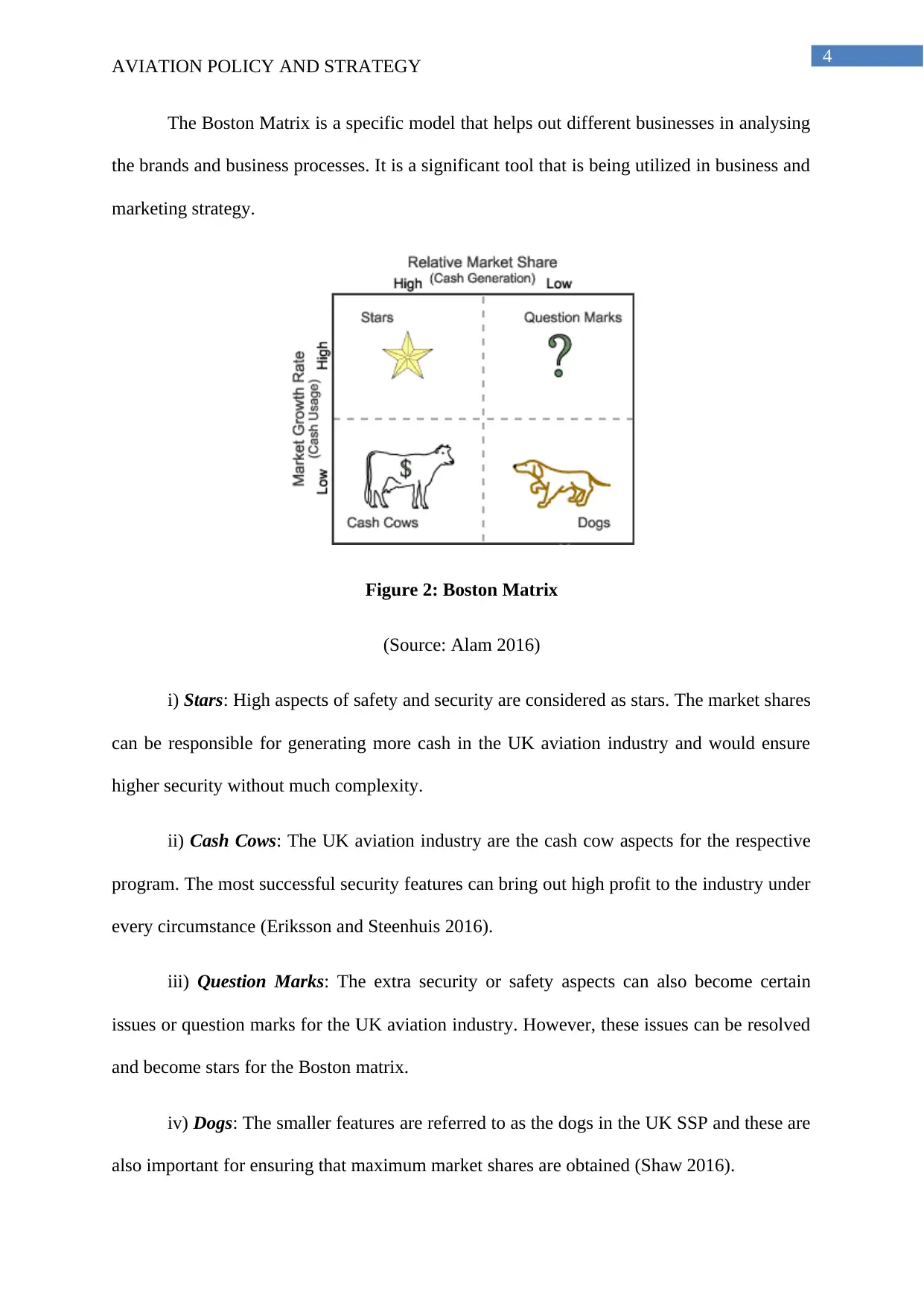
The Boston Matrix is a specific model that helps out different businesses in analysing
the brands and business processes. It is a significant tool that is being utilized in business and
marketing strategy.
Figure 2: Boston Matrix
(Source: Alam 2016)
i) Stars: High aspects of safety and security are considered as stars. The market shares
can be responsible for generating more cash in the UK aviation industry and would ensure
higher security without much complexity.
ii) Cash Cows: The UK aviation industry are the cash cow aspects for the respective
program. The most successful security features can bring out high profit to the industry under
every circumstance (Eriksson and Steenhuis 2016).
iii) Question Marks: The extra security or safety aspects can also become certain
issues or question marks for the UK aviation industry. However, these issues can be resolved
and become stars for the Boston matrix.
iv) Dogs: The smaller features are referred to as the dogs in the UK SSP and these are
also important for ensuring that maximum market shares are obtained (Shaw 2016).
AVIATION POLICY AND STRATEGY
The Boston Matrix is a specific model that helps out different businesses in analysing
the brands and business processes. It is a significant tool that is being utilized in business and
marketing strategy.
Figure 2: Boston Matrix
(Source: Alam 2016)
i) Stars: High aspects of safety and security are considered as stars. The market shares
can be responsible for generating more cash in the UK aviation industry and would ensure
higher security without much complexity.
ii) Cash Cows: The UK aviation industry are the cash cow aspects for the respective
program. The most successful security features can bring out high profit to the industry under
every circumstance (Eriksson and Steenhuis 2016).
iii) Question Marks: The extra security or safety aspects can also become certain
issues or question marks for the UK aviation industry. However, these issues can be resolved
and become stars for the Boston matrix.
iv) Dogs: The smaller features are referred to as the dogs in the UK SSP and these are
also important for ensuring that maximum market shares are obtained (Shaw 2016).
5
AVIATION POLICY AND STRATEGY
5. Porter’s Five Forces Analysis
This particular methodology and tool is required for analysis of the external
environment, where the industry of UK aviation is operating.
i) Supplier Power: This particular supplier power is extremely high and all the aspects
for safety, such as fuel, labour and aircraft are being affected by the external environment for
UK SSP.
ii) Buyer Power: Wong and Brooks 2015 have mentioned that with the proliferation
of online services and systems, the customers are highly impacted and the business gains
maximum effectiveness without much complexity. The requirements of safety aspects are
also included on top priority.
iii) Exit and Entry Barriers: There is also a chance for exit and entry barriers as these
could be extremely vulnerable for the entire industry. However, Bieger and Agosti 2017
argued that, one of the major barriers in this aspect is that the security and safety features
might be affected major and the industry would not be able to manage it successfully.
Furthermore, the respective industry leverages the efficiencies and then synergies from
several economies of scale. As a result, it can be concluded that the entry barriers are quite
high.
iv) Competitive Rivalry: High competition with several other industries in the rest of
the world can create high competitive rivalry for the UK aviation industry and the respect
policy. Apart from this particular policy, there are few other strategies and policies as well,
which are responsible for bringing out maximum competition in the industry and can produce
more security to the clients and employees.
v) Threat of Substitutes: There is also a high chance for threat of substitutes of
different policies and strategies related to security and safety in the UK aviation industry.
AVIATION POLICY AND STRATEGY
5. Porter’s Five Forces Analysis
This particular methodology and tool is required for analysis of the external
environment, where the industry of UK aviation is operating.
i) Supplier Power: This particular supplier power is extremely high and all the aspects
for safety, such as fuel, labour and aircraft are being affected by the external environment for
UK SSP.
ii) Buyer Power: Wong and Brooks 2015 have mentioned that with the proliferation
of online services and systems, the customers are highly impacted and the business gains
maximum effectiveness without much complexity. The requirements of safety aspects are
also included on top priority.
iii) Exit and Entry Barriers: There is also a chance for exit and entry barriers as these
could be extremely vulnerable for the entire industry. However, Bieger and Agosti 2017
argued that, one of the major barriers in this aspect is that the security and safety features
might be affected major and the industry would not be able to manage it successfully.
Furthermore, the respective industry leverages the efficiencies and then synergies from
several economies of scale. As a result, it can be concluded that the entry barriers are quite
high.
iv) Competitive Rivalry: High competition with several other industries in the rest of
the world can create high competitive rivalry for the UK aviation industry and the respect
policy. Apart from this particular policy, there are few other strategies and policies as well,
which are responsible for bringing out maximum competition in the industry and can produce
more security to the clients and employees.
v) Threat of Substitutes: There is also a high chance for threat of substitutes of
different policies and strategies related to security and safety in the UK aviation industry.
⊘ This is a preview!⊘
Do you want full access?
Subscribe today to unlock all pages.
Trusted by 1+ million students worldwide
6
AVIATION POLICY AND STRATEGY
There exists different parameters and features of the UK SSP that could have major
substitution in the developing countries and could easily enter into the market without much
issue.
6. Mintzberg’s 5P’s Strategy
The aviation safety policy complies with the international safety requirements and
make sure that if any type of difference is present, the respective reasons should be well
understood (Eschen et al. 2018). Furthermore, this particular aviation safety policy of the UK
ensures that a world class aviation infrastructure is being considered on top priority after
inclusion of airports, air traffic service and airspace. The 5Ps strategy of Mintzberg provides
a clear understanding of 5 distinct factors, which are as follows:
i) Plan: Planning is the most vital aspect for any particular strategy or program.
Several issues can be easily identified by proper planning. The UK SSP has been made after
well planning by the members of the UK aviation industry and hence it has become
extremely successful.
ii) Ploy: Strategy should also be used after plotting major disruptions and hence
getting better results from the competitors to ensure that they are discouraged subsequently
(Koroglu and Eceral 2015).
iii) Pattern: A proper pattern of actions is needed to be plotted for building a strategic
advantage and ensuring highly responsive customer support procedure. The policy is also
required to be maintained properly for ensuring a proper approach towards strategic planning.
iv) Position: This particular aspect is required for defining strategy and hence helping
to explore the most subsequent fit within the business and the environment for proper
development of a sustainable competitive advantage.
AVIATION POLICY AND STRATEGY
There exists different parameters and features of the UK SSP that could have major
substitution in the developing countries and could easily enter into the market without much
issue.
6. Mintzberg’s 5P’s Strategy
The aviation safety policy complies with the international safety requirements and
make sure that if any type of difference is present, the respective reasons should be well
understood (Eschen et al. 2018). Furthermore, this particular aviation safety policy of the UK
ensures that a world class aviation infrastructure is being considered on top priority after
inclusion of airports, air traffic service and airspace. The 5Ps strategy of Mintzberg provides
a clear understanding of 5 distinct factors, which are as follows:
i) Plan: Planning is the most vital aspect for any particular strategy or program.
Several issues can be easily identified by proper planning. The UK SSP has been made after
well planning by the members of the UK aviation industry and hence it has become
extremely successful.
ii) Ploy: Strategy should also be used after plotting major disruptions and hence
getting better results from the competitors to ensure that they are discouraged subsequently
(Koroglu and Eceral 2015).
iii) Pattern: A proper pattern of actions is needed to be plotted for building a strategic
advantage and ensuring highly responsive customer support procedure. The policy is also
required to be maintained properly for ensuring a proper approach towards strategic planning.
iv) Position: This particular aspect is required for defining strategy and hence helping
to explore the most subsequent fit within the business and the environment for proper
development of a sustainable competitive advantage.
Paraphrase This Document
Need a fresh take? Get an instant paraphrase of this document with our AI Paraphraser
7
AVIATION POLICY AND STRATEGY
v) Perspective: Different perspectives are needed to be considered for understanding
the success factor of the aviation policy of the UK SSP (Henriksen and Ponte 2018). Risks
are eradicated by this specific approach with several innovative products and strategies.
7. Bowman’s Strategic Clock
The policy is also responsible for targeting as well as coordinating proportionate
regulatory oversight as well as intervention based on risk exposure or safety performance.
Khalil 2017 have stated that proper co-operation and resources are required to be managed
within stakeholders for delivering the best outcomes for the UK citizens and then actively
seek out the emerging risks and undertake proactive actions for minimizing the effect over
the aviation system. As a result, the respective UK SSP promotes a positive safety culture
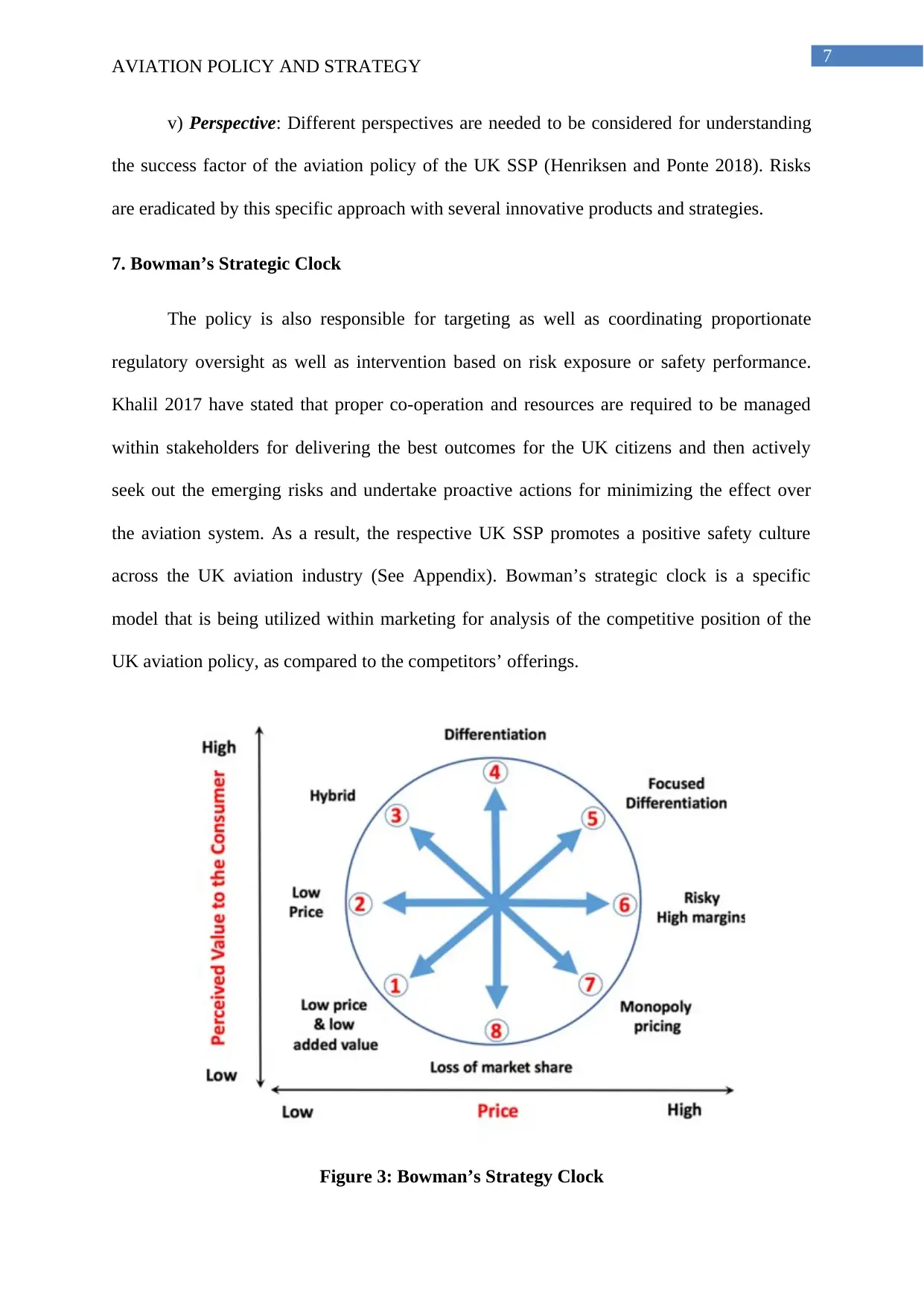
across the UK aviation industry (See Appendix). Bowman’s strategic clock is a specific
model that is being utilized within marketing for analysis of the competitive position of the
UK aviation policy, as compared to the competitors’ offerings.
Figure 3: Bowman’s Strategy Clock
AVIATION POLICY AND STRATEGY
v) Perspective: Different perspectives are needed to be considered for understanding
the success factor of the aviation policy of the UK SSP (Henriksen and Ponte 2018). Risks
are eradicated by this specific approach with several innovative products and strategies.
7. Bowman’s Strategic Clock
The policy is also responsible for targeting as well as coordinating proportionate
regulatory oversight as well as intervention based on risk exposure or safety performance.
Khalil 2017 have stated that proper co-operation and resources are required to be managed
within stakeholders for delivering the best outcomes for the UK citizens and then actively
seek out the emerging risks and undertake proactive actions for minimizing the effect over
the aviation system. As a result, the respective UK SSP promotes a positive safety culture
across the UK aviation industry (See Appendix). Bowman’s strategic clock is a specific
model that is being utilized within marketing for analysis of the competitive position of the
UK aviation policy, as compared to the competitors’ offerings.
Figure 3: Bowman’s Strategy Clock
8
AVIATION POLICY AND STRATEGY
(Source: Finch et al. 2016)
The above mentioned figure shows six different aspects for the aviation policy of the
UK and all of these could be compared with the substitute UK aviation safety policies for
ensuring better success and effectiveness.
8. Core Competencies
Apart from the support of high commitment from the UK, the respective policy can
easily and promptly manage or control overall risks related to aviation safety as well as
maintain or set up the required organizational structures or mechanism for doing so. It is also
needed for sustaining current levels of safety for the UK citizens and then seek in continuous
improvement (Alam 2016). The core competencies are the resources as well as capabilities,
which consist of the strategic benefits of the policy. The core competencies of the UK SSP
include high security and safety aspects, higher flexibility as well as adaptability, team work
and aviation employee competencies. All of these are being fulfilled by the specific aviation
policy. These core competencies are also being analysed by the stakeholders and it is needed
to manage the stakeholders properly for making the policy both competitive and attractive.
The policy is found competitive and attractive by the top management, however unattractive
and uncompetitive by the employees.
9. Blue Ocean Strategy
It is extremely important and significant to ensure that the respective aviation planes
and jets are safe and secured and would not incur huge threats for the customers. Lumpé 2016
has argued that for this specific purpose, different countries and organizations have
introduced some of the most popular and distinct policies and strategies for aviation industry
that ensure that high security and safety is being prevailed under every circumstance. The
blue ocean strategy is the respective pursuit of low cost and differentiation for opening up a
AVIATION POLICY AND STRATEGY
(Source: Finch et al. 2016)
The above mentioned figure shows six different aspects for the aviation policy of the
UK and all of these could be compared with the substitute UK aviation safety policies for
ensuring better success and effectiveness.
8. Core Competencies
Apart from the support of high commitment from the UK, the respective policy can
easily and promptly manage or control overall risks related to aviation safety as well as
maintain or set up the required organizational structures or mechanism for doing so. It is also
needed for sustaining current levels of safety for the UK citizens and then seek in continuous
improvement (Alam 2016). The core competencies are the resources as well as capabilities,
which consist of the strategic benefits of the policy. The core competencies of the UK SSP
include high security and safety aspects, higher flexibility as well as adaptability, team work
and aviation employee competencies. All of these are being fulfilled by the specific aviation
policy. These core competencies are also being analysed by the stakeholders and it is needed
to manage the stakeholders properly for making the policy both competitive and attractive.
The policy is found competitive and attractive by the top management, however unattractive
and uncompetitive by the employees.
9. Blue Ocean Strategy
It is extremely important and significant to ensure that the respective aviation planes
and jets are safe and secured and would not incur huge threats for the customers. Lumpé 2016
has argued that for this specific purpose, different countries and organizations have
introduced some of the most popular and distinct policies and strategies for aviation industry
that ensure that high security and safety is being prevailed under every circumstance. The
blue ocean strategy is the respective pursuit of low cost and differentiation for opening up a
⊘ This is a preview!⊘
Do you want full access?
Subscribe today to unlock all pages.
Trusted by 1+ million students worldwide
9
AVIATION POLICY AND STRATEGY
new market area and also creation of new demands. The competition with different aviation
policies and strategies are reduced to a high level for the UK SSP.
Therefore, from the above discussion, a conclusion can be drawn that aviation has
been technologically revolutionized by the subsequent introduction of the jet that permitted a
significant form of transport in the entire world. This type of safety refers to the state of any
particular aviation system and organization, where the risks related to different aviation
activities are associated to the direct support of aircraft operations, so that it is being
controlled to an acceptable level. The aviation safety even makes sure that the practice,
theory, categorization and investigation of different flight failures are being noted and
observed on top priority. The above provided essay has clearly analysed a detailed
description of the UK SSP, which is an UK safety policy or strategy with proper explanation.
AVIATION POLICY AND STRATEGY
new market area and also creation of new demands. The competition with different aviation
policies and strategies are reduced to a high level for the UK SSP.
Therefore, from the above discussion, a conclusion can be drawn that aviation has
been technologically revolutionized by the subsequent introduction of the jet that permitted a
significant form of transport in the entire world. This type of safety refers to the state of any
particular aviation system and organization, where the risks related to different aviation
activities are associated to the direct support of aircraft operations, so that it is being
controlled to an acceptable level. The aviation safety even makes sure that the practice,
theory, categorization and investigation of different flight failures are being noted and
observed on top priority. The above provided essay has clearly analysed a detailed
description of the UK SSP, which is an UK safety policy or strategy with proper explanation.
Paraphrase This Document
Need a fresh take? Get an instant paraphrase of this document with our AI Paraphraser
10
AVIATION POLICY AND STRATEGY
References
Alam, M.A., 2016. Techno-stress and productivity: Survey evidence from the aviation
industry. Journal of Air Transport Management, 50, pp.62-70.
Albers, S., Baum, H., Auerbach, S. and Delfmann, W., 2017. Strategic management in the
aviation industry. Routledge.
Bieger, T. and Agosti, S., 2017. Business models in the airline sector–evolution and
perspectives. In Strategic management in the aviation industry (pp. 41-64). Routledge.
Eriksson, S. and Steenhuis, H.J. eds., 2016. The global commercial aviation industry. New
York: Routledge.
Eschen, H., Kötter, T., Rodeck, R., Harnisch, M. and Schüppstuhl, T., 2018. Augmented and
virtual reality for inspection and maintenance processes in the aviation industry. Procedia
manufacturing, 19, pp.156-163.
Finch, S.C., Pennell, C.G.L., Kerby, J.W.F. and Cave, V.M., 2016. Mice find endophyte‐
infected seed of tall fescue unpalatable–implications for the aviation industry. Grass and
Forage Science, 71(4), pp.659-666.
Henriksen, L.F. and Ponte, S., 2018. Public orchestration, social networks, and transnational
environmental governance: Lessons from the aviation industry. Regulation &
governance, 12(1), pp.23-45.
Khalil, Y.F., 2017. Eco-efficient lightweight carbon-fiber reinforced polymer for
environmentally greener commercial aviation industry. Sustainable Production and
consumption, 12, pp.16-26.
Kim, H.J., Jo, N.O. and Shin, K.S., 2015. Text Mining-Based Emerging Trend Analysis for
the Aviation Industry. Journal of intelligence and information systems, 21(1), pp.65-82.
AVIATION POLICY AND STRATEGY
References
Alam, M.A., 2016. Techno-stress and productivity: Survey evidence from the aviation
industry. Journal of Air Transport Management, 50, pp.62-70.
Albers, S., Baum, H., Auerbach, S. and Delfmann, W., 2017. Strategic management in the
aviation industry. Routledge.
Bieger, T. and Agosti, S., 2017. Business models in the airline sector–evolution and
perspectives. In Strategic management in the aviation industry (pp. 41-64). Routledge.
Eriksson, S. and Steenhuis, H.J. eds., 2016. The global commercial aviation industry. New
York: Routledge.
Eschen, H., Kötter, T., Rodeck, R., Harnisch, M. and Schüppstuhl, T., 2018. Augmented and
virtual reality for inspection and maintenance processes in the aviation industry. Procedia
manufacturing, 19, pp.156-163.
Finch, S.C., Pennell, C.G.L., Kerby, J.W.F. and Cave, V.M., 2016. Mice find endophyte‐
infected seed of tall fescue unpalatable–implications for the aviation industry. Grass and
Forage Science, 71(4), pp.659-666.
Henriksen, L.F. and Ponte, S., 2018. Public orchestration, social networks, and transnational
environmental governance: Lessons from the aviation industry. Regulation &
governance, 12(1), pp.23-45.
Khalil, Y.F., 2017. Eco-efficient lightweight carbon-fiber reinforced polymer for
environmentally greener commercial aviation industry. Sustainable Production and
consumption, 12, pp.16-26.
Kim, H.J., Jo, N.O. and Shin, K.S., 2015. Text Mining-Based Emerging Trend Analysis for
the Aviation Industry. Journal of intelligence and information systems, 21(1), pp.65-82.
11
AVIATION POLICY AND STRATEGY
Koroglu, B.A. and Eceral, T.O., 2015. Human capital and innovation capacity of firms in
defense and aviation industry in Ankara. Procedia-Social and Behavioral Sciences, 195,
pp.1583-1592.
Lumpé, M.P., 2016. Leadership and organization in the aviation industry. Routledge.
Mediratta, R., Ahluwalia, K. and Yeo, S.H., 2016. State-of-the-art on vibratory finishing in
the aviation industry: an industrial and academic perspective. The International Journal of
Advanced Manufacturing Technology, 85(1-4), pp.415-429.
Shaw, S., 2016. Airline marketing and management. Routledge.
Van der Linden, F.R., 2015. Airlines and air mail: The post office and the birth of the
commercial aviation industry. University Press of Kentucky.
Wagner, S.M. and Walton, R.O., 2016. Additive manufacturing’s impact and future in the
aviation industry. Production Planning & Control, 27(13), pp.1124-1130.
Wong, S. and Brooks, N., 2015. Evolving risk-based security: A review of current issues and
emerging trends impacting security screening in the aviation industry. Journal of Air
Transport Management, 48, pp.60-64.
Zhou, W., Wang, T., Yu, Y., Chen, D. and Zhu, B., 2016. Scenario analysis of CO2
emissions from China’s civil aviation industry through 2030. Applied energy, 175, pp.100-
108.
AVIATION POLICY AND STRATEGY
Koroglu, B.A. and Eceral, T.O., 2015. Human capital and innovation capacity of firms in
defense and aviation industry in Ankara. Procedia-Social and Behavioral Sciences, 195,
pp.1583-1592.
Lumpé, M.P., 2016. Leadership and organization in the aviation industry. Routledge.
Mediratta, R., Ahluwalia, K. and Yeo, S.H., 2016. State-of-the-art on vibratory finishing in
the aviation industry: an industrial and academic perspective. The International Journal of
Advanced Manufacturing Technology, 85(1-4), pp.415-429.
Shaw, S., 2016. Airline marketing and management. Routledge.
Van der Linden, F.R., 2015. Airlines and air mail: The post office and the birth of the
commercial aviation industry. University Press of Kentucky.
Wagner, S.M. and Walton, R.O., 2016. Additive manufacturing’s impact and future in the
aviation industry. Production Planning & Control, 27(13), pp.1124-1130.
Wong, S. and Brooks, N., 2015. Evolving risk-based security: A review of current issues and
emerging trends impacting security screening in the aviation industry. Journal of Air
Transport Management, 48, pp.60-64.
Zhou, W., Wang, T., Yu, Y., Chen, D. and Zhu, B., 2016. Scenario analysis of CO2
emissions from China’s civil aviation industry through 2030. Applied energy, 175, pp.100-
108.
⊘ This is a preview!⊘
Do you want full access?
Subscribe today to unlock all pages.
Trusted by 1+ million students worldwide

1 out of 14


Related Documents


Your All-in-One AI-Powered Toolkit for Academic Success.
+13062052269
info@desklib.com
Available 24*7 on WhatsApp / Email
![[object Object]](/_next/static/media/star-bottom.7253800d.svg)
Unlock your academic potential
Copyright © 2020–2026 A2Z Services. All Rights Reserved. Developed and managed by ZUCOL.