Comprehensive Analysis of the UK Business Environment for Strategy
VerifiedAdded on 2022/09/09
|18
|3387
|28
Report
AI Summary
This report provides a detailed analysis of the UK business environment, focusing on factors influencing business operations and performance. It begins by outlining key differences between public and private sector organizations, followed by an examination of fiscal and monetary policies and their impact on businesses. The report then explores resource allocation in different economic systems (capitalist, socialist, and mixed), and the effects of supply and demand on the market. It also applies Porter's 5 Forces framework to assess the competitive landscape and discusses the influence of market decisions on business policy, including the 4 Ps (Product, Place, Price, Promotion). Furthermore, the report addresses the impact of culture on business operations, and examines the influence of global factors, including EU policies, on UK businesses, providing insights into pre- and post-Brexit periods. The report is designed to aid a UK firm in developing effective strategies for success in its industry.
Running head: BUSINESS ENVIRONMENT
Business Environment
Name of the Student
Name of the University
Author Note
Business Environment
Name of the Student
Name of the University
Author Note

Paraphrase This Document
Need a fresh take? Get an instant paraphrase of this document with our AI Paraphraser
2BUSINESS ENVIRONMENT
Table of Contents
Background Overview.....................................................................................................................3
1. Understanding the Key Differences between Public and Private Sector Organizations..........4
2. Understanding the Impact of Fiscal and Monetary Policy on Business...................................5
3. Understanding how Resources are allocated in Different Types of Economies......................7
4. Impact of Supply and Demand on the Market.........................................................................8
5. Porter’s 5 Forces and their Impact on Business Operations.....................................................9
6. Effect of Market Decisions on Business Policy.....................................................................11
7. Impact of Culture on Business...............................................................................................12
8. Impact of Global Factors on UK Business.............................................................................13
9. Understanding the Impact of EU Policies on UK Business...................................................14
References......................................................................................................................................17
Table of Contents
Background Overview.....................................................................................................................3
1. Understanding the Key Differences between Public and Private Sector Organizations..........4
2. Understanding the Impact of Fiscal and Monetary Policy on Business...................................5
3. Understanding how Resources are allocated in Different Types of Economies......................7
4. Impact of Supply and Demand on the Market.........................................................................8
5. Porter’s 5 Forces and their Impact on Business Operations.....................................................9
6. Effect of Market Decisions on Business Policy.....................................................................11
7. Impact of Culture on Business...............................................................................................12
8. Impact of Global Factors on UK Business.............................................................................13
9. Understanding the Impact of EU Policies on UK Business...................................................14
References......................................................................................................................................17
3BUSINESS ENVIRONMENT
Background Overview
The term business environment refers to the sum total of internal and external factors that are
seen to influence the operations and the performance of a business. Both factors can also
influence one another and work collectively, together in order to have a sound impact on
business performance (Prajogo 2016). There are many types of external business environments
that can influence the outcome of an enterprise such as political and social factors, economic
situation, demographics, the natural environment, legal frameworks and technological growth
and development. Internal factors which are seen to have control or influence on a business
environment are the strengths and weaknesses of a company, the opportunities that a company is
faced with for growth and expansion and the threats that a company could likely face in the
running of its business operations and which it needs to overcome in order to be able to survive
in the market over the long term (Hamilton and Webster 2018). This assignment engages in a
general analysis of a business environment that will come to the aid of a UK firm looking to
become more prominent and well-known in its industry. The assignment points out the key
differences between public and private sector organizations, showcases the role that stakeholders
have to play in a business organization through the use of a mind map, discusses the impact of
fiscal and monetary policies on businesses, shows how resources are allocated in a capitalist
economy, mixed economy and socialist economy, discusses the impact of supply and demand on
the market, the forces of Michael Porter, and the impact of market decision on business policies.
What is also discussed in this assignment are the various cultural elements that influences the
Background Overview
The term business environment refers to the sum total of internal and external factors that are
seen to influence the operations and the performance of a business. Both factors can also
influence one another and work collectively, together in order to have a sound impact on
business performance (Prajogo 2016). There are many types of external business environments
that can influence the outcome of an enterprise such as political and social factors, economic
situation, demographics, the natural environment, legal frameworks and technological growth
and development. Internal factors which are seen to have control or influence on a business
environment are the strengths and weaknesses of a company, the opportunities that a company is
faced with for growth and expansion and the threats that a company could likely face in the
running of its business operations and which it needs to overcome in order to be able to survive
in the market over the long term (Hamilton and Webster 2018). This assignment engages in a
general analysis of a business environment that will come to the aid of a UK firm looking to
become more prominent and well-known in its industry. The assignment points out the key
differences between public and private sector organizations, showcases the role that stakeholders
have to play in a business organization through the use of a mind map, discusses the impact of
fiscal and monetary policies on businesses, shows how resources are allocated in a capitalist
economy, mixed economy and socialist economy, discusses the impact of supply and demand on
the market, the forces of Michael Porter, and the impact of market decision on business policies.
What is also discussed in this assignment are the various cultural elements that influences the
⊘ This is a preview!⊘
Do you want full access?
Subscribe today to unlock all pages.

Trusted by 1+ million students worldwide

4BUSINESS ENVIRONMENT
outcome of business operations and a graph is provided of the impact that EU policies have had
on UK business in the pre- and post Brexit periods.
1. Understanding the Key Differences between Public and Private
Sector Organizations
Public Sector Organization Private Sector Organizations
The shares of a public sector organization are
traded in the stock exchange
PSO’s are able to access public money and
they are also in a position to raise new money
There are public disclosure requirements that a
PSO has to adhere to
Owing to the ready availability of information
of a public sector organization, to engage in the
valuation of the business becomes quite easy
for market analysts to do.
A privately held company does not trade its
shares in the stock market
Private sector organizations have to rely on
capital acquired through personal investment,
investment by shareholders and loans
There are no public disclosures that a private
sector organization must make in order to
operate
A private company will not be in a position to
allow market analysts to evaluate the value of
the business unless it makes available a wide
variety of internal information for this purpose.
outcome of business operations and a graph is provided of the impact that EU policies have had
on UK business in the pre- and post Brexit periods.
1. Understanding the Key Differences between Public and Private
Sector Organizations
Public Sector Organization Private Sector Organizations
The shares of a public sector organization are
traded in the stock exchange
PSO’s are able to access public money and
they are also in a position to raise new money
There are public disclosure requirements that a
PSO has to adhere to
Owing to the ready availability of information
of a public sector organization, to engage in the
valuation of the business becomes quite easy
for market analysts to do.
A privately held company does not trade its
shares in the stock market
Private sector organizations have to rely on
capital acquired through personal investment,
investment by shareholders and loans
There are no public disclosures that a private
sector organization must make in order to
operate
A private company will not be in a position to
allow market analysts to evaluate the value of
the business unless it makes available a wide
variety of internal information for this purpose.
Paraphrase This Document
Need a fresh take? Get an instant paraphrase of this document with our AI Paraphraser
5BUSINESS ENVIRONMENT
Liabilities are quite limited in nature for a
public sector organization
Liabilities are greater in number for a private
sector organization (Bah and Fang 2015)
2. Understanding the Impact of Fiscal and Monetary Policy on
Business
Fiscal policy generally entails changes in taxation policies and in spending policies for the
average consumer. A lower rate of taxation implies that people have more power to spend their
money and there is a greater amount of cash that businesses can spend in equipment and jobs.
The stimulus spending programs are an important feature of fiscal policy and while these tend to
be quite short term in their character, these are seen to entail infrastructure projects that are
capable of driving the demand of businesses through the creation of jobs in the short term,
through an increase in consumption tax or income tax. This again implies that the disposable
income of the people is reduced in amount and as a consequence of this business activity is
capable of decelerating by a considerable degree (Erasmus et al. 2016).
Liabilities are quite limited in nature for a
public sector organization
Liabilities are greater in number for a private
sector organization (Bah and Fang 2015)
2. Understanding the Impact of Fiscal and Monetary Policy on
Business
Fiscal policy generally entails changes in taxation policies and in spending policies for the
average consumer. A lower rate of taxation implies that people have more power to spend their
money and there is a greater amount of cash that businesses can spend in equipment and jobs.
The stimulus spending programs are an important feature of fiscal policy and while these tend to
be quite short term in their character, these are seen to entail infrastructure projects that are
capable of driving the demand of businesses through the creation of jobs in the short term,
through an increase in consumption tax or income tax. This again implies that the disposable
income of the people is reduced in amount and as a consequence of this business activity is
capable of decelerating by a considerable degree (Erasmus et al. 2016).
6BUSINESS ENVIRONMENT
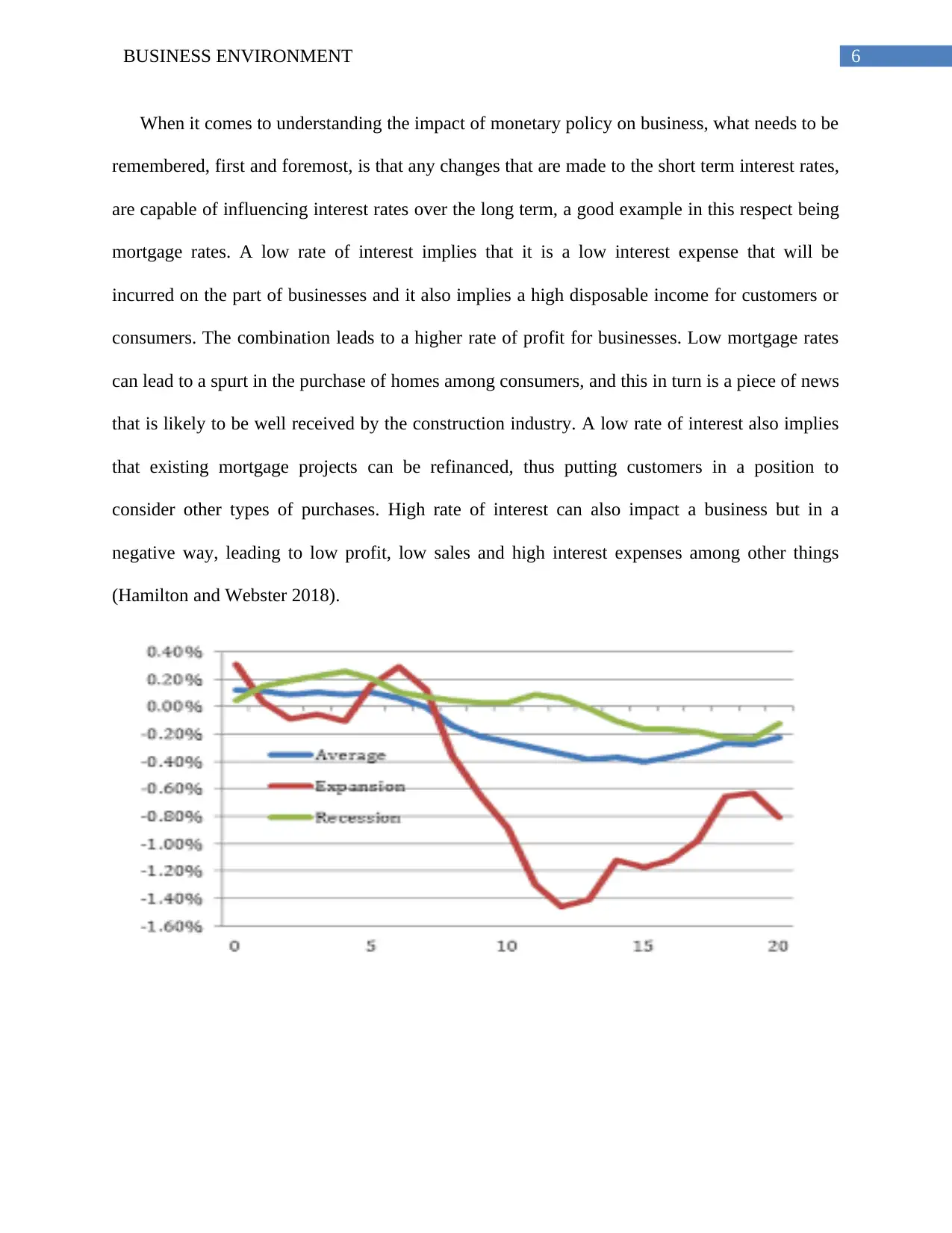
When it comes to understanding the impact of monetary policy on business, what needs to be
remembered, first and foremost, is that any changes that are made to the short term interest rates,
are capable of influencing interest rates over the long term, a good example in this respect being
mortgage rates. A low rate of interest implies that it is a low interest expense that will be
incurred on the part of businesses and it also implies a high disposable income for customers or
consumers. The combination leads to a higher rate of profit for businesses. Low mortgage rates
can lead to a spurt in the purchase of homes among consumers, and this in turn is a piece of news
that is likely to be well received by the construction industry. A low rate of interest also implies
that existing mortgage projects can be refinanced, thus putting customers in a position to
consider other types of purchases. High rate of interest can also impact a business but in a
negative way, leading to low profit, low sales and high interest expenses among other things
(Hamilton and Webster 2018).
When it comes to understanding the impact of monetary policy on business, what needs to be
remembered, first and foremost, is that any changes that are made to the short term interest rates,
are capable of influencing interest rates over the long term, a good example in this respect being
mortgage rates. A low rate of interest implies that it is a low interest expense that will be
incurred on the part of businesses and it also implies a high disposable income for customers or
consumers. The combination leads to a higher rate of profit for businesses. Low mortgage rates
can lead to a spurt in the purchase of homes among consumers, and this in turn is a piece of news
that is likely to be well received by the construction industry. A low rate of interest also implies
that existing mortgage projects can be refinanced, thus putting customers in a position to
consider other types of purchases. High rate of interest can also impact a business but in a
negative way, leading to low profit, low sales and high interest expenses among other things
(Hamilton and Webster 2018).
⊘ This is a preview!⊘
Do you want full access?
Subscribe today to unlock all pages.
Trusted by 1+ million students worldwide

7BUSINESS ENVIRONMENT
3. Understanding how Resources are allocated in Different Types of
Economies
Type of Economy Resource Allocation
Capitalist Economy Resource allocation takes place through the use
of market mechanisms. The price of various
services and goods that includes the prices of
the various factors of production happen to be
determined using the forces of supply and
demand. The free price mechanism puts
producers in a position to decide what to
product and what not to produce.
Socialist Economy Resources are allocated, planned, controlled
and regulated by government authorities.
Major economic policies are first formulated
and the implemented by central planning
authorities
Mixed Economy Resources are allocated and problems are
resolved through the use of controlled price
mechanism and free price mechanism. The free
3. Understanding how Resources are allocated in Different Types of
Economies
Type of Economy Resource Allocation
Capitalist Economy Resource allocation takes place through the use
of market mechanisms. The price of various
services and goods that includes the prices of
the various factors of production happen to be
determined using the forces of supply and
demand. The free price mechanism puts
producers in a position to decide what to
product and what not to produce.
Socialist Economy Resources are allocated, planned, controlled
and regulated by government authorities.
Major economic policies are first formulated
and the implemented by central planning
authorities
Mixed Economy Resources are allocated and problems are
resolved through the use of controlled price
mechanism and free price mechanism. The free
Paraphrase This Document
Need a fresh take? Get an instant paraphrase of this document with our AI Paraphraser
8BUSINESS ENVIRONMENT
price mechanism is one that is seen to function
in the private sector as a consequence prices
are allowed to undergo a change, based on the
supply and the demand of goods and services.
Private sectors are in a position to produce
goods as per the market demand and can
dictate the prices of goods. Government may
use fiscal or monetary policy to control as well
as regulate production in the private sector
4. Impact of Supply and Demand on the Market
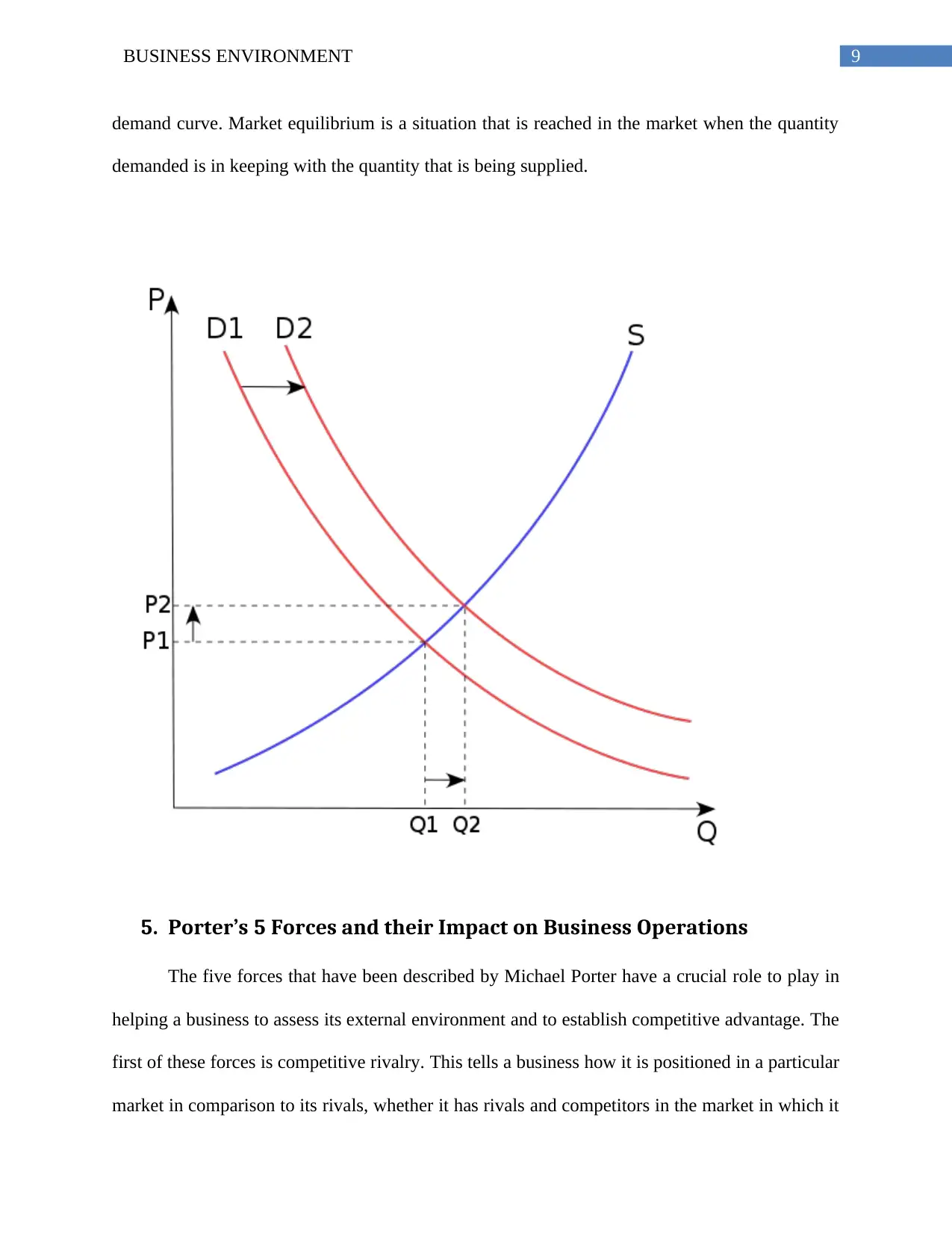
Demand as well as supply has a crucial role to play in price determination. There are four
important laws using which the impact of supply and demand on the market may be well
understood. The first law states that if supply is unchanged but the demand increases, then it will
lead to a high equilibrium in price as well as high quantity. If the supply remains unchanged by
the demand increases, then this will lead to a low price equilibrium pricing as well as low
quantity. If the demand does not change but the supply is seen to increase, then it will lead to
high quantity and low equilibrium pricing. If the demand does not change and the supply is seen
to decrease, then it will lead to low quantity and a high equilibrium in pricing. Equilibrium in
this context refers to what may be termed as price quantity pair, in which the quantity which is
being demanded is equivalent to the quantity that is being supplied. This particular equilibrium is
something that is represented well enough by the intersection between the supply and the
price mechanism is one that is seen to function
in the private sector as a consequence prices
are allowed to undergo a change, based on the
supply and the demand of goods and services.
Private sectors are in a position to produce
goods as per the market demand and can
dictate the prices of goods. Government may
use fiscal or monetary policy to control as well
as regulate production in the private sector
4. Impact of Supply and Demand on the Market
Demand as well as supply has a crucial role to play in price determination. There are four
important laws using which the impact of supply and demand on the market may be well
understood. The first law states that if supply is unchanged but the demand increases, then it will
lead to a high equilibrium in price as well as high quantity. If the supply remains unchanged by
the demand increases, then this will lead to a low price equilibrium pricing as well as low
quantity. If the demand does not change but the supply is seen to increase, then it will lead to
high quantity and low equilibrium pricing. If the demand does not change and the supply is seen
to decrease, then it will lead to low quantity and a high equilibrium in pricing. Equilibrium in
this context refers to what may be termed as price quantity pair, in which the quantity which is
being demanded is equivalent to the quantity that is being supplied. This particular equilibrium is
something that is represented well enough by the intersection between the supply and the
9BUSINESS ENVIRONMENT
demand curve. Market equilibrium is a situation that is reached in the market when the quantity
demanded is in keeping with the quantity that is being supplied.
5. Porter’s 5 Forces and their Impact on Business Operations
The five forces that have been described by Michael Porter have a crucial role to play in
helping a business to assess its external environment and to establish competitive advantage. The
first of these forces is competitive rivalry. This tells a business how it is positioned in a particular
market in comparison to its rivals, whether it has rivals and competitors in the market in which it
demand curve. Market equilibrium is a situation that is reached in the market when the quantity
demanded is in keeping with the quantity that is being supplied.
5. Porter’s 5 Forces and their Impact on Business Operations
The five forces that have been described by Michael Porter have a crucial role to play in
helping a business to assess its external environment and to establish competitive advantage. The
first of these forces is competitive rivalry. This tells a business how it is positioned in a particular
market in comparison to its rivals, whether it has rivals and competitors in the market in which it
⊘ This is a preview!⊘
Do you want full access?
Subscribe today to unlock all pages.
Trusted by 1+ million students worldwide

10BUSINESS ENVIRONMENT
operates at all, and how powerful the rivals and competitors are, based on which it has to draw
and implement business policies so that it can overcome such rivalry, and establish competitive
advantage (Kljucnikov et al. 2016). The second important force is the bargaining power of
suppliers which tells the owners of a business whether or not suppliers are likely to exert power
or influence on the business operations by acting high handed during the provision of supplies
and for assuring quality for the same. The third force is the bargaining power of customers. This
tells the business owners the power or the extent of influence that customers are likely to have on
the outcome of the business operations and its success in the market. The fourth is the threat of
substitution, which tells a business whether or not its products or services are likely to be
substituted by a new or rival business enterprise. The fifth and final force is the threat of new
entry which informs a business whether any new businesses in the same or related industry are
coming up or emerging, and which are likely to have an impact on the business operations (Belas
et al. 2018).
operates at all, and how powerful the rivals and competitors are, based on which it has to draw
and implement business policies so that it can overcome such rivalry, and establish competitive
advantage (Kljucnikov et al. 2016). The second important force is the bargaining power of
suppliers which tells the owners of a business whether or not suppliers are likely to exert power
or influence on the business operations by acting high handed during the provision of supplies
and for assuring quality for the same. The third force is the bargaining power of customers. This
tells the business owners the power or the extent of influence that customers are likely to have on
the outcome of the business operations and its success in the market. The fourth is the threat of
substitution, which tells a business whether or not its products or services are likely to be
substituted by a new or rival business enterprise. The fifth and final force is the threat of new
entry which informs a business whether any new businesses in the same or related industry are
coming up or emerging, and which are likely to have an impact on the business operations (Belas
et al. 2018).
Paraphrase This Document
Need a fresh take? Get an instant paraphrase of this document with our AI Paraphraser

11BUSINESS ENVIRONMENT
6. Effect of Market Decisions on Business Policy
The effect of market decisions on business policy is something that can be well understood
using the framework of the 4 P’s which is explained in the table below
Market Strategy Impact on Business
Product The type of product which is being marketed,
will be determine whether or not it will be
successful for the business. The product has to
be characterized by good demand and supply
aspects and has to be appealing for its target
audience in order for the business to do well.
Place The place where the marketing strategies are
implemented will also influence the outcome
of a business. The marketing activities have to
be carried out in a prime location, where the
business will be able to reach out to its target
audience easily and where it will be able to
ensure continuous customer footfall for its
products and services.
6. Effect of Market Decisions on Business Policy
The effect of market decisions on business policy is something that can be well understood
using the framework of the 4 P’s which is explained in the table below
Market Strategy Impact on Business
Product The type of product which is being marketed,
will be determine whether or not it will be
successful for the business. The product has to
be characterized by good demand and supply
aspects and has to be appealing for its target
audience in order for the business to do well.
Place The place where the marketing strategies are
implemented will also influence the outcome
of a business. The marketing activities have to
be carried out in a prime location, where the
business will be able to reach out to its target
audience easily and where it will be able to
ensure continuous customer footfall for its
products and services.

12BUSINESS ENVIRONMENT
Price The price of the product is likely to influence
its business success by a considerable degree.
Prices should be kept competitive so that the
target audience is able to find it affordable and
can buy it in large numbers instead of one at a
time or once in a while.
Promotion The manner by which the product or service is
promoted will influence its business outcome
quite a bit (Cepel et al. 2018).
7. Impact of Culture on Business
Impact of Culture on Business
Pace - Culture has an impact on the pace of a particular business. It has a role to play in
determining whether a business is fast paced or it is slow paced, or whether it is medium
paced, depending on whether this culture is positive or negative.
Business Protocol – The protocols on which a particular business is run is also
something that is influenced by culture. It determines how people are going to meet, and
verbally engage and interact with one another.
Price The price of the product is likely to influence
its business success by a considerable degree.
Prices should be kept competitive so that the
target audience is able to find it affordable and
can buy it in large numbers instead of one at a
time or once in a while.
Promotion The manner by which the product or service is
promoted will influence its business outcome
quite a bit (Cepel et al. 2018).
7. Impact of Culture on Business
Impact of Culture on Business
Pace - Culture has an impact on the pace of a particular business. It has a role to play in
determining whether a business is fast paced or it is slow paced, or whether it is medium
paced, depending on whether this culture is positive or negative.
Business Protocol – The protocols on which a particular business is run is also
something that is influenced by culture. It determines how people are going to meet, and
verbally engage and interact with one another.
⊘ This is a preview!⊘
Do you want full access?
Subscribe today to unlock all pages.
Trusted by 1+ million students worldwide

1 out of 18


Related Documents


Your All-in-One AI-Powered Toolkit for Academic Success.
+13062052269
info@desklib.com
Available 24*7 on WhatsApp / Email
![[object Object]](/_next/static/media/star-bottom.7253800d.svg)
Unlock your academic potential
Copyright © 2020–2026 A2Z Services. All Rights Reserved. Developed and managed by ZUCOL.