Comprehensive Analysis: UK Business Environment and Globalisation
VerifiedAdded on 2023/06/18
|9
|2743
|188
Report
AI Summary
This report provides a detailed analysis of the UK business environment, encompassing various organizational types across different sectors, legal structures, and the distinctions between public and private ownership, including their financing methods. It assesses the UK's competition policy and legislative framework related to anti-competitive practices, examining the role of the Competition and Markets Authority in reviewing business practices and their impact on consumers. The report further explores the government's objectives and fiscal and monetary policy instruments for regulating the economy during recessions, analyzing the effects on employment, taxation, interest rates, balance of payments, and exchange rates in relation to business operations. Finally, it delves into the concept of globalisation and its effects on business, competition, and the overall economy, providing a comprehensive understanding of the factors shaping the UK business landscape. Desklib provides access to this and similar solved assignments.

Environment
1
1

Paraphrase This Document
Need a fresh take? Get an instant paraphrase of this document with our AI Paraphraser
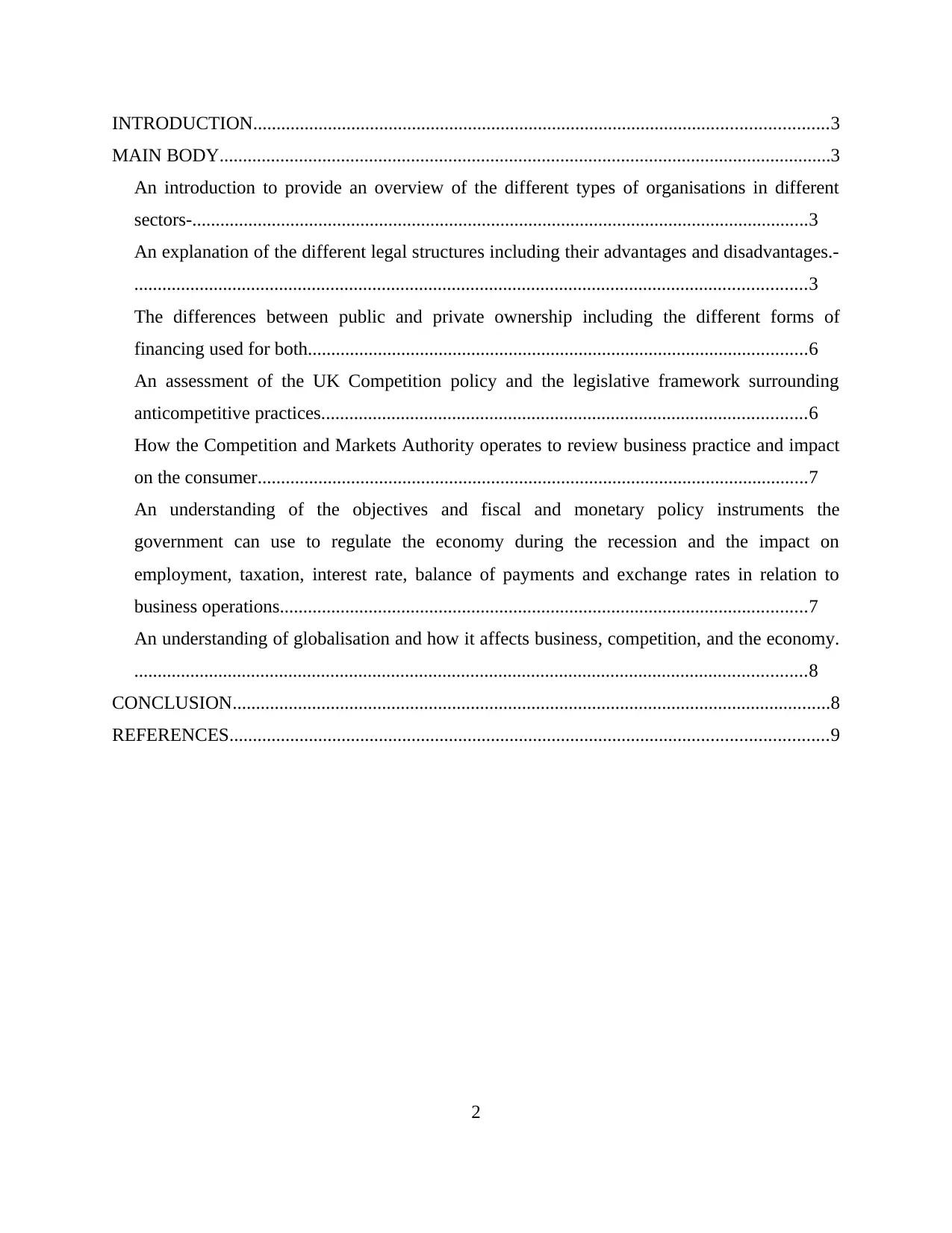
INTRODUCTION...........................................................................................................................3
MAIN BODY...................................................................................................................................3
An introduction to provide an overview of the different types of organisations in different
sectors-....................................................................................................................................3
An explanation of the different legal structures including their advantages and disadvantages.-
................................................................................................................................................3
The differences between public and private ownership including the different forms of
financing used for both...........................................................................................................6
An assessment of the UK Competition policy and the legislative framework surrounding
anticompetitive practices........................................................................................................6
How the Competition and Markets Authority operates to review business practice and impact
on the consumer......................................................................................................................7
An understanding of the objectives and fiscal and monetary policy instruments the
government can use to regulate the economy during the recession and the impact on
employment, taxation, interest rate, balance of payments and exchange rates in relation to
business operations.................................................................................................................7
An understanding of globalisation and how it affects business, competition, and the economy.
................................................................................................................................................8
CONCLUSION................................................................................................................................8
REFERENCES................................................................................................................................9
2
MAIN BODY...................................................................................................................................3
An introduction to provide an overview of the different types of organisations in different
sectors-....................................................................................................................................3
An explanation of the different legal structures including their advantages and disadvantages.-
................................................................................................................................................3
The differences between public and private ownership including the different forms of
financing used for both...........................................................................................................6
An assessment of the UK Competition policy and the legislative framework surrounding
anticompetitive practices........................................................................................................6
How the Competition and Markets Authority operates to review business practice and impact
on the consumer......................................................................................................................7
An understanding of the objectives and fiscal and monetary policy instruments the
government can use to regulate the economy during the recession and the impact on
employment, taxation, interest rate, balance of payments and exchange rates in relation to
business operations.................................................................................................................7
An understanding of globalisation and how it affects business, competition, and the economy.
................................................................................................................................................8
CONCLUSION................................................................................................................................8
REFERENCES................................................................................................................................9
2
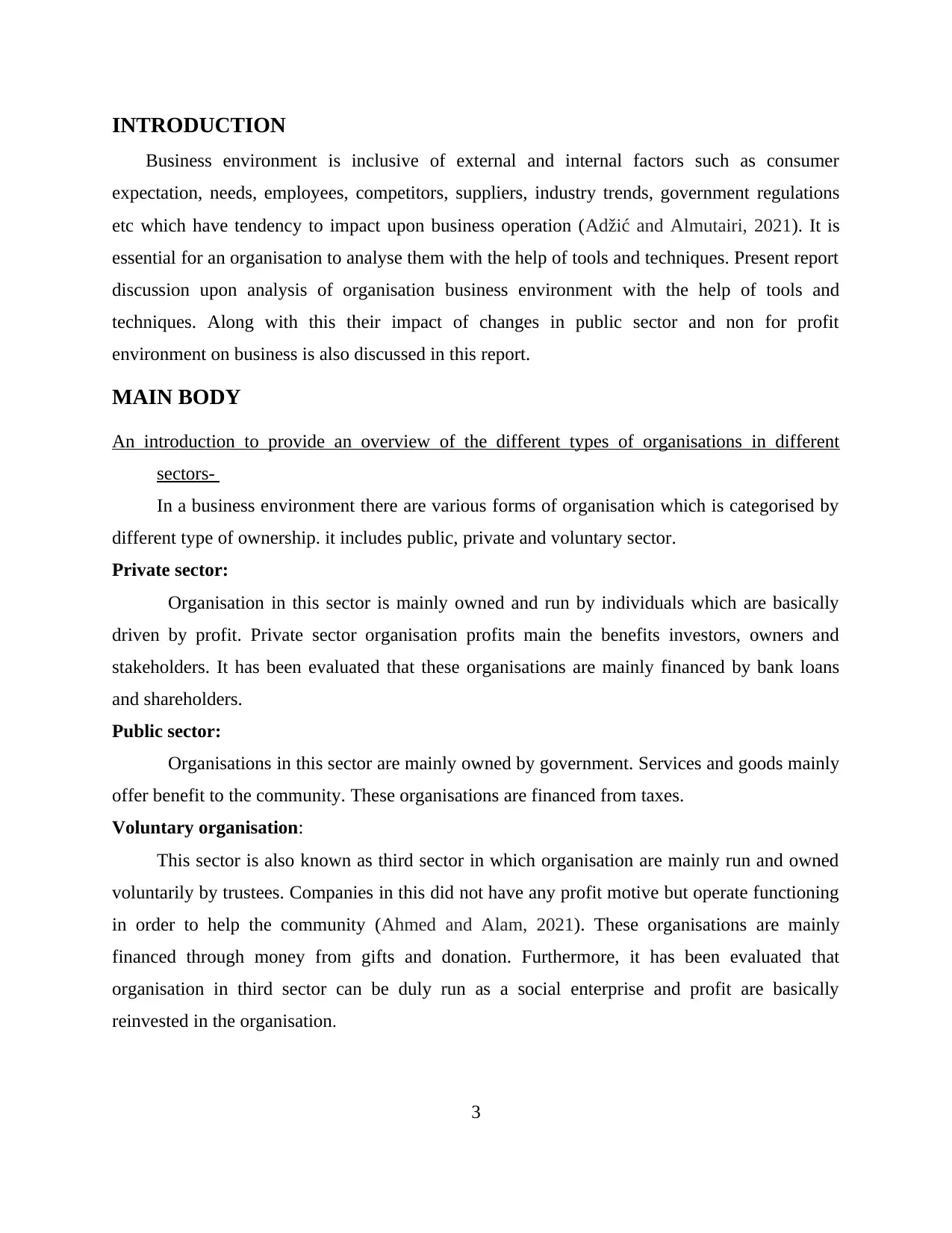
INTRODUCTION
Business environment is inclusive of external and internal factors such as consumer
expectation, needs, employees, competitors, suppliers, industry trends, government regulations
etc which have tendency to impact upon business operation (Adžić and Almutairi, 2021). It is
essential for an organisation to analyse them with the help of tools and techniques. Present report
discussion upon analysis of organisation business environment with the help of tools and
techniques. Along with this their impact of changes in public sector and non for profit
environment on business is also discussed in this report.
MAIN BODY
An introduction to provide an overview of the different types of organisations in different
sectors-
In a business environment there are various forms of organisation which is categorised by
different type of ownership. it includes public, private and voluntary sector.
Private sector:
Organisation in this sector is mainly owned and run by individuals which are basically
driven by profit. Private sector organisation profits main the benefits investors, owners and
stakeholders. It has been evaluated that these organisations are mainly financed by bank loans
and shareholders.
Public sector:
Organisations in this sector are mainly owned by government. Services and goods mainly
offer benefit to the community. These organisations are financed from taxes.
Voluntary organisation:
This sector is also known as third sector in which organisation are mainly run and owned
voluntarily by trustees. Companies in this did not have any profit motive but operate functioning
in order to help the community (Ahmed and Alam, 2021). These organisations are mainly
financed through money from gifts and donation. Furthermore, it has been evaluated that
organisation in third sector can be duly run as a social enterprise and profit are basically
reinvested in the organisation.
3
Business environment is inclusive of external and internal factors such as consumer
expectation, needs, employees, competitors, suppliers, industry trends, government regulations
etc which have tendency to impact upon business operation (Adžić and Almutairi, 2021). It is
essential for an organisation to analyse them with the help of tools and techniques. Present report
discussion upon analysis of organisation business environment with the help of tools and
techniques. Along with this their impact of changes in public sector and non for profit
environment on business is also discussed in this report.
MAIN BODY
An introduction to provide an overview of the different types of organisations in different
sectors-
In a business environment there are various forms of organisation which is categorised by
different type of ownership. it includes public, private and voluntary sector.
Private sector:
Organisation in this sector is mainly owned and run by individuals which are basically
driven by profit. Private sector organisation profits main the benefits investors, owners and
stakeholders. It has been evaluated that these organisations are mainly financed by bank loans
and shareholders.
Public sector:
Organisations in this sector are mainly owned by government. Services and goods mainly
offer benefit to the community. These organisations are financed from taxes.
Voluntary organisation:
This sector is also known as third sector in which organisation are mainly run and owned
voluntarily by trustees. Companies in this did not have any profit motive but operate functioning
in order to help the community (Ahmed and Alam, 2021). These organisations are mainly
financed through money from gifts and donation. Furthermore, it has been evaluated that
organisation in third sector can be duly run as a social enterprise and profit are basically
reinvested in the organisation.
3
⊘ This is a preview!⊘
Do you want full access?
Subscribe today to unlock all pages.

Trusted by 1+ million students worldwide
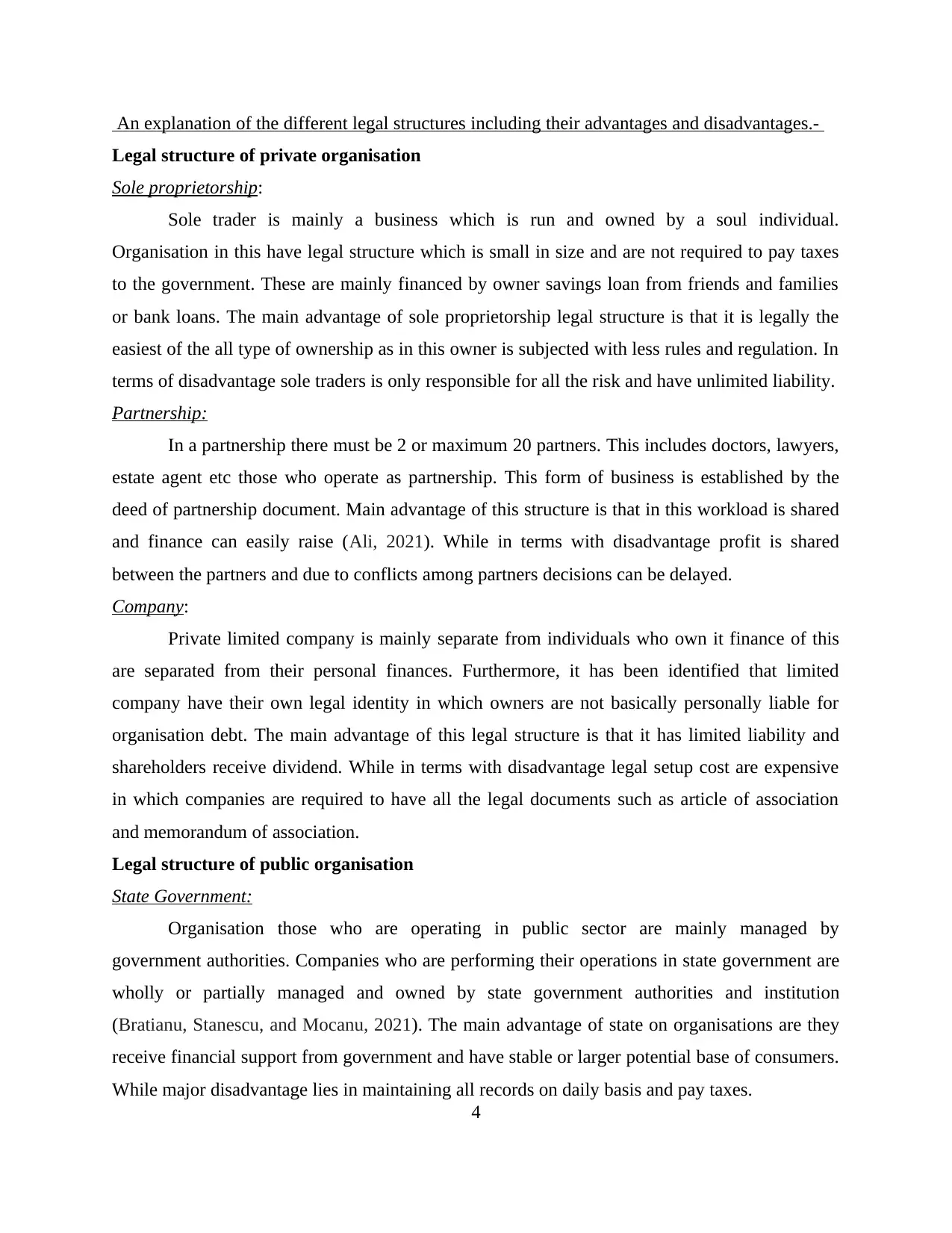
An explanation of the different legal structures including their advantages and disadvantages.-
Legal structure of private organisation
Sole proprietorship:
Sole trader is mainly a business which is run and owned by a soul individual.
Organisation in this have legal structure which is small in size and are not required to pay taxes
to the government. These are mainly financed by owner savings loan from friends and families
or bank loans. The main advantage of sole proprietorship legal structure is that it is legally the
easiest of the all type of ownership as in this owner is subjected with less rules and regulation. In
terms of disadvantage sole traders is only responsible for all the risk and have unlimited liability.
Partnership:
In a partnership there must be 2 or maximum 20 partners. This includes doctors, lawyers,
estate agent etc those who operate as partnership. This form of business is established by the
deed of partnership document. Main advantage of this structure is that in this workload is shared
and finance can easily raise (Ali, 2021). While in terms with disadvantage profit is shared
between the partners and due to conflicts among partners decisions can be delayed.
Company:
Private limited company is mainly separate from individuals who own it finance of this
are separated from their personal finances. Furthermore, it has been identified that limited
company have their own legal identity in which owners are not basically personally liable for
organisation debt. The main advantage of this legal structure is that it has limited liability and
shareholders receive dividend. While in terms with disadvantage legal setup cost are expensive
in which companies are required to have all the legal documents such as article of association
and memorandum of association.
Legal structure of public organisation
State Government:
Organisation those who are operating in public sector are mainly managed by
government authorities. Companies who are performing their operations in state government are
wholly or partially managed and owned by state government authorities and institution
(Bratianu, Stanescu, and Mocanu, 2021). The main advantage of state on organisations are they
receive financial support from government and have stable or larger potential base of consumers.
While major disadvantage lies in maintaining all records on daily basis and pay taxes.
4
Legal structure of private organisation
Sole proprietorship:
Sole trader is mainly a business which is run and owned by a soul individual.
Organisation in this have legal structure which is small in size and are not required to pay taxes
to the government. These are mainly financed by owner savings loan from friends and families
or bank loans. The main advantage of sole proprietorship legal structure is that it is legally the
easiest of the all type of ownership as in this owner is subjected with less rules and regulation. In
terms of disadvantage sole traders is only responsible for all the risk and have unlimited liability.
Partnership:
In a partnership there must be 2 or maximum 20 partners. This includes doctors, lawyers,
estate agent etc those who operate as partnership. This form of business is established by the
deed of partnership document. Main advantage of this structure is that in this workload is shared
and finance can easily raise (Ali, 2021). While in terms with disadvantage profit is shared
between the partners and due to conflicts among partners decisions can be delayed.
Company:
Private limited company is mainly separate from individuals who own it finance of this
are separated from their personal finances. Furthermore, it has been identified that limited
company have their own legal identity in which owners are not basically personally liable for
organisation debt. The main advantage of this legal structure is that it has limited liability and
shareholders receive dividend. While in terms with disadvantage legal setup cost are expensive
in which companies are required to have all the legal documents such as article of association
and memorandum of association.
Legal structure of public organisation
State Government:
Organisation those who are operating in public sector are mainly managed by
government authorities. Companies who are performing their operations in state government are
wholly or partially managed and owned by state government authorities and institution
(Bratianu, Stanescu, and Mocanu, 2021). The main advantage of state on organisations are they
receive financial support from government and have stable or larger potential base of consumers.
While major disadvantage lies in maintaining all records on daily basis and pay taxes.
4
Paraphrase This Document
Need a fresh take? Get an instant paraphrase of this document with our AI Paraphraser
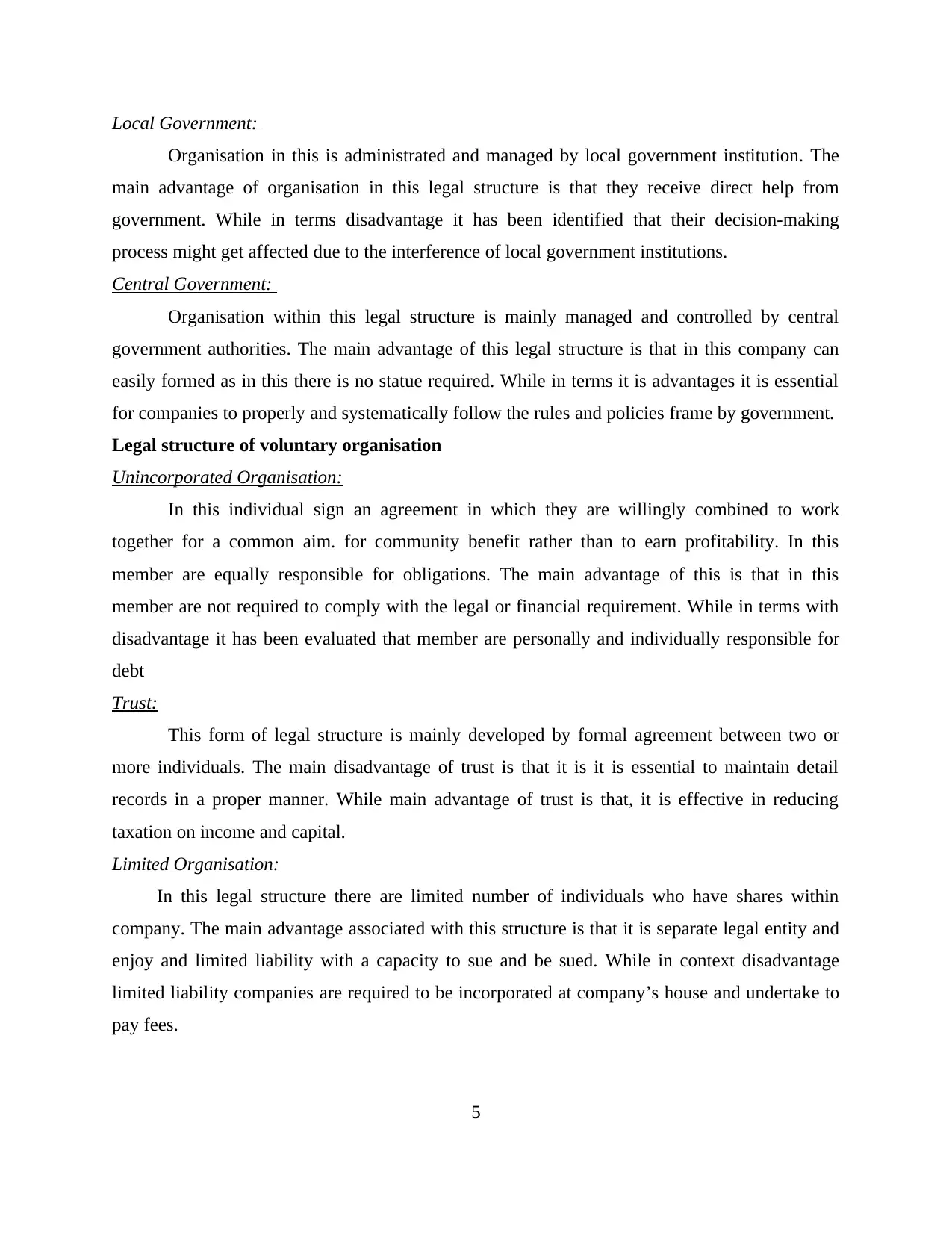
Local Government:
Organisation in this is administrated and managed by local government institution. The
main advantage of organisation in this legal structure is that they receive direct help from
government. While in terms disadvantage it has been identified that their decision-making
process might get affected due to the interference of local government institutions.
Central Government:
Organisation within this legal structure is mainly managed and controlled by central
government authorities. The main advantage of this legal structure is that in this company can
easily formed as in this there is no statue required. While in terms it is advantages it is essential
for companies to properly and systematically follow the rules and policies frame by government.
Legal structure of voluntary organisation
Unincorporated Organisation:
In this individual sign an agreement in which they are willingly combined to work
together for a common aim. for community benefit rather than to earn profitability. In this
member are equally responsible for obligations. The main advantage of this is that in this
member are not required to comply with the legal or financial requirement. While in terms with
disadvantage it has been evaluated that member are personally and individually responsible for
debt
Trust:
This form of legal structure is mainly developed by formal agreement between two or
more individuals. The main disadvantage of trust is that it is it is essential to maintain detail
records in a proper manner. While main advantage of trust is that, it is effective in reducing
taxation on income and capital.
Limited Organisation:
In this legal structure there are limited number of individuals who have shares within
company. The main advantage associated with this structure is that it is separate legal entity and
enjoy and limited liability with a capacity to sue and be sued. While in context disadvantage
limited liability companies are required to be incorporated at company’s house and undertake to
pay fees.
5
Organisation in this is administrated and managed by local government institution. The
main advantage of organisation in this legal structure is that they receive direct help from
government. While in terms disadvantage it has been identified that their decision-making
process might get affected due to the interference of local government institutions.
Central Government:
Organisation within this legal structure is mainly managed and controlled by central
government authorities. The main advantage of this legal structure is that in this company can
easily formed as in this there is no statue required. While in terms it is advantages it is essential
for companies to properly and systematically follow the rules and policies frame by government.
Legal structure of voluntary organisation
Unincorporated Organisation:
In this individual sign an agreement in which they are willingly combined to work
together for a common aim. for community benefit rather than to earn profitability. In this
member are equally responsible for obligations. The main advantage of this is that in this
member are not required to comply with the legal or financial requirement. While in terms with
disadvantage it has been evaluated that member are personally and individually responsible for
debt
Trust:
This form of legal structure is mainly developed by formal agreement between two or
more individuals. The main disadvantage of trust is that it is it is essential to maintain detail
records in a proper manner. While main advantage of trust is that, it is effective in reducing
taxation on income and capital.
Limited Organisation:
In this legal structure there are limited number of individuals who have shares within
company. The main advantage associated with this structure is that it is separate legal entity and
enjoy and limited liability with a capacity to sue and be sued. While in context disadvantage
limited liability companies are required to be incorporated at company’s house and undertake to
pay fees.
5
The differences between public and private ownership including the different forms of financing
used for both.
Private ownership is mainly termed in a case when company is owned and managed by
organisation, management, founders or group of private investors. While in public ownership
companies are owned and managed by the government. Public ownership refers to government
provision of services and goods. The major difference between public and private ownership is
that in public ownership organisation can raise funds directly from general public by issuing
shares. While in terms of private company they could not raise capital from public until they
fulfil the disclosure requirements (Cherunilam, 2021). In addition to this the other difference
between public ownership and private ownership is that in public ownership companies run with
an objective to serve individual. While in contrast private ownership run for profit motive. It has
been evaluated that in context with resignation of auditors in a public company these can be only
removed by resolution of the organisation at general meeting with the consent of ASICs. While
in contrast public companies do not require consent of ASICs in order to remove an auditor.
Public ownership has ability to raise capital and funds through the sale of the securities to
wide range of buyers. While in terms of private ownership company is financed by bank loans,
credit union, local authorities, crowd funding, asset, finance and leasing and more. In this it is
important for Sainsbury to analyse all the sources of financing available as to conduct operations
effectively.
An assessment of the UK Competition policy and the legislative framework surrounding
anticompetitive practices.
By analysing UK competition policy and the legislation framework surrounding anti-
competitive practices it has been evaluated that' competition law is core practices which restrict
or undermined competition to the determinant of consumer. It mainly inclusive of abusive of a
dominant market position by an organisation, anti-competitive agreements among organisation
6
used for both.
Private ownership is mainly termed in a case when company is owned and managed by
organisation, management, founders or group of private investors. While in public ownership
companies are owned and managed by the government. Public ownership refers to government
provision of services and goods. The major difference between public and private ownership is
that in public ownership organisation can raise funds directly from general public by issuing
shares. While in terms of private company they could not raise capital from public until they
fulfil the disclosure requirements (Cherunilam, 2021). In addition to this the other difference
between public ownership and private ownership is that in public ownership companies run with
an objective to serve individual. While in contrast private ownership run for profit motive. It has
been evaluated that in context with resignation of auditors in a public company these can be only
removed by resolution of the organisation at general meeting with the consent of ASICs. While
in contrast public companies do not require consent of ASICs in order to remove an auditor.
Public ownership has ability to raise capital and funds through the sale of the securities to
wide range of buyers. While in terms of private ownership company is financed by bank loans,
credit union, local authorities, crowd funding, asset, finance and leasing and more. In this it is
important for Sainsbury to analyse all the sources of financing available as to conduct operations
effectively.
An assessment of the UK Competition policy and the legislative framework surrounding
anticompetitive practices.
By analysing UK competition policy and the legislation framework surrounding anti-
competitive practices it has been evaluated that' competition law is core practices which restrict
or undermined competition to the determinant of consumer. It mainly inclusive of abusive of a
dominant market position by an organisation, anti-competitive agreements among organisation
6
⊘ This is a preview!⊘
Do you want full access?
Subscribe today to unlock all pages.
Trusted by 1+ million students worldwide
takeovers or merger and more. United Kingdom government enacted Competition Act 1998 in
order to regulate competition in the market. This is mainly to provide consumers with
competitive products and prices choices. The main advantage of competitive policy is that apply
rules in order to make sure that organisations engaged in fair competition. It helps in increasing
efficiency which creates by the choice for consumers and also helps in reducing prices and
making improvement and quality. United Kingdom anti-competitive behaviour is mainly
prohibited under chapter 1 and 2 of the Competition Act 1998 (Ciacci, Ivaldi and Soliani, 2021).
In this it is essential for all the organisation irrespective of its legal status size and sector to aware
of the competition law and fulfil all the obligations in order to avoid penalties. It is essential for
Sainsbury to conduct operations by adhering all the obligations under UK competition policy. If
Sainsbury breach this then they will face criminal cartel offence.
How the Competition and Markets Authority operates to review business practice and impact on
the consumer.
The Competition and Market authority effectively operates to review and investigate
merger which would restrict competition. Furthermore, it has been evaluated that Competition
and Market authority is efficiently undertaking market study and conduct frequent investigation
to examine impact of competition which is increasing problems for consumers. Furthermore, it
has been evaluated that in order to review business practices Competition and Market authority
enforce consumer protection legislation in order to efficiently tackle market condition and
practices. Main objective of Competition and Market authority is to identify wrongdoing, protect
consumers and educate business organisation. It has been identified that Competition and Market
authority conduct investigation on the merger to duly restrict competition, undertake market
studies and investigation investigate anti-competitive agreements, criminal proceeding and duly
enforce consumer protection. It is essential for Sainsbury to engage in ethical and transparent
competition in order to avoid penalties.
7
order to regulate competition in the market. This is mainly to provide consumers with
competitive products and prices choices. The main advantage of competitive policy is that apply
rules in order to make sure that organisations engaged in fair competition. It helps in increasing
efficiency which creates by the choice for consumers and also helps in reducing prices and
making improvement and quality. United Kingdom anti-competitive behaviour is mainly
prohibited under chapter 1 and 2 of the Competition Act 1998 (Ciacci, Ivaldi and Soliani, 2021).
In this it is essential for all the organisation irrespective of its legal status size and sector to aware
of the competition law and fulfil all the obligations in order to avoid penalties. It is essential for
Sainsbury to conduct operations by adhering all the obligations under UK competition policy. If
Sainsbury breach this then they will face criminal cartel offence.
How the Competition and Markets Authority operates to review business practice and impact on
the consumer.
The Competition and Market authority effectively operates to review and investigate
merger which would restrict competition. Furthermore, it has been evaluated that Competition
and Market authority is efficiently undertaking market study and conduct frequent investigation
to examine impact of competition which is increasing problems for consumers. Furthermore, it
has been evaluated that in order to review business practices Competition and Market authority
enforce consumer protection legislation in order to efficiently tackle market condition and
practices. Main objective of Competition and Market authority is to identify wrongdoing, protect
consumers and educate business organisation. It has been identified that Competition and Market
authority conduct investigation on the merger to duly restrict competition, undertake market
studies and investigation investigate anti-competitive agreements, criminal proceeding and duly
enforce consumer protection. It is essential for Sainsbury to engage in ethical and transparent
competition in order to avoid penalties.
7
Paraphrase This Document
Need a fresh take? Get an instant paraphrase of this document with our AI Paraphraser
An understanding of the objectives and fiscal and monetary policy instruments the government
can use to regulate the economy during the recession and the impact on employment,
taxation, interest rate, balance of payments and exchange rates in relation to business
operations.
It has been identified that in the time period of recession in order to regulate economy there
are number of fiscal and monetary policy instruments that a government can use in order to
regulate economy and the impact on employment, interest rate, taxation balance of payment and
exchange in context to business operation. The main objective of fiscal and monetary policy is to
control the price level of country when the inflation is high. This helps in regulating the price
with the help of fiscal policies government can stabilize the economy. The two most important
tools of fiscal policy include spending and taxes. For instance, if government is trying to spur
spending on consumers that can lower down tax. While in terms with monetary policy tools it
includes open market operations, reserve requirement, the discount rate and interest on reserves.
With the help of these fiscal and monetary policy instruments government can efficiently
regulate economy during the time period of recession. This will help business organisation
Sainsbury conduct operations without decreasing employment ratio in company.
An understanding of globalisation and how it affects business, competition, and the economy.
Globalisation is termed as a process in which there is free of products and services, labour
etc is conducted. Globalisation has significant impact upon business as it allows them to attract a
greater number of consumers (Estevão, Lopes and Penela, 2021). It provides them a massive
market. Globalisation also affect business in terms of having opportunity to raise capital and
acquire resources, labour and other elements. However, it has been identified that globalisation is
significantly increasing competition in which large number of organisations around the world
offers products and services in competitive price range. Furthermore, it has been evaluated the
globalisation significantly reduces the cost of manufacturing in which organisation can offer
products to consumers at lower prices. It helps in increasing the standard of living and boost
economy around the world as it helps in making market more efficient. It is Sainsbury is required
to grab opportunities facilitated due to globalisation in order to enhance growth and development
and maximise consumer base around the globe.
8
can use to regulate the economy during the recession and the impact on employment,
taxation, interest rate, balance of payments and exchange rates in relation to business
operations.
It has been identified that in the time period of recession in order to regulate economy there
are number of fiscal and monetary policy instruments that a government can use in order to
regulate economy and the impact on employment, interest rate, taxation balance of payment and
exchange in context to business operation. The main objective of fiscal and monetary policy is to
control the price level of country when the inflation is high. This helps in regulating the price
with the help of fiscal policies government can stabilize the economy. The two most important
tools of fiscal policy include spending and taxes. For instance, if government is trying to spur
spending on consumers that can lower down tax. While in terms with monetary policy tools it
includes open market operations, reserve requirement, the discount rate and interest on reserves.
With the help of these fiscal and monetary policy instruments government can efficiently
regulate economy during the time period of recession. This will help business organisation
Sainsbury conduct operations without decreasing employment ratio in company.
An understanding of globalisation and how it affects business, competition, and the economy.
Globalisation is termed as a process in which there is free of products and services, labour
etc is conducted. Globalisation has significant impact upon business as it allows them to attract a
greater number of consumers (Estevão, Lopes and Penela, 2021). It provides them a massive
market. Globalisation also affect business in terms of having opportunity to raise capital and
acquire resources, labour and other elements. However, it has been identified that globalisation is
significantly increasing competition in which large number of organisations around the world
offers products and services in competitive price range. Furthermore, it has been evaluated the
globalisation significantly reduces the cost of manufacturing in which organisation can offer
products to consumers at lower prices. It helps in increasing the standard of living and boost
economy around the world as it helps in making market more efficient. It is Sainsbury is required
to grab opportunities facilitated due to globalisation in order to enhance growth and development
and maximise consumer base around the globe.
8
CONCLUSION
From the above report has been concluded that it is essential for organisation to have proper
understanding the legal requirement and structure in which they are operating their functions.
With the help of this they can operate functioning in a proper legal structure. Organisation is also
required to emphasize upon engagement in transparent competitive practices in order to conduct
business efficiently without facing legal obligation and penalties.
REFERENCES
Books and Journals
Adžić, S. and Almutairi, S., 2021. Paternalistic leadership in Kuwaiti business environment:
Culturally endorsed, but largely ineffective. Industrija, 49(1), pp.43-65.
Ahmed, F. and Alam, M.A., 2021. Business Environment: Indian and Global Perspective. PHI
Learning Pvt. Ltd..
Ali, Z.E.I.Y., 2021. Contemporary trends in auditing and their role in reducing audit risk in the
Sudanese business environment A field study on the National Audit Bureau and some
audit offices operating in Khartoum State. ENTERPRENEURSHIP JOURNAL FOR
FINANCE AND BUSINESS, 2(1).
Amankwah-Amoah, J., Khan, Z. and Wood, G., 2021. COVID-19 and business failures: The
paradoxes of experience, scale, and scope for theory and practice. European
Management Journal, 39(2), pp.179-184.
Bratianu, C., Stanescu, D.F. and Mocanu, R., 2021. Exploring the Knowledge Management
Impact on Business Education. Sustainability, 13(4), p.2313.
Cherunilam, F., 2021. Business environment. Himalaya Publishing House Pvt. Ltd.
Choudhury, A.H. and Mandal, S., 2021. The role of familial, social, educational and business
environmental factors on entrepreneurial intention among university students in
Bangladesh. Materials Today: Proceedings.
Ciacci, A., Ivaldi, E. and Soliani, R., 2021. A Potential Business Environment of Smart Cities: A
Subjective Approach. In Strategic Outlook in Business and Finance Innovation:
Multidimensional Policies for Emerging Economies. Emerald Publishing Limited.
Estevão, J., Lopes, J.D. and Penela, D., 2021. The doing business ranking and the design of
public policies: the effect of regional dynamics. Economic Research-Ekonomska
Istraživanja, 34(1), pp.2469-2483.
9
From the above report has been concluded that it is essential for organisation to have proper
understanding the legal requirement and structure in which they are operating their functions.
With the help of this they can operate functioning in a proper legal structure. Organisation is also
required to emphasize upon engagement in transparent competitive practices in order to conduct
business efficiently without facing legal obligation and penalties.
REFERENCES
Books and Journals
Adžić, S. and Almutairi, S., 2021. Paternalistic leadership in Kuwaiti business environment:
Culturally endorsed, but largely ineffective. Industrija, 49(1), pp.43-65.
Ahmed, F. and Alam, M.A., 2021. Business Environment: Indian and Global Perspective. PHI
Learning Pvt. Ltd..
Ali, Z.E.I.Y., 2021. Contemporary trends in auditing and their role in reducing audit risk in the
Sudanese business environment A field study on the National Audit Bureau and some
audit offices operating in Khartoum State. ENTERPRENEURSHIP JOURNAL FOR
FINANCE AND BUSINESS, 2(1).
Amankwah-Amoah, J., Khan, Z. and Wood, G., 2021. COVID-19 and business failures: The
paradoxes of experience, scale, and scope for theory and practice. European
Management Journal, 39(2), pp.179-184.
Bratianu, C., Stanescu, D.F. and Mocanu, R., 2021. Exploring the Knowledge Management
Impact on Business Education. Sustainability, 13(4), p.2313.
Cherunilam, F., 2021. Business environment. Himalaya Publishing House Pvt. Ltd.
Choudhury, A.H. and Mandal, S., 2021. The role of familial, social, educational and business
environmental factors on entrepreneurial intention among university students in
Bangladesh. Materials Today: Proceedings.
Ciacci, A., Ivaldi, E. and Soliani, R., 2021. A Potential Business Environment of Smart Cities: A
Subjective Approach. In Strategic Outlook in Business and Finance Innovation:
Multidimensional Policies for Emerging Economies. Emerald Publishing Limited.
Estevão, J., Lopes, J.D. and Penela, D., 2021. The doing business ranking and the design of
public policies: the effect of regional dynamics. Economic Research-Ekonomska
Istraživanja, 34(1), pp.2469-2483.
9
⊘ This is a preview!⊘
Do you want full access?
Subscribe today to unlock all pages.
Trusted by 1+ million students worldwide

1 out of 9


Related Documents


Your All-in-One AI-Powered Toolkit for Academic Success.
+13062052269
info@desklib.com
Available 24*7 on WhatsApp / Email
![[object Object]](/_next/static/media/star-bottom.7253800d.svg)
Unlock your academic potential
Copyright © 2020–2026 A2Z Services. All Rights Reserved. Developed and managed by ZUCOL.