Analysis of Business Structures and Director Duties (Business Law)
VerifiedAdded on 2021/05/31
|10
|3364
|168
Report
AI Summary
This report examines the legal aspects of business in the United Kingdom, focusing on the advantages and disadvantages of two prominent business structures: unlimited partnerships and private limited companies. It delves into the relevant legislation, particularly the Partnership Act 1890 and the Companies Act 2006, and analyzes key case laws such as Tiffin v Lester Aldridge LLP, Salomon v Salomon & Co Ltd, and Howard Smith Ltd v Ampol Petroleum Ltd to illustrate the legal principles governing these structures. Furthermore, the report explores the duties of company directors, as outlined in the Companies Act 2006, including their obligations to act within the scope of their powers, promote the success of the company, and consider the interests of various stakeholders. The report provides an in-depth analysis of these legal frameworks and their implications for business operations in the UK.
Running head: BUSINESS LAW 0
Legal Aspects of
Business
Legal Aspects of
Business

Paraphrase This Document
Need a fresh take? Get an instant paraphrase of this document with our AI Paraphraser
BUSINESS LAW 1
TASK 1
In the United Kingdom, the business environment is friendly for organisations which are
incorporated or operating in the country due to flexible legal requirements and growth
opportunities. There many forms of business structures existing in the nation such as sole
traders, limited partnerships, unlimited partnerships, LLPs, and companies. These business
structures have both advantages and disadvantages based on their attributes and legal
requirements. Unlimited partnerships and private limited companies are two of the most
popular forms of business structures which entities choose for their business. Evaluation of
these two business structures will be the focus of this essay, and relevant case laws and
legislation will be discussed as well.
The key legislation that governs the unlimited partnerships which operate in the UK is the
Partnership Act 1890. A partnership is based on an agreement between two or more parties
which is constructed based on the partnership agreement. Its disadvantages include
partners have unlimited liability which means the court can use their personal assets to pay
off the loans or liabilities of the partnership as it did not have a separate personality. Its
advantages include fewer legal formalities and easy formation. Section 1 of the act provides
that definition of a partnership. It is referred to the relationship between individuals for
carrying on a business in common, and the partners have a view of profit
(Legislation.gov.uk, 2018a). There are four elements of a partnership which are given based
on this definition which includes the relationship between people, carrying a business, in
common, and with a view of profit. The first key element provides that in order to establish
a partnership, it is necessary that a relationship is created between the parties to the
partnership.
In Tiffin v Lester Aldridge LLP [2012] EWCA Civ 35 case, the importance of the element of the
relationship between parties was emphasised by the court. In this case, a claimant becomes
a fixed share partner in a firm, and he also received a salary and small amount of the profits,
and he had limited rights. He claimed an unfair dismissal when other partners fired him
from his post. The court held that the relationship between partners is the key element of a
partnership and it does not affect the number of shares a partner holds (Berry, 2017).
TASK 1
In the United Kingdom, the business environment is friendly for organisations which are
incorporated or operating in the country due to flexible legal requirements and growth
opportunities. There many forms of business structures existing in the nation such as sole
traders, limited partnerships, unlimited partnerships, LLPs, and companies. These business
structures have both advantages and disadvantages based on their attributes and legal
requirements. Unlimited partnerships and private limited companies are two of the most
popular forms of business structures which entities choose for their business. Evaluation of
these two business structures will be the focus of this essay, and relevant case laws and
legislation will be discussed as well.
The key legislation that governs the unlimited partnerships which operate in the UK is the
Partnership Act 1890. A partnership is based on an agreement between two or more parties
which is constructed based on the partnership agreement. Its disadvantages include
partners have unlimited liability which means the court can use their personal assets to pay
off the loans or liabilities of the partnership as it did not have a separate personality. Its
advantages include fewer legal formalities and easy formation. Section 1 of the act provides
that definition of a partnership. It is referred to the relationship between individuals for
carrying on a business in common, and the partners have a view of profit
(Legislation.gov.uk, 2018a). There are four elements of a partnership which are given based
on this definition which includes the relationship between people, carrying a business, in
common, and with a view of profit. The first key element provides that in order to establish
a partnership, it is necessary that a relationship is created between the parties to the
partnership.
In Tiffin v Lester Aldridge LLP [2012] EWCA Civ 35 case, the importance of the element of the
relationship between parties was emphasised by the court. In this case, a claimant becomes
a fixed share partner in a firm, and he also received a salary and small amount of the profits,
and he had limited rights. He claimed an unfair dismissal when other partners fired him
from his post. The court held that the relationship between partners is the key element of a
partnership and it does not affect the number of shares a partner holds (Berry, 2017).
BUSINESS LAW 2
Furthermore, a partner cannot be an employee of the partnership, hence, the claimant
cannot claim for unfair dismissal. The second element of a partnership is “to carry out a
business”. It provides that partners must join together to carry out a business in the
partnership. A good example was given in Khan v Miah [2000] 1 WLR 2123 case in which the
court provided that a partnership cannot exist between partners until trading begins,
therefore, an agreement for carrying out a business in the future cannot form a partnership.
Similar judgement was given in s The third element of the partnership is “in common” which
means partners must carry out the business of the partnership in common. In George Hall &
Son v Platt [1954] TR 331 case, a farmer and an agriculture merchant agreed to grow
carrots, and they equally divided the expenses and profit. The court that law is clear on the
fact that in order to establish a partnership, parties must carry out business in common
hence it was considered as a partnership (Roach, 2014). The fourth element of the
partnership is “with a view of profit” which means that the business must be carried out
with an intention to make a profit even if the parties do not realise it. In Jennings v Baddeley
[1856] 3 K&J 78 case, the court held that as long as a partnership is capable of making a
profit, then it does not matter that partners are not making profit, it is the intention of
making a profit which is important. However, in Cox v Hickman [1860] 11 ER 431 case, the
House of Lords provided that a right to profit is not enough to create a partnership between
parties (Henning, 2017).
A private limited company or Ltd is another form of business structure which is popular in
the UK. The Companies Act 2006 governs the operation of Ltd in the UK. A private limited
corporation is different from a public limited company (PLC) which has the ability to issue its
share in the public for raising capital and list them on the stock exchange. According to
section 9 of the act, each Ltd is required to maintain and registered documents such as a
memorandum of association (MoA) and article of association (AoA) (Legislation.gov.uk,
2018b). The AoA is an important document because it provided guidelines which are
required to be followed by the management of the company while operating its business
and necessary bylaws which ensure that the operations of the enterprise comply by the
provisions of Companies Act 2006 and other relevant laws. Section 10, 11, 12 and 13
provided provisions regarding different statements which are required to be made by the
management of a private limited company such as capita and initial shareholding,
Furthermore, a partner cannot be an employee of the partnership, hence, the claimant
cannot claim for unfair dismissal. The second element of a partnership is “to carry out a
business”. It provides that partners must join together to carry out a business in the
partnership. A good example was given in Khan v Miah [2000] 1 WLR 2123 case in which the
court provided that a partnership cannot exist between partners until trading begins,
therefore, an agreement for carrying out a business in the future cannot form a partnership.
Similar judgement was given in s The third element of the partnership is “in common” which
means partners must carry out the business of the partnership in common. In George Hall &
Son v Platt [1954] TR 331 case, a farmer and an agriculture merchant agreed to grow
carrots, and they equally divided the expenses and profit. The court that law is clear on the
fact that in order to establish a partnership, parties must carry out business in common
hence it was considered as a partnership (Roach, 2014). The fourth element of the
partnership is “with a view of profit” which means that the business must be carried out
with an intention to make a profit even if the parties do not realise it. In Jennings v Baddeley
[1856] 3 K&J 78 case, the court held that as long as a partnership is capable of making a
profit, then it does not matter that partners are not making profit, it is the intention of
making a profit which is important. However, in Cox v Hickman [1860] 11 ER 431 case, the
House of Lords provided that a right to profit is not enough to create a partnership between
parties (Henning, 2017).
A private limited company or Ltd is another form of business structure which is popular in
the UK. The Companies Act 2006 governs the operation of Ltd in the UK. A private limited
corporation is different from a public limited company (PLC) which has the ability to issue its
share in the public for raising capital and list them on the stock exchange. According to
section 9 of the act, each Ltd is required to maintain and registered documents such as a
memorandum of association (MoA) and article of association (AoA) (Legislation.gov.uk,
2018b). The AoA is an important document because it provided guidelines which are
required to be followed by the management of the company while operating its business
and necessary bylaws which ensure that the operations of the enterprise comply by the
provisions of Companies Act 2006 and other relevant laws. Section 10, 11, 12 and 13
provided provisions regarding different statements which are required to be made by the
management of a private limited company such as capita and initial shareholding,
⊘ This is a preview!⊘
Do you want full access?
Subscribe today to unlock all pages.

Trusted by 1+ million students worldwide
BUSINESS LAW 3
guarantee, proposed officers and compliance respectively. Section 59 provides that it is
mandatory for all private limited companies operating in the UK to add Ltd or ‘Limited' at
the end of their name.
A private limited company’s features include limited liability of members based on which
the creditors of the enterprise cannot demand their unpaid money from the members.
Moreover, it has a separate personality in the eyes of the law which allow it to create
contractual relationships with third parties and sue or be sued by parties as well. It can hold
property or land under its name. It has perpetual succession which means it did not
terminate in case its members die. The limited liability and separate personality provisions
are two of the most crucial features of a private limited company which were established by
the court in Salomon v Salomon & Co Ltd [1897] AC 22 case. It is one of the most important
case laws in the company law. The facts of this case provide that Salomon started its new
business by transferring his old assets based on which he became the majority shareholder
and debenture holder of Salomon & Co Ltd (McLaughlin, 2015). After a while, the
corporation faced significant losses and filed for liquidation. During the liquidation, Salomon
received money whereas creditors’ debts remained unpaid as he was the debenture holder.
Creditors filed a suit by claiming that Salomon shouldn’t receive any money because the
company is its agent because he is the majority shareholders and the debentures are a
scam.
The House of Lords provided a judgement that a company has separate personality and it
cannot be considered as the agent of majority shareholders. Moreover, details regarding
debentures are given in the company’s documents which prove their validity; therefore,
Salomon is not liable to pay the unpaid amount of creditors. The judgement of this case
established the provision of a separate personality, and limited liability and this rule were
followed as an uncompromising precedent in various other cases such as Macaura v
Northern Assurance Co Ltd [1925] AC 619 case. In this case, a timber estate (Macaura) sold
his products to a corporation which was owned solely by him, and he became its largest
creditor. The timber was insured under his name, and it caught fire. Macaura claimed
money from the insurance company, and they rejected its claim by stating that it is under
his name rather than the company (Talbot, 2015). He filed a suit in the court, and the House
of Lords rejected his claim by stated that a shareholder did not have an equitable interest in
guarantee, proposed officers and compliance respectively. Section 59 provides that it is
mandatory for all private limited companies operating in the UK to add Ltd or ‘Limited' at
the end of their name.
A private limited company’s features include limited liability of members based on which
the creditors of the enterprise cannot demand their unpaid money from the members.
Moreover, it has a separate personality in the eyes of the law which allow it to create
contractual relationships with third parties and sue or be sued by parties as well. It can hold
property or land under its name. It has perpetual succession which means it did not
terminate in case its members die. The limited liability and separate personality provisions
are two of the most crucial features of a private limited company which were established by
the court in Salomon v Salomon & Co Ltd [1897] AC 22 case. It is one of the most important
case laws in the company law. The facts of this case provide that Salomon started its new
business by transferring his old assets based on which he became the majority shareholder
and debenture holder of Salomon & Co Ltd (McLaughlin, 2015). After a while, the
corporation faced significant losses and filed for liquidation. During the liquidation, Salomon
received money whereas creditors’ debts remained unpaid as he was the debenture holder.
Creditors filed a suit by claiming that Salomon shouldn’t receive any money because the
company is its agent because he is the majority shareholders and the debentures are a
scam.
The House of Lords provided a judgement that a company has separate personality and it
cannot be considered as the agent of majority shareholders. Moreover, details regarding
debentures are given in the company’s documents which prove their validity; therefore,
Salomon is not liable to pay the unpaid amount of creditors. The judgement of this case
established the provision of a separate personality, and limited liability and this rule were
followed as an uncompromising precedent in various other cases such as Macaura v
Northern Assurance Co Ltd [1925] AC 619 case. In this case, a timber estate (Macaura) sold
his products to a corporation which was owned solely by him, and he became its largest
creditor. The timber was insured under his name, and it caught fire. Macaura claimed
money from the insurance company, and they rejected its claim by stating that it is under
his name rather than the company (Talbot, 2015). He filed a suit in the court, and the House
of Lords rejected his claim by stated that a shareholder did not have an equitable interest in
Paraphrase This Document
Need a fresh take? Get an instant paraphrase of this document with our AI Paraphraser
BUSINESS LAW 4
the property of the company based on which Macaura cannot claim for insurance for the
corporation. Thus, each of these structures has separate advantages and disadvantages
based on which parties in the UK can select their business structure.
the property of the company based on which Macaura cannot claim for insurance for the
corporation. Thus, each of these structures has separate advantages and disadvantages
based on which parties in the UK can select their business structure.
BUSINESS LAW 5
TASK 2
A company is an artificial person, and it cannot take its decision on its own, therefore,
directors are responsible for taking business decisions in an organisation. Directors have the
power to take business decisions for an enterprise in order to promote its growth; however,
they can misuse this power to fulfil personal interest rather than achieving business
objectives. To avoid misusing powers, the Companies Act 2006 provides duties which are
mandatory to be fulfilled by directors to ensure that they take business decisions for
promoting the growth of the company. Section 171, 172 and 173 provides provisions
regarding different duties of directors which are mandatory to be fulfilled by them
(Legislation.gov.uk, 2018b). The duty of a director to act and take business decisions within
the scope of his/her powers is given under section 171. It is mandatory for a director to
comply with the provisions given in the constitution of a corporation while taking any
business decisions or creating future strategies as provided under section 171 (a).
Each corporation is required to create a constitution as per section 297 which provides
guidelines and bylaws regarding powers of directors. It is also necessary that directors only
use their powers for performing tasks and purposes for which they were conferred to them
as given under section 171 (b). These principles were implemented by the court in Howard
Smith Ltd v Ampol Petroleum Ltd [1974] AC 821. In this case, directors allotted shares to a
corporation which had made a takeover bid. The court held that directors have the power to
issue shares for the purpose of raising capital for the company, however, they improperly
exercised their powers by issuing shares to reduce majority holding of other shareholders,
therefore, directors were held guilty of breaching their duties (Lim, 2014). In Hogg v
Cramphorn Ltd [1967] Ch 254 case, the power of issuing shares are considered as a fiduciary
right of directors which they can use for the benefit of the enterprise. However, if the power
is misused by them for personal benefits, then they can be held liable for breaching their
duties. The court provided in this case that directors had more than one motive to issue a
share, and they provided their judgement based on the primary motive of directors which
prove that directors are bind by their duties (Valsan, 2016).
TASK 2
A company is an artificial person, and it cannot take its decision on its own, therefore,
directors are responsible for taking business decisions in an organisation. Directors have the
power to take business decisions for an enterprise in order to promote its growth; however,
they can misuse this power to fulfil personal interest rather than achieving business
objectives. To avoid misusing powers, the Companies Act 2006 provides duties which are
mandatory to be fulfilled by directors to ensure that they take business decisions for
promoting the growth of the company. Section 171, 172 and 173 provides provisions
regarding different duties of directors which are mandatory to be fulfilled by them
(Legislation.gov.uk, 2018b). The duty of a director to act and take business decisions within
the scope of his/her powers is given under section 171. It is mandatory for a director to
comply with the provisions given in the constitution of a corporation while taking any
business decisions or creating future strategies as provided under section 171 (a).
Each corporation is required to create a constitution as per section 297 which provides
guidelines and bylaws regarding powers of directors. It is also necessary that directors only
use their powers for performing tasks and purposes for which they were conferred to them
as given under section 171 (b). These principles were implemented by the court in Howard
Smith Ltd v Ampol Petroleum Ltd [1974] AC 821. In this case, directors allotted shares to a
corporation which had made a takeover bid. The court held that directors have the power to
issue shares for the purpose of raising capital for the company, however, they improperly
exercised their powers by issuing shares to reduce majority holding of other shareholders,
therefore, directors were held guilty of breaching their duties (Lim, 2014). In Hogg v
Cramphorn Ltd [1967] Ch 254 case, the power of issuing shares are considered as a fiduciary
right of directors which they can use for the benefit of the enterprise. However, if the power
is misused by them for personal benefits, then they can be held liable for breaching their
duties. The court provided in this case that directors had more than one motive to issue a
share, and they provided their judgement based on the primary motive of directors which
prove that directors are bind by their duties (Valsan, 2016).
⊘ This is a preview!⊘
Do you want full access?
Subscribe today to unlock all pages.
Trusted by 1+ million students worldwide
BUSINESS LAW 6
Section 172 provided that duty of directors in order to take business decisions which
promotes its success. It is the duty of a director to act in good faith while taking business
decisions regarding the company as given under section 172 (1). Directors have to take into
consideration the likely consequences of their actions in the long run, interest of employees,
relationship of the corporation with its customers, supplier and others, impact on the
community, maintaining of the reputation and need of act fairly between members. Other
than these factors, while taking any other business decision, directors have to ensure that
they are promoting the success of the enterprise and interest of its members as given under
section 172 (2). It is directors’ duty to consider the impact on a rule or decision on the
interests of the creditors of the enterprise as given under section 172 (3). The court uses a
subjective test to determine whether directors acted in good faith or not. In Neptune
(Vehicle Washing Equipment) Ltd v Fitzgerald (No.2) [1995] BCC 1000 case, the court held
that directors failed to declare their decisions and record them into the minutes of the
meeting regarding termination of the employment contract and payment of a compensation
of £100,000 (Nwafor, 2012).
Reporting requirements, paper trail and business review of director’s report as given in
section 417 are some of the ways which prove the good faith of directors. The Directors
have to take business decisions which they deemed are suitable for the growth of the
business rather than what the court believes is suitable for the business. However, directors
have to take appropriate measures for ensuring that doubt did not raise on their actions
regarding whether decisions are taken under good faith or not. Another good example of
directors not acting in good faith was given in Extrasure Travel Insurances Ltd v Scattergood
[2003] All ER (D) 364 case. In this case, in order to pay off their debts and fulfill their
liabilities, directors transferred the capital of the company by taking a business decision
(Bac, 2017). It was held by the court that the directors misused their power by using the
capital of the corporation to pay off their debts. The court held them liable for breaching
their duties towards the corporation under section 172 and for taking business decisions
which did not promote the success of the enterprise or its members.
The duty of exercising independent judgement is another key duty which is required to be
followed by the directors while taking business decisions as given under section 173. The
independent judgement means they should compare and evaluate the possible courses of
Section 172 provided that duty of directors in order to take business decisions which
promotes its success. It is the duty of a director to act in good faith while taking business
decisions regarding the company as given under section 172 (1). Directors have to take into
consideration the likely consequences of their actions in the long run, interest of employees,
relationship of the corporation with its customers, supplier and others, impact on the
community, maintaining of the reputation and need of act fairly between members. Other
than these factors, while taking any other business decision, directors have to ensure that
they are promoting the success of the enterprise and interest of its members as given under
section 172 (2). It is directors’ duty to consider the impact on a rule or decision on the
interests of the creditors of the enterprise as given under section 172 (3). The court uses a
subjective test to determine whether directors acted in good faith or not. In Neptune
(Vehicle Washing Equipment) Ltd v Fitzgerald (No.2) [1995] BCC 1000 case, the court held
that directors failed to declare their decisions and record them into the minutes of the
meeting regarding termination of the employment contract and payment of a compensation
of £100,000 (Nwafor, 2012).
Reporting requirements, paper trail and business review of director’s report as given in
section 417 are some of the ways which prove the good faith of directors. The Directors
have to take business decisions which they deemed are suitable for the growth of the
business rather than what the court believes is suitable for the business. However, directors
have to take appropriate measures for ensuring that doubt did not raise on their actions
regarding whether decisions are taken under good faith or not. Another good example of
directors not acting in good faith was given in Extrasure Travel Insurances Ltd v Scattergood
[2003] All ER (D) 364 case. In this case, in order to pay off their debts and fulfill their
liabilities, directors transferred the capital of the company by taking a business decision
(Bac, 2017). It was held by the court that the directors misused their power by using the
capital of the corporation to pay off their debts. The court held them liable for breaching
their duties towards the corporation under section 172 and for taking business decisions
which did not promote the success of the enterprise or its members.
The duty of exercising independent judgement is another key duty which is required to be
followed by the directors while taking business decisions as given under section 173. The
independent judgement means they should compare and evaluate the possible courses of
Paraphrase This Document
Need a fresh take? Get an instant paraphrase of this document with our AI Paraphraser
BUSINESS LAW 7
their conduct and make a decision after assessing different possibilities. The duty of
independent judgement of a director is not infringed in case the director perform his duties
as per the agreement with the company which restricts the future exercise of discretion as
given under section 173 (2) (a). Furthermore, the duties are not infringed if the director
complies with the constitution of the company as per section 173 (2) (b). The court
implemented this principle in Fulham Football Club Ltd v Cabra Estates PLC [1994] 1 BCLC
363 case. The facts of this case provide that a company entered into a contract for
developing a football ground and it gives a guarantee to its client that Fulham Football Club
Ltd will not object the development of this project in the future (Mukwiri, 2013). The
enterprise also guaranteed that the football club would not make an investment decision
regarding compulsory purchase or investment in a similar project. Based on these factors,
the Court of Appeal stated that directors breached their as given under section 173.
The court provided that the restriction of future discretion is permissible although it is
wrong to bind such discretion. It was held that directors failed to take actions as per the
constitution of the company based on which they are held liable for breaching their duties.
Similar judgement was given in Thorby v Goldberg [1964] 112 CLR 597 case. In this case,
Neill L.J. rejected the claim of directors by stating that the terms are not binding because
the law provides that a director must not fetter the exercise of his fiduciary duties. The court
provided that directors should act in good faith of the company however it did not
completely prohibit them from entering into contractual relationships that constrain them
from exercising their powers in the future (Dawson, 2011). Thus, it can be concluded that
directors are required to comply with a number of duties while performing their business
decisions. These duties are imposed by the Companies Act 2006 in order to ensure that
directors did not misuse their power to act on behalf of the corporation to fulfil their
personal interest; instead, they should focus on promoting the growth and success of the
enterprise and its stakeholders.
their conduct and make a decision after assessing different possibilities. The duty of
independent judgement of a director is not infringed in case the director perform his duties
as per the agreement with the company which restricts the future exercise of discretion as
given under section 173 (2) (a). Furthermore, the duties are not infringed if the director
complies with the constitution of the company as per section 173 (2) (b). The court
implemented this principle in Fulham Football Club Ltd v Cabra Estates PLC [1994] 1 BCLC
363 case. The facts of this case provide that a company entered into a contract for
developing a football ground and it gives a guarantee to its client that Fulham Football Club
Ltd will not object the development of this project in the future (Mukwiri, 2013). The
enterprise also guaranteed that the football club would not make an investment decision
regarding compulsory purchase or investment in a similar project. Based on these factors,
the Court of Appeal stated that directors breached their as given under section 173.
The court provided that the restriction of future discretion is permissible although it is
wrong to bind such discretion. It was held that directors failed to take actions as per the
constitution of the company based on which they are held liable for breaching their duties.
Similar judgement was given in Thorby v Goldberg [1964] 112 CLR 597 case. In this case,
Neill L.J. rejected the claim of directors by stating that the terms are not binding because
the law provides that a director must not fetter the exercise of his fiduciary duties. The court
provided that directors should act in good faith of the company however it did not
completely prohibit them from entering into contractual relationships that constrain them
from exercising their powers in the future (Dawson, 2011). Thus, it can be concluded that
directors are required to comply with a number of duties while performing their business
decisions. These duties are imposed by the Companies Act 2006 in order to ensure that
directors did not misuse their power to act on behalf of the corporation to fulfil their
personal interest; instead, they should focus on promoting the growth and success of the
enterprise and its stakeholders.
BUSINESS LAW 8
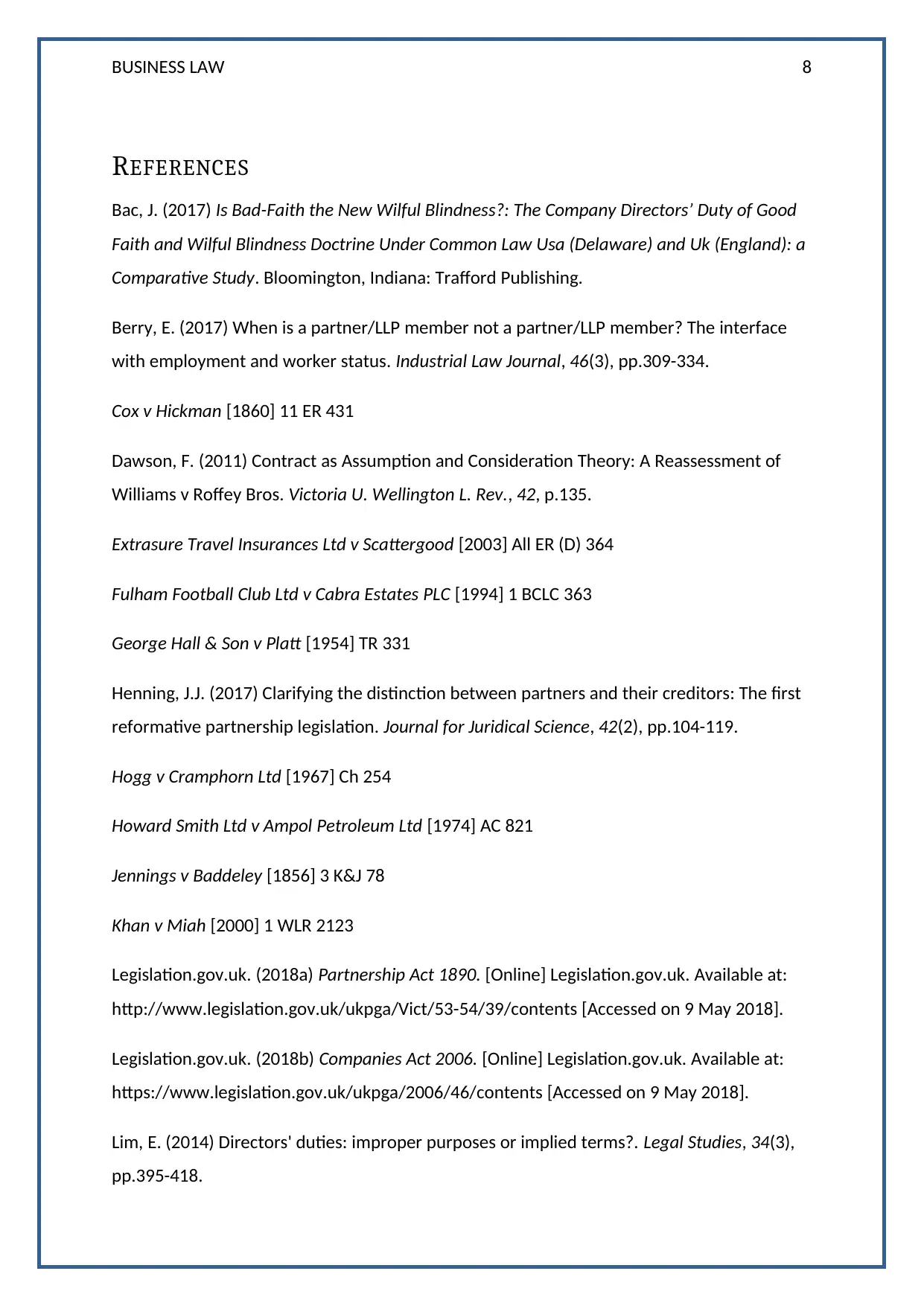
REFERENCES
Bac, J. (2017) Is Bad-Faith the New Wilful Blindness?: The Company Directors’ Duty of Good
Faith and Wilful Blindness Doctrine Under Common Law Usa (Delaware) and Uk (England): a
Comparative Study. Bloomington, Indiana: Trafford Publishing.
Berry, E. (2017) When is a partner/LLP member not a partner/LLP member? The interface
with employment and worker status. Industrial Law Journal, 46(3), pp.309-334.
Cox v Hickman [1860] 11 ER 431
Dawson, F. (2011) Contract as Assumption and Consideration Theory: A Reassessment of
Williams v Roffey Bros. Victoria U. Wellington L. Rev., 42, p.135.
Extrasure Travel Insurances Ltd v Scattergood [2003] All ER (D) 364
Fulham Football Club Ltd v Cabra Estates PLC [1994] 1 BCLC 363
George Hall & Son v Platt [1954] TR 331
Henning, J.J. (2017) Clarifying the distinction between partners and their creditors: The first
reformative partnership legislation. Journal for Juridical Science, 42(2), pp.104-119.
Hogg v Cramphorn Ltd [1967] Ch 254
Howard Smith Ltd v Ampol Petroleum Ltd [1974] AC 821
Jennings v Baddeley [1856] 3 K&J 78
Khan v Miah [2000] 1 WLR 2123
Legislation.gov.uk. (2018a) Partnership Act 1890. [Online] Legislation.gov.uk. Available at:
http://www.legislation.gov.uk/ukpga/Vict/53-54/39/contents [Accessed on 9 May 2018].
Legislation.gov.uk. (2018b) Companies Act 2006. [Online] Legislation.gov.uk. Available at:
https://www.legislation.gov.uk/ukpga/2006/46/contents [Accessed on 9 May 2018].
Lim, E. (2014) Directors' duties: improper purposes or implied terms?. Legal Studies, 34(3),
pp.395-418.
REFERENCES
Bac, J. (2017) Is Bad-Faith the New Wilful Blindness?: The Company Directors’ Duty of Good
Faith and Wilful Blindness Doctrine Under Common Law Usa (Delaware) and Uk (England): a
Comparative Study. Bloomington, Indiana: Trafford Publishing.
Berry, E. (2017) When is a partner/LLP member not a partner/LLP member? The interface
with employment and worker status. Industrial Law Journal, 46(3), pp.309-334.
Cox v Hickman [1860] 11 ER 431
Dawson, F. (2011) Contract as Assumption and Consideration Theory: A Reassessment of
Williams v Roffey Bros. Victoria U. Wellington L. Rev., 42, p.135.
Extrasure Travel Insurances Ltd v Scattergood [2003] All ER (D) 364
Fulham Football Club Ltd v Cabra Estates PLC [1994] 1 BCLC 363
George Hall & Son v Platt [1954] TR 331
Henning, J.J. (2017) Clarifying the distinction between partners and their creditors: The first
reformative partnership legislation. Journal for Juridical Science, 42(2), pp.104-119.
Hogg v Cramphorn Ltd [1967] Ch 254
Howard Smith Ltd v Ampol Petroleum Ltd [1974] AC 821
Jennings v Baddeley [1856] 3 K&J 78
Khan v Miah [2000] 1 WLR 2123
Legislation.gov.uk. (2018a) Partnership Act 1890. [Online] Legislation.gov.uk. Available at:
http://www.legislation.gov.uk/ukpga/Vict/53-54/39/contents [Accessed on 9 May 2018].
Legislation.gov.uk. (2018b) Companies Act 2006. [Online] Legislation.gov.uk. Available at:
https://www.legislation.gov.uk/ukpga/2006/46/contents [Accessed on 9 May 2018].
Lim, E. (2014) Directors' duties: improper purposes or implied terms?. Legal Studies, 34(3),
pp.395-418.
⊘ This is a preview!⊘
Do you want full access?
Subscribe today to unlock all pages.
Trusted by 1+ million students worldwide
BUSINESS LAW 9
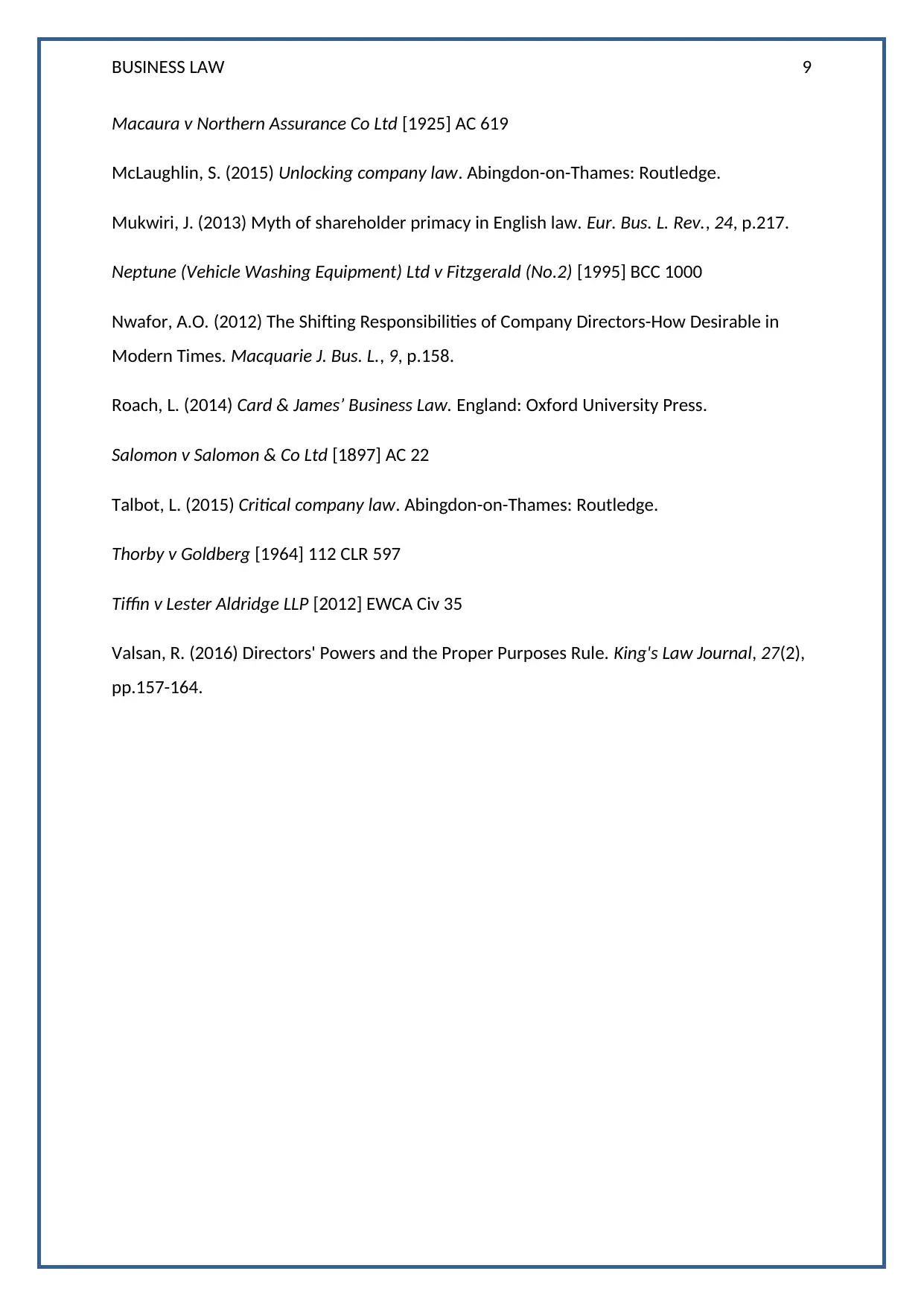
Macaura v Northern Assurance Co Ltd [1925] AC 619
McLaughlin, S. (2015) Unlocking company law. Abingdon-on-Thames: Routledge.
Mukwiri, J. (2013) Myth of shareholder primacy in English law. Eur. Bus. L. Rev., 24, p.217.
Neptune (Vehicle Washing Equipment) Ltd v Fitzgerald (No.2) [1995] BCC 1000
Nwafor, A.O. (2012) The Shifting Responsibilities of Company Directors-How Desirable in
Modern Times. Macquarie J. Bus. L., 9, p.158.
Roach, L. (2014) Card & James’ Business Law. England: Oxford University Press.
Salomon v Salomon & Co Ltd [1897] AC 22
Talbot, L. (2015) Critical company law. Abingdon-on-Thames: Routledge.
Thorby v Goldberg [1964] 112 CLR 597
Tiffin v Lester Aldridge LLP [2012] EWCA Civ 35
Valsan, R. (2016) Directors' Powers and the Proper Purposes Rule. King's Law Journal, 27(2),
pp.157-164.
Macaura v Northern Assurance Co Ltd [1925] AC 619
McLaughlin, S. (2015) Unlocking company law. Abingdon-on-Thames: Routledge.
Mukwiri, J. (2013) Myth of shareholder primacy in English law. Eur. Bus. L. Rev., 24, p.217.
Neptune (Vehicle Washing Equipment) Ltd v Fitzgerald (No.2) [1995] BCC 1000
Nwafor, A.O. (2012) The Shifting Responsibilities of Company Directors-How Desirable in
Modern Times. Macquarie J. Bus. L., 9, p.158.
Roach, L. (2014) Card & James’ Business Law. England: Oxford University Press.
Salomon v Salomon & Co Ltd [1897] AC 22
Talbot, L. (2015) Critical company law. Abingdon-on-Thames: Routledge.
Thorby v Goldberg [1964] 112 CLR 597
Tiffin v Lester Aldridge LLP [2012] EWCA Civ 35
Valsan, R. (2016) Directors' Powers and the Proper Purposes Rule. King's Law Journal, 27(2),
pp.157-164.

1 out of 10


Related Documents


Your All-in-One AI-Powered Toolkit for Academic Success.
+13062052269
info@desklib.com
Available 24*7 on WhatsApp / Email
![[object Object]](/_next/static/media/star-bottom.7253800d.svg)
Unlock your academic potential
Copyright © 2020–2026 A2Z Services. All Rights Reserved. Developed and managed by ZUCOL.