Comprehensive Report on UK Business Law: Classifications, Sources
VerifiedAdded on 2023/06/14
|10
|2669
|292
Report
AI Summary
This report provides a detailed overview of business law in the United Kingdom, focusing on the classification of laws, the legal system including the roles of the High Court and Supreme Court, and various sources of law such as case law. It delves into the process of making legislation, explains delegated legislation with examples, and examines the law-making process under UK Employment Law. The report further elaborates on the legal duties of employers, covering aspects such as minimum wage, safe working conditions, and equal pay. Finally, it addresses wrongful and unfair dismissal under employment law, outlining the rights of employees and potential remedies. This comprehensive analysis aims to provide a clear understanding of the key aspects of business and employment law in the UK.
BUSINESS LAW

Paraphrase This Document
Need a fresh take? Get an instant paraphrase of this document with our AI Paraphraser
Table of Contents
INTRODUCTION..........................................................................................................................3
MAIN BODY..................................................................................................................................3
CLASSIFICATION OF LAW....................................................................................................3
Definition and identification of laws...........................................................................................3
Forms of Laws in United Kingdom.............................................................................................4
1. Civil law...................................................................................................................................4
2. Criminal law.............................................................................................................................4
Role of courts in UK ...................................................................................................................4
High Court(HC)...........................................................................................................................4
Supreme Court.............................................................................................................................5
Various Sources of Law.............................................................................................................5
Case Law as a source of law.......................................................................................................5
Process of making legislation.....................................................................................................5
Meaning and example of Delegated Legislation.........................................................................6
Law making process of United Kingdom under Employment law.............................................7
Legal duties of Employer ............................................................................................................7
Wrongful and unfair dismissal under employment law...............................................................7
CONCLUSION...............................................................................................................................8
REFERENCES...............................................................................................................................1
INTRODUCTION..........................................................................................................................3
MAIN BODY..................................................................................................................................3
CLASSIFICATION OF LAW....................................................................................................3
Definition and identification of laws...........................................................................................3
Forms of Laws in United Kingdom.............................................................................................4
1. Civil law...................................................................................................................................4
2. Criminal law.............................................................................................................................4
Role of courts in UK ...................................................................................................................4
High Court(HC)...........................................................................................................................4
Supreme Court.............................................................................................................................5
Various Sources of Law.............................................................................................................5
Case Law as a source of law.......................................................................................................5
Process of making legislation.....................................................................................................5
Meaning and example of Delegated Legislation.........................................................................6
Law making process of United Kingdom under Employment law.............................................7
Legal duties of Employer ............................................................................................................7
Wrongful and unfair dismissal under employment law...............................................................7
CONCLUSION...............................................................................................................................8
REFERENCES...............................................................................................................................1
INTRODUCTION
The rules and regulations that are related to the enterprise and commercial activities are
known as business law. It involves all the policies that govern how to start manage and run
the business. Business laws play a very vital role in regulating the business activities in a
country (Adams 2012). It helps to handle the various compensation issues in the
organisation and also helps in safeguarding the rights of the shareholders. The employment
law is established to protect the rights of the employees and also specifies the various duties
of employer and employees (Аkramov, et.al, 2020). The report includes the different
classifications of laws in UK, Its legal system highlighting the functions of High Court and
Supreme Court and the report also gives the detailed description of various sources of law,
process of making legislation, examples and meaning of secondary legislation, statutory
duties of employer and unfair dismissal of the employees at workplace under Employment
Law of United Kingdom.
MAIN BODY
CLASSIFICATION OF LAW
Definition and identification of laws
Laws is defined as the set are the set of rules and policies enacted by the government of the
country and for the protection of the rights of the citizens. These rules are binding on the people
of the country, and they are bound to follow the regulations of the country (Slapper and Kelly
2013). These laws help in resolving the disputes that can arise at workplace and also binds the
employer and employee to follow the duties and responsibilities assign under the act. The rules
of the law of UK is based upon the case law which adapts to the changing needs and
requirements of the society. The common law legal system is defined as the collection of the
legislation and is based on the precedents (LeBaron, et.al, 2019). These laws are framed by
passing the regulation by the authorities that is headed by the ‘Head of state’ House of Commons
and House of Lords. The House of Commons is directly elected by the people and the Prime
Minister is the member of the House.
The rules and regulations that are related to the enterprise and commercial activities are
known as business law. It involves all the policies that govern how to start manage and run
the business. Business laws play a very vital role in regulating the business activities in a
country (Adams 2012). It helps to handle the various compensation issues in the
organisation and also helps in safeguarding the rights of the shareholders. The employment
law is established to protect the rights of the employees and also specifies the various duties
of employer and employees (Аkramov, et.al, 2020). The report includes the different
classifications of laws in UK, Its legal system highlighting the functions of High Court and
Supreme Court and the report also gives the detailed description of various sources of law,
process of making legislation, examples and meaning of secondary legislation, statutory
duties of employer and unfair dismissal of the employees at workplace under Employment
Law of United Kingdom.
MAIN BODY
CLASSIFICATION OF LAW
Definition and identification of laws
Laws is defined as the set are the set of rules and policies enacted by the government of the
country and for the protection of the rights of the citizens. These rules are binding on the people
of the country, and they are bound to follow the regulations of the country (Slapper and Kelly
2013). These laws help in resolving the disputes that can arise at workplace and also binds the
employer and employee to follow the duties and responsibilities assign under the act. The rules
of the law of UK is based upon the case law which adapts to the changing needs and
requirements of the society. The common law legal system is defined as the collection of the
legislation and is based on the precedents (LeBaron, et.al, 2019). These laws are framed by
passing the regulation by the authorities that is headed by the ‘Head of state’ House of Commons
and House of Lords. The House of Commons is directly elected by the people and the Prime
Minister is the member of the House.
⊘ This is a preview!⊘
Do you want full access?
Subscribe today to unlock all pages.

Trusted by 1+ million students worldwide
Forms of Laws in United Kingdom
1. Civil law
Civil law is the system that is commonly used to support the legal systems of various European
countries and is based on the written codes and laws that is it is a codified law. Civil law is the
considered as the primary source of law. It is very different from the criminal law and is related
to the rights and properties of people and organization (Farmer, 2020). It settles the disputes
between the individual and organization for which compensation is awarded. Some examples of
civil laws which is family conflicts such as divorce, personal injury, breach of contract and
employment act.
2. Criminal law
Criminal law related to the activities which negatively impacts the person or property. Under the
criminal law if any person breaches the provisions of the law or has conducted does any act
which violates the law subjects to criminal proceedings which is usually bought by the
prosecution and is heard by the Court of justice or the Central criminal Court (Pihlajamäki,
2021). The outcome in the criminal law is either conviction or punishment who has committed
the crime.
Role of courts in UK
High Court(HC)
The HC hears the disputes and appeals of the judgment from the lower tribunal. The Royal
Courts of justice is situated in London. The lawsuit which come before the court of justice
authorities are heard by single judge. The tribunal is bound to follow the principles of the
precedents and its judgments is also based on the case laws. Any appeal which is made from the
orders of the tribunal is first bought in the Court of Appeal and then to the Apex Court (Leyland,
2021). The tribunal hears the most serious cases and complex civil and family cases The HC is
further categorized into three major divisions- Queen’s Bench Appeal, Chancery and family
division. Each court has its ‘Head’ The courts of the Queen Bench Division is divided into
various courts such as Commercial , Technology, construction, Mercantile, Admiralty ,
Administrative and planning court. The Queen’s Bench is the biggest of all the divisions . The
courts of Chancery Division Court includes Bankruptcy and companies, Patents and Intellectual
Property Enterprise court.
1. Civil law
Civil law is the system that is commonly used to support the legal systems of various European
countries and is based on the written codes and laws that is it is a codified law. Civil law is the
considered as the primary source of law. It is very different from the criminal law and is related
to the rights and properties of people and organization (Farmer, 2020). It settles the disputes
between the individual and organization for which compensation is awarded. Some examples of
civil laws which is family conflicts such as divorce, personal injury, breach of contract and
employment act.
2. Criminal law
Criminal law related to the activities which negatively impacts the person or property. Under the
criminal law if any person breaches the provisions of the law or has conducted does any act
which violates the law subjects to criminal proceedings which is usually bought by the
prosecution and is heard by the Court of justice or the Central criminal Court (Pihlajamäki,
2021). The outcome in the criminal law is either conviction or punishment who has committed
the crime.
Role of courts in UK
High Court(HC)
The HC hears the disputes and appeals of the judgment from the lower tribunal. The Royal
Courts of justice is situated in London. The lawsuit which come before the court of justice
authorities are heard by single judge. The tribunal is bound to follow the principles of the
precedents and its judgments is also based on the case laws. Any appeal which is made from the
orders of the tribunal is first bought in the Court of Appeal and then to the Apex Court (Leyland,
2021). The tribunal hears the most serious cases and complex civil and family cases The HC is
further categorized into three major divisions- Queen’s Bench Appeal, Chancery and family
division. Each court has its ‘Head’ The courts of the Queen Bench Division is divided into
various courts such as Commercial , Technology, construction, Mercantile, Admiralty ,
Administrative and planning court. The Queen’s Bench is the biggest of all the divisions . The
courts of Chancery Division Court includes Bankruptcy and companies, Patents and Intellectual
Property Enterprise court.
Paraphrase This Document
Need a fresh take? Get an instant paraphrase of this document with our AI Paraphraser
Supreme Court
The Supreme Court was established in 2009 with the motive to accomplish absolute change
between United Kingdom senior judges and Upper House of the Parliament. Supreme Court is
considered as an apex court as the judgment of the SC is binding on all the parties. The appeal
from the decisions of High Court finally goes to Supreme Court and the judgment is last and
binding on all the parties to disagreement. It is considered as final court of appeal and plays a
very important role in the development of the United Kingdom Law. It never listens to the cases
unless any relevant order is made by the lower court (Hanretty, 2020). Supreme Court is the
final court of appeal for the civil as well as the criminal cases from England, Wales and Northern
Ireland. Supreme Court considers the appeals related to the cases based on the public
importance in United Kingdom. Cases in the Apex Court are heard by five, seven or nine of the
twelve justice of the court each has its own opinion and the decision is made by majority.
Various Sources of Law
Case Law as a source of law
Laws can be classified as the rules and regulations that govern the behaviour of an individual in
the society. Sources of laws can be classified into primary and secondary sources. Case law is on
of the primary source of law that forms the belief of case law under the lawful system. It is
based on the past principles of law that are based on the past decision. Judgments passed in the
important cases were recorded and became the source of law of the present cases related to the
same subject matter (Elliott, et.al, 2018). It acts as guide for the judges related to the cases of
same subject matter. It simply means that the courts follows and apply the principles which were
declared in the previous cases that were decided by senior judges.
Process of making legislation
Bills can commence from any two houses that are the House of Lords and Commons. The legal
document goes through various phase:
First reading: First stage relates to the title of the bill and it arrives in the Lords and is
considered as the formality stage where name of the legal document is read in chamber.
Second reading: The detail on bill is discussed as well as amended in this stage. The members
discussed the areas where any specific change in to be done (Gordon, 2018). There is no vote at
this stage.
The Supreme Court was established in 2009 with the motive to accomplish absolute change
between United Kingdom senior judges and Upper House of the Parliament. Supreme Court is
considered as an apex court as the judgment of the SC is binding on all the parties. The appeal
from the decisions of High Court finally goes to Supreme Court and the judgment is last and
binding on all the parties to disagreement. It is considered as final court of appeal and plays a
very important role in the development of the United Kingdom Law. It never listens to the cases
unless any relevant order is made by the lower court (Hanretty, 2020). Supreme Court is the
final court of appeal for the civil as well as the criminal cases from England, Wales and Northern
Ireland. Supreme Court considers the appeals related to the cases based on the public
importance in United Kingdom. Cases in the Apex Court are heard by five, seven or nine of the
twelve justice of the court each has its own opinion and the decision is made by majority.
Various Sources of Law
Case Law as a source of law
Laws can be classified as the rules and regulations that govern the behaviour of an individual in
the society. Sources of laws can be classified into primary and secondary sources. Case law is on
of the primary source of law that forms the belief of case law under the lawful system. It is
based on the past principles of law that are based on the past decision. Judgments passed in the
important cases were recorded and became the source of law of the present cases related to the
same subject matter (Elliott, et.al, 2018). It acts as guide for the judges related to the cases of
same subject matter. It simply means that the courts follows and apply the principles which were
declared in the previous cases that were decided by senior judges.
Process of making legislation
Bills can commence from any two houses that are the House of Lords and Commons. The legal
document goes through various phase:
First reading: First stage relates to the title of the bill and it arrives in the Lords and is
considered as the formality stage where name of the legal document is read in chamber.
Second reading: The detail on bill is discussed as well as amended in this stage. The members
discussed the areas where any specific change in to be done (Gordon, 2018). There is no vote at
this stage.
Committee stage: The detailed examination of the bill is done. The members start from the
beginning and examine till the end. Voting is taken place to determine the modification that have
to be made in the bill.
Report stage: The administrative unit reports the debate and the changes are sent back to the
House of Lords and the official document is further discussed and voted upon by the house.
Third reading: The bill is portrayed in the House and short discussions be done regarding any
changes to be made or not.
Consideration of Amendments: If the Lords have made the alteration to the draft legal
document then it is sent to the Houses to agree about the respective changes made in the bill. It is
on the discretion of the Commons either to accept, reject or make their own changes. Any
changes made are sent back to the House of Lords.
Royal Assent: When both Houses agree regarding the changes made, the bill is sanctioned and
becomes law.
Meaning and example of Delegated Legislation
When the government gives the ministers the authority to make laws this is known as Delegated
legislation. Acts of Parliaments often confer their powers in the hands of the ministers and gives
the authority to make laws. It is also known as the secondary delegation. Delegated legislation is
the procedure where the governing body is given the authority to make own laws by the
primary legislation. This process enables the authorities to make laws without any wait for the
new act of parliament to be passed. It reduces the unnecessary burden on the legislatures and
gives the executive the authority to make the laws as it helps the legislature to concentrate more
on the important matters. It also helps the person to make laws who have efficient knowledge
and experience (Craig, 2019). Delegated legislation also plays an important role in the
emergency situation where it becomes necessary to take necessary steps to resolve particular
situation. The House of Lords has framed two administrative unit which keeps an eye on the
delegated legislation that is Delegated Powers and Regulatory Reform Committee and Merits of
Statutory Instruments Committee. Rules, regulations and bylaws are examples of delegated
legislation.
beginning and examine till the end. Voting is taken place to determine the modification that have
to be made in the bill.
Report stage: The administrative unit reports the debate and the changes are sent back to the
House of Lords and the official document is further discussed and voted upon by the house.
Third reading: The bill is portrayed in the House and short discussions be done regarding any
changes to be made or not.
Consideration of Amendments: If the Lords have made the alteration to the draft legal
document then it is sent to the Houses to agree about the respective changes made in the bill. It is
on the discretion of the Commons either to accept, reject or make their own changes. Any
changes made are sent back to the House of Lords.
Royal Assent: When both Houses agree regarding the changes made, the bill is sanctioned and
becomes law.
Meaning and example of Delegated Legislation
When the government gives the ministers the authority to make laws this is known as Delegated
legislation. Acts of Parliaments often confer their powers in the hands of the ministers and gives
the authority to make laws. It is also known as the secondary delegation. Delegated legislation is
the procedure where the governing body is given the authority to make own laws by the
primary legislation. This process enables the authorities to make laws without any wait for the
new act of parliament to be passed. It reduces the unnecessary burden on the legislatures and
gives the executive the authority to make the laws as it helps the legislature to concentrate more
on the important matters. It also helps the person to make laws who have efficient knowledge
and experience (Craig, 2019). Delegated legislation also plays an important role in the
emergency situation where it becomes necessary to take necessary steps to resolve particular
situation. The House of Lords has framed two administrative unit which keeps an eye on the
delegated legislation that is Delegated Powers and Regulatory Reform Committee and Merits of
Statutory Instruments Committee. Rules, regulations and bylaws are examples of delegated
legislation.
⊘ This is a preview!⊘
Do you want full access?
Subscribe today to unlock all pages.
Trusted by 1+ million students worldwide
Law making process of United Kingdom under Employment law
Legal duties of Employer
Under the Employment Law both employer and employee have duties and responsibilities
towards each other in the course of employment. The employer should ensure that the business
follows all the rules and regulation which is mentioned under the employment law. Employers
have the responsibility for the health and safety of the employees at workplace and any visitor
who comes to their premises. The statutory duties include:
The employees should be made national minimum wages as mentioned under the contract
of the employment.
The company should provide payslip on which detailed information about the wages
should be specified (Giliker, 2018).
It is the core duty of the employer to provide safe and clean working environment by
providing safety equipment’s for those working at hazardous places.
The organisation should offer the employees a resting period of at least 20 minutes if they
are working for more than six hours a day.
The leader should conduct the risk assessments in order to examine all the risk at work
place and take measures to control or reduce the risk or provide necessary training to the
employees working at risky areas.
It is the duty and responsibility of the employer to pay equal amount of wage to all the
employees according to their work and never discriminate on the basis of gender.
Wrongful and unfair dismissal under employment law
Wrongful dismissal: The term wrongful dismissal refers to breach of written agreement of
employment by the employer. It is also called wrongful termination or wrongful discharge
(Ezeabaogu, Chukwu and Aguwamba, 2019). In case of wrongful dismissal the employee can
go to the employment court within three months from the date of expiration of employment. The
claim for the wrongful dismissal cannot exceed £25,000 to an employment tribunal.
Unfair dismissal: Unfair dismissal occurs when the employer ends the declaration of
employment. The claim related to the unfair dismissal can be done by employee if the employer
has a fair reason to dismiss.
Legal duties of Employer
Under the Employment Law both employer and employee have duties and responsibilities
towards each other in the course of employment. The employer should ensure that the business
follows all the rules and regulation which is mentioned under the employment law. Employers
have the responsibility for the health and safety of the employees at workplace and any visitor
who comes to their premises. The statutory duties include:
The employees should be made national minimum wages as mentioned under the contract
of the employment.
The company should provide payslip on which detailed information about the wages
should be specified (Giliker, 2018).
It is the core duty of the employer to provide safe and clean working environment by
providing safety equipment’s for those working at hazardous places.
The organisation should offer the employees a resting period of at least 20 minutes if they
are working for more than six hours a day.
The leader should conduct the risk assessments in order to examine all the risk at work
place and take measures to control or reduce the risk or provide necessary training to the
employees working at risky areas.
It is the duty and responsibility of the employer to pay equal amount of wage to all the
employees according to their work and never discriminate on the basis of gender.
Wrongful and unfair dismissal under employment law
Wrongful dismissal: The term wrongful dismissal refers to breach of written agreement of
employment by the employer. It is also called wrongful termination or wrongful discharge
(Ezeabaogu, Chukwu and Aguwamba, 2019). In case of wrongful dismissal the employee can
go to the employment court within three months from the date of expiration of employment. The
claim for the wrongful dismissal cannot exceed £25,000 to an employment tribunal.
Unfair dismissal: Unfair dismissal occurs when the employer ends the declaration of
employment. The claim related to the unfair dismissal can be done by employee if the employer
has a fair reason to dismiss.
Paraphrase This Document
Need a fresh take? Get an instant paraphrase of this document with our AI Paraphraser
CONCLUSION
As per the study it can be summarized that laws are very important for protection and
safeguarding the rights of the person living in the society. The legal system of United Kingdom
is based on the common law. These rules and regulations are binding on all the citizens of the
country. Under the employment law, various duties of the employer is discussed which states
that employer is responsible for the health and safety of their employees working at their
premises. It is the obligation of the employer to insure that the rules and regulations of the
business if followed. The employer should also make sure that the employer is paid national
minimum wages and also provided with equal pay and no discrimination should be done within
the premises.
As per the study it can be summarized that laws are very important for protection and
safeguarding the rights of the person living in the society. The legal system of United Kingdom
is based on the common law. These rules and regulations are binding on all the citizens of the
country. Under the employment law, various duties of the employer is discussed which states
that employer is responsible for the health and safety of their employees working at their
premises. It is the obligation of the employer to insure that the rules and regulations of the
business if followed. The employer should also make sure that the employer is paid national
minimum wages and also provided with equal pay and no discrimination should be done within
the premises.
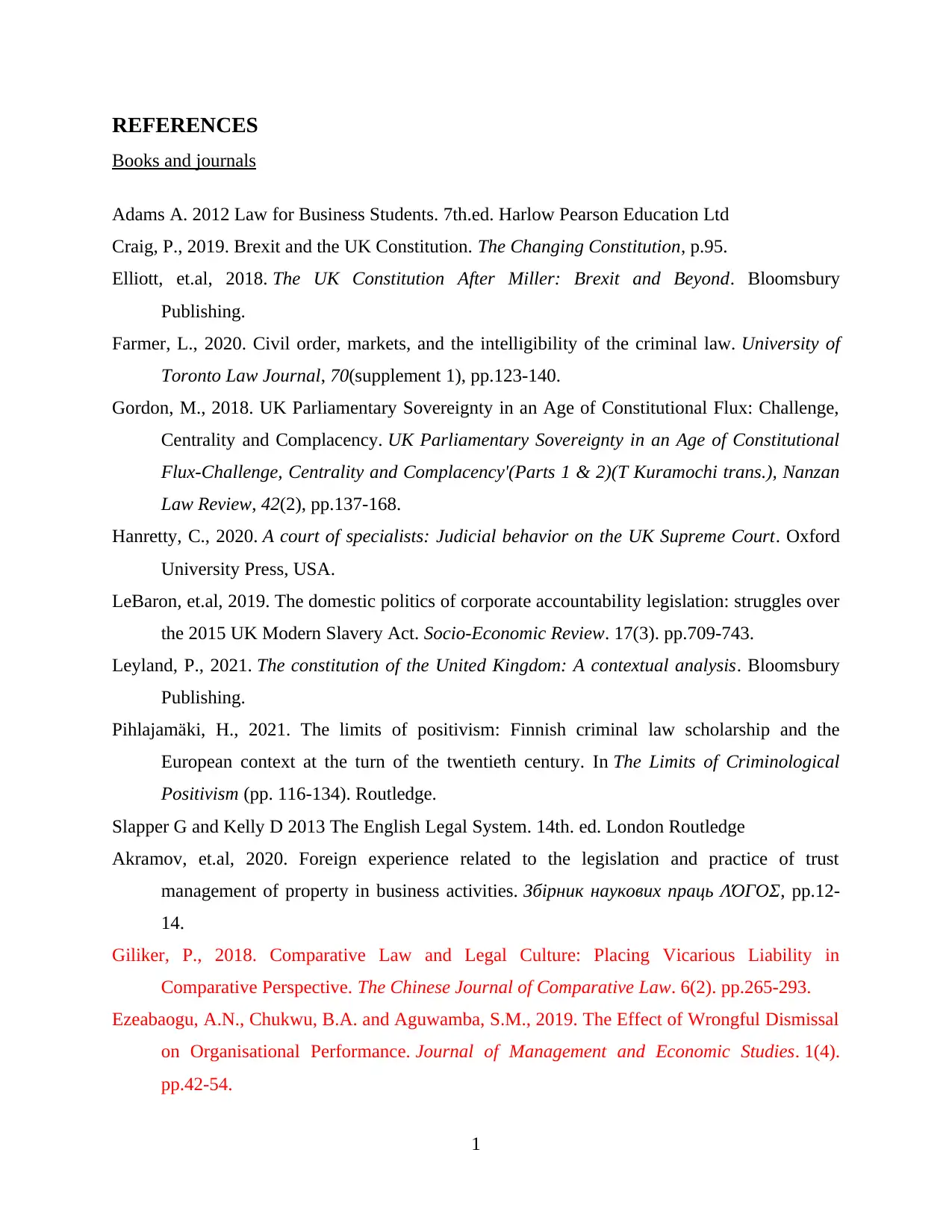
REFERENCES
Books and journals
Adams A. 2012 Law for Business Students. 7th.ed. Harlow Pearson Education Ltd
Craig, P., 2019. Brexit and the UK Constitution. The Changing Constitution, p.95.
Elliott, et.al, 2018. The UK Constitution After Miller: Brexit and Beyond. Bloomsbury
Publishing.
Farmer, L., 2020. Civil order, markets, and the intelligibility of the criminal law. University of
Toronto Law Journal, 70(supplement 1), pp.123-140.
Gordon, M., 2018. UK Parliamentary Sovereignty in an Age of Constitutional Flux: Challenge,
Centrality and Complacency. UK Parliamentary Sovereignty in an Age of Constitutional
Flux-Challenge, Centrality and Complacency'(Parts 1 & 2)(T Kuramochi trans.), Nanzan
Law Review, 42(2), pp.137-168.
Hanretty, C., 2020. A court of specialists: Judicial behavior on the UK Supreme Court. Oxford
University Press, USA.
LeBaron, et.al, 2019. The domestic politics of corporate accountability legislation: struggles over
the 2015 UK Modern Slavery Act. Socio-Economic Review. 17(3). pp.709-743.
Leyland, P., 2021. The constitution of the United Kingdom: A contextual analysis. Bloomsbury
Publishing.
Pihlajamäki, H., 2021. The limits of positivism: Finnish criminal law scholarship and the
European context at the turn of the twentieth century. In The Limits of Criminological
Positivism (pp. 116-134). Routledge.
Slapper G and Kelly D 2013 The English Legal System. 14th. ed. London Routledge
Аkramov, et.al, 2020. Foreign experience related to the legislation and practice of trust
management of property in business activities. Збірник наукових праць ΛΌГOΣ, pp.12-
14.
Giliker, P., 2018. Comparative Law and Legal Culture: Placing Vicarious Liability in
Comparative Perspective. The Chinese Journal of Comparative Law. 6(2). pp.265-293.
Ezeabaogu, A.N., Chukwu, B.A. and Aguwamba, S.M., 2019. The Effect of Wrongful Dismissal
on Organisational Performance. Journal of Management and Economic Studies. 1(4).
pp.42-54.
1
Books and journals
Adams A. 2012 Law for Business Students. 7th.ed. Harlow Pearson Education Ltd
Craig, P., 2019. Brexit and the UK Constitution. The Changing Constitution, p.95.
Elliott, et.al, 2018. The UK Constitution After Miller: Brexit and Beyond. Bloomsbury
Publishing.
Farmer, L., 2020. Civil order, markets, and the intelligibility of the criminal law. University of
Toronto Law Journal, 70(supplement 1), pp.123-140.
Gordon, M., 2018. UK Parliamentary Sovereignty in an Age of Constitutional Flux: Challenge,
Centrality and Complacency. UK Parliamentary Sovereignty in an Age of Constitutional
Flux-Challenge, Centrality and Complacency'(Parts 1 & 2)(T Kuramochi trans.), Nanzan
Law Review, 42(2), pp.137-168.
Hanretty, C., 2020. A court of specialists: Judicial behavior on the UK Supreme Court. Oxford
University Press, USA.
LeBaron, et.al, 2019. The domestic politics of corporate accountability legislation: struggles over
the 2015 UK Modern Slavery Act. Socio-Economic Review. 17(3). pp.709-743.
Leyland, P., 2021. The constitution of the United Kingdom: A contextual analysis. Bloomsbury
Publishing.
Pihlajamäki, H., 2021. The limits of positivism: Finnish criminal law scholarship and the
European context at the turn of the twentieth century. In The Limits of Criminological
Positivism (pp. 116-134). Routledge.
Slapper G and Kelly D 2013 The English Legal System. 14th. ed. London Routledge
Аkramov, et.al, 2020. Foreign experience related to the legislation and practice of trust
management of property in business activities. Збірник наукових праць ΛΌГOΣ, pp.12-
14.
Giliker, P., 2018. Comparative Law and Legal Culture: Placing Vicarious Liability in
Comparative Perspective. The Chinese Journal of Comparative Law. 6(2). pp.265-293.
Ezeabaogu, A.N., Chukwu, B.A. and Aguwamba, S.M., 2019. The Effect of Wrongful Dismissal
on Organisational Performance. Journal of Management and Economic Studies. 1(4).
pp.42-54.
1
⊘ This is a preview!⊘
Do you want full access?
Subscribe today to unlock all pages.
Trusted by 1+ million students worldwide

2

1 out of 10


Related Documents


Your All-in-One AI-Powered Toolkit for Academic Success.
+13062052269
info@desklib.com
Available 24*7 on WhatsApp / Email
![[object Object]](/_next/static/media/star-bottom.7253800d.svg)
Unlock your academic potential
Copyright © 2020–2026 A2Z Services. All Rights Reserved. Developed and managed by ZUCOL.