BMP4002 Business Law: UK Business Organizations & Legal Context Report
VerifiedAdded on 2023/06/06
|8
|2498
|343
Report
AI Summary
This report provides an overview of the legal context for business organizations in the United Kingdom, focusing on key sources of law such as the Companies Act 2006 and the Partnership Act of 1890. It discusses various legal business structures, including sole proprietorships, general partnerships, limited liability partnerships, and limited liability companies, highlighting their advantages and disadvantages. The report also offers recommendations for IOM Solutions, a private company seeking future expansion, suggesting that a limited liability corporation structure would be the most beneficial due to its ability to raise capital, provide limited liability, and offer tax benefits. The analysis covers the legal responsibilities of businesses, the importance of adhering to regulations, and the implications of different business structures on liability and management. The report concludes by emphasizing the importance of understanding the UK's legal framework for business success and recommends that IOM Solutions consider the benefits of a limited liability company for its future growth.
Business Management
BMP4002 Business Law
Assessment 2
Report describing the key sources of
laws as the legal context for business
organizations in the UK
Submitted by:
Name:
ID:
1
BMP4002 Business Law
Assessment 2
Report describing the key sources of
laws as the legal context for business
organizations in the UK
Submitted by:
Name:
ID:
1

Paraphrase This Document
Need a fresh take? Get an instant paraphrase of this document with our AI Paraphraser
Contents
Introduction..........................................................................p
Businesses & Organizations in the UK.............................p
The legal business structure of UK companies...............p
Recommendations for IOM Solutions...............................p
Conclusion..........................................................................p
References..........................................................................p
2
Introduction..........................................................................p
Businesses & Organizations in the UK.............................p
The legal business structure of UK companies...............p
Recommendations for IOM Solutions...............................p
Conclusion..........................................................................p
References..........................................................................p
2
Introduction
The process through which the reciprocation of goods and services done between
the individuals is known as business. The buyers and sellers deals in buying and
selling of goods and services in the market. These products are sold to the
customers on a particular price. Business law basically governs the functions of the
business organizations that are being operated all over the country. It provides
certain norms or regulations upon which every business establishment carry on its
operations(Sweeting, 2022). These rules are important to create a code of conduct for
the organizations so that they can perform the business activities in an effective
manner. There are different type of legislation that are being provided by business
law, such as employment law, taxation law,etc. The following report discuss about
various types of legal business structure of the companies in United Kingdom.
Further, it also renders certain suggestions to IOM solutions which is a private
company that wants future expansion of its business.
Businesses & Organizations in the UK
Business law is an approach through which the organization can decide its code of
conduct and the manner in which they are required to carry the business operations.
This particular branch of law describes that how an employer needs to maintain a
healthy relationship with the employees or the workers associated with the
organization. It also helps in providing safe working environment to the employees in
which the employer is prohibited to perform any sort of irregular activities against the
employees(Eckert, Crommentuijn-Marsh and Black, 2022). It is crucial for any organization to
understand that each and every employee holds importance and are valuable. They
give their sweat and blood to the organization and work hard to achieve the desired
aim of the company. The success of the business depends upon the performance of
the workers. The employees are also required to follow the rules and regulations that
are made by the organization and are obligatory on the employees. This is important
in order to avoid any sort of legal consequences. These laws also states certain
rights for the employees in case of any unlawful activity carried on by the employer
against them. They can approach to the court of law for the enforcement of such
rights in case of any violations.
3
The process through which the reciprocation of goods and services done between
the individuals is known as business. The buyers and sellers deals in buying and
selling of goods and services in the market. These products are sold to the
customers on a particular price. Business law basically governs the functions of the
business organizations that are being operated all over the country. It provides
certain norms or regulations upon which every business establishment carry on its
operations(Sweeting, 2022). These rules are important to create a code of conduct for
the organizations so that they can perform the business activities in an effective
manner. There are different type of legislation that are being provided by business
law, such as employment law, taxation law,etc. The following report discuss about
various types of legal business structure of the companies in United Kingdom.
Further, it also renders certain suggestions to IOM solutions which is a private
company that wants future expansion of its business.
Businesses & Organizations in the UK
Business law is an approach through which the organization can decide its code of
conduct and the manner in which they are required to carry the business operations.
This particular branch of law describes that how an employer needs to maintain a
healthy relationship with the employees or the workers associated with the
organization. It also helps in providing safe working environment to the employees in
which the employer is prohibited to perform any sort of irregular activities against the
employees(Eckert, Crommentuijn-Marsh and Black, 2022). It is crucial for any organization to
understand that each and every employee holds importance and are valuable. They
give their sweat and blood to the organization and work hard to achieve the desired
aim of the company. The success of the business depends upon the performance of
the workers. The employees are also required to follow the rules and regulations that
are made by the organization and are obligatory on the employees. This is important
in order to avoid any sort of legal consequences. These laws also states certain
rights for the employees in case of any unlawful activity carried on by the employer
against them. They can approach to the court of law for the enforcement of such
rights in case of any violations.
3
⊘ This is a preview!⊘
Do you want full access?
Subscribe today to unlock all pages.

Trusted by 1+ million students worldwide
The Companies Act 2006 provides a legal framework for the business
establishments situated in United Kingdom. The business organizations are required
to follow the guidelines mentioned in the statute. Basically, Companies act governs
the incorporation and winding up of a business(Puri, et.al, 2020). According to this act,
company holds a separate legal identity other than its members. It can sue and can
be sued by other company. Business organization is liable to pay the debts or loans
in terms of any liability. The business is qualified to file a lawsuit and to be sued in
UK civil courts. In the case of the company, there is also eternal succession. It
implies that the business should survive the passing of any shareholder. In addition,
the company's operations and existence may continue in the event that the
institution's shareholder was admitted or expelled. For its legal functions, it too has a
detached name and independent seal.
The term "vicarious liability" refers to a master's responsibility for an employee's job.
This resembles a master-servant relationship. Therefore, the leader is responsible
for any disregard on the part of the employee. This could imply that the institution is
obligated to cover claims of compensation for harm caused by a worker acting in the
course of performing their duties for the company. The manager is the legitimate
owner of the business(Ahmed, Qin and Martínez, 2019). Additionally, the institution's
manager must interpret all significant choices. The director essentially serves as the
head of the executive branch. As a result, the institution's director is granted a variety
of powers. The director is responsible for carrying out all required business actions.
Therefore, every executive choice has an effect on the company's workforce.
Therefore, the management must make decisions that are effective for the business.
The Partnership Act of 1890 governs partnership firms. Additionally, these
businesses must adhere to the laws outlined in the partnership law. Every business
also uses two main documents for its operations. The institution's long-term goals
and objectives are outlined in the MOA, or Memorandum of Association. All of the
institution's shareholders must properly sign this. It provides information on the
fundamental structure that governs how the institution operates in the market. In
contrast to this, the AOA is the Article of Association, which outlines the normal
conditions for institution employees. It provides information on the standard norms
4
establishments situated in United Kingdom. The business organizations are required
to follow the guidelines mentioned in the statute. Basically, Companies act governs
the incorporation and winding up of a business(Puri, et.al, 2020). According to this act,
company holds a separate legal identity other than its members. It can sue and can
be sued by other company. Business organization is liable to pay the debts or loans
in terms of any liability. The business is qualified to file a lawsuit and to be sued in
UK civil courts. In the case of the company, there is also eternal succession. It
implies that the business should survive the passing of any shareholder. In addition,
the company's operations and existence may continue in the event that the
institution's shareholder was admitted or expelled. For its legal functions, it too has a
detached name and independent seal.
The term "vicarious liability" refers to a master's responsibility for an employee's job.
This resembles a master-servant relationship. Therefore, the leader is responsible
for any disregard on the part of the employee. This could imply that the institution is
obligated to cover claims of compensation for harm caused by a worker acting in the
course of performing their duties for the company. The manager is the legitimate
owner of the business(Ahmed, Qin and Martínez, 2019). Additionally, the institution's
manager must interpret all significant choices. The director essentially serves as the
head of the executive branch. As a result, the institution's director is granted a variety
of powers. The director is responsible for carrying out all required business actions.
Therefore, every executive choice has an effect on the company's workforce.
Therefore, the management must make decisions that are effective for the business.
The Partnership Act of 1890 governs partnership firms. Additionally, these
businesses must adhere to the laws outlined in the partnership law. Every business
also uses two main documents for its operations. The institution's long-term goals
and objectives are outlined in the MOA, or Memorandum of Association. All of the
institution's shareholders must properly sign this. It provides information on the
fundamental structure that governs how the institution operates in the market. In
contrast to this, the AOA is the Article of Association, which outlines the normal
conditions for institution employees. It provides information on the standard norms
4
Paraphrase This Document
Need a fresh take? Get an instant paraphrase of this document with our AI Paraphraser
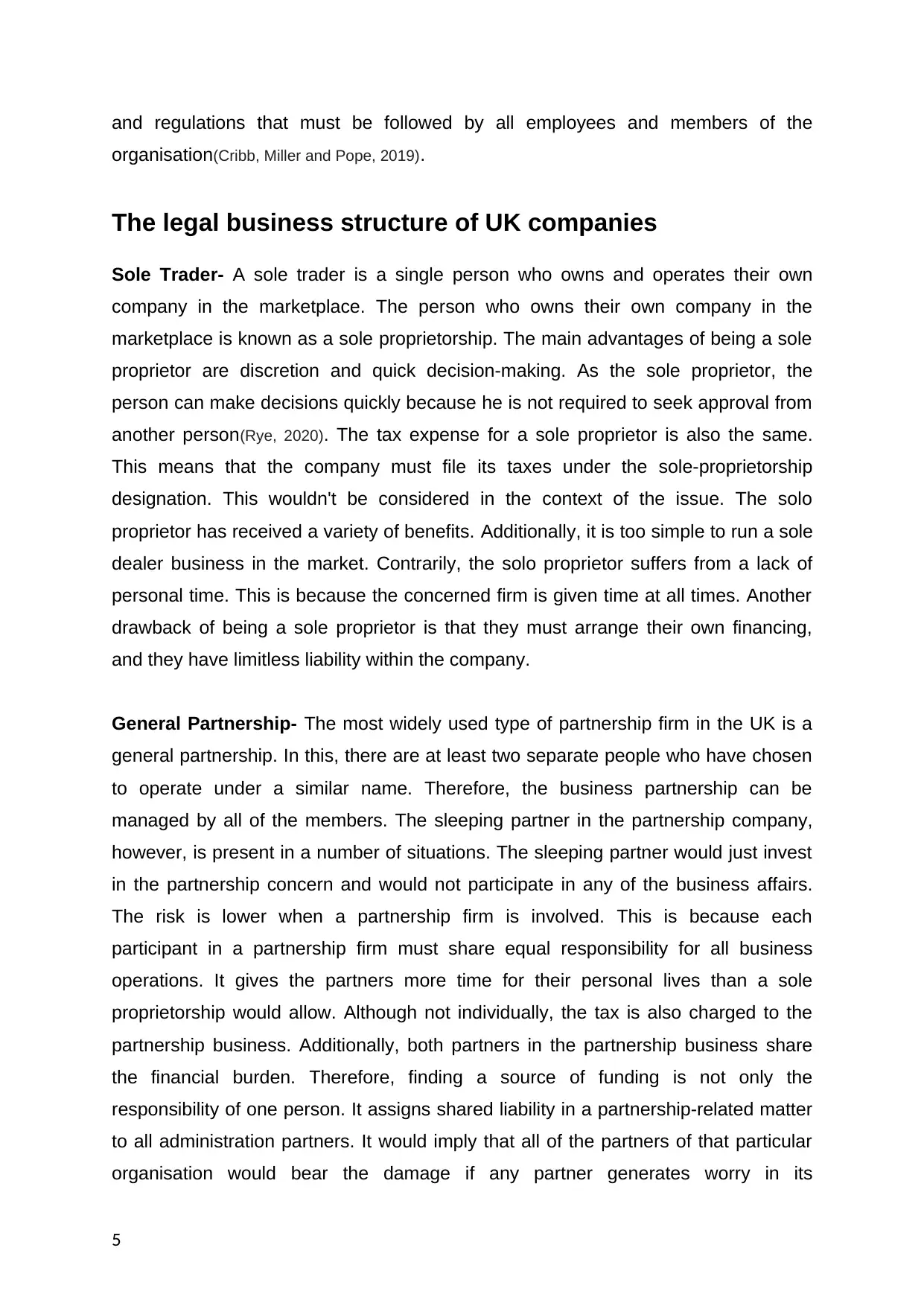
and regulations that must be followed by all employees and members of the
organisation(Cribb, Miller and Pope, 2019).
The legal business structure of UK companies
Sole Trader- A sole trader is a single person who owns and operates their own
company in the marketplace. The person who owns their own company in the
marketplace is known as a sole proprietorship. The main advantages of being a sole
proprietor are discretion and quick decision-making. As the sole proprietor, the
person can make decisions quickly because he is not required to seek approval from
another person(Rye, 2020). The tax expense for a sole proprietor is also the same.
This means that the company must file its taxes under the sole-proprietorship
designation. This wouldn't be considered in the context of the issue. The solo
proprietor has received a variety of benefits. Additionally, it is too simple to run a sole
dealer business in the market. Contrarily, the solo proprietor suffers from a lack of
personal time. This is because the concerned firm is given time at all times. Another
drawback of being a sole proprietor is that they must arrange their own financing,
and they have limitless liability within the company.
General Partnership- The most widely used type of partnership firm in the UK is a
general partnership. In this, there are at least two separate people who have chosen
to operate under a similar name. Therefore, the business partnership can be
managed by all of the members. The sleeping partner in the partnership company,
however, is present in a number of situations. The sleeping partner would just invest
in the partnership concern and would not participate in any of the business affairs.
The risk is lower when a partnership firm is involved. This is because each
participant in a partnership firm must share equal responsibility for all business
operations. It gives the partners more time for their personal lives than a sole
proprietorship would allow. Although not individually, the tax is also charged to the
partnership business. Additionally, both partners in the partnership business share
the financial burden. Therefore, finding a source of funding is not only the
responsibility of one person. It assigns shared liability in a partnership-related matter
to all administration partners. It would imply that all of the partners of that particular
organisation would bear the damage if any partner generates worry in its
5
organisation(Cribb, Miller and Pope, 2019).
The legal business structure of UK companies
Sole Trader- A sole trader is a single person who owns and operates their own
company in the marketplace. The person who owns their own company in the
marketplace is known as a sole proprietorship. The main advantages of being a sole
proprietor are discretion and quick decision-making. As the sole proprietor, the
person can make decisions quickly because he is not required to seek approval from
another person(Rye, 2020). The tax expense for a sole proprietor is also the same.
This means that the company must file its taxes under the sole-proprietorship
designation. This wouldn't be considered in the context of the issue. The solo
proprietor has received a variety of benefits. Additionally, it is too simple to run a sole
dealer business in the market. Contrarily, the solo proprietor suffers from a lack of
personal time. This is because the concerned firm is given time at all times. Another
drawback of being a sole proprietor is that they must arrange their own financing,
and they have limitless liability within the company.
General Partnership- The most widely used type of partnership firm in the UK is a
general partnership. In this, there are at least two separate people who have chosen
to operate under a similar name. Therefore, the business partnership can be
managed by all of the members. The sleeping partner in the partnership company,
however, is present in a number of situations. The sleeping partner would just invest
in the partnership concern and would not participate in any of the business affairs.
The risk is lower when a partnership firm is involved. This is because each
participant in a partnership firm must share equal responsibility for all business
operations. It gives the partners more time for their personal lives than a sole
proprietorship would allow. Although not individually, the tax is also charged to the
partnership business. Additionally, both partners in the partnership business share
the financial burden. Therefore, finding a source of funding is not only the
responsibility of one person. It assigns shared liability in a partnership-related matter
to all administration partners. It would imply that all of the partners of that particular
organisation would bear the damage if any partner generates worry in its
5
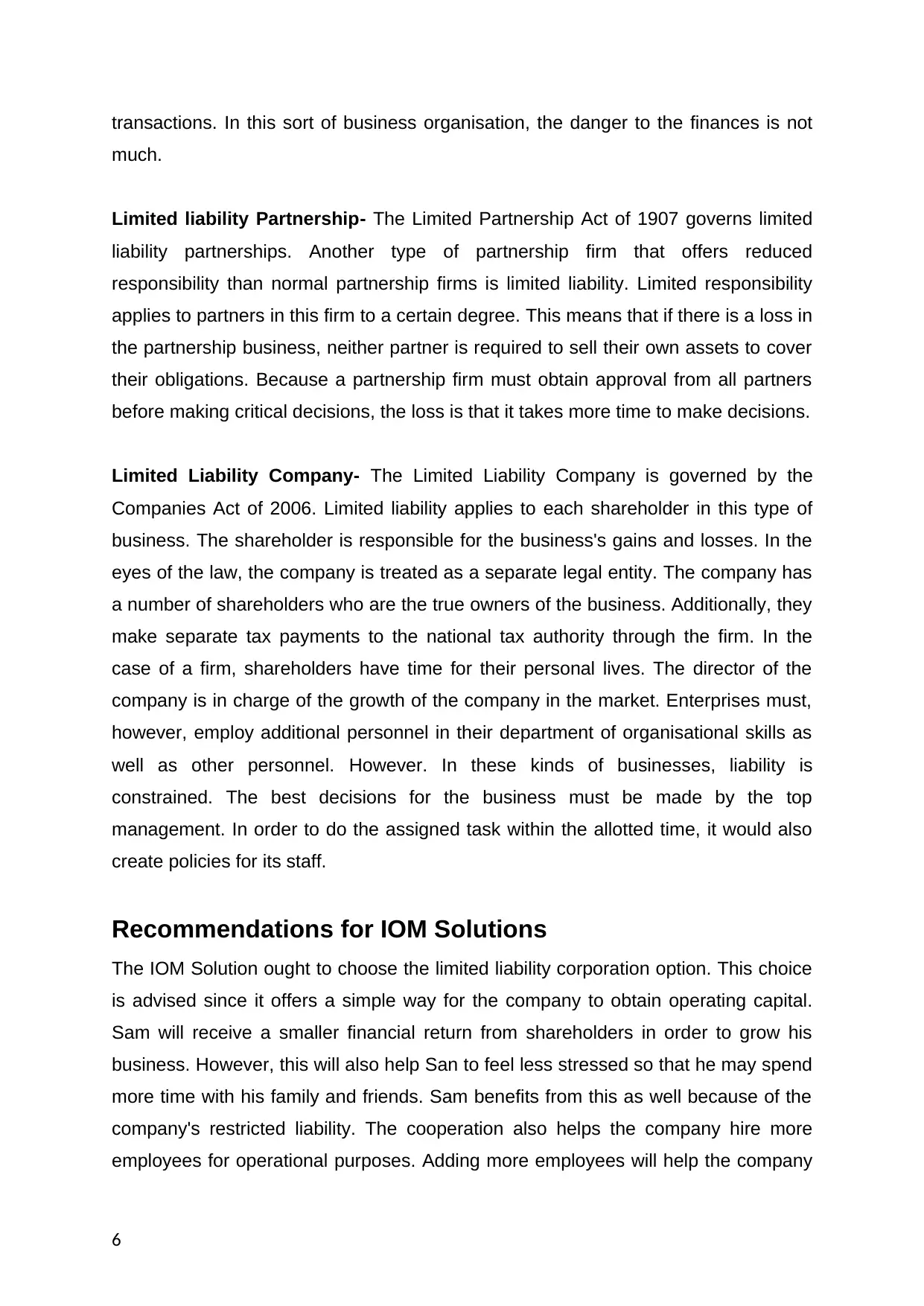
transactions. In this sort of business organisation, the danger to the finances is not
much.
Limited liability Partnership- The Limited Partnership Act of 1907 governs limited
liability partnerships. Another type of partnership firm that offers reduced
responsibility than normal partnership firms is limited liability. Limited responsibility
applies to partners in this firm to a certain degree. This means that if there is a loss in
the partnership business, neither partner is required to sell their own assets to cover
their obligations. Because a partnership firm must obtain approval from all partners
before making critical decisions, the loss is that it takes more time to make decisions.
Limited Liability Company- The Limited Liability Company is governed by the
Companies Act of 2006. Limited liability applies to each shareholder in this type of
business. The shareholder is responsible for the business's gains and losses. In the
eyes of the law, the company is treated as a separate legal entity. The company has
a number of shareholders who are the true owners of the business. Additionally, they
make separate tax payments to the national tax authority through the firm. In the
case of a firm, shareholders have time for their personal lives. The director of the
company is in charge of the growth of the company in the market. Enterprises must,
however, employ additional personnel in their department of organisational skills as
well as other personnel. However. In these kinds of businesses, liability is
constrained. The best decisions for the business must be made by the top
management. In order to do the assigned task within the allotted time, it would also
create policies for its staff.
Recommendations for IOM Solutions
The IOM Solution ought to choose the limited liability corporation option. This choice
is advised since it offers a simple way for the company to obtain operating capital.
Sam will receive a smaller financial return from shareholders in order to grow his
business. However, this will also help San to feel less stressed so that he may spend
more time with his family and friends. Sam benefits from this as well because of the
company's restricted liability. The cooperation also helps the company hire more
employees for operational purposes. Adding more employees will help the company
6
much.
Limited liability Partnership- The Limited Partnership Act of 1907 governs limited
liability partnerships. Another type of partnership firm that offers reduced
responsibility than normal partnership firms is limited liability. Limited responsibility
applies to partners in this firm to a certain degree. This means that if there is a loss in
the partnership business, neither partner is required to sell their own assets to cover
their obligations. Because a partnership firm must obtain approval from all partners
before making critical decisions, the loss is that it takes more time to make decisions.
Limited Liability Company- The Limited Liability Company is governed by the
Companies Act of 2006. Limited liability applies to each shareholder in this type of
business. The shareholder is responsible for the business's gains and losses. In the
eyes of the law, the company is treated as a separate legal entity. The company has
a number of shareholders who are the true owners of the business. Additionally, they
make separate tax payments to the national tax authority through the firm. In the
case of a firm, shareholders have time for their personal lives. The director of the
company is in charge of the growth of the company in the market. Enterprises must,
however, employ additional personnel in their department of organisational skills as
well as other personnel. However. In these kinds of businesses, liability is
constrained. The best decisions for the business must be made by the top
management. In order to do the assigned task within the allotted time, it would also
create policies for its staff.
Recommendations for IOM Solutions
The IOM Solution ought to choose the limited liability corporation option. This choice
is advised since it offers a simple way for the company to obtain operating capital.
Sam will receive a smaller financial return from shareholders in order to grow his
business. However, this will also help San to feel less stressed so that he may spend
more time with his family and friends. Sam benefits from this as well because of the
company's restricted liability. The cooperation also helps the company hire more
employees for operational purposes. Adding more employees will help the company
6
⊘ This is a preview!⊘
Do you want full access?
Subscribe today to unlock all pages.
Trusted by 1+ million students worldwide
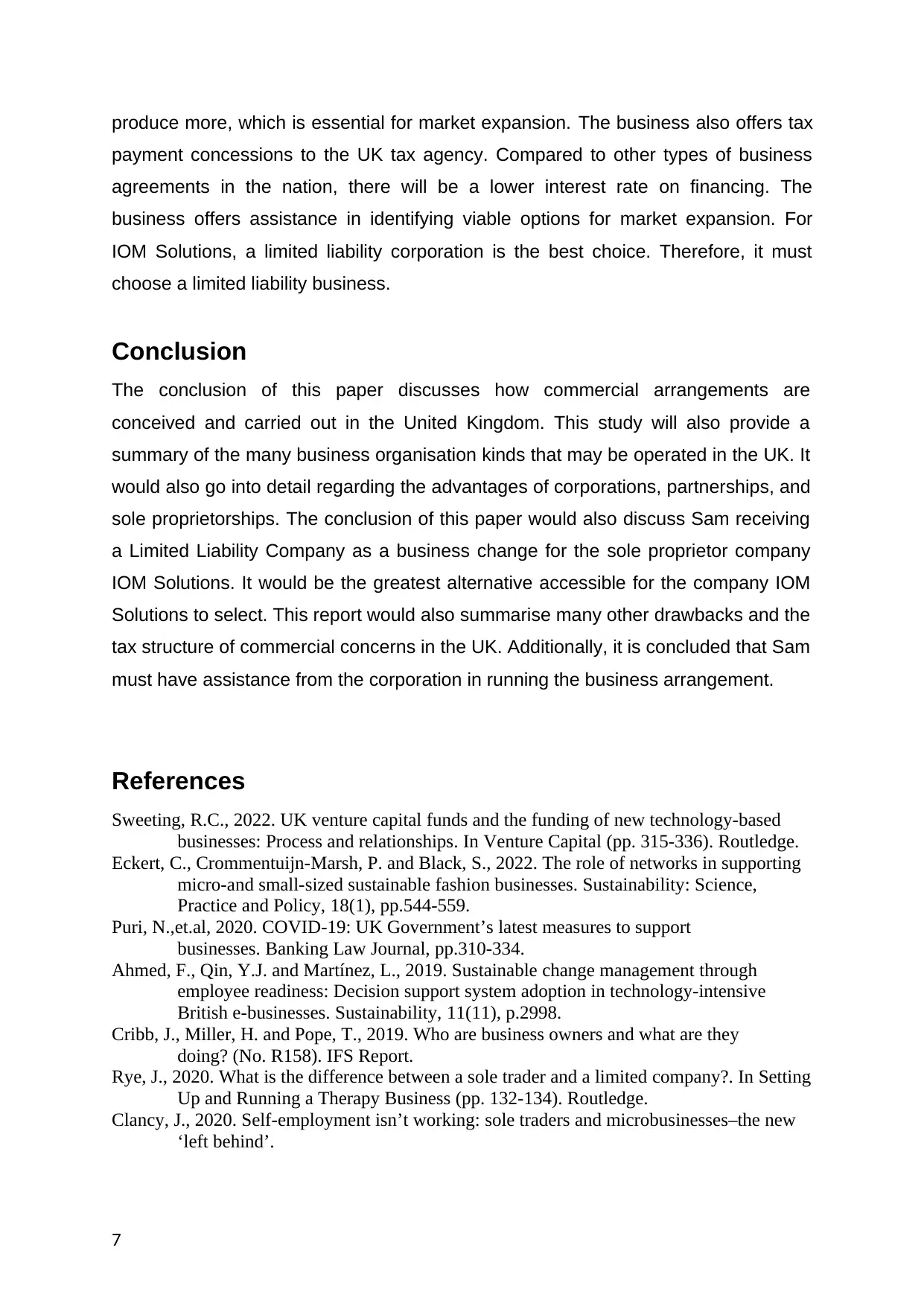
produce more, which is essential for market expansion. The business also offers tax
payment concessions to the UK tax agency. Compared to other types of business
agreements in the nation, there will be a lower interest rate on financing. The
business offers assistance in identifying viable options for market expansion. For
IOM Solutions, a limited liability corporation is the best choice. Therefore, it must
choose a limited liability business.
Conclusion
The conclusion of this paper discusses how commercial arrangements are
conceived and carried out in the United Kingdom. This study will also provide a
summary of the many business organisation kinds that may be operated in the UK. It
would also go into detail regarding the advantages of corporations, partnerships, and
sole proprietorships. The conclusion of this paper would also discuss Sam receiving
a Limited Liability Company as a business change for the sole proprietor company
IOM Solutions. It would be the greatest alternative accessible for the company IOM
Solutions to select. This report would also summarise many other drawbacks and the
tax structure of commercial concerns in the UK. Additionally, it is concluded that Sam
must have assistance from the corporation in running the business arrangement.
References
Sweeting, R.C., 2022. UK venture capital funds and the funding of new technology-based
businesses: Process and relationships. In Venture Capital (pp. 315-336). Routledge.
Eckert, C., Crommentuijn-Marsh, P. and Black, S., 2022. The role of networks in supporting
micro-and small-sized sustainable fashion businesses. Sustainability: Science,
Practice and Policy, 18(1), pp.544-559.
Puri, N.,et.al, 2020. COVID-19: UK Government’s latest measures to support
businesses. Banking Law Journal, pp.310-334.
Ahmed, F., Qin, Y.J. and Martínez, L., 2019. Sustainable change management through
employee readiness: Decision support system adoption in technology-intensive
British e-businesses. Sustainability, 11(11), p.2998.
Cribb, J., Miller, H. and Pope, T., 2019. Who are business owners and what are they
doing? (No. R158). IFS Report.
Rye, J., 2020. What is the difference between a sole trader and a limited company?. In Setting
Up and Running a Therapy Business (pp. 132-134). Routledge.
Clancy, J., 2020. Self-employment isn’t working: sole traders and microbusinesses–the new
‘left behind’.
7
payment concessions to the UK tax agency. Compared to other types of business
agreements in the nation, there will be a lower interest rate on financing. The
business offers assistance in identifying viable options for market expansion. For
IOM Solutions, a limited liability corporation is the best choice. Therefore, it must
choose a limited liability business.
Conclusion
The conclusion of this paper discusses how commercial arrangements are
conceived and carried out in the United Kingdom. This study will also provide a
summary of the many business organisation kinds that may be operated in the UK. It
would also go into detail regarding the advantages of corporations, partnerships, and
sole proprietorships. The conclusion of this paper would also discuss Sam receiving
a Limited Liability Company as a business change for the sole proprietor company
IOM Solutions. It would be the greatest alternative accessible for the company IOM
Solutions to select. This report would also summarise many other drawbacks and the
tax structure of commercial concerns in the UK. Additionally, it is concluded that Sam
must have assistance from the corporation in running the business arrangement.
References
Sweeting, R.C., 2022. UK venture capital funds and the funding of new technology-based
businesses: Process and relationships. In Venture Capital (pp. 315-336). Routledge.
Eckert, C., Crommentuijn-Marsh, P. and Black, S., 2022. The role of networks in supporting
micro-and small-sized sustainable fashion businesses. Sustainability: Science,
Practice and Policy, 18(1), pp.544-559.
Puri, N.,et.al, 2020. COVID-19: UK Government’s latest measures to support
businesses. Banking Law Journal, pp.310-334.
Ahmed, F., Qin, Y.J. and Martínez, L., 2019. Sustainable change management through
employee readiness: Decision support system adoption in technology-intensive
British e-businesses. Sustainability, 11(11), p.2998.
Cribb, J., Miller, H. and Pope, T., 2019. Who are business owners and what are they
doing? (No. R158). IFS Report.
Rye, J., 2020. What is the difference between a sole trader and a limited company?. In Setting
Up and Running a Therapy Business (pp. 132-134). Routledge.
Clancy, J., 2020. Self-employment isn’t working: sole traders and microbusinesses–the new
‘left behind’.
7
Paraphrase This Document
Need a fresh take? Get an instant paraphrase of this document with our AI Paraphraser
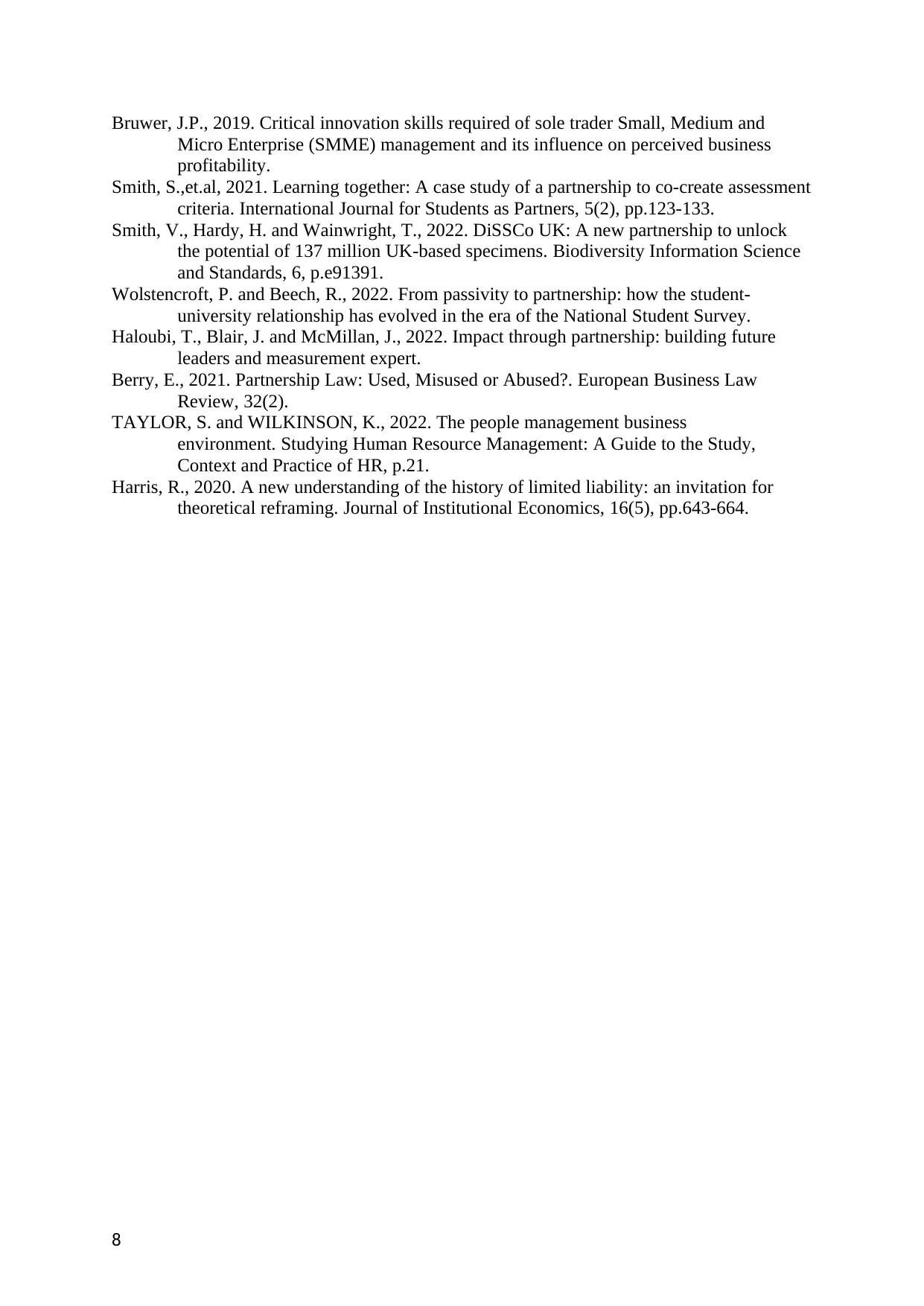
Bruwer, J.P., 2019. Critical innovation skills required of sole trader Small, Medium and
Micro Enterprise (SMME) management and its influence on perceived business
profitability.
Smith, S.,et.al, 2021. Learning together: A case study of a partnership to co-create assessment
criteria. International Journal for Students as Partners, 5(2), pp.123-133.
Smith, V., Hardy, H. and Wainwright, T., 2022. DiSSCo UK: A new partnership to unlock
the potential of 137 million UK-based specimens. Biodiversity Information Science
and Standards, 6, p.e91391.
Wolstencroft, P. and Beech, R., 2022. From passivity to partnership: how the student-
university relationship has evolved in the era of the National Student Survey.
Haloubi, T., Blair, J. and McMillan, J., 2022. Impact through partnership: building future
leaders and measurement expert.
Berry, E., 2021. Partnership Law: Used, Misused or Abused?. European Business Law
Review, 32(2).
TAYLOR, S. and WILKINSON, K., 2022. The people management business
environment. Studying Human Resource Management: A Guide to the Study,
Context and Practice of HR, p.21.
Harris, R., 2020. A new understanding of the history of limited liability: an invitation for
theoretical reframing. Journal of Institutional Economics, 16(5), pp.643-664.
8
Micro Enterprise (SMME) management and its influence on perceived business
profitability.
Smith, S.,et.al, 2021. Learning together: A case study of a partnership to co-create assessment
criteria. International Journal for Students as Partners, 5(2), pp.123-133.
Smith, V., Hardy, H. and Wainwright, T., 2022. DiSSCo UK: A new partnership to unlock
the potential of 137 million UK-based specimens. Biodiversity Information Science
and Standards, 6, p.e91391.
Wolstencroft, P. and Beech, R., 2022. From passivity to partnership: how the student-
university relationship has evolved in the era of the National Student Survey.
Haloubi, T., Blair, J. and McMillan, J., 2022. Impact through partnership: building future
leaders and measurement expert.
Berry, E., 2021. Partnership Law: Used, Misused or Abused?. European Business Law
Review, 32(2).
TAYLOR, S. and WILKINSON, K., 2022. The people management business
environment. Studying Human Resource Management: A Guide to the Study,
Context and Practice of HR, p.21.
Harris, R., 2020. A new understanding of the history of limited liability: an invitation for
theoretical reframing. Journal of Institutional Economics, 16(5), pp.643-664.
8

1 out of 8


Related Documents


Your All-in-One AI-Powered Toolkit for Academic Success.
+13062052269
info@desklib.com
Available 24*7 on WhatsApp / Email
![[object Object]](/_next/static/media/star-bottom.7253800d.svg)
Unlock your academic potential
Copyright © 2020–2026 A2Z Services. All Rights Reserved. Developed and managed by ZUCOL.