Business Law Unit 7: UK Legal System and Business Organizations
VerifiedAdded on 2023/06/05
|12
|4270
|162
Report
AI Summary
This report provides a comprehensive overview of the UK business law landscape. It begins by exploring the nature of the UK legal system, including its sources of law such as case law, legislation, and the role of the government in law-making. The report then analyzes the effectiveness of the legal system and critically evaluates its evolution. A significant portion of the report focuses on the impact of law on businesses, covering aspects like taxation (HMRC), employment law, and contract law. It differentiates between legislation, regulations, and standards. Finally, the report delves into the formation of different types of business organizations, including sole traders and limited companies, and critically evaluates their structures and implications, offering insights into the complexities of establishing and managing a business within the UK legal framework.
Unit 7: Business Law

Paraphrase This Document
Need a fresh take? Get an instant paraphrase of this document with our AI Paraphraser
INTRODUCTION
The business have an direct impact from law in very essential and vast for an enterprise,
there are various kind of business models in UK which play very important role in company. For
understanding depth of this topic we go through from nature of legal system in UK and the
source of law, the role of government to make law, impact on various law on any kind of
business, formation of various kind of business organisation with their funding and management
which have best solution for business model in UK and their sources of law(Begum, 2020). At
time of covering whole topic point by point we get to know for serious variations of law in UK
and their major scenario within sources of their organisation. Moreover, these important
information provides better view of legal system in UK and role which government play in same
legal system of country.
MAIN BODY
LO1 - NATURE OF THE LEGAL SYSTEM :
The UK have four country in this which is Scotland, England and Wales and Northern
Ireland, each of them have their own jurisdiction and courts law which apply various jurisdiction
were derived through parliamentary act and statutory instrument. They have various jurisdiction
and courts which can decide matter as according to their courtroom regulation but all matter
appeal lies to Supreme court of UK(Blindell, 2021). The legal system of country is working well
and still they have no written constitution for the country as Queen is head of state but all major
authority vests within the government which have all executive function. There are significant
constitutional since Labour Government came in force in year 1997. They immediately start
process for devolution, which means transferring some areas of government to countries which
forms UK.
DIFFERENT SOURCES OF LAW :
Mainly there are 3 sources of law in UK before December 31st 2020 but after exit from
EU, UK have 2 sources of law through which they consist law without a written constitution:
CASE LAWS :
The judge made decision in court of records or higher court will be binding on each
inferior court of country. From going through precedent in earlier cases the judgement of same
case happen in past which have been already decided assists court for having decision if facts of
The business have an direct impact from law in very essential and vast for an enterprise,
there are various kind of business models in UK which play very important role in company. For
understanding depth of this topic we go through from nature of legal system in UK and the
source of law, the role of government to make law, impact on various law on any kind of
business, formation of various kind of business organisation with their funding and management
which have best solution for business model in UK and their sources of law(Begum, 2020). At
time of covering whole topic point by point we get to know for serious variations of law in UK
and their major scenario within sources of their organisation. Moreover, these important
information provides better view of legal system in UK and role which government play in same
legal system of country.
MAIN BODY
LO1 - NATURE OF THE LEGAL SYSTEM :
The UK have four country in this which is Scotland, England and Wales and Northern
Ireland, each of them have their own jurisdiction and courts law which apply various jurisdiction
were derived through parliamentary act and statutory instrument. They have various jurisdiction
and courts which can decide matter as according to their courtroom regulation but all matter
appeal lies to Supreme court of UK(Blindell, 2021). The legal system of country is working well
and still they have no written constitution for the country as Queen is head of state but all major
authority vests within the government which have all executive function. There are significant
constitutional since Labour Government came in force in year 1997. They immediately start
process for devolution, which means transferring some areas of government to countries which
forms UK.
DIFFERENT SOURCES OF LAW :
Mainly there are 3 sources of law in UK before December 31st 2020 but after exit from
EU, UK have 2 sources of law through which they consist law without a written constitution:
CASE LAWS :
The judge made decision in court of records or higher court will be binding on each
inferior court of country. From going through precedent in earlier cases the judgement of same
case happen in past which have been already decided assists court for having decision if facts of
case are same. Once case have to be decided in same facts such as new case then the case get
treated in same way like before as according to principle of “stare decisis” this means “ to stand
by things decided”, the lower court do follow precedence set through previous case with similar
fact and if facts were similarly sufficient and not exactly same as judge have options:
1) Distinguish : If case facts are different then judges have an option for distinguish 2 cases
and they do not have to follow decision of earlier cases.
2) OVERRULE : If the decision is made by lower court in a case, then in same case upper
court can overrule the judgement made by lower court(Baillie, 2019).
3) REVERSE : In which appeal raise on higher court then the judges can reverse the
judgement passed by lower court.
LEGISLATION :
This is the primary source of law in UK, this is the only entity which make or abolish law
and this means making a new law or altering existing one. Bill passed by parliament means
getting approval from both the houses then bill become act. There are steps which make new
law. The rules set from legislation were refer to statutory provision. The parliamentary act or
statue are essential source to form new law or to demolish older one as this is one of a primary
source for making law of country beside decision of judge in court.
ROLE OF GOVERNMENT IN MAKING LAW :
This have a big role of government to make law in UK as this is only a way for making
law in country through parliament. The legislation is made through parliament which have 2
house one is House of common and second is House of lords, the parliamentary act apply in all 4
country of UK.
There are two kind of bill which were produced before parliament:
1) PUBLIC BILL : The bill which is presented when public in large have to change law
adopted from cabinet in programme of legislative government.
2) PRIVATE BILL : The bill will be introduced through non ministerial MP's, the bill have
priority in some day but not regularly as the lack of parliamentary time.
COMMON LAW :
The decision made by appellate court or previous judicial precedent called as case law or
common law or case law, the system give pre eminence to common law as this is consider that
this is unfair for treat same fact in various manner(Cejnar, and Duke, 2018). The judges referred
treated in same way like before as according to principle of “stare decisis” this means “ to stand
by things decided”, the lower court do follow precedence set through previous case with similar
fact and if facts were similarly sufficient and not exactly same as judge have options:
1) Distinguish : If case facts are different then judges have an option for distinguish 2 cases
and they do not have to follow decision of earlier cases.
2) OVERRULE : If the decision is made by lower court in a case, then in same case upper
court can overrule the judgement made by lower court(Baillie, 2019).
3) REVERSE : In which appeal raise on higher court then the judges can reverse the
judgement passed by lower court.
LEGISLATION :
This is the primary source of law in UK, this is the only entity which make or abolish law
and this means making a new law or altering existing one. Bill passed by parliament means
getting approval from both the houses then bill become act. There are steps which make new
law. The rules set from legislation were refer to statutory provision. The parliamentary act or
statue are essential source to form new law or to demolish older one as this is one of a primary
source for making law of country beside decision of judge in court.
ROLE OF GOVERNMENT IN MAKING LAW :
This have a big role of government to make law in UK as this is only a way for making
law in country through parliament. The legislation is made through parliament which have 2
house one is House of common and second is House of lords, the parliamentary act apply in all 4
country of UK.
There are two kind of bill which were produced before parliament:
1) PUBLIC BILL : The bill which is presented when public in large have to change law
adopted from cabinet in programme of legislative government.
2) PRIVATE BILL : The bill will be introduced through non ministerial MP's, the bill have
priority in some day but not regularly as the lack of parliamentary time.
COMMON LAW :
The decision made by appellate court or previous judicial precedent called as case law or
common law or case law, the system give pre eminence to common law as this is consider that
this is unfair for treat same fact in various manner(Cejnar, and Duke, 2018). The judges referred
⊘ This is a preview!⊘
Do you want full access?
Subscribe today to unlock all pages.

Trusted by 1+ million students worldwide
to cases happened in past for making decision in present cases which were enforced in future
judgements of courts. In future when case come to court similar to previous one then the court
gives same judgement.
STATUTORY LAW :
This is a written document or an act which is being consider as will of legislature. This is
declaration for command formed by law which have to be prohibits or followed some actions of
people. This is a rule of law or system of principles which have been laid down through the
legislature which governs citizen of country. When the bill is passed from both the houses for
getting followed through every citizen and if they fail then judicial proceedings have to be done
against a citizen. The court have to follow the law or act passed be legislation.
M1 – EFFECTIVENESS OF THE LEGAL SYSTEM :
The UK's legal system is totally based on precedent which were clear as this have
substantive common law. After exiting European Union, UK have now become totally
independent judiciary with rule of law and the fact attracts business confidence which make
stability in commercial world and changes with a rapid speed. Arbitration of UK become most
common legal factor for resolve a dispute which have is a great thing for time efficiency of court
and the citizen of country or people in dispute. The organisation of UK are rising as according to
time and this become on of most leading insurance, commercial and financial centre in whole
world which make an impact on business in whole UK.
D1 – CRITICAL EVOLUTION OF THE LEGAL SYSTEM :
United Kingdom have common law in the country but this do not have written
constitution which makes whole difference and unstable situation which makes dis-balance in
law making or even follow them. In the court they apply rule of “stare decisis” which have to be
described above for the project(Cowling, and, et. al., 2020). Since they have dependency on
judgement which have given before use of judgement in similar situation which have been core
in UK courts but this break harmony of law when situation is related but not exactly same. Still
they have loopholes in legal system of UK which need to look after for betterment of citizens.
judgements of courts. In future when case come to court similar to previous one then the court
gives same judgement.
STATUTORY LAW :
This is a written document or an act which is being consider as will of legislature. This is
declaration for command formed by law which have to be prohibits or followed some actions of
people. This is a rule of law or system of principles which have been laid down through the
legislature which governs citizen of country. When the bill is passed from both the houses for
getting followed through every citizen and if they fail then judicial proceedings have to be done
against a citizen. The court have to follow the law or act passed be legislation.
M1 – EFFECTIVENESS OF THE LEGAL SYSTEM :
The UK's legal system is totally based on precedent which were clear as this have
substantive common law. After exiting European Union, UK have now become totally
independent judiciary with rule of law and the fact attracts business confidence which make
stability in commercial world and changes with a rapid speed. Arbitration of UK become most
common legal factor for resolve a dispute which have is a great thing for time efficiency of court
and the citizen of country or people in dispute. The organisation of UK are rising as according to
time and this become on of most leading insurance, commercial and financial centre in whole
world which make an impact on business in whole UK.
D1 – CRITICAL EVOLUTION OF THE LEGAL SYSTEM :
United Kingdom have common law in the country but this do not have written
constitution which makes whole difference and unstable situation which makes dis-balance in
law making or even follow them. In the court they apply rule of “stare decisis” which have to be
described above for the project(Cowling, and, et. al., 2020). Since they have dependency on
judgement which have given before use of judgement in similar situation which have been core
in UK courts but this break harmony of law when situation is related but not exactly same. Still
they have loopholes in legal system of UK which need to look after for betterment of citizens.
Paraphrase This Document
Need a fresh take? Get an instant paraphrase of this document with our AI Paraphraser
LO2 - IMPACT OF THE LAW IN BUSINESS :
The UK law is applicable on every part of business and each company have to face legal
obligations and rules for their organisation or business to run in smooth way and this effect the
employer to employee from contract to company everyone get affect through laws of industry
and business. Make sure that the business meet legal requirement which can grow this and
protect business from massive mistake.
IMPACT ON COMPANY :
When business make gain or revenue then there have to be some legal obligation affect
business through payment of tax for HMRC, solely depends on a structure of company:
SOLE TRADER :
In three month of self employment a sole trader get register himself in HMRC, if failure
of registration occur then the fine of hundred pound have to given through the sole trader and
after registration the company completes an annual self assessment task is must needed and pay
due taxes(Mandal, and Aiyanna, 2019).
LIMITED COMPANIES :
There are some requirement for their company, the business have to get register in
companies house with listing all director along with significant influence in the business.
Submission of annual tax return to HMRC and pay corporate tax is mandatory.
IMPACT ON EMPLOYMENT:
As according to Employment act the business have legal duty for worker through
providing them pension, liability insurance, minimum wages etc. If they have some legal
requirement a employer do include their business which if they would fail to do then the business
face a big loss:
HMRC : The business have to get register through an employer with HMRC before paying any
of the worker.
WORK : For a business Legal obligation is to keep check whether worker have legal right to
work in UK or not.
WAGE : Employer have to pay their worker as according to National Minimum Wage which is
provided by government of UK.
SALARY : Employer have to give payslip to worker which show how they earn in their pay
scale period.
The UK law is applicable on every part of business and each company have to face legal
obligations and rules for their organisation or business to run in smooth way and this effect the
employer to employee from contract to company everyone get affect through laws of industry
and business. Make sure that the business meet legal requirement which can grow this and
protect business from massive mistake.
IMPACT ON COMPANY :
When business make gain or revenue then there have to be some legal obligation affect
business through payment of tax for HMRC, solely depends on a structure of company:
SOLE TRADER :
In three month of self employment a sole trader get register himself in HMRC, if failure
of registration occur then the fine of hundred pound have to given through the sole trader and
after registration the company completes an annual self assessment task is must needed and pay
due taxes(Mandal, and Aiyanna, 2019).
LIMITED COMPANIES :
There are some requirement for their company, the business have to get register in
companies house with listing all director along with significant influence in the business.
Submission of annual tax return to HMRC and pay corporate tax is mandatory.
IMPACT ON EMPLOYMENT:
As according to Employment act the business have legal duty for worker through
providing them pension, liability insurance, minimum wages etc. If they have some legal
requirement a employer do include their business which if they would fail to do then the business
face a big loss:
HMRC : The business have to get register through an employer with HMRC before paying any
of the worker.
WORK : For a business Legal obligation is to keep check whether worker have legal right to
work in UK or not.
WAGE : Employer have to pay their worker as according to National Minimum Wage which is
provided by government of UK.
SALARY : Employer have to give payslip to worker which show how they earn in their pay
scale period.
CONTRACT : Every employer have to provide a written legal contract to the worker which
include their working house, salary, duties and contractual rights to the workers.
IMPACT ON CONTRACT :
Contract basically affect business because of organisation or company the contract is
must to form before starting business despite the fact that they sell product or provides services.
Law of contract is included in each scenario to buy, sell and resell the product there will be legal
factor which a contract is must to have thing for any employer or worker in world of business.
M2 : DIFFERENCE BETWEEN LEGISLATION, REGULATIONS AND STANDARDS :
LEGISLATION : This is a legal entity for government which govern set of organisation or
body, an industry, community or whole country which have systematic way to make laws in
country for each citizen which have to be followed through every business enterprise(Meggitt,
2022).
REGULATIONS : Regulation are set of legal need which have to be followed through an
organisation for business or any other deal which have to be related to legal obligation for
country because of protection, proper safety and other factor in public interest which make rules
in administration.
STANDARDS : These make specification for product or services through organisations, this
may have long list for guideline for module of company which make sure safety and quality.
This consist requirement for the business which need to be there or which have to be followed by
an enterprise.
D2 – CRITICAL EVALUTION OF DIFFERENT TYPES OF BUSINESS
ORGANISATION :
Making a corporate whether become a sole trader, PLC or LLP, this is not as easy as this
look. The person have to invest time and money more than they can ever imagined, a successful
business want investment in various kind of people and various type of time management results
in growth of business which can not possible for everyone as they want tactics and skill for
understand the corporate world in depth so that a owner of company can survive in business
include their working house, salary, duties and contractual rights to the workers.
IMPACT ON CONTRACT :
Contract basically affect business because of organisation or company the contract is
must to form before starting business despite the fact that they sell product or provides services.
Law of contract is included in each scenario to buy, sell and resell the product there will be legal
factor which a contract is must to have thing for any employer or worker in world of business.
M2 : DIFFERENCE BETWEEN LEGISLATION, REGULATIONS AND STANDARDS :
LEGISLATION : This is a legal entity for government which govern set of organisation or
body, an industry, community or whole country which have systematic way to make laws in
country for each citizen which have to be followed through every business enterprise(Meggitt,
2022).
REGULATIONS : Regulation are set of legal need which have to be followed through an
organisation for business or any other deal which have to be related to legal obligation for
country because of protection, proper safety and other factor in public interest which make rules
in administration.
STANDARDS : These make specification for product or services through organisations, this
may have long list for guideline for module of company which make sure safety and quality.
This consist requirement for the business which need to be there or which have to be followed by
an enterprise.
D2 – CRITICAL EVALUTION OF DIFFERENT TYPES OF BUSINESS
ORGANISATION :
Making a corporate whether become a sole trader, PLC or LLP, this is not as easy as this
look. The person have to invest time and money more than they can ever imagined, a successful
business want investment in various kind of people and various type of time management results
in growth of business which can not possible for everyone as they want tactics and skill for
understand the corporate world in depth so that a owner of company can survive in business
⊘ This is a preview!⊘
Do you want full access?
Subscribe today to unlock all pages.
Trusted by 1+ million students worldwide
organisation world and change their profit in industry but they want to make sure be ready in
calculative way to manage loss as well(Mogaji, 2020).
LO3 - FORMATION OF DIFFERENT TYPES OF ORGANISATION :
Formation of a company is process for register company with companies house which is
registrar for company in UK, anyone register a company from completing the online application
form. After registration, a company enters in contract in their own name or take ownership for
their assets.
1) SOLE TRADERS : As per individual business, sole trader want to register to HM
Revenue and Customs to make a company after registration with HMRC a sole trader
have to submit self assessment tax return to fully make as a company in UK and need to
file tax return per annum(Nästega, 2022).
2) LLP : There is few ways which a limited company have to be registered, they can register
company online without approval of registration through company house and though a
agent of professional company or send postal to company house directly through
proposing name of company, address of office, details of director, PSC information,
MOA and AOA. Everything have to be there in information list in good manner to
formation of LLP.
3) PLC : This want to have good capital assets and resources for the company. To form a
PLC they have to make AOA which clearly mention the purpose to make a company,
assets and capital along with member with company house as no business have to take
place in United Kingdom without registering to companies house.
MANGEMENT AND FUNDS OF BUSINESS ORGANISATIONS :
There are many way through which owner of a business manage the found for an
organisation from which a company can be grow in market and increase their value. Some of
many way from a company fund can manage from company:
SMALL BUSINESS GRANT have to be provided through UK government with private
organisation and local authority which they give funding and make opportunity to owner
calculative way to manage loss as well(Mogaji, 2020).
LO3 - FORMATION OF DIFFERENT TYPES OF ORGANISATION :
Formation of a company is process for register company with companies house which is
registrar for company in UK, anyone register a company from completing the online application
form. After registration, a company enters in contract in their own name or take ownership for
their assets.
1) SOLE TRADERS : As per individual business, sole trader want to register to HM
Revenue and Customs to make a company after registration with HMRC a sole trader
have to submit self assessment tax return to fully make as a company in UK and need to
file tax return per annum(Nästega, 2022).
2) LLP : There is few ways which a limited company have to be registered, they can register
company online without approval of registration through company house and though a
agent of professional company or send postal to company house directly through
proposing name of company, address of office, details of director, PSC information,
MOA and AOA. Everything have to be there in information list in good manner to
formation of LLP.
3) PLC : This want to have good capital assets and resources for the company. To form a
PLC they have to make AOA which clearly mention the purpose to make a company,
assets and capital along with member with company house as no business have to take
place in United Kingdom without registering to companies house.
MANGEMENT AND FUNDS OF BUSINESS ORGANISATIONS :
There are many way through which owner of a business manage the found for an
organisation from which a company can be grow in market and increase their value. Some of
many way from a company fund can manage from company:
SMALL BUSINESS GRANT have to be provided through UK government with private
organisation and local authority which they give funding and make opportunity to owner
Paraphrase This Document
Need a fresh take? Get an instant paraphrase of this document with our AI Paraphraser
of small business which is available for new or existing company(Nemeczek, and Pitz,
2018).
CROWDFUNDING give platform which a company raise fund through number of
investment through individual purchaser and investor. Company give an equity in
exchange for investment or this have to provide rewards and grants for investors in
exchange of their capital.
VENTURE CAPITALS invest capital growing and start ups with high risk which results
in great potential for raise an organisation. They have large capital with huge risk and
knowledge which make them expect considerable reward returns and make sure that a
organisation have good plan of business for investment which assist in economic growth
in an area or nationwide.
CROWDFUNDING gives platform in which a company raise fund through number of
investment from individual purchaser and investors. Company gives equity in exchange
for the investment or this provide reward and grants for investor in exchange of capital.
VENTURE CAPITALS invest capital in growing business and start up with high risk
which results in good potential to raise the organisation(Nwoha, 2021). They offers good
capital with taking high risk and knowledge which make them expect considerable
reward and make sure that an organisation have better business plan for investment.
MERCHANT CASH ADVANCE is finance from which a company get funding in
exchange of percentage for their daily credit card Income, this is only for a company
which take majority sale from credit cards. MCA provides fund on advance bases in an
average monthly sales taken for m the card.
M3 – ADVANTAGES AND DISADVANTAGES OF DIFFERENT TYPE OF
BUSINESS ORGANISATION :
SOLE TRADER :
ADVANTAGES DISADVANTAGES
1) This is easy for setting up due to few legal
need. Sole trader have whole control over
1) As a sole trader they run a company on their
own downfall this take time for them to generate
2018).
CROWDFUNDING give platform which a company raise fund through number of
investment through individual purchaser and investor. Company give an equity in
exchange for investment or this have to provide rewards and grants for investors in
exchange of their capital.
VENTURE CAPITALS invest capital growing and start ups with high risk which results
in great potential for raise an organisation. They have large capital with huge risk and
knowledge which make them expect considerable reward returns and make sure that a
organisation have good plan of business for investment which assist in economic growth
in an area or nationwide.
CROWDFUNDING gives platform in which a company raise fund through number of
investment from individual purchaser and investors. Company gives equity in exchange
for the investment or this provide reward and grants for investor in exchange of capital.
VENTURE CAPITALS invest capital in growing business and start up with high risk
which results in good potential to raise the organisation(Nwoha, 2021). They offers good
capital with taking high risk and knowledge which make them expect considerable
reward and make sure that an organisation have better business plan for investment.
MERCHANT CASH ADVANCE is finance from which a company get funding in
exchange of percentage for their daily credit card Income, this is only for a company
which take majority sale from credit cards. MCA provides fund on advance bases in an
average monthly sales taken for m the card.
M3 – ADVANTAGES AND DISADVANTAGES OF DIFFERENT TYPE OF
BUSINESS ORGANISATION :
SOLE TRADER :
ADVANTAGES DISADVANTAGES
1) This is easy for setting up due to few legal
need. Sole trader have whole control over
1) As a sole trader they run a company on their
own downfall this take time for them to generate
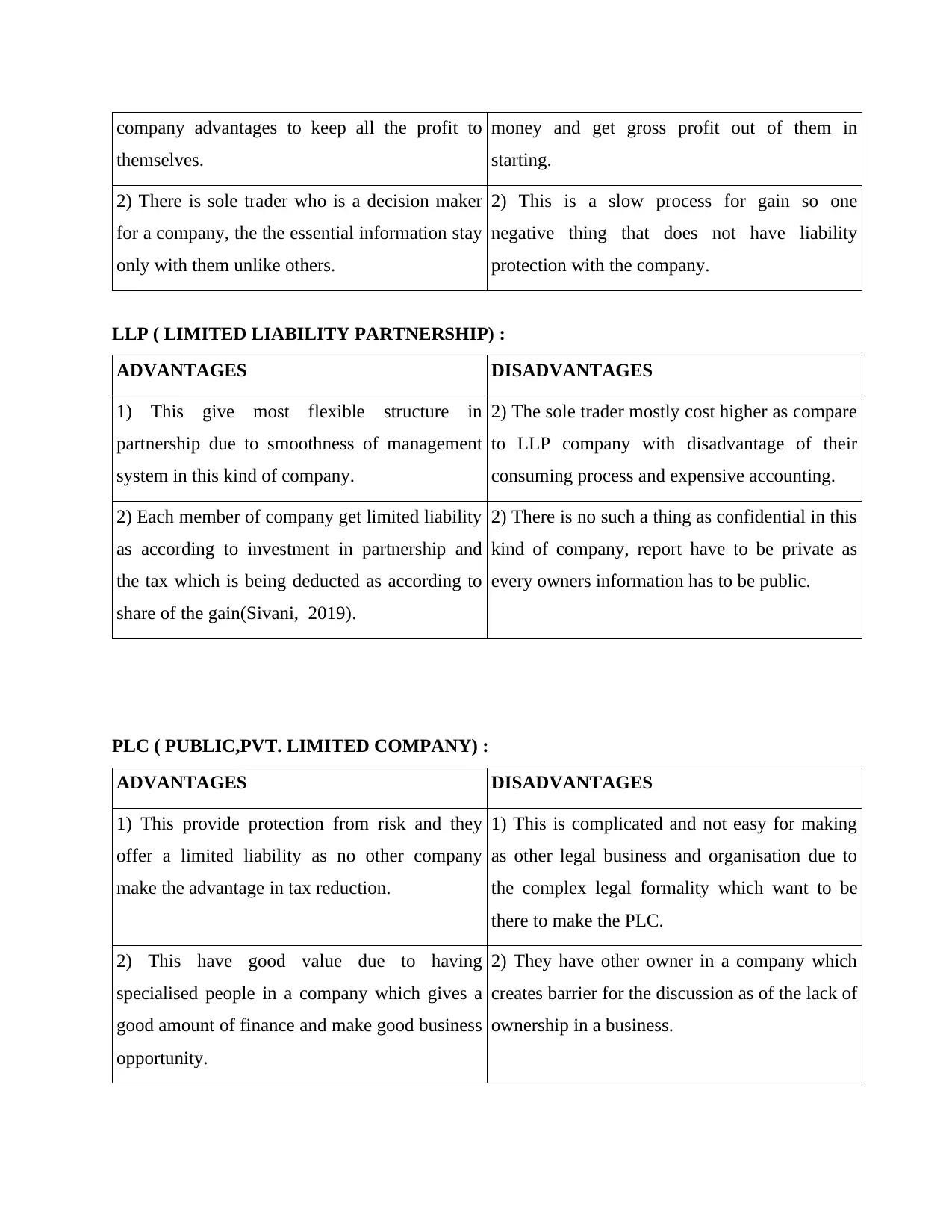
company advantages to keep all the profit to
themselves.
money and get gross profit out of them in
starting.
2) There is sole trader who is a decision maker
for a company, the the essential information stay
only with them unlike others.
2) This is a slow process for gain so one
negative thing that does not have liability
protection with the company.
LLP ( LIMITED LIABILITY PARTNERSHIP) :
ADVANTAGES DISADVANTAGES
1) This give most flexible structure in
partnership due to smoothness of management
system in this kind of company.
2) The sole trader mostly cost higher as compare
to LLP company with disadvantage of their
consuming process and expensive accounting.
2) Each member of company get limited liability
as according to investment in partnership and
the tax which is being deducted as according to
share of the gain(Sivani, 2019).
2) There is no such a thing as confidential in this
kind of company, report have to be private as
every owners information has to be public.
PLC ( PUBLIC,PVT. LIMITED COMPANY) :
ADVANTAGES DISADVANTAGES
1) This provide protection from risk and they
offer a limited liability as no other company
make the advantage in tax reduction.
1) This is complicated and not easy for making
as other legal business and organisation due to
the complex legal formality which want to be
there to make the PLC.
2) This have good value due to having
specialised people in a company which gives a
good amount of finance and make good business
opportunity.
2) They have other owner in a company which
creates barrier for the discussion as of the lack of
ownership in a business.
themselves.
money and get gross profit out of them in
starting.
2) There is sole trader who is a decision maker
for a company, the the essential information stay
only with them unlike others.
2) This is a slow process for gain so one
negative thing that does not have liability
protection with the company.
LLP ( LIMITED LIABILITY PARTNERSHIP) :
ADVANTAGES DISADVANTAGES
1) This give most flexible structure in
partnership due to smoothness of management
system in this kind of company.
2) The sole trader mostly cost higher as compare
to LLP company with disadvantage of their
consuming process and expensive accounting.
2) Each member of company get limited liability
as according to investment in partnership and
the tax which is being deducted as according to
share of the gain(Sivani, 2019).
2) There is no such a thing as confidential in this
kind of company, report have to be private as
every owners information has to be public.
PLC ( PUBLIC,PVT. LIMITED COMPANY) :
ADVANTAGES DISADVANTAGES
1) This provide protection from risk and they
offer a limited liability as no other company
make the advantage in tax reduction.
1) This is complicated and not easy for making
as other legal business and organisation due to
the complex legal formality which want to be
there to make the PLC.
2) This have good value due to having
specialised people in a company which gives a
good amount of finance and make good business
opportunity.
2) They have other owner in a company which
creates barrier for the discussion as of the lack of
ownership in a business.
⊘ This is a preview!⊘
Do you want full access?
Subscribe today to unlock all pages.
Trusted by 1+ million students worldwide
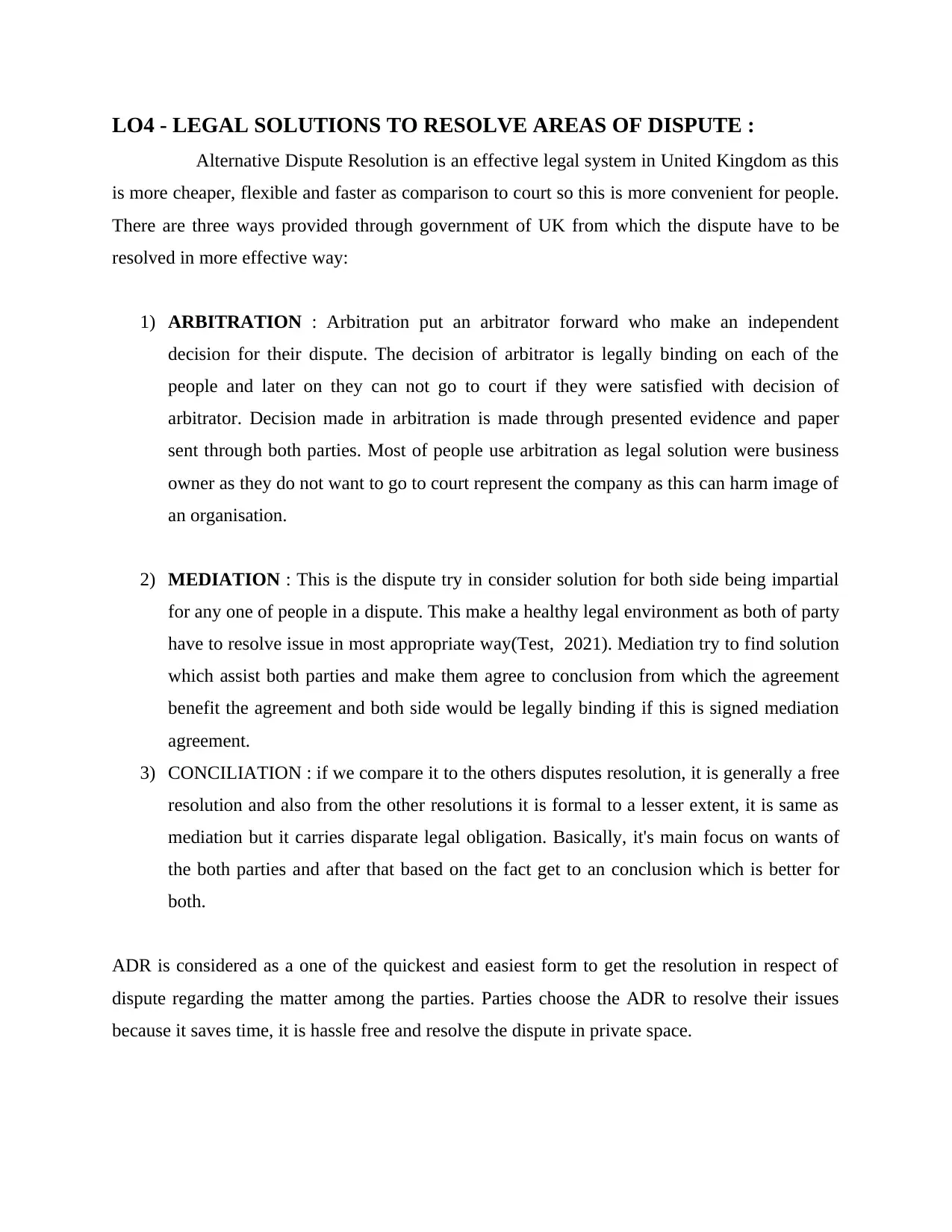
LO4 - LEGAL SOLUTIONS TO RESOLVE AREAS OF DISPUTE :
Alternative Dispute Resolution is an effective legal system in United Kingdom as this
is more cheaper, flexible and faster as comparison to court so this is more convenient for people.
There are three ways provided through government of UK from which the dispute have to be
resolved in more effective way:
1) ARBITRATION : Arbitration put an arbitrator forward who make an independent
decision for their dispute. The decision of arbitrator is legally binding on each of the
people and later on they can not go to court if they were satisfied with decision of
arbitrator. Decision made in arbitration is made through presented evidence and paper
sent through both parties. Most of people use arbitration as legal solution were business
owner as they do not want to go to court represent the company as this can harm image of
an organisation.
2) MEDIATION : This is the dispute try in consider solution for both side being impartial
for any one of people in a dispute. This make a healthy legal environment as both of party
have to resolve issue in most appropriate way(Test, 2021). Mediation try to find solution
which assist both parties and make them agree to conclusion from which the agreement
benefit the agreement and both side would be legally binding if this is signed mediation
agreement.
3) CONCILIATION : if we compare it to the others disputes resolution, it is generally a free
resolution and also from the other resolutions it is formal to a lesser extent, it is same as
mediation but it carries disparate legal obligation. Basically, it's main focus on wants of
the both parties and after that based on the fact get to an conclusion which is better for
both.
ADR is considered as a one of the quickest and easiest form to get the resolution in respect of
dispute regarding the matter among the parties. Parties choose the ADR to resolve their issues
because it saves time, it is hassle free and resolve the dispute in private space.
Alternative Dispute Resolution is an effective legal system in United Kingdom as this
is more cheaper, flexible and faster as comparison to court so this is more convenient for people.
There are three ways provided through government of UK from which the dispute have to be
resolved in more effective way:
1) ARBITRATION : Arbitration put an arbitrator forward who make an independent
decision for their dispute. The decision of arbitrator is legally binding on each of the
people and later on they can not go to court if they were satisfied with decision of
arbitrator. Decision made in arbitration is made through presented evidence and paper
sent through both parties. Most of people use arbitration as legal solution were business
owner as they do not want to go to court represent the company as this can harm image of
an organisation.
2) MEDIATION : This is the dispute try in consider solution for both side being impartial
for any one of people in a dispute. This make a healthy legal environment as both of party
have to resolve issue in most appropriate way(Test, 2021). Mediation try to find solution
which assist both parties and make them agree to conclusion from which the agreement
benefit the agreement and both side would be legally binding if this is signed mediation
agreement.
3) CONCILIATION : if we compare it to the others disputes resolution, it is generally a free
resolution and also from the other resolutions it is formal to a lesser extent, it is same as
mediation but it carries disparate legal obligation. Basically, it's main focus on wants of
the both parties and after that based on the fact get to an conclusion which is better for
both.
ADR is considered as a one of the quickest and easiest form to get the resolution in respect of
dispute regarding the matter among the parties. Parties choose the ADR to resolve their issues
because it saves time, it is hassle free and resolve the dispute in private space.
Paraphrase This Document
Need a fresh take? Get an instant paraphrase of this document with our AI Paraphraser
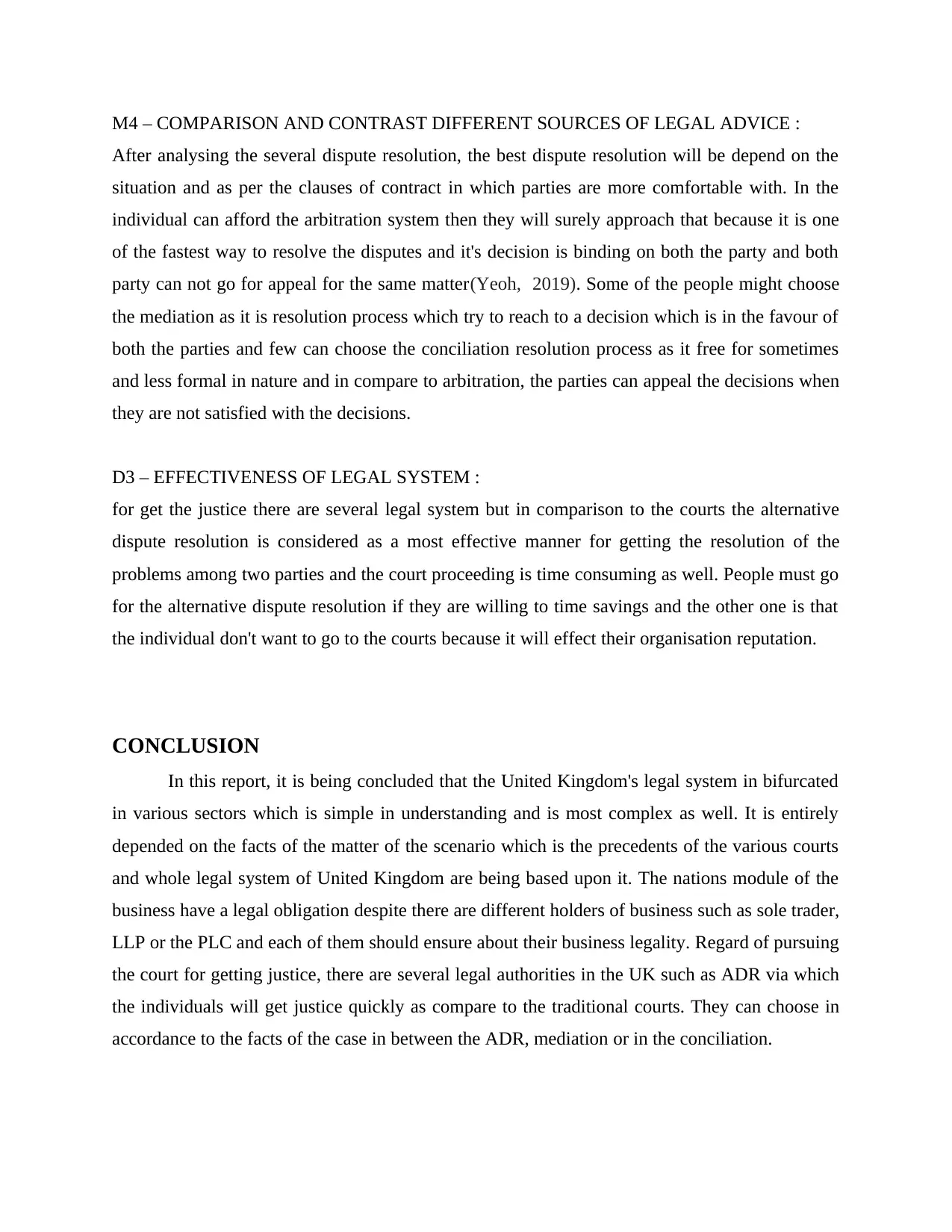
M4 – COMPARISON AND CONTRAST DIFFERENT SOURCES OF LEGAL ADVICE :
After analysing the several dispute resolution, the best dispute resolution will be depend on the
situation and as per the clauses of contract in which parties are more comfortable with. In the
individual can afford the arbitration system then they will surely approach that because it is one
of the fastest way to resolve the disputes and it's decision is binding on both the party and both
party can not go for appeal for the same matter(Yeoh, 2019). Some of the people might choose
the mediation as it is resolution process which try to reach to a decision which is in the favour of
both the parties and few can choose the conciliation resolution process as it free for sometimes
and less formal in nature and in compare to arbitration, the parties can appeal the decisions when
they are not satisfied with the decisions.
D3 – EFFECTIVENESS OF LEGAL SYSTEM :
for get the justice there are several legal system but in comparison to the courts the alternative
dispute resolution is considered as a most effective manner for getting the resolution of the
problems among two parties and the court proceeding is time consuming as well. People must go
for the alternative dispute resolution if they are willing to time savings and the other one is that
the individual don't want to go to the courts because it will effect their organisation reputation.
CONCLUSION
In this report, it is being concluded that the United Kingdom's legal system in bifurcated
in various sectors which is simple in understanding and is most complex as well. It is entirely
depended on the facts of the matter of the scenario which is the precedents of the various courts
and whole legal system of United Kingdom are being based upon it. The nations module of the
business have a legal obligation despite there are different holders of business such as sole trader,
LLP or the PLC and each of them should ensure about their business legality. Regard of pursuing
the court for getting justice, there are several legal authorities in the UK such as ADR via which
the individuals will get justice quickly as compare to the traditional courts. They can choose in
accordance to the facts of the case in between the ADR, mediation or in the conciliation.
After analysing the several dispute resolution, the best dispute resolution will be depend on the
situation and as per the clauses of contract in which parties are more comfortable with. In the
individual can afford the arbitration system then they will surely approach that because it is one
of the fastest way to resolve the disputes and it's decision is binding on both the party and both
party can not go for appeal for the same matter(Yeoh, 2019). Some of the people might choose
the mediation as it is resolution process which try to reach to a decision which is in the favour of
both the parties and few can choose the conciliation resolution process as it free for sometimes
and less formal in nature and in compare to arbitration, the parties can appeal the decisions when
they are not satisfied with the decisions.
D3 – EFFECTIVENESS OF LEGAL SYSTEM :
for get the justice there are several legal system but in comparison to the courts the alternative
dispute resolution is considered as a most effective manner for getting the resolution of the
problems among two parties and the court proceeding is time consuming as well. People must go
for the alternative dispute resolution if they are willing to time savings and the other one is that
the individual don't want to go to the courts because it will effect their organisation reputation.
CONCLUSION
In this report, it is being concluded that the United Kingdom's legal system in bifurcated
in various sectors which is simple in understanding and is most complex as well. It is entirely
depended on the facts of the matter of the scenario which is the precedents of the various courts
and whole legal system of United Kingdom are being based upon it. The nations module of the
business have a legal obligation despite there are different holders of business such as sole trader,
LLP or the PLC and each of them should ensure about their business legality. Regard of pursuing
the court for getting justice, there are several legal authorities in the UK such as ADR via which
the individuals will get justice quickly as compare to the traditional courts. They can choose in
accordance to the facts of the case in between the ADR, mediation or in the conciliation.
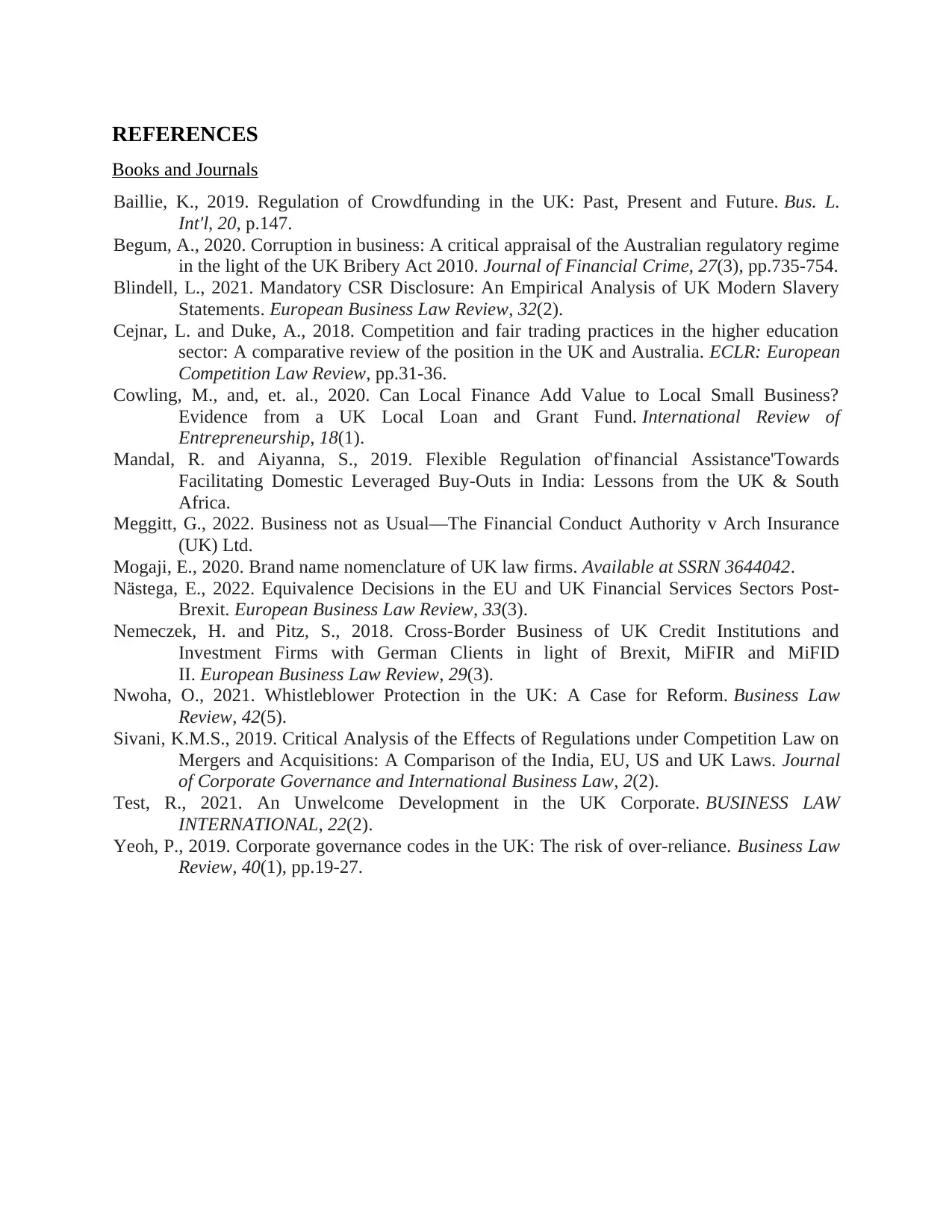
REFERENCES
Books and Journals
Baillie, K., 2019. Regulation of Crowdfunding in the UK: Past, Present and Future. Bus. L.
Int'l, 20, p.147.
Begum, A., 2020. Corruption in business: A critical appraisal of the Australian regulatory regime
in the light of the UK Bribery Act 2010. Journal of Financial Crime, 27(3), pp.735-754.
Blindell, L., 2021. Mandatory CSR Disclosure: An Empirical Analysis of UK Modern Slavery
Statements. European Business Law Review, 32(2).
Cejnar, L. and Duke, A., 2018. Competition and fair trading practices in the higher education
sector: A comparative review of the position in the UK and Australia. ECLR: European
Competition Law Review, pp.31-36.
Cowling, M., and, et. al., 2020. Can Local Finance Add Value to Local Small Business?
Evidence from a UK Local Loan and Grant Fund. International Review of
Entrepreneurship, 18(1).
Mandal, R. and Aiyanna, S., 2019. Flexible Regulation of'financial Assistance'Towards
Facilitating Domestic Leveraged Buy-Outs in India: Lessons from the UK & South
Africa.
Meggitt, G., 2022. Business not as Usual—The Financial Conduct Authority v Arch Insurance
(UK) Ltd.
Mogaji, E., 2020. Brand name nomenclature of UK law firms. Available at SSRN 3644042.
Nästega, E., 2022. Equivalence Decisions in the EU and UK Financial Services Sectors Post-
Brexit. European Business Law Review, 33(3).
Nemeczek, H. and Pitz, S., 2018. Cross-Border Business of UK Credit Institutions and
Investment Firms with German Clients in light of Brexit, MiFIR and MiFID
II. European Business Law Review, 29(3).
Nwoha, O., 2021. Whistleblower Protection in the UK: A Case for Reform. Business Law
Review, 42(5).
Sivani, K.M.S., 2019. Critical Analysis of the Effects of Regulations under Competition Law on
Mergers and Acquisitions: A Comparison of the India, EU, US and UK Laws. Journal
of Corporate Governance and International Business Law, 2(2).
Test, R., 2021. An Unwelcome Development in the UK Corporate. BUSINESS LAW
INTERNATIONAL, 22(2).
Yeoh, P., 2019. Corporate governance codes in the UK: The risk of over-reliance. Business Law
Review, 40(1), pp.19-27.
Books and Journals
Baillie, K., 2019. Regulation of Crowdfunding in the UK: Past, Present and Future. Bus. L.
Int'l, 20, p.147.
Begum, A., 2020. Corruption in business: A critical appraisal of the Australian regulatory regime
in the light of the UK Bribery Act 2010. Journal of Financial Crime, 27(3), pp.735-754.
Blindell, L., 2021. Mandatory CSR Disclosure: An Empirical Analysis of UK Modern Slavery
Statements. European Business Law Review, 32(2).
Cejnar, L. and Duke, A., 2018. Competition and fair trading practices in the higher education
sector: A comparative review of the position in the UK and Australia. ECLR: European
Competition Law Review, pp.31-36.
Cowling, M., and, et. al., 2020. Can Local Finance Add Value to Local Small Business?
Evidence from a UK Local Loan and Grant Fund. International Review of
Entrepreneurship, 18(1).
Mandal, R. and Aiyanna, S., 2019. Flexible Regulation of'financial Assistance'Towards
Facilitating Domestic Leveraged Buy-Outs in India: Lessons from the UK & South
Africa.
Meggitt, G., 2022. Business not as Usual—The Financial Conduct Authority v Arch Insurance
(UK) Ltd.
Mogaji, E., 2020. Brand name nomenclature of UK law firms. Available at SSRN 3644042.
Nästega, E., 2022. Equivalence Decisions in the EU and UK Financial Services Sectors Post-
Brexit. European Business Law Review, 33(3).
Nemeczek, H. and Pitz, S., 2018. Cross-Border Business of UK Credit Institutions and
Investment Firms with German Clients in light of Brexit, MiFIR and MiFID
II. European Business Law Review, 29(3).
Nwoha, O., 2021. Whistleblower Protection in the UK: A Case for Reform. Business Law
Review, 42(5).
Sivani, K.M.S., 2019. Critical Analysis of the Effects of Regulations under Competition Law on
Mergers and Acquisitions: A Comparison of the India, EU, US and UK Laws. Journal
of Corporate Governance and International Business Law, 2(2).
Test, R., 2021. An Unwelcome Development in the UK Corporate. BUSINESS LAW
INTERNATIONAL, 22(2).
Yeoh, P., 2019. Corporate governance codes in the UK: The risk of over-reliance. Business Law
Review, 40(1), pp.19-27.
⊘ This is a preview!⊘
Do you want full access?
Subscribe today to unlock all pages.
Trusted by 1+ million students worldwide

1 out of 12


Related Documents


Your All-in-One AI-Powered Toolkit for Academic Success.
+13062052269
info@desklib.com
Available 24*7 on WhatsApp / Email
![[object Object]](/_next/static/media/star-bottom.7253800d.svg)
Unlock your academic potential
Copyright © 2020–2026 A2Z Services. All Rights Reserved. Developed and managed by ZUCOL.