Impact of COVID-19 and Brexit on UK Economy and Government Measures
VerifiedAdded on 2023/06/18
|10
|3339
|78
Report
AI Summary
This report provides an analysis of the UK economy, focusing on the impacts of COVID-19 and Brexit. It discusses the negative effects of the pandemic, including decreased GDP, industry stagnation, and disruptions to the circular flow of money. The report also examines various government responses, such as the Coronavirus Job Retention Scheme, Self-Employment Income Support Scheme, Kickstart Scheme, and Eat Out to Help Out Scheme, along with the Bank of England's measures to support the economy. Furthermore, it addresses the likely impacts of Brexit, including inflation and reduced employment. The report concludes with recommendations for the UK government to facilitate economic growth and development. Desklib offers a variety of similar solved assignments and past papers for students.

Business

Paraphrase This Document
Need a fresh take? Get an instant paraphrase of this document with our AI Paraphraser

CBE TEMPLATE
Executive Summary
The report briefly talks about effect of COVID-19 and Brexit on the economy of UK and how
the governmental measures are taken in response to COVID-19 in order to accelerate economic
growth and development. Lastly, the report also delivers certain recommendations that the
government of UK can use in order to facilitate the economic growth.
Executive Summary
The report briefly talks about effect of COVID-19 and Brexit on the economy of UK and how
the governmental measures are taken in response to COVID-19 in order to accelerate economic
growth and development. Lastly, the report also delivers certain recommendations that the
government of UK can use in order to facilitate the economic growth.
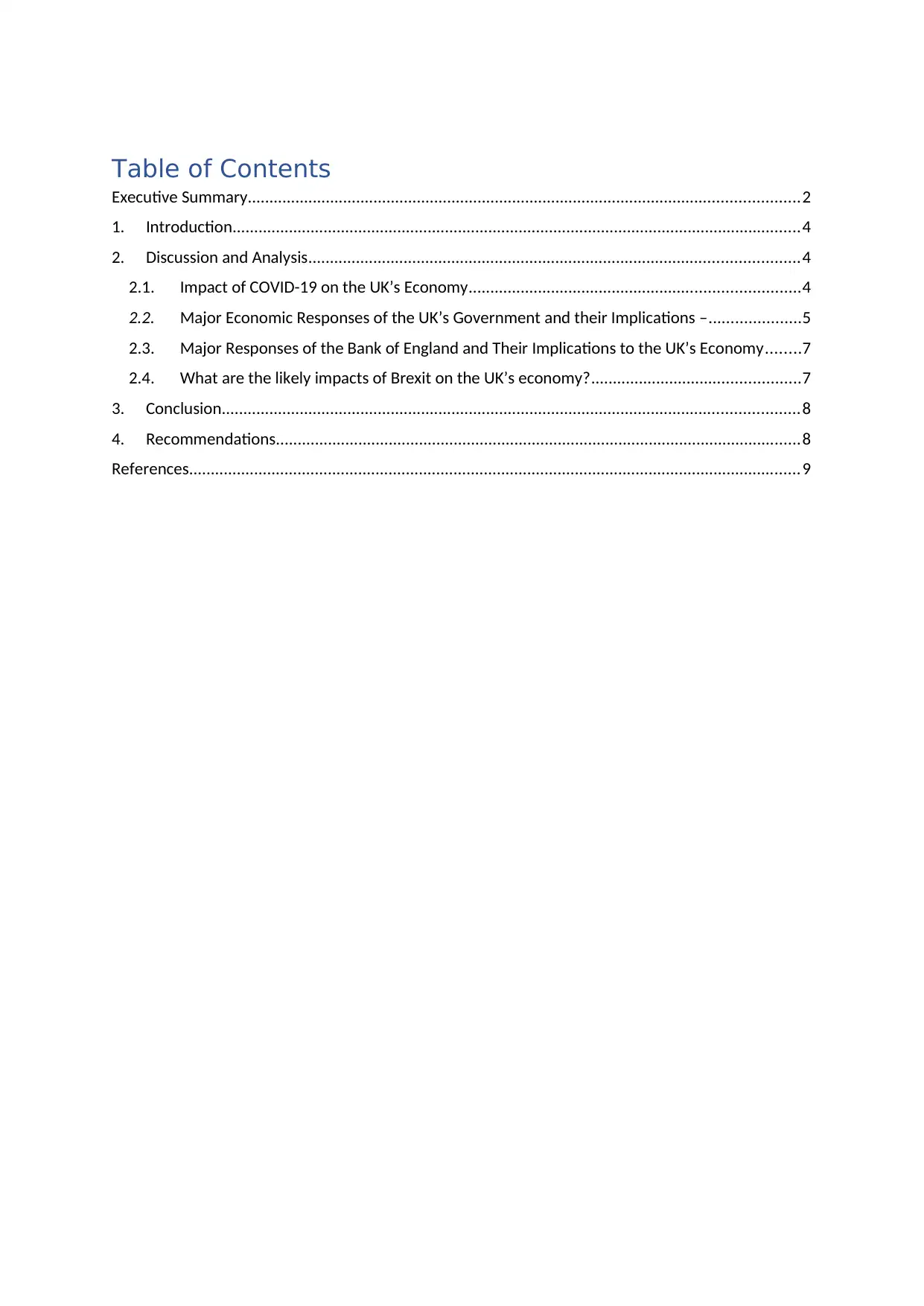
Table of Contents
Executive Summary...............................................................................................................................2
1. Introduction...................................................................................................................................4
2. Discussion and Analysis.................................................................................................................4
2.1. Impact of COVID-19 on the UK’s Economy............................................................................4
2.2. Major Economic Responses of the UK’s Government and their Implications –.....................5
2.3. Major Responses of the Bank of England and Their Implications to the UK’s Economy........7
2.4. What are the likely impacts of Brexit on the UK’s economy?................................................7
3. Conclusion.....................................................................................................................................8
4. Recommendations.........................................................................................................................8
References.............................................................................................................................................9
Executive Summary...............................................................................................................................2
1. Introduction...................................................................................................................................4
2. Discussion and Analysis.................................................................................................................4
2.1. Impact of COVID-19 on the UK’s Economy............................................................................4
2.2. Major Economic Responses of the UK’s Government and their Implications –.....................5
2.3. Major Responses of the Bank of England and Their Implications to the UK’s Economy........7
2.4. What are the likely impacts of Brexit on the UK’s economy?................................................7
3. Conclusion.....................................................................................................................................8
4. Recommendations.........................................................................................................................8
References.............................................................................................................................................9
⊘ This is a preview!⊘
Do you want full access?
Subscribe today to unlock all pages.

Trusted by 1+ million students worldwide
1. Introduction
COVID-19 has negatively impacted the worldwide economy. COVID-19 has slowed down the
economic growth around the globe due to lockdown which restricted the mobility of people, shut
down of businesses. Covering the effect of COVID-19 on U.K.’s economy and the responses taken by
the government to come back with the challenge. Brexit is also one of the negative because many
businesses further increase inflation, reduce employment rate, restricted trade other negative
impacts to the economy of UK. The report talks about the impact of COVID-19 on U.K.’s economy
that how the circular flow of money has affected in the economy, the economic responses taken by
the government of UK such as Coronavirus job retention scheme, self-employment income support
scheme, kickstart scheme, eat out to help out scheme, the responses of bank of England and their
implications to the economy of UK, the effect of Brexit on the economy of UK and further
recommendations to the government for enhancing economic growth (Amankwah-Amoah and
Wang, 2019).
2. Discussion and Analysis
2.1. Impact of COVID-19 on the UK’s Economy
Due to COVID-19, the GDP during crisis in the year 2020 has slight increment by 1.2% but on
February 2020 the GDP also showed a stagnant growth with a percentage of 6.3 and below. There
were different industries and businesses that negatively impacted due to COVID-19, the construction
industry fell by 2.9%, the production manufacturing industries has also seen a stagnant growth of
0.2% and 0.3% respectively. Although there has been a significant growth of the service sectors
where in 1.7% growth has been seen. The GDP in the year 2020 has been stuck below 6.6% in UK.
The reports also showed that GDP of UK in the year 2020 sale by 9.9% which is twice lower than that
of 2009 financial crisis. The International Monetary Fund forecasted that the economy of UK and the
global economy would fall down more than the economic turn down experienced in the year 2008
and 2009 of the global financial crisis. It also delivers that how the COVID-19 outbreak will reduce
the labour supply, Quarantine, lock down and social distancing would affect the mobility. Apart from
that the shutdown of workplaces would damage the productivity and the supply chains. The GDP
would also be negatively affected with the number of income decline and other economic
uncertainty (De Ville and Siles-Brügge, 2019).
The resolution foundation has declared the time period of outbreak, the restriction faced over the
spread of the infection, and other measures in order to reduce the chances of getting the virus. It
also reflects the initial economic effects. The circular flow of U.K.’s economy talks about three
approaches while measuring the GDP of the country. These approaches are production, income,
expenditure.
Production: Production is something which is called as the value of the final output, deducted the
intermediate inputs, and adding the taxes net of subsidies to the products. The COVID-19 outbreak
caused less production level in respect to the lower demand of the products and services result into
lower sales and business closures. It also seen that there is lower level of employment and has
worked as per the labourers and employees are urged to stay at home. Apart from that, the
production process is highly impacted as these are directly integrated with the global economy.
There has been a significant growth of food services market.
COVID-19 has negatively impacted the worldwide economy. COVID-19 has slowed down the
economic growth around the globe due to lockdown which restricted the mobility of people, shut
down of businesses. Covering the effect of COVID-19 on U.K.’s economy and the responses taken by
the government to come back with the challenge. Brexit is also one of the negative because many
businesses further increase inflation, reduce employment rate, restricted trade other negative
impacts to the economy of UK. The report talks about the impact of COVID-19 on U.K.’s economy
that how the circular flow of money has affected in the economy, the economic responses taken by
the government of UK such as Coronavirus job retention scheme, self-employment income support
scheme, kickstart scheme, eat out to help out scheme, the responses of bank of England and their
implications to the economy of UK, the effect of Brexit on the economy of UK and further
recommendations to the government for enhancing economic growth (Amankwah-Amoah and
Wang, 2019).
2. Discussion and Analysis
2.1. Impact of COVID-19 on the UK’s Economy
Due to COVID-19, the GDP during crisis in the year 2020 has slight increment by 1.2% but on
February 2020 the GDP also showed a stagnant growth with a percentage of 6.3 and below. There
were different industries and businesses that negatively impacted due to COVID-19, the construction
industry fell by 2.9%, the production manufacturing industries has also seen a stagnant growth of
0.2% and 0.3% respectively. Although there has been a significant growth of the service sectors
where in 1.7% growth has been seen. The GDP in the year 2020 has been stuck below 6.6% in UK.
The reports also showed that GDP of UK in the year 2020 sale by 9.9% which is twice lower than that
of 2009 financial crisis. The International Monetary Fund forecasted that the economy of UK and the
global economy would fall down more than the economic turn down experienced in the year 2008
and 2009 of the global financial crisis. It also delivers that how the COVID-19 outbreak will reduce
the labour supply, Quarantine, lock down and social distancing would affect the mobility. Apart from
that the shutdown of workplaces would damage the productivity and the supply chains. The GDP
would also be negatively affected with the number of income decline and other economic
uncertainty (De Ville and Siles-Brügge, 2019).
The resolution foundation has declared the time period of outbreak, the restriction faced over the
spread of the infection, and other measures in order to reduce the chances of getting the virus. It
also reflects the initial economic effects. The circular flow of U.K.’s economy talks about three
approaches while measuring the GDP of the country. These approaches are production, income,
expenditure.
Production: Production is something which is called as the value of the final output, deducted the
intermediate inputs, and adding the taxes net of subsidies to the products. The COVID-19 outbreak
caused less production level in respect to the lower demand of the products and services result into
lower sales and business closures. It also seen that there is lower level of employment and has
worked as per the labourers and employees are urged to stay at home. Apart from that, the
production process is highly impacted as these are directly integrated with the global economy.
There has been a significant growth of food services market.
Paraphrase This Document
Need a fresh take? Get an instant paraphrase of this document with our AI Paraphraser
Income: Income is it mean by the value of revenue which is resultant of the sales of products and
services and adding the taxes net of subsidies and production. There is a negative impact COVID-19
on the demand of on the demand and supply of goods and services. The lower level of labour and
capital inputs in the economy has adversely impacted the income. There is a fall in level of
employment that reduces the lower compensation and the payment of wages and salaries. The
reduction in the capital income has further impacts the gross operating surplus. Apart from that.
there is also seen the downturn of income and the return to the self-employed. There is also a
drastic impact on the unemployment and unemployment rate.
Expenditure: Expenditure is determined by the value derived from the sum of all the final
expenditure deducted from the imports. Household consumption will determine the lower level of
non-essential expenditure. The shutdown of shops and mobility of people around will also reduce
their spending and the contact between consumers and business. The capital expenditure
businesses how also been affected. Investment pertaining to the construction activities and import
of goods are also affected at lowering down rates (Dhingra, Machin and Overman, 2017).
2.2. Major Economic Responses of the UK’s Government and
their Implications –
Coronavirus job retention scheme
The coronavirus job retention scheme was formulated to help such employees whose business have
been negatively affected by COVID-19. This scheme was formulated in order to focus on retaining
the employees. The scheme focused over delivering the employees support so that they are able to
maintain and sustain their business, deliver compensation to their employees get quick returns of
the production activities. If the employees are not able to maintain their working capital, in such
cases employees can apply and access to the grant that includes 80% of the usual monthly wage cost
up to £2500 in a month. In addition to that the associated employer National insurance contribution
pension contributions on the grant. The employees accessing the grant of the government must not
work for any other employer for a period. This Coronavirus job retention scheme pertains to income
tax, national insurance contribution and minimum pension contribution. apart from that employs
receives from the government funds that helps to motivate such employees to accelerate
production and get quick returns. The government decides to deliver compensation as furloughed
workers. It is also recorded as subsidies in production. Employers carry on with the payment of
compensation which is calculated under wages and salaries being liable for income tax, insurance
contributions and pension contributions. The subsidy on production is recorded as per which is in
salary for furloughed employees. This also reflects the balance concept of corona job retention
scheme. Wherein the employers who furloughs the employees, the output of these employers are
considered zero. There are employers who pay additional compensation to the furlough employees
thus in such instances the compensation would reflect higher and furthermore it would be
presented in reduction in GOS (gross operating surplus) and the effect of furloughing would reflect
lower income and output (Gudgin and et.al., 2018).
Self-employment income support scheme
The self-employment income support scheme (SEISS) is formulated by the government of UK that
stretches hand of support to such self-employed or the member of a partnership in UK who have lost
their businesses, and the sources of income due to COVID-19. For accessing the government helps
the eligibility criteria set by the government includes trading profit which does not includes more
than £50,000 or excess than half of recipient’s total income from the self-employment. With the
help of self-employment income support scheme these people can assess taxable grant of 80% of
services and adding the taxes net of subsidies and production. There is a negative impact COVID-19
on the demand of on the demand and supply of goods and services. The lower level of labour and
capital inputs in the economy has adversely impacted the income. There is a fall in level of
employment that reduces the lower compensation and the payment of wages and salaries. The
reduction in the capital income has further impacts the gross operating surplus. Apart from that.
there is also seen the downturn of income and the return to the self-employed. There is also a
drastic impact on the unemployment and unemployment rate.
Expenditure: Expenditure is determined by the value derived from the sum of all the final
expenditure deducted from the imports. Household consumption will determine the lower level of
non-essential expenditure. The shutdown of shops and mobility of people around will also reduce
their spending and the contact between consumers and business. The capital expenditure
businesses how also been affected. Investment pertaining to the construction activities and import
of goods are also affected at lowering down rates (Dhingra, Machin and Overman, 2017).
2.2. Major Economic Responses of the UK’s Government and
their Implications –
Coronavirus job retention scheme
The coronavirus job retention scheme was formulated to help such employees whose business have
been negatively affected by COVID-19. This scheme was formulated in order to focus on retaining
the employees. The scheme focused over delivering the employees support so that they are able to
maintain and sustain their business, deliver compensation to their employees get quick returns of
the production activities. If the employees are not able to maintain their working capital, in such
cases employees can apply and access to the grant that includes 80% of the usual monthly wage cost
up to £2500 in a month. In addition to that the associated employer National insurance contribution
pension contributions on the grant. The employees accessing the grant of the government must not
work for any other employer for a period. This Coronavirus job retention scheme pertains to income
tax, national insurance contribution and minimum pension contribution. apart from that employs
receives from the government funds that helps to motivate such employees to accelerate
production and get quick returns. The government decides to deliver compensation as furloughed
workers. It is also recorded as subsidies in production. Employers carry on with the payment of
compensation which is calculated under wages and salaries being liable for income tax, insurance
contributions and pension contributions. The subsidy on production is recorded as per which is in
salary for furloughed employees. This also reflects the balance concept of corona job retention
scheme. Wherein the employers who furloughs the employees, the output of these employers are
considered zero. There are employers who pay additional compensation to the furlough employees
thus in such instances the compensation would reflect higher and furthermore it would be
presented in reduction in GOS (gross operating surplus) and the effect of furloughing would reflect
lower income and output (Gudgin and et.al., 2018).
Self-employment income support scheme
The self-employment income support scheme (SEISS) is formulated by the government of UK that
stretches hand of support to such self-employed or the member of a partnership in UK who have lost
their businesses, and the sources of income due to COVID-19. For accessing the government helps
the eligibility criteria set by the government includes trading profit which does not includes more
than £50,000 or excess than half of recipient’s total income from the self-employment. With the
help of self-employment income support scheme these people can assess taxable grant of 80% of
the total trading profit up to £2500 a month. In this scheme the self-employment who receives the
government grants can continue to take another employment including voluntary work. In the SEISS
Scheme the aim is not to maintain employee on the payroll but it is supported to get a return to
production. It is also reflected as a subsidy on production wherein the beneficiary is still considered
as self-employed. The subsidy from the SEISS is considered as mixed income than wages and salary
for employees. In SEISS it is not important That the output of the self-employment should be zero as
the self-employed people can continue to take another employment opportunity (Hu, 2020).
Kickstart scheme
The kickstart scheme talks about delivering six months paid job with the local employer. Kickstart
scheme is an initiative taken by the government of UK focusing to best to job opportunities to the
young citizens in the country so that they are able to gain career opportunities and experience of
working. The funding of the scheme is done by the government of UK. The youngsters between 16 to
24 years can access the benefits of the scheme, the kickstart scheme was initiated with the major
focus of avoiding the risk of unemployment. Apart from that, employers of any business size gain
access for funding that includes hundred percent of national minimum wage for 25 hours per week
with a specified time period of six months. Associated employer national insurance contribution,
minimum automatic enrolment pension contribution. The government also delivers funding to these
employers in order to deliver training and development opportunities to the young people.
Government of UK offers £1500 when the employers recruit any one of the young person at the
company. The employees are fully liable as per kickstart scheme to deliver growth to support until
the candidate achieves a good position in the organisation. The kickstart scheme was basically
formulated for the sole purpose of boosting the employment rate which has negatively affected due
to COVID-19. Kickstart business focused both the employers and employees as business who is even
negatively affected due to economic downturn. Under the kickstart scheme the government
delivered funding to the employees in order to enhance the business demand, diversity social
mobility of the specific business. The government also added approaches in order to stimulate
businesses in the country so that they apply for the scheme. The kickstart scheme covers England,
Scotland and Wales in UK. For delivering text a job to the young employees they must be offered as
per the national minimum wage in addition to pension and national insurance contribution. Apart
from that employers who recruit less than 30 placements cannot apply for the scheme (Kulhánek
and Sulich, 2018).
Eat out to help out scheme
Eat out to help out scheme was launched by the government of UK in order to deliver support to the
businesses in the COVID era. This scheme was mainly focus to deliver support to the businesses by
offering them 50% of on the cost of their food and non-alcoholic beverages that they provide. The
eat out to help out scheme was delivered to all Mondays to Wednesday. The discount was offered at
a maximum of £10 per head. This scheme was mainly launched for the purpose of encouraging
customer demand so that they are able to eat out on the scheme days offered by the government in
the business outlets. As per the data, it is found that approx. eight £40 million was paid by the
government under the scheme. Apart from that more than hundred million means are been served
by the restaurants under the eat out to help out scheme as per the treasury figures.
government grants can continue to take another employment including voluntary work. In the SEISS
Scheme the aim is not to maintain employee on the payroll but it is supported to get a return to
production. It is also reflected as a subsidy on production wherein the beneficiary is still considered
as self-employed. The subsidy from the SEISS is considered as mixed income than wages and salary
for employees. In SEISS it is not important That the output of the self-employment should be zero as
the self-employed people can continue to take another employment opportunity (Hu, 2020).
Kickstart scheme
The kickstart scheme talks about delivering six months paid job with the local employer. Kickstart
scheme is an initiative taken by the government of UK focusing to best to job opportunities to the
young citizens in the country so that they are able to gain career opportunities and experience of
working. The funding of the scheme is done by the government of UK. The youngsters between 16 to
24 years can access the benefits of the scheme, the kickstart scheme was initiated with the major
focus of avoiding the risk of unemployment. Apart from that, employers of any business size gain
access for funding that includes hundred percent of national minimum wage for 25 hours per week
with a specified time period of six months. Associated employer national insurance contribution,
minimum automatic enrolment pension contribution. The government also delivers funding to these
employers in order to deliver training and development opportunities to the young people.
Government of UK offers £1500 when the employers recruit any one of the young person at the
company. The employees are fully liable as per kickstart scheme to deliver growth to support until
the candidate achieves a good position in the organisation. The kickstart scheme was basically
formulated for the sole purpose of boosting the employment rate which has negatively affected due
to COVID-19. Kickstart business focused both the employers and employees as business who is even
negatively affected due to economic downturn. Under the kickstart scheme the government
delivered funding to the employees in order to enhance the business demand, diversity social
mobility of the specific business. The government also added approaches in order to stimulate
businesses in the country so that they apply for the scheme. The kickstart scheme covers England,
Scotland and Wales in UK. For delivering text a job to the young employees they must be offered as
per the national minimum wage in addition to pension and national insurance contribution. Apart
from that employers who recruit less than 30 placements cannot apply for the scheme (Kulhánek
and Sulich, 2018).
Eat out to help out scheme
Eat out to help out scheme was launched by the government of UK in order to deliver support to the
businesses in the COVID era. This scheme was mainly focus to deliver support to the businesses by
offering them 50% of on the cost of their food and non-alcoholic beverages that they provide. The
eat out to help out scheme was delivered to all Mondays to Wednesday. The discount was offered at
a maximum of £10 per head. This scheme was mainly launched for the purpose of encouraging
customer demand so that they are able to eat out on the scheme days offered by the government in
the business outlets. As per the data, it is found that approx. eight £40 million was paid by the
government under the scheme. Apart from that more than hundred million means are been served
by the restaurants under the eat out to help out scheme as per the treasury figures.
⊘ This is a preview!⊘
Do you want full access?
Subscribe today to unlock all pages.
Trusted by 1+ million students worldwide
2.3. Major Responses of the Bank of England and Their
Implications to the UK’s Economy
Reduced Interest Rate
The bank of England supports the government policy by making sure that businesses have access to
new loan at least cost, to make sure that the market for government of UK continues to function, to
make sure that those who are not able to pay debts will be offered repayment holidays. The bank of
England base rate was turned down from 0.75% to 0.25% and then to 0.1%. Mark Carney who was
the governor or of bank of England, he addressed that the interest rate in the country would turn
down but Will be above than 0%. You also suggest an added that 0.1% interest-rate was the least
interest rates offered by bank of England. This lower interest rates were focus to deliver support to
the businesses and households at lower borrowing cost. The bank of England also launched new
schemes in order to deliver cost-effective funding sources. The cutting down of interest rate by
offering the banks and building societies funding sources at lower interest rate. So that household
can access easy loans at least interest rates. The bank of England also focused to deliver funding so
that there is and significant increase in lending. The schemes were also launched to deliver financial
support to the small and medium businesses (Lenart-Gansiniec ed., 2018 ).
Sustenance of Government Bonds
Due to economic downturn seen in the UK wherein the bond market has been affected negatively.
The bank of England Has introduced the policy for increasing its government bond buying
programme. Wherein approx. hundred billion pounds’ investment has been made to the same.
The main purpose behind the bank purchase of government bonds from the investors like pension
fund and other investor to lower down the interest rates on home mortgages, loans and maintain
the flow of money throughout the financial System. The bank of England monitory policy initiated to
facilitate the asset purchase facility wherein the bank of England holds UK government in corporate
bonds by £200 billion with a total expenditure of six £45 billion. Where in the major part of the
money was utilised to buy government bonds. And remaining was corporate bonds.
2.4. What are the likely impacts of Brexit on the UK’s
economy?
Immediate impact of Brexit on the U.K.’s economy
As for the study due to Brexit the inflation rate in UK has been pushed by 1.7% in the year 2017
which has caused financial burden to the British households pushing it to £404. Further, Brexit also
affected the national British income in the year 2017 by 0.6% and 1.3%. Further the unemployment
rate has been increased by 1.5% and investments of businesses by 6%. It is estimated that there has
been a fall in trade due to the impact of single market membership. Brexit have also effected the
efficiency of the economy of UK by lowering trade, loss of economies of scale due to small-scale
production, low market competition. Brexit have slowed down the economic growth 21% in 2019.
Further UK government also added that Brexit would lower down the economy of UK by 6.7%. The
British pound also fell down to $1.36 that also affect the import making higher prices of
imports. The rising prices by 3% have caused inflation in the year 2017 (Nikitina and Lapiņa, 2019).
Future Impact
Different economic studies have been conducted in order to evaluate the long-term impact of Brexit
on the economy of UK. This economic study emphasises on answering the economic level in UK by
Implications to the UK’s Economy
Reduced Interest Rate
The bank of England supports the government policy by making sure that businesses have access to
new loan at least cost, to make sure that the market for government of UK continues to function, to
make sure that those who are not able to pay debts will be offered repayment holidays. The bank of
England base rate was turned down from 0.75% to 0.25% and then to 0.1%. Mark Carney who was
the governor or of bank of England, he addressed that the interest rate in the country would turn
down but Will be above than 0%. You also suggest an added that 0.1% interest-rate was the least
interest rates offered by bank of England. This lower interest rates were focus to deliver support to
the businesses and households at lower borrowing cost. The bank of England also launched new
schemes in order to deliver cost-effective funding sources. The cutting down of interest rate by
offering the banks and building societies funding sources at lower interest rate. So that household
can access easy loans at least interest rates. The bank of England also focused to deliver funding so
that there is and significant increase in lending. The schemes were also launched to deliver financial
support to the small and medium businesses (Lenart-Gansiniec ed., 2018 ).
Sustenance of Government Bonds
Due to economic downturn seen in the UK wherein the bond market has been affected negatively.
The bank of England Has introduced the policy for increasing its government bond buying
programme. Wherein approx. hundred billion pounds’ investment has been made to the same.
The main purpose behind the bank purchase of government bonds from the investors like pension
fund and other investor to lower down the interest rates on home mortgages, loans and maintain
the flow of money throughout the financial System. The bank of England monitory policy initiated to
facilitate the asset purchase facility wherein the bank of England holds UK government in corporate
bonds by £200 billion with a total expenditure of six £45 billion. Where in the major part of the
money was utilised to buy government bonds. And remaining was corporate bonds.
2.4. What are the likely impacts of Brexit on the UK’s
economy?
Immediate impact of Brexit on the U.K.’s economy
As for the study due to Brexit the inflation rate in UK has been pushed by 1.7% in the year 2017
which has caused financial burden to the British households pushing it to £404. Further, Brexit also
affected the national British income in the year 2017 by 0.6% and 1.3%. Further the unemployment
rate has been increased by 1.5% and investments of businesses by 6%. It is estimated that there has
been a fall in trade due to the impact of single market membership. Brexit have also effected the
efficiency of the economy of UK by lowering trade, loss of economies of scale due to small-scale
production, low market competition. Brexit have slowed down the economic growth 21% in 2019.
Further UK government also added that Brexit would lower down the economy of UK by 6.7%. The
British pound also fell down to $1.36 that also affect the import making higher prices of
imports. The rising prices by 3% have caused inflation in the year 2017 (Nikitina and Lapiņa, 2019).
Future Impact
Different economic studies have been conducted in order to evaluate the long-term impact of Brexit
on the economy of UK. This economic study emphasises on answering the economic level in UK by
Paraphrase This Document
Need a fresh take? Get an instant paraphrase of this document with our AI Paraphraser
the year 2030. Evaluating examine that the stronger trade, investment and migratory will enhance
the economic output. Economist also predicted that the trade barriers would increase in UK and
economist assumes that Brexit would or slow down the economy growth in UK. The different
economic studies suggest that the economy of UK will grow slowly of the post-Brexit. Economist
predicts that there would be approx. 18% reduction in output in the year 2030, if UK last member of
EU and the economy of UK will grow slowly if UK do not last as the member of EU (Matović, 2020).
3. Conclusion
In the light of the above discussion points drawn talks about how COVID-19 have affected the
economy of UK. The manufacturing businesses have been affected adversely but there can be seen a
positive response in service industries such as food industries have grown. The report also shows the
responses of the government to combat with the COVID-19 challenge in order to accelerate
economic growth by formulation of desirable policy that covers different factors such as
employments, business finances and others. There are certain responses of bank of England as well
in response to COVID-19 including reducing the interest rates, pertaining to government bonds and
other measures taken. Brexit has also been one of the reasons for which have increased challenges
for economic growth. Both immediate and future of Brexit are been discussed in the report.
4. Recommendations
Economy growth in UK has slowed down wherein Brexit and COVID-19 has been one of the
major reason. Due to Brexit the value of pound has lowered down, the high prices have cause
inflation and negatively affected the households. Apart from that COVID-19 is also adversely affected
the economy of UK. Here are certain recommendations that how UK can enhance productivity, these
are as:
Build more homes, including by easing planning restrictions
Purchasing a house in UK is very expensive. If UK government will focus on building more houses it
would results to enhance mobility of workers to find accommodation facilities in different regions of
UK at affordable ranges. This would help the working citizens to move around the regions and get
better employment opportunities. It would majorly enhance the living standards of the people living
in UK.
Improve quality of infrastructure
Transportation and other issues pertaining to the infrastructure development specifically lowers
down the productivity. The government of UK should deliver better connectivity to celebrate growth
in UK.
Reform education system
In UK the students mostly score low for basic skills, UK also continues for having less number of
skilled workers. Reforming education system rendering better schooling facilities and education to
the youngsters would help them to easily find jobs. Further, it would enhance the employment rate
and number of skilled working citizens in the UK.
Invest in research
the economic output. Economist also predicted that the trade barriers would increase in UK and
economist assumes that Brexit would or slow down the economy growth in UK. The different
economic studies suggest that the economy of UK will grow slowly of the post-Brexit. Economist
predicts that there would be approx. 18% reduction in output in the year 2030, if UK last member of
EU and the economy of UK will grow slowly if UK do not last as the member of EU (Matović, 2020).
3. Conclusion
In the light of the above discussion points drawn talks about how COVID-19 have affected the
economy of UK. The manufacturing businesses have been affected adversely but there can be seen a
positive response in service industries such as food industries have grown. The report also shows the
responses of the government to combat with the COVID-19 challenge in order to accelerate
economic growth by formulation of desirable policy that covers different factors such as
employments, business finances and others. There are certain responses of bank of England as well
in response to COVID-19 including reducing the interest rates, pertaining to government bonds and
other measures taken. Brexit has also been one of the reasons for which have increased challenges
for economic growth. Both immediate and future of Brexit are been discussed in the report.
4. Recommendations
Economy growth in UK has slowed down wherein Brexit and COVID-19 has been one of the
major reason. Due to Brexit the value of pound has lowered down, the high prices have cause
inflation and negatively affected the households. Apart from that COVID-19 is also adversely affected
the economy of UK. Here are certain recommendations that how UK can enhance productivity, these
are as:
Build more homes, including by easing planning restrictions
Purchasing a house in UK is very expensive. If UK government will focus on building more houses it
would results to enhance mobility of workers to find accommodation facilities in different regions of
UK at affordable ranges. This would help the working citizens to move around the regions and get
better employment opportunities. It would majorly enhance the living standards of the people living
in UK.
Improve quality of infrastructure
Transportation and other issues pertaining to the infrastructure development specifically lowers
down the productivity. The government of UK should deliver better connectivity to celebrate growth
in UK.
Reform education system
In UK the students mostly score low for basic skills, UK also continues for having less number of
skilled workers. Reforming education system rendering better schooling facilities and education to
the youngsters would help them to easily find jobs. Further, it would enhance the employment rate
and number of skilled working citizens in the UK.
Invest in research
The research and development is low in UK. The government of UK should invest on research and
development in order to support small businesses to compete internationally and enhance economic
development in the UK.
References
development in order to support small businesses to compete internationally and enhance economic
development in the UK.
References
⊘ This is a preview!⊘
Do you want full access?
Subscribe today to unlock all pages.
Trusted by 1+ million students worldwide

1 out of 10


Related Documents


Your All-in-One AI-Powered Toolkit for Academic Success.
+13062052269
info@desklib.com
Available 24*7 on WhatsApp / Email
![[object Object]](/_next/static/media/star-bottom.7253800d.svg)
Unlock your academic potential
Copyright © 2020–2026 A2Z Services. All Rights Reserved. Developed and managed by ZUCOL.