Evaluating the Gig Economy: Policy and Regulatory Gaps in the UK
VerifiedAdded on 2023/06/12
|14
|5549
|354
Essay
AI Summary
This essay provides an overview of the gig economy, defining it as a labor market characterized by short-term contracts and freelance work. It examines both the positive aspects, such as flexibility and independence for workers, and the negative aspects, including lack of benefits and potential for isolation. The essay also addresses the current state of policies and regulations governing the gig economy in the UK, highlighting the loopholes and lack of comprehensive legislation. It concludes by recommending new and dynamic legislative measures to effectively regulate this rapidly growing sector and ensure its contribution to the country's economic growth and development, while also protecting the rights and well-being of gig workers.
Gig economy and lack
of Policy and
Regulations
of Policy and
Regulations

Paraphrase This Document
Need a fresh take? Get an instant paraphrase of this document with our AI Paraphraser

Table of Contents
INTRODUCTION ..........................................................................................................................2
MAIN BODY...................................................................................................................................2
CONCLUSION ...............................................................................................................................8
REFERENCES..............................................................................................................................10
INTRODUCTION ..........................................................................................................................2
MAIN BODY...................................................................................................................................2
CONCLUSION ...............................................................................................................................8
REFERENCES..............................................................................................................................10

INTRODUCTION
The emerging gig economies around the world are expected to take a larger place in the
future of the labour market by becoming its well known face because of its growing prominence
at the global level in the academic field and business field which add value to a economy. It has
taken a professional identity among the economic experts where it includes self-employment,
contractors, micro-entrepreneurship, freelancers in different sectors, etc. Gig economy is a newer
concept for not only the citizens residing in United Kingdom but for all the people around the
world. The so- called term Gig economy market is changing the manner by which people define
The emerging gig economies around the world are expected to take a larger place in the
future of the labour market by becoming its well known face because of its growing prominence
at the global level in the academic field and business field which add value to a economy. It has
taken a professional identity among the economic experts where it includes self-employment,
contractors, micro-entrepreneurship, freelancers in different sectors, etc. Gig economy is a newer
concept for not only the citizens residing in United Kingdom but for all the people around the
world. The so- called term Gig economy market is changing the manner by which people define
⊘ This is a preview!⊘
Do you want full access?
Subscribe today to unlock all pages.

Trusted by 1+ million students worldwide
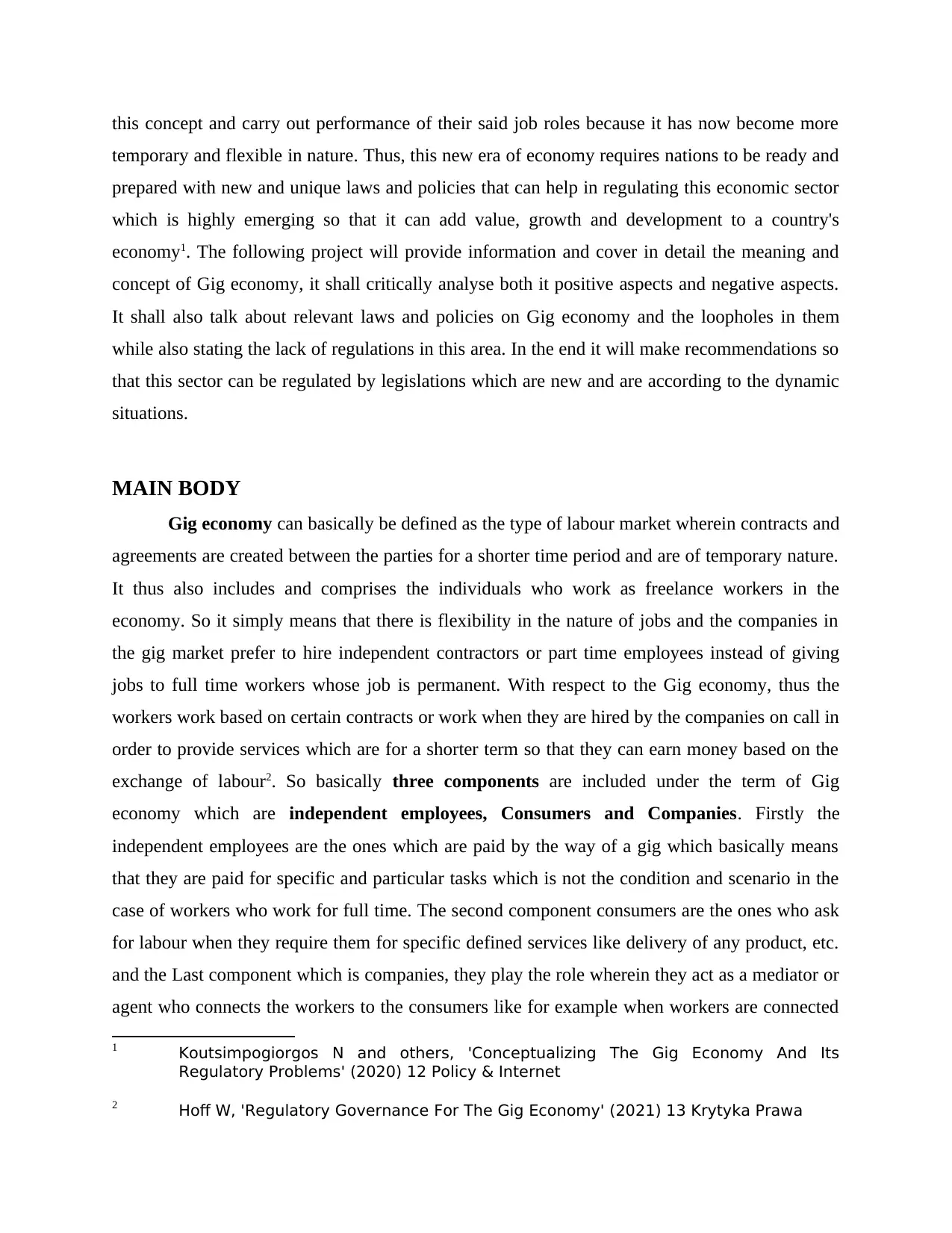
this concept and carry out performance of their said job roles because it has now become more
temporary and flexible in nature. Thus, this new era of economy requires nations to be ready and
prepared with new and unique laws and policies that can help in regulating this economic sector
which is highly emerging so that it can add value, growth and development to a country's
economy1. The following project will provide information and cover in detail the meaning and
concept of Gig economy, it shall critically analyse both it positive aspects and negative aspects.
It shall also talk about relevant laws and policies on Gig economy and the loopholes in them
while also stating the lack of regulations in this area. In the end it will make recommendations so
that this sector can be regulated by legislations which are new and are according to the dynamic
situations.
MAIN BODY
Gig economy can basically be defined as the type of labour market wherein contracts and
agreements are created between the parties for a shorter time period and are of temporary nature.
It thus also includes and comprises the individuals who work as freelance workers in the
economy. So it simply means that there is flexibility in the nature of jobs and the companies in
the gig market prefer to hire independent contractors or part time employees instead of giving
jobs to full time workers whose job is permanent. With respect to the Gig economy, thus the
workers work based on certain contracts or work when they are hired by the companies on call in
order to provide services which are for a shorter term so that they can earn money based on the
exchange of labour2. So basically three components are included under the term of Gig
economy which are independent employees, Consumers and Companies. Firstly the
independent employees are the ones which are paid by the way of a gig which basically means
that they are paid for specific and particular tasks which is not the condition and scenario in the
case of workers who work for full time. The second component consumers are the ones who ask
for labour when they require them for specific defined services like delivery of any product, etc.
and the Last component which is companies, they play the role wherein they act as a mediator or
agent who connects the workers to the consumers like for example when workers are connected
1 Koutsimpogiorgos N and others, 'Conceptualizing The Gig Economy And Its
Regulatory Problems' (2020) 12 Policy & Internet
2 Hoff W, 'Regulatory Governance For The Gig Economy' (2021) 13 Krytyka Prawa
temporary and flexible in nature. Thus, this new era of economy requires nations to be ready and
prepared with new and unique laws and policies that can help in regulating this economic sector
which is highly emerging so that it can add value, growth and development to a country's
economy1. The following project will provide information and cover in detail the meaning and
concept of Gig economy, it shall critically analyse both it positive aspects and negative aspects.
It shall also talk about relevant laws and policies on Gig economy and the loopholes in them
while also stating the lack of regulations in this area. In the end it will make recommendations so
that this sector can be regulated by legislations which are new and are according to the dynamic
situations.
MAIN BODY
Gig economy can basically be defined as the type of labour market wherein contracts and
agreements are created between the parties for a shorter time period and are of temporary nature.
It thus also includes and comprises the individuals who work as freelance workers in the
economy. So it simply means that there is flexibility in the nature of jobs and the companies in
the gig market prefer to hire independent contractors or part time employees instead of giving
jobs to full time workers whose job is permanent. With respect to the Gig economy, thus the
workers work based on certain contracts or work when they are hired by the companies on call in
order to provide services which are for a shorter term so that they can earn money based on the
exchange of labour2. So basically three components are included under the term of Gig
economy which are independent employees, Consumers and Companies. Firstly the
independent employees are the ones which are paid by the way of a gig which basically means
that they are paid for specific and particular tasks which is not the condition and scenario in the
case of workers who work for full time. The second component consumers are the ones who ask
for labour when they require them for specific defined services like delivery of any product, etc.
and the Last component which is companies, they play the role wherein they act as a mediator or
agent who connects the workers to the consumers like for example when workers are connected
1 Koutsimpogiorgos N and others, 'Conceptualizing The Gig Economy And Its
Regulatory Problems' (2020) 12 Policy & Internet
2 Hoff W, 'Regulatory Governance For The Gig Economy' (2021) 13 Krytyka Prawa
Paraphrase This Document
Need a fresh take? Get an instant paraphrase of this document with our AI Paraphraser
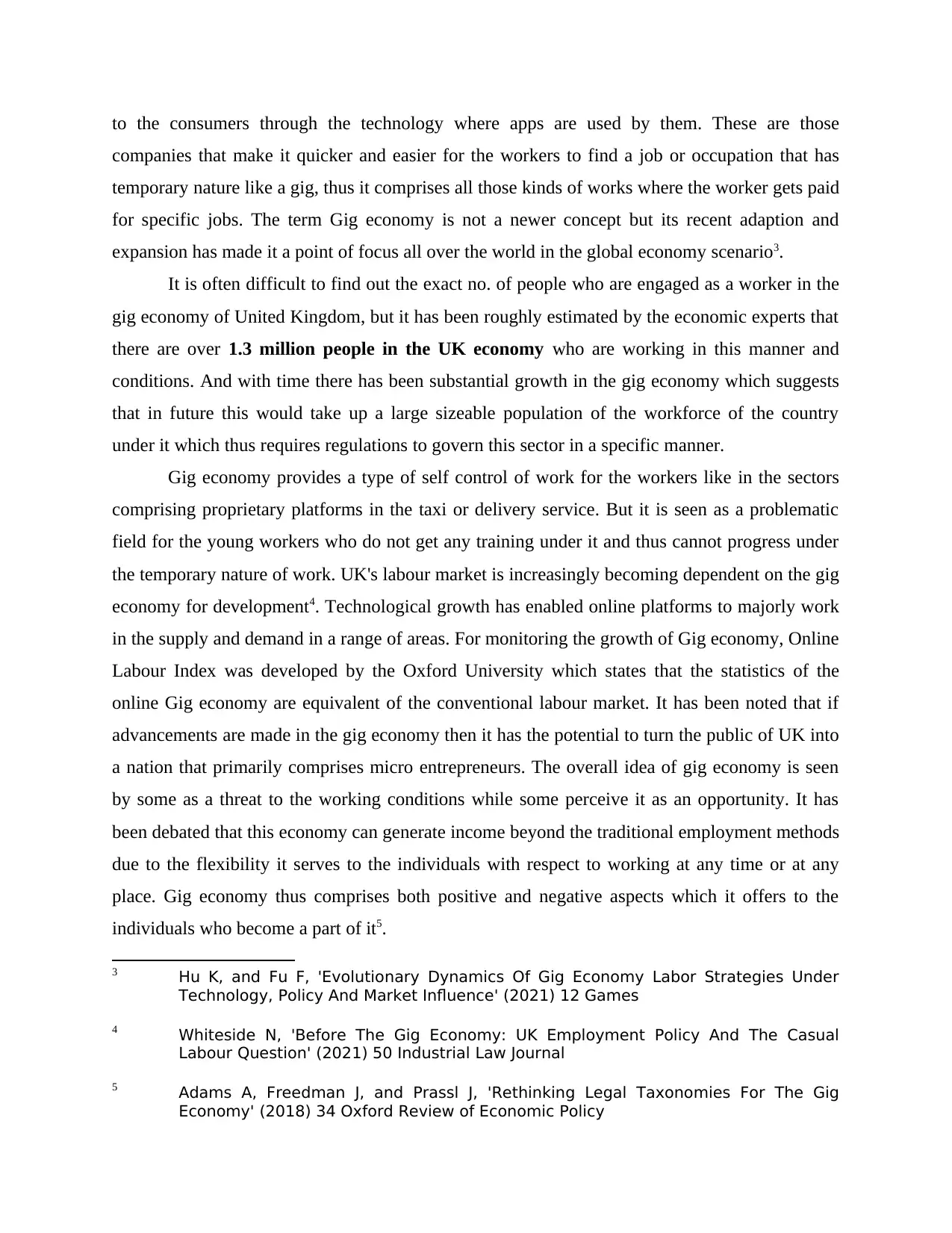
to the consumers through the technology where apps are used by them. These are those
companies that make it quicker and easier for the workers to find a job or occupation that has
temporary nature like a gig, thus it comprises all those kinds of works where the worker gets paid
for specific jobs. The term Gig economy is not a newer concept but its recent adaption and
expansion has made it a point of focus all over the world in the global economy scenario3.
It is often difficult to find out the exact no. of people who are engaged as a worker in the
gig economy of United Kingdom, but it has been roughly estimated by the economic experts that
there are over 1.3 million people in the UK economy who are working in this manner and
conditions. And with time there has been substantial growth in the gig economy which suggests
that in future this would take up a large sizeable population of the workforce of the country
under it which thus requires regulations to govern this sector in a specific manner.
Gig economy provides a type of self control of work for the workers like in the sectors
comprising proprietary platforms in the taxi or delivery service. But it is seen as a problematic
field for the young workers who do not get any training under it and thus cannot progress under
the temporary nature of work. UK's labour market is increasingly becoming dependent on the gig
economy for development4. Technological growth has enabled online platforms to majorly work
in the supply and demand in a range of areas. For monitoring the growth of Gig economy, Online
Labour Index was developed by the Oxford University which states that the statistics of the
online Gig economy are equivalent of the conventional labour market. It has been noted that if
advancements are made in the gig economy then it has the potential to turn the public of UK into
a nation that primarily comprises micro entrepreneurs. The overall idea of gig economy is seen
by some as a threat to the working conditions while some perceive it as an opportunity. It has
been debated that this economy can generate income beyond the traditional employment methods
due to the flexibility it serves to the individuals with respect to working at any time or at any
place. Gig economy thus comprises both positive and negative aspects which it offers to the
individuals who become a part of it5.
3 Hu K, and Fu F, 'Evolutionary Dynamics Of Gig Economy Labor Strategies Under
Technology, Policy And Market Influence' (2021) 12 Games
4 Whiteside N, 'Before The Gig Economy: UK Employment Policy And The Casual
Labour Question' (2021) 50 Industrial Law Journal
5 Adams A, Freedman J, and Prassl J, 'Rethinking Legal Taxonomies For The Gig
Economy' (2018) 34 Oxford Review of Economic Policy
companies that make it quicker and easier for the workers to find a job or occupation that has
temporary nature like a gig, thus it comprises all those kinds of works where the worker gets paid
for specific jobs. The term Gig economy is not a newer concept but its recent adaption and
expansion has made it a point of focus all over the world in the global economy scenario3.
It is often difficult to find out the exact no. of people who are engaged as a worker in the
gig economy of United Kingdom, but it has been roughly estimated by the economic experts that
there are over 1.3 million people in the UK economy who are working in this manner and
conditions. And with time there has been substantial growth in the gig economy which suggests
that in future this would take up a large sizeable population of the workforce of the country
under it which thus requires regulations to govern this sector in a specific manner.
Gig economy provides a type of self control of work for the workers like in the sectors
comprising proprietary platforms in the taxi or delivery service. But it is seen as a problematic
field for the young workers who do not get any training under it and thus cannot progress under
the temporary nature of work. UK's labour market is increasingly becoming dependent on the gig
economy for development4. Technological growth has enabled online platforms to majorly work
in the supply and demand in a range of areas. For monitoring the growth of Gig economy, Online
Labour Index was developed by the Oxford University which states that the statistics of the
online Gig economy are equivalent of the conventional labour market. It has been noted that if
advancements are made in the gig economy then it has the potential to turn the public of UK into
a nation that primarily comprises micro entrepreneurs. The overall idea of gig economy is seen
by some as a threat to the working conditions while some perceive it as an opportunity. It has
been debated that this economy can generate income beyond the traditional employment methods
due to the flexibility it serves to the individuals with respect to working at any time or at any
place. Gig economy thus comprises both positive and negative aspects which it offers to the
individuals who become a part of it5.
3 Hu K, and Fu F, 'Evolutionary Dynamics Of Gig Economy Labor Strategies Under
Technology, Policy And Market Influence' (2021) 12 Games
4 Whiteside N, 'Before The Gig Economy: UK Employment Policy And The Casual
Labour Question' (2021) 50 Industrial Law Journal
5 Adams A, Freedman J, and Prassl J, 'Rethinking Legal Taxonomies For The Gig
Economy' (2018) 34 Oxford Review of Economic Policy

The positive aspects of a Gig economy are first of all it offers flexibility to the workers
which means that the workers can work freely with respect to time period and place of work.
Thus they can work in the hours when they want to or wherever they want. In a gig job the
workers are given work with a task deadline by which it must be completed but it is up to the
workers how they want to accomplish the given task6. The next positive aspect is Greater
Independence, as Gig economy offers greater control for the workers on their work and the
added advantage with it is that there is compulsion on the part of the workers to work from a
office, thus they can work from anywhere they like to. Independence also helps the workers in
boosting their amount of confidence as they do not have a continued supervision on them and
thus they try to work with dedication to complete the task assigned to them in the best possible
manner. The gig economy workers are not dependent on anyone for schedule of work thus they
have complete individual right to select their time schedule of working. Gig workers in the
economy also have the advantage of showcasing and using their talent and skills in variety of
jobs and in different sectors of the economy7. It is beneficial as the workers do not get bored and
do not get fed up from the tasks or jobs as they are not monotonous in nature and they keep
changing with the changing dynamics of different work sectors and the fluctuations in the
demand that comes from the consumers. The gig work for the workers gets interesting with time
as they deal with different nature of projects that contain differential elements and use of
different abilities and skills of the workers which makes the work unique for them every time
they go for a work with different companies or agents who offer different types of works to
them. It thus brings out uniqueness, creativity and innovative ideas for the gig workers who get
the benefit of working in differential conditions and with different work. The most essential
positive aspect of gig economy is the pay of the workers as they get paid which varies for them
depending on the company to company basis and their salary policies for the freelance workers.
The gig workers get the advantage of asking payments for the labour service provided by them
on an hourly basis8. This basically means that the workers of gig economy get greater control
6 'Gig Economy Development As A Challenge For The Labor Market Regulation
Sphere' (2019) 110 Studia Prawno-Ekonomiczne
7 Wood A and others, 'Good Gig, Bad Gig: Autonomy And Algorithmic Control In The
Global Gig Economy' (2018) 33 Work, Employment and Society
8 Lloyd I, 'Applying Notions Of Employment Within The Gig Economy - How Disruptive
Is The Gig Economy For Employment Law?' (2019) 20 Computer Law Review
which means that the workers can work freely with respect to time period and place of work.
Thus they can work in the hours when they want to or wherever they want. In a gig job the
workers are given work with a task deadline by which it must be completed but it is up to the
workers how they want to accomplish the given task6. The next positive aspect is Greater
Independence, as Gig economy offers greater control for the workers on their work and the
added advantage with it is that there is compulsion on the part of the workers to work from a
office, thus they can work from anywhere they like to. Independence also helps the workers in
boosting their amount of confidence as they do not have a continued supervision on them and
thus they try to work with dedication to complete the task assigned to them in the best possible
manner. The gig economy workers are not dependent on anyone for schedule of work thus they
have complete individual right to select their time schedule of working. Gig workers in the
economy also have the advantage of showcasing and using their talent and skills in variety of
jobs and in different sectors of the economy7. It is beneficial as the workers do not get bored and
do not get fed up from the tasks or jobs as they are not monotonous in nature and they keep
changing with the changing dynamics of different work sectors and the fluctuations in the
demand that comes from the consumers. The gig work for the workers gets interesting with time
as they deal with different nature of projects that contain differential elements and use of
different abilities and skills of the workers which makes the work unique for them every time
they go for a work with different companies or agents who offer different types of works to
them. It thus brings out uniqueness, creativity and innovative ideas for the gig workers who get
the benefit of working in differential conditions and with different work. The most essential
positive aspect of gig economy is the pay of the workers as they get paid which varies for them
depending on the company to company basis and their salary policies for the freelance workers.
The gig workers get the advantage of asking payments for the labour service provided by them
on an hourly basis8. This basically means that the workers of gig economy get greater control
6 'Gig Economy Development As A Challenge For The Labor Market Regulation
Sphere' (2019) 110 Studia Prawno-Ekonomiczne
7 Wood A and others, 'Good Gig, Bad Gig: Autonomy And Algorithmic Control In The
Global Gig Economy' (2018) 33 Work, Employment and Society
8 Lloyd I, 'Applying Notions Of Employment Within The Gig Economy - How Disruptive
Is The Gig Economy For Employment Law?' (2019) 20 Computer Law Review
⊘ This is a preview!⊘
Do you want full access?
Subscribe today to unlock all pages.
Trusted by 1+ million students worldwide
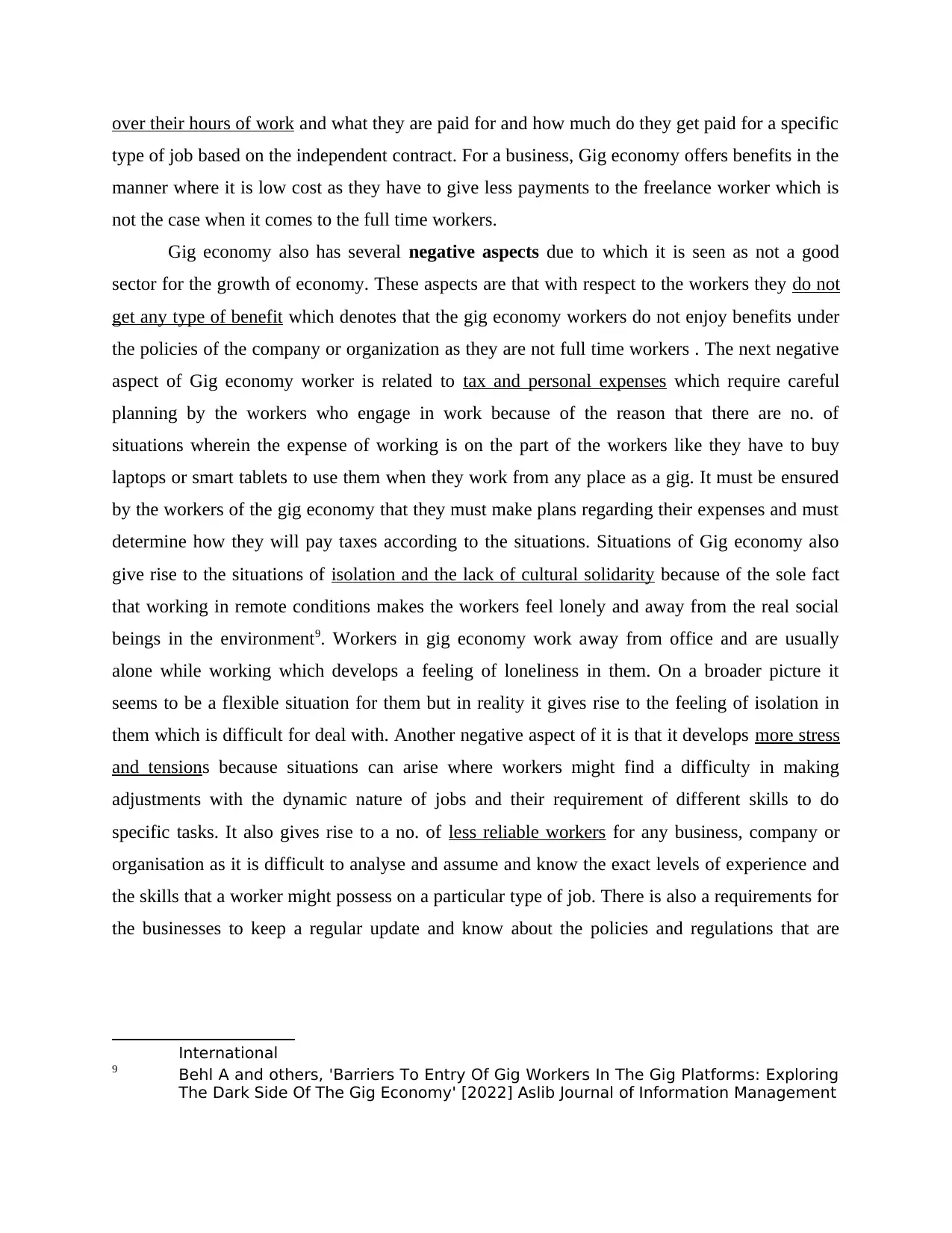
over their hours of work and what they are paid for and how much do they get paid for a specific
type of job based on the independent contract. For a business, Gig economy offers benefits in the
manner where it is low cost as they have to give less payments to the freelance worker which is
not the case when it comes to the full time workers.
Gig economy also has several negative aspects due to which it is seen as not a good
sector for the growth of economy. These aspects are that with respect to the workers they do not
get any type of benefit which denotes that the gig economy workers do not enjoy benefits under
the policies of the company or organization as they are not full time workers . The next negative
aspect of Gig economy worker is related to tax and personal expenses which require careful
planning by the workers who engage in work because of the reason that there are no. of
situations wherein the expense of working is on the part of the workers like they have to buy
laptops or smart tablets to use them when they work from any place as a gig. It must be ensured
by the workers of the gig economy that they must make plans regarding their expenses and must
determine how they will pay taxes according to the situations. Situations of Gig economy also
give rise to the situations of isolation and the lack of cultural solidarity because of the sole fact
that working in remote conditions makes the workers feel lonely and away from the real social
beings in the environment9. Workers in gig economy work away from office and are usually
alone while working which develops a feeling of loneliness in them. On a broader picture it
seems to be a flexible situation for them but in reality it gives rise to the feeling of isolation in
them which is difficult for deal with. Another negative aspect of it is that it develops more stress
and tensions because situations can arise where workers might find a difficulty in making
adjustments with the dynamic nature of jobs and their requirement of different skills to do
specific tasks. It also gives rise to a no. of less reliable workers for any business, company or
organisation as it is difficult to analyse and assume and know the exact levels of experience and
the skills that a worker might possess on a particular type of job. There is also a requirements for
the businesses to keep a regular update and know about the policies and regulations that are
International
9 Behl A and others, 'Barriers To Entry Of Gig Workers In The Gig Platforms: Exploring
The Dark Side Of The Gig Economy' [2022] Aslib Journal of Information Management
type of job based on the independent contract. For a business, Gig economy offers benefits in the
manner where it is low cost as they have to give less payments to the freelance worker which is
not the case when it comes to the full time workers.
Gig economy also has several negative aspects due to which it is seen as not a good
sector for the growth of economy. These aspects are that with respect to the workers they do not
get any type of benefit which denotes that the gig economy workers do not enjoy benefits under
the policies of the company or organization as they are not full time workers . The next negative
aspect of Gig economy worker is related to tax and personal expenses which require careful
planning by the workers who engage in work because of the reason that there are no. of
situations wherein the expense of working is on the part of the workers like they have to buy
laptops or smart tablets to use them when they work from any place as a gig. It must be ensured
by the workers of the gig economy that they must make plans regarding their expenses and must
determine how they will pay taxes according to the situations. Situations of Gig economy also
give rise to the situations of isolation and the lack of cultural solidarity because of the sole fact
that working in remote conditions makes the workers feel lonely and away from the real social
beings in the environment9. Workers in gig economy work away from office and are usually
alone while working which develops a feeling of loneliness in them. On a broader picture it
seems to be a flexible situation for them but in reality it gives rise to the feeling of isolation in
them which is difficult for deal with. Another negative aspect of it is that it develops more stress
and tensions because situations can arise where workers might find a difficulty in making
adjustments with the dynamic nature of jobs and their requirement of different skills to do
specific tasks. It also gives rise to a no. of less reliable workers for any business, company or
organisation as it is difficult to analyse and assume and know the exact levels of experience and
the skills that a worker might possess on a particular type of job. There is also a requirements for
the businesses to keep a regular update and know about the policies and regulations that are
International
9 Behl A and others, 'Barriers To Entry Of Gig Workers In The Gig Platforms: Exploring
The Dark Side Of The Gig Economy' [2022] Aslib Journal of Information Management
Paraphrase This Document
Need a fresh take? Get an instant paraphrase of this document with our AI Paraphraser

formulated by the government for regulating the workers of gig economy. Because if the laws
are not known it can add negative situations in the market10.
It has been argued by different organizations that work in the sector of maintaining
relations at the workplace that the gig economy creates difficult situations wherein the
employment status of the workers working in the gig economy are not defined. There has been
increased focus on the workers of the gig economy and their employment rights which depends
on their status of employment. Because of the fact that a person defined as a worker or the one
who is self-employed is more likely to have a distinct legal status and right to the ones that are
considered as an employee. Under the current employment law of UK, there are basically three
classifications of employees based on their status which are self-employed and contractors,
workers and employees which has given them different rights within employment11. Under the
Employment Rights Act of 1996, workers and employee are classified as employee meaning
that individual who works under any contract of employment which can be a service contract or
apprenticeship and can be in oral or written form. And on the other hand, worker is that
individual who works under contract of employment wherein the person takes up the work to
perform personally or by giving services for any other party to the contract whose status must not
be of a client or customer. In simpler terms, all employees are workers but not all workers are
employees. Confusion also arises around this classification because of the limb workers that are
referred in the employment law as workers who work under contracts for services but are not
operating a business on their own account. These workers are characterized by some features of
self-employment and some features of employment so they do not satisfy the employment status.
An individual is generally classified as a worker if they have contract formation to do
certain work and their rewards is for money. The employer in these cases have to work till the
contract that is made lasts. Whereas Casual work is classified as workers who occasionally work
for a specific business and the terms used for them is freelancers, zero hours employment,
workers as required, etc. Self employed individuals thus have minimal employment rights to
10 Kässi O, and Lehdonvirta V, 'Online Labour Index: Measuring The Online Gig
Economy For Policy And Research' (2018) 137 Technological Forecasting and Social
Change
11 Berger T and others, 'Uber Happy? Work And Well-Being In The ‘Gig Economy’'
(2019) 34 Economic Policy
are not known it can add negative situations in the market10.
It has been argued by different organizations that work in the sector of maintaining
relations at the workplace that the gig economy creates difficult situations wherein the
employment status of the workers working in the gig economy are not defined. There has been
increased focus on the workers of the gig economy and their employment rights which depends
on their status of employment. Because of the fact that a person defined as a worker or the one
who is self-employed is more likely to have a distinct legal status and right to the ones that are
considered as an employee. Under the current employment law of UK, there are basically three
classifications of employees based on their status which are self-employed and contractors,
workers and employees which has given them different rights within employment11. Under the
Employment Rights Act of 1996, workers and employee are classified as employee meaning
that individual who works under any contract of employment which can be a service contract or
apprenticeship and can be in oral or written form. And on the other hand, worker is that
individual who works under contract of employment wherein the person takes up the work to
perform personally or by giving services for any other party to the contract whose status must not
be of a client or customer. In simpler terms, all employees are workers but not all workers are
employees. Confusion also arises around this classification because of the limb workers that are
referred in the employment law as workers who work under contracts for services but are not
operating a business on their own account. These workers are characterized by some features of
self-employment and some features of employment so they do not satisfy the employment status.
An individual is generally classified as a worker if they have contract formation to do
certain work and their rewards is for money. The employer in these cases have to work till the
contract that is made lasts. Whereas Casual work is classified as workers who occasionally work
for a specific business and the terms used for them is freelancers, zero hours employment,
workers as required, etc. Self employed individuals thus have minimal employment rights to
10 Kässi O, and Lehdonvirta V, 'Online Labour Index: Measuring The Online Gig
Economy For Policy And Research' (2018) 137 Technological Forecasting and Social
Change
11 Berger T and others, 'Uber Happy? Work And Well-Being In The ‘Gig Economy’'
(2019) 34 Economic Policy

govern them under the legal system of UK except with respect to their health and safety and
giving them protection against discriminations12.
There have been many cases that have arisen in UK law based on the sector of Gig
economy. With respect to taxi driving, Uber currently describes its drivers are 'Partner drivers'
meaning classifying them as self-employed contractors. The issue with respect to classifying
Uber drivers formally as workers, employed by Uber or as self employed has been recently
addressed by the judiciary under the legal system. In 2016, a case was put forward on behalf of
the two Uber drivers in front of Central London Employment Tribunal and it was argued in the
case that the Uber drivers should receive certain workers rights including the rights of getting
holiday pay and must be entitled to get the national minimum wages. Supreme Court while
giving decision on this case ruled that the drivers who work on this ride sharing app shall not be
considered as independent contractors in gig economy rather they will be classified as workers so
that they become entitled to basic employment rights and wage rights. The decision was given in
the light that there was no real statutory provision that could protect the workers of the gig
economy13. What was put forward by the court in the case to govern the relationship between the
Uber and its drivers which could show that an employment relationship was established between
them was that there was a fixed nature of remuneration for the drivers who had no bargaining
power in that, the fact that the terms of services for the driver was dictated by Uber, the
performance of the drivers was in control of Uber through the performance metrics and
cancellation penalties and there was restrictions on the part of drivers that they could not
establish any kind of relationship with their riders. These facts that were clearly stated by the
court in giving its decision of naming them as workers instead of independent contractors. This
case prompted the government of United Kingdom to formulate and bring laws that could
specifically deal with the workers of gig economy so that they did not feel as being away from
the employment rights of the company.
To deal with these scenarios the UK government brought out the rule by the name of
IR35rule to govern the conduct of the self employment people in the labour market and so that it
12 'Gig Economy- Redefining The Future Workforce' (2020) 7 Strad Research
13 'The Gig Economy: What Is It, Why Is It In The Headlines And What Does The Future
Hold?' (World Economic Forum, 2022)
<https://www.weforum.org/agenda/2021/05/what-gig-economy-workers/> accessed
2 March 2022
giving them protection against discriminations12.
There have been many cases that have arisen in UK law based on the sector of Gig
economy. With respect to taxi driving, Uber currently describes its drivers are 'Partner drivers'
meaning classifying them as self-employed contractors. The issue with respect to classifying
Uber drivers formally as workers, employed by Uber or as self employed has been recently
addressed by the judiciary under the legal system. In 2016, a case was put forward on behalf of
the two Uber drivers in front of Central London Employment Tribunal and it was argued in the
case that the Uber drivers should receive certain workers rights including the rights of getting
holiday pay and must be entitled to get the national minimum wages. Supreme Court while
giving decision on this case ruled that the drivers who work on this ride sharing app shall not be
considered as independent contractors in gig economy rather they will be classified as workers so
that they become entitled to basic employment rights and wage rights. The decision was given in
the light that there was no real statutory provision that could protect the workers of the gig
economy13. What was put forward by the court in the case to govern the relationship between the
Uber and its drivers which could show that an employment relationship was established between
them was that there was a fixed nature of remuneration for the drivers who had no bargaining
power in that, the fact that the terms of services for the driver was dictated by Uber, the
performance of the drivers was in control of Uber through the performance metrics and
cancellation penalties and there was restrictions on the part of drivers that they could not
establish any kind of relationship with their riders. These facts that were clearly stated by the
court in giving its decision of naming them as workers instead of independent contractors. This
case prompted the government of United Kingdom to formulate and bring laws that could
specifically deal with the workers of gig economy so that they did not feel as being away from
the employment rights of the company.
To deal with these scenarios the UK government brought out the rule by the name of
IR35rule to govern the conduct of the self employment people in the labour market and so that it
12 'Gig Economy- Redefining The Future Workforce' (2020) 7 Strad Research
13 'The Gig Economy: What Is It, Why Is It In The Headlines And What Does The Future
Hold?' (World Economic Forum, 2022)
<https://www.weforum.org/agenda/2021/05/what-gig-economy-workers/> accessed
2 March 2022
⊘ This is a preview!⊘
Do you want full access?
Subscribe today to unlock all pages.
Trusted by 1+ million students worldwide
could act as a major legislation of current time. It was brought out in the legal system in the year
2017 which created a revolutionary history to a great extent as it was the first time that any
particular legislation was brought which included freelance workers and independent
workers under its ambit of stated provisions. Generally it has been said it was a set of tax
measures in United Kingdom which focuses primarily on fighting the masked employment in the
country. In the early time of the year 2017 it was observed that this reform was passed mainly for
the public sector and the organizations in it but as the time has changed due to it in the year 2021
it is said to have been proposed for the companies and organizations working in the private
sector as well14. The IR35rule being a legislation that has been passed by the parliamentary
houses of United Kingdom on its territory affects the workers who are self-employed as well as
the companies who are working in the geographical region because of it being a British law. It
also lays down provisions that govern the taxes and well as the defined duties and
responsibilities of the concerned workers that takes place or arises from these activities.
The trend for giving recognition to those engaged in the gig economy as “Workers”
seems to have essential consequences for the pension rights. Because as getting the status of
workers they automatically get entitled to be enrolled under the pension schemes. Companies in
the gig economy have taken different approaches to define their workers like a Dutch company
by the name of Just Eat Takeaway which is one of the world's biggest firms with respect to the
delivery of food announced in the recent years that it gig workers in the economy would now
become employees who would then enjoy a series of benefits.
After analysing all the aspects as well as laws of the country it can be analysed that there
lies the number of loopholes mainly with respect to the gig workers which are required to be
overcome by the legislators with the help of formation of the laws in accordance to them. With
the increasing concerns of labour rights mainly with respect to the gig economy are laying the
continuous pressure on the companies of the economy reason being they tend to bifurcate the
workers on the basis of certain categories such as independent contractors, fixed employees , etc.
as a result of which it has been contented that because of the said bifurcation the gig economy
workers are not entitled to get the benefits of the sick pay, minimum wages, etc. one such major
change was brought in the country by the decision made by the supreme court in the case of
14 'Pros And Cons Of The Gig Economy | Employee Benefits Firm' (Assured Partners
Consulting, 2022) <https://assuredpc.com/2022/02/22/pros-and-cons-of-the-gig-
economy/> accessed 2 March 2022
2017 which created a revolutionary history to a great extent as it was the first time that any
particular legislation was brought which included freelance workers and independent
workers under its ambit of stated provisions. Generally it has been said it was a set of tax
measures in United Kingdom which focuses primarily on fighting the masked employment in the
country. In the early time of the year 2017 it was observed that this reform was passed mainly for
the public sector and the organizations in it but as the time has changed due to it in the year 2021
it is said to have been proposed for the companies and organizations working in the private
sector as well14. The IR35rule being a legislation that has been passed by the parliamentary
houses of United Kingdom on its territory affects the workers who are self-employed as well as
the companies who are working in the geographical region because of it being a British law. It
also lays down provisions that govern the taxes and well as the defined duties and
responsibilities of the concerned workers that takes place or arises from these activities.
The trend for giving recognition to those engaged in the gig economy as “Workers”
seems to have essential consequences for the pension rights. Because as getting the status of
workers they automatically get entitled to be enrolled under the pension schemes. Companies in
the gig economy have taken different approaches to define their workers like a Dutch company
by the name of Just Eat Takeaway which is one of the world's biggest firms with respect to the
delivery of food announced in the recent years that it gig workers in the economy would now
become employees who would then enjoy a series of benefits.
After analysing all the aspects as well as laws of the country it can be analysed that there
lies the number of loopholes mainly with respect to the gig workers which are required to be
overcome by the legislators with the help of formation of the laws in accordance to them. With
the increasing concerns of labour rights mainly with respect to the gig economy are laying the
continuous pressure on the companies of the economy reason being they tend to bifurcate the
workers on the basis of certain categories such as independent contractors, fixed employees , etc.
as a result of which it has been contented that because of the said bifurcation the gig economy
workers are not entitled to get the benefits of the sick pay, minimum wages, etc. one such major
change was brought in the country by the decision made by the supreme court in the case of
14 'Pros And Cons Of The Gig Economy | Employee Benefits Firm' (Assured Partners
Consulting, 2022) <https://assuredpc.com/2022/02/22/pros-and-cons-of-the-gig-
economy/> accessed 2 March 2022
Paraphrase This Document
Need a fresh take? Get an instant paraphrase of this document with our AI Paraphraser
Uber. Where the court held that drivers are not to be bifurcated as the independent contractors
rather they are to be addressed as the workers. Moreover, with respect to the companies like
Uber, a Airbnb, these have emerged recently in the economy and now have become ell
established in their particular sectors but with respect to their competitors there are still young
and fresh and these companies previously enjoyed exploiting the loopholes in labour laws but
because of the newer regulations the said loopholes are addressed in the recent laws which has
been brought out by the government. Moreover, in most of the states including United Kingdom
and United States, there lies the classification with respect to the employees as well as the
independent contractors of the company. The companies of these countries has used the
ambiguity for which the bifurcation of the gig workers belong to and hence there lies a general
lack of targeted regulations.
As a result of bifurcation of the employees such as independent contractors, gave a
relaxation to the companies in order to obviate the payroll taxes of the employees and also
exculpated them from the requirement of giving the protection as well as certain benefits such as
the maximum working hours and the paid leaves. Hence by the measure of resulting low
expenses with respect to the labour allowed organisations to drive the revenues of the company
while offering low prices to the employees. Other than this earlier the independent contractors or
the workers of gig economy were made ineligible for the benefits of the unemployment. But with
the decision of the supreme court mad in the case of Uber, it can be assumed that the other
companies of the economy as well will soon stand in the race of classifying the gig workers as
employees rather than the mere independent contractors. Accordingly as a result of which the
government will also take an initiative to enforce regulations imposing this shift15.
Other than this the loopholes with respect to the legal regulations of the gig economy can
also be ascertained by the help of five principles of frame work of fair work. Moreover, with
respect to the very first principle which is of the fair pay, it is said that the workers irrespective
of the fact of their bifurcation of employment, are entitled to have a decorous income after taking
into account the costs related to work and active working hours. The employees are entitled top
be get paid on timely basis for all the work which they had done in the similar manner as that of
15 '23 Essential Gig Economy Statistics [2022]: Definitions, Facts, And Trends On Gig
Work – Zippia' (Zippia.com, 2022) <https://www.zippia.com/advice/gig-economy-
statistics/> accessed 2 March 2022
rather they are to be addressed as the workers. Moreover, with respect to the companies like
Uber, a Airbnb, these have emerged recently in the economy and now have become ell
established in their particular sectors but with respect to their competitors there are still young
and fresh and these companies previously enjoyed exploiting the loopholes in labour laws but
because of the newer regulations the said loopholes are addressed in the recent laws which has
been brought out by the government. Moreover, in most of the states including United Kingdom
and United States, there lies the classification with respect to the employees as well as the
independent contractors of the company. The companies of these countries has used the
ambiguity for which the bifurcation of the gig workers belong to and hence there lies a general
lack of targeted regulations.
As a result of bifurcation of the employees such as independent contractors, gave a
relaxation to the companies in order to obviate the payroll taxes of the employees and also
exculpated them from the requirement of giving the protection as well as certain benefits such as
the maximum working hours and the paid leaves. Hence by the measure of resulting low
expenses with respect to the labour allowed organisations to drive the revenues of the company
while offering low prices to the employees. Other than this earlier the independent contractors or
the workers of gig economy were made ineligible for the benefits of the unemployment. But with
the decision of the supreme court mad in the case of Uber, it can be assumed that the other
companies of the economy as well will soon stand in the race of classifying the gig workers as
employees rather than the mere independent contractors. Accordingly as a result of which the
government will also take an initiative to enforce regulations imposing this shift15.
Other than this the loopholes with respect to the legal regulations of the gig economy can
also be ascertained by the help of five principles of frame work of fair work. Moreover, with
respect to the very first principle which is of the fair pay, it is said that the workers irrespective
of the fact of their bifurcation of employment, are entitled to have a decorous income after taking
into account the costs related to work and active working hours. The employees are entitled top
be get paid on timely basis for all the work which they had done in the similar manner as that of
15 '23 Essential Gig Economy Statistics [2022]: Definitions, Facts, And Trends On Gig
Work – Zippia' (Zippia.com, 2022) <https://www.zippia.com/advice/gig-economy-
statistics/> accessed 2 March 2022
the regular employees. The other being the aspect of fair conditions, the economy lack the
regulation which states the equitable fair conditions of work for the v workers of gig economy as
compared to that of the other ordinary employees. The country is lacking the policies and
regulations which aids in protecting the gig workers from the risks which arises out of the work
processes. Also there lies the need of certain proactive measures in order to promote as well as
protect the health and safety of the gig workers. The other being the fair contracts, generally the
gig workers or the freelancers are not subjected to have the proper form of contract along with
the terms and conditions which are of transparent nature and are easily accessible to the workers.
Because of which the workers are not made entitled to be governed by the local laws reason
being the said contract does not identify it. As as result of this the freelancers or the gig workers
are being prevented from seeking the grievances and the redresses. The other can be of the fair
management, where the gig workers do not get the right of being properly and fairly managed.
They do not enjoy the power and authorities to make appeals against the decisions which affects
them like when disciplinarian actions are taken against them or if they are not informed of the
reasons behind taking those decisions which effect their existence as workers in the gig
economy16. Also there is lack of documented policy which can provide them with equal rights as
similar to that of the other employees so that they can be managed on a platform, for instance for
the process of hiring of the workers or their termination or taking disciplinary actions. The last
aspect being the fair representation, the gig workers of the country are facing a problem with
respect to the specific documented process or platform by which they can raise their genuine
concerns and voices. Further because of the said classification of the categories of the
employment, the gig workers are not given the right to organise in collective bodies and hence
there cannot take place the preparations of the platform in order to cooperate and negotiate with
them.
Moreover, after analysing the loopholes or the drawback which prevails in the gig
economy there also lies the need of having certain recommendation or the conclusions in order
to overcome the same resulting the gig economy workers at par to some extent with that of the
other employees. It is required on the part of government of the country to formulate the policies
16 (Brodmin.com, 2022) <https://brodmin.com/case-studies/gig-economy-case-study/>
accessed 2 March 2022
regulation which states the equitable fair conditions of work for the v workers of gig economy as
compared to that of the other ordinary employees. The country is lacking the policies and
regulations which aids in protecting the gig workers from the risks which arises out of the work
processes. Also there lies the need of certain proactive measures in order to promote as well as
protect the health and safety of the gig workers. The other being the fair contracts, generally the
gig workers or the freelancers are not subjected to have the proper form of contract along with
the terms and conditions which are of transparent nature and are easily accessible to the workers.
Because of which the workers are not made entitled to be governed by the local laws reason
being the said contract does not identify it. As as result of this the freelancers or the gig workers
are being prevented from seeking the grievances and the redresses. The other can be of the fair
management, where the gig workers do not get the right of being properly and fairly managed.
They do not enjoy the power and authorities to make appeals against the decisions which affects
them like when disciplinarian actions are taken against them or if they are not informed of the
reasons behind taking those decisions which effect their existence as workers in the gig
economy16. Also there is lack of documented policy which can provide them with equal rights as
similar to that of the other employees so that they can be managed on a platform, for instance for
the process of hiring of the workers or their termination or taking disciplinary actions. The last
aspect being the fair representation, the gig workers of the country are facing a problem with
respect to the specific documented process or platform by which they can raise their genuine
concerns and voices. Further because of the said classification of the categories of the
employment, the gig workers are not given the right to organise in collective bodies and hence
there cannot take place the preparations of the platform in order to cooperate and negotiate with
them.
Moreover, after analysing the loopholes or the drawback which prevails in the gig
economy there also lies the need of having certain recommendation or the conclusions in order
to overcome the same resulting the gig economy workers at par to some extent with that of the
other employees. It is required on the part of government of the country to formulate the policies
16 (Brodmin.com, 2022) <https://brodmin.com/case-studies/gig-economy-case-study/>
accessed 2 March 2022
⊘ This is a preview!⊘
Do you want full access?
Subscribe today to unlock all pages.
Trusted by 1+ million students worldwide

1 out of 14


Related Documents


Your All-in-One AI-Powered Toolkit for Academic Success.
+13062052269
info@desklib.com
Available 24*7 on WhatsApp / Email
![[object Object]](/_next/static/media/star-bottom.7253800d.svg)
Unlock your academic potential
Copyright © 2020–2026 A2Z Services. All Rights Reserved. Developed and managed by ZUCOL.