Business Law Report: UK Legal System, Business Law and Organizations
VerifiedAdded on 2023/01/19
|12
|4370
|87
Report
AI Summary
This report provides a detailed analysis of UK business law, encompassing the legal system, sources of law, and the role of government in law-making. It explores the application of statutory and common law to businesses, offering a critical reflection on the legal system's strengths and weaknesses with examples. The report also includes concise explanations of company, employment, and contract law, differentiating between legislation, regulations, and business standards. It evaluates the legal status and formation of different organizational structures, including sole proprietorships and partnerships, along with their management, funding, advantages, and disadvantages. The report also addresses legal solutions for various business problems and evaluates the effectiveness of these recommendations compared with alternatives. The report concludes with a summary of the findings.
Business Law

Paraphrase This Document
Need a fresh take? Get an instant paraphrase of this document with our AI Paraphraser
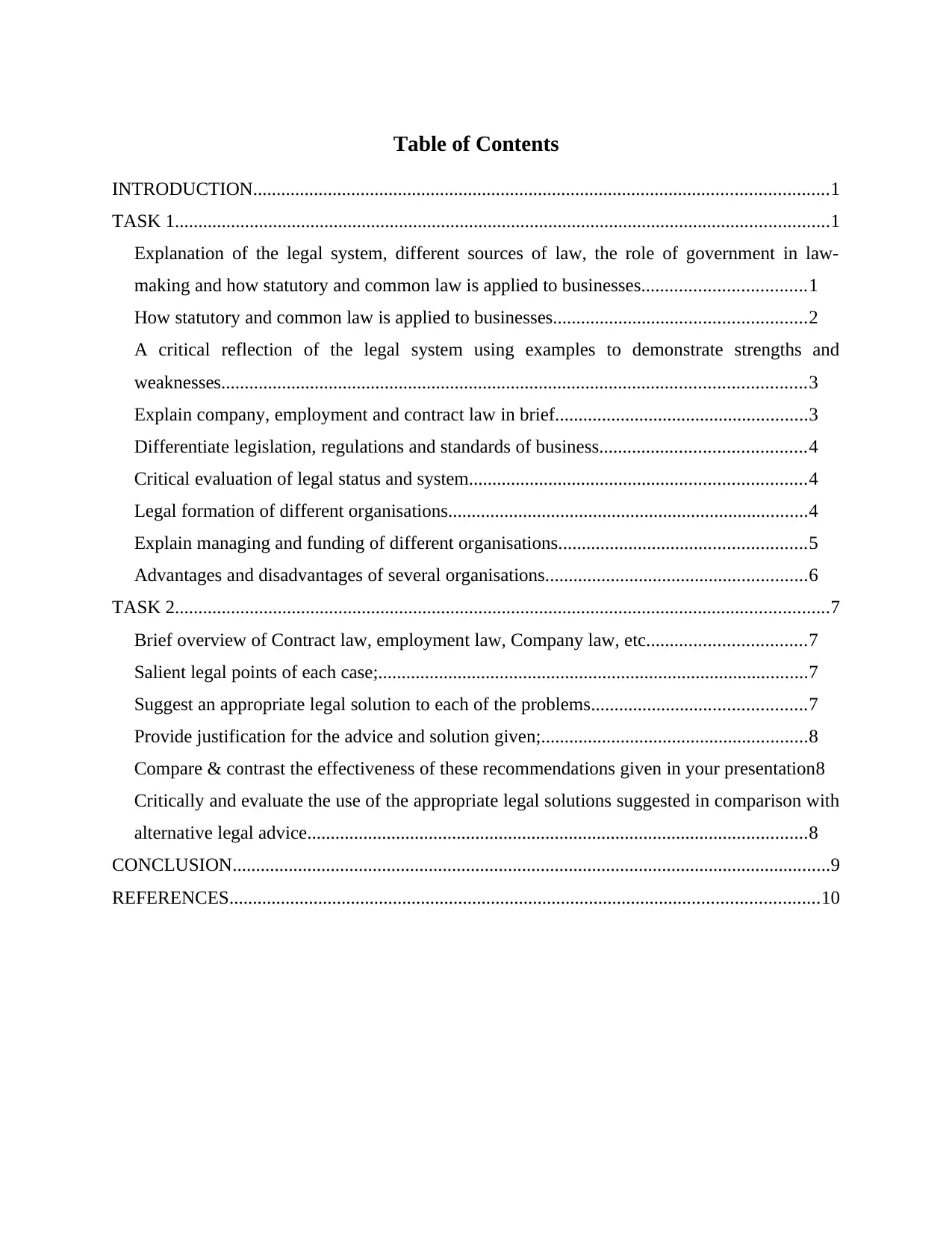
Table of Contents
INTRODUCTION...........................................................................................................................1
TASK 1............................................................................................................................................1
Explanation of the legal system, different sources of law, the role of government in law-
making and how statutory and common law is applied to businesses...................................1
How statutory and common law is applied to businesses......................................................2
A critical reflection of the legal system using examples to demonstrate strengths and
weaknesses.............................................................................................................................3
Explain company, employment and contract law in brief......................................................3
Differentiate legislation, regulations and standards of business............................................4
Critical evaluation of legal status and system........................................................................4
Legal formation of different organisations.............................................................................4
Explain managing and funding of different organisations.....................................................5
Advantages and disadvantages of several organisations........................................................6
TASK 2............................................................................................................................................7
Brief overview of Contract law, employment law, Company law, etc..................................7
Salient legal points of each case;............................................................................................7
Suggest an appropriate legal solution to each of the problems..............................................7
Provide justification for the advice and solution given;.........................................................8
Compare & contrast the effectiveness of these recommendations given in your presentation8
Critically and evaluate the use of the appropriate legal solutions suggested in comparison with
alternative legal advice...........................................................................................................8
CONCLUSION................................................................................................................................9
REFERENCES..............................................................................................................................10
INTRODUCTION...........................................................................................................................1
TASK 1............................................................................................................................................1
Explanation of the legal system, different sources of law, the role of government in law-
making and how statutory and common law is applied to businesses...................................1
How statutory and common law is applied to businesses......................................................2
A critical reflection of the legal system using examples to demonstrate strengths and
weaknesses.............................................................................................................................3
Explain company, employment and contract law in brief......................................................3
Differentiate legislation, regulations and standards of business............................................4
Critical evaluation of legal status and system........................................................................4
Legal formation of different organisations.............................................................................4
Explain managing and funding of different organisations.....................................................5
Advantages and disadvantages of several organisations........................................................6
TASK 2............................................................................................................................................7
Brief overview of Contract law, employment law, Company law, etc..................................7
Salient legal points of each case;............................................................................................7
Suggest an appropriate legal solution to each of the problems..............................................7
Provide justification for the advice and solution given;.........................................................8
Compare & contrast the effectiveness of these recommendations given in your presentation8
Critically and evaluate the use of the appropriate legal solutions suggested in comparison with
alternative legal advice...........................................................................................................8
CONCLUSION................................................................................................................................9
REFERENCES..............................................................................................................................10
INTRODUCTION
United Kingdom is a multi-division government country where citizens are given several
rights, rules and remedies in their legislation. It’s very diverse in nature which makes it exciting
to amend or create new laws in country. Business law is also most important division especially,
for business organisations. These provide guidelines to perform several tasks of business and
make it to full-fill all legal procedures. Every year the royal queen gives a heart-warming speech
on occasion of government making programmes for current assessment year. This speech known
as “speech from throne “also has guidelines and help other legal bodies an idea to follow up
correct procedure. This report consists of several divisions of business law in brief and detailed
submission. Adding to this various sources, methods and techniques used by business
organisation in several circumstances.
TASK 1
Explanation of the legal system, different sources of law, the role of government in law-making
and how statutory and common law is applied to businesses.
Legal System of UK is so powerful where they take each and every decision of own. Final
decision to commence any of the new law is in the hands of Queen where she needs to pass the
bill which has been proposed by Parliament House. Law in UK is divided by geographical
partitions but its ruled by four sources of laws, these are categorised accordingly and each covers
different aspects of law:
Legislation: It’s the power house of creating, repeating and deleting a law, which means it
has several powers and multiple workings which will ultimately cooperate with legal sections
and working procedures. It’s one of supreme bodies in country which coordinates with all
divisions of laws in nation. Legislation is divided into two parts which are primary legislation
and delegated legislation. It’s a supreme law making authority apart from European union,
updated legislation has legal bodies which have authority over parliament to make laws.
Common Law: This division is also very important aspect of law making, principles made
in old case laws are accuracy to law. In case, parliamentary it shall create a big view of
perspective. This common law has been in history before development of much known judicial
system. In kings ruling, king was the part of highest hierarchy and laws passed by him were
made laws and were followed by whole area ruled by them. Common laws are very much
1
United Kingdom is a multi-division government country where citizens are given several
rights, rules and remedies in their legislation. It’s very diverse in nature which makes it exciting
to amend or create new laws in country. Business law is also most important division especially,
for business organisations. These provide guidelines to perform several tasks of business and
make it to full-fill all legal procedures. Every year the royal queen gives a heart-warming speech
on occasion of government making programmes for current assessment year. This speech known
as “speech from throne “also has guidelines and help other legal bodies an idea to follow up
correct procedure. This report consists of several divisions of business law in brief and detailed
submission. Adding to this various sources, methods and techniques used by business
organisation in several circumstances.
TASK 1
Explanation of the legal system, different sources of law, the role of government in law-making
and how statutory and common law is applied to businesses.
Legal System of UK is so powerful where they take each and every decision of own. Final
decision to commence any of the new law is in the hands of Queen where she needs to pass the
bill which has been proposed by Parliament House. Law in UK is divided by geographical
partitions but its ruled by four sources of laws, these are categorised accordingly and each covers
different aspects of law:
Legislation: It’s the power house of creating, repeating and deleting a law, which means it
has several powers and multiple workings which will ultimately cooperate with legal sections
and working procedures. It’s one of supreme bodies in country which coordinates with all
divisions of laws in nation. Legislation is divided into two parts which are primary legislation
and delegated legislation. It’s a supreme law making authority apart from European union,
updated legislation has legal bodies which have authority over parliament to make laws.
Common Law: This division is also very important aspect of law making, principles made
in old case laws are accuracy to law. In case, parliamentary it shall create a big view of
perspective. This common law has been in history before development of much known judicial
system. In kings ruling, king was the part of highest hierarchy and laws passed by him were
made laws and were followed by whole area ruled by them. Common laws are very much
1
⊘ This is a preview!⊘
Do you want full access?
Subscribe today to unlock all pages.

Trusted by 1+ million students worldwide
popular and one of most followed law, it distinguishes each law to be different and sometime
some really extraordinary laws or opinions become an act in parliament.
European union: this union was created for benefit of citizens; it needs was realised after
WWII. People started civilising again but this union was created to not affect each other. This
consists of twenty-eight countries and due to this all these countries have a dominating market
globally. This union gives a benefit in controlling the market as well since most developed
countries are part of it, it provides global dominance. Also, the concept of creating this union
was to end wars between all countries and promote peace.
European convention of human rights: This conventions sole purpose is to spread and
support peace in all countries. The basic need of having this convention is to create and produce
a better living environment for everyone and cultivate progressive countries. This union
especially takes care of implying human rights laws and norms properly within business
organisations and different sectors as well. human rights are one thing which are very diplomatic
and these changes with several new amendments to make with the changing society.
The process to form any of the new law is complex within UK where government have to
monitor each and every sections. The process starts by filing the bill within the Parliament
House. Then, it is sent to first reading in which title to the bill is given. Discussion is to be done
in second reading that whether bill should be entertained or it should be dismissed. In committee
stage, bill is discussed that what are those point where changes are needed to be done. The
member of report stage changes the points which are marked by the committee stage. Finally, in
third reading voting is required to be done to determine that how many members are there who
agrees on the bill to commence as a new law. Then, there is the House of Lords in which peer
member conducts all of the steps again to find that whether still errors are there or not. At the
end, approval is required from Queen under the Act Royal Assent Act 1961.
How statutory and common law is applied to businesses.
Statutory law: It’s the law provided in written format produced by the legislation of
United Kingdom. The basic principle it works on is that its applied by judges, its wordings are
used by them and its workings in the justice court. Since, it cannot be justified for a profitable
outcome its always used in simplest form.
Procedure of application in justice court: this procedure can be explained through an old
case of the year 1836 R vs. Harris in which accused bit nose of victim and in law it was
2
some really extraordinary laws or opinions become an act in parliament.
European union: this union was created for benefit of citizens; it needs was realised after
WWII. People started civilising again but this union was created to not affect each other. This
consists of twenty-eight countries and due to this all these countries have a dominating market
globally. This union gives a benefit in controlling the market as well since most developed
countries are part of it, it provides global dominance. Also, the concept of creating this union
was to end wars between all countries and promote peace.
European convention of human rights: This conventions sole purpose is to spread and
support peace in all countries. The basic need of having this convention is to create and produce
a better living environment for everyone and cultivate progressive countries. This union
especially takes care of implying human rights laws and norms properly within business
organisations and different sectors as well. human rights are one thing which are very diplomatic
and these changes with several new amendments to make with the changing society.
The process to form any of the new law is complex within UK where government have to
monitor each and every sections. The process starts by filing the bill within the Parliament
House. Then, it is sent to first reading in which title to the bill is given. Discussion is to be done
in second reading that whether bill should be entertained or it should be dismissed. In committee
stage, bill is discussed that what are those point where changes are needed to be done. The
member of report stage changes the points which are marked by the committee stage. Finally, in
third reading voting is required to be done to determine that how many members are there who
agrees on the bill to commence as a new law. Then, there is the House of Lords in which peer
member conducts all of the steps again to find that whether still errors are there or not. At the
end, approval is required from Queen under the Act Royal Assent Act 1961.
How statutory and common law is applied to businesses.
Statutory law: It’s the law provided in written format produced by the legislation of
United Kingdom. The basic principle it works on is that its applied by judges, its wordings are
used by them and its workings in the justice court. Since, it cannot be justified for a profitable
outcome its always used in simplest form.
Procedure of application in justice court: this procedure can be explained through an old
case of the year 1836 R vs. Harris in which accused bit nose of victim and in law it was
2
Paraphrase This Document
Need a fresh take? Get an instant paraphrase of this document with our AI Paraphraser
mentioned that “stab, cute or wound” another person is crime but not biting. On this basis the
accused was released and no charges were implemented on him. This example explains the
literal meaning of this law and term of this law can only be used in its literal meaning and it
cannot be bend or changed for getting desired outcome.
Common law: In the simplest terms this law can be defined as the judgements given in
court room for special decision or cases which could only be implemented in cases. It was
originated in early middle ages in king’s court rooms, where the decisions given by king were
made into law, taking this concept sometimes some extraordinary jurisdictions which are given
by supreme benches are accepted by legislation and implemented in acts of parliament.
Procedure of application in justice court: implementing this law in court rooms in very
common and easy to define. Similar cases happened before are refereed in this case law and are
provided to be in favour of current case. If a case is having same facts or issue or dispute
between two parties, there are series of similar case laws to which one can refer and gain benefits
in their case law with getting desired results as judgements.
A critical reflection of the legal system using examples to demonstrate strengths and weaknesses.
It’s the work of law commission to keep a track over England's and Wales law to
continuously amend changes needed. This is done through research and several consultations in
particular areas to provide changes to parliament. It’s the choice of parliament to make these
changes or not. Basic aim was to provide changes and get things done in either way and keep
changing with change in society and environment.
Explain company, employment and contract law in brief.
Copyright Law: It is the law which is helpful for any of the business organisation as it
helps to secure their products to be copied. It is one of the law which helps company to earn
profit by allowing to sell products by obtaining the legal rights which is one of the positive
impact on business organisation as it gives opportunity to earn profit.
Employment law: It is the relationship between employees and employers, which
governs expectations of both parties from each other. In this contractual agreement form of law
all members or employees are obligated by a basic system of terms and conditions while working
which are mandatory followed by all and if any person tries to escape them or figure out a loop
hole is charged with fines and penalties. It protects business and employees from getting any
unfair treatment on any basis.
3
accused was released and no charges were implemented on him. This example explains the
literal meaning of this law and term of this law can only be used in its literal meaning and it
cannot be bend or changed for getting desired outcome.
Common law: In the simplest terms this law can be defined as the judgements given in
court room for special decision or cases which could only be implemented in cases. It was
originated in early middle ages in king’s court rooms, where the decisions given by king were
made into law, taking this concept sometimes some extraordinary jurisdictions which are given
by supreme benches are accepted by legislation and implemented in acts of parliament.
Procedure of application in justice court: implementing this law in court rooms in very
common and easy to define. Similar cases happened before are refereed in this case law and are
provided to be in favour of current case. If a case is having same facts or issue or dispute
between two parties, there are series of similar case laws to which one can refer and gain benefits
in their case law with getting desired results as judgements.
A critical reflection of the legal system using examples to demonstrate strengths and weaknesses.
It’s the work of law commission to keep a track over England's and Wales law to
continuously amend changes needed. This is done through research and several consultations in
particular areas to provide changes to parliament. It’s the choice of parliament to make these
changes or not. Basic aim was to provide changes and get things done in either way and keep
changing with change in society and environment.
Explain company, employment and contract law in brief.
Copyright Law: It is the law which is helpful for any of the business organisation as it
helps to secure their products to be copied. It is one of the law which helps company to earn
profit by allowing to sell products by obtaining the legal rights which is one of the positive
impact on business organisation as it gives opportunity to earn profit.
Employment law: It is the relationship between employees and employers, which
governs expectations of both parties from each other. In this contractual agreement form of law
all members or employees are obligated by a basic system of terms and conditions while working
which are mandatory followed by all and if any person tries to escape them or figure out a loop
hole is charged with fines and penalties. It protects business and employees from getting any
unfair treatment on any basis.
3
Contract law: It is relationship between parties which is a legal bind structure, where both
parties have agreed on given terms voluntarily. It is the legal body which is applied over them
and an obligate consisting sale of goods, regulations between good and services and command
role of exchange between both parties. d duty is imposed as well. It controls and governs
interpretation of both parties, and also governs relationship and validity of contract. It consists of
general daily purpose business deals consisting sale of goods, regulations between good and
services and command role of exchange between both parties.
Differentiate legislation, regulations and standards of business.
Legislation: these are the acts obligated on any business organisation by government
which keep it regularised and coordinated. Following these guidelines one can achieve several
levels of benefits and become a clean legal entity. It protects the firm in case of any dispute,
since no illegal activity will be in record proof for such organisation.
Regulation: these are provisions which are made by organisation to be followed by both
employee and employer. This protects and acts like remedy for both parties in case of disputes
and causes penalties to accused and provides claim to innocent party.
Standards: There are certain rules and regulation which are formulated in organisation to
maintain decorum of the place. These are levels setup by people at higher hierarchy to make their
subordinates work with qualitative and quantitative efforts. The basic goals of organisation are
received through these and do provide much support towards maintaining standards.
Critical evaluation of legal status and system.
United Kingdom consists of four countries mixing together to form a unique jurisdiction
system each internally having their own legal system and court procedure. The legislation here is
not fully written and highest bench of hierarchy here is the royal queen and all major actions are
to be taken after queen’s approval. There are two primary houses name as house of commons
and house of lords which are the procedural place to make a draft bill into an act in parliament.
The constitutions is base ground on statute and common law are majorly prominent laws used in
court rooms by judges.
Legal formation of different organisations.
Sole proprietorship: A sole trader of business, run by a single individual plus all the
responsibility and duty is full filled by this one person. In this business organisation there is no
4
parties have agreed on given terms voluntarily. It is the legal body which is applied over them
and an obligate consisting sale of goods, regulations between good and services and command
role of exchange between both parties. d duty is imposed as well. It controls and governs
interpretation of both parties, and also governs relationship and validity of contract. It consists of
general daily purpose business deals consisting sale of goods, regulations between good and
services and command role of exchange between both parties.
Differentiate legislation, regulations and standards of business.
Legislation: these are the acts obligated on any business organisation by government
which keep it regularised and coordinated. Following these guidelines one can achieve several
levels of benefits and become a clean legal entity. It protects the firm in case of any dispute,
since no illegal activity will be in record proof for such organisation.
Regulation: these are provisions which are made by organisation to be followed by both
employee and employer. This protects and acts like remedy for both parties in case of disputes
and causes penalties to accused and provides claim to innocent party.
Standards: There are certain rules and regulation which are formulated in organisation to
maintain decorum of the place. These are levels setup by people at higher hierarchy to make their
subordinates work with qualitative and quantitative efforts. The basic goals of organisation are
received through these and do provide much support towards maintaining standards.
Critical evaluation of legal status and system.
United Kingdom consists of four countries mixing together to form a unique jurisdiction
system each internally having their own legal system and court procedure. The legislation here is
not fully written and highest bench of hierarchy here is the royal queen and all major actions are
to be taken after queen’s approval. There are two primary houses name as house of commons
and house of lords which are the procedural place to make a draft bill into an act in parliament.
The constitutions is base ground on statute and common law are majorly prominent laws used in
court rooms by judges.
Legal formation of different organisations.
Sole proprietorship: A sole trader of business, run by a single individual plus all the
responsibility and duty is full filled by this one person. In this business organisation there is no
4
⊘ This is a preview!⊘
Do you want full access?
Subscribe today to unlock all pages.
Trusted by 1+ million students worldwide
distinction between the owner and the organisation. Here one can employ people to distribute
responsibility but cannot share the organisation with any other person. Setting up a sole
proprietorship business is not very easy and does not need for any legalisation. Generally, its not
even need to be legally registered, in case if the person wants one can register the company in
local registration office and start the business.
Partnership: In this type of organisation one shall share the duties and responsibilities
with another person. This is a contractual agreement form of organisation which is formulated
after a legal agreement between two people. This contract will consist the divisions of duties,
responsibilities and profit ratio, which will be shared by both. In this form of business two people
agree upon a certain terms and conditions to which both will gain in monetary terms. Any
partnership firm needs to follow the steps mentioned below to successfully formulate partnership
legally:
Formulate a contract between all partners and get it legally verified.
Register the organisation in local registry office.
Set-up shareholders and start the business.
Limited liability partnership: It’s like any casual organisation, its formed on basis of
contract agreement with ratios and terms & conditions are pre-decided in this legal document.
The biggest difference this organisation consists is that no partner shares any liability with
company’s debts and creditors. Here, the company is very much a separate legal entity in nature
and does not need any member to take any responsibility on the company's debts. It’s very much
self-sufficient in nature and does not affect its owners at time of winding-up. Legal procedure to
setup an LLP is mentioned below:
register under the company house.
Prepare list of directors and hire a secretary.
Sell at least some percent of shares of in public.
Set-up business policies and hire employees.
Start the business, with decided percentage of duties and responsibility.
Explain managing and funding of different organisations.
Basis of: Sole proprietorship Partnership LLP
Management Managing such firms is Managing this firm In a LLP the basic plus
5
responsibility but cannot share the organisation with any other person. Setting up a sole
proprietorship business is not very easy and does not need for any legalisation. Generally, its not
even need to be legally registered, in case if the person wants one can register the company in
local registration office and start the business.
Partnership: In this type of organisation one shall share the duties and responsibilities
with another person. This is a contractual agreement form of organisation which is formulated
after a legal agreement between two people. This contract will consist the divisions of duties,
responsibilities and profit ratio, which will be shared by both. In this form of business two people
agree upon a certain terms and conditions to which both will gain in monetary terms. Any
partnership firm needs to follow the steps mentioned below to successfully formulate partnership
legally:
Formulate a contract between all partners and get it legally verified.
Register the organisation in local registry office.
Set-up shareholders and start the business.
Limited liability partnership: It’s like any casual organisation, its formed on basis of
contract agreement with ratios and terms & conditions are pre-decided in this legal document.
The biggest difference this organisation consists is that no partner shares any liability with
company’s debts and creditors. Here, the company is very much a separate legal entity in nature
and does not need any member to take any responsibility on the company's debts. It’s very much
self-sufficient in nature and does not affect its owners at time of winding-up. Legal procedure to
setup an LLP is mentioned below:
register under the company house.
Prepare list of directors and hire a secretary.
Sell at least some percent of shares of in public.
Set-up business policies and hire employees.
Start the business, with decided percentage of duties and responsibility.
Explain managing and funding of different organisations.
Basis of: Sole proprietorship Partnership LLP
Management Managing such firms is Managing this firm In a LLP the basic plus
5
Paraphrase This Document
Need a fresh take? Get an instant paraphrase of this document with our AI Paraphraser
very easy and quick to
do. Its solely managed
and worked up by single
person. This person has
to full fill all the duties
and responsibilities of
this firm and all
decisions to be made in
this business is to be
done by one person, this
means no other entity
shall have any authority
to make any debts
involves time taking
and a lot of paper work,
all duties and work
pressure is divided into
two people and never
one person. Here the
company is the
headache of all
members equally.
point is that its a
separate legal entity in
nature which describes
it to be beneficial in
nature since, if in any
circumstance the
company has to wind
up the members
personal assets are not
held liable towards it.
Funding Personal loans
bank loans
personal savings
Personal loans
investment by
all partners.
Shares and
debentures of
company.
Loan from bank
selling shares
on stock
exchange.
Advantages and disadvantages of several organisations.
Sole proprietorship: Here, the biggest advantage is that no one person has to interfere in
decision making procedure but due to single person setup the capital investment is very low.
Partnership: in this firm the advantage is that one member is never pressurised with
responsibility since its divided among all but because of too much member’s decision making
process becomes very lengthy.
LLP: in here, the organisation is a setup of vast members and sharing no responsibility
over liquidation of company but due to so many members the decision making process becomes
low and effects organisation.
6
do. Its solely managed
and worked up by single
person. This person has
to full fill all the duties
and responsibilities of
this firm and all
decisions to be made in
this business is to be
done by one person, this
means no other entity
shall have any authority
to make any debts
involves time taking
and a lot of paper work,
all duties and work
pressure is divided into
two people and never
one person. Here the
company is the
headache of all
members equally.
point is that its a
separate legal entity in
nature which describes
it to be beneficial in
nature since, if in any
circumstance the
company has to wind
up the members
personal assets are not
held liable towards it.
Funding Personal loans
bank loans
personal savings
Personal loans
investment by
all partners.
Shares and
debentures of
company.
Loan from bank
selling shares
on stock
exchange.
Advantages and disadvantages of several organisations.
Sole proprietorship: Here, the biggest advantage is that no one person has to interfere in
decision making procedure but due to single person setup the capital investment is very low.
Partnership: in this firm the advantage is that one member is never pressurised with
responsibility since its divided among all but because of too much member’s decision making
process becomes very lengthy.
LLP: in here, the organisation is a setup of vast members and sharing no responsibility
over liquidation of company but due to so many members the decision making process becomes
low and effects organisation.
6
TASK 2
Brief overview of Contract law, employment law, Company law, etc.
Company law: It was created in year 2006 by the name “Company Act”, for purpose of
accumulating all facts and figures of a business organisation and later formulate them properly in
a legal system and make them legally bound by this act. This act covers mostly all areas of
activities recorded in any business organisation, later it defines methods and remedies in case
any dispute arises while working. It provides a set of laws which are comprehensive in nature to
United Kingdom and change almost every working procedure of law in concern with business
entities.
Contract law: It is one of the law which tells that how any of the organisation need to
enter into the contract. It also tells that what are the work that need to be focused at the time of
conducting the activity of business organisation.
Employment law: This law deal with the relation of employer and employee that what
they must do for achieving the goals of an organisation. Whenever any of the business fails to
comply with the terms and condition then different penalties are imposed upon it.
Salient legal points of each case;
Case 1: It was the case where different contract terms were formed. Due to financial issues
it was found that Orange ltd wants to reduce the salary of Gordon who works as a salesman. But,
now company have started to earn healthy amount of money due to which Gordon want to end
the new contract and start the previous contract but Orange Ltd is not allowing to do so.
Case 2: Case has taken place between Janet and Virgin Media where company didn’t
provide the services which were required by Janet. It is one of the case where dispute has raised
just because of miscommunication. Virgin Media have sent the bill where they have charged the
bill for internet and phone line.
Case 3: This case is related with Blackhorse Ltd and their creditors where debt upon
business organisation have been increasing day by day. Here, one of creditors have file the case
for winding up petition. Company wants the additional time period to pay off the debts.
Suggest an appropriate legal solution to each of the problems
Case 1: Here, both the party have the option to adopt conciliation method of solving the
dispute. In conciliation, neutral third element between two parties. Here, they shall provide much
7
Brief overview of Contract law, employment law, Company law, etc.
Company law: It was created in year 2006 by the name “Company Act”, for purpose of
accumulating all facts and figures of a business organisation and later formulate them properly in
a legal system and make them legally bound by this act. This act covers mostly all areas of
activities recorded in any business organisation, later it defines methods and remedies in case
any dispute arises while working. It provides a set of laws which are comprehensive in nature to
United Kingdom and change almost every working procedure of law in concern with business
entities.
Contract law: It is one of the law which tells that how any of the organisation need to
enter into the contract. It also tells that what are the work that need to be focused at the time of
conducting the activity of business organisation.
Employment law: This law deal with the relation of employer and employee that what
they must do for achieving the goals of an organisation. Whenever any of the business fails to
comply with the terms and condition then different penalties are imposed upon it.
Salient legal points of each case;
Case 1: It was the case where different contract terms were formed. Due to financial issues
it was found that Orange ltd wants to reduce the salary of Gordon who works as a salesman. But,
now company have started to earn healthy amount of money due to which Gordon want to end
the new contract and start the previous contract but Orange Ltd is not allowing to do so.
Case 2: Case has taken place between Janet and Virgin Media where company didn’t
provide the services which were required by Janet. It is one of the case where dispute has raised
just because of miscommunication. Virgin Media have sent the bill where they have charged the
bill for internet and phone line.
Case 3: This case is related with Blackhorse Ltd and their creditors where debt upon
business organisation have been increasing day by day. Here, one of creditors have file the case
for winding up petition. Company wants the additional time period to pay off the debts.
Suggest an appropriate legal solution to each of the problems
Case 1: Here, both the party have the option to adopt conciliation method of solving the
dispute. In conciliation, neutral third element between two parties. Here, they shall provide much
7
⊘ This is a preview!⊘
Do you want full access?
Subscribe today to unlock all pages.
Trusted by 1+ million students worldwide
support to the issue between the parties and find the wrong person in dispute so that solutions
can be provided for better result.
Case 2: In this case, company have the option to take the helps to mediation process to
resolve the problem because the major issues in this particular case is related with
miscommunication.
Case 3: In this respective case, company both the disputed parties have the option to take
the help of Arbitration process to resolve the problem.
Provide justification for the advice and solution given;
Case 1: Conciliation can help to resolve the problem because it will give the idea that both
of the disputed parties can reach as near as possible to the contract to resolve the problem.
Case 2: Mediation will help company and party to find the actual reason of arising
disputes. It is said that it can help to sort the problem related to miscommunication easily
because better solutions can be given easily.
Case 3: All of the terms and condition will be given in written form that when debt is
needed to be paid off. It will help company to survive in future period of time and even debts
can be paid in short period of time.
Compare & contrast the effectiveness of these recommendations given in your presentation
Arbitration: In this method one gets confidentiality in method, and provides distinctive reasons to
provide several solutions and method to create and justify this method. Its the best method in
setting up a big dispute without need of interference from court.
Conciliation: Its not that effective in nature since it only conveys information to both sides but
does not give advice to resolve dispute.
Mediation: here its just provides the information of dispute and issues in the organisation, but it
does not provide any setup for any distinction of setup. Its not that effective in nature but
can help in small disputes.
Critically and evaluate the use of the appropriate legal solutions suggested in comparison with
alternative legal advice
Arbitration: in this the third party appointed is a neutral person who does not declare any
decision and provides solution in various disputes.
8
can be provided for better result.
Case 2: In this case, company have the option to take the helps to mediation process to
resolve the problem because the major issues in this particular case is related with
miscommunication.
Case 3: In this respective case, company both the disputed parties have the option to take
the help of Arbitration process to resolve the problem.
Provide justification for the advice and solution given;
Case 1: Conciliation can help to resolve the problem because it will give the idea that both
of the disputed parties can reach as near as possible to the contract to resolve the problem.
Case 2: Mediation will help company and party to find the actual reason of arising
disputes. It is said that it can help to sort the problem related to miscommunication easily
because better solutions can be given easily.
Case 3: All of the terms and condition will be given in written form that when debt is
needed to be paid off. It will help company to survive in future period of time and even debts
can be paid in short period of time.
Compare & contrast the effectiveness of these recommendations given in your presentation
Arbitration: In this method one gets confidentiality in method, and provides distinctive reasons to
provide several solutions and method to create and justify this method. Its the best method in
setting up a big dispute without need of interference from court.
Conciliation: Its not that effective in nature since it only conveys information to both sides but
does not give advice to resolve dispute.
Mediation: here its just provides the information of dispute and issues in the organisation, but it
does not provide any setup for any distinction of setup. Its not that effective in nature but
can help in small disputes.
Critically and evaluate the use of the appropriate legal solutions suggested in comparison with
alternative legal advice
Arbitration: in this the third party appointed is a neutral person who does not declare any
decision and provides solution in various disputes.
8
Paraphrase This Document
Need a fresh take? Get an instant paraphrase of this document with our AI Paraphraser
Conciliation: In this method the third party informs each other about the other party's opinion
and demand but its does not give and support or help.
Mediation: Here, arbitrator gives advice and provides several methods of gaining benefits from
both sides and making both parties resolve their dispute.
CONCLUSION
This report consists a brief amalgamation of understanding business law and its various
divisions critically. This consists of perfect representation of correct workings and several
remedies in matter of dispute. The case laws present here will provide a conclusive and
summarised solutions towards several issues which arise in business organisations. It also
portrays towards importance of having strong business law acts and legislations, as provided by
UK government, through which they have a strong ground to work in their country.
9
and demand but its does not give and support or help.
Mediation: Here, arbitrator gives advice and provides several methods of gaining benefits from
both sides and making both parties resolve their dispute.
CONCLUSION
This report consists a brief amalgamation of understanding business law and its various
divisions critically. This consists of perfect representation of correct workings and several
remedies in matter of dispute. The case laws present here will provide a conclusive and
summarised solutions towards several issues which arise in business organisations. It also
portrays towards importance of having strong business law acts and legislations, as provided by
UK government, through which they have a strong ground to work in their country.
9
REFERENCES
Books and Journals
Allen, W. T., 2017. Our schizophrenic conception of the business corporation. In Corporate
Governance. (pp. 79-99). Gower.
Bayern, S., 2016. The Implications of Modern Business–Entity Law for the Regulation of
Autonomous Systems. European Journal of Risk Regulation. 7(2). pp.297-309.
Besley, T., 2015. Law, regulation, and the business climate: The nature and influence of the
World Bank Doing Business project. Journal of Economic Perspectives. 29(3). pp.99-
120.
Cameron, P., 2017. International energy investment law: the pursuit of stability. OUP Catalogue.
Cleaveland, M. C., Dutcher, C. and Epps, K., 2015. Comparing Business Law in online and face-
to-face formats: A difference in student learning perception. Academy of Educational
Leadership Journal. 19(1). p.123.
Cowan, S., 2018. All change or business as usual? Reforming the law of rape in
Scotland. Reforming the Law of Rape in Scotland (May 28, 2018). Rethinking Rape
Law: International and Comparative Perspectives Edited by Clare McGlynn and
Vanessa Munro (Routledge 2010).
Epstein, R. A., 2018. A Common Law for the First Amendment. Harv. JL & Pub. Pol'y. 41. p.1.
Forrer, J. J. and Katsos, J. E., 2015. Business and peace in the buffer condition. Academy of
Management Perspectives. 29(4). pp.438-450.
Hansmann, H. and Kraakman, R., 2017. The end of history for corporate law. In Corporate
Governance. (pp. 49-78). Gower.
Harner, M. M. and Rhee, R. J., 2014. Deal Deconstructions, Case Studies, and Case Simulations:
Toward Practice Readiness with New Padagogies in Teaching Business and
Transactional Law. Am. U. Bus. L. Rev. 3. p.81.
McCormack, G., 2017. Business restructuring law in Europe: making a fresh start. Journal of
Corporate Law Studies. 17(1). pp.167-202.
Murray, J., 2014. Social Enterprise Innovation: Delaware's Public Benefit Corporation
Law. Harv. Bus. L. Rev. 4. p.345.
Picciotto, S., 2017. Rights, responsibilities and regulation of international business.
In Globalization and International Investment. (pp. 177-198). Routledge.
Raz, J., 2017. The rule of law and its virtue. In The Rule of Law and the Separation of
Powers. (pp. 77-94). Routledge.
Rutledge, T. E., 2014. A Corporation Has No Soul-The Business Entity Law Response to
Challenges to the PPACA Contraceptive Mandate. Wm. & Mary Bus. L. Rev. 5. p.1.
Scheuer, L., 2015. The Legal Marijuana Industry's Challenge for Business Entity Law. Wm. &
Mary Bus. L. Rev. 6 p.511.
Scheuerman, W. E., 2017. Economic Globalization and the Rule of Law 1. In Constitutionalism
and Democracy. (pp. 437-460). Routledge.
Tushnet, M., 2017. Comparative constitutional law. In The Oxford handbook of comparative law.
Wachter, S. and Mittelstadt, B., 2019. A right to reasonable inferences: re-thinking data
protection law in the age of big data and AI. Columbia Business Law Review.
10
Books and Journals
Allen, W. T., 2017. Our schizophrenic conception of the business corporation. In Corporate
Governance. (pp. 79-99). Gower.
Bayern, S., 2016. The Implications of Modern Business–Entity Law for the Regulation of
Autonomous Systems. European Journal of Risk Regulation. 7(2). pp.297-309.
Besley, T., 2015. Law, regulation, and the business climate: The nature and influence of the
World Bank Doing Business project. Journal of Economic Perspectives. 29(3). pp.99-
120.
Cameron, P., 2017. International energy investment law: the pursuit of stability. OUP Catalogue.
Cleaveland, M. C., Dutcher, C. and Epps, K., 2015. Comparing Business Law in online and face-
to-face formats: A difference in student learning perception. Academy of Educational
Leadership Journal. 19(1). p.123.
Cowan, S., 2018. All change or business as usual? Reforming the law of rape in
Scotland. Reforming the Law of Rape in Scotland (May 28, 2018). Rethinking Rape
Law: International and Comparative Perspectives Edited by Clare McGlynn and
Vanessa Munro (Routledge 2010).
Epstein, R. A., 2018. A Common Law for the First Amendment. Harv. JL & Pub. Pol'y. 41. p.1.
Forrer, J. J. and Katsos, J. E., 2015. Business and peace in the buffer condition. Academy of
Management Perspectives. 29(4). pp.438-450.
Hansmann, H. and Kraakman, R., 2017. The end of history for corporate law. In Corporate
Governance. (pp. 49-78). Gower.
Harner, M. M. and Rhee, R. J., 2014. Deal Deconstructions, Case Studies, and Case Simulations:
Toward Practice Readiness with New Padagogies in Teaching Business and
Transactional Law. Am. U. Bus. L. Rev. 3. p.81.
McCormack, G., 2017. Business restructuring law in Europe: making a fresh start. Journal of
Corporate Law Studies. 17(1). pp.167-202.
Murray, J., 2014. Social Enterprise Innovation: Delaware's Public Benefit Corporation
Law. Harv. Bus. L. Rev. 4. p.345.
Picciotto, S., 2017. Rights, responsibilities and regulation of international business.
In Globalization and International Investment. (pp. 177-198). Routledge.
Raz, J., 2017. The rule of law and its virtue. In The Rule of Law and the Separation of
Powers. (pp. 77-94). Routledge.
Rutledge, T. E., 2014. A Corporation Has No Soul-The Business Entity Law Response to
Challenges to the PPACA Contraceptive Mandate. Wm. & Mary Bus. L. Rev. 5. p.1.
Scheuer, L., 2015. The Legal Marijuana Industry's Challenge for Business Entity Law. Wm. &
Mary Bus. L. Rev. 6 p.511.
Scheuerman, W. E., 2017. Economic Globalization and the Rule of Law 1. In Constitutionalism
and Democracy. (pp. 437-460). Routledge.
Tushnet, M., 2017. Comparative constitutional law. In The Oxford handbook of comparative law.
Wachter, S. and Mittelstadt, B., 2019. A right to reasonable inferences: re-thinking data
protection law in the age of big data and AI. Columbia Business Law Review.
10
⊘ This is a preview!⊘
Do you want full access?
Subscribe today to unlock all pages.
Trusted by 1+ million students worldwide

1 out of 12


Related Documents


Your All-in-One AI-Powered Toolkit for Academic Success.
+13062052269
info@desklib.com
Available 24*7 on WhatsApp / Email
![[object Object]](/_next/static/media/star-bottom.7253800d.svg)
Unlock your academic potential
Copyright © 2020–2026 A2Z Services. All Rights Reserved. Developed and managed by ZUCOL.