BMP4002 Business Law: Analysis of UK Legal System and its Impact

Verified

Added on  2023/06/08

|4
|1257
|128
Report
AI Summary
This report provides a comprehensive overview of the UK legal system, detailing its classifications, sources, and impact on commercial organizations. It begins by defining law within the UK context, highlighting the four legal systems and the role of statute law, legal decisions, and legislation. The report then discusses the two main classifications of laws: primary and secondary legislation, outlining their characteristics and the powers they grant. It identifies the three distinct legal jurisdictions within the UK: England and Wales, Northern Ireland, and Scotland, noting their unique legal foundations. Furthermore, the report explains the hierarchy of principal sources of law, including legislation, common law, human rights law, and EU law, and discusses their characteristics with examples. Finally, it examines the impact of UK law on commercial organizations, focusing on employment law and its role in governing employer-employee relationships and setting minimum working conditions. This analysis provides a thorough understanding of the UK's legal framework and its implications for businesses. Desklib provides solved assignments and study resources for students.
Document Page
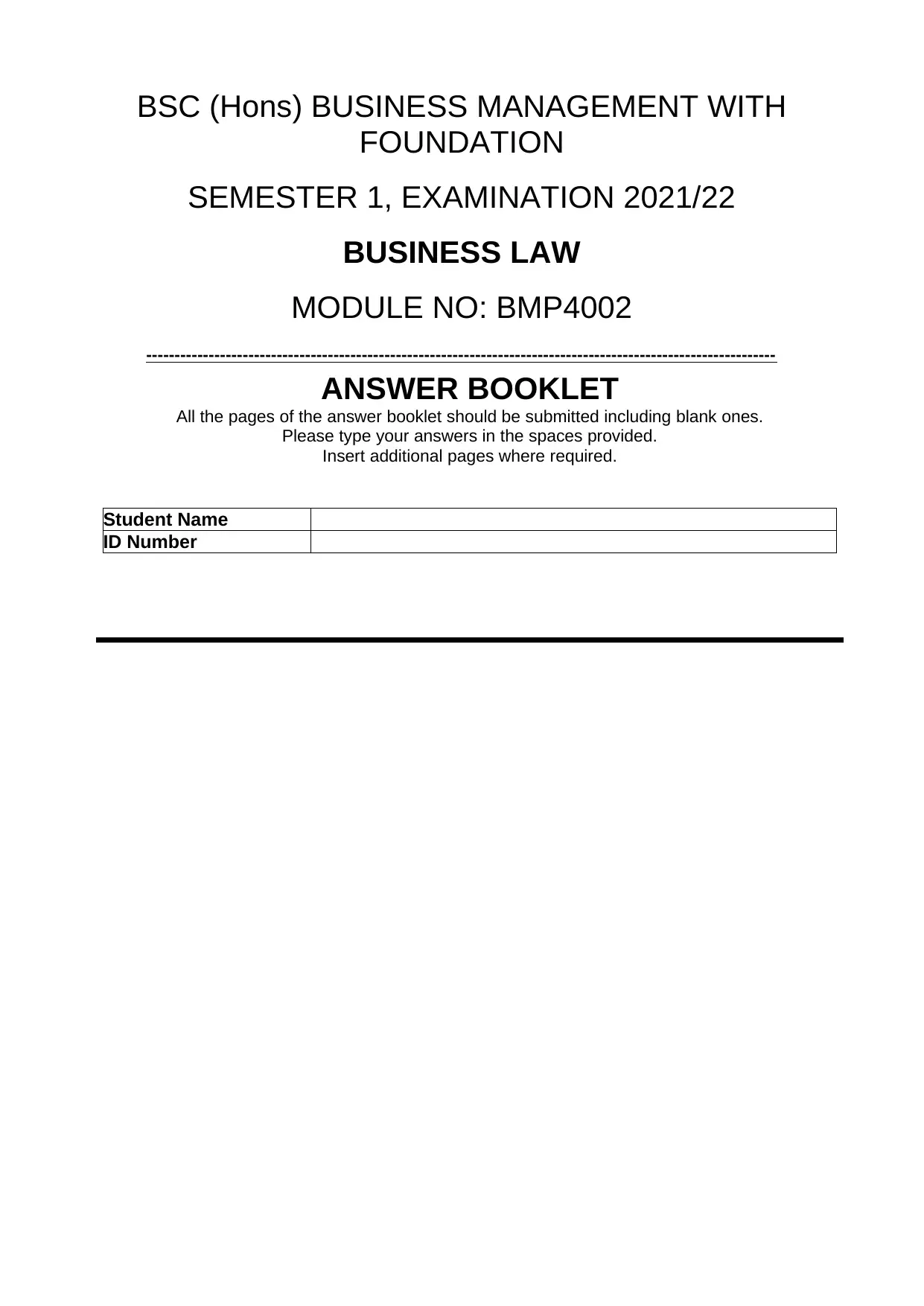
BSC (Hons) BUSINESS MANAGEMENT WITH
FOUNDATION
SEMESTER 1, EXAMINATION 2021/22
BUSINESS LAW
MODULE NO: BMP4002
---------------------------------------------------------------------------------------------------------------
ANSWER BOOKLET
All the pages of the answer booklet should be submitted including blank ones.
Please type your answers in the spaces provided.
Insert additional pages where required.
Student Name
ID Number
tabler-icon-diamond-filled.svg

Paraphrase This Document

Need a fresh take? Get an instant paraphrase of this document with our AI Paraphraser
Document Page
Q.1 The UK Classifications of Laws
(I) Provide a clear definition of law within UK Context
The United Kingdom is based on four legal systems and each drives the particular
geographical area for a historical reason. The constitutional law of the UK contains of statute law;
there legal decisions are serve as a guide or rule to applied in a similar case ion the future. Along
with this practical in the courts while interpreting the laws by judges. Along with legislation is a law
which has been passed by the parliament of UK, and people has to follow this rule, otherwise they
have to pay penalty for this (Allen, and Blackham, 2019).
(ii) Define and discuss the characteristics of the two main classifications of laws in
UK
UK laws having a Two types of legislation which are listed below:
Primary legislation- It consist the acts of parliament or statutes, it is granting
the additional law- making power to different branch of the governments by the
act. This primary legislation act has been passed by the UK parliament and it is
based on two types primary general acts and local and personal acts.
Secondary legislation- It consist the statuary instruments which is used in
generic term for regulations, order, rules, code etc. it also knows as the
subordinate and subsidiary legislation. This is generally made by the
government Minsters under the power of delegate by the parliament.
(iii) Identify the three different Legal systems in UK
United Kingdom having a three distinct legal jurisdictions which are listed below:
England and Wales- This system are referring to the legal system which is administered by the
court of England and Wales, those ruled are related to the civil and criminal’s matters. Along with it
is based in the principles of the common law and the courts of England and Wales are headed by the
senior courts of England and Wales and consisting by the court of appeal (Hardman, 2021).
.
Northern Ireland- It is based on the common law system and its administered by the courts of
Northern Ireland, by applying to the supreme court pf the UK in both ways civil and criminal
matters, the court of Northern Ireland are headed by the court of Judicature of Northern Ireland.
Scotland- this law system is very unique, it is based Roman law, which is grounded by the
uncodified civil law. Along with it also features the common law with the medieval sources.
Q.2 The UK Source of law
(i) Identify and briefly explain the hierarchy of the principal sources of laws in
the English Legal System
English law is making by the four major ways such as, namely legislation, common law, human
rights law and EU law. It recognised by the Parliament and supreme court having the authority to
making- law, legislation is created by the parliament and start as a bill. Public bill brought by the
government which is affected by the general public. English legal system is a common law which is
passing the legislation but, it also creates the precedent through the case law. It is based on the upon
the judicial decisions. Along with it developed in England from approximately 1066 to the present.
2 of 4
Document Page
(ii) Explain the characteristics of the sources of laws identified above giving
examples of each
Authoritative commentary of the law is useful for working in a new law and need to find the most
significant information which are listed below:
Legislation- It refer to the statute law and applied to the country’s written laws. For example,
enacted or consolidation.
Case law- This law is made by judge and it is the primary source of law that forms the doctrine of
precedent in the English legal system for example law reports.
Parliamentary conventions- It is typically found within the English legal system and it helps to
compensate for the UK lack of single written constitution.
Equity- It prevails the common law, if in case of application of discretionary. The main
achievement of equity is trusts, charities and so on.
(iii) Discuss the impact of the respective laws on the multilingual organisation
Multilingual organisation is the international association of an academic and scientific professional
association; which member is undertaken the research in all areas of linguistics. The language of
schooling is the complex issues, because language play an important role in communication the
educational process. Second problem is a policy vacuum; it is the most jurisdictions where the
explicit the policy on language in general (Hull and Clancy, 2022). The main general issues are
languages across the school’s programme or society is hardly address this.
Q.3 Give examples of how the UK law making process have a
direct impact on commercial organisations focusing on one
of the below list:
Explain and give the features of one of the following laws:
(i) Contract law
(ii) The law of Tort
(iii) Employment law
Employment law- It is the areas of law where the government govern the employer and employee
relationship every business is use the employment law. It is area of law which helps to deals with
the legal rights and duties of employers and employees. Employment law tell that when manger can
hire the employees or they work.so this law helps to find that what the amount pay the employer
according to their work. (Lloyd-Jones,2022). They create the minimum requirements for the
working conditions of the employees.
3 of 4
Document Page
Reference
Books and Journals
Allen, D. and Blackham, A., 2019. Under wraps: secrecy, confidentiality and the enforcement of
equality law in Australia and the United Kingdom. Melb. UL Rev., 43, p.384.
Hardman, J., 2021. The law and economics of lockdown mitigation: Bankruptcy errors in the
United Kingdom. International Insolvency Review, 30(3), pp.344-360.
Hull, D.W. and Clancy, M.J., 2022. The Application of Competition Law to the Pharmaceutical
Sector in the European Union and United Kingdom. Journal of European Competition Law
& Practice.
Lloyd-Jones, L., 2022. INTERNATIONAL LAW BEFORE UNITED KINGDOM COURTS: A
QUIET REVOLUTION. International & Comparative Law Quarterly, 71(3), pp.503-529.
4 of 4
chevron_up_icon
1 out of 4
circle_padding
hide_on_mobile
zoom_out_icon
[object Object]