An Analysis of the UK Legal System: Law, Courts, and Government
VerifiedAdded on  2021/02/22
|12
|1892
|51
Report
AI Summary
This report provides a comprehensive overview of the UK legal system, detailing its various sources of law, including domestic legislation, common law, European Union law, and the European Convention on Human Rights. It examines the crucial role of the government in the law-making process, from the preparation of bills to their passage through Parliament. The report also explores the functions of the courts in applying both statute and common law, highlighting how judges interpret and clarify laws. Furthermore, it assesses the effectiveness of the UK legal system, noting recent reforms and the impact of information technology on access to justice. The report concludes by summarizing the key components of the UK's legal framework, emphasizing the significance of statutory law and the interplay between different legal sources and institutions.

PROFESSIONAL
DISCUSSION
DISCUSSION
Paraphrase This Document
Need a fresh take? Get an instant paraphrase of this document with our AI Paraphraser

TABLE OF CONTENTS
INTRODUCTION...........................................................................................................................3
MAIN BODY...................................................................................................................................3
CONCLUSION................................................................................................................................6
REFERENCES................................................................................................................................7
INTRODUCTION...........................................................................................................................3
MAIN BODY...................................................................................................................................3
CONCLUSION................................................................................................................................6
REFERENCES................................................................................................................................7

INTRODUCTION
Legal system basically a procedure or the process which is being used for interpreting as
well as enforcing the different laws. The legal system of UK is well known for its powerful
presence and thus imposing the strict legislation within the country. Its legal system consist of
various system like tax system, Jury system which provide its citizens the democratic choice
along with making the system effective.
This essay the various law sources used in the country, the role of government in process
of law making and role of courts in applying statues as well as common laws.
MAIN BODY
Sources of law
England has a well defined law and is strictly followed by its citizen as well as other
entities. The legal system in England is well known for its effective decision making and thus
has the immense power. These laws are mainly formed by four bodies and thus has four sources
namely
Domestic legislation
It comprises of both the legislation primary as well as secondary. Primary legislation is
passed by the parliament and thus includes Government sponsored bills as well as bills of private
members (Arrowsmith and Craven, 2016). In view of the secondary legislation, government has
the full power to establish it and is generally done through the issue of some regulations namely
Statutory instruments.
Common law
The common law have been established over the past centuries by the judicial precedents
as well as known by the name of Case Law. This common law runs similar to the entire country
and thus applies on the same level to all the citizens. This law was made through the use of
principles which were developed over centuries back during the law standardisation throughout
the England.
Europion union
In EU law, the directives are required to be formulated within the member state's national
law and thus EU needs member stares government in order to introduce the legislation in
following areas and the different laws in that areas should be applied according to the legal
principles of EU.
Legal system basically a procedure or the process which is being used for interpreting as
well as enforcing the different laws. The legal system of UK is well known for its powerful
presence and thus imposing the strict legislation within the country. Its legal system consist of
various system like tax system, Jury system which provide its citizens the democratic choice
along with making the system effective.
This essay the various law sources used in the country, the role of government in process
of law making and role of courts in applying statues as well as common laws.
MAIN BODY
Sources of law
England has a well defined law and is strictly followed by its citizen as well as other
entities. The legal system in England is well known for its effective decision making and thus
has the immense power. These laws are mainly formed by four bodies and thus has four sources
namely
Domestic legislation
It comprises of both the legislation primary as well as secondary. Primary legislation is
passed by the parliament and thus includes Government sponsored bills as well as bills of private
members (Arrowsmith and Craven, 2016). In view of the secondary legislation, government has
the full power to establish it and is generally done through the issue of some regulations namely
Statutory instruments.
Common law
The common law have been established over the past centuries by the judicial precedents
as well as known by the name of Case Law. This common law runs similar to the entire country
and thus applies on the same level to all the citizens. This law was made through the use of
principles which were developed over centuries back during the law standardisation throughout
the England.
Europion union
In EU law, the directives are required to be formulated within the member state's national
law and thus EU needs member stares government in order to introduce the legislation in
following areas and the different laws in that areas should be applied according to the legal
principles of EU.
⊘ This is a preview!⊘
Do you want full access?
Subscribe today to unlock all pages.

Trusted by 1+ million students worldwide

European Convention on human rights(ECHR)
ECHR is one of the well known international law which was incorporated within
domestic legislation by the act of Human rights, 1998.
Role of government in process of law making
Government plays an essential role in making the laws in England and hence is the
central in law making process. The first stage in the process of law making is the preparation of
bill which is basically the draft being prepared by UK government. Government prepares three
kinds of bills namely public bills, private member bills and private bills. Once the bills are made,
government moves to the ext stage in which it is sent for the clearance by PBL committee
meeting (Brown, 2019). Government through the well defined process convey this draft to the
PBL committee where they addresses the final draft along with other documents. These
documents normally consists of the Explanatory notes which are published alongside the draft
bill. Once the PBL committee is satisfied then the bill becomes ready for the introduction (Daly,
Hughes and Armstrong, 2018). Third stage comprises of the parliament where the bills are either
addressed in Common's house or in Lord's House. Here the government plays the vital role and
makes decision on the basis of the legislation programmes within each House. Generally some of
the Bills must begin within Commons like the Bill whose major objective is tax imposition. After
these stages, the bill goes through the first reading and second reading. In the second reading, the
government minister opens the debate through setting the case of bill and thus mentioning its
provision. If the Government lost the votes then bill is not further proceeded. The last stage
comprise of making the bill an act. After the necessary amendments, it returns to the first house
for making some changes. Once the changes are being implemented, Bill is passed and thus
introduced in the session beginning.
Role of courts in applying statues as well as common laws
A common law is basically the procedural laws as well as substantive law which is being
built by the judges with the help of decisions within cases that they have addressed. On the
opposite side, Statute laws are the laws which are developed by the parliament in the form of
some legislations. In England, Magistrates normally make as well as follow their precedents and
thus this create an immense variation within the local as well as regional customs. This means
that the local regimes remain barely identifiable form each other. Judges develops the common
laws by delivering the written judgements regarding the cases that are presented before them.
ECHR is one of the well known international law which was incorporated within
domestic legislation by the act of Human rights, 1998.
Role of government in process of law making
Government plays an essential role in making the laws in England and hence is the
central in law making process. The first stage in the process of law making is the preparation of
bill which is basically the draft being prepared by UK government. Government prepares three
kinds of bills namely public bills, private member bills and private bills. Once the bills are made,
government moves to the ext stage in which it is sent for the clearance by PBL committee
meeting (Brown, 2019). Government through the well defined process convey this draft to the
PBL committee where they addresses the final draft along with other documents. These
documents normally consists of the Explanatory notes which are published alongside the draft
bill. Once the PBL committee is satisfied then the bill becomes ready for the introduction (Daly,
Hughes and Armstrong, 2018). Third stage comprises of the parliament where the bills are either
addressed in Common's house or in Lord's House. Here the government plays the vital role and
makes decision on the basis of the legislation programmes within each House. Generally some of
the Bills must begin within Commons like the Bill whose major objective is tax imposition. After
these stages, the bill goes through the first reading and second reading. In the second reading, the
government minister opens the debate through setting the case of bill and thus mentioning its
provision. If the Government lost the votes then bill is not further proceeded. The last stage
comprise of making the bill an act. After the necessary amendments, it returns to the first house
for making some changes. Once the changes are being implemented, Bill is passed and thus
introduced in the session beginning.
Role of courts in applying statues as well as common laws
A common law is basically the procedural laws as well as substantive law which is being
built by the judges with the help of decisions within cases that they have addressed. On the
opposite side, Statute laws are the laws which are developed by the parliament in the form of
some legislations. In England, Magistrates normally make as well as follow their precedents and
thus this create an immense variation within the local as well as regional customs. This means
that the local regimes remain barely identifiable form each other. Judges develops the common
laws by delivering the written judgements regarding the cases that are presented before them.
Paraphrase This Document
Need a fresh take? Get an instant paraphrase of this document with our AI Paraphraser

Taking of the statutes, The statutes law generally codifies the specific rules wherein the common
law offers interpretation and thus the clarification whenever the instant cases facts are being
applied to some codified law (Dougan, 2017). The law courts are highly involved in designing
the statute law and a significant increase has been made in the statue number passed by the law
of UK. Statute law is generally the continuous development that allows the judges of the courts
to inter pre and formulate statue law. The laws on which the different judges comments are made
essentially by the 'accident of litigation'. Here the statue law made by Courts plays an important
role and thus helps to bring changes within the legislation system of England and the whole UK.
Besides this, the statue reference found by the courts are constantly checked and thus updated as
the acts remains unstable and thus changes. Judges monitor these through online platform or
some law library.
Legal system effectiveness
There has been a drastic change in the reforms of UK and has developed to a great range
where the role of legal system has been imperative. The recent reforms and changes in the legal
system are creation of the supreme court by replacing the judicial functions and responsibilities
of House of Lords, establishment of Board of Legal services for regulating legal profession as
well as promoting innovation, creation of the National crime agency by replacing wide number
of agencies. In the era of this recent development, an legal system has been crucial for the UK
government and has thus helped them to overcome the problems (Lock QC, Blundell and Mills,
2016). The autonomy as well as the stability of the UK legal system makes it effective enough to
apply these reforms effectively. During these reforms, UK introduced various legal
administration as well as some coalition administration that narrowed the range of these
problems and thus emphasised on the effective case management. UK passes some laws that
bought legal changes and hence affected many tribunals. The powerful legislation system of UK
have been well known to hire the most qualified lawyers which are potent enough to provide
justice in the court. Besides this, the utilization of information technology by the legal system of
UK has developed and improved the access to the justice by allowing a large number of people
to file their own litigation online applications.
UK legal system
UK is basically the constitutional monarchy and the head of state is the monarch whose
responsibilities as well as power are chosen by the convention. Thus, UK generally operates on
law offers interpretation and thus the clarification whenever the instant cases facts are being
applied to some codified law (Dougan, 2017). The law courts are highly involved in designing
the statute law and a significant increase has been made in the statue number passed by the law
of UK. Statute law is generally the continuous development that allows the judges of the courts
to inter pre and formulate statue law. The laws on which the different judges comments are made
essentially by the 'accident of litigation'. Here the statue law made by Courts plays an important
role and thus helps to bring changes within the legislation system of England and the whole UK.
Besides this, the statue reference found by the courts are constantly checked and thus updated as
the acts remains unstable and thus changes. Judges monitor these through online platform or
some law library.
Legal system effectiveness
There has been a drastic change in the reforms of UK and has developed to a great range
where the role of legal system has been imperative. The recent reforms and changes in the legal
system are creation of the supreme court by replacing the judicial functions and responsibilities
of House of Lords, establishment of Board of Legal services for regulating legal profession as
well as promoting innovation, creation of the National crime agency by replacing wide number
of agencies. In the era of this recent development, an legal system has been crucial for the UK
government and has thus helped them to overcome the problems (Lock QC, Blundell and Mills,
2016). The autonomy as well as the stability of the UK legal system makes it effective enough to
apply these reforms effectively. During these reforms, UK introduced various legal
administration as well as some coalition administration that narrowed the range of these
problems and thus emphasised on the effective case management. UK passes some laws that
bought legal changes and hence affected many tribunals. The powerful legislation system of UK
have been well known to hire the most qualified lawyers which are potent enough to provide
justice in the court. Besides this, the utilization of information technology by the legal system of
UK has developed and improved the access to the justice by allowing a large number of people
to file their own litigation online applications.
UK legal system
UK is basically the constitutional monarchy and the head of state is the monarch whose
responsibilities as well as power are chosen by the convention. Thus, UK generally operates on

the system of common laws that combines legislation passing and precedent creation through
various case laws. Some of the laws applies throughout UK while some applies in only one or
two countries. There are mainly four sources of the legislation of UK namely Common law,
European union law, Legislation and European Convention on Human rights. Besides this, this
country do not have any written constitution and thus comprise of four major parts which are
Statue law, Conventions, Common law and Works of authority. Among all these, Statue law is
considered as the most significant law (Esq and Wilson, 2017). The government generally have
two chambers of legislative which are House of Commons as well as House of Lords. The
House of Commons comprises of the elected members whereas in the other hand House of Lords
comprise of elected peers and inherited titles. Moreover, the statue law which is being passed by
the parliament, other legal principles are based on the judges decisions which are involved in
interpreting the statue law. These collective judicial decisions normally constitute the common
law. Every single department of UK jurisdictions have formed their own case laws as well as
common laws. The final element of UK constitution covers conventions as well as work of
authority that do not consist of the statutory authority but still have the binding force.
CONCLUSION
It has been summarized that there are different sources of laws in UK namely Common
law, Domestic legislation, European Union and European convention on human rights which
helps the UK in making their legislative system effective. Government plays an important
process of law-making and thus starts with preparation of the bill. Once this bill is passed, it is
introduced and becomes and act. Besides the law courts in UK are highly competent and thus
follows the basic procedure for applying common law as well as statue law. The magistrate
usually follows their precedent and provide clarification on the cases. The legal system of UK
comprise of four parts Statue law, conventions, common law and work of authority which are the
main pillars of UK legislation.
various case laws. Some of the laws applies throughout UK while some applies in only one or
two countries. There are mainly four sources of the legislation of UK namely Common law,
European union law, Legislation and European Convention on Human rights. Besides this, this
country do not have any written constitution and thus comprise of four major parts which are
Statue law, Conventions, Common law and Works of authority. Among all these, Statue law is
considered as the most significant law (Esq and Wilson, 2017). The government generally have
two chambers of legislative which are House of Commons as well as House of Lords. The
House of Commons comprises of the elected members whereas in the other hand House of Lords
comprise of elected peers and inherited titles. Moreover, the statue law which is being passed by
the parliament, other legal principles are based on the judges decisions which are involved in
interpreting the statue law. These collective judicial decisions normally constitute the common
law. Every single department of UK jurisdictions have formed their own case laws as well as
common laws. The final element of UK constitution covers conventions as well as work of
authority that do not consist of the statutory authority but still have the binding force.
CONCLUSION
It has been summarized that there are different sources of laws in UK namely Common
law, Domestic legislation, European Union and European convention on human rights which
helps the UK in making their legislative system effective. Government plays an important
process of law-making and thus starts with preparation of the bill. Once this bill is passed, it is
introduced and becomes and act. Besides the law courts in UK are highly competent and thus
follows the basic procedure for applying common law as well as statue law. The magistrate
usually follows their precedent and provide clarification on the cases. The legal system of UK
comprise of four parts Statue law, conventions, common law and work of authority which are the
main pillars of UK legislation.
⊘ This is a preview!⊘
Do you want full access?
Subscribe today to unlock all pages.

Trusted by 1+ million students worldwide

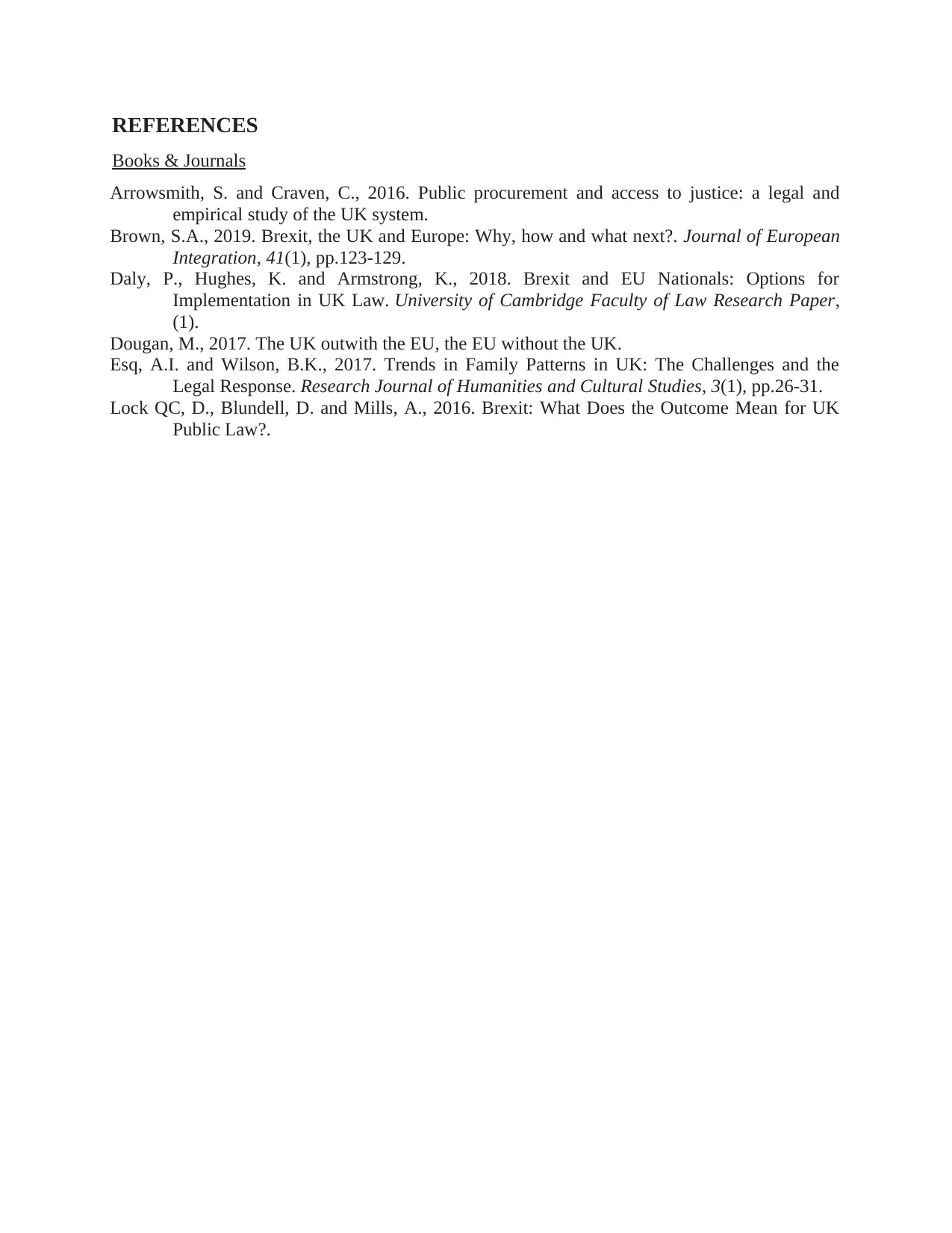
REFERENCES
Books & Journals
Arrowsmith, S. and Craven, C., 2016. Public procurement and access to justice: a legal and
empirical study of the UK system.
Brown, S.A., 2019. Brexit, the UK and Europe: Why, how and what next?. Journal of European
Integration, 41(1), pp.123-129.
Daly, P., Hughes, K. and Armstrong, K., 2018. Brexit and EU Nationals: Options for
Implementation in UK Law. University of Cambridge Faculty of Law Research Paper,
(1).
Dougan, M., 2017. The UK outwith the EU, the EU without the UK.
Esq, A.I. and Wilson, B.K., 2017. Trends in Family Patterns in UK: The Challenges and the
Legal Response. Research Journal of Humanities and Cultural Studies, 3(1), pp.26-31.
Lock QC, D., Blundell, D. and Mills, A., 2016. Brexit: What Does the Outcome Mean for UK
Public Law?.
Books & Journals
Arrowsmith, S. and Craven, C., 2016. Public procurement and access to justice: a legal and
empirical study of the UK system.
Brown, S.A., 2019. Brexit, the UK and Europe: Why, how and what next?. Journal of European
Integration, 41(1), pp.123-129.
Daly, P., Hughes, K. and Armstrong, K., 2018. Brexit and EU Nationals: Options for
Implementation in UK Law. University of Cambridge Faculty of Law Research Paper,
(1).
Dougan, M., 2017. The UK outwith the EU, the EU without the UK.
Esq, A.I. and Wilson, B.K., 2017. Trends in Family Patterns in UK: The Challenges and the
Legal Response. Research Journal of Humanities and Cultural Studies, 3(1), pp.26-31.
Lock QC, D., Blundell, D. and Mills, A., 2016. Brexit: What Does the Outcome Mean for UK
Public Law?.
Paraphrase This Document
Need a fresh take? Get an instant paraphrase of this document with our AI Paraphraser


⊘ This is a preview!⊘
Do you want full access?
Subscribe today to unlock all pages.

Trusted by 1+ million students worldwide

Paraphrase This Document
Need a fresh take? Get an instant paraphrase of this document with our AI Paraphraser


⊘ This is a preview!⊘
Do you want full access?
Subscribe today to unlock all pages.

Trusted by 1+ million students worldwide
1 out of 12
Related Documents
Your All-in-One AI-Powered Toolkit for Academic Success.
 +13062052269
info@desklib.com
Available 24*7 on WhatsApp / Email
Unlock your academic potential
Copyright © 2020–2025 A2Z Services. All Rights Reserved. Developed and managed by ZUCOL.