Evaluation of UK's 2050 Net Zero Goal in Bioenergy Sector
VerifiedAdded on 2022/12/27
|11
|2223
|59
Report
AI Summary
This report presents an executive summary and detailed analysis of the UK's 2050 net-zero goal, focusing on the bioenergy sector and its implications. The report explores the context of European integration and its role in achieving these goals, including the assessment of related roles, responsibilities, and tasks. It provides an overview of the net-zero goal, the bioenergy sector, and related challenges. The report identifies key issues such as the balance between carbon dioxide removal and residual emissions, reliance on future carbon removal technologies, and the socio-technical challenges associated with negative emissions. The conclusion highlights the importance of European integration and the need to address challenges to achieve the UK's net-zero emissions target by 2050. The report also emphasizes the benefits of achieving this target, including improved social and environmental outcomes, and discusses the potential impacts and indirect effects of climate change on the bioenergy sector.

Business
Project
Project

Paraphrase This Document
Need a fresh take? Get an instant paraphrase of this document with our AI Paraphraser

EXECUTIVE SUMMARY
Business project is intended towards achievement of defined targets for which is aligned
with business strategy of a company. Hence, business project involves a set of action that defines
strategies or planning of an organization.
Business project is intended towards achievement of defined targets for which is aligned
with business strategy of a company. Hence, business project involves a set of action that defines
strategies or planning of an organization.
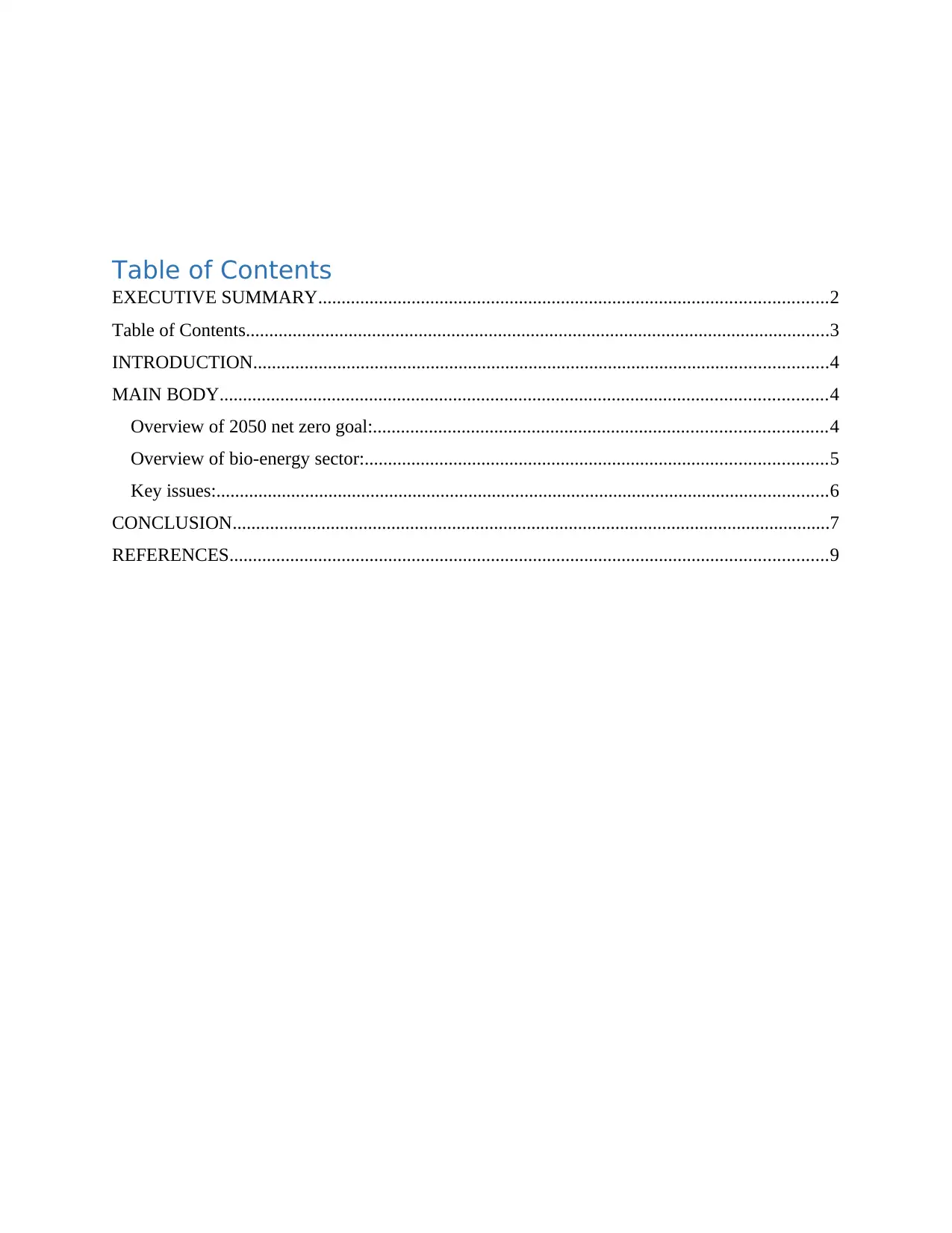
Table of Contents
EXECUTIVE SUMMARY.............................................................................................................2
Table of Contents.............................................................................................................................3
INTRODUCTION...........................................................................................................................4
MAIN BODY..................................................................................................................................4
Overview of 2050 net zero goal:.................................................................................................4
Overview of bio-energy sector:...................................................................................................5
Key issues:...................................................................................................................................6
CONCLUSION................................................................................................................................7
REFERENCES................................................................................................................................9
EXECUTIVE SUMMARY.............................................................................................................2
Table of Contents.............................................................................................................................3
INTRODUCTION...........................................................................................................................4
MAIN BODY..................................................................................................................................4
Overview of 2050 net zero goal:.................................................................................................4
Overview of bio-energy sector:...................................................................................................5
Key issues:...................................................................................................................................6
CONCLUSION................................................................................................................................7
REFERENCES................................................................................................................................9
⊘ This is a preview!⊘
Do you want full access?
Subscribe today to unlock all pages.

Trusted by 1+ million students worldwide
INTRODUCTION
Business project refers to a formal document that contains objectives of business, along with
methodology and time frame which is required to attain goals of an organization. This project
type is classified by purpose as well as content (Celebi and et.al., 2020).
This report is based on evaluation of assigned uses or sources of energy. Chosen uses or
source of energy for the report is logistic utilization as well as European integration with United
Kingdom grid. Further, its roles, responsibilities as well as tasks are defined, along with
identification of nature in relevance to expected deliverable and its due date. Apart from it,
nature of source and sources of chosen energy is developed in a detailed manner. Further,
academic theories are utilized for the purpose of assisting development as well as evaluation of
key issues regarding uses or sources of energy in relevance to 2050 net zero goals of United
Kingdom. Lastly, findings are summarized in a detailed manner.
MAIN BODY
Overview of 2050 net zero goal:
European integration refers to a procedure of industrial, political, social, cultural, economic
as well as legal integration in context to states that are wholly and partially in Europe. It poses of
daunting challenges or issues in case of political science. European integration indicates product
for selective pooling in relevance to national sovereignty and ultimate jurisdiction. It is driven by
establishment for common European market (de Vries and et.al., 2017). European integration
pertains its own supranational institutions, currency as well as system of law. Further,
methodology for measurement of European union includes multiple indicators that includes trade
in context to goods as well as services. Additionally, it includes flow of capital cross-border,
migration of labour etc. Apart from it, European union aims at being an economy that is climate-
neutral by the year 2050 along with green-house gas emissions which is net-zero. Deal of
European deal pertains this aim in line with commitment of European union to action of climate
action under agreement of Paris. Net zero emission allows removal of emissions which are
unavoidable, for example, emissions through aviation as well as manufacturing. In the year 2019.
Commission of European presented a green deal and its flagship plan is aimed towards making
climate of a nation nutreal till the year 2050. This objective can be achieved through the law of
European climate which sets neutrality of climate into a binding legislation of European union.
Business project refers to a formal document that contains objectives of business, along with
methodology and time frame which is required to attain goals of an organization. This project
type is classified by purpose as well as content (Celebi and et.al., 2020).
This report is based on evaluation of assigned uses or sources of energy. Chosen uses or
source of energy for the report is logistic utilization as well as European integration with United
Kingdom grid. Further, its roles, responsibilities as well as tasks are defined, along with
identification of nature in relevance to expected deliverable and its due date. Apart from it,
nature of source and sources of chosen energy is developed in a detailed manner. Further,
academic theories are utilized for the purpose of assisting development as well as evaluation of
key issues regarding uses or sources of energy in relevance to 2050 net zero goals of United
Kingdom. Lastly, findings are summarized in a detailed manner.
MAIN BODY
Overview of 2050 net zero goal:
European integration refers to a procedure of industrial, political, social, cultural, economic
as well as legal integration in context to states that are wholly and partially in Europe. It poses of
daunting challenges or issues in case of political science. European integration indicates product
for selective pooling in relevance to national sovereignty and ultimate jurisdiction. It is driven by
establishment for common European market (de Vries and et.al., 2017). European integration
pertains its own supranational institutions, currency as well as system of law. Further,
methodology for measurement of European union includes multiple indicators that includes trade
in context to goods as well as services. Additionally, it includes flow of capital cross-border,
migration of labour etc. Apart from it, European union aims at being an economy that is climate-
neutral by the year 2050 along with green-house gas emissions which is net-zero. Deal of
European deal pertains this aim in line with commitment of European union to action of climate
action under agreement of Paris. Net zero emission allows removal of emissions which are
unavoidable, for example, emissions through aviation as well as manufacturing. In the year 2019.
Commission of European presented a green deal and its flagship plan is aimed towards making
climate of a nation nutreal till the year 2050. This objective can be achieved through the law of
European climate which sets neutrality of climate into a binding legislation of European union.
Paraphrase This Document
Need a fresh take? Get an instant paraphrase of this document with our AI Paraphraser
Roles, responsibilities and tasks that are associated with preparation of this project plan in
a detailed manner involves management and execution of every steps that are related to this
business project on evaluation of zero-gas emissions in relation to European Integration with
United Kingdom grid. It involves analysis of concept related to European integration and its
relation to achievement of long-term target of 2050 for zero-gas emissions. Hence, aims of Uk
grid is identified, required tasks are analysed. Further, outcomes are required to be interpreted
and presented in a detailed manner. Time period which is required for the purpose of completing
this business project is 3 months.
Overview of bio-energy sector:
The transition of society which is climate neutral comes up as an urgent challenge as well
as an opportunity for building a enhanced and better future. All economic sectors of a society
plays a crucial role in this context for formulating a zero-gas emission mission of United
Kingdom.it involves industry, mobility, forestry, agriculture as well as buildings. European
integration leads a way for investment with the motive of providing a realistic and technological
solutions that helps in empowerment of citizens of a nation (deLlano-Paz and et.al., 2018). Apart
from it, European integration with United Kingdom grid enables alignment of actions of a
country in relevance to key areas which involves industrial policies, research as well as financial
sectors that ensures social fairness. Mission associated with 2050 long term strategy of United
Kingdom in case of zero-gas emissions pinpoints climate-neutral European union which includes
exploration of pathways and key sectors for transition. It covers every policies of European
union that aligns with objective of agreement for keeping global temperature enhanced or
increased.
Further, while considering disadvantages or challenges which are associated with
European integration in context to 2050 strategy of zero-gas emissions of United Kingdom it can
be noted that it leads to insufficient policies. As, high percentage of spending of European Union
is involved under this strategy of European integration. It leads towards increment in price for
consumers as well as encouragement of oversupply. Another issue is that European integration
does not necessarily indicates member with Euro. Instead, high amount of emphasis is placed by
European union on single currency. It leads to emergence of many issues and leads to
contribution for lower rates in context to economic growth and along with it leads to higher
unemployment. Apart from it, for United Kingdom costs associated with membership of
a detailed manner involves management and execution of every steps that are related to this
business project on evaluation of zero-gas emissions in relation to European Integration with
United Kingdom grid. It involves analysis of concept related to European integration and its
relation to achievement of long-term target of 2050 for zero-gas emissions. Hence, aims of Uk
grid is identified, required tasks are analysed. Further, outcomes are required to be interpreted
and presented in a detailed manner. Time period which is required for the purpose of completing
this business project is 3 months.
Overview of bio-energy sector:
The transition of society which is climate neutral comes up as an urgent challenge as well
as an opportunity for building a enhanced and better future. All economic sectors of a society
plays a crucial role in this context for formulating a zero-gas emission mission of United
Kingdom.it involves industry, mobility, forestry, agriculture as well as buildings. European
integration leads a way for investment with the motive of providing a realistic and technological
solutions that helps in empowerment of citizens of a nation (deLlano-Paz and et.al., 2018). Apart
from it, European integration with United Kingdom grid enables alignment of actions of a
country in relevance to key areas which involves industrial policies, research as well as financial
sectors that ensures social fairness. Mission associated with 2050 long term strategy of United
Kingdom in case of zero-gas emissions pinpoints climate-neutral European union which includes
exploration of pathways and key sectors for transition. It covers every policies of European
union that aligns with objective of agreement for keeping global temperature enhanced or
increased.
Further, while considering disadvantages or challenges which are associated with
European integration in context to 2050 strategy of zero-gas emissions of United Kingdom it can
be noted that it leads to insufficient policies. As, high percentage of spending of European Union
is involved under this strategy of European integration. It leads towards increment in price for
consumers as well as encouragement of oversupply. Another issue is that European integration
does not necessarily indicates member with Euro. Instead, high amount of emphasis is placed by
European union on single currency. It leads to emergence of many issues and leads to
contribution for lower rates in context to economic growth and along with it leads to higher
unemployment. Apart from it, for United Kingdom costs associated with membership of
European union is high. Further, European union pertains pressure on countries for pursuing
austerity. It leads to spending cuts for meeting targets of budget deficit. But, at the time of
recession it has contributed towards prolonged economic stagnation. It comes up as a challenge
in context to attainment of goals that are associated with long term strategy of United Kingdom
for zero-gas emissions. Further, United Kingdom currently does not pertain on adequate track for
meeting 80 percent emissions by the year 2050. This strategy indicates that approach of zero-gas
emissions is technically feasible but at the same time it is highly challenging. It incurs high
amount of costs. Another challenge which is associated with economic integration is that
members of this union are required to follow or adhere towards rules and regulations for trading,
policies related to monetary, as well as fiscal policies which are established by external body of
policy making.
On the contrary, while considering advantages associated with European integration for
mission of zero-gas emissions it can be stated that reaching target of net zero provides various
essential benefits to United Kingdom. It provides wider level of social benefits to society, such
as, health of humans is improved as quality of air is enhanced. Along with it, natura environment
is provided which is better-protected (Devi and Gupta, 2019). It enables people to become more
productive. European union mainly falls into three major categories, that includes, trading
benefits, employment as well as political corporation. It leads towards deduction in costs which
is associated with trading and further, enhanced availability of products for wider selection.
Apart from it, it enables gaining of efficiency which leads to higher power of purchasing for
citizens of a nation. In addition to it, European integration pertains opportunity to United
Kingdom for improvement by providing laterization in context to trade. It ensures expansion of
market, sharing of technology and investments across borders.
European integration can be described as an arrangement between nations which typically
involves reduction as well as elimination of barriers of trade, in coordination to monetary as well
as fiscal policies. It targets towards reduction of costs in relevance to both producers as well as
consumers that enhances trade among nations that are involves in an agreement. Hence,
European integration in case of United Kingdom grid indicates a preferential area f trading, a
union of customs, economic union, as well as complete integration of economic. It represents
total harmonization in context to fiscal policies as well as complete monetary union.
austerity. It leads to spending cuts for meeting targets of budget deficit. But, at the time of
recession it has contributed towards prolonged economic stagnation. It comes up as a challenge
in context to attainment of goals that are associated with long term strategy of United Kingdom
for zero-gas emissions. Further, United Kingdom currently does not pertain on adequate track for
meeting 80 percent emissions by the year 2050. This strategy indicates that approach of zero-gas
emissions is technically feasible but at the same time it is highly challenging. It incurs high
amount of costs. Another challenge which is associated with economic integration is that
members of this union are required to follow or adhere towards rules and regulations for trading,
policies related to monetary, as well as fiscal policies which are established by external body of
policy making.
On the contrary, while considering advantages associated with European integration for
mission of zero-gas emissions it can be stated that reaching target of net zero provides various
essential benefits to United Kingdom. It provides wider level of social benefits to society, such
as, health of humans is improved as quality of air is enhanced. Along with it, natura environment
is provided which is better-protected (Devi and Gupta, 2019). It enables people to become more
productive. European union mainly falls into three major categories, that includes, trading
benefits, employment as well as political corporation. It leads towards deduction in costs which
is associated with trading and further, enhanced availability of products for wider selection.
Apart from it, it enables gaining of efficiency which leads to higher power of purchasing for
citizens of a nation. In addition to it, European integration pertains opportunity to United
Kingdom for improvement by providing laterization in context to trade. It ensures expansion of
market, sharing of technology and investments across borders.
European integration can be described as an arrangement between nations which typically
involves reduction as well as elimination of barriers of trade, in coordination to monetary as well
as fiscal policies. It targets towards reduction of costs in relevance to both producers as well as
consumers that enhances trade among nations that are involves in an agreement. Hence,
European integration in case of United Kingdom grid indicates a preferential area f trading, a
union of customs, economic union, as well as complete integration of economic. It represents
total harmonization in context to fiscal policies as well as complete monetary union.
⊘ This is a preview!⊘
Do you want full access?
Subscribe today to unlock all pages.
Trusted by 1+ million students worldwide
Key issues:
United Kingdom aims towards delivering greenhouse gas which pertains non-zero emissions
by the year 2050. It broadly lines with advice provided by pane of intergovernmental in
relevance to climate change. Both committee inter-panel climate change and United Kingdom
highlights requirement for negative emissions along with enhanced efforts for cutting outputs of
greenhouse gas, in case emissions that are falling to net-zero. However, it is noted by experts that
combination of emissions of reduction as well as negative emissions in a single target for
reaching goal of net-zero might come up as a emergence of problems (Rashidi and Cullinane,
2019). It may result in delayed cuts of emissions, and insufficiency in relevance to focusing on
development of negative emission technologies. Following are some key issues faced:
Key issue 1: One of the key issues which is associated with net-zero targets requires
meeting of two balances, that are, removal of carbon dioxide when residual emissions pertains
offset. Here, the issue lies in relevance to interaction among these two. Further, side-effect lies
with leaking back of carbon into forest and soil. It brings various social as well as environmental
risk, for example, heightened competition in case of land. Hence, main issue in case of non-zero
emissions is related to prospective technologies. It does not exist as a socio-technical system
which is large scale and ready for the purpose of deployment.
Key issue 2: Apart from it, plans for non-zero highly relies on promises that are related to
removal of future carbon, rather than reduction of emissions in a current basis. Further,
techniques of removal of carbo pertains an effort for reduction of uncertainties related to
technical might leads towards heighten expectation in relation to future removals.
Key issue 3: Further, negative emissions indicate that for the purpose of meeting net-zero
targets it is required to suck carbon dioxide from the atmosphere. It indicates towards natural
form for sequestration of carbon. This global initiative which is associated with zero-gas
emissions sets minimum level of criteria for the purpose of designing targets in relation to net-
zero gas emissions. Achievement of emissions related to net-zero indicates remaining of human-
caused for emissions of GHG which can be balanced out by removing it from atmosphere in
procedure of removal of carbon (Wendling, 2019).
CONCLUSION
` From the above report it can be concluded that European integration proves to be an
incentive which are valuable for reformation of policies in states of eastern European. It pertains
United Kingdom aims towards delivering greenhouse gas which pertains non-zero emissions
by the year 2050. It broadly lines with advice provided by pane of intergovernmental in
relevance to climate change. Both committee inter-panel climate change and United Kingdom
highlights requirement for negative emissions along with enhanced efforts for cutting outputs of
greenhouse gas, in case emissions that are falling to net-zero. However, it is noted by experts that
combination of emissions of reduction as well as negative emissions in a single target for
reaching goal of net-zero might come up as a emergence of problems (Rashidi and Cullinane,
2019). It may result in delayed cuts of emissions, and insufficiency in relevance to focusing on
development of negative emission technologies. Following are some key issues faced:
Key issue 1: One of the key issues which is associated with net-zero targets requires
meeting of two balances, that are, removal of carbon dioxide when residual emissions pertains
offset. Here, the issue lies in relevance to interaction among these two. Further, side-effect lies
with leaking back of carbon into forest and soil. It brings various social as well as environmental
risk, for example, heightened competition in case of land. Hence, main issue in case of non-zero
emissions is related to prospective technologies. It does not exist as a socio-technical system
which is large scale and ready for the purpose of deployment.
Key issue 2: Apart from it, plans for non-zero highly relies on promises that are related to
removal of future carbon, rather than reduction of emissions in a current basis. Further,
techniques of removal of carbo pertains an effort for reduction of uncertainties related to
technical might leads towards heighten expectation in relation to future removals.
Key issue 3: Further, negative emissions indicate that for the purpose of meeting net-zero
targets it is required to suck carbon dioxide from the atmosphere. It indicates towards natural
form for sequestration of carbon. This global initiative which is associated with zero-gas
emissions sets minimum level of criteria for the purpose of designing targets in relation to net-
zero gas emissions. Achievement of emissions related to net-zero indicates remaining of human-
caused for emissions of GHG which can be balanced out by removing it from atmosphere in
procedure of removal of carbon (Wendling, 2019).
CONCLUSION
` From the above report it can be concluded that European integration proves to be an
incentive which are valuable for reformation of policies in states of eastern European. It pertains
Paraphrase This Document
Need a fresh take? Get an instant paraphrase of this document with our AI Paraphraser
a prospect for accession of European union. It focuses on enlargement of European union and
development of European integration. Further, this report states that non-zero gas emissions
indicate carbon neutrality by balancing emissions of carbon dioxide by removal or elimination of
carbon dioxide emissions. It is utilised for the procedure of releasing carbon dioxide in
association with energy production, industrial processes, transportation as well as agriculture.
While on the one hand there are several benefits which are associated with non-zero gas
emission strategy of United Kingdom for the year 2050 in context to European integration.
While, on the other hand, it pertains several types of challenges or issues as well.
development of European integration. Further, this report states that non-zero gas emissions
indicate carbon neutrality by balancing emissions of carbon dioxide by removal or elimination of
carbon dioxide emissions. It is utilised for the procedure of releasing carbon dioxide in
association with energy production, industrial processes, transportation as well as agriculture.
While on the one hand there are several benefits which are associated with non-zero gas
emission strategy of United Kingdom for the year 2050 in context to European integration.
While, on the other hand, it pertains several types of challenges or issues as well.
REFERENCES
Books and Journals:
Celebi, A. D., and et.al., 2020. Temperature control on wastewater and downstream nitrous oxide
emissions in an urbanized river system. Water Research, 187, p.116417.Chemical
Engineering Science. 204. pp.59-75.
de Vries, W., and et.al., 2017. Modelling long-term impacts of changes in climate, nitrogen
deposition and ozone exposure on carbon sequestration of European forest
ecosystems. Science of the Total Environment. 605. pp.1097-1116.
deLlano-Paz, F., and et.al., 2018. Power generation and pollutant emissions in the European
Union: A mean-variance model. Journal of Cleaner Production. 181. pp.123-135.
Devi, S. and Gupta, N., 2019. Effects of inclusion of delay in the imposition of environmental
tax on the emission of greenhouse gases. Chaos, Solitons & Fractals. 125. pp.41-53.
Rashidi, K. and Cullinane, K., 2019. Evaluating the sustainability of national logistics
performance using Data Envelopment Analysis. Transport Policy. 74. pp.35-46.
Wendling, Z. A., 2019. Bridges beyond renewable energy: Decarbonizing the global electricity
sector under uncertainty. Energy research & social science. 48. pp.235-245.
Books and Journals:
Celebi, A. D., and et.al., 2020. Temperature control on wastewater and downstream nitrous oxide
emissions in an urbanized river system. Water Research, 187, p.116417.Chemical
Engineering Science. 204. pp.59-75.
de Vries, W., and et.al., 2017. Modelling long-term impacts of changes in climate, nitrogen
deposition and ozone exposure on carbon sequestration of European forest
ecosystems. Science of the Total Environment. 605. pp.1097-1116.
deLlano-Paz, F., and et.al., 2018. Power generation and pollutant emissions in the European
Union: A mean-variance model. Journal of Cleaner Production. 181. pp.123-135.
Devi, S. and Gupta, N., 2019. Effects of inclusion of delay in the imposition of environmental
tax on the emission of greenhouse gases. Chaos, Solitons & Fractals. 125. pp.41-53.
Rashidi, K. and Cullinane, K., 2019. Evaluating the sustainability of national logistics
performance using Data Envelopment Analysis. Transport Policy. 74. pp.35-46.
Wendling, Z. A., 2019. Bridges beyond renewable energy: Decarbonizing the global electricity
sector under uncertainty. Energy research & social science. 48. pp.235-245.
⊘ This is a preview!⊘
Do you want full access?
Subscribe today to unlock all pages.
Trusted by 1+ million students worldwide

Paraphrase This Document
Need a fresh take? Get an instant paraphrase of this document with our AI Paraphraser

1

1 out of 11


Related Documents


Your All-in-One AI-Powered Toolkit for Academic Success.
+13062052269
info@desklib.com
Available 24*7 on WhatsApp / Email
![[object Object]](/_next/static/media/star-bottom.7253800d.svg)
Unlock your academic potential
Copyright © 2020–2026 A2Z Services. All Rights Reserved. Developed and managed by ZUCOL.