Taxation: Purpose, Structure, and Ethics - DFA 2104Y (3)

Verified

Added on  2021/04/27

|20
|2109
|578
Report
AI Summary
This report provides a comprehensive overview of the UK taxation system, focusing on its purpose, structure, and ethical considerations. It examines how the UK tax system encourages and discourages certain economic activities through various incentives and disincentives. The report delves into the social and environmental aspects of taxation, including the redistribution of wealth and the promotion of sustainable practices. It also details the structure of the UK tax system, including the roles of key bodies like Her Majesty's Treasury and HMRC. Furthermore, the report outlines the sources of revenue law, different types of taxes (direct and indirect), and the impact of European Union membership and double taxation agreements. The report differentiates between tax avoidance and tax evasion, explaining the General Anti-Abuse Rule (GAAR). Finally, the report explores the ethical responsibilities of accountants in tax matters, including the handling of client errors and potential tax evasion activities. The report concludes with a multiple-choice question (MCQ) to test understanding of the ethical considerations.
Document Page
Taxation
DFA 2104Y (3)
tabler-icon-diamond-filled.svg

Paraphrase This Document

Need a fresh take? Get an instant paraphrase of this document with our AI Paraphraser
Document Page
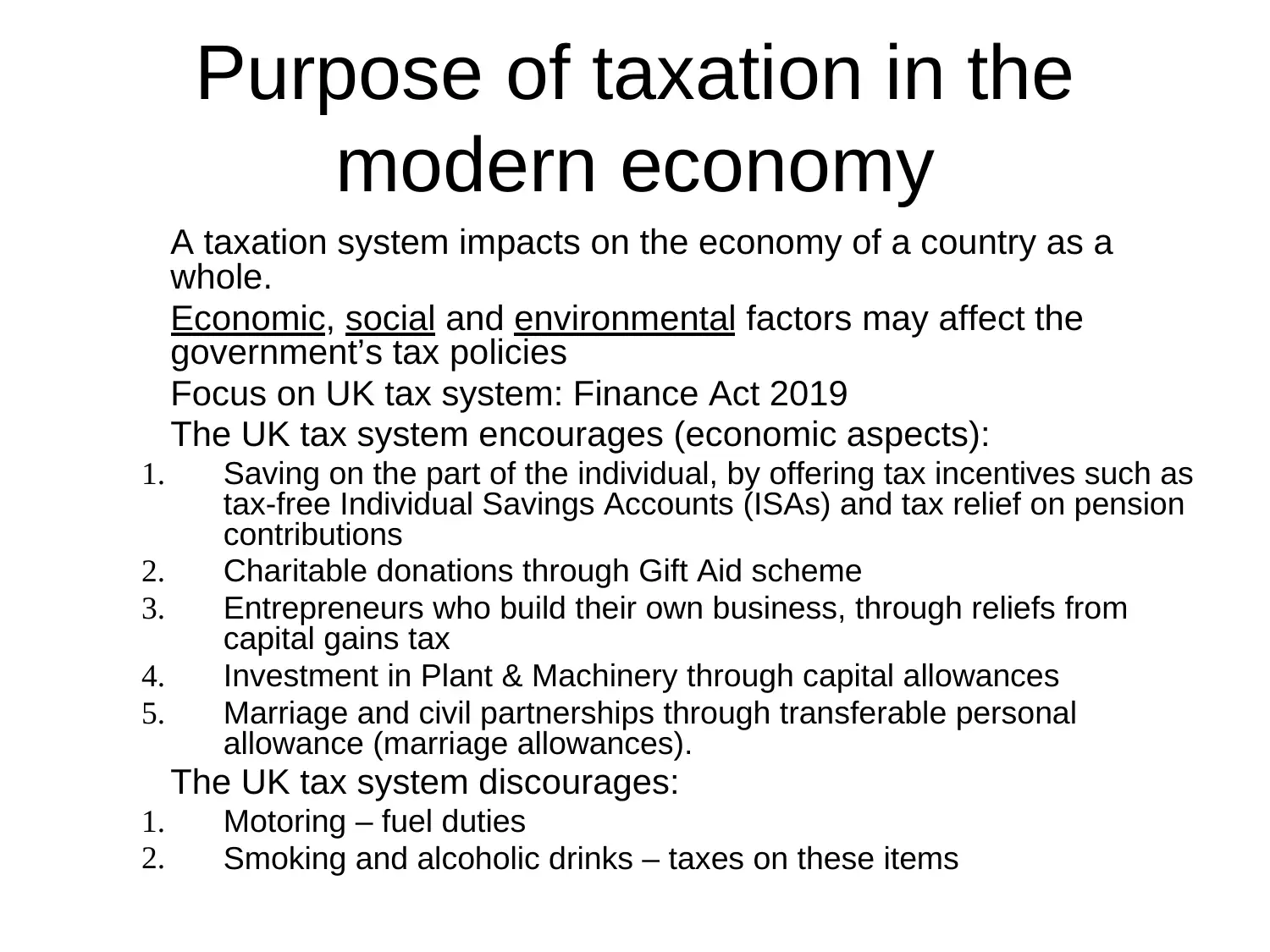
Purpose of taxation in the
modern economy
A taxation system impacts on the economy of a country as a
whole.
Economic, social and environmental factors may affect the
government’s tax policies
Focus on UK tax system: Finance Act 2019
The UK tax system encourages (economic aspects):
1. Saving on the part of the individual, by offering tax incentives such as
tax-free Individual Savings Accounts (ISAs) and tax relief on pension
contributions
2. Charitable donations through Gift Aid scheme
3. Entrepreneurs who build their own business, through reliefs from
capital gains tax
4. Investment in Plant & Machinery through capital allowances
5. Marriage and civil partnerships through transferable personal
allowance (marriage allowances).
The UK tax system discourages:
1. Motoring – fuel duties
2. Smoking and alcoholic drinks – taxes on these items
Document Page
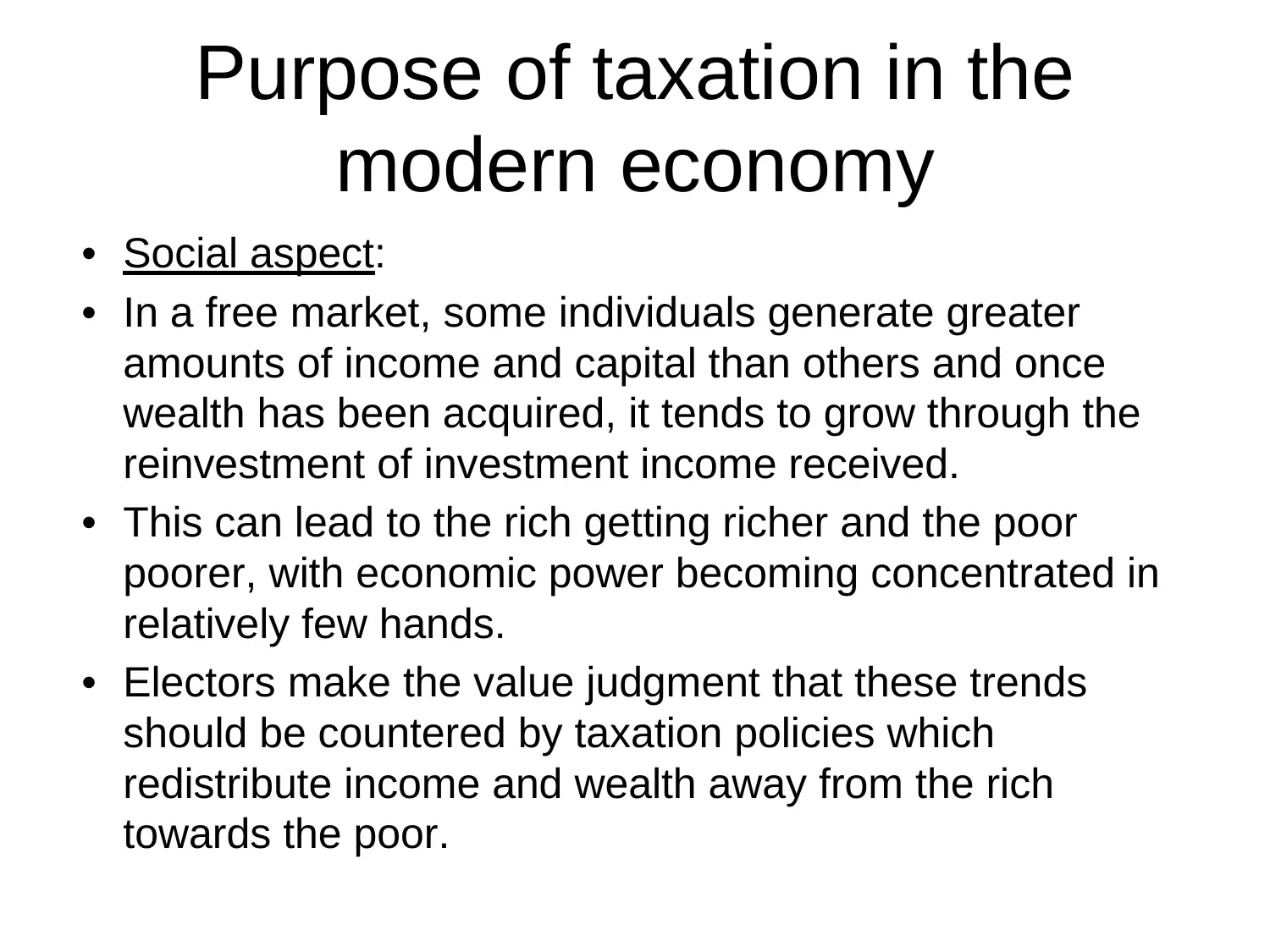
Purpose of taxation in the
modern economy
Social aspect:
In a free market, some individuals generate greater
amounts of income and capital than others and once
wealth has been acquired, it tends to grow through the
reinvestment of investment income received.
This can lead to the rich getting richer and the poor
poorer, with economic power becoming concentrated in
relatively few hands.
Electors make the value judgment that these trends
should be countered by taxation policies which
redistribute income and wealth away from the rich
towards the poor.
Document Page
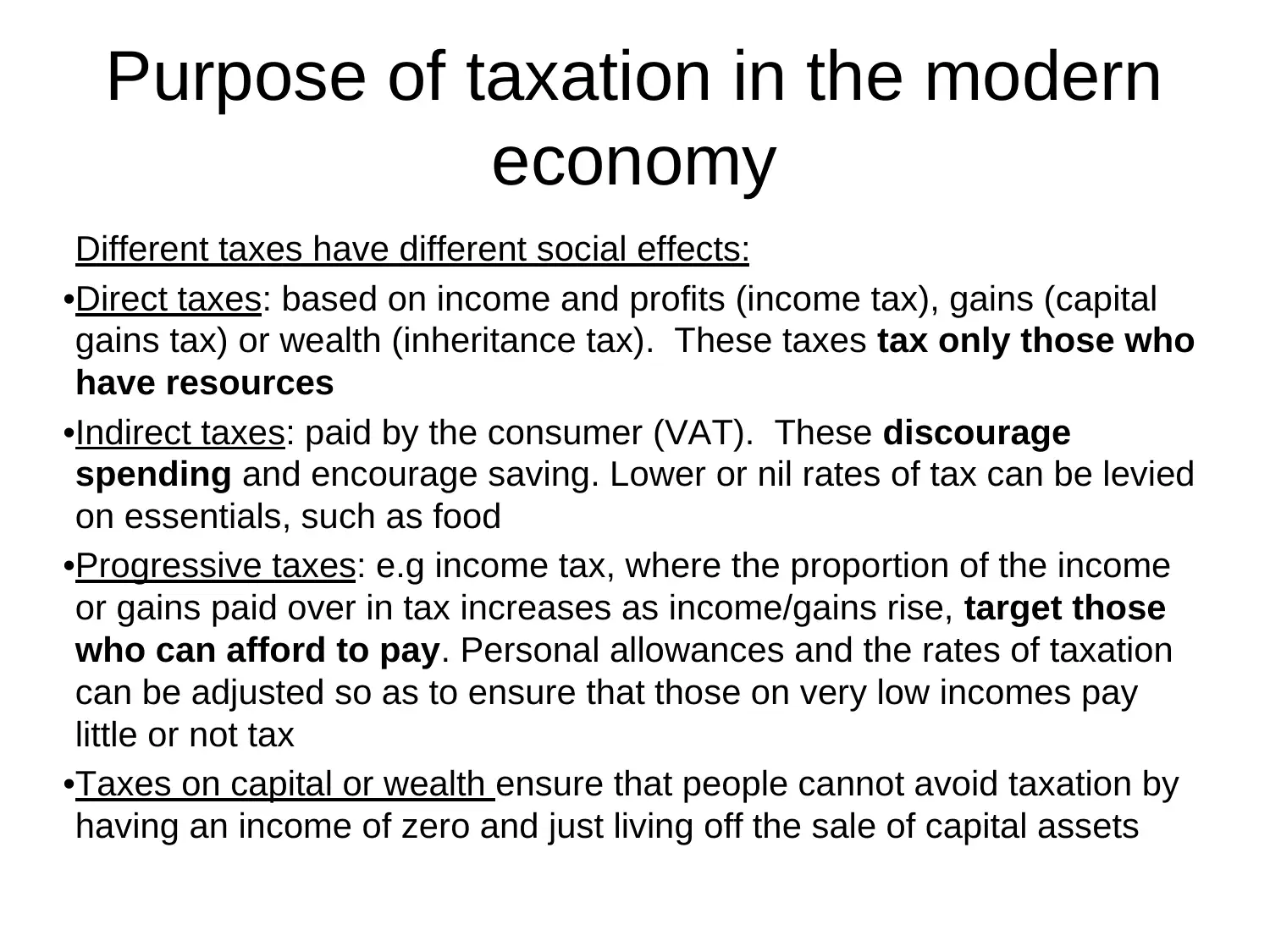
Purpose of taxation in the modern
economy
Different taxes have different social effects:
Direct taxes: based on income and profits (income tax), gains (capital
gains tax) or wealth (inheritance tax). These taxes tax only those who
have resources
Indirect taxes: paid by the consumer (VAT). These discourage
spending and encourage saving. Lower or nil rates of tax can be levied
on essentials, such as food
Progressive taxes: e.g income tax, where the proportion of the income
or gains paid over in tax increases as income/gains rise, target those
who can afford to pay. Personal allowances and the rates of taxation
can be adjusted so as to ensure that those on very low incomes pay
little or not tax
Taxes on capital or wealth ensure that people cannot avoid taxation by
having an income of zero and just living off the sale of capital assets
tabler-icon-diamond-filled.svg

Paraphrase This Document

Need a fresh take? Get an instant paraphrase of this document with our AI Paraphraser
Document Page
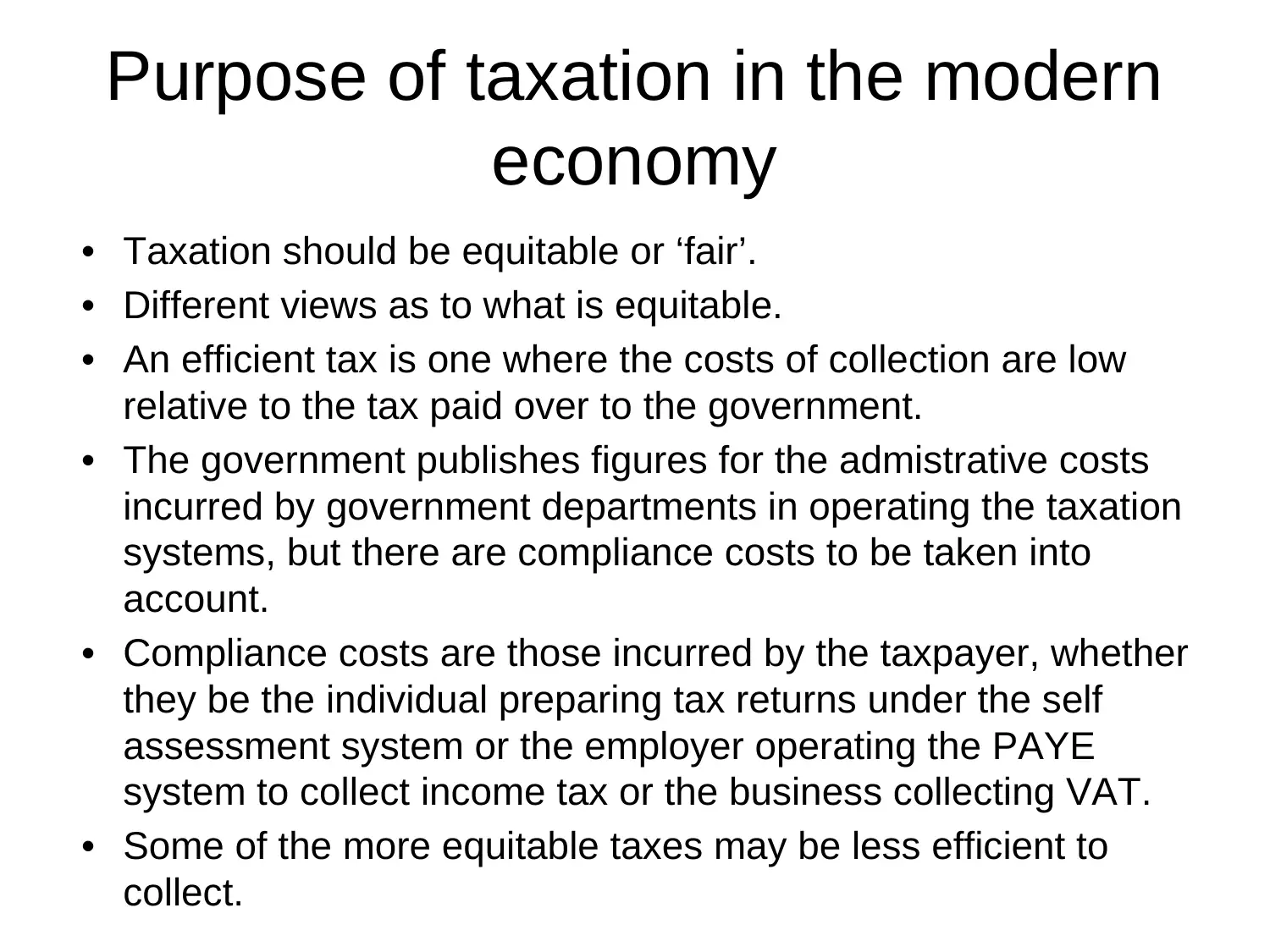
Purpose of taxation in the modern
economy
Taxation should be equitable or ‘fair’.
Different views as to what is equitable.
An efficient tax is one where the costs of collection are low
relative to the tax paid over to the government.
The government publishes figures for the admistrative costs
incurred by government departments in operating the taxation
systems, but there are compliance costs to be taken into
account.
Compliance costs are those incurred by the taxpayer, whether
they be the individual preparing tax returns under the self
assessment system or the employer operating the PAYE
system to collect income tax or the business collecting VAT.
Some of the more equitable taxes may be less efficient to
collect.
Document Page
Purpose of taxation in the modern
economy
Environmental aspect: The taxation system is moving slowly
to accommodate the environmental concerns - e.g concerns
about renewable and non-renewable sources of energy and
global warming.
E.gs of tax changes:
Climate change levy, raised on businesses in proportion to their
consumption of energy. Its claimed purpose is to encourage reduced
consumption.
Landfill tax: levied on the operators of landfill sites on each tonne of
rubbish/waste processed at the site. Its claimed purpose is to
encourage recycling by taxing waste which has to be stored.
Changes to rules on the lease or purchase of cars, and taxation of cars
and private fuel provided for employees to be dependent on CO2
emissions.
Document Page
UK tax system structure
Her Majesty’s Treasury: formally imposes and collects
taxation. The management of the Treasury is the
responsibility of the Chancellor of the Exchequer.
Her Majesty’s Revenue and Customs (HMRC) – A
single body that controls and administers all areas of
UK tax law
Crown Prosecution Services (CPS): provides legal
advice and institutes and conducts criminal
prosecutions in England and Wales where there has
been an investigation by HMRC.
Tax Tribunal: tax appeals are heard by the Tax
Tribunal which is made up of two tiers, First Tier
Tribunal and Upper Tribunal
tabler-icon-diamond-filled.svg

Paraphrase This Document

Need a fresh take? Get an instant paraphrase of this document with our AI Paraphraser
Document Page
Sources of revenue law
If you want to pass this module, you need to learn the
basic tax rules.
What are the sources of these rules? They are
summarised below:
Tax legislation/statutes are law: adherence is mandatory.
Tax legislation updated each year by the annual Finance
Act
Case law: decisions made in tax cases brought before
courts, binding and may challenge tax legislation.
HMRC guidance: Statements of practice, extra-statutory
concessions, a wide range of explanatory leaflets,
Revenue and Customs Brief, The Internal Guidance,
Agent Update for tax practitioners
Document Page
Taxes in the UK
Income tax – payable by individuals and partnerships on
their earnings and investment income. Earnings can be
from self-employment and employment
Capital gains tax – payable by individuals on disposal of
capital assets (land, buildings, shares, etc)
Corporation tax – payable by companies on all their
income and gains
Inheritance tax – payable by individuals and trustees on
disposal of wealth
Value added tax (VAT) – payable on the supply of most
goods and services by the final consumer, i.e., us!
You will also meet National Insurance: payable by
employers, employees and the self-employed
Document Page
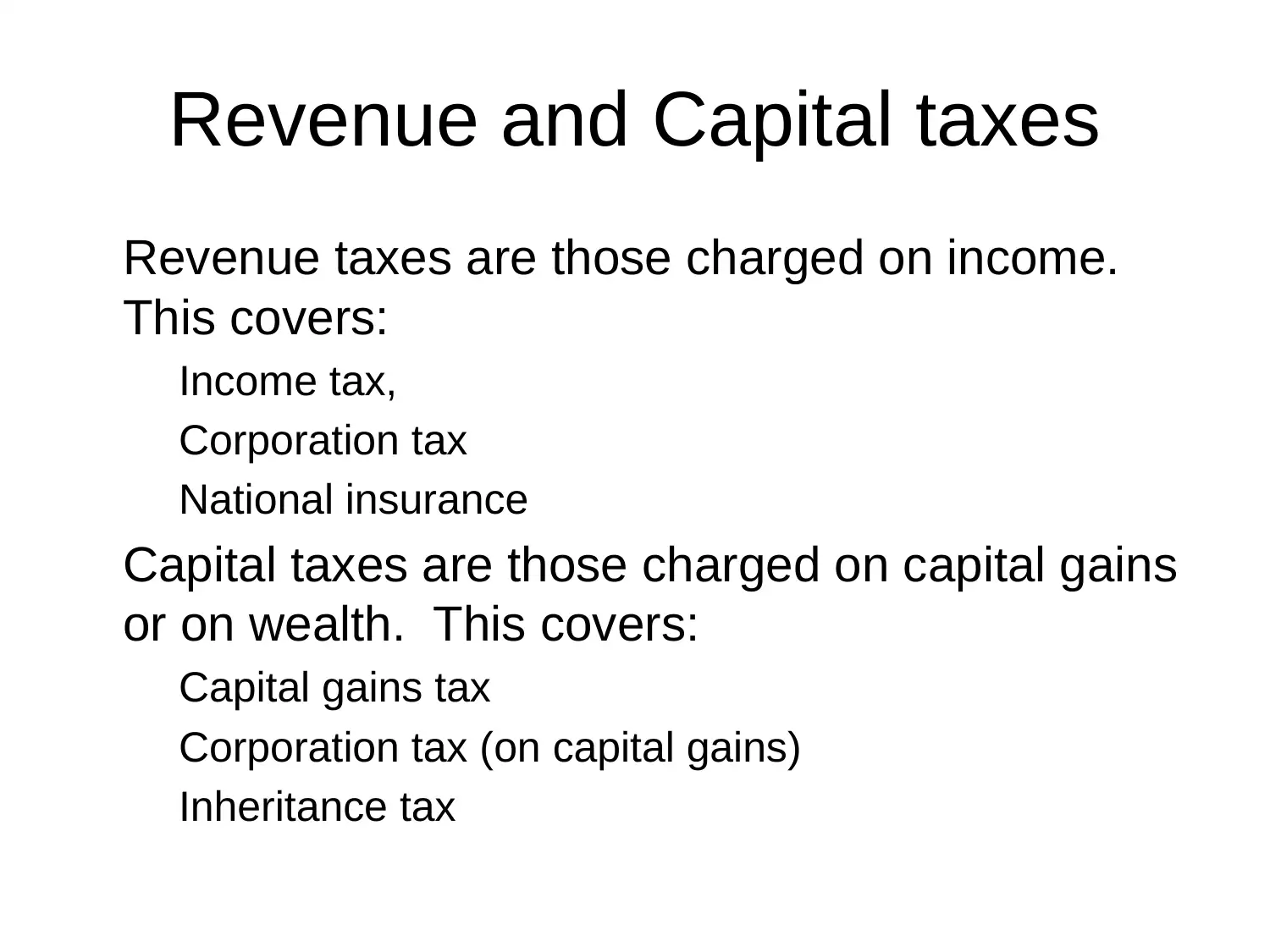
Revenue and Capital taxes
Revenue taxes are those charged on income.
This covers:
Income tax,
Corporation tax
National insurance
Capital taxes are those charged on capital gains
or on wealth. This covers:
Capital gains tax
Corporation tax (on capital gains)
Inheritance tax
tabler-icon-diamond-filled.svg

Paraphrase This Document

Need a fresh take? Get an instant paraphrase of this document with our AI Paraphraser
Document Page
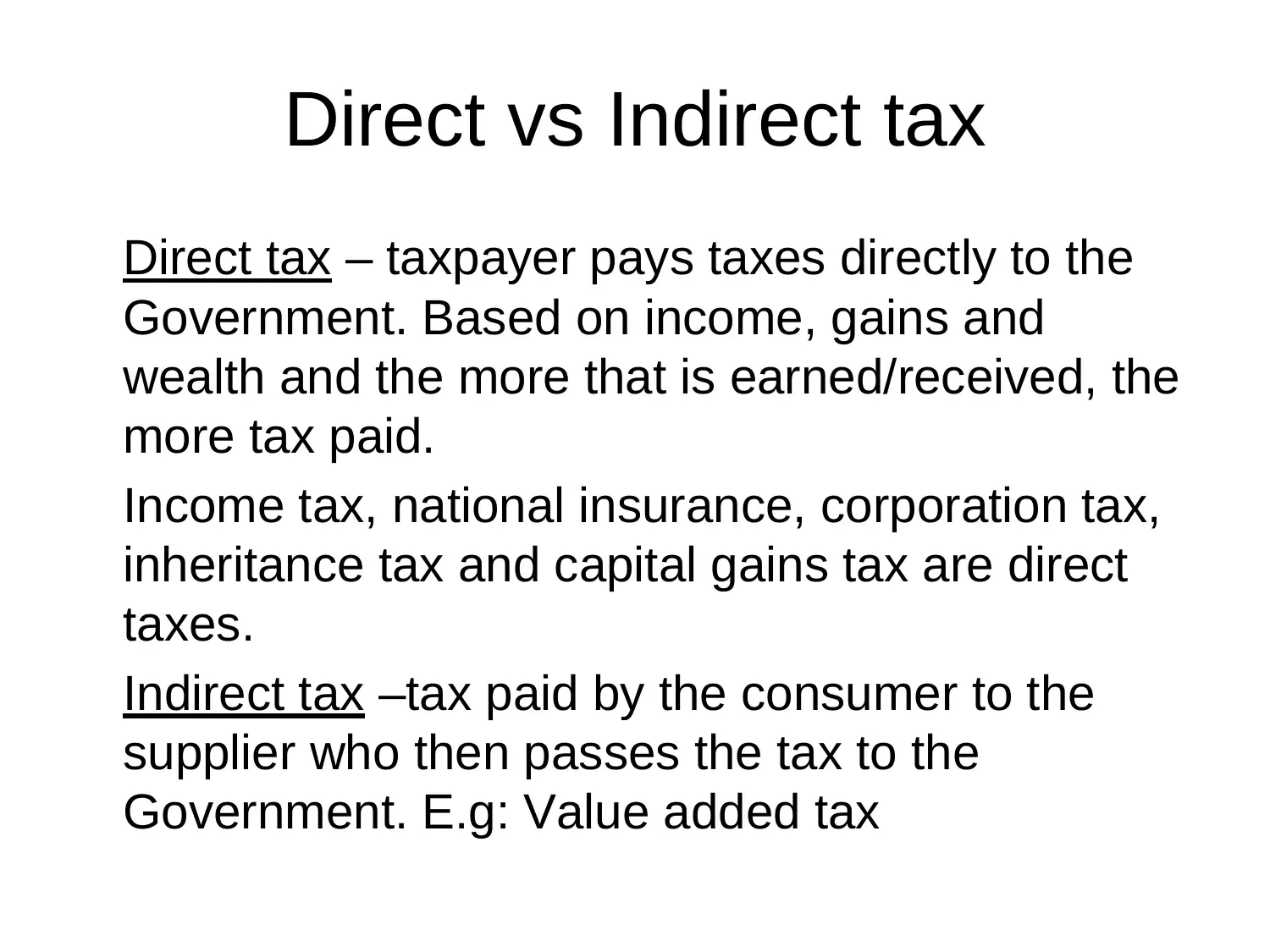
Direct vs Indirect tax
Direct tax – taxpayer pays taxes directly to the
Government. Based on income, gains and
wealth and the more that is earned/received, the
more tax paid.
Income tax, national insurance, corporation tax,
inheritance tax and capital gains tax are direct
taxes.
Indirect tax –tax paid by the consumer to the
supplier who then passes the tax to the
Government. E.g: Value added tax
Document Page
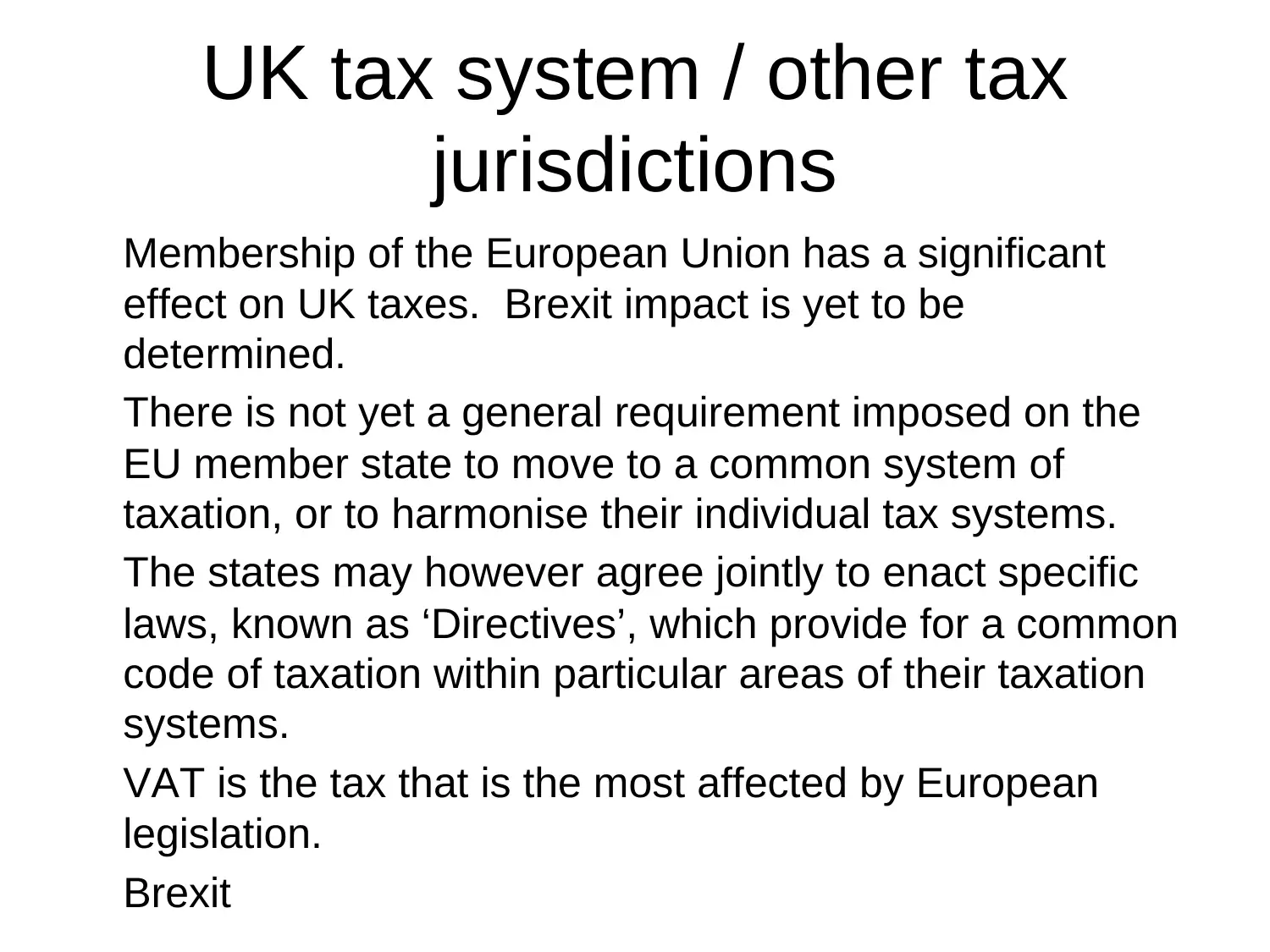
UK tax system / other tax
jurisdictions
Membership of the European Union has a significant
effect on UK taxes. Brexit impact is yet to be
determined.
There is not yet a general requirement imposed on the
EU member state to move to a common system of
taxation, or to harmonise their individual tax systems.
The states may however agree jointly to enact specific
laws, known as ‘Directives’, which provide for a common
code of taxation within particular areas of their taxation
systems.
VAT is the tax that is the most affected by European
legislation.
Brexit
chevron_up_icon
1 out of 20
circle_padding
hide_on_mobile
zoom_out_icon
[object Object]