UK Taxation System: Analysis, Comparisons, and Unincorporated Bodies
VerifiedAdded on 2023/06/08
|23
|6423
|455
Report
AI Summary
This report provides a detailed analysis of the UK taxation system, differentiating between direct and indirect taxes, and comparing it with the taxation systems of India and the USA. It covers various aspects of the UK tax system, including tax rates, exemptions, and the roles of different government levels in tax collection. The report also discusses the characteristics, advantages, and disadvantages of unincorporated associations, along with their taxation liabilities. Furthermore, it offers recommendations for developing an effective tax system in the UK, focusing on increasing public finance, capital expenditure, and labor productivity. The content aims to provide a comprehensive understanding of the UK taxation landscape and related entities, offering valuable insights for students and professionals. Access more solved assignments and resources on Desklib.
TAXATION

Paraphrase This Document
Need a fresh take? Get an instant paraphrase of this document with our AI Paraphraser
Contents
INTRODUCTION...........................................................................................................................3
MAIN BODY...................................................................................................................................3
TASK 1:..................................................................................................................................3
TASK 2:..................................................................................................................................9
TASK 3:................................................................................................................................12
TASK 4:................................................................................................................................15
CONCLUSION..............................................................................................................................19
REFERENCES..............................................................................................................................20
INTRODUCTION...........................................................................................................................3
MAIN BODY...................................................................................................................................3
TASK 1:..................................................................................................................................3
TASK 2:..................................................................................................................................9
TASK 3:................................................................................................................................12
TASK 4:................................................................................................................................15
CONCLUSION..............................................................................................................................19
REFERENCES..............................................................................................................................20
INTRODUCTION
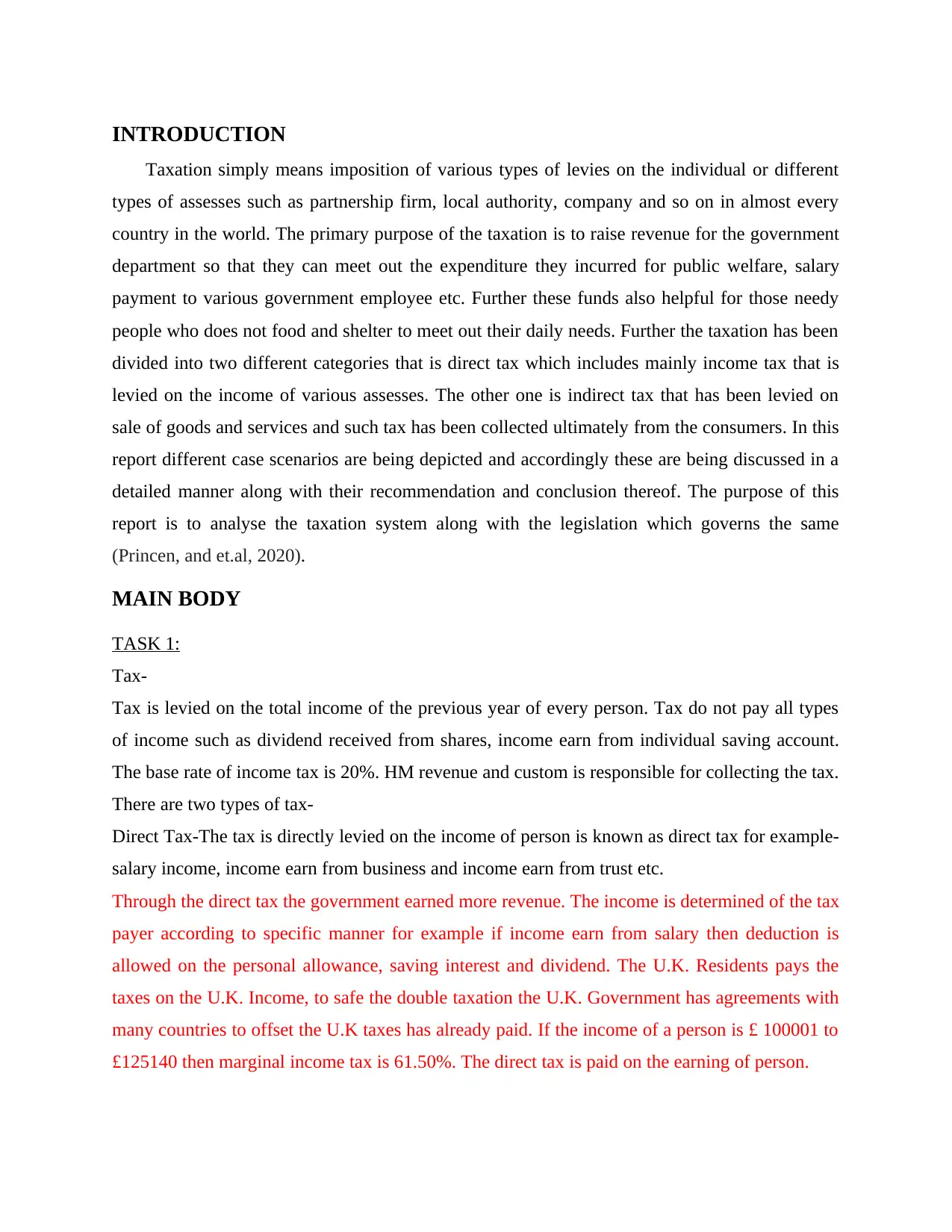
Taxation simply means imposition of various types of levies on the individual or different
types of assesses such as partnership firm, local authority, company and so on in almost every
country in the world. The primary purpose of the taxation is to raise revenue for the government
department so that they can meet out the expenditure they incurred for public welfare, salary
payment to various government employee etc. Further these funds also helpful for those needy
people who does not food and shelter to meet out their daily needs. Further the taxation has been
divided into two different categories that is direct tax which includes mainly income tax that is
levied on the income of various assesses. The other one is indirect tax that has been levied on
sale of goods and services and such tax has been collected ultimately from the consumers. In this
report different case scenarios are being depicted and accordingly these are being discussed in a
detailed manner along with their recommendation and conclusion thereof. The purpose of this
report is to analyse the taxation system along with the legislation which governs the same
(Princen, and et.al, 2020).
MAIN BODY
TASK 1:
Tax-
Tax is levied on the total income of the previous year of every person. Tax do not pay all types
of income such as dividend received from shares, income earn from individual saving account.
The base rate of income tax is 20%. HM revenue and custom is responsible for collecting the tax.
There are two types of tax-
Direct Tax-The tax is directly levied on the income of person is known as direct tax for example-
salary income, income earn from business and income earn from trust etc.
Through the direct tax the government earned more revenue. The income is determined of the tax
payer according to specific manner for example if income earn from salary then deduction is
allowed on the personal allowance, saving interest and dividend. The U.K. Residents pays the
taxes on the U.K. Income, to safe the double taxation the U.K. Government has agreements with
many countries to offset the U.K taxes has already paid. If the income of a person is £ 100001 to
£125140 then marginal income tax is 61.50%. The direct tax is paid on the earning of person.
Taxation simply means imposition of various types of levies on the individual or different
types of assesses such as partnership firm, local authority, company and so on in almost every
country in the world. The primary purpose of the taxation is to raise revenue for the government
department so that they can meet out the expenditure they incurred for public welfare, salary
payment to various government employee etc. Further these funds also helpful for those needy
people who does not food and shelter to meet out their daily needs. Further the taxation has been
divided into two different categories that is direct tax which includes mainly income tax that is
levied on the income of various assesses. The other one is indirect tax that has been levied on
sale of goods and services and such tax has been collected ultimately from the consumers. In this
report different case scenarios are being depicted and accordingly these are being discussed in a
detailed manner along with their recommendation and conclusion thereof. The purpose of this
report is to analyse the taxation system along with the legislation which governs the same
(Princen, and et.al, 2020).
MAIN BODY
TASK 1:
Tax-
Tax is levied on the total income of the previous year of every person. Tax do not pay all types
of income such as dividend received from shares, income earn from individual saving account.
The base rate of income tax is 20%. HM revenue and custom is responsible for collecting the tax.
There are two types of tax-
Direct Tax-The tax is directly levied on the income of person is known as direct tax for example-
salary income, income earn from business and income earn from trust etc.
Through the direct tax the government earned more revenue. The income is determined of the tax
payer according to specific manner for example if income earn from salary then deduction is
allowed on the personal allowance, saving interest and dividend. The U.K. Residents pays the
taxes on the U.K. Income, to safe the double taxation the U.K. Government has agreements with
many countries to offset the U.K taxes has already paid. If the income of a person is £ 100001 to
£125140 then marginal income tax is 61.50%. The direct tax is paid on the earning of person.
⊘ This is a preview!⊘
Do you want full access?
Subscribe today to unlock all pages.

Trusted by 1+ million students worldwide
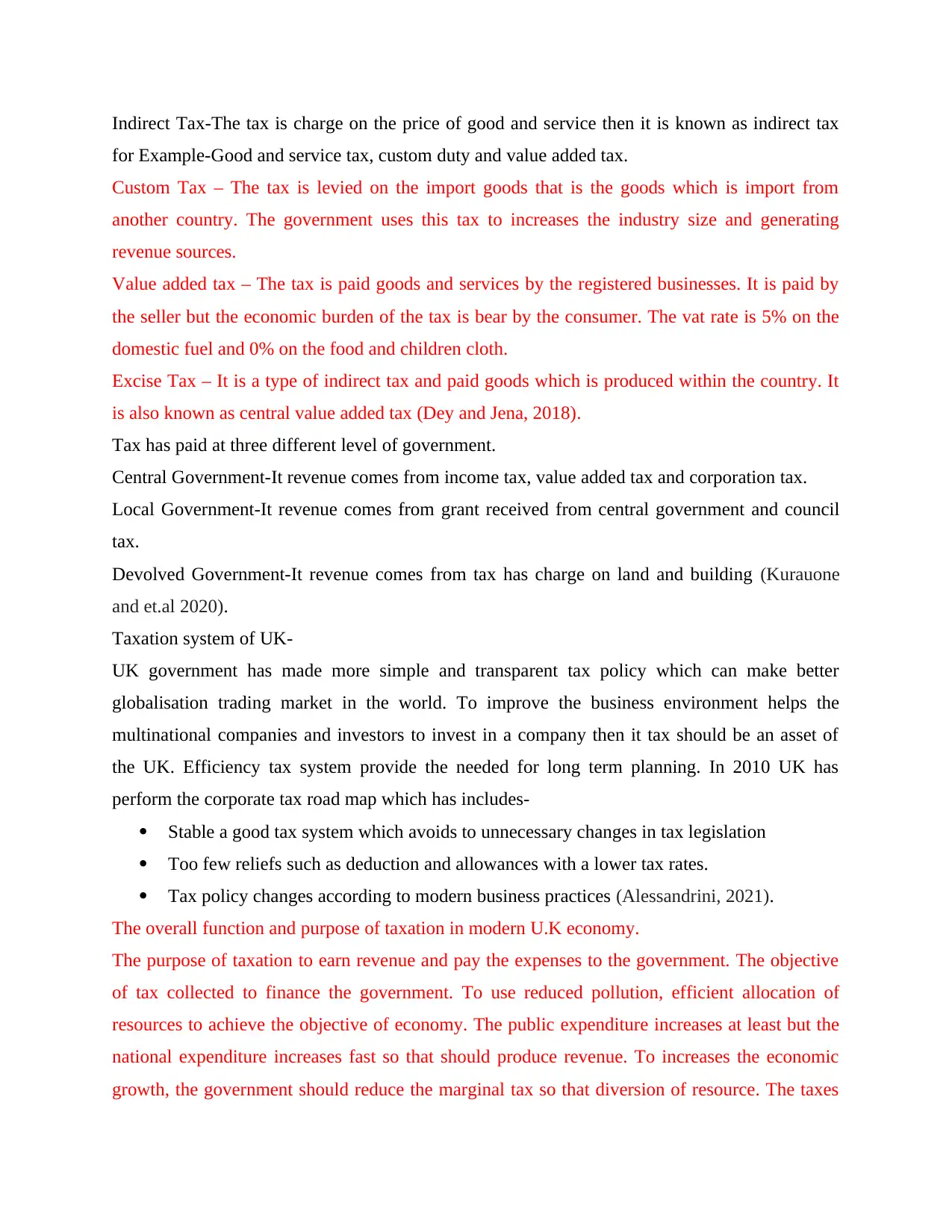
Indirect Tax-The tax is charge on the price of good and service then it is known as indirect tax
for Example-Good and service tax, custom duty and value added tax.
Custom Tax – The tax is levied on the import goods that is the goods which is import from
another country. The government uses this tax to increases the industry size and generating
revenue sources.
Value added tax – The tax is paid goods and services by the registered businesses. It is paid by
the seller but the economic burden of the tax is bear by the consumer. The vat rate is 5% on the
domestic fuel and 0% on the food and children cloth.
Excise Tax – It is a type of indirect tax and paid goods which is produced within the country. It
is also known as central value added tax (Dey and Jena, 2018).
Tax has paid at three different level of government.
Central Government-It revenue comes from income tax, value added tax and corporation tax.
Local Government-It revenue comes from grant received from central government and council
tax.
Devolved Government-It revenue comes from tax has charge on land and building (Kurauone
and et.al 2020).
Taxation system of UK-
UK government has made more simple and transparent tax policy which can make better
globalisation trading market in the world. To improve the business environment helps the
multinational companies and investors to invest in a company then it tax should be an asset of
the UK. Efficiency tax system provide the needed for long term planning. In 2010 UK has
perform the corporate tax road map which has includes-
Stable a good tax system which avoids to unnecessary changes in tax legislation
Too few reliefs such as deduction and allowances with a lower tax rates.
Tax policy changes according to modern business practices (Alessandrini, 2021).
The overall function and purpose of taxation in modern U.K economy.
The purpose of taxation to earn revenue and pay the expenses to the government. The objective
of tax collected to finance the government. To use reduced pollution, efficient allocation of
resources to achieve the objective of economy. The public expenditure increases at least but the
national expenditure increases fast so that should produce revenue. To increases the economic
growth, the government should reduce the marginal tax so that diversion of resource. The taxes
for Example-Good and service tax, custom duty and value added tax.
Custom Tax – The tax is levied on the import goods that is the goods which is import from
another country. The government uses this tax to increases the industry size and generating
revenue sources.
Value added tax – The tax is paid goods and services by the registered businesses. It is paid by
the seller but the economic burden of the tax is bear by the consumer. The vat rate is 5% on the
domestic fuel and 0% on the food and children cloth.
Excise Tax – It is a type of indirect tax and paid goods which is produced within the country. It
is also known as central value added tax (Dey and Jena, 2018).
Tax has paid at three different level of government.
Central Government-It revenue comes from income tax, value added tax and corporation tax.
Local Government-It revenue comes from grant received from central government and council
tax.
Devolved Government-It revenue comes from tax has charge on land and building (Kurauone
and et.al 2020).
Taxation system of UK-
UK government has made more simple and transparent tax policy which can make better
globalisation trading market in the world. To improve the business environment helps the
multinational companies and investors to invest in a company then it tax should be an asset of
the UK. Efficiency tax system provide the needed for long term planning. In 2010 UK has
perform the corporate tax road map which has includes-
Stable a good tax system which avoids to unnecessary changes in tax legislation
Too few reliefs such as deduction and allowances with a lower tax rates.
Tax policy changes according to modern business practices (Alessandrini, 2021).
The overall function and purpose of taxation in modern U.K economy.
The purpose of taxation to earn revenue and pay the expenses to the government. The objective
of tax collected to finance the government. To use reduced pollution, efficient allocation of
resources to achieve the objective of economy. The public expenditure increases at least but the
national expenditure increases fast so that should produce revenue. To increases the economic
growth, the government should reduce the marginal tax so that diversion of resource. The taxes
Paraphrase This Document
Need a fresh take? Get an instant paraphrase of this document with our AI Paraphraser
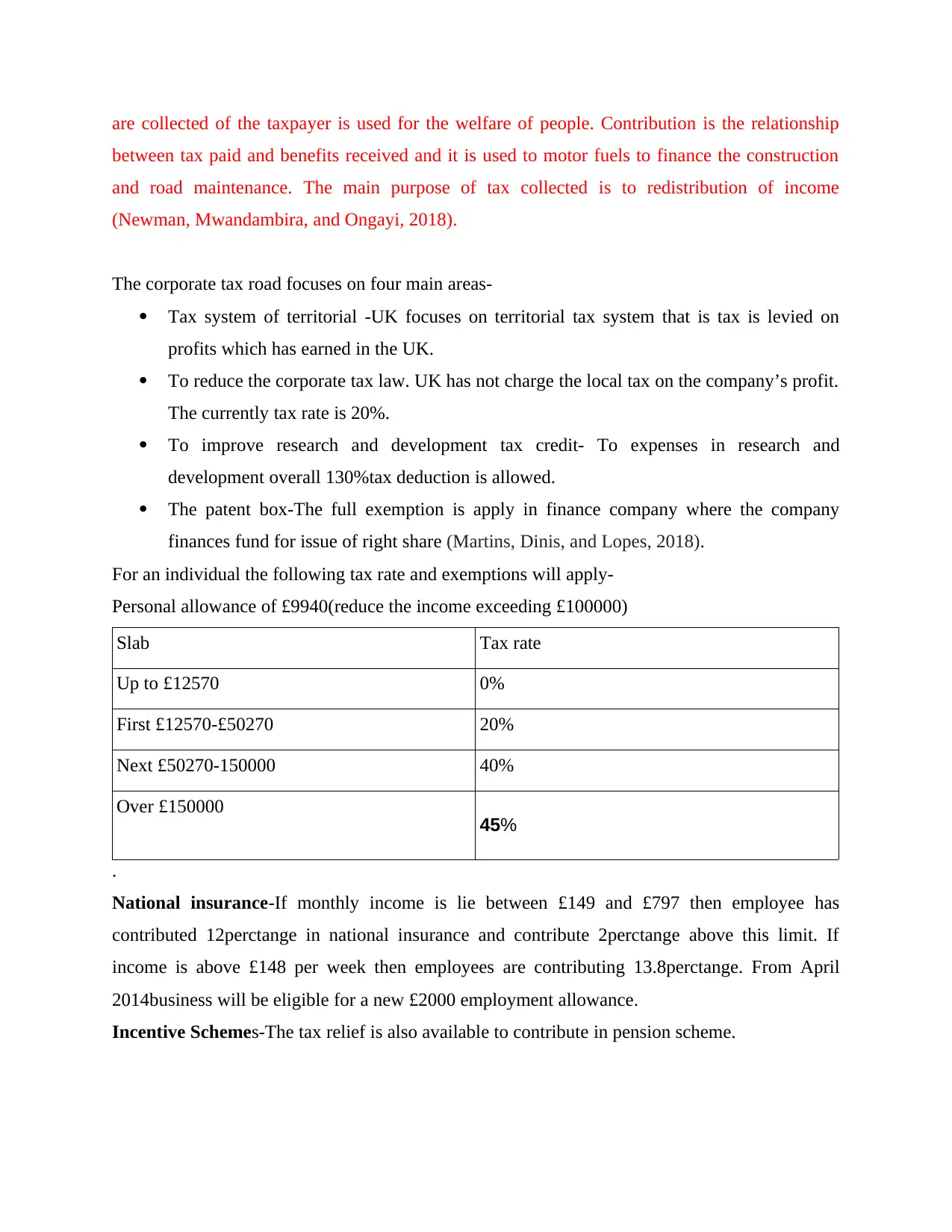
are collected of the taxpayer is used for the welfare of people. Contribution is the relationship
between tax paid and benefits received and it is used to motor fuels to finance the construction
and road maintenance. The main purpose of tax collected is to redistribution of income
(Newman, Mwandambira, and Ongayi, 2018).
The corporate tax road focuses on four main areas-
Tax system of territorial -UK focuses on territorial tax system that is tax is levied on
profits which has earned in the UK.
To reduce the corporate tax law. UK has not charge the local tax on the company’s profit.
The currently tax rate is 20%.
To improve research and development tax credit- To expenses in research and
development overall 130%tax deduction is allowed.
The patent box-The full exemption is apply in finance company where the company
finances fund for issue of right share (Martins, Dinis, and Lopes, 2018).
For an individual the following tax rate and exemptions will apply-
Personal allowance of £9940(reduce the income exceeding £100000)
Slab Tax rate
Up to £12570 0%
First £12570-£50270 20%
Next £50270-150000 40%
Over £150000 45%
.
National insurance-If monthly income is lie between £149 and £797 then employee has
contributed 12perctange in national insurance and contribute 2perctange above this limit. If
income is above £148 per week then employees are contributing 13.8perctange. From April
2014business will be eligible for a new £2000 employment allowance.
Incentive Schemes-The tax relief is also available to contribute in pension scheme.
between tax paid and benefits received and it is used to motor fuels to finance the construction
and road maintenance. The main purpose of tax collected is to redistribution of income
(Newman, Mwandambira, and Ongayi, 2018).
The corporate tax road focuses on four main areas-
Tax system of territorial -UK focuses on territorial tax system that is tax is levied on
profits which has earned in the UK.
To reduce the corporate tax law. UK has not charge the local tax on the company’s profit.
The currently tax rate is 20%.
To improve research and development tax credit- To expenses in research and
development overall 130%tax deduction is allowed.
The patent box-The full exemption is apply in finance company where the company
finances fund for issue of right share (Martins, Dinis, and Lopes, 2018).
For an individual the following tax rate and exemptions will apply-
Personal allowance of £9940(reduce the income exceeding £100000)
Slab Tax rate
Up to £12570 0%
First £12570-£50270 20%
Next £50270-150000 40%
Over £150000 45%
.
National insurance-If monthly income is lie between £149 and £797 then employee has
contributed 12perctange in national insurance and contribute 2perctange above this limit. If
income is above £148 per week then employees are contributing 13.8perctange. From April
2014business will be eligible for a new £2000 employment allowance.
Incentive Schemes-The tax relief is also available to contribute in pension scheme.
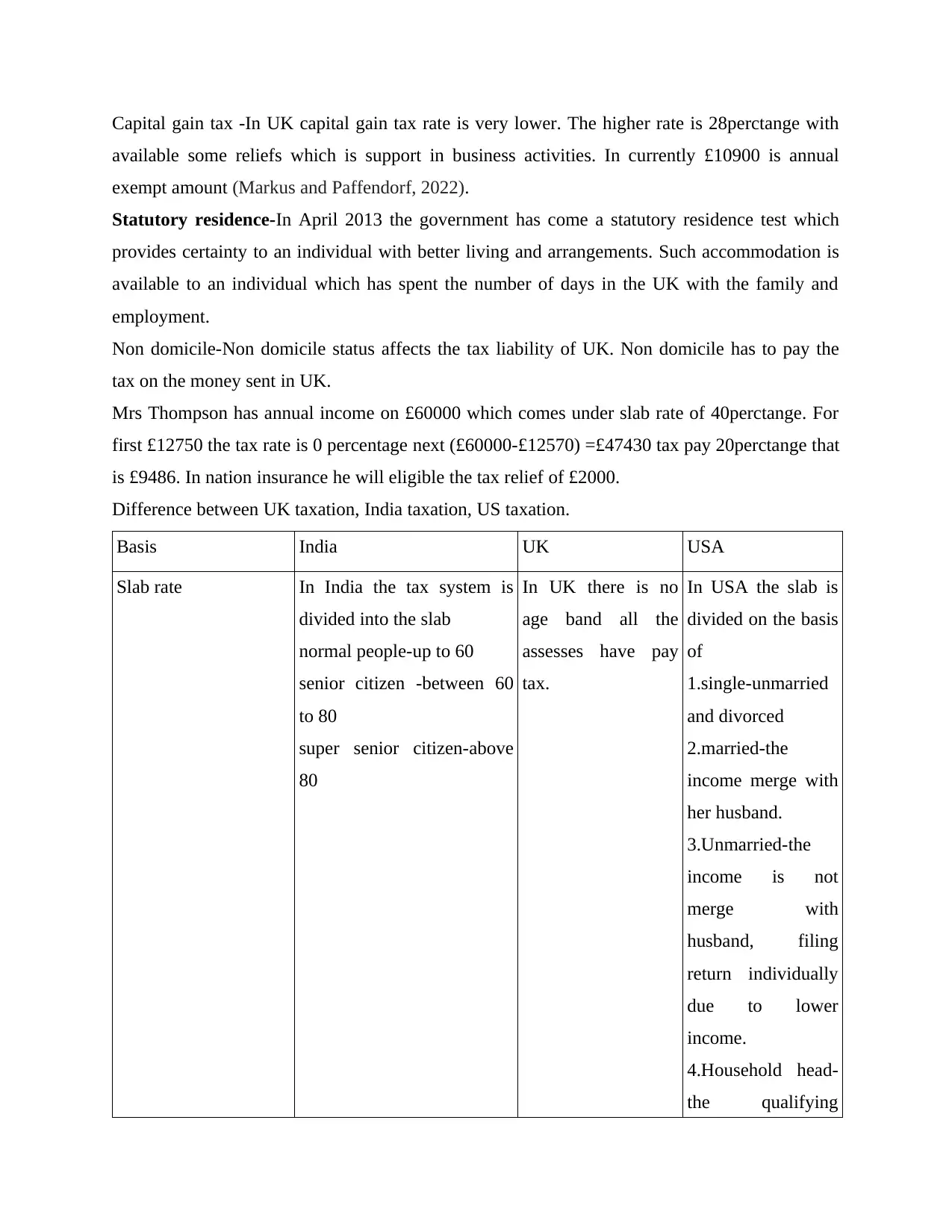
Capital gain tax -In UK capital gain tax rate is very lower. The higher rate is 28perctange with
available some reliefs which is support in business activities. In currently £10900 is annual
exempt amount (Markus and Paffendorf, 2022).
Statutory residence-In April 2013 the government has come a statutory residence test which
provides certainty to an individual with better living and arrangements. Such accommodation is
available to an individual which has spent the number of days in the UK with the family and
employment.
Non domicile-Non domicile status affects the tax liability of UK. Non domicile has to pay the
tax on the money sent in UK.
Mrs Thompson has annual income on £60000 which comes under slab rate of 40perctange. For
first £12750 the tax rate is 0 percentage next (£60000-£12570) =£47430 tax pay 20perctange that
is £9486. In nation insurance he will eligible the tax relief of £2000.
Difference between UK taxation, India taxation, US taxation.
Basis India UK USA
Slab rate In India the tax system is
divided into the slab
normal people-up to 60
senior citizen -between 60
to 80
super senior citizen-above
80
In UK there is no
age band all the
assesses have pay
tax.
In USA the slab is
divided on the basis
of
1.single-unmarried
and divorced
2.married-the
income merge with
her husband.
3.Unmarried-the
income is not
merge with
husband, filing
return individually
due to lower
income.
4.Household head-
the qualifying
available some reliefs which is support in business activities. In currently £10900 is annual
exempt amount (Markus and Paffendorf, 2022).
Statutory residence-In April 2013 the government has come a statutory residence test which
provides certainty to an individual with better living and arrangements. Such accommodation is
available to an individual which has spent the number of days in the UK with the family and
employment.
Non domicile-Non domicile status affects the tax liability of UK. Non domicile has to pay the
tax on the money sent in UK.
Mrs Thompson has annual income on £60000 which comes under slab rate of 40perctange. For
first £12750 the tax rate is 0 percentage next (£60000-£12570) =£47430 tax pay 20perctange that
is £9486. In nation insurance he will eligible the tax relief of £2000.
Difference between UK taxation, India taxation, US taxation.
Basis India UK USA
Slab rate In India the tax system is
divided into the slab
normal people-up to 60
senior citizen -between 60
to 80
super senior citizen-above
80
In UK there is no
age band all the
assesses have pay
tax.
In USA the slab is
divided on the basis
of
1.single-unmarried
and divorced
2.married-the
income merge with
her husband.
3.Unmarried-the
income is not
merge with
husband, filing
return individually
due to lower
income.
4.Household head-
the qualifying
⊘ This is a preview!⊘
Do you want full access?
Subscribe today to unlock all pages.
Trusted by 1+ million students worldwide
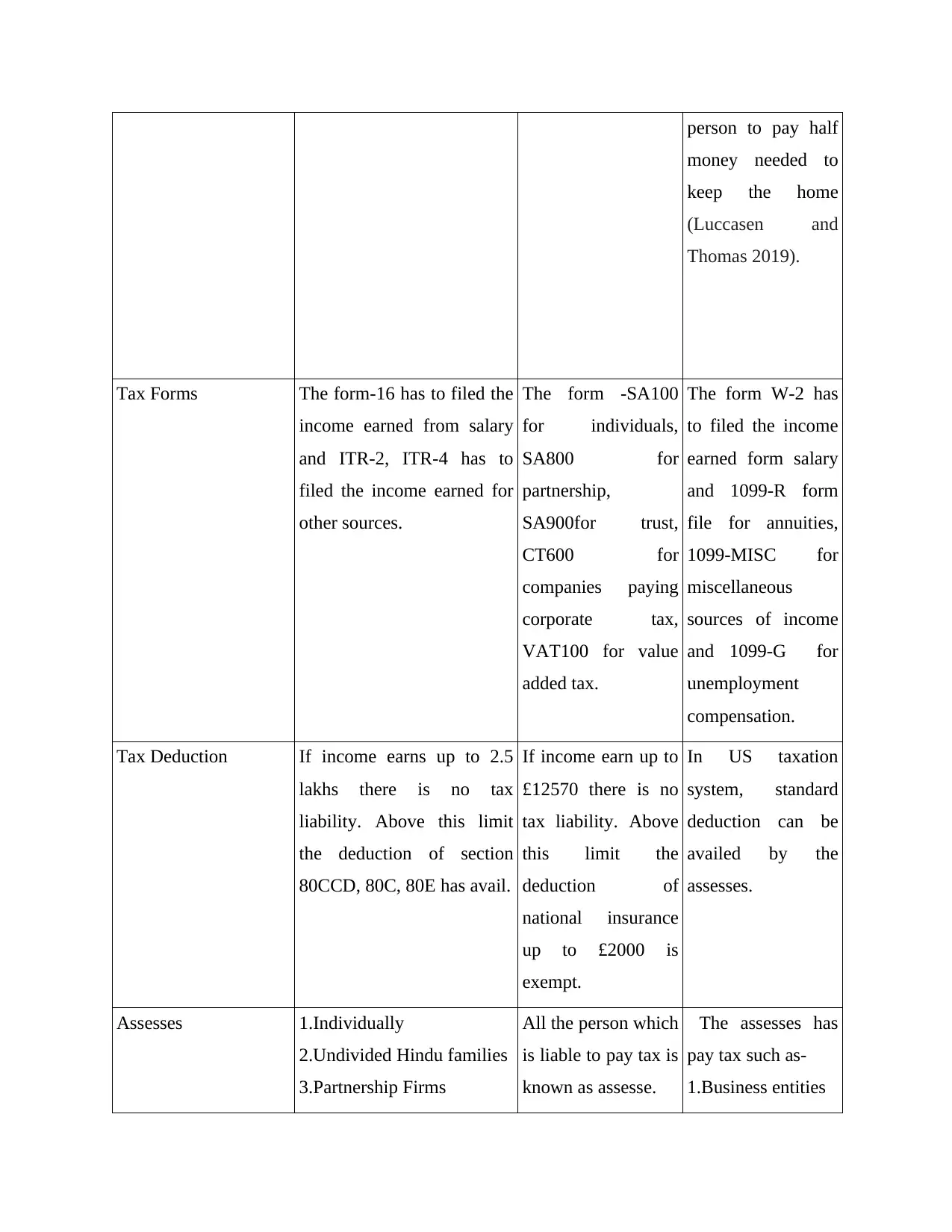
person to pay half
money needed to
keep the home
(Luccasen and
Thomas 2019).
Tax Forms The form-16 has to filed the
income earned from salary
and ITR-2, ITR-4 has to
filed the income earned for
other sources.
The form -SA100
for individuals,
SA800 for
partnership,
SA900for trust,
CT600 for
companies paying
corporate tax,
VAT100 for value
added tax.
The form W-2 has
to filed the income
earned form salary
and 1099-R form
file for annuities,
1099-MISC for
miscellaneous
sources of income
and 1099-G for
unemployment
compensation.
Tax Deduction If income earns up to 2.5
lakhs there is no tax
liability. Above this limit
the deduction of section
80CCD, 80C, 80E has avail.
If income earn up to
£12570 there is no
tax liability. Above
this limit the
deduction of
national insurance
up to £2000 is
exempt.
In US taxation
system, standard
deduction can be
availed by the
assesses.
Assesses 1.Individually
2.Undivided Hindu families
3.Partnership Firms
All the person which
is liable to pay tax is
known as assesse.
The assesses has
pay tax such as-
1.Business entities
money needed to
keep the home
(Luccasen and
Thomas 2019).
Tax Forms The form-16 has to filed the
income earned from salary
and ITR-2, ITR-4 has to
filed the income earned for
other sources.
The form -SA100
for individuals,
SA800 for
partnership,
SA900for trust,
CT600 for
companies paying
corporate tax,
VAT100 for value
added tax.
The form W-2 has
to filed the income
earned form salary
and 1099-R form
file for annuities,
1099-MISC for
miscellaneous
sources of income
and 1099-G for
unemployment
compensation.
Tax Deduction If income earns up to 2.5
lakhs there is no tax
liability. Above this limit
the deduction of section
80CCD, 80C, 80E has avail.
If income earn up to
£12570 there is no
tax liability. Above
this limit the
deduction of
national insurance
up to £2000 is
exempt.
In US taxation
system, standard
deduction can be
availed by the
assesses.
Assesses 1.Individually
2.Undivided Hindu families
3.Partnership Firms
All the person which
is liable to pay tax is
known as assesse.
The assesses has
pay tax such as-
1.Business entities
Paraphrase This Document
Need a fresh take? Get an instant paraphrase of this document with our AI Paraphraser
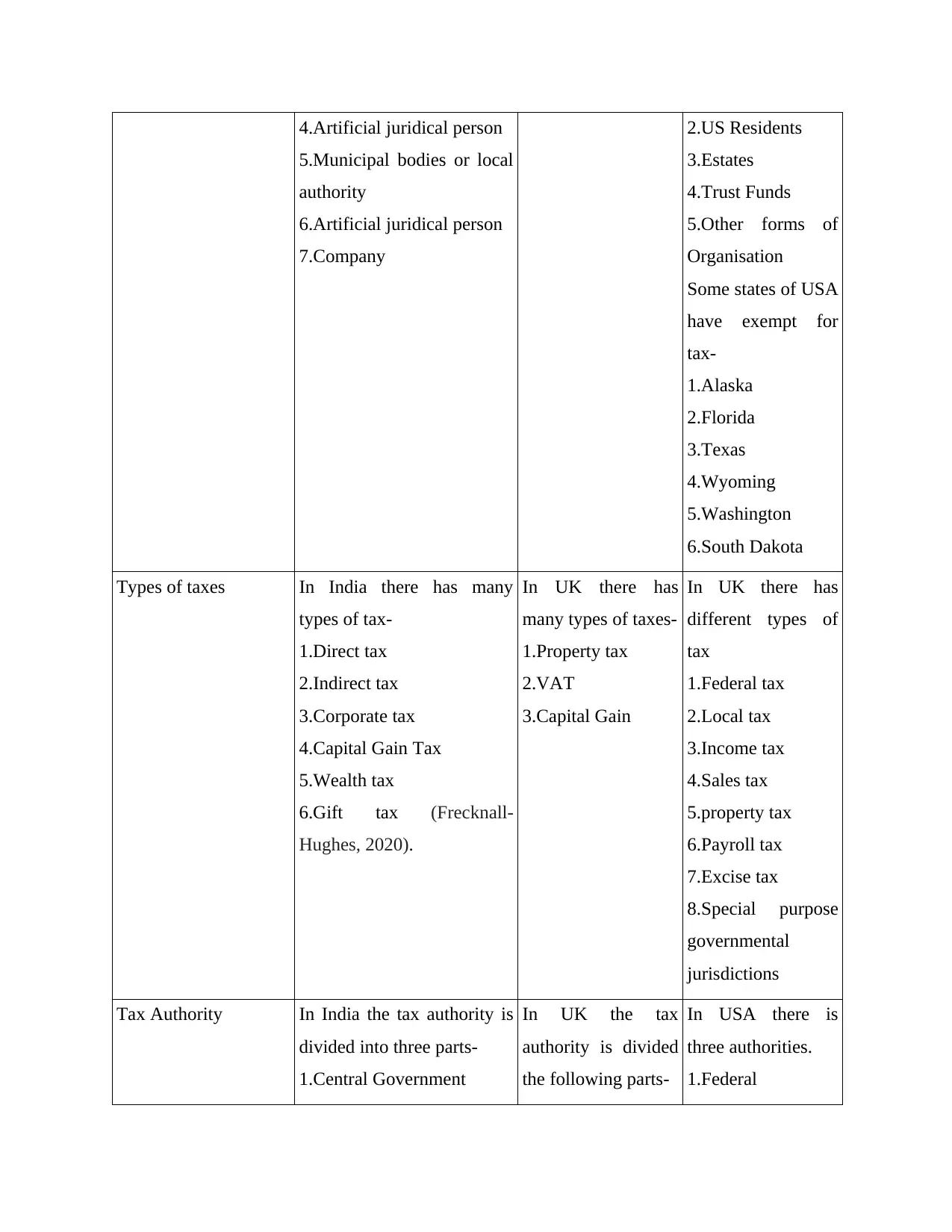
4.Artificial juridical person
5.Municipal bodies or local
authority
6.Artificial juridical person
7.Company
2.US Residents
3.Estates
4.Trust Funds
5.Other forms of
Organisation
Some states of USA
have exempt for
tax-
1.Alaska
2.Florida
3.Texas
4.Wyoming
5.Washington
6.South Dakota
Types of taxes In India there has many
types of tax-
1.Direct tax
2.Indirect tax
3.Corporate tax
4.Capital Gain Tax
5.Wealth tax
6.Gift tax (Frecknall-
Hughes, 2020).
In UK there has
many types of taxes-
1.Property tax
2.VAT
3.Capital Gain
In UK there has
different types of
tax
1.Federal tax
2.Local tax
3.Income tax
4.Sales tax
5.property tax
6.Payroll tax
7.Excise tax
8.Special purpose
governmental
jurisdictions
Tax Authority In India the tax authority is
divided into three parts-
1.Central Government
In UK the tax
authority is divided
the following parts-
In USA there is
three authorities.
1.Federal
5.Municipal bodies or local
authority
6.Artificial juridical person
7.Company
2.US Residents
3.Estates
4.Trust Funds
5.Other forms of
Organisation
Some states of USA
have exempt for
tax-
1.Alaska
2.Florida
3.Texas
4.Wyoming
5.Washington
6.South Dakota
Types of taxes In India there has many
types of tax-
1.Direct tax
2.Indirect tax
3.Corporate tax
4.Capital Gain Tax
5.Wealth tax
6.Gift tax (Frecknall-
Hughes, 2020).
In UK there has
many types of taxes-
1.Property tax
2.VAT
3.Capital Gain
In UK there has
different types of
tax
1.Federal tax
2.Local tax
3.Income tax
4.Sales tax
5.property tax
6.Payroll tax
7.Excise tax
8.Special purpose
governmental
jurisdictions
Tax Authority In India the tax authority is
divided into three parts-
1.Central Government
In UK the tax
authority is divided
the following parts-
In USA there is
three authorities.
1.Federal
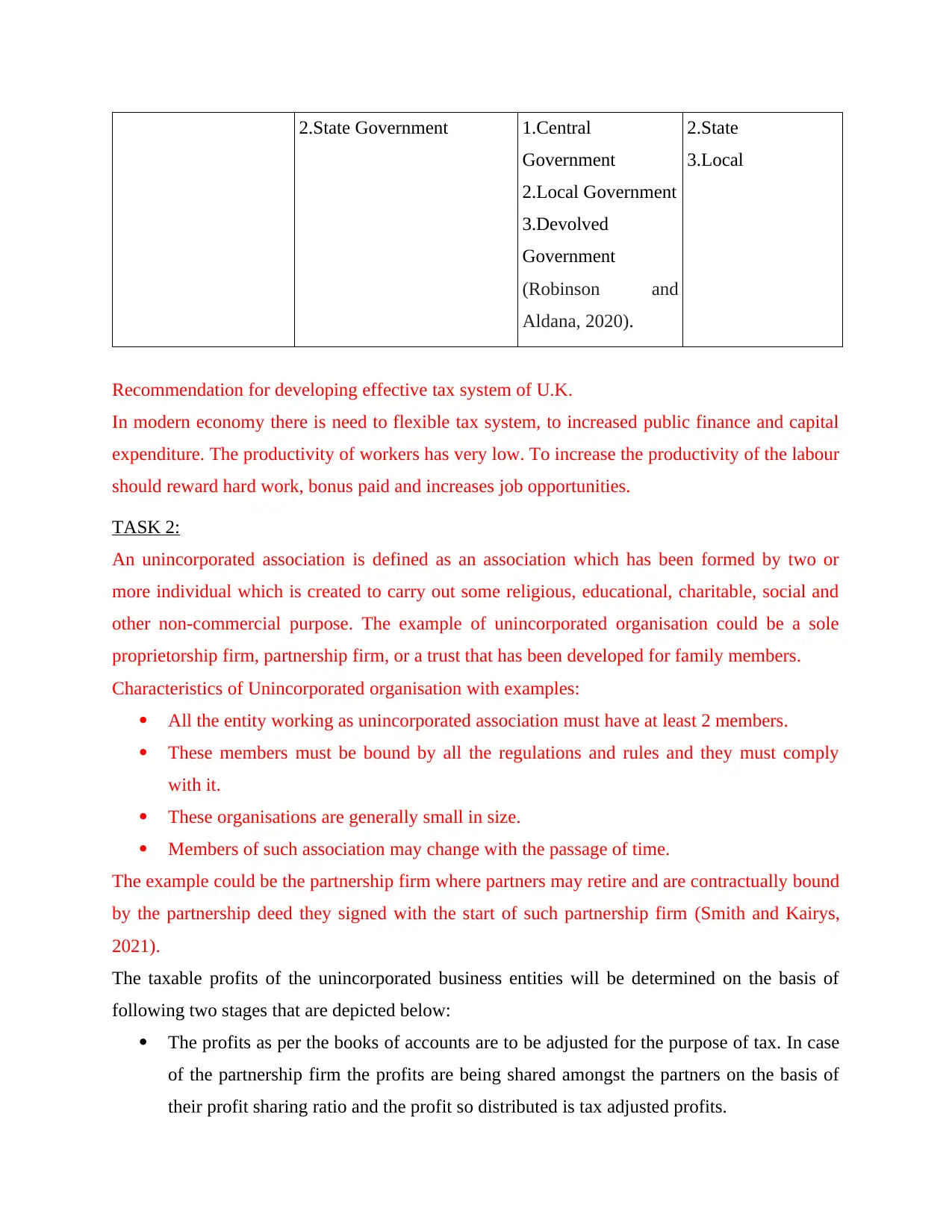
2.State Government 1.Central
Government
2.Local Government
3.Devolved
Government
(Robinson and
Aldana, 2020).
2.State
3.Local
Recommendation for developing effective tax system of U.K.
In modern economy there is need to flexible tax system, to increased public finance and capital
expenditure. The productivity of workers has very low. To increase the productivity of the labour
should reward hard work, bonus paid and increases job opportunities.
TASK 2:
An unincorporated association is defined as an association which has been formed by two or
more individual which is created to carry out some religious, educational, charitable, social and
other non-commercial purpose. The example of unincorporated organisation could be a sole
proprietorship firm, partnership firm, or a trust that has been developed for family members.
Characteristics of Unincorporated organisation with examples:
All the entity working as unincorporated association must have at least 2 members.
These members must be bound by all the regulations and rules and they must comply
with it.
These organisations are generally small in size.
Members of such association may change with the passage of time.
The example could be the partnership firm where partners may retire and are contractually bound
by the partnership deed they signed with the start of such partnership firm (Smith and Kairys,
2021).
The taxable profits of the unincorporated business entities will be determined on the basis of
following two stages that are depicted below:
The profits as per the books of accounts are to be adjusted for the purpose of tax. In case
of the partnership firm the profits are being shared amongst the partners on the basis of
their profit sharing ratio and the profit so distributed is tax adjusted profits.
Government
2.Local Government
3.Devolved
Government
(Robinson and
Aldana, 2020).
2.State
3.Local
Recommendation for developing effective tax system of U.K.
In modern economy there is need to flexible tax system, to increased public finance and capital
expenditure. The productivity of workers has very low. To increase the productivity of the labour
should reward hard work, bonus paid and increases job opportunities.
TASK 2:
An unincorporated association is defined as an association which has been formed by two or
more individual which is created to carry out some religious, educational, charitable, social and
other non-commercial purpose. The example of unincorporated organisation could be a sole
proprietorship firm, partnership firm, or a trust that has been developed for family members.
Characteristics of Unincorporated organisation with examples:
All the entity working as unincorporated association must have at least 2 members.
These members must be bound by all the regulations and rules and they must comply
with it.
These organisations are generally small in size.
Members of such association may change with the passage of time.
The example could be the partnership firm where partners may retire and are contractually bound
by the partnership deed they signed with the start of such partnership firm (Smith and Kairys,
2021).
The taxable profits of the unincorporated business entities will be determined on the basis of
following two stages that are depicted below:
The profits as per the books of accounts are to be adjusted for the purpose of tax. In case
of the partnership firm the profits are being shared amongst the partners on the basis of
their profit sharing ratio and the profit so distributed is tax adjusted profits.
⊘ This is a preview!⊘
Do you want full access?
Subscribe today to unlock all pages.
Trusted by 1+ million students worldwide
After that the assessment rules are being applied to the partner’s tax adjusted profits for
the trading period (Christensen and Seabrooke, 2020).
Advantage and disadvantage of Operating an unincorporated organisation:
Advantage could be that these firms have legal status as they are registered with the government
authority. Therefore, they are bound to the laws and regulation which are application to them.
The example could be in case of partnership firm would be that they need to follow partnership
act establish by the act of law.
Disadvantage could be that as they are being carrying out by minimum 2 members, therefore
they may be dispute arises amongst them regarding profit sharing which affects the business of
the organisation.
The taxation liabilities of unincorporated association are that they have to pay the income tax
they earned on the profits throughout the year to the government. Their individual partners have
to file the business return and shows that they have earned profits from the firm as their business
income. Their taxability will be separate from the association as they both have separate legal
status.
Personal taxation is the tax which is imposed or levied on individual from the income they
earned throughout the financial year such as from salary, other sources, rental income and so on.
The partnership firm has to pay tax on their profits which they earn during the financial year by
filling the tax return of firm. On the other hand, in case of sole traders, the return has to be
submitted by sole trader as an individual carrying out business. No return or tax has to be paid in
the name of sole trader organisation (Martin, 2019).
When a trader started the new business then they can operate that business as an unincorporated
entity. The trader has the choice for the legal status of their business depending upon the tax
implications in various business structure that is suitable for the trader to carry out the business
in a smooth manner. When the carried upon by the two persons then it is better to start the
business in the form of partnership firm as it consists of clarity amongst the ratio in which profit
and loss will be distributed. From the point of view of Tax, the decision must be taken by making
comparison with that self-employed person and the salaried employee. In case where the
business is incurring the losses in that case the issue arises towards the employment of someone
that will create employee cost for the corporation.
The calculation of tax liability of Mr Lucian is being computed in the following manner:
the trading period (Christensen and Seabrooke, 2020).
Advantage and disadvantage of Operating an unincorporated organisation:
Advantage could be that these firms have legal status as they are registered with the government
authority. Therefore, they are bound to the laws and regulation which are application to them.
The example could be in case of partnership firm would be that they need to follow partnership
act establish by the act of law.
Disadvantage could be that as they are being carrying out by minimum 2 members, therefore
they may be dispute arises amongst them regarding profit sharing which affects the business of
the organisation.
The taxation liabilities of unincorporated association are that they have to pay the income tax
they earned on the profits throughout the year to the government. Their individual partners have
to file the business return and shows that they have earned profits from the firm as their business
income. Their taxability will be separate from the association as they both have separate legal
status.
Personal taxation is the tax which is imposed or levied on individual from the income they
earned throughout the financial year such as from salary, other sources, rental income and so on.
The partnership firm has to pay tax on their profits which they earn during the financial year by
filling the tax return of firm. On the other hand, in case of sole traders, the return has to be
submitted by sole trader as an individual carrying out business. No return or tax has to be paid in
the name of sole trader organisation (Martin, 2019).
When a trader started the new business then they can operate that business as an unincorporated
entity. The trader has the choice for the legal status of their business depending upon the tax
implications in various business structure that is suitable for the trader to carry out the business
in a smooth manner. When the carried upon by the two persons then it is better to start the
business in the form of partnership firm as it consists of clarity amongst the ratio in which profit
and loss will be distributed. From the point of view of Tax, the decision must be taken by making
comparison with that self-employed person and the salaried employee. In case where the
business is incurring the losses in that case the issue arises towards the employment of someone
that will create employee cost for the corporation.
The calculation of tax liability of Mr Lucian is being computed in the following manner:
Paraphrase This Document
Need a fresh take? Get an instant paraphrase of this document with our AI Paraphraser
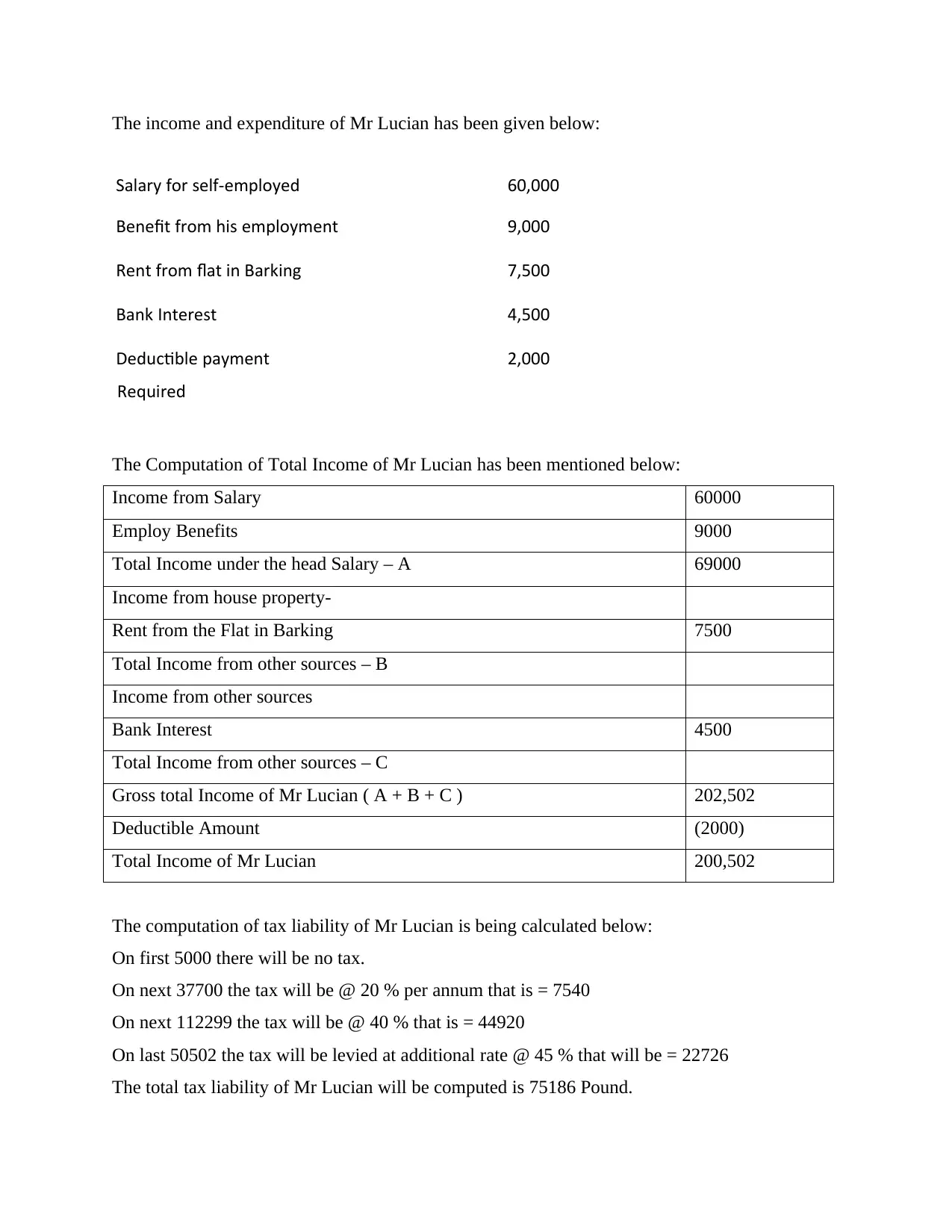
The income and expenditure of Mr Lucian has been given below:
Salary for self-employed 60,000
Benefit from his employment 9,000
Rent from flat in Barking 7,500
Bank Interest 4,500
Deductible payment
Required
2,000
The Computation of Total Income of Mr Lucian has been mentioned below:
Income from Salary 60000
Employ Benefits 9000
Total Income under the head Salary – A 69000
Income from house property-
Rent from the Flat in Barking 7500
Total Income from other sources – B
Income from other sources
Bank Interest 4500
Total Income from other sources – C
Gross total Income of Mr Lucian ( A + B + C ) 202,502
Deductible Amount (2000)
Total Income of Mr Lucian 200,502
The computation of tax liability of Mr Lucian is being calculated below:
On first 5000 there will be no tax.
On next 37700 the tax will be @ 20 % per annum that is = 7540
On next 112299 the tax will be @ 40 % that is = 44920
On last 50502 the tax will be levied at additional rate @ 45 % that will be = 22726
The total tax liability of Mr Lucian will be computed is 75186 Pound.
Salary for self-employed 60,000
Benefit from his employment 9,000
Rent from flat in Barking 7,500
Bank Interest 4,500
Deductible payment
Required
2,000
The Computation of Total Income of Mr Lucian has been mentioned below:
Income from Salary 60000
Employ Benefits 9000
Total Income under the head Salary – A 69000
Income from house property-
Rent from the Flat in Barking 7500
Total Income from other sources – B
Income from other sources
Bank Interest 4500
Total Income from other sources – C
Gross total Income of Mr Lucian ( A + B + C ) 202,502
Deductible Amount (2000)
Total Income of Mr Lucian 200,502
The computation of tax liability of Mr Lucian is being calculated below:
On first 5000 there will be no tax.
On next 37700 the tax will be @ 20 % per annum that is = 7540
On next 112299 the tax will be @ 40 % that is = 44920
On last 50502 the tax will be levied at additional rate @ 45 % that will be = 22726
The total tax liability of Mr Lucian will be computed is 75186 Pound.
On the basis of above analysis, the conclusion will be drawn that if Mr Lucian taxable income is
lower than 150000 then the additional tax he has paid @ 45% could have saved easily. For that
purpose, it is essential for him to indulge in more saving that would reduce his taxable income
below 1500000 Pound.
TASK 3:
Taxation Liabilities for both Private and Public Companies:
There is a highly dynamic corporate tax system in the UK. From the last ten years, the
UK government has taken into account the consideration of a comprehensive review of country's
corporate taxation system. Government has considered about consulting with corporates on the
direction of UK corporate taxation system. Government is focusing on the reforming of the
taxation policies regarding public and private companies to provide benefits such as detailed tax
base, lower corporate rates and emphasis on generating increased taxable profits in the country.
Tax liabilities of a public limited company and a private company are provided below: -
Public companies as well as private companies are liable to pay corporate tax at a rate of 19
percent till the year 2017 presently at 18 percent, unlike the unincorporated businesses and
national insurance who are liable to pay income tax on their income. Corporate tax is charged on
the annual returns of the limited companies (Frizell, 2021). For an example, if a company earned
a revenue of £150000 and cost incurred during the specific period is £35000 the net profit to the
company is £115000 for that year so the tax liability of the limited company for that period will
calculated at a straight rate of 19 percent and there is further deduction is available to the
company. Any salary paid to the director of public company will be taxed in the hands of that
director and income tax will charge on such salary income but any profit distributed to such
director will not be taxable in the hands of director as the tax is already paid upon such earnings
by the company.
A private limited company in the UK having a separate legal identity from its actual owners. It
means that the owners, management and governing body of the company is not personally
responsible for the company's liabilities and contracts. Private companies have a different legal
character in the UK as the owner's liabilities are limited to the extent of their contribution. The
shareholders of these companies are not legally bound to pay any liability of the private limited
companies. Green energy is a UK based private company engaged in the business of distribution
of petrol and diesel for motor vehicles. It is looking for the regular compliance with tax laws and
lower than 150000 then the additional tax he has paid @ 45% could have saved easily. For that
purpose, it is essential for him to indulge in more saving that would reduce his taxable income
below 1500000 Pound.
TASK 3:
Taxation Liabilities for both Private and Public Companies:
There is a highly dynamic corporate tax system in the UK. From the last ten years, the
UK government has taken into account the consideration of a comprehensive review of country's
corporate taxation system. Government has considered about consulting with corporates on the
direction of UK corporate taxation system. Government is focusing on the reforming of the
taxation policies regarding public and private companies to provide benefits such as detailed tax
base, lower corporate rates and emphasis on generating increased taxable profits in the country.
Tax liabilities of a public limited company and a private company are provided below: -
Public companies as well as private companies are liable to pay corporate tax at a rate of 19
percent till the year 2017 presently at 18 percent, unlike the unincorporated businesses and
national insurance who are liable to pay income tax on their income. Corporate tax is charged on
the annual returns of the limited companies (Frizell, 2021). For an example, if a company earned
a revenue of £150000 and cost incurred during the specific period is £35000 the net profit to the
company is £115000 for that year so the tax liability of the limited company for that period will
calculated at a straight rate of 19 percent and there is further deduction is available to the
company. Any salary paid to the director of public company will be taxed in the hands of that
director and income tax will charge on such salary income but any profit distributed to such
director will not be taxable in the hands of director as the tax is already paid upon such earnings
by the company.
A private limited company in the UK having a separate legal identity from its actual owners. It
means that the owners, management and governing body of the company is not personally
responsible for the company's liabilities and contracts. Private companies have a different legal
character in the UK as the owner's liabilities are limited to the extent of their contribution. The
shareholders of these companies are not legally bound to pay any liability of the private limited
companies. Green energy is a UK based private company engaged in the business of distribution
of petrol and diesel for motor vehicles. It is looking for the regular compliance with tax laws and
⊘ This is a preview!⊘
Do you want full access?
Subscribe today to unlock all pages.
Trusted by 1+ million students worldwide

1 out of 23


Related Documents


Your All-in-One AI-Powered Toolkit for Academic Success.
+13062052269
info@desklib.com
Available 24*7 on WhatsApp / Email
![[object Object]](/_next/static/media/star-bottom.7253800d.svg)
Unlock your academic potential
Copyright © 2020–2026 A2Z Services. All Rights Reserved. Developed and managed by ZUCOL.