The Role of UK Universities in Fostering Economic Growth: A Proposal
VerifiedAdded on 2020/01/23
|10
|3137
|36
Project
AI Summary
This research proposal outlines a study analyzing the role of UK universities in fostering economic growth. The study will examine the background of the UK's economy, the role of universities in developing employability skills, and their impact on unemployment. The research aims to analyze the link between education and economic growth, assess the economic impact of UK educational institutions, and determine the specific contributions of universities. The literature review covers the educational industry, factors affecting its growth, and the economic impact of educational institutions. The methodology includes an inductive research approach, interpretivism philosophy, a descriptive research design, and secondary data collection through books, journals, and online articles. Snowball sampling and thematic analysis will be used. Ethical considerations and limitations, including time and finance, are also addressed. The proposal includes a time frame using a Gantt chart to ensure timely completion of the study.

RESEARCH PROPOSAL

Paraphrase This Document
Need a fresh take? Get an instant paraphrase of this document with our AI Paraphraser
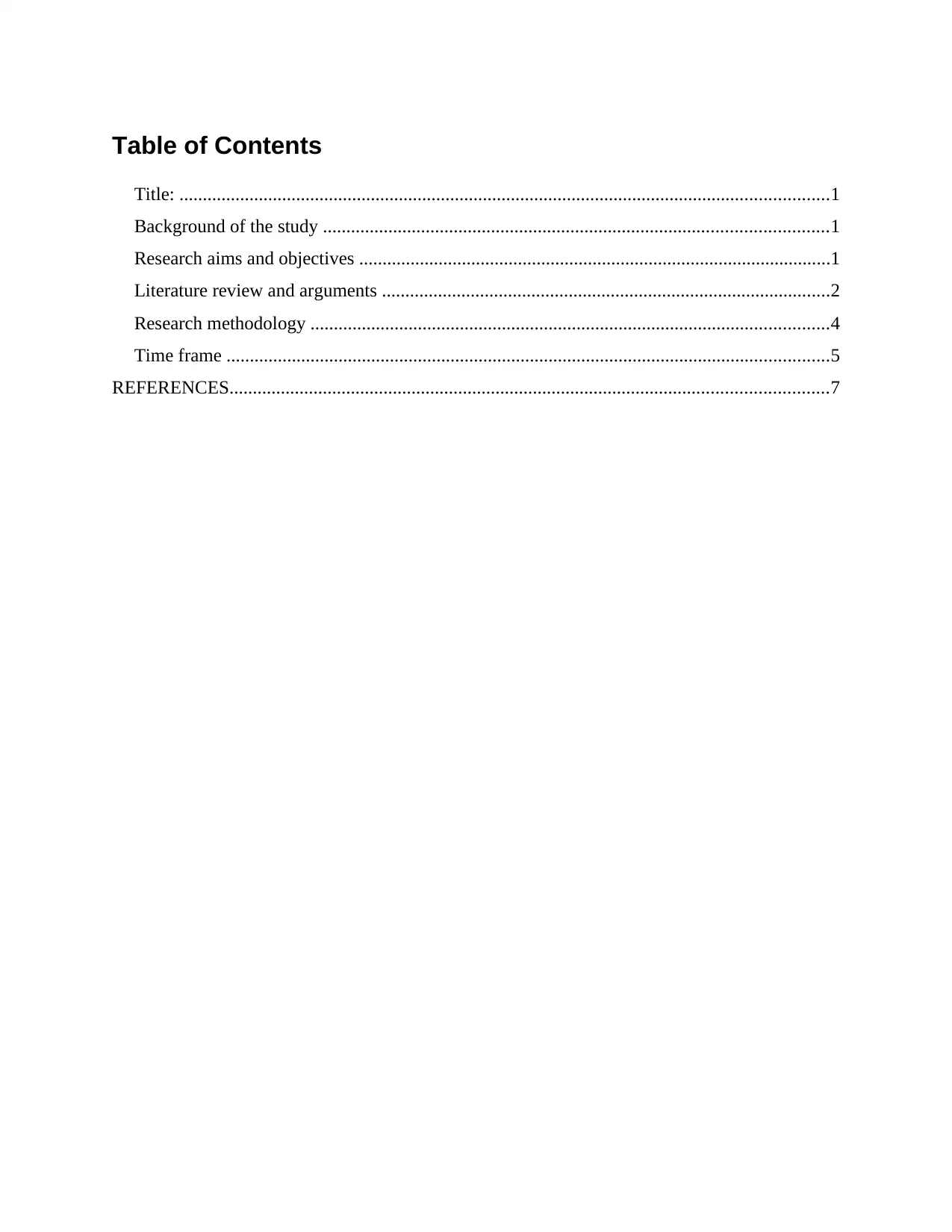
Table of Contents
Title: ...........................................................................................................................................1
Background of the study ............................................................................................................1
Research aims and objectives .....................................................................................................1
Literature review and arguments ................................................................................................2
Research methodology ...............................................................................................................4
Time frame .................................................................................................................................5
REFERENCES................................................................................................................................7
Title: ...........................................................................................................................................1
Background of the study ............................................................................................................1
Research aims and objectives .....................................................................................................1
Literature review and arguments ................................................................................................2
Research methodology ...............................................................................................................4
Time frame .................................................................................................................................5
REFERENCES................................................................................................................................7
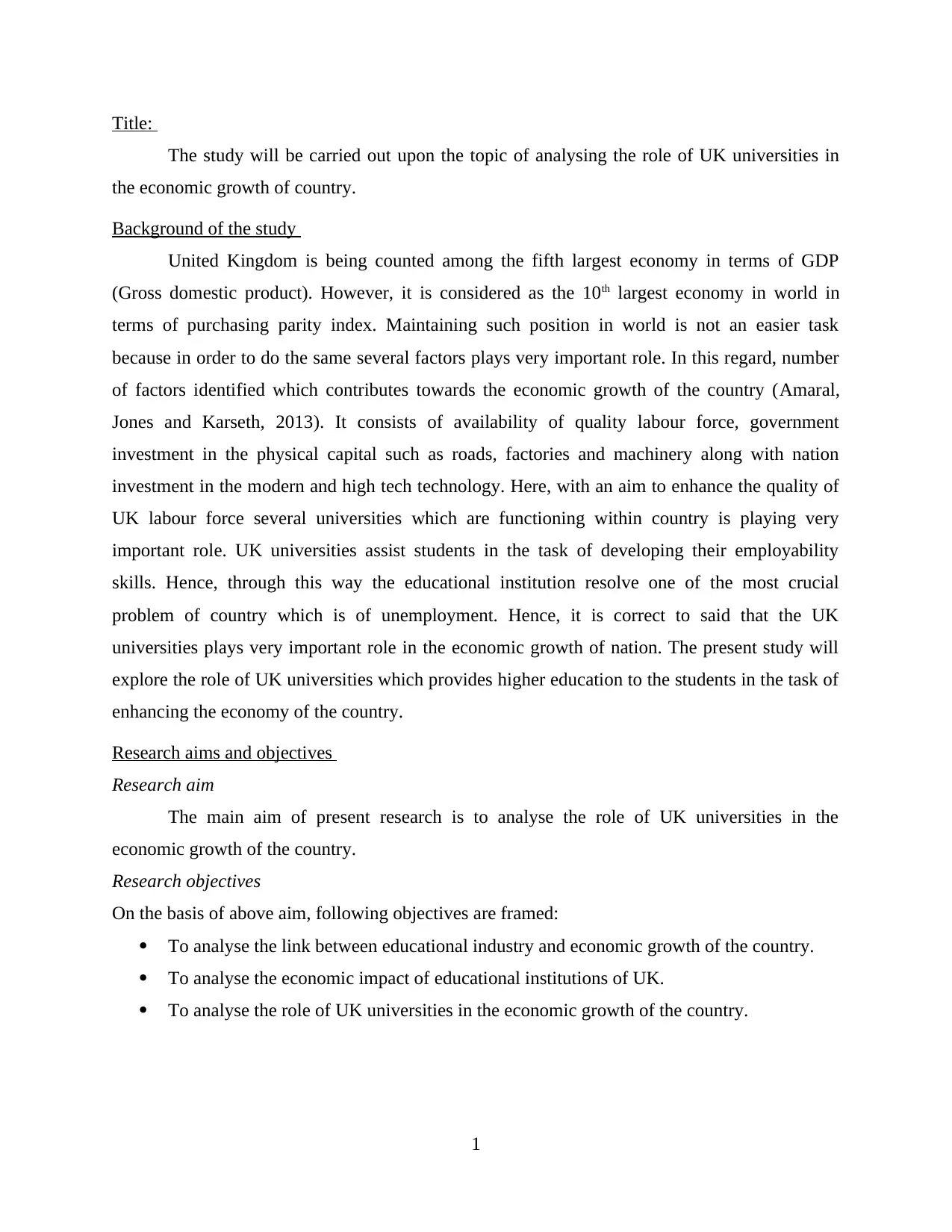
Title:
The study will be carried out upon the topic of analysing the role of UK universities in
the economic growth of country.
Background of the study
United Kingdom is being counted among the fifth largest economy in terms of GDP
(Gross domestic product). However, it is considered as the 10th largest economy in world in
terms of purchasing parity index. Maintaining such position in world is not an easier task
because in order to do the same several factors plays very important role. In this regard, number
of factors identified which contributes towards the economic growth of the country (Amaral,
Jones and Karseth, 2013). It consists of availability of quality labour force, government
investment in the physical capital such as roads, factories and machinery along with nation
investment in the modern and high tech technology. Here, with an aim to enhance the quality of
UK labour force several universities which are functioning within country is playing very
important role. UK universities assist students in the task of developing their employability
skills. Hence, through this way the educational institution resolve one of the most crucial
problem of country which is of unemployment. Hence, it is correct to said that the UK
universities plays very important role in the economic growth of nation. The present study will
explore the role of UK universities which provides higher education to the students in the task of
enhancing the economy of the country.
Research aims and objectives
Research aim
The main aim of present research is to analyse the role of UK universities in the
economic growth of the country.
Research objectives
On the basis of above aim, following objectives are framed:
To analyse the link between educational industry and economic growth of the country.
To analyse the economic impact of educational institutions of UK.
To analyse the role of UK universities in the economic growth of the country.
1
The study will be carried out upon the topic of analysing the role of UK universities in
the economic growth of country.
Background of the study
United Kingdom is being counted among the fifth largest economy in terms of GDP
(Gross domestic product). However, it is considered as the 10th largest economy in world in
terms of purchasing parity index. Maintaining such position in world is not an easier task
because in order to do the same several factors plays very important role. In this regard, number
of factors identified which contributes towards the economic growth of the country (Amaral,
Jones and Karseth, 2013). It consists of availability of quality labour force, government
investment in the physical capital such as roads, factories and machinery along with nation
investment in the modern and high tech technology. Here, with an aim to enhance the quality of
UK labour force several universities which are functioning within country is playing very
important role. UK universities assist students in the task of developing their employability
skills. Hence, through this way the educational institution resolve one of the most crucial
problem of country which is of unemployment. Hence, it is correct to said that the UK
universities plays very important role in the economic growth of nation. The present study will
explore the role of UK universities which provides higher education to the students in the task of
enhancing the economy of the country.
Research aims and objectives
Research aim
The main aim of present research is to analyse the role of UK universities in the
economic growth of the country.
Research objectives
On the basis of above aim, following objectives are framed:
To analyse the link between educational industry and economic growth of the country.
To analyse the economic impact of educational institutions of UK.
To analyse the role of UK universities in the economic growth of the country.
1
⊘ This is a preview!⊘
Do you want full access?
Subscribe today to unlock all pages.

Trusted by 1+ million students worldwide
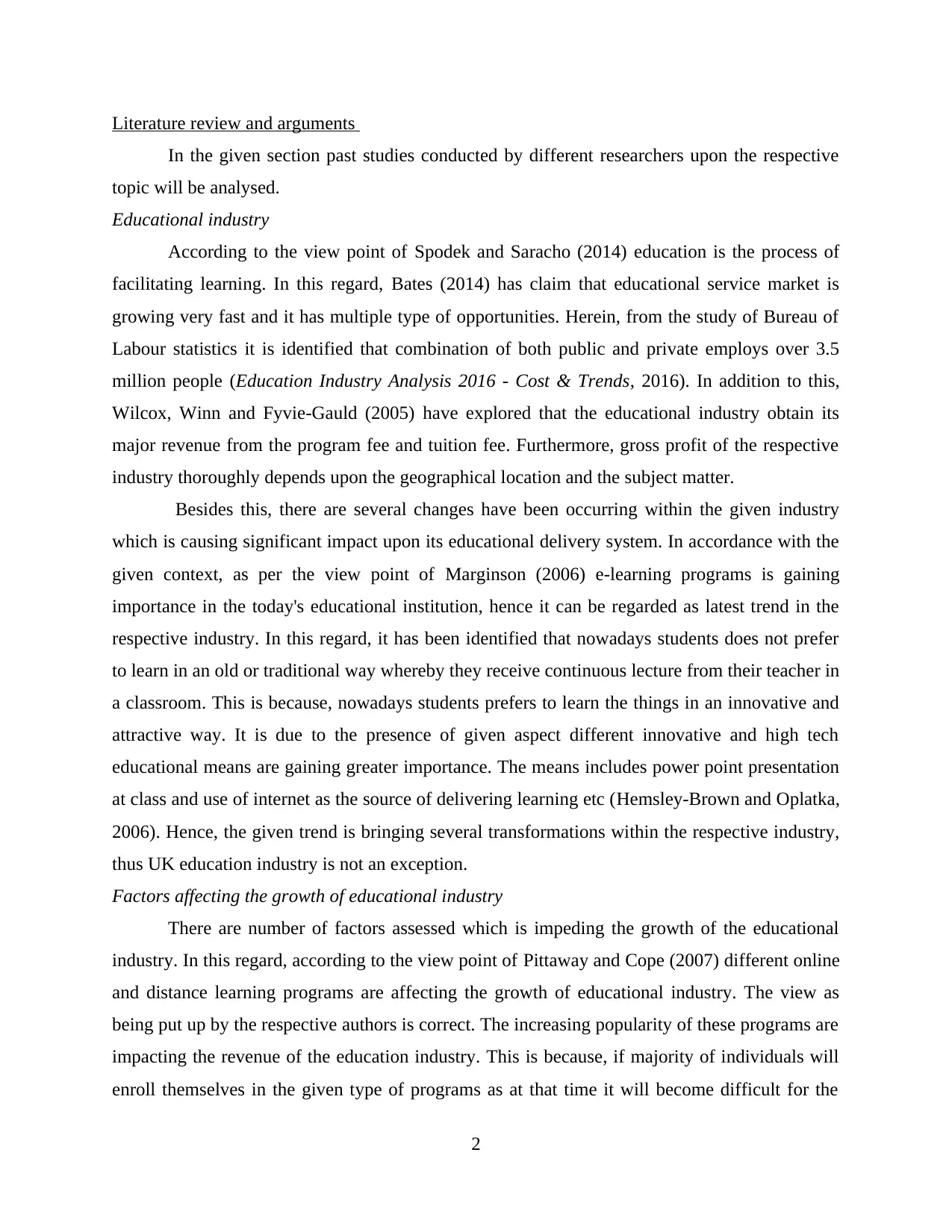
Literature review and arguments
In the given section past studies conducted by different researchers upon the respective
topic will be analysed.
Educational industry
According to the view point of Spodek and Saracho (2014) education is the process of
facilitating learning. In this regard, Bates (2014) has claim that educational service market is
growing very fast and it has multiple type of opportunities. Herein, from the study of Bureau of
Labour statistics it is identified that combination of both public and private employs over 3.5
million people (Education Industry Analysis 2016 - Cost & Trends, 2016). In addition to this,
Wilcox, Winn and Fyvie‐Gauld (2005) have explored that the educational industry obtain its
major revenue from the program fee and tuition fee. Furthermore, gross profit of the respective
industry thoroughly depends upon the geographical location and the subject matter.
Besides this, there are several changes have been occurring within the given industry
which is causing significant impact upon its educational delivery system. In accordance with the
given context, as per the view point of Marginson (2006) e-learning programs is gaining
importance in the today's educational institution, hence it can be regarded as latest trend in the
respective industry. In this regard, it has been identified that nowadays students does not prefer
to learn in an old or traditional way whereby they receive continuous lecture from their teacher in
a classroom. This is because, nowadays students prefers to learn the things in an innovative and
attractive way. It is due to the presence of given aspect different innovative and high tech
educational means are gaining greater importance. The means includes power point presentation
at class and use of internet as the source of delivering learning etc (Hemsley-Brown and Oplatka,
2006). Hence, the given trend is bringing several transformations within the respective industry,
thus UK education industry is not an exception.
Factors affecting the growth of educational industry
There are number of factors assessed which is impeding the growth of the educational
industry. In this regard, according to the view point of Pittaway and Cope (2007) different online
and distance learning programs are affecting the growth of educational industry. The view as
being put up by the respective authors is correct. The increasing popularity of these programs are
impacting the revenue of the education industry. This is because, if majority of individuals will
enroll themselves in the given type of programs as at that time it will become difficult for the
2
In the given section past studies conducted by different researchers upon the respective
topic will be analysed.
Educational industry
According to the view point of Spodek and Saracho (2014) education is the process of
facilitating learning. In this regard, Bates (2014) has claim that educational service market is
growing very fast and it has multiple type of opportunities. Herein, from the study of Bureau of
Labour statistics it is identified that combination of both public and private employs over 3.5
million people (Education Industry Analysis 2016 - Cost & Trends, 2016). In addition to this,
Wilcox, Winn and Fyvie‐Gauld (2005) have explored that the educational industry obtain its
major revenue from the program fee and tuition fee. Furthermore, gross profit of the respective
industry thoroughly depends upon the geographical location and the subject matter.
Besides this, there are several changes have been occurring within the given industry
which is causing significant impact upon its educational delivery system. In accordance with the
given context, as per the view point of Marginson (2006) e-learning programs is gaining
importance in the today's educational institution, hence it can be regarded as latest trend in the
respective industry. In this regard, it has been identified that nowadays students does not prefer
to learn in an old or traditional way whereby they receive continuous lecture from their teacher in
a classroom. This is because, nowadays students prefers to learn the things in an innovative and
attractive way. It is due to the presence of given aspect different innovative and high tech
educational means are gaining greater importance. The means includes power point presentation
at class and use of internet as the source of delivering learning etc (Hemsley-Brown and Oplatka,
2006). Hence, the given trend is bringing several transformations within the respective industry,
thus UK education industry is not an exception.
Factors affecting the growth of educational industry
There are number of factors assessed which is impeding the growth of the educational
industry. In this regard, according to the view point of Pittaway and Cope (2007) different online
and distance learning programs are affecting the growth of educational industry. The view as
being put up by the respective authors is correct. The increasing popularity of these programs are
impacting the revenue of the education industry. This is because, if majority of individuals will
enroll themselves in the given type of programs as at that time it will become difficult for the
2
Paraphrase This Document
Need a fresh take? Get an instant paraphrase of this document with our AI Paraphraser
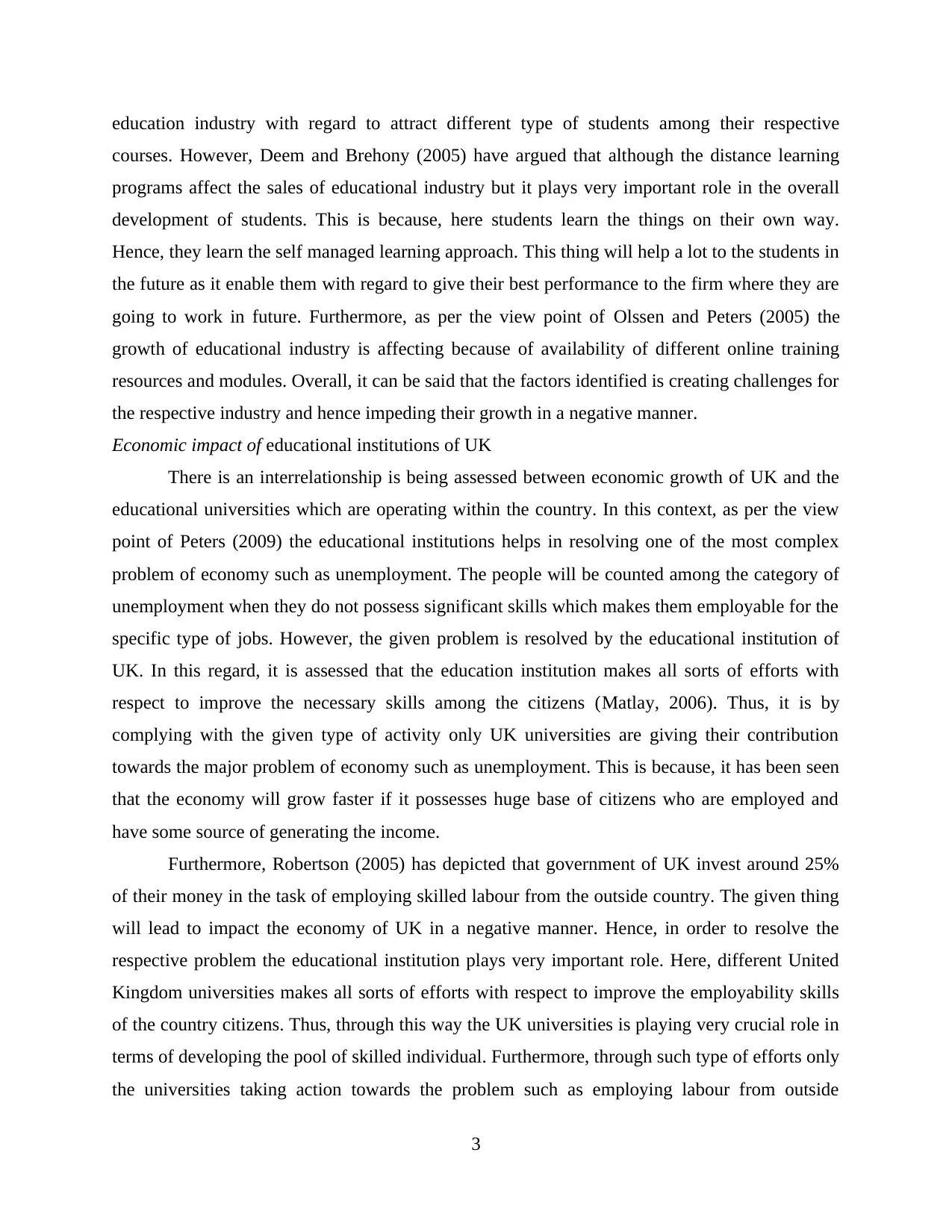
education industry with regard to attract different type of students among their respective
courses. However, Deem and Brehony (2005) have argued that although the distance learning
programs affect the sales of educational industry but it plays very important role in the overall
development of students. This is because, here students learn the things on their own way.
Hence, they learn the self managed learning approach. This thing will help a lot to the students in
the future as it enable them with regard to give their best performance to the firm where they are
going to work in future. Furthermore, as per the view point of Olssen and Peters (2005) the
growth of educational industry is affecting because of availability of different online training
resources and modules. Overall, it can be said that the factors identified is creating challenges for
the respective industry and hence impeding their growth in a negative manner.
Economic impact of educational institutions of UK
There is an interrelationship is being assessed between economic growth of UK and the
educational universities which are operating within the country. In this context, as per the view
point of Peters (2009) the educational institutions helps in resolving one of the most complex
problem of economy such as unemployment. The people will be counted among the category of
unemployment when they do not possess significant skills which makes them employable for the
specific type of jobs. However, the given problem is resolved by the educational institution of
UK. In this regard, it is assessed that the education institution makes all sorts of efforts with
respect to improve the necessary skills among the citizens (Matlay, 2006). Thus, it is by
complying with the given type of activity only UK universities are giving their contribution
towards the major problem of economy such as unemployment. This is because, it has been seen
that the economy will grow faster if it possesses huge base of citizens who are employed and
have some source of generating the income.
Furthermore, Robertson (2005) has depicted that government of UK invest around 25%
of their money in the task of employing skilled labour from the outside country. The given thing
will lead to impact the economy of UK in a negative manner. Hence, in order to resolve the
respective problem the educational institution plays very important role. Here, different United
Kingdom universities makes all sorts of efforts with respect to improve the employability skills
of the country citizens. Thus, through this way the UK universities is playing very crucial role in
terms of developing the pool of skilled individual. Furthermore, through such type of efforts only
the universities taking action towards the problem such as employing labour from outside
3
courses. However, Deem and Brehony (2005) have argued that although the distance learning
programs affect the sales of educational industry but it plays very important role in the overall
development of students. This is because, here students learn the things on their own way.
Hence, they learn the self managed learning approach. This thing will help a lot to the students in
the future as it enable them with regard to give their best performance to the firm where they are
going to work in future. Furthermore, as per the view point of Olssen and Peters (2005) the
growth of educational industry is affecting because of availability of different online training
resources and modules. Overall, it can be said that the factors identified is creating challenges for
the respective industry and hence impeding their growth in a negative manner.
Economic impact of educational institutions of UK
There is an interrelationship is being assessed between economic growth of UK and the
educational universities which are operating within the country. In this context, as per the view
point of Peters (2009) the educational institutions helps in resolving one of the most complex
problem of economy such as unemployment. The people will be counted among the category of
unemployment when they do not possess significant skills which makes them employable for the
specific type of jobs. However, the given problem is resolved by the educational institution of
UK. In this regard, it is assessed that the education institution makes all sorts of efforts with
respect to improve the necessary skills among the citizens (Matlay, 2006). Thus, it is by
complying with the given type of activity only UK universities are giving their contribution
towards the major problem of economy such as unemployment. This is because, it has been seen
that the economy will grow faster if it possesses huge base of citizens who are employed and
have some source of generating the income.
Furthermore, Robertson (2005) has depicted that government of UK invest around 25%
of their money in the task of employing skilled labour from the outside country. The given thing
will lead to impact the economy of UK in a negative manner. Hence, in order to resolve the
respective problem the educational institution plays very important role. Here, different United
Kingdom universities makes all sorts of efforts with respect to improve the employability skills
of the country citizens. Thus, through this way the UK universities is playing very crucial role in
terms of developing the pool of skilled individual. Furthermore, through such type of efforts only
the universities taking action towards the problem such as employing labour from outside
3
country. Thus, the economy of UK is impacting in a positive way. Overall, it can be depicted that
educational institution have very important role in the economic growth of any country (Raduntz,
2005). This is because, with the help of different educational institutions only significant
improvement in the condition of country's labour market will be carried out. Hence, through this
way economy will get achieve the positive benefits.
Research methodology
With an aim to carry out the study upon the selected topic, assistance will be taken from
different type of research tools and techniques. In this regard, the detailed explanation regarding
the selected research tools is depicted in below: Research approach: It basically depicts about the ways of conducting the study upon the
specific topic. The approach is of two type such as inductive and deductive etc. The
selection with regard to the respective approaches thoroughly depends upon the
formation of hypothesis by the scholar. For example, researcher will make use of
inductive approach when it does not formulate the hypothesis for its study. In the similar
way, deductive approach will be applied when scholar tend to formulate the hypothesis.
Here, in the present study inductive approach will be applied because it does not include
any hypothesis (Weischedel, Matear and Deans, 2005). Research philosophy: The research philosophy assist the scholar in the task of assembling
the data for the selected topic under study. In addition to this, an effective research
philosophy also help researchers with regard to improve their knowledge and
understanding regarding the specific topic. Hence, it guides scholars towards the right
path and assist them in terms of drawing an appropriate conclusion for the study. The
philosophy is of two type such as interpretivism and positivism. However, for the present
study interpretivism research philosophy will be used. It is used because with the help of
it opinions as being given by different scholar upon the selected subject will be analysed
in an effectual way. Research design: Research design is the overall strategy which scholar uses for the
purpose to integrate the varied components of study in a logical and coherent way
(Research design, 2016). Hence, the research design plays very important role in the task
of attaining the aims and objectives of the study. The research design is of three types
such as exploratory, descriptive and explanatory etc. However, for the present study
4
educational institution have very important role in the economic growth of any country (Raduntz,
2005). This is because, with the help of different educational institutions only significant
improvement in the condition of country's labour market will be carried out. Hence, through this
way economy will get achieve the positive benefits.
Research methodology
With an aim to carry out the study upon the selected topic, assistance will be taken from
different type of research tools and techniques. In this regard, the detailed explanation regarding
the selected research tools is depicted in below: Research approach: It basically depicts about the ways of conducting the study upon the
specific topic. The approach is of two type such as inductive and deductive etc. The
selection with regard to the respective approaches thoroughly depends upon the
formation of hypothesis by the scholar. For example, researcher will make use of
inductive approach when it does not formulate the hypothesis for its study. In the similar
way, deductive approach will be applied when scholar tend to formulate the hypothesis.
Here, in the present study inductive approach will be applied because it does not include
any hypothesis (Weischedel, Matear and Deans, 2005). Research philosophy: The research philosophy assist the scholar in the task of assembling
the data for the selected topic under study. In addition to this, an effective research
philosophy also help researchers with regard to improve their knowledge and
understanding regarding the specific topic. Hence, it guides scholars towards the right
path and assist them in terms of drawing an appropriate conclusion for the study. The
philosophy is of two type such as interpretivism and positivism. However, for the present
study interpretivism research philosophy will be used. It is used because with the help of
it opinions as being given by different scholar upon the selected subject will be analysed
in an effectual way. Research design: Research design is the overall strategy which scholar uses for the
purpose to integrate the varied components of study in a logical and coherent way
(Research design, 2016). Hence, the research design plays very important role in the task
of attaining the aims and objectives of the study. The research design is of three types
such as exploratory, descriptive and explanatory etc. However, for the present study
4
⊘ This is a preview!⊘
Do you want full access?
Subscribe today to unlock all pages.
Trusted by 1+ million students worldwide
which is based on the topic of analysing the role of UK universities in the economic
growth of the country descriptive research design will be used. With the help of given
methods, detailed analysis upon the selected topic will be carried out. Hence, as a result
of it framed aims and objectives will be met by the scholar in an effectual way. Data collection:It is important for the scholar that it should source the data from the right
sources. This is because, selection of wrong source of data will hamper the overall results
of the study (Stanley, 2013). Here, for the respective study which is on analysing the role
of UK universities in the economic growth of the country, data will be assembled through
the secondary sources. For this purpose, the means such as books, journals and online
articles will be used. Sampling: In the present study, snow ball sampling technique will be used wherein a
chain will be formulated with an aim to get the answer from different respondents with
respect to the given study. With the help of given method, the problems associated with
the respective research will be resolved by the researcher in an effectual way. Data analysis: It is very important for the researcher that it should make the proper
analysis of its collected data. If it is not done then in this situation it will become very
difficult for the scholar with respect to the get the answer of the framed research
questions (Gautam and Luitel, 2013). The data collected for the present study will be
analysed with the help of thematic technique wherein varied themes will be formed on
the basis of aims and objectives of the research. Ethical consideration: Number of ethical aspects will be considered while conducting the
research upon the respective study. In this context, here researcher will ensure that it will
collect all the latest information with regard to the given study. For this purpose, data
prior to the year 2005 will be collected.
Research limitation: Time and finance will be regarded as the two major limitations
which are related with the respective study (Denzin and Lincoln, 2011).
Time frame
With an aim to complete the study within given specified time limit, assistance will be
taken from the approach such as Gantt chart (Bryman, 2012). In this regard, timeline with respect
to the present study is prepared which is depicted in below:
Task / 1 Week 2 Week 3 Week 4 Week 5 week
5
growth of the country descriptive research design will be used. With the help of given
methods, detailed analysis upon the selected topic will be carried out. Hence, as a result
of it framed aims and objectives will be met by the scholar in an effectual way. Data collection:It is important for the scholar that it should source the data from the right
sources. This is because, selection of wrong source of data will hamper the overall results
of the study (Stanley, 2013). Here, for the respective study which is on analysing the role
of UK universities in the economic growth of the country, data will be assembled through
the secondary sources. For this purpose, the means such as books, journals and online
articles will be used. Sampling: In the present study, snow ball sampling technique will be used wherein a
chain will be formulated with an aim to get the answer from different respondents with
respect to the given study. With the help of given method, the problems associated with
the respective research will be resolved by the researcher in an effectual way. Data analysis: It is very important for the researcher that it should make the proper
analysis of its collected data. If it is not done then in this situation it will become very
difficult for the scholar with respect to the get the answer of the framed research
questions (Gautam and Luitel, 2013). The data collected for the present study will be
analysed with the help of thematic technique wherein varied themes will be formed on
the basis of aims and objectives of the research. Ethical consideration: Number of ethical aspects will be considered while conducting the
research upon the respective study. In this context, here researcher will ensure that it will
collect all the latest information with regard to the given study. For this purpose, data
prior to the year 2005 will be collected.
Research limitation: Time and finance will be regarded as the two major limitations
which are related with the respective study (Denzin and Lincoln, 2011).
Time frame
With an aim to complete the study within given specified time limit, assistance will be
taken from the approach such as Gantt chart (Bryman, 2012). In this regard, timeline with respect
to the present study is prepared which is depicted in below:
Task / 1 Week 2 Week 3 Week 4 Week 5 week
5
Paraphrase This Document
Need a fresh take? Get an instant paraphrase of this document with our AI Paraphraser
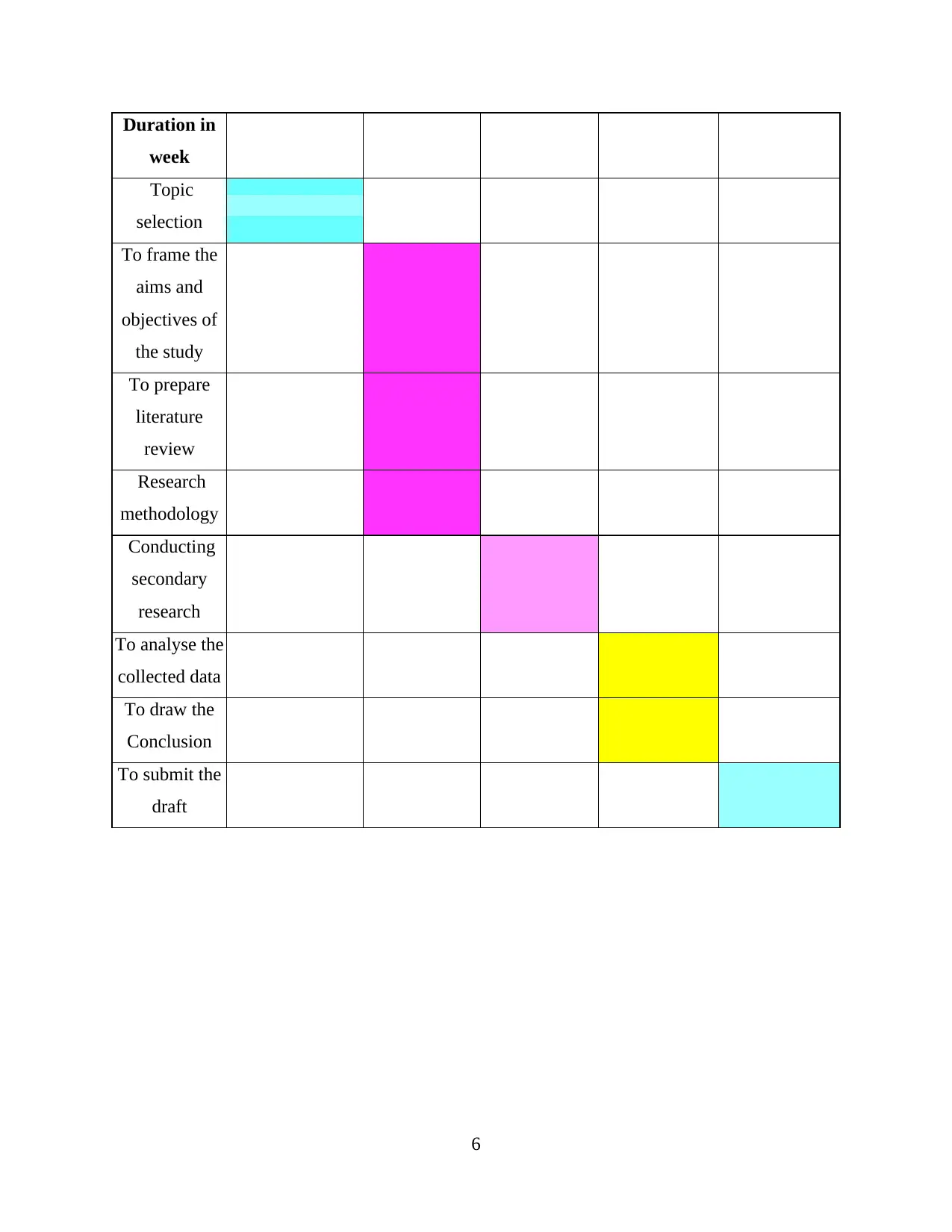
Duration in
week
Topic
selection
To frame the
aims and
objectives of
the study
To prepare
literature
review
Research
methodology
Conducting
secondary
research
To analyse the
collected data
To draw the
Conclusion
To submit the
draft
6
week
Topic
selection
To frame the
aims and
objectives of
the study
To prepare
literature
review
Research
methodology
Conducting
secondary
research
To analyse the
collected data
To draw the
Conclusion
To submit the
draft
6
REFERENCES
Books, online and journals
Weischedel, B., Matear, S., Deans, R. K., 2005. A qualitative approach to investigating online
strategic decision making. Qualitative Market Research: An International Journal. 8(1). pp.
61–76.
Stanley, L., 2013. Feminist praxis (RLE feminist theory): Research, theory and epistemology in
feminist sociology. Routledge.
Gautam, S. and Luitel, B. C., 2013. A Third Space Research Methodology Through the
Metaphor of Mokshya. Journal of Education and Research. 3(2). pp. 96-116.
Denzin, N. K. and Lincoln, Y. S., 2011. The SAGE handbook of qualitative research. Sage.
Bryman, A., 2012. Social research methods. Oxford university press.Carson, D., 2014. Design
Research Methodology: Introducing Evidence BASED Design. Journal of Education and
Research. 14(1). pp. 1-10.
Amaral, A., Jones, G. A. and Karseth, B., 2013. Governing higher education: National
perspectives on institutional governance (Vol. 2). Springer Science & Business Media.
Spodek, B. and Saracho, O. N., 2014. Handbook of research on the education of young children.
Routledge.
Bates, T., 2014. The Role of Technology in Distance Education (Routledge Revivals). Routledge.
Blaug, M., 2014. Economics of education: A selected annotated bibliography. Elsevier.
Wilcox, P., Winn, S. and Fyvie‐Gauld, M., 2005. ‘It was nothing to do with the university, it was
just the people’: the role of social support in the first‐year experience of higher
education. Studies in higher education. 30(6). pp. 707-722.
Marginson, S., 2006. Dynamics of national and global competition in higher education. Higher
education. 52(1). pp. 1-39.
Hemsley-Brown, J. and Oplatka, I., 2006. Universities in a competitive global marketplace: A
systematic review of the literature on higher education marketing. International Journal of
Public Sector Management. 19(4). pp. 316-338.
Pittaway, L. and Cope, J., 2007. Entrepreneurship education a systematic review of the
evidence. International Small Business Journal. 25(5). pp.479-510.
7
Books, online and journals
Weischedel, B., Matear, S., Deans, R. K., 2005. A qualitative approach to investigating online
strategic decision making. Qualitative Market Research: An International Journal. 8(1). pp.
61–76.
Stanley, L., 2013. Feminist praxis (RLE feminist theory): Research, theory and epistemology in
feminist sociology. Routledge.
Gautam, S. and Luitel, B. C., 2013. A Third Space Research Methodology Through the
Metaphor of Mokshya. Journal of Education and Research. 3(2). pp. 96-116.
Denzin, N. K. and Lincoln, Y. S., 2011. The SAGE handbook of qualitative research. Sage.
Bryman, A., 2012. Social research methods. Oxford university press.Carson, D., 2014. Design
Research Methodology: Introducing Evidence BASED Design. Journal of Education and
Research. 14(1). pp. 1-10.
Amaral, A., Jones, G. A. and Karseth, B., 2013. Governing higher education: National
perspectives on institutional governance (Vol. 2). Springer Science & Business Media.
Spodek, B. and Saracho, O. N., 2014. Handbook of research on the education of young children.
Routledge.
Bates, T., 2014. The Role of Technology in Distance Education (Routledge Revivals). Routledge.
Blaug, M., 2014. Economics of education: A selected annotated bibliography. Elsevier.
Wilcox, P., Winn, S. and Fyvie‐Gauld, M., 2005. ‘It was nothing to do with the university, it was
just the people’: the role of social support in the first‐year experience of higher
education. Studies in higher education. 30(6). pp. 707-722.
Marginson, S., 2006. Dynamics of national and global competition in higher education. Higher
education. 52(1). pp. 1-39.
Hemsley-Brown, J. and Oplatka, I., 2006. Universities in a competitive global marketplace: A
systematic review of the literature on higher education marketing. International Journal of
Public Sector Management. 19(4). pp. 316-338.
Pittaway, L. and Cope, J., 2007. Entrepreneurship education a systematic review of the
evidence. International Small Business Journal. 25(5). pp.479-510.
7
⊘ This is a preview!⊘
Do you want full access?
Subscribe today to unlock all pages.
Trusted by 1+ million students worldwide
Deem*, R. and Brehony, K. J., 2005. Management as ideology: The case of ‘new
managerialism’in higher education. Oxford review of education. 31(2). pp. 217-235.
Olssen*, M. and Peters, M. A., 2005. Neoliberalism, higher education and the knowledge
economy: From the free market to knowledge capitalism. Journal of education policy. 20(3).
pp. 313-345.
Peters, M., 2009. National education policy constructions of the ‘ knowledge economy’:
towards a critique. The Journal of Educational Enquiry. 2(1).
Matlay, H., 2006. Researching entrepreneurship and education: Part 2: what is entrepreneurship
education and does it matter?. Education+ Training. 48(8/9). pp.704-718.
Robertson*, S. L., 2005. Re‐imagining and rescripting the future of education: Global
knowledge economy discourses and the challenge to education systems. Comparative
education. 41(2). pp. 151-170.
Raduntz, H., 2005. Chapter 13: The Marketization of Education within the Global Capitalist
Economy. Counterpoints. 280. pp. 231-245.
Education Industry Analysis 2016 - Cost & Trends. 2016. [Online]. Availabile through:
<https://www.franchisehelp.com/industry-reports/educational-franchise-industry-report/>.
[Accessed on 25th March 2016].
Resercah design. 2016. [Online]. Availabile through:
<https://www.nyu.edu/classes/bkg/methods/005847ch1.pdf>. [Accessed on 25th March 2016].
8
managerialism’in higher education. Oxford review of education. 31(2). pp. 217-235.
Olssen*, M. and Peters, M. A., 2005. Neoliberalism, higher education and the knowledge
economy: From the free market to knowledge capitalism. Journal of education policy. 20(3).
pp. 313-345.
Peters, M., 2009. National education policy constructions of the ‘ knowledge economy’:
towards a critique. The Journal of Educational Enquiry. 2(1).
Matlay, H., 2006. Researching entrepreneurship and education: Part 2: what is entrepreneurship
education and does it matter?. Education+ Training. 48(8/9). pp.704-718.
Robertson*, S. L., 2005. Re‐imagining and rescripting the future of education: Global
knowledge economy discourses and the challenge to education systems. Comparative
education. 41(2). pp. 151-170.
Raduntz, H., 2005. Chapter 13: The Marketization of Education within the Global Capitalist
Economy. Counterpoints. 280. pp. 231-245.
Education Industry Analysis 2016 - Cost & Trends. 2016. [Online]. Availabile through:
<https://www.franchisehelp.com/industry-reports/educational-franchise-industry-report/>.
[Accessed on 25th March 2016].
Resercah design. 2016. [Online]. Availabile through:
<https://www.nyu.edu/classes/bkg/methods/005847ch1.pdf>. [Accessed on 25th March 2016].
8

1 out of 10


Related Documents


Your All-in-One AI-Powered Toolkit for Academic Success.
+13062052269
info@desklib.com
Available 24*7 on WhatsApp / Email
![[object Object]](/_next/static/media/star-bottom.7253800d.svg)
Unlock your academic potential
Copyright © 2020–2026 A2Z Services. All Rights Reserved. Developed and managed by ZUCOL.