Practical and Research Project: Ulysses Club Membership Challenges
VerifiedAdded on 2020/03/01
|13
|3340
|38
Project
AI Summary
This research project examines the declining membership of the Ulysses Club, a motorcycle club for riders over 40, primarily in Australia and New Zealand. The project investigates the reasons behind the decline, including the aging membership, the cessation of the club newsletter, and the removal of non-rider memberships. It explores research questions focused on the challenges faced by bike riding clubs, potential solutions to minimize issues, and recommendations for attracting new members. The literature review highlights demographic factors, the impact of technology, and the role of social media. The research design involves both primary and secondary data collection, including interviews and questionnaires with club members, along with analysis of club websites and related articles. The project aims to provide insights and strategies for the Ulysses Club to address its membership challenges and ensure its future.
Running head: PRACTICAL & RESEARCH PROJECT
Practical and Research Project
Ulysses Club
Name of Student:
Student ID:
Name of University:
Author’s Note
Practical and Research Project
Ulysses Club
Name of Student:
Student ID:
Name of University:
Author’s Note

Paraphrase This Document
Need a fresh take? Get an instant paraphrase of this document with our AI Paraphraser
1
PRACTICAL & RESEARCH PROJECT
Table of Contents
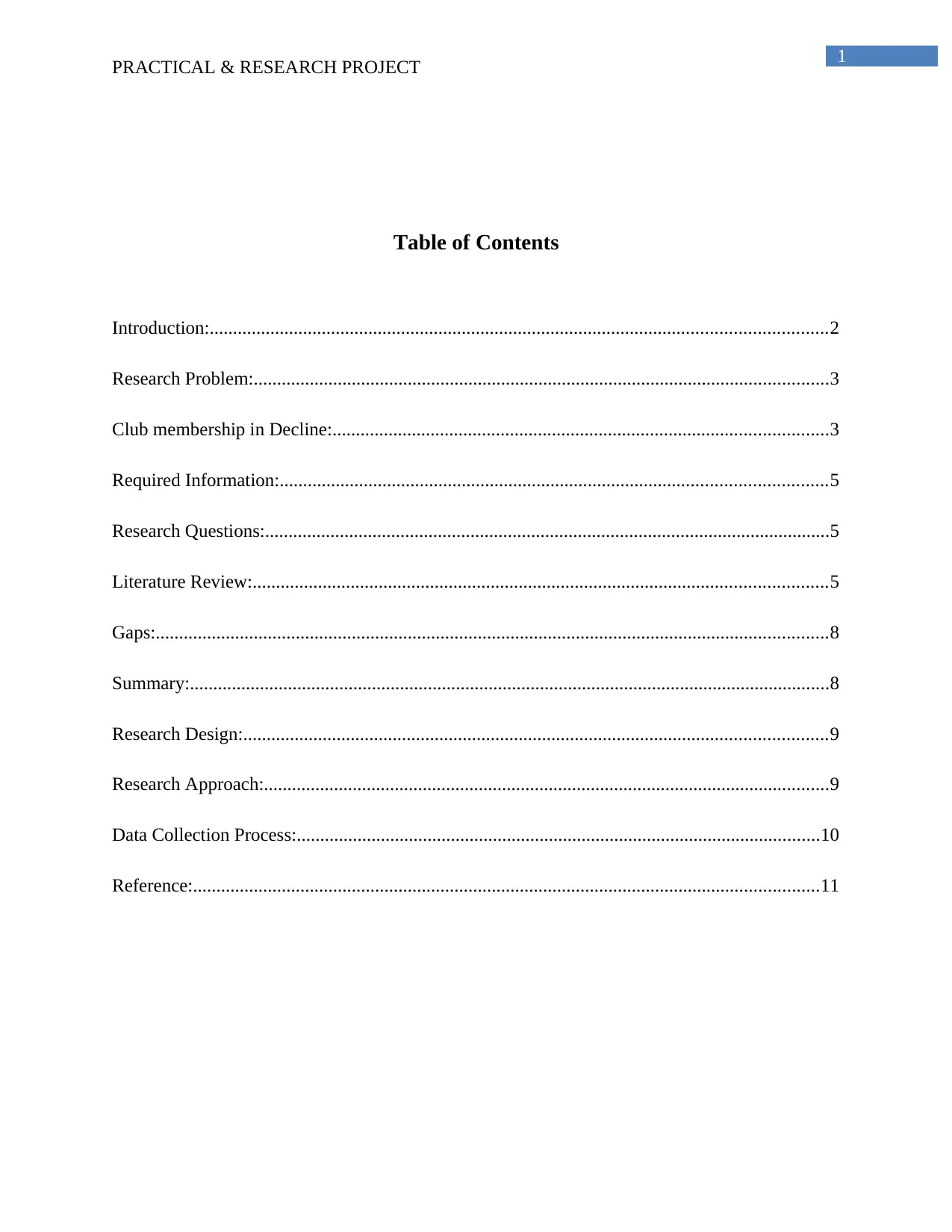
Introduction:....................................................................................................................................2
Research Problem:...........................................................................................................................3
Club membership in Decline:..........................................................................................................3
Required Information:.....................................................................................................................5
Research Questions:.........................................................................................................................5
Literature Review:...........................................................................................................................5
Gaps:................................................................................................................................................8
Summary:.........................................................................................................................................8
Research Design:.............................................................................................................................9
Research Approach:.........................................................................................................................9
Data Collection Process:................................................................................................................10
Reference:......................................................................................................................................11
PRACTICAL & RESEARCH PROJECT
Table of Contents
Introduction:....................................................................................................................................2
Research Problem:...........................................................................................................................3
Club membership in Decline:..........................................................................................................3
Required Information:.....................................................................................................................5
Research Questions:.........................................................................................................................5
Literature Review:...........................................................................................................................5
Gaps:................................................................................................................................................8
Summary:.........................................................................................................................................8
Research Design:.............................................................................................................................9
Research Approach:.........................................................................................................................9
Data Collection Process:................................................................................................................10
Reference:......................................................................................................................................11
2
PRACTICAL & RESEARCH PROJECT
Introduction:
The Ulysses Club is situated both in Australia and New Zealand, formed for the
motorcyclists over and above the age of forty. This club cropped up in Australia in December
1983, in response to a letter from the present day redundant magazine of Bike Australia editor,
Peter Thoeming (Morandin, Bagozzi & Bergami, 2013). The name ‘Ulysses Club’ was the
proposal of Rob Hall, while the motto of the club, “Grow Old Disgracefully” was initiated by Pat
Lynch, Rob’s then girlfriend. The “old man” logo that is being still used as the emblem of the
club was sketched by Peter Thoeming. The club has made use of the original hand-sketched form
of the logo that was made by Peter. The club’s introductory meeting was apprehended in Sydney
on December 6th, 1983, when five people who were present in the meeting permitted of the draft
constitution and the Ulysses Club was duly created. This meeting gave birth to a draft
constitution along with the formation of the three primary purposes of the club:
a. In providing ways where the old motorcyclists can get along together for camaraderie and
shared support.
b. In showing through example that motor cycling can be pleasurable and a practical movement
for the riders of all ages.
c. In drawing attention of the private and public institutions to the requirements and opinions of
the older riders.
These unique purposes are being entrenched in the constitution of the club and have till
date remained unaffected. This motor cycling club has been the biggest organization of its kind
having 138 branches within Australia and existing globally in places like Italy, Germany,
PRACTICAL & RESEARCH PROJECT
Introduction:
The Ulysses Club is situated both in Australia and New Zealand, formed for the
motorcyclists over and above the age of forty. This club cropped up in Australia in December
1983, in response to a letter from the present day redundant magazine of Bike Australia editor,
Peter Thoeming (Morandin, Bagozzi & Bergami, 2013). The name ‘Ulysses Club’ was the
proposal of Rob Hall, while the motto of the club, “Grow Old Disgracefully” was initiated by Pat
Lynch, Rob’s then girlfriend. The “old man” logo that is being still used as the emblem of the
club was sketched by Peter Thoeming. The club has made use of the original hand-sketched form
of the logo that was made by Peter. The club’s introductory meeting was apprehended in Sydney
on December 6th, 1983, when five people who were present in the meeting permitted of the draft
constitution and the Ulysses Club was duly created. This meeting gave birth to a draft
constitution along with the formation of the three primary purposes of the club:
a. In providing ways where the old motorcyclists can get along together for camaraderie and
shared support.
b. In showing through example that motor cycling can be pleasurable and a practical movement
for the riders of all ages.
c. In drawing attention of the private and public institutions to the requirements and opinions of
the older riders.
These unique purposes are being entrenched in the constitution of the club and have till
date remained unaffected. This motor cycling club has been the biggest organization of its kind
having 138 branches within Australia and existing globally in places like Italy, Germany,
⊘ This is a preview!⊘
Do you want full access?
Subscribe today to unlock all pages.

Trusted by 1+ million students worldwide
3
PRACTICAL & RESEARCH PROJECT
Austria, Vietnam and Norway. Furthermore, the partner of the member, who has conquered the
age of forty, may also be divulged as a club member on prior application. Till a member achieves
the 50 age level, he or she is considered to be a junior member of the club, however having full
membership rights along with privileges.
Research Problem:
This research would take into account the issue of declining membership of Ulysses Club
in Australia and the reasons on why the club is not being able to attract any new members. The
club states it is under no pressure and is in competition with none to increase the members. The
club has been able to recognize that a few more of the existing clubs have been able to offer
diversified experiences for the riders to select from.
Club membership in Decline:
A larger group of members of the club have in recent times expressed their concerns at
the serious turn down in the membership of club over a period of three years. The recent official
figures from the club management states that the use of the cycle has been falling as the
percentage of the adults who ride at least once a month fell to 15 per cent the previous year. The
decline of quite a larger section of the people was marked in Australia and New Zealand. The
bike riding clubs or organizations have been blaming the government for failing to offer ample
funding for the provision for bike riding transportation along with fears of safety on the part of
would-be bikers. The membership of the club did manage to peak up in 2010, figures stating that
28,000 members were at the helm, though it declined in the next few years with figures
suggesting the total under present circumstances is at 16,000 (Biezen, & Poguntke, (2014).
PRACTICAL & RESEARCH PROJECT
Austria, Vietnam and Norway. Furthermore, the partner of the member, who has conquered the
age of forty, may also be divulged as a club member on prior application. Till a member achieves
the 50 age level, he or she is considered to be a junior member of the club, however having full
membership rights along with privileges.
Research Problem:
This research would take into account the issue of declining membership of Ulysses Club
in Australia and the reasons on why the club is not being able to attract any new members. The
club states it is under no pressure and is in competition with none to increase the members. The
club has been able to recognize that a few more of the existing clubs have been able to offer
diversified experiences for the riders to select from.
Club membership in Decline:
A larger group of members of the club have in recent times expressed their concerns at
the serious turn down in the membership of club over a period of three years. The recent official
figures from the club management states that the use of the cycle has been falling as the
percentage of the adults who ride at least once a month fell to 15 per cent the previous year. The
decline of quite a larger section of the people was marked in Australia and New Zealand. The
bike riding clubs or organizations have been blaming the government for failing to offer ample
funding for the provision for bike riding transportation along with fears of safety on the part of
would-be bikers. The membership of the club did manage to peak up in 2010, figures stating that
28,000 members were at the helm, though it declined in the next few years with figures
suggesting the total under present circumstances is at 16,000 (Biezen, & Poguntke, (2014).
Paraphrase This Document
Need a fresh take? Get an instant paraphrase of this document with our AI Paraphraser
4
PRACTICAL & RESEARCH PROJECT
With due regards to the Ulysses club, the decline in the membership has been for reasons
like the termination of the club Newsletter which has been one of the popular journal,
predominantly enjoyed by many who have been the non-riding members. From the period from
2010 to 2015, the club did manage to generate fifty newsletters. However, with few of the
important members leaving the club scene, only five newsletters have been produced in the last
two years. Moreover, it was decided at the AGM that the generation of the Newsletter is not
worth the exertion. This fact has been ridiculed by many of the club members on the sudden stop
of the newsletters, which was once deemed popular. As suggested by some of the top members,
one does not require articles, just the oddments and the one-off clipart that can easily be cut and
pasted from the website of the club.
In every three month’s time, a run list is being shaped and propelled through posts to all
the members of the club who are not having the broadband facilities. The only extra effort that is
being required was in placing a piece of paper into the envelopes of the recipients. It took the
club officials a maximum time of two hours in producing and posting the club newsletter to their
members with the list of the run. At the time when the club was producing so many of the
newsletters during the period of 2012-2013, the club comprised of 85 members who did not have
the email amenities. It is of no coincidence that following the annihilation of the Newsletter, in
the present scenario there is only less than half the figure of club members without facilities of
email.
Another potential factor that might have resulted in the decline of the club membership is
the decision in removing AUD $6 membership for the non-riders that was popular among many
of the non-riding members (Berry & Wilcox, 2015). This is yet another of those reasons for those
PRACTICAL & RESEARCH PROJECT
With due regards to the Ulysses club, the decline in the membership has been for reasons
like the termination of the club Newsletter which has been one of the popular journal,
predominantly enjoyed by many who have been the non-riding members. From the period from
2010 to 2015, the club did manage to generate fifty newsletters. However, with few of the
important members leaving the club scene, only five newsletters have been produced in the last
two years. Moreover, it was decided at the AGM that the generation of the Newsletter is not
worth the exertion. This fact has been ridiculed by many of the club members on the sudden stop
of the newsletters, which was once deemed popular. As suggested by some of the top members,
one does not require articles, just the oddments and the one-off clipart that can easily be cut and
pasted from the website of the club.
In every three month’s time, a run list is being shaped and propelled through posts to all
the members of the club who are not having the broadband facilities. The only extra effort that is
being required was in placing a piece of paper into the envelopes of the recipients. It took the
club officials a maximum time of two hours in producing and posting the club newsletter to their
members with the list of the run. At the time when the club was producing so many of the
newsletters during the period of 2012-2013, the club comprised of 85 members who did not have
the email amenities. It is of no coincidence that following the annihilation of the Newsletter, in
the present scenario there is only less than half the figure of club members without facilities of
email.
Another potential factor that might have resulted in the decline of the club membership is
the decision in removing AUD $6 membership for the non-riders that was popular among many
of the non-riding members (Berry & Wilcox, 2015). This is yet another of those reasons for those
5
PRACTICAL & RESEARCH PROJECT
members who no longer are capable in riding with the club, not renewing their association with
the club.
Required Information:
The information that is being required for addressing the issues that Ulysses Club is
facing would require extensive analysis of both the primary and the secondary sources. The
primary sources would be dealing with the members of the club through one-on-one interviews
and questionnaires containing questions that would be based on the issues and challenges the
club is facing. The secondary source of information would be gathered through club websites
and other related articles over the database.
Research Questions:
This research study would take in certain research questions that would assist the researcher in
going along with the paper:
a. What are the issues that are being faced by bike riding clubs like Ulysses Club in Australia?
b. How can the issues faced by Ulysses Club be minimized for it to stay ahead of the
competition?
c. What are the possible recommendations through which new members can be attracted by bike
riding clubs like Ulysses in Australia?
Literature Review:
According to Biezen, & Poguntke, (2014), one of the major challenges that are being
encountered by this motorcycle clubs is the age of the members. In most of the motorcycle clubs,
PRACTICAL & RESEARCH PROJECT
members who no longer are capable in riding with the club, not renewing their association with
the club.
Required Information:
The information that is being required for addressing the issues that Ulysses Club is
facing would require extensive analysis of both the primary and the secondary sources. The
primary sources would be dealing with the members of the club through one-on-one interviews
and questionnaires containing questions that would be based on the issues and challenges the
club is facing. The secondary source of information would be gathered through club websites
and other related articles over the database.
Research Questions:
This research study would take in certain research questions that would assist the researcher in
going along with the paper:
a. What are the issues that are being faced by bike riding clubs like Ulysses Club in Australia?
b. How can the issues faced by Ulysses Club be minimized for it to stay ahead of the
competition?
c. What are the possible recommendations through which new members can be attracted by bike
riding clubs like Ulysses in Australia?
Literature Review:
According to Biezen, & Poguntke, (2014), one of the major challenges that are being
encountered by this motorcycle clubs is the age of the members. In most of the motorcycle clubs,
⊘ This is a preview!⊘
Do you want full access?
Subscribe today to unlock all pages.
Trusted by 1+ million students worldwide
6
PRACTICAL & RESEARCH PROJECT
the average ages of the members has been fifty, and under certain circumstances even sixty. In
the coming twenty years, this clubs would not be having a lot of the members. As per Hung, et
al., (2017), the largest factor of declining of motorcycle membership has been related to the
demographic factor. In this research, a survey was conducted where it was found that the average
age fifteen months ago was stated to be sixty-seven, with over 25 per cent of that population
being over the age of seventy five.
As per Everett, (2015), even though the hobbyists pass on, their bikes linger. On previous
occasions, the successive owners have joined the club, substituting the previous owner of the
bike. However, regrettably this tradition is getting lost somewhere. One of the members of a
motorcycle riding club stated that previously the turnover used to be same for the membership,
with some of the new members joining in at the same time or at the augmented rate. However, in
the present scenario, the rates of new members have gone down or are not increasing the way it
used to at one time. According to Berry, (2015), the clubs are keen in finding the source of such
issues and understand the obstacle that lies ahead, taking important steps in combating the
membership issue that is on the decline. This research did take into account the method of
increasing the membership through the benefit of modern technology and the ways of delivering
information in cost-effective ways.
As per Launay & Dunbar, (2015), the Southern Cross Association has been offering
technical resources on the website of its that has been saving their members quite a few dollars,
adding the much required value to the membership due prices. The workshop manuals generally
run upto 1000 pages and for obvious reasons it is costly in printing and mailing of the same, so
the club shifted the whole process online where the members can download it for free. The
internet has been able to bring in the diversion into the households of the potential members;
PRACTICAL & RESEARCH PROJECT
the average ages of the members has been fifty, and under certain circumstances even sixty. In
the coming twenty years, this clubs would not be having a lot of the members. As per Hung, et
al., (2017), the largest factor of declining of motorcycle membership has been related to the
demographic factor. In this research, a survey was conducted where it was found that the average
age fifteen months ago was stated to be sixty-seven, with over 25 per cent of that population
being over the age of seventy five.
As per Everett, (2015), even though the hobbyists pass on, their bikes linger. On previous
occasions, the successive owners have joined the club, substituting the previous owner of the
bike. However, regrettably this tradition is getting lost somewhere. One of the members of a
motorcycle riding club stated that previously the turnover used to be same for the membership,
with some of the new members joining in at the same time or at the augmented rate. However, in
the present scenario, the rates of new members have gone down or are not increasing the way it
used to at one time. According to Berry, (2015), the clubs are keen in finding the source of such
issues and understand the obstacle that lies ahead, taking important steps in combating the
membership issue that is on the decline. This research did take into account the method of
increasing the membership through the benefit of modern technology and the ways of delivering
information in cost-effective ways.
As per Launay & Dunbar, (2015), the Southern Cross Association has been offering
technical resources on the website of its that has been saving their members quite a few dollars,
adding the much required value to the membership due prices. The workshop manuals generally
run upto 1000 pages and for obvious reasons it is costly in printing and mailing of the same, so
the club shifted the whole process online where the members can download it for free. The
internet has been able to bring in the diversion into the households of the potential members;
Paraphrase This Document
Need a fresh take? Get an instant paraphrase of this document with our AI Paraphraser
7
PRACTICAL & RESEARCH PROJECT
many such clubs have been seeing this as the value of bringing the hobby off the computer
monitor and onto the streets. According to Fishman, Washington & Haworth, (2014), several
biker association have taken up the initiative in having a youth program. One of the things that
they have been trying to perform is working with the trade schools for introducing antique bikes
and relevant information about them into the prospectus.
According to Fishman et al., (2015), attracting new members in the club has become one
of the broader initiatives. In one of the surveys conducted within this research, members are of
the opinion that when they joined these motorcycle clubs around forty years ago, it was much
bunged society. However, in the present scenario, a particular motorcycle club is inviting the
members of the other bike clubs to come in, visit them and have an experience. As per Hardiman
& Burgin, (2013), several of the motorcycle clubs have been parking their Ducati sand Ninjas in
the parking lot for the people to see and have a discussion with the owners. According to
Bachand-Marleau, Lee & El-Geneidy, (2012), the bottom line for such an issue and to better the
health of the club is to acclimatize with the needs of the members, through either socializing at
the shows and events and on tours, for attracting new members to the club. As per Ricci, (2015),
social media has been another reason for which the motorcycle clubs operations are being
jeopardized. With the taking over of the social media, people are just going about posting, “I am
riding tomorrow, want to go?” This fact has taken away the requirement and significance of the
pre-planned group rides. People are not showing up for the rides they used to on previous
occasions. As per McKee, (2015), taking up the role of the leaders in this motorcycle clubs are
becoming a hazardous jobs and not much members are showing interest is such factors.
According to Morandin, Bagozzi & Bergami, (2013), the word-of-mouth is not the best
way of communicating the news of the club to its members and to the candidates who are
PRACTICAL & RESEARCH PROJECT
many such clubs have been seeing this as the value of bringing the hobby off the computer
monitor and onto the streets. According to Fishman, Washington & Haworth, (2014), several
biker association have taken up the initiative in having a youth program. One of the things that
they have been trying to perform is working with the trade schools for introducing antique bikes
and relevant information about them into the prospectus.
According to Fishman et al., (2015), attracting new members in the club has become one
of the broader initiatives. In one of the surveys conducted within this research, members are of
the opinion that when they joined these motorcycle clubs around forty years ago, it was much
bunged society. However, in the present scenario, a particular motorcycle club is inviting the
members of the other bike clubs to come in, visit them and have an experience. As per Hardiman
& Burgin, (2013), several of the motorcycle clubs have been parking their Ducati sand Ninjas in
the parking lot for the people to see and have a discussion with the owners. According to
Bachand-Marleau, Lee & El-Geneidy, (2012), the bottom line for such an issue and to better the
health of the club is to acclimatize with the needs of the members, through either socializing at
the shows and events and on tours, for attracting new members to the club. As per Ricci, (2015),
social media has been another reason for which the motorcycle clubs operations are being
jeopardized. With the taking over of the social media, people are just going about posting, “I am
riding tomorrow, want to go?” This fact has taken away the requirement and significance of the
pre-planned group rides. People are not showing up for the rides they used to on previous
occasions. As per McKee, (2015), taking up the role of the leaders in this motorcycle clubs are
becoming a hazardous jobs and not much members are showing interest is such factors.
According to Morandin, Bagozzi & Bergami, (2013), the word-of-mouth is not the best
way of communicating the news of the club to its members and to the candidates who are
8
PRACTICAL & RESEARCH PROJECT
interested. Therefore the best way of communicating is to put together a newsletter that would be
letting the people know when the organization is planning its next rides, events and other
meetings. The website of the bike clubs needs to be maintained in the best possible way as a
mean of communicating with others. According to Hardiman & Burgin, (2013), the success of
the motorcycle clubs is primarily based on attitude. In order to take the member in serious
manner, especially the one at the top, he should prepare himself with a sneer instead of a smile
on his face. It is the attitude and the demeanor that attracts others towards the motorcycle clubs
where associating with one particular group might augment the social status.
Gaps:
There have been few gaps within these research studies that have been identified in the
research work. Most of the scholars failed to mention the ways the new members would be
attracted and the ways technology can be playing a vital role in bettering the overall situation. It
is important to understand the way digitalization would be helping in enhancing the situation of
these clubs that have been facing the ire of declining membership. The scholars have mainly
discussed on the issues but not the solutions that might be followed by this clubs to gain more
membership and tackling the issues.
Summary:
This literature review part took into account the issues that have been mentioned in the
articles of eminent scholars like losing out on the conventional ways of hobbying, social media
playing a role in disrupting the process that used to happen previously, not letting people know
through the newsletter what has been planned. Another way has been showcasing the bikes
PRACTICAL & RESEARCH PROJECT
interested. Therefore the best way of communicating is to put together a newsletter that would be
letting the people know when the organization is planning its next rides, events and other
meetings. The website of the bike clubs needs to be maintained in the best possible way as a
mean of communicating with others. According to Hardiman & Burgin, (2013), the success of
the motorcycle clubs is primarily based on attitude. In order to take the member in serious
manner, especially the one at the top, he should prepare himself with a sneer instead of a smile
on his face. It is the attitude and the demeanor that attracts others towards the motorcycle clubs
where associating with one particular group might augment the social status.
Gaps:
There have been few gaps within these research studies that have been identified in the
research work. Most of the scholars failed to mention the ways the new members would be
attracted and the ways technology can be playing a vital role in bettering the overall situation. It
is important to understand the way digitalization would be helping in enhancing the situation of
these clubs that have been facing the ire of declining membership. The scholars have mainly
discussed on the issues but not the solutions that might be followed by this clubs to gain more
membership and tackling the issues.
Summary:
This literature review part took into account the issues that have been mentioned in the
articles of eminent scholars like losing out on the conventional ways of hobbying, social media
playing a role in disrupting the process that used to happen previously, not letting people know
through the newsletter what has been planned. Another way has been showcasing the bikes
⊘ This is a preview!⊘
Do you want full access?
Subscribe today to unlock all pages.
Trusted by 1+ million students worldwide
9
PRACTICAL & RESEARCH PROJECT
during the meeting and making people interested about the bikes on offer and the motorcycles
they can experience if they become the members of a particular club.
Research Design:
A design of the research can be stated as the complete draft of the research work. The
design of the research takes in the questions of the research, research issues, identification of the
variables, data gathering method and the plan related to breakdown of data. Among the several
research issues, this particular paper would take in the experimental study. For the purpose of the
explanatory research, the research issues are being monitored taking in the data collected over
time. Five of the independent variables are being taken in as reliability, empathy, responsiveness,
assurance and tangibility. The questionnaire of self-completed nature would be dispersed making
use of the feasibility practice of sampling to the members of the Ulysses Club for evaluating the
membership decline in the club within Australia.
Research Approach:
The approach of the research can be mainly divided into three sorts that are deductive,
abductive and inductive. In case of deductive approach, the validity of the gathered data tests the
validity of the assumption. On certain other occasions, the inductive approach takes in the new
theories that would be developed. The abductive approach clarifies some of the other surprising
specifics and sequences and with the subject for evaluation of the facts.
This would witness the use of the deductive approach. It has cropped up with a research
issue for monitoring the declining factor in membership of Ulysses Club and the ways of
attracting new members. For doing the research work, the researcher would be performing the
PRACTICAL & RESEARCH PROJECT
during the meeting and making people interested about the bikes on offer and the motorcycles
they can experience if they become the members of a particular club.
Research Design:
A design of the research can be stated as the complete draft of the research work. The
design of the research takes in the questions of the research, research issues, identification of the
variables, data gathering method and the plan related to breakdown of data. Among the several
research issues, this particular paper would take in the experimental study. For the purpose of the
explanatory research, the research issues are being monitored taking in the data collected over
time. Five of the independent variables are being taken in as reliability, empathy, responsiveness,
assurance and tangibility. The questionnaire of self-completed nature would be dispersed making
use of the feasibility practice of sampling to the members of the Ulysses Club for evaluating the
membership decline in the club within Australia.
Research Approach:
The approach of the research can be mainly divided into three sorts that are deductive,
abductive and inductive. In case of deductive approach, the validity of the gathered data tests the
validity of the assumption. On certain other occasions, the inductive approach takes in the new
theories that would be developed. The abductive approach clarifies some of the other surprising
specifics and sequences and with the subject for evaluation of the facts.
This would witness the use of the deductive approach. It has cropped up with a research
issue for monitoring the declining factor in membership of Ulysses Club and the ways of
attracting new members. For doing the research work, the researcher would be performing the
Paraphrase This Document
Need a fresh take? Get an instant paraphrase of this document with our AI Paraphraser
10
PRACTICAL & RESEARCH PROJECT
study based on drawn conclusions on certain specific facts and coherent base. Therefore, the
deductive approach would be the best way of dealing with this topic.
Data Collection Process:
There are generally two ways of gathering data which the researcher needs to taken in
honestly. The survey method is being selected as the primary research principle whereas for the
secondary research the data that is generated through other sources has been chosen. A
researcher can take into account any sort of methods for the purpose of primary analysis of the
data like questionnaire and interviews. Secondary sources take in the relevant journals and
articles along with magazines where the researchers present those data with their own
perceptions.
PRACTICAL & RESEARCH PROJECT
study based on drawn conclusions on certain specific facts and coherent base. Therefore, the
deductive approach would be the best way of dealing with this topic.
Data Collection Process:
There are generally two ways of gathering data which the researcher needs to taken in
honestly. The survey method is being selected as the primary research principle whereas for the
secondary research the data that is generated through other sources has been chosen. A
researcher can take into account any sort of methods for the purpose of primary analysis of the
data like questionnaire and interviews. Secondary sources take in the relevant journals and
articles along with magazines where the researchers present those data with their own
perceptions.
11
PRACTICAL & RESEARCH PROJECT
Reference:
Bachand-Marleau, J., Lee, B., & El-Geneidy, A. (2012). Better understanding of factors
influencing likelihood of using shared bicycle systems and frequency of
use. Transportation Research Record: Journal of the Transportation Research Board,
(2314), 66-71.
Berry, J. M. (2015). Lobbying for the people: The political behavior of public interest groups.
Princeton University Press.
Berry, J. M., & Wilcox, C. (2015). The interest group society. Routledge.
Biezen, I. V., & Poguntke, T. (2014). The decline of membership-based politics. Party
Politics, 20(2), 205-216.
Everett, C. R. (2015). Group membership, relationship banking and loan default risk: the case of
online social lending.
Fishman, E., Washington, S., & Haworth, N. (2014). Bike share’s impact on car use: evidence
from the United States, Great Britain, and Australia. Transportation Research Part D:
Transport and Environment, 31, 13-20.
Fishman, E., Washington, S., Haworth, N., & Watson, A. (2015). Factors influencing bike share
membership: An analysis of Melbourne and Brisbane. Transportation research part A:
policy and practice, 71, 17-30.
Hardiman, N., & Burgin, S. (2013). Mountain biking: downhill for the environment or chance to
up a gear?. International journal of environmental studies, 70(6), 976-986.
PRACTICAL & RESEARCH PROJECT
Reference:
Bachand-Marleau, J., Lee, B., & El-Geneidy, A. (2012). Better understanding of factors
influencing likelihood of using shared bicycle systems and frequency of
use. Transportation Research Record: Journal of the Transportation Research Board,
(2314), 66-71.
Berry, J. M. (2015). Lobbying for the people: The political behavior of public interest groups.
Princeton University Press.
Berry, J. M., & Wilcox, C. (2015). The interest group society. Routledge.
Biezen, I. V., & Poguntke, T. (2014). The decline of membership-based politics. Party
Politics, 20(2), 205-216.
Everett, C. R. (2015). Group membership, relationship banking and loan default risk: the case of
online social lending.
Fishman, E., Washington, S., & Haworth, N. (2014). Bike share’s impact on car use: evidence
from the United States, Great Britain, and Australia. Transportation Research Part D:
Transport and Environment, 31, 13-20.
Fishman, E., Washington, S., Haworth, N., & Watson, A. (2015). Factors influencing bike share
membership: An analysis of Melbourne and Brisbane. Transportation research part A:
policy and practice, 71, 17-30.
Hardiman, N., & Burgin, S. (2013). Mountain biking: downhill for the environment or chance to
up a gear?. International journal of environmental studies, 70(6), 976-986.
⊘ This is a preview!⊘
Do you want full access?
Subscribe today to unlock all pages.
Trusted by 1+ million students worldwide

1 out of 13


Your All-in-One AI-Powered Toolkit for Academic Success.
+13062052269
info@desklib.com
Available 24*7 on WhatsApp / Email
![[object Object]](/_next/static/media/star-bottom.7253800d.svg)
Unlock your academic potential
Copyright © 2020–2026 A2Z Services. All Rights Reserved. Developed and managed by ZUCOL.