A Critical Analysis: Strengths & Weaknesses of UN Genocide Convention
VerifiedAdded on 2023/06/11
|10
|2934
|458
Essay
AI Summary
This essay provides an in-depth analysis of the United Nations Genocide Convention, examining its strengths and weaknesses in the context of international law and the prevention of genocide. It begins by outlining the historical context leading to the UN's formation and the Convention's creation, highlighting the failures of the League of Nations and the impetus from World War II. The essay then delves into specific strengths, such as the establishment of a framework for international cooperation and intervention in conflict zones, exemplified by the UN's involvement in the Israeli-Palestinian conflict and peacekeeping efforts in South Sudan. However, it also critically assesses weaknesses, including the exclusion of political groups from the Convention's definition of protected groups, potentially limiting its scope and effectiveness in addressing internal conflicts and politically motivated violence. The essay further discusses how the comprehensive yet selective nature of the Convention can lead to misinterpretations and a failure to address smaller-scale acts of destruction. It concludes by emphasizing the need for continuous evaluation and adaptation of the Convention to ensure its relevance and efficacy in preventing and punishing genocide in the 21st century. Desklib provides access to this essay along with a wide array of study resources.
The Strengths and Weaknesses of the United Nations Genocide Convention 1
The Strengths and Weaknesses of the United Nations Genocide Convention
Name
Course
Professor
Institution
City/State
Date
The Strengths and Weaknesses of the United Nations Genocide Convention
Name
Course
Professor
Institution
City/State
Date

Paraphrase This Document
Need a fresh take? Get an instant paraphrase of this document with our AI Paraphraser
The Strengths and Weaknesses of the United Nations Genocide Convention 2
The Strengths and Weaknesses of the United Nations Genocide Convention
In light of the concerns that prompted World Wars and the United Nations (UN) was
established in 1945 by a sanction marked by fifty-one nations globally with the goal that wicked
disasters like those in 1914 and 1940 could never occur again. The First World War that
occurred in 1914 and 1918 was the consequence of mystery settlements and organizations
together that in the long run pulled every one of the countries required down into rough clash.
Resembling a place of cards inclined through the smallest push, the insecure conciliatory
atmosphere of the multipolar world during the start of the twentieth century failed into present
day fighting on a level at no other time found in any general public (Baderin, 2005, 23). New
cars, new arms, as well as new pulverization demolished terrains and the people of Europe,
Atlantic, Pacific, and Africa. During 1918, the war tidy and smoke developed since the Austro-
Hungarians, Ottomans, and Germans, surrendered to America, England, and France. Woodrow
Wilson, the educator leader of America during that time of warfare and from that point ventured
into peace meeting. Lecturing the gathering countries, which their countries had an ethical
commitment to the worldwide group, (Smith, 2016, 67) presented the predecessor of the United
Nations and the Nations league. The nation’s league was conceived under the organization of
Taft worked out the league notion to impose peace.
The introduction of the League of Nations constitution explained the capacity along with
motivation behind the association since it was founded to secure the world from any future
clashes. Participation among country situations and intervention in struggle regions was a gift
from league heaven, as it turned into the main worldwide body to set up an open stage for dialog
inside the universal framework (Odinkalu, 2001, 51). In any case, trust that the League of
Nations would settle all the world's issues were covered when "Germany rose up out of World
The Strengths and Weaknesses of the United Nations Genocide Convention
In light of the concerns that prompted World Wars and the United Nations (UN) was
established in 1945 by a sanction marked by fifty-one nations globally with the goal that wicked
disasters like those in 1914 and 1940 could never occur again. The First World War that
occurred in 1914 and 1918 was the consequence of mystery settlements and organizations
together that in the long run pulled every one of the countries required down into rough clash.
Resembling a place of cards inclined through the smallest push, the insecure conciliatory
atmosphere of the multipolar world during the start of the twentieth century failed into present
day fighting on a level at no other time found in any general public (Baderin, 2005, 23). New
cars, new arms, as well as new pulverization demolished terrains and the people of Europe,
Atlantic, Pacific, and Africa. During 1918, the war tidy and smoke developed since the Austro-
Hungarians, Ottomans, and Germans, surrendered to America, England, and France. Woodrow
Wilson, the educator leader of America during that time of warfare and from that point ventured
into peace meeting. Lecturing the gathering countries, which their countries had an ethical
commitment to the worldwide group, (Smith, 2016, 67) presented the predecessor of the United
Nations and the Nations league. The nation’s league was conceived under the organization of
Taft worked out the league notion to impose peace.
The introduction of the League of Nations constitution explained the capacity along with
motivation behind the association since it was founded to secure the world from any future
clashes. Participation among country situations and intervention in struggle regions was a gift
from league heaven, as it turned into the main worldwide body to set up an open stage for dialog
inside the universal framework (Odinkalu, 2001, 51). In any case, trust that the League of
Nations would settle all the world's issues were covered when "Germany rose up out of World
The Strengths and Weaknesses of the United Nations Genocide Convention 3
War I as a disappointed power" after the '20s and '30s. Following the crumple of the Weimar
State as well as the ascent of Nazi social gathering, Germany grabbed the chance to thrust its
armed forces through focal Europe and start of warfare in 1939 (Odinkalu, 2001, 16). This turned
into a worldwide clash that included Italy, England, the Soviet Union, Japan and the United
States.
At last, the Second World War emerged with the foundation of two extraordinary forces,
the Soviet Union United States. These partners amid Second World War turned out to be severe
foes following 1945 as political and ideological contrasts destroyed them (Umozurike, 1996, 50).
The current disintegrated Nations League was supplanted when the Charter of United Nations
became effective on October 24 out of 1945 (Umozurike, 1996, 12). Their aggregate impact
engaged the association and offers it the authenticity that the League of Nations League needed.
The United Nation flourished from that point as it turned into an impetus for change in
light of helpful emergencies and the penchant of war. Social administrations created far and wide
because of the association, and compromise turned into a key aspect of intergovernmental office.
The UN in its present situation is liable to inspection (Mutua , 1999, 15). In spite of its quality in
its effort in ensuring and helping the mankind requirements as well as working as power of
mediatory for worldwide compromise, the United Nations falters as a "government of world" as
it proclaims small administration and is ineffectual at being a power of dynamic.
From its most punctual origination, the UN was expected to provide the world
legislatures as a stage for dialog. Amid the Era of Cold War, legislative issues, since the globe
was isolated, communist and Capitalist, East and West, U.S. what's more, U.S.S.R., the United
Nations had its primary chances to build up its part like a middle person in the universal
framework (Kodjo, 1990, 45). Shockingly, the primary clash the United Nations was engaged
War I as a disappointed power" after the '20s and '30s. Following the crumple of the Weimar
State as well as the ascent of Nazi social gathering, Germany grabbed the chance to thrust its
armed forces through focal Europe and start of warfare in 1939 (Odinkalu, 2001, 16). This turned
into a worldwide clash that included Italy, England, the Soviet Union, Japan and the United
States.
At last, the Second World War emerged with the foundation of two extraordinary forces,
the Soviet Union United States. These partners amid Second World War turned out to be severe
foes following 1945 as political and ideological contrasts destroyed them (Umozurike, 1996, 50).
The current disintegrated Nations League was supplanted when the Charter of United Nations
became effective on October 24 out of 1945 (Umozurike, 1996, 12). Their aggregate impact
engaged the association and offers it the authenticity that the League of Nations League needed.
The United Nation flourished from that point as it turned into an impetus for change in
light of helpful emergencies and the penchant of war. Social administrations created far and wide
because of the association, and compromise turned into a key aspect of intergovernmental office.
The UN in its present situation is liable to inspection (Mutua , 1999, 15). In spite of its quality in
its effort in ensuring and helping the mankind requirements as well as working as power of
mediatory for worldwide compromise, the United Nations falters as a "government of world" as
it proclaims small administration and is ineffectual at being a power of dynamic.
From its most punctual origination, the UN was expected to provide the world
legislatures as a stage for dialog. Amid the Era of Cold War, legislative issues, since the globe
was isolated, communist and Capitalist, East and West, U.S. what's more, U.S.S.R., the United
Nations had its primary chances to build up its part like a middle person in the universal
framework (Kodjo, 1990, 45). Shockingly, the primary clash the United Nations was engaged
⊘ This is a preview!⊘
Do you want full access?
Subscribe today to unlock all pages.

Trusted by 1+ million students worldwide
The Strengths and Weaknesses of the United Nations Genocide Convention 4
with was not amid the United States and the Soviet Union; relatively, it worried the foundation
of State of Israeli on the Eastern Mediterranean drift. In 1948, the UN built up thr United Nations
Truce Supervision Organization (UNTSO) "to oversee the Armistice Agreements amongst Israel
and its Arab neighbours (Danwood, 2006, 20).Violence emitted between Israeli powers and
Palestinians and their Arab partners in light of the establishment of the sovereign State of Israel.
The United Nations, through the UNTSO functioned as the mediatory power to settle the
contention. The association conveyed the heads of the two gatherings to the table for meetings to
examine arrangements, rather than utilizing war to pick up control of zones (Lawrence J.
LeBlanc, 1991, 12). The United Nation's work with Israel and the Arab States around the
Mediterranean set the point of reference for UN Peacekeeping work. Consistently into the
present, the association has utilized Peacekeeping powers to back off animosity and start quiet
arrangements between aggressive gatherings. Subsequently, the United Nations was immediately
lifted into an association with meat on its bones. It quickly increased more acknowledgment and
regard than its antecedent the League of Nations did. Since the decades moved on, the world still
confronted brutal encounters on almost every one of its landmasses (Goodman, R. and Jinks, D.,
2005, 34). The UN increased more regard and quality as their sanction was being respected by
means of the association's work.
Preludes to strife inside South Sudan Since the establishing of South Sudan, things have
not been simple for the world's most up to date nation. Little outskirt conflicts between the North
and South have hampered strain between the two countries. Moreover, Sudan has made it
troublesome for South Sudan to offer oil (Shaw, M., 2015, 20). Contradictions over costs and
charges have slowed down the oil generation, which is gathered in South Sudan however refined
and sold in Sudan in the north as they have more offices, global associations, and exchange
with was not amid the United States and the Soviet Union; relatively, it worried the foundation
of State of Israeli on the Eastern Mediterranean drift. In 1948, the UN built up thr United Nations
Truce Supervision Organization (UNTSO) "to oversee the Armistice Agreements amongst Israel
and its Arab neighbours (Danwood, 2006, 20).Violence emitted between Israeli powers and
Palestinians and their Arab partners in light of the establishment of the sovereign State of Israel.
The United Nations, through the UNTSO functioned as the mediatory power to settle the
contention. The association conveyed the heads of the two gatherings to the table for meetings to
examine arrangements, rather than utilizing war to pick up control of zones (Lawrence J.
LeBlanc, 1991, 12). The United Nation's work with Israel and the Arab States around the
Mediterranean set the point of reference for UN Peacekeeping work. Consistently into the
present, the association has utilized Peacekeeping powers to back off animosity and start quiet
arrangements between aggressive gatherings. Subsequently, the United Nations was immediately
lifted into an association with meat on its bones. It quickly increased more acknowledgment and
regard than its antecedent the League of Nations did. Since the decades moved on, the world still
confronted brutal encounters on almost every one of its landmasses (Goodman, R. and Jinks, D.,
2005, 34). The UN increased more regard and quality as their sanction was being respected by
means of the association's work.
Preludes to strife inside South Sudan Since the establishing of South Sudan, things have
not been simple for the world's most up to date nation. Little outskirt conflicts between the North
and South have hampered strain between the two countries. Moreover, Sudan has made it
troublesome for South Sudan to offer oil (Shaw, M., 2015, 20). Contradictions over costs and
charges have slowed down the oil generation, which is gathered in South Sudan however refined
and sold in Sudan in the north as they have more offices, global associations, and exchange
Paraphrase This Document
Need a fresh take? Get an instant paraphrase of this document with our AI Paraphraser
The Strengths and Weaknesses of the United Nations Genocide Convention 5
understandings. Past the oil clashes, notwithstanding, the biggest wellspring of contention has
originated from inside the South Sudanese government itself. In December of 2013, President
Salva Kiir, an ethnic Dinka, South Sudan's biggest ethnic gathering, evacuated the Vice
President, Riek Machar, a Nuer, the second biggest ethnic gathering, over assertions of
debasement (Shaw, M., 2015, 15). This prompted political infighting in the Senate took after by
brutality spilling out into the boulevards of the capital, Juba. The brutality rapidly spread to
different urban areas including Bor and Bentiu.
During the month of battling, South Sudan alone has more than 413,000 regular citizens
who were dislodged from their homes, making a huge compassionate and outcast emergency in a
financially frail nation. The political differences between President Kiir and previous VP Machar
split the armed force down the middle along for the most part ethnic lines and have empowered
state armies and other non-government furnished gatherings to ascend (Ratner, S.R., 2003, 18).
There is likewise a lot of firearms, rockets, rocket launchers, gas based weapons, projectiles, and
different explosives in the nation because of many years of contention over the past forty years.
Subsequently, it is simple for the normal resident to be very much outfitted and impelled to battle
close by ethnic lines. There are charges of mass killings that are reminiscent of the viciousness
seen amid the Darfur Genocide. In August 2015, a peace assertion was marked to diminish the
brutality in the region. It was fleeting as there was infringement on the two sides (Quigley, L.V.,
1960, 14). The common war might be lawfully finished, however viciousness and quarrels
remain. Over a million people remain dislodged and an obliterated economy joined with a
starvation keeps on compounding the circumstance.
UNMISS is principally made out of UN Peacekeepers and police authorities who enlarge
existing South Sudanese powers. It is vital to take note of that UNMISS isn't effectively
understandings. Past the oil clashes, notwithstanding, the biggest wellspring of contention has
originated from inside the South Sudanese government itself. In December of 2013, President
Salva Kiir, an ethnic Dinka, South Sudan's biggest ethnic gathering, evacuated the Vice
President, Riek Machar, a Nuer, the second biggest ethnic gathering, over assertions of
debasement (Shaw, M., 2015, 15). This prompted political infighting in the Senate took after by
brutality spilling out into the boulevards of the capital, Juba. The brutality rapidly spread to
different urban areas including Bor and Bentiu.
During the month of battling, South Sudan alone has more than 413,000 regular citizens
who were dislodged from their homes, making a huge compassionate and outcast emergency in a
financially frail nation. The political differences between President Kiir and previous VP Machar
split the armed force down the middle along for the most part ethnic lines and have empowered
state armies and other non-government furnished gatherings to ascend (Ratner, S.R., 2003, 18).
There is likewise a lot of firearms, rockets, rocket launchers, gas based weapons, projectiles, and
different explosives in the nation because of many years of contention over the past forty years.
Subsequently, it is simple for the normal resident to be very much outfitted and impelled to battle
close by ethnic lines. There are charges of mass killings that are reminiscent of the viciousness
seen amid the Darfur Genocide. In August 2015, a peace assertion was marked to diminish the
brutality in the region. It was fleeting as there was infringement on the two sides (Quigley, L.V.,
1960, 14). The common war might be lawfully finished, however viciousness and quarrels
remain. Over a million people remain dislodged and an obliterated economy joined with a
starvation keeps on compounding the circumstance.
UNMISS is principally made out of UN Peacekeepers and police authorities who enlarge
existing South Sudanese powers. It is vital to take note of that UNMISS isn't effectively
The Strengths and Weaknesses of the United Nations Genocide Convention 6
occupied with battling in the common war (Luard, E., 1979, 25). They do bolster the official
administration of South Sudan yet are not there to battle in the war. Or maybe, they offer help
and extra security to urban areas and towns. UNMISS has been occupied with a few firefights
with rebels, as the last have assaulted stations and even non military personnel covers.
Subsequently, five peacekeepers have been slaughtered. Some inquiries on the adequacy of
peacekeepers are frequently restricted by laws and the organization of the UN (Stamatopoulou,
E., 1994, 17). Notwithstanding, this has not hampered their main goal of observing and
examining human rights infringement, securing regular people, making the conditions for
conveyance of philanthropic help, and supporting the usage of the end of dangers assertion.
In any case, the Convention isn't totally futile. As Kuper noted, much of the time the four
secured gatherings and political gatherings are firmly associated. On the off chance that the
casualties reliably have a place with a racial, ethnic, national or religious gathering, despite the
fact that the culprits assert their casualties are political, the Genocide Convention can be
summoned (Barnett, M., 2002, 67). The issue is that it is harder to demonstrate blame if the
political gathering focused on isn't unequivocally expressed. It is additionally conceivable that a
political gathering could be defrauded for absolutely political finishes. This contention applies
similarly to financial and different gatherings that ought to be incorporated into the definition.
Numerous spectators have noticed that there was an "under-the-table" trade off made
amid the Convention to avoid political gatherings. This was done to secure confirmation by part
expresses that expected that their inner concealment of contradictions may be liable to outside
impedance under the Convention. . Without the part states' help, the Genocide Convention would
not get off the ground (Powell, C., 2007, 50). However, as Kuper noted, obstruction in a
sovereign state to ensure exploited gatherings was the principle reason for the Convention
occupied with battling in the common war (Luard, E., 1979, 25). They do bolster the official
administration of South Sudan yet are not there to battle in the war. Or maybe, they offer help
and extra security to urban areas and towns. UNMISS has been occupied with a few firefights
with rebels, as the last have assaulted stations and even non military personnel covers.
Subsequently, five peacekeepers have been slaughtered. Some inquiries on the adequacy of
peacekeepers are frequently restricted by laws and the organization of the UN (Stamatopoulou,
E., 1994, 17). Notwithstanding, this has not hampered their main goal of observing and
examining human rights infringement, securing regular people, making the conditions for
conveyance of philanthropic help, and supporting the usage of the end of dangers assertion.
In any case, the Convention isn't totally futile. As Kuper noted, much of the time the four
secured gatherings and political gatherings are firmly associated. On the off chance that the
casualties reliably have a place with a racial, ethnic, national or religious gathering, despite the
fact that the culprits assert their casualties are political, the Genocide Convention can be
summoned (Barnett, M., 2002, 67). The issue is that it is harder to demonstrate blame if the
political gathering focused on isn't unequivocally expressed. It is additionally conceivable that a
political gathering could be defrauded for absolutely political finishes. This contention applies
similarly to financial and different gatherings that ought to be incorporated into the definition.
Numerous spectators have noticed that there was an "under-the-table" trade off made
amid the Convention to avoid political gatherings. This was done to secure confirmation by part
expresses that expected that their inner concealment of contradictions may be liable to outside
impedance under the Convention. . Without the part states' help, the Genocide Convention would
not get off the ground (Powell, C., 2007, 50). However, as Kuper noted, obstruction in a
sovereign state to ensure exploited gatherings was the principle reason for the Convention
⊘ This is a preview!⊘
Do you want full access?
Subscribe today to unlock all pages.
Trusted by 1+ million students worldwide
The Strengths and Weaknesses of the United Nations Genocide Convention 7
(UNITED STATES, 1985, 10). This appears to recommend that excluding political gatherings in
the definition is a disappointment of the Convention.
At long last, being comprehensive and selective in the meantime appears to cause
different issues. The comprehensiveness of the physical components diminishes consideration
from the primary accentuation of the Convention: the murdering of part or a whole gathering in
that capacity. What's more, by barring political gatherings, inward slaughters completed under
any of the five grounds said could go unnoticed by the outside world, as the culprits can assert
that what they are conferring is a "political concealment (INTERNATIONAL COURT OF
JUSTICE, 1951, 12)." The universal group would then act just when killings are gigantic in
scope and did over an expanded timeframe. In this way, the Convention does not cover little
scale decimation as it should. Combined with the general perspective of massacre as something
like the Holocaust or the aggregate obliteration of a race, ethnic gathering or nation (UNITED
STATES, 1985, 12). there is a propensity to not decipher the legitimate meaning of decimation
as the physical demolition of a piece of a gathering. After some time, this false elucidation has
moved toward becoming what people in general comprehend as slaughter. This clarifies the
formation of befuddling terms, for example, "destructive slaughter" to fit in a circumstance
where just a little piece of a gathering is demolished.
Keeping in mind the end goal to elevate worldwide collaboration and to secure global
peace and security by the acknowledgment of commitments not to turn to war, by the solution of
open, just, and noteworthy relations between countries, by the firm foundation of the
understandings of universal law as the genuine part of direct among Governments, and by the
support of equity and a trustworthy regard for all settlement commitments in the dealings of
sorted out people groups with each other (Powell, C., 2007, 50). It is conceivable to anticipate
(UNITED STATES, 1985, 10). This appears to recommend that excluding political gatherings in
the definition is a disappointment of the Convention.
At long last, being comprehensive and selective in the meantime appears to cause
different issues. The comprehensiveness of the physical components diminishes consideration
from the primary accentuation of the Convention: the murdering of part or a whole gathering in
that capacity. What's more, by barring political gatherings, inward slaughters completed under
any of the five grounds said could go unnoticed by the outside world, as the culprits can assert
that what they are conferring is a "political concealment (INTERNATIONAL COURT OF
JUSTICE, 1951, 12)." The universal group would then act just when killings are gigantic in
scope and did over an expanded timeframe. In this way, the Convention does not cover little
scale decimation as it should. Combined with the general perspective of massacre as something
like the Holocaust or the aggregate obliteration of a race, ethnic gathering or nation (UNITED
STATES, 1985, 12). there is a propensity to not decipher the legitimate meaning of decimation
as the physical demolition of a piece of a gathering. After some time, this false elucidation has
moved toward becoming what people in general comprehend as slaughter. This clarifies the
formation of befuddling terms, for example, "destructive slaughter" to fit in a circumstance
where just a little piece of a gathering is demolished.
Keeping in mind the end goal to elevate worldwide collaboration and to secure global
peace and security by the acknowledgment of commitments not to turn to war, by the solution of
open, just, and noteworthy relations between countries, by the firm foundation of the
understandings of universal law as the genuine part of direct among Governments, and by the
support of equity and a trustworthy regard for all settlement commitments in the dealings of
sorted out people groups with each other (Powell, C., 2007, 50). It is conceivable to anticipate
Paraphrase This Document
Need a fresh take? Get an instant paraphrase of this document with our AI Paraphraser
The Strengths and Weaknesses of the United Nations Genocide Convention 8
future full-scale decimation and keep annihilation from getting to be developing utilizing this
standard.
future full-scale decimation and keep annihilation from getting to be developing utilizing this
standard.
The Strengths and Weaknesses of the United Nations Genocide Convention 9
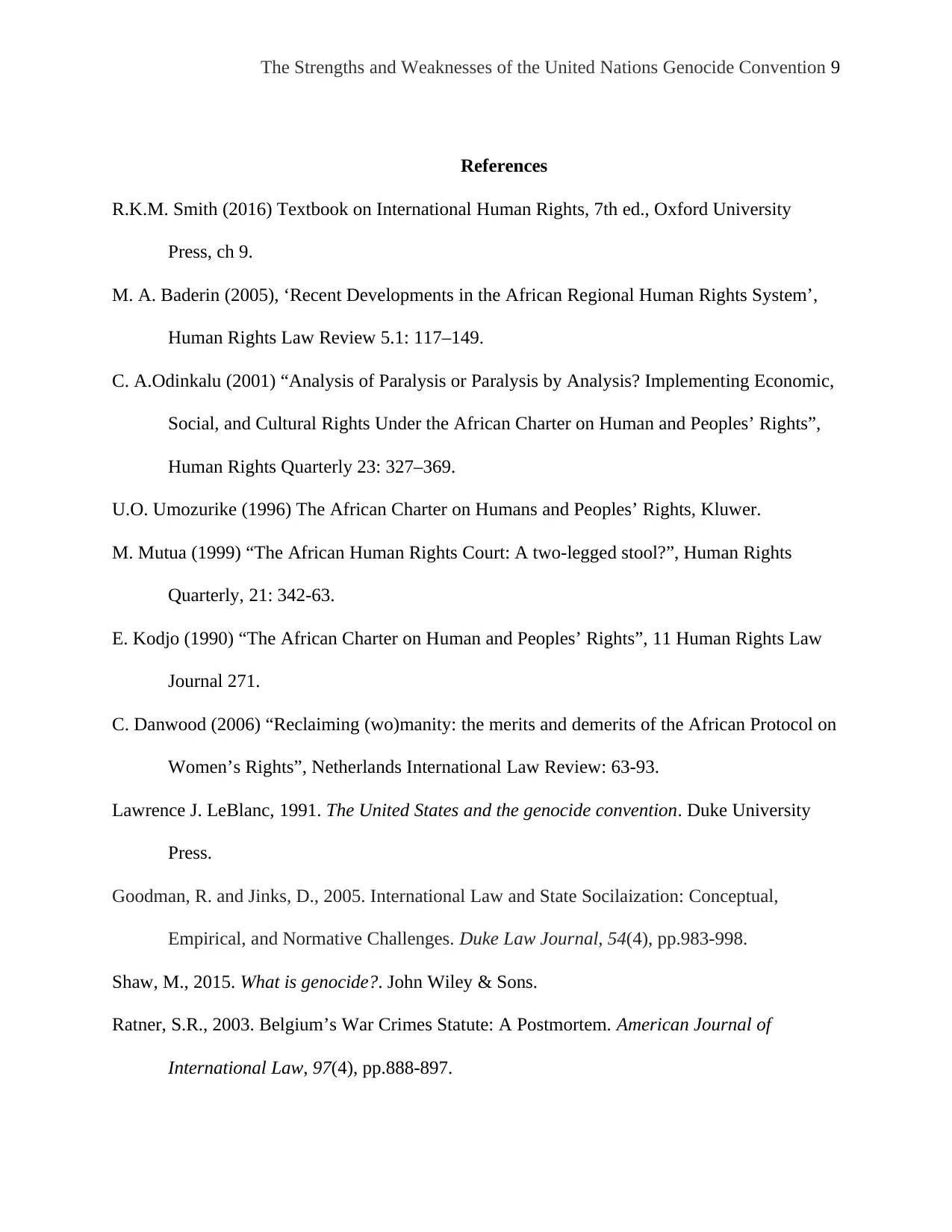
References
R.K.M. Smith (2016) Textbook on International Human Rights, 7th ed., Oxford University
Press, ch 9.
M. A. Baderin (2005), ‘Recent Developments in the African Regional Human Rights System’,
Human Rights Law Review 5.1: 117–149.
C. A.Odinkalu (2001) “Analysis of Paralysis or Paralysis by Analysis? Implementing Economic,
Social, and Cultural Rights Under the African Charter on Human and Peoples’ Rights”,
Human Rights Quarterly 23: 327–369.
U.O. Umozurike (1996) The African Charter on Humans and Peoples’ Rights, Kluwer.
M. Mutua (1999) “The African Human Rights Court: A two-legged stool?”, Human Rights
Quarterly, 21: 342-63.
E. Kodjo (1990) “The African Charter on Human and Peoples’ Rights”, 11 Human Rights Law
Journal 271.
C. Danwood (2006) “Reclaiming (wo)manity: the merits and demerits of the African Protocol on
Women’s Rights”, Netherlands International Law Review: 63-93.
Lawrence J. LeBlanc, 1991. The United States and the genocide convention. Duke University
Press.
Goodman, R. and Jinks, D., 2005. International Law and State Socilaization: Conceptual,
Empirical, and Normative Challenges. Duke Law Journal, 54(4), pp.983-998.
Shaw, M., 2015. What is genocide?. John Wiley & Sons.
Ratner, S.R., 2003. Belgium’s War Crimes Statute: A Postmortem. American Journal of
International Law, 97(4), pp.888-897.
References
R.K.M. Smith (2016) Textbook on International Human Rights, 7th ed., Oxford University
Press, ch 9.
M. A. Baderin (2005), ‘Recent Developments in the African Regional Human Rights System’,
Human Rights Law Review 5.1: 117–149.
C. A.Odinkalu (2001) “Analysis of Paralysis or Paralysis by Analysis? Implementing Economic,
Social, and Cultural Rights Under the African Charter on Human and Peoples’ Rights”,
Human Rights Quarterly 23: 327–369.
U.O. Umozurike (1996) The African Charter on Humans and Peoples’ Rights, Kluwer.
M. Mutua (1999) “The African Human Rights Court: A two-legged stool?”, Human Rights
Quarterly, 21: 342-63.
E. Kodjo (1990) “The African Charter on Human and Peoples’ Rights”, 11 Human Rights Law
Journal 271.
C. Danwood (2006) “Reclaiming (wo)manity: the merits and demerits of the African Protocol on
Women’s Rights”, Netherlands International Law Review: 63-93.
Lawrence J. LeBlanc, 1991. The United States and the genocide convention. Duke University
Press.
Goodman, R. and Jinks, D., 2005. International Law and State Socilaization: Conceptual,
Empirical, and Normative Challenges. Duke Law Journal, 54(4), pp.983-998.
Shaw, M., 2015. What is genocide?. John Wiley & Sons.
Ratner, S.R., 2003. Belgium’s War Crimes Statute: A Postmortem. American Journal of
International Law, 97(4), pp.888-897.
⊘ This is a preview!⊘
Do you want full access?
Subscribe today to unlock all pages.
Trusted by 1+ million students worldwide
The Strengths and Weaknesses of the United Nations Genocide Convention 10
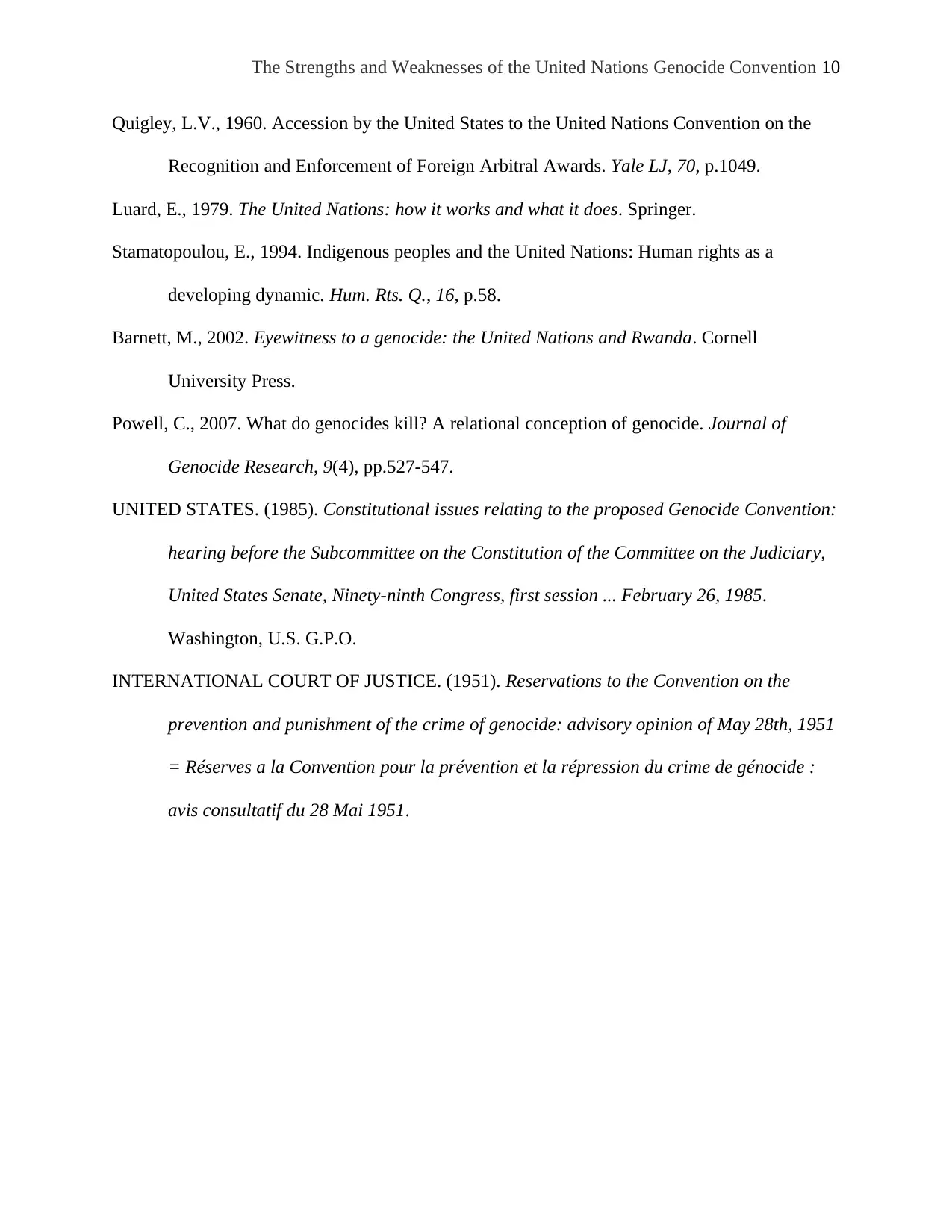
Quigley, L.V., 1960. Accession by the United States to the United Nations Convention on the
Recognition and Enforcement of Foreign Arbitral Awards. Yale LJ, 70, p.1049.
Luard, E., 1979. The United Nations: how it works and what it does. Springer.
Stamatopoulou, E., 1994. Indigenous peoples and the United Nations: Human rights as a
developing dynamic. Hum. Rts. Q., 16, p.58.
Barnett, M., 2002. Eyewitness to a genocide: the United Nations and Rwanda. Cornell
University Press.
Powell, C., 2007. What do genocides kill? A relational conception of genocide. Journal of
Genocide Research, 9(4), pp.527-547.
UNITED STATES. (1985). Constitutional issues relating to the proposed Genocide Convention:
hearing before the Subcommittee on the Constitution of the Committee on the Judiciary,
United States Senate, Ninety-ninth Congress, first session ... February 26, 1985.
Washington, U.S. G.P.O.
INTERNATIONAL COURT OF JUSTICE. (1951). Reservations to the Convention on the
prevention and punishment of the crime of genocide: advisory opinion of May 28th, 1951
= Réserves a la Convention pour la prévention et la répression du crime de génocide :
avis consultatif du 28 Mai 1951.
Quigley, L.V., 1960. Accession by the United States to the United Nations Convention on the
Recognition and Enforcement of Foreign Arbitral Awards. Yale LJ, 70, p.1049.
Luard, E., 1979. The United Nations: how it works and what it does. Springer.
Stamatopoulou, E., 1994. Indigenous peoples and the United Nations: Human rights as a
developing dynamic. Hum. Rts. Q., 16, p.58.
Barnett, M., 2002. Eyewitness to a genocide: the United Nations and Rwanda. Cornell
University Press.
Powell, C., 2007. What do genocides kill? A relational conception of genocide. Journal of
Genocide Research, 9(4), pp.527-547.
UNITED STATES. (1985). Constitutional issues relating to the proposed Genocide Convention:
hearing before the Subcommittee on the Constitution of the Committee on the Judiciary,
United States Senate, Ninety-ninth Congress, first session ... February 26, 1985.
Washington, U.S. G.P.O.
INTERNATIONAL COURT OF JUSTICE. (1951). Reservations to the Convention on the
prevention and punishment of the crime of genocide: advisory opinion of May 28th, 1951
= Réserves a la Convention pour la prévention et la répression du crime de génocide :
avis consultatif du 28 Mai 1951.

1 out of 10


Related Documents


Your All-in-One AI-Powered Toolkit for Academic Success.
+13062052269
info@desklib.com
Available 24*7 on WhatsApp / Email
![[object Object]](/_next/static/media/star-bottom.7253800d.svg)
Unlock your academic potential
Copyright © 2020–2026 A2Z Services. All Rights Reserved. Developed and managed by ZUCOL.