Assessment of Undernutrition in Young Children, Lahore, Pakistan
VerifiedAdded on 2022/11/01
|10
|1120
|230
Project
AI Summary
This project investigates undernutrition in children aged two years and below in Lahore, Pakistan, highlighting it as a leading cause of childhood mortality. The study employs a case-control design, with a sample of 100 cases and 200 controls at Children's Hospital, Lahore. It aims to determine the status of undernutrition, identify risk factors, and assess its socioeconomic and health impacts. The project will utilize a semi-structured questionnaire to collect data on weight, length, and wealth index, with data analysis performed using SPSS. Ethical considerations include informed consent, ethical approval, and confidentiality. The expected outcomes suggest associations between undernutrition, low literacy, and socioeconomic factors, with the potential to inform interventions like micronutrient supplementation programs and improved public health policies to combat childhood undernutrition. The project will be managed by one researcher, with support from hospital staff and the university’s ethical review committee, and aims to provide valuable insights into the prevalence and determinants of undernutrition in the target population.
Undernutrition in Children
aged 2 years and below in
Lahore, Pakistan
Presented by:
aged 2 years and below in
Lahore, Pakistan
Presented by:
Paraphrase This Document
Need a fresh take? Get an instant paraphrase of this document with our AI Paraphraser

Study duration
Project Summary
Rationale and Background
Study Goals and Objectives
Study Design and Methods
◦ Study Area
◦ Sampling Design
◦ Sample size considerations
◦ Data analysis
◦ Ethical considerations
◦ Study limitations
Study impact
Project management arrangements
Outline:
Project Summary
Rationale and Background
Study Goals and Objectives
Study Design and Methods
◦ Study Area
◦ Sampling Design
◦ Sample size considerations
◦ Data analysis
◦ Ethical considerations
◦ Study limitations
Study impact
Project management arrangements
Outline:

Undernutrition is one of the leading causes of childhood
mortality in developing countries.
Pakistan is experiencing childhood mortality due to
undernutrition at an alarming rate.
Multiple factors affect the nutritional status of children but
there is a dearth of information on undernutrition of children
aged two years and below, hence the need for this research.
Study area: Children Hospital in Lahore, Pakistan
Sampling design: case control study
Sample size: 100 cases and 200 controls
Data analysis: Descriptive and quantitative statistics
Ethical considerations: informed consent, ethical approval,
anonymity, confidentiality
Project Summary
mortality in developing countries.
Pakistan is experiencing childhood mortality due to
undernutrition at an alarming rate.
Multiple factors affect the nutritional status of children but
there is a dearth of information on undernutrition of children
aged two years and below, hence the need for this research.
Study area: Children Hospital in Lahore, Pakistan
Sampling design: case control study
Sample size: 100 cases and 200 controls
Data analysis: Descriptive and quantitative statistics
Ethical considerations: informed consent, ethical approval,
anonymity, confidentiality
Project Summary
⊘ This is a preview!⊘
Do you want full access?
Subscribe today to unlock all pages.

Trusted by 1+ million students worldwide

Undernutrition is the leading cause of child mortality globally especially
in developing countries
Childhood undernutrition causes 21 per cent of the total deaths in
children aged five years and below (Mokdad et al., 2016).
◦ 428 deaths per 100,000 caused by childhood undernutrition
Studies show poor childhood nutrition is associated with functional
impairment and slow cognitive development (Tariq, Sajjad, Zakar, Zakar,
& Fischer, 2018).
Pakistan experience high childhood mortality due to undernutrition
(Unicef, 2014,2013)
Multiple factors affect the nutritional status of children:
◦ maternal literacy, the use of healthcare services and financial status etc (Katepa-
Bwalya et al., 2015).
Most studies on childhood undernutrition have focused on children aged
5 years and considered few health factors;
◦ Hence the need for a study that considers a younger age because at an advanced
age the child is likely to develop permanent cognitive and physical impairment.
Rationale & Background
in developing countries
Childhood undernutrition causes 21 per cent of the total deaths in
children aged five years and below (Mokdad et al., 2016).
◦ 428 deaths per 100,000 caused by childhood undernutrition
Studies show poor childhood nutrition is associated with functional
impairment and slow cognitive development (Tariq, Sajjad, Zakar, Zakar,
& Fischer, 2018).
Pakistan experience high childhood mortality due to undernutrition
(Unicef, 2014,2013)
Multiple factors affect the nutritional status of children:
◦ maternal literacy, the use of healthcare services and financial status etc (Katepa-
Bwalya et al., 2015).
Most studies on childhood undernutrition have focused on children aged
5 years and considered few health factors;
◦ Hence the need for a study that considers a younger age because at an advanced
age the child is likely to develop permanent cognitive and physical impairment.
Rationale & Background
Paraphrase This Document
Need a fresh take? Get an instant paraphrase of this document with our AI Paraphraser

To ascertain the status of undernutrition in
children aged 2 years and below in Lahore,
Pakistan.
Detailed review of existing and relevant literature
will be carried out to determine the risk factors
for undernutrition, its socioeconomic and health
impact on children aged two years and below.
The research proposal will also be used to seek
for funding of the project from relevant
stakeholders such as the ministry of health of
Pakistan and non-governmental organizations.
Study Goals & Objectives
children aged 2 years and below in Lahore,
Pakistan.
Detailed review of existing and relevant literature
will be carried out to determine the risk factors
for undernutrition, its socioeconomic and health
impact on children aged two years and below.
The research proposal will also be used to seek
for funding of the project from relevant
stakeholders such as the ministry of health of
Pakistan and non-governmental organizations.
Study Goals & Objectives

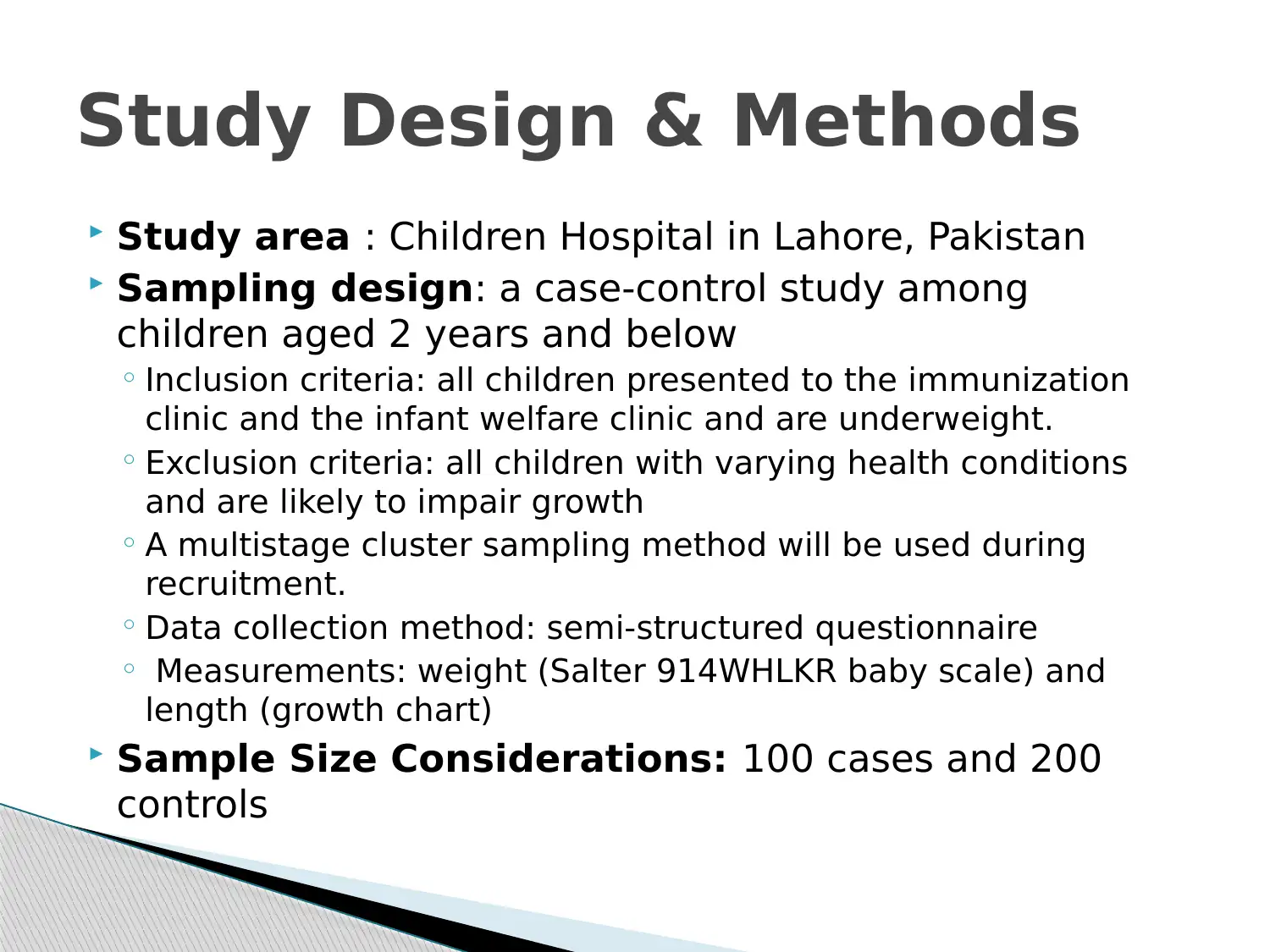
Study area : Children Hospital in Lahore, Pakistan
Sampling design: a case-control study among
children aged 2 years and below
◦ Inclusion criteria: all children presented to the immunization
clinic and the infant welfare clinic and are underweight.
◦ Exclusion criteria: all children with varying health conditions
and are likely to impair growth
◦ A multistage cluster sampling method will be used during
recruitment.
◦ Data collection method: semi-structured questionnaire
◦ Measurements: weight (Salter 914WHLKR baby scale) and
length (growth chart)
Sample Size Considerations: 100 cases and 200
controls
Study Design & Methods
Sampling design: a case-control study among
children aged 2 years and below
◦ Inclusion criteria: all children presented to the immunization
clinic and the infant welfare clinic and are underweight.
◦ Exclusion criteria: all children with varying health conditions
and are likely to impair growth
◦ A multistage cluster sampling method will be used during
recruitment.
◦ Data collection method: semi-structured questionnaire
◦ Measurements: weight (Salter 914WHLKR baby scale) and
length (growth chart)
Sample Size Considerations: 100 cases and 200
controls
Study Design & Methods
⊘ This is a preview!⊘
Do you want full access?
Subscribe today to unlock all pages.

Trusted by 1+ million students worldwide

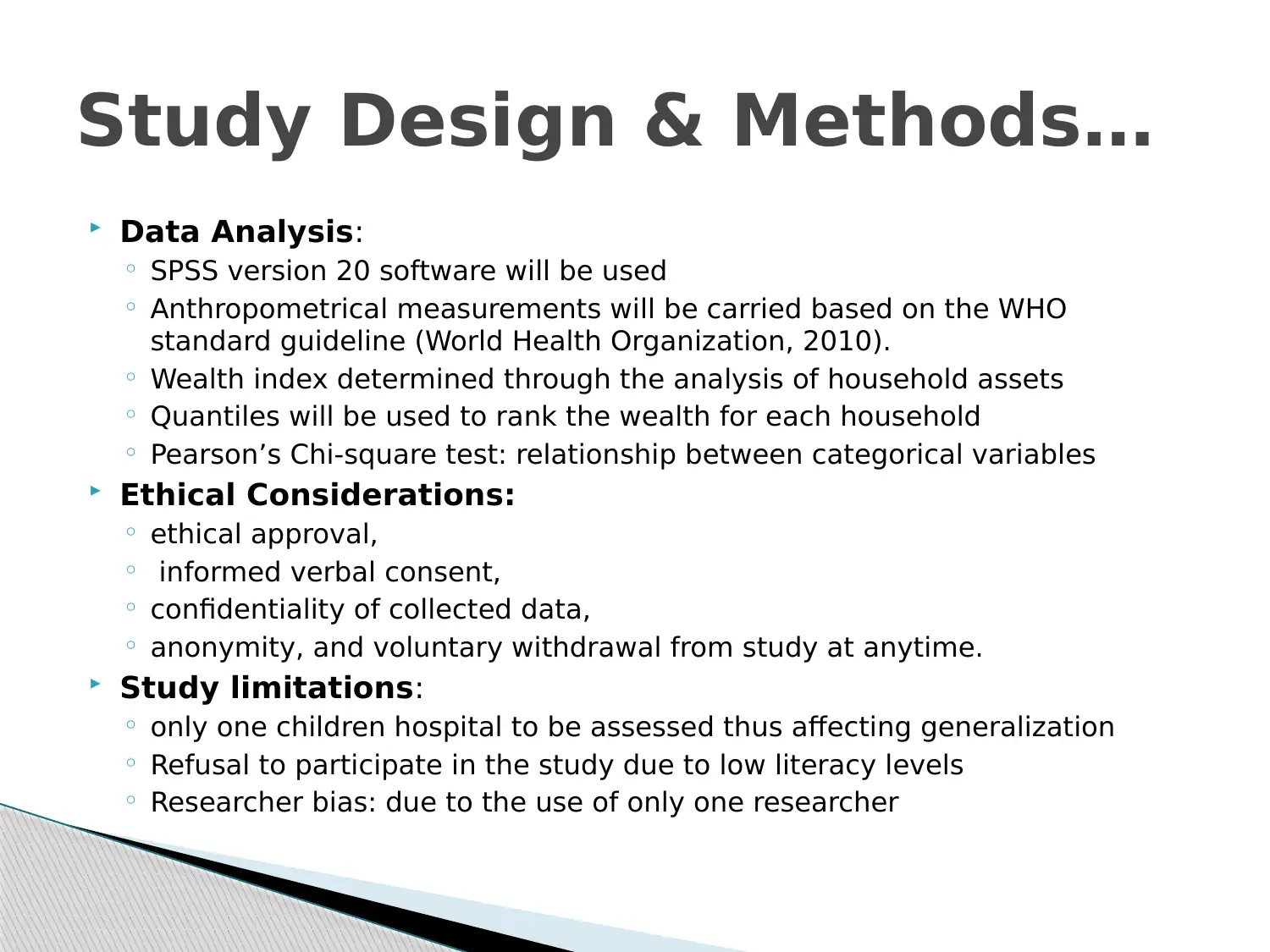
Data Analysis:
◦ SPSS version 20 software will be used
◦ Anthropometrical measurements will be carried based on the WHO
standard guideline (World Health Organization, 2010).
◦ Wealth index determined through the analysis of household assets
◦ Quantiles will be used to rank the wealth for each household
◦ Pearson’s Chi-square test: relationship between categorical variables
Ethical Considerations:
◦ ethical approval,
◦ informed verbal consent,
◦ confidentiality of collected data,
◦ anonymity, and voluntary withdrawal from study at anytime.
Study limitations:
◦ only one children hospital to be assessed thus affecting generalization
◦ Refusal to participate in the study due to low literacy levels
◦ Researcher bias: due to the use of only one researcher
Study Design & Methods…
◦ SPSS version 20 software will be used
◦ Anthropometrical measurements will be carried based on the WHO
standard guideline (World Health Organization, 2010).
◦ Wealth index determined through the analysis of household assets
◦ Quantiles will be used to rank the wealth for each household
◦ Pearson’s Chi-square test: relationship between categorical variables
Ethical Considerations:
◦ ethical approval,
◦ informed verbal consent,
◦ confidentiality of collected data,
◦ anonymity, and voluntary withdrawal from study at anytime.
Study limitations:
◦ only one children hospital to be assessed thus affecting generalization
◦ Refusal to participate in the study due to low literacy levels
◦ Researcher bias: due to the use of only one researcher
Study Design & Methods…
Paraphrase This Document
Need a fresh take? Get an instant paraphrase of this document with our AI Paraphraser

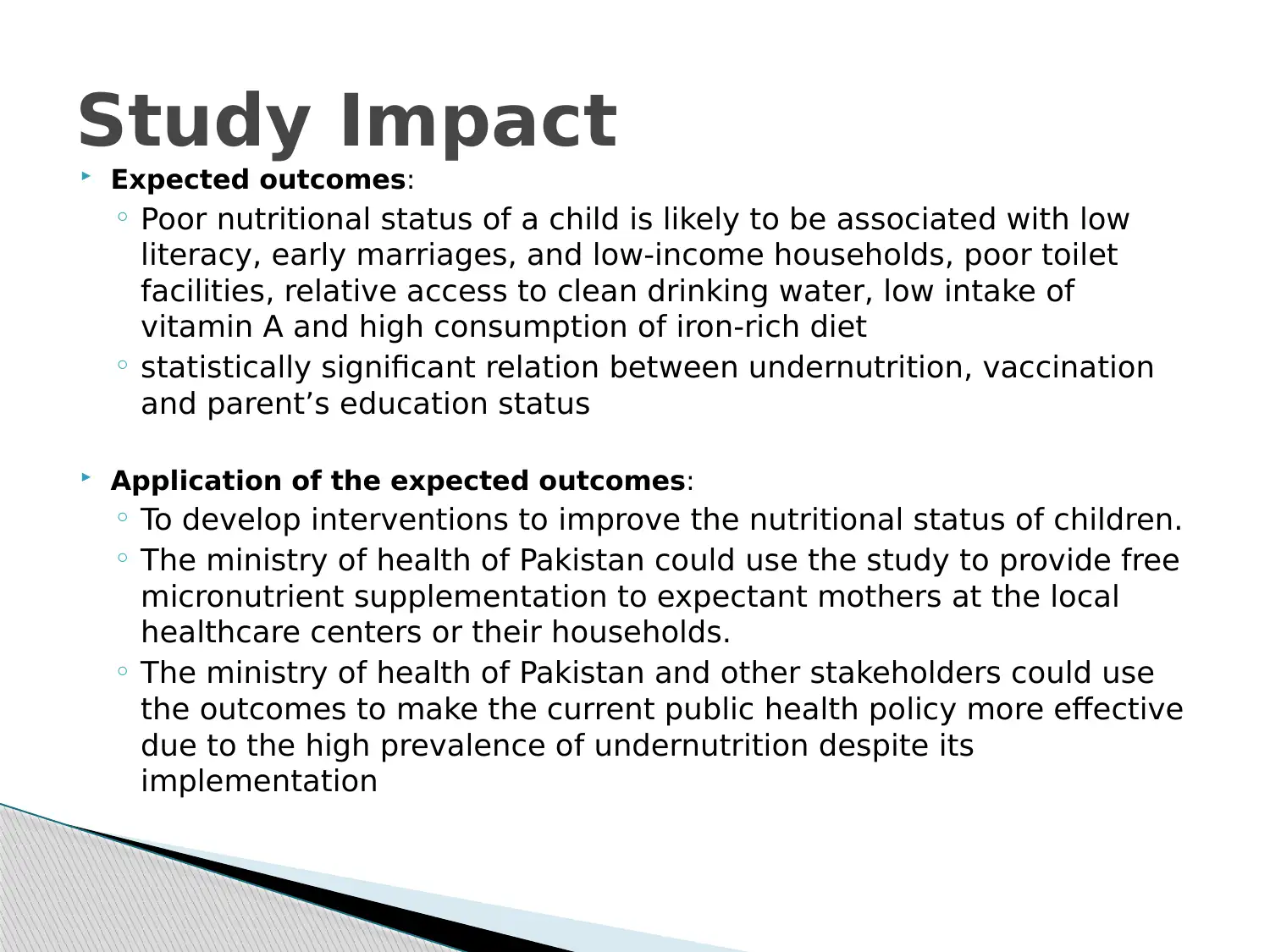
Expected outcomes:
◦ Poor nutritional status of a child is likely to be associated with low
literacy, early marriages, and low-income households, poor toilet
facilities, relative access to clean drinking water, low intake of
vitamin A and high consumption of iron-rich diet
◦ statistically significant relation between undernutrition, vaccination
and parent’s education status
Application of the expected outcomes:
◦ To develop interventions to improve the nutritional status of children.
◦ The ministry of health of Pakistan could use the study to provide free
micronutrient supplementation to expectant mothers at the local
healthcare centers or their households.
◦ The ministry of health of Pakistan and other stakeholders could use
the outcomes to make the current public health policy more effective
due to the high prevalence of undernutrition despite its
implementation
Study Impact
◦ Poor nutritional status of a child is likely to be associated with low
literacy, early marriages, and low-income households, poor toilet
facilities, relative access to clean drinking water, low intake of
vitamin A and high consumption of iron-rich diet
◦ statistically significant relation between undernutrition, vaccination
and parent’s education status
Application of the expected outcomes:
◦ To develop interventions to improve the nutritional status of children.
◦ The ministry of health of Pakistan could use the study to provide free
micronutrient supplementation to expectant mothers at the local
healthcare centers or their households.
◦ The ministry of health of Pakistan and other stakeholders could use
the outcomes to make the current public health policy more effective
due to the high prevalence of undernutrition despite its
implementation
Study Impact

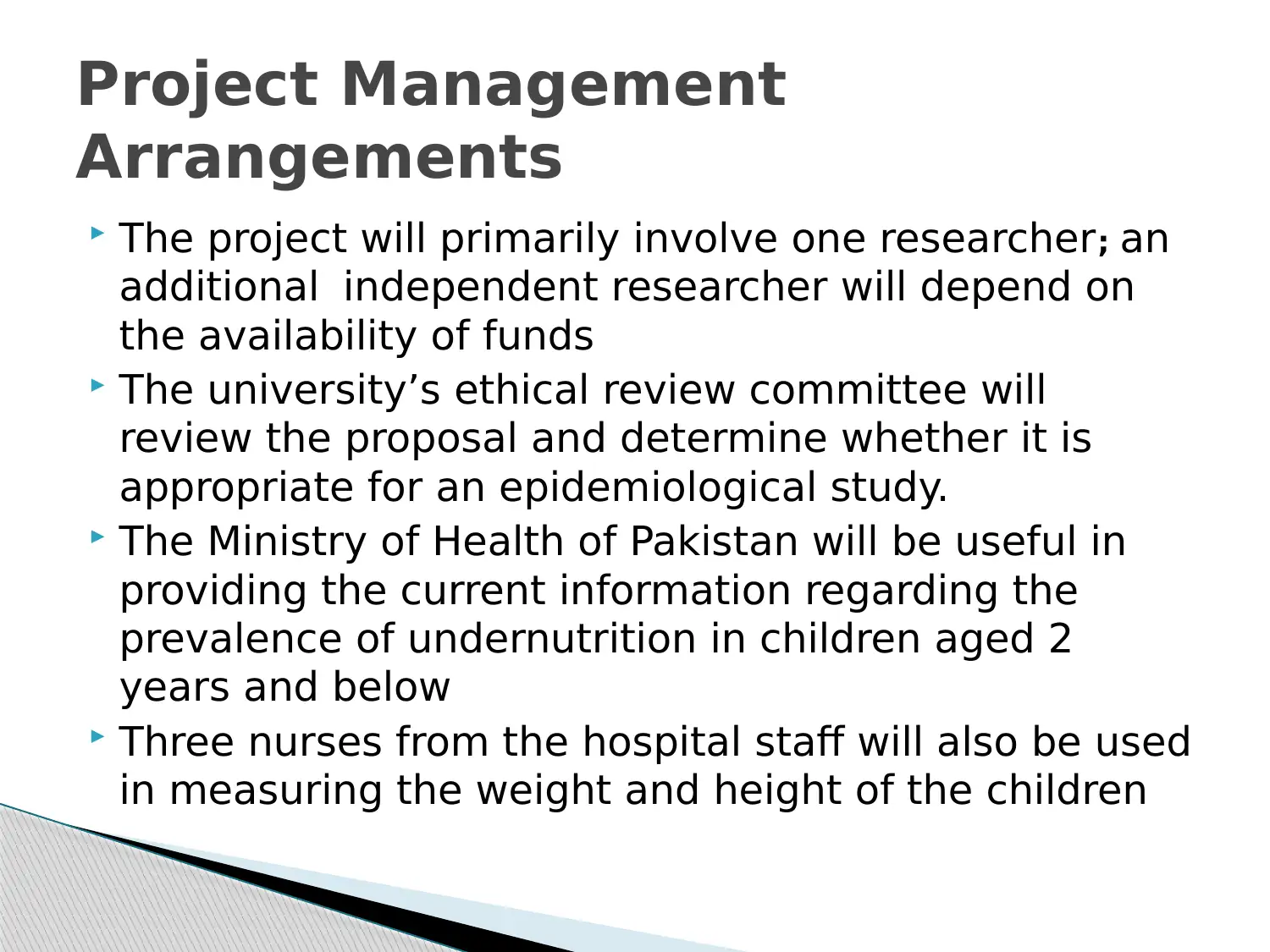
The project will primarily involve one researcher; an
additional independent researcher will depend on
the availability of funds
The university’s ethical review committee will
review the proposal and determine whether it is
appropriate for an epidemiological study.
The Ministry of Health of Pakistan will be useful in
providing the current information regarding the
prevalence of undernutrition in children aged 2
years and below
Three nurses from the hospital staff will also be used
in measuring the weight and height of the children
Project Management
Arrangements
additional independent researcher will depend on
the availability of funds
The university’s ethical review committee will
review the proposal and determine whether it is
appropriate for an epidemiological study.
The Ministry of Health of Pakistan will be useful in
providing the current information regarding the
prevalence of undernutrition in children aged 2
years and below
Three nurses from the hospital staff will also be used
in measuring the weight and height of the children
Project Management
Arrangements
⊘ This is a preview!⊘
Do you want full access?
Subscribe today to unlock all pages.

Trusted by 1+ million students worldwide

Katepa-Bwalya, M., Mukonka, V., Kankasa, C., Masaninga, F., Babaniyi, O., & Siziya, S.
(2015). Infants and young children feeding practices and nutritional status in two
districts of Zambia. International breastfeeding journal, 10(1), 5.
Mokdad, A. H., Forouzanfar, M. H., Daoud, F., El Bcheraoui, C., Moradi-Lakeh, M.,
Khalil, I.,
... & Wagner, J. (2016). Health in times of uncertainty in the eastern
Mediterranean region, 1990–2013: a systematic analysis for the Global
Burden of Disease Study 2013. The Lancet Global Health, 4(10), e704-
e713.
Tariq, J., Sajjad, A., Zakar, R., Zakar, M. Z., & Fischer, F. (2018). Factors Associated
with Undernutrition in Children under the Age of Two Years: Secondary Data
Analysis Based on the Pakistan Demographic and Health Survey
2012⁻2013. Nutrients, 10(6), 676. doi:10.3390/nu10060676
UNICEF, U. (2013). The right ingredients: The need to invest in child
nutrition. UNICEF: London, UK.
Unicef. (2014). Pakistan Annual Report 2013. Islamabad, Pakistan: UNICEF Pakistan.
World Health Organization. (2010). Indicators for assessing infant and young child
feeding practices: part 2: measurement. WHO Press; Geneva, Switzerland.
References
(2015). Infants and young children feeding practices and nutritional status in two
districts of Zambia. International breastfeeding journal, 10(1), 5.
Mokdad, A. H., Forouzanfar, M. H., Daoud, F., El Bcheraoui, C., Moradi-Lakeh, M.,
Khalil, I.,
... & Wagner, J. (2016). Health in times of uncertainty in the eastern
Mediterranean region, 1990–2013: a systematic analysis for the Global
Burden of Disease Study 2013. The Lancet Global Health, 4(10), e704-
e713.
Tariq, J., Sajjad, A., Zakar, R., Zakar, M. Z., & Fischer, F. (2018). Factors Associated
with Undernutrition in Children under the Age of Two Years: Secondary Data
Analysis Based on the Pakistan Demographic and Health Survey
2012⁻2013. Nutrients, 10(6), 676. doi:10.3390/nu10060676
UNICEF, U. (2013). The right ingredients: The need to invest in child
nutrition. UNICEF: London, UK.
Unicef. (2014). Pakistan Annual Report 2013. Islamabad, Pakistan: UNICEF Pakistan.
World Health Organization. (2010). Indicators for assessing infant and young child
feeding practices: part 2: measurement. WHO Press; Geneva, Switzerland.
References
1 out of 10
Related Documents
Your All-in-One AI-Powered Toolkit for Academic Success.
+13062052269
info@desklib.com
Available 24*7 on WhatsApp / Email
Unlock your academic potential
Copyright © 2020–2025 A2Z Services. All Rights Reserved. Developed and managed by ZUCOL.