Understanding Intrapersonal Communication: Theories and Examples

Verified

Added on  2023/06/08

|5
|1091
|291
Essay
AI Summary
This essay delves into the concept of intrapersonal communication, exploring key theories such as balance theory, cognitive dissonance theory, and inoculation theory to understand its intricacies. Intrapersonal communication is defined as the use of language and thought within oneself, involving a sender, receiver, and feedback loop for clarifying ideas and situations. The essay highlights the importance of self-concept, encompassing beliefs, values, and attitudes, in shaping intrapersonal communication. Through personal examples, the essay illustrates how these theories manifest in real-life scenarios, such as maintaining friendships based on shared perceptions and managing cross-cultural employee relations. The conclusion emphasizes the role of effective communication, driven by intrapersonal understanding, in both personal and professional contexts, underscoring its significance in today's diverse society and business environment.

Document Page
Running head: INDIVIDUAL AND GROUP SKILLS
INDIVIDUAL AND GROUP SKILLS
Name of the student
Name of the University
Author’s note
tabler-icon-diamond-filled.svg

Paraphrase This Document

Need a fresh take? Get an instant paraphrase of this document with our AI Paraphraser
Document Page
1INDIVIDUAL AND GROUP SKILLS
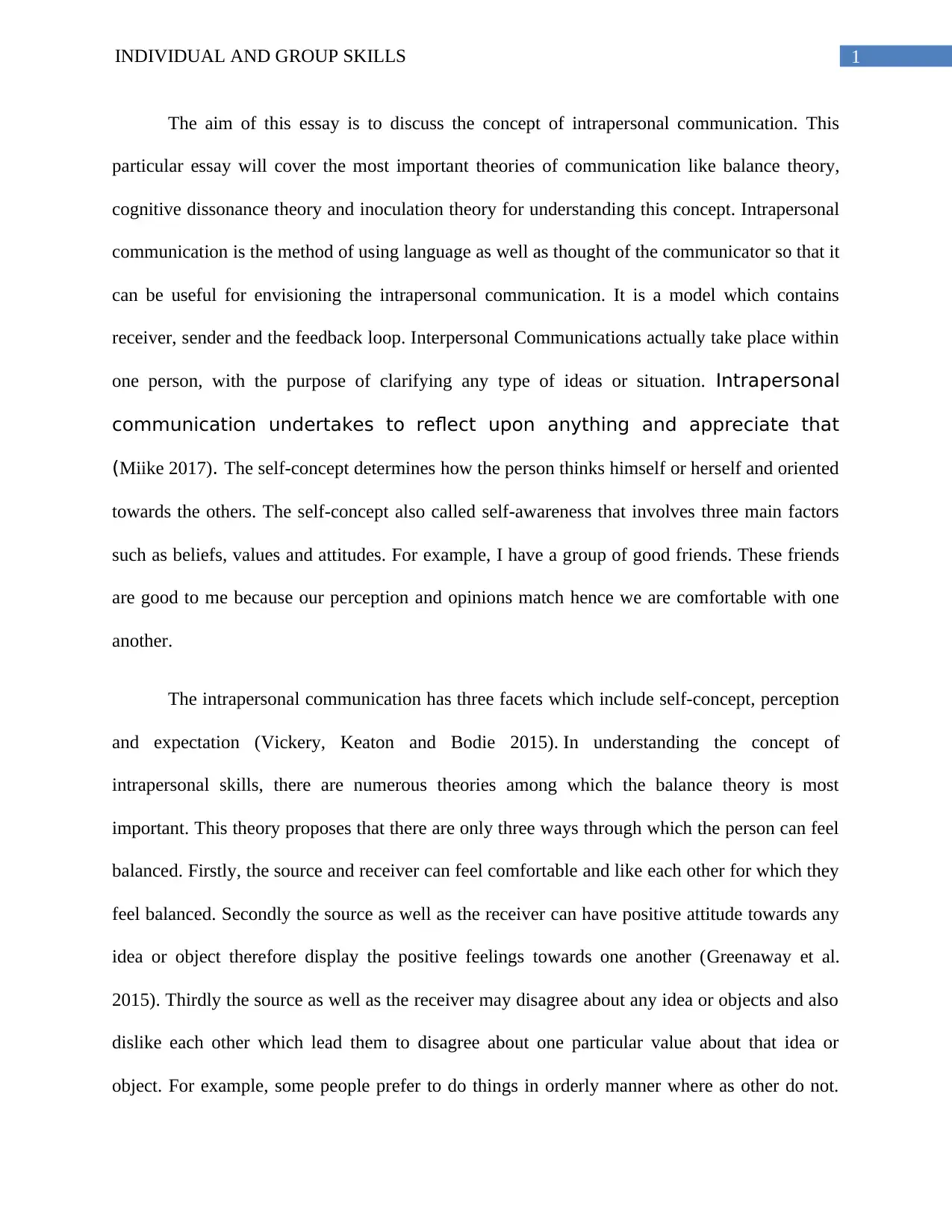
The aim of this essay is to discuss the concept of intrapersonal communication. This
particular essay will cover the most important theories of communication like balance theory,
cognitive dissonance theory and inoculation theory for understanding this concept. Intrapersonal
communication is the method of using language as well as thought of the communicator so that it
can be useful for envisioning the intrapersonal communication. It is a model which contains
receiver, sender and the feedback loop. Interpersonal Communications actually take place within
one person, with the purpose of clarifying any type of ideas or situation. Intrapersonal
communication undertakes to reflect upon anything and appreciate that
(Miike 2017). The self-concept determines how the person thinks himself or herself and oriented
towards the others. The self-concept also called self-awareness that involves three main factors
such as beliefs, values and attitudes. For example, I have a group of good friends. These friends
are good to me because our perception and opinions match hence we are comfortable with one
another.
The intrapersonal communication has three facets which include self-concept, perception
and expectation (Vickery, Keaton and Bodie 2015). In understanding the concept of
intrapersonal skills, there are numerous theories among which the balance theory is most
important. This theory proposes that there are only three ways through which the person can feel
balanced. Firstly, the source and receiver can feel comfortable and like each other for which they
feel balanced. Secondly the source as well as the receiver can have positive attitude towards any
idea or object therefore display the positive feelings towards one another (Greenaway et al.
2015). Thirdly the source as well as the receiver may disagree about any idea or objects and also
dislike each other which lead them to disagree about one particular value about that idea or
object. For example, some people prefer to do things in orderly manner where as other do not.
Document Page
2INDIVIDUAL AND GROUP SKILLS
Therefore, it can be said that intrapersonal communication takes place in these two groups
as they manage their attitude of preferring orderliness in everything thus bring balance.
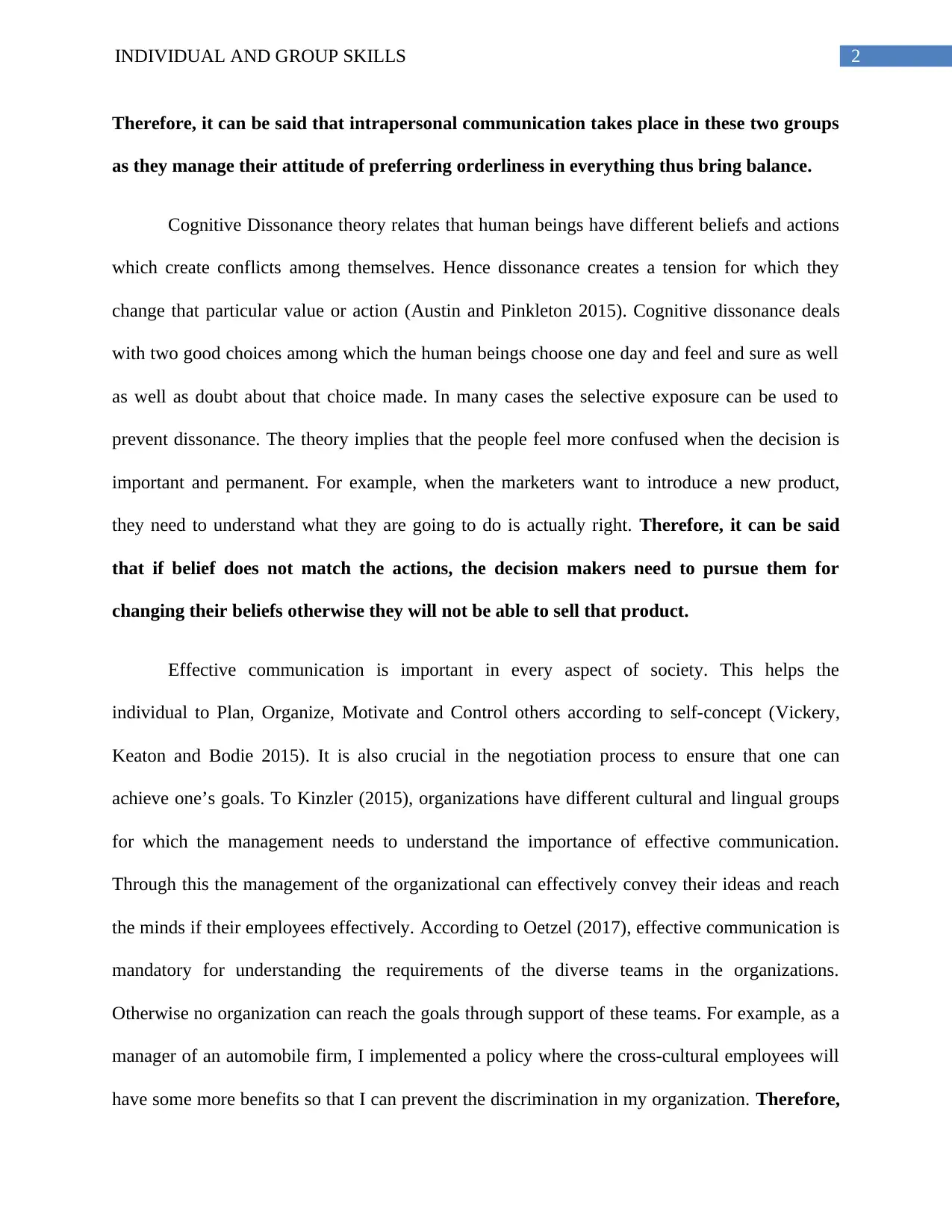
Cognitive Dissonance theory relates that human beings have different beliefs and actions
which create conflicts among themselves. Hence dissonance creates a tension for which they
change that particular value or action (Austin and Pinkleton 2015). Cognitive dissonance deals
with two good choices among which the human beings choose one day and feel and sure as well
as well as doubt about that choice made. In many cases the selective exposure can be used to
prevent dissonance. The theory implies that the people feel more confused when the decision is
important and permanent. For example, when the marketers want to introduce a new product,
they need to understand what they are going to do is actually right. Therefore, it can be said
that if belief does not match the actions, the decision makers need to pursue them for
changing their beliefs otherwise they will not be able to sell that product.
Effective communication is important in every aspect of society. This helps the
individual to Plan, Organize, Motivate and Control others according to self-concept (Vickery,
Keaton and Bodie 2015). It is also crucial in the negotiation process to ensure that one can
achieve one’s goals. To Kinzler (2015), organizations have different cultural and lingual groups
for which the management needs to understand the importance of effective communication.
Through this the management of the organizational can effectively convey their ideas and reach
the minds if their employees effectively. According to Oetzel (2017), effective communication is
mandatory for understanding the requirements of the diverse teams in the organizations.
Otherwise no organization can reach the goals through support of these teams. For example, as a
manager of an automobile firm, I implemented a policy where the cross-cultural employees will
have some more benefits so that I can prevent the discrimination in my organization. Therefore,
Document Page
3INDIVIDUAL AND GROUP SKILLS
it can be stated that without effective communication style I would not have convey my
ideas thus create issues.
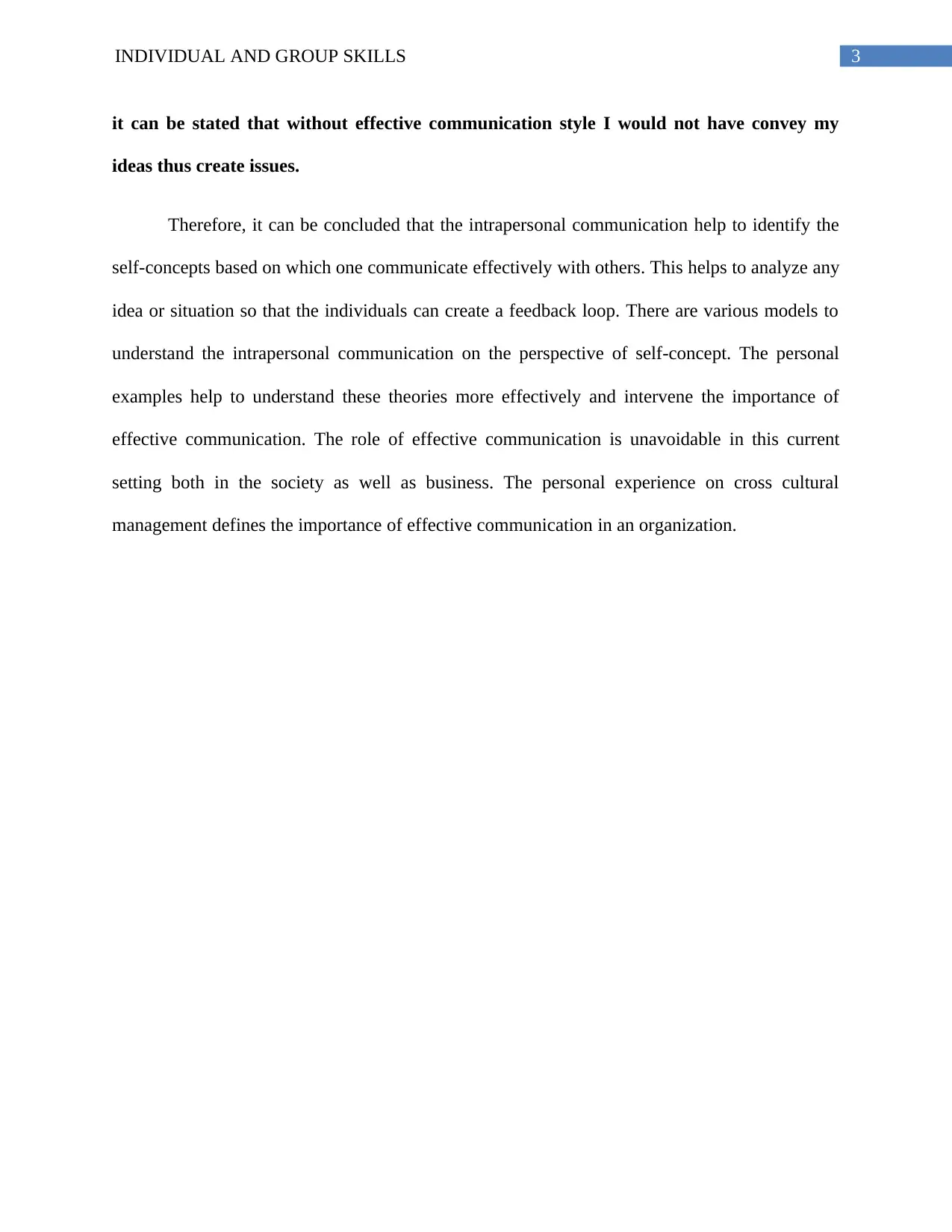
Therefore, it can be concluded that the intrapersonal communication help to identify the
self-concepts based on which one communicate effectively with others. This helps to analyze any
idea or situation so that the individuals can create a feedback loop. There are various models to
understand the intrapersonal communication on the perspective of self-concept. The personal
examples help to understand these theories more effectively and intervene the importance of
effective communication. The role of effective communication is unavoidable in this current
setting both in the society as well as business. The personal experience on cross cultural
management defines the importance of effective communication in an organization.
tabler-icon-diamond-filled.svg

Paraphrase This Document

Need a fresh take? Get an instant paraphrase of this document with our AI Paraphraser
Document Page
4INDIVIDUAL AND GROUP SKILLS
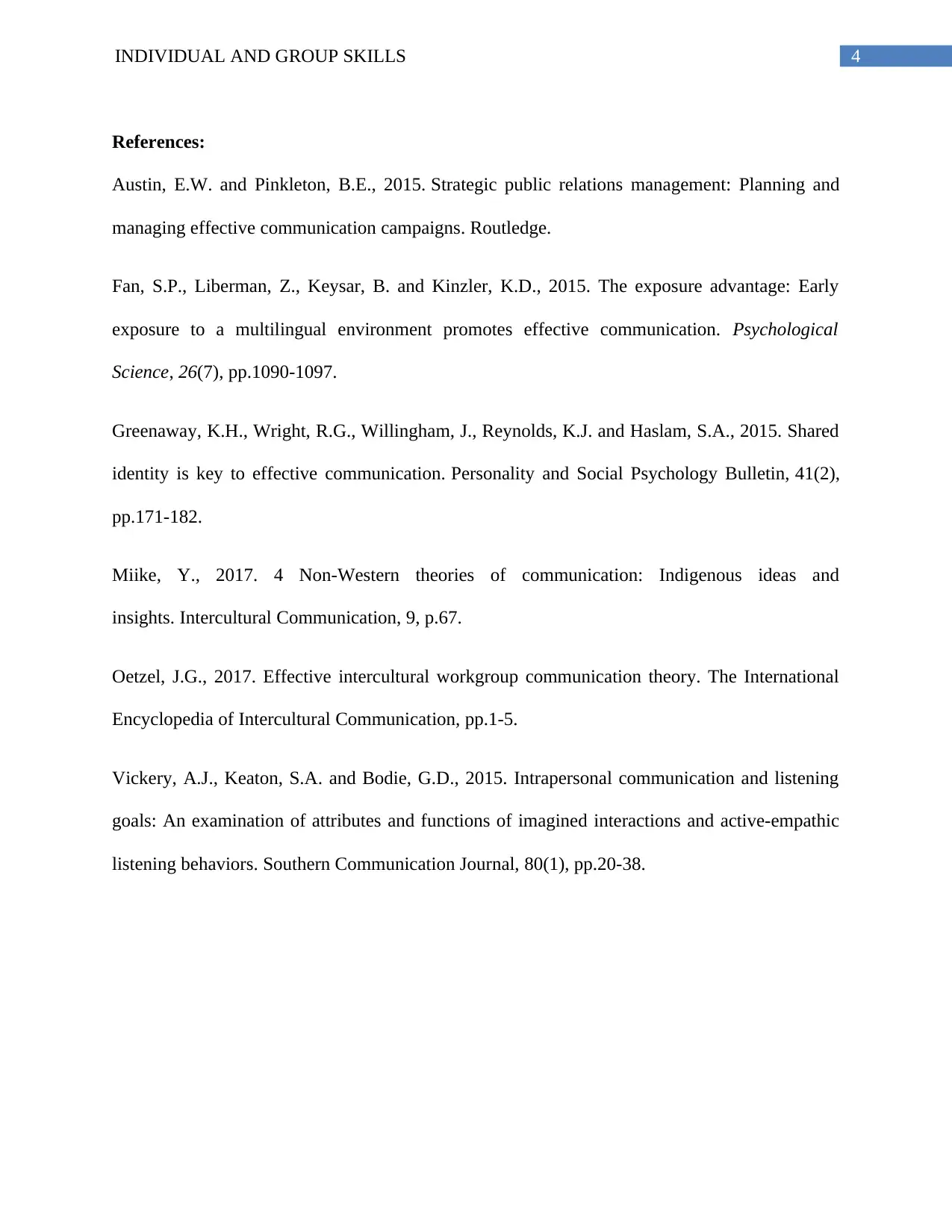
References:
Austin, E.W. and Pinkleton, B.E., 2015. Strategic public relations management: Planning and
managing effective communication campaigns. Routledge.
Fan, S.P., Liberman, Z., Keysar, B. and Kinzler, K.D., 2015. The exposure advantage: Early
exposure to a multilingual environment promotes effective communication. Psychological
Science, 26(7), pp.1090-1097.
Greenaway, K.H., Wright, R.G., Willingham, J., Reynolds, K.J. and Haslam, S.A., 2015. Shared
identity is key to effective communication. Personality and Social Psychology Bulletin, 41(2),
pp.171-182.
Miike, Y., 2017. 4 Non-Western theories of communication: Indigenous ideas and
insights. Intercultural Communication, 9, p.67.
Oetzel, J.G., 2017. Effective intercultural workgroup communication theory. The International
Encyclopedia of Intercultural Communication, pp.1-5.
Vickery, A.J., Keaton, S.A. and Bodie, G.D., 2015. Intrapersonal communication and listening
goals: An examination of attributes and functions of imagined interactions and active-empathic
listening behaviors. Southern Communication Journal, 80(1), pp.20-38.
chevron_up_icon
1 out of 5
circle_padding
hide_on_mobile
zoom_out_icon
[object Object]