Comprehensive Report: Understanding the Counselling Process Steps

Verified

Added on  2023/05/31

|9
|1635
|70
Report
AI Summary
This report provides a detailed overview of the counselling process, outlining the key steps involved, including relationship building, problem assessment, goal setting, intervention, and evaluation. It emphasizes the importance of various counselling skills such as active listening, asking open-ended questions, reflection, empathy, genuineness, and unconditional positive regard. The report also touches upon different counselling theories like psychoanalytic therapy, person-centered therapy, and cognitive behavioral therapy, highlighting their unique approaches to addressing client issues. The conclusion underscores the significance of a strong client-counselor relationship in empowering clients and achieving their mental health goals, advocating for the use of intentional counselling techniques to understand human nature and promote optimal mental well-being. Desklib provides many similar solved assignments for students.
Document Page
The process of counselling
tabler-icon-diamond-filled.svg

Paraphrase This Document

Need a fresh take? Get an instant paraphrase of this document with our AI Paraphraser
Document Page
Contents
Introduction......................................................................................................................................1
Steps in Counselling Process...........................................................................................................1
Counselling Skills............................................................................................................................3
Counselling Theories.......................................................................................................................5
Conclusion.......................................................................................................................................5
References........................................................................................................................................6
Document Page
Introduction
The counselling process is considered to be a planned structure with the dialogues that are
mainly in between the counselor and the client. The cooperative process is about trained
professionals who are helping a person to identify different difficulties and concerns that one is
experiencing. The development of ways is mainly to deal with problems so that the different and
new skills could be understood for oneself and others. For example, the students in a college or
the university are generally seen to be anxious about how the study and have a lack of clarity for
the educational and the career direction. They have concerns with their self-esteem and so the
counselling process is important for building relationship, with setting goals and other
intervention processes.
Steps in Counselling Process
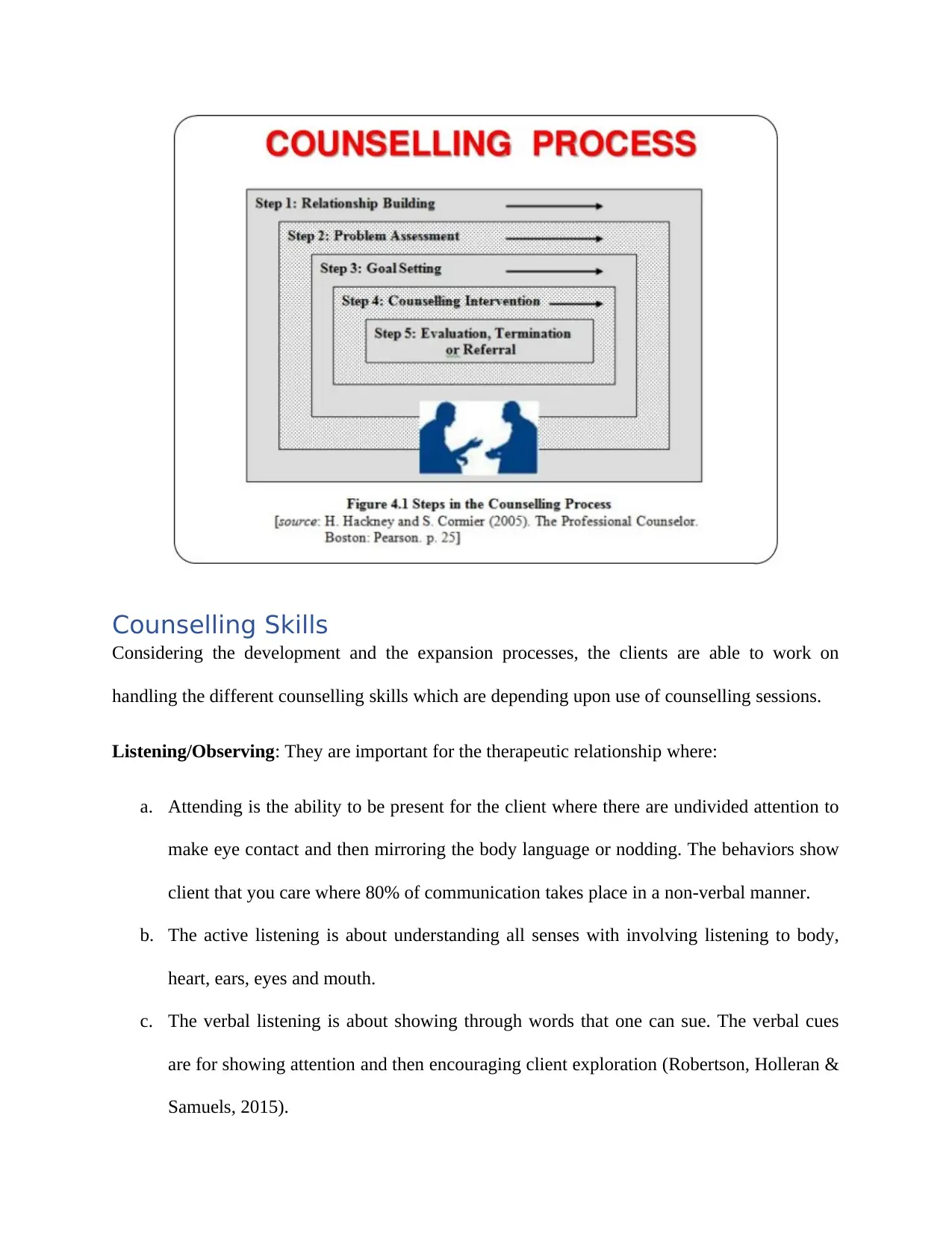
a. Relationship Building: This involves the focus on engaging the clients and exploring
issues that directly affect them. The interviews are mainly for handling what client is
reading like the verbal and the non-verbal message with making inferences about the
counselling situations. There is a need to introduce yourself with inviting client to sit
down and ensuring that the client is comfortable as well. The invitations are for the social
conversations that are mainly to reduce the anxiety and watch non-verbal behavior as
signs for the emotional state of client (Wosket, 2016).
b. Problem Assessment: It is the time when the counselor and the client are trying to build a
relationship and then problem assessment with proper collection and classification of
information for client life situation and the reasons which are seeking counselling.
c. Goal Setting: The activities focus on the outcomes where the client needs to achieve what
they are looking for (Verwey et al., 2016). There are times when the counselor and the
Document Page
clients are complaining about the counselling sessions and there are goals which play
important role for giving a particular direction. The goals are defined through explicit and
measured terms that have to be feasible within the range of counsellor knowledge and
skills.
d. Intervention: There are different views that concerns about what a counselor needs to do
with the clients, as per the theoretical positions. The example is about handling person
centered approach that suggest about whether the counselor needs to be involved rather
than intervening by placing emphasis on relationship. The attempts for behavioral
approach is to initiate activities that helps in altering of behavior (Parayil & George,
2016).
e. Evaluation follow up and the termination: This is when the counselor needs to think
about handling the process of counselling and termination with concern related to
successful termination as well. The termination of counselling process will also be
conducted through sensitivity with clients. There is a need to plan for different
possibilities for future needs where termination is considered not only at the end of a
relationship but also where the counselling is not helpful. The role is to review progress
with creating closure in the client counselor (McMahon, 2016).
tabler-icon-diamond-filled.svg

Paraphrase This Document

Need a fresh take? Get an instant paraphrase of this document with our AI Paraphraser
Document Page
Counselling Skills
Considering the development and the expansion processes, the clients are able to work on
handling the different counselling skills which are depending upon use of counselling sessions.
Listening/Observing: They are important for the therapeutic relationship where:
a. Attending is the ability to be present for the client where there are undivided attention to
make eye contact and then mirroring the body language or nodding. The behaviors show
client that you care where 80% of communication takes place in a non-verbal manner.
b. The active listening is about understanding all senses with involving listening to body,
heart, ears, eyes and mouth.
c. The verbal listening is about showing through words that one can sue. The verbal cues
are for showing attention and then encouraging client exploration (Robertson, Holleran &
Samuels, 2015).
Document Page
Asking Questions: The questions are important for the therapeutic environment where one needs
to allow and learn more for the client details. It includes different questions which one may ask
and then set the tone of the sessions with counselling processes. The questions generally occur in
the form of:
a. Closed: This is when the practice is about answering a yes or a no. The closed questions
are generally seen to be avoided where they do not support any exploration which is
deep.
b. Open: The gathering of information and the one which is not considered/answered in a
yes or no, requires a proper reflection or client end exploration is called as open case. The
open cases and questions are intentional and therapeutic (McLeod, 2011).
Reflection: They are mainly used for handling the counselling processes that are helpful in
describing about the state of client which comes from the cues of verbal and the non-verbal
standards.
a. Feelings reflections: This is for allowing the clients to properly hear about the
expressions. Here, one needs to focus on descriptive feeling for a statement of client. This
also includes helpful factors to look at the non-verbal feeling at a client cue.
b. Restating or rephrasing: This is mainly for allowing the client with better relationship and
then allowing one to understand about what the client has said along with gaining clarity.
c. Affirmations: The encouragement comes with affirming behaviors and allowing
empowering of clients. The affirmation process includes client progress with goals that
are for encouraging clients to do what is important.
Document Page
Empathy: The ability to put oneself in other’s shoes. It is about sympathy and showing
understanding for what client is feeling.
Genuineness: The genuine factors are related to creating a congruence which is mainly in
between oneself and the words. The therapists are different to provide Genuity that includes
counselling techniques with verbal and non-verbal cues (Aguilar & Moreno, 2017).
Unconditional Positive Regards: There is a need to demonstrate the unconditional positive
regards where the idea is to accept the clients for who they are and how are they able to express
warmth with respect.
Counselor Self-Disclosure: The counselling skills are for maneuvering, where the generally
rules are followed to share the personal information.
Counselling Theories
Psychoanalytic Therapy: this is for supporting the idea of driving human actions. It includes
dream analysis, with free association and the resistance analysis.
Person Centered Therapy: This theory is defined in the form of psychotherapy which is based
on operating assumptions where human beings are able to fulfill the potential. The client
centered approach is about self-actualization, empathy and then defining the unconditional
positive regards.
Cognitive Behavioral Therapy: This is a short-term approach with practices that human
problems stem from the different faulty patterns of thinking. Here, the involvement is of
automatic thinking and negative thought patterns as well (Beaumont, Hickey, McAndrew,
Goldman & Warne, 2016).
tabler-icon-diamond-filled.svg

Paraphrase This Document

Need a fresh take? Get an instant paraphrase of this document with our AI Paraphraser
Document Page
Conclusion
Counselling is mainly about creating a stronger relationship with the client that will help in
empowering them. It will help in obtaining a mental health with fulfillment of the goals. There is
a proper use of the intentional counseling techniques to understand the human nature that is
through counseling theories and then obtaining optimal mental satisfaction.
References
Aguilar, M. F. G., & Moreno, M. S. (2017). Chilean educational centers and the external
counselling process: A look from the perspective of its protagonists. education policy
analysis archives, 25, 77.
Beaumont, E., Hickey, A. J., McAndrew, S., Goldman, S., & Warne, T. (2016). Minding the
gaps: Using narrative accounts to explore people's experiences of using North Staffs
MIND's Adult Counselling Service. Counselling and Psychotherapy Research, 16(4), 298-
306.
McLeod, J. (2011). Qualitative research in counselling and psychotherapy. Sage.
McMahon, M. (Ed.). (2016). Career counselling: Constructivist approaches. Routledge.
Parayil, T. J., & George, T. S. (2016). On the Question of Integrating Spirituality with
Counselling in India. Artha-Journal of Social Sciences, 15(1), 35-57.
Robertson, L. H., Holleran, K., & Samuels, M. (2015). Tailoring University Counselling
Services to Aboriginal and International Students: Lessons from Native and International
Student Centres at a Canadian University. Canadian Journal of Higher Education, 45(1),
122-135.
Document Page
Verwey, R., Van der Weegen, S., Spreeuwenberg, M., Tange, H., Van der Weijden, T., & De
Witte, L. (2016). Process evaluation of physical activity counselling with and without the
use of mobile technology: a mixed methods study. International journal of nursing
studies, 53, 3-16.
Wosket, V. (2016). The therapeutic use of self: Counselling practice, research and supervision.
Routledge.
chevron_up_icon
1 out of 9
circle_padding
hide_on_mobile
zoom_out_icon
[object Object]