Happiness: An Exploration Through Positive Psychology Techniques

Verified

Added on  2021/11/18

|8
|2179
|76
Essay
AI Summary
This essay delves into the multifaceted concept of happiness, exploring its various definitions and categorizations, including hedonic and eudaimonic perspectives. It emphasizes the role of positive psychology, as defined by Seligman and Csikszentmihalyi, in understanding and promoting well-being. The essay highlights the application of positive psychology interventions, such as gratitude and counselling techniques, across different contexts like children, families, and career development. It discusses how these interventions can enhance self-esteem, relationships, and overall life satisfaction. The essay concludes by asserting the importance of positive psychology in fostering long-lasting behavioural changes and promoting a fulfilling life, emphasizing the value of counselling and coaching in achieving these goals. The essay also references several studies and researches to support the arguments.

Document Page
PSYCHOLOGY
tabler-icon-diamond-filled.svg

Paraphrase This Document

Need a fresh take? Get an instant paraphrase of this document with our AI Paraphraser
Document Page
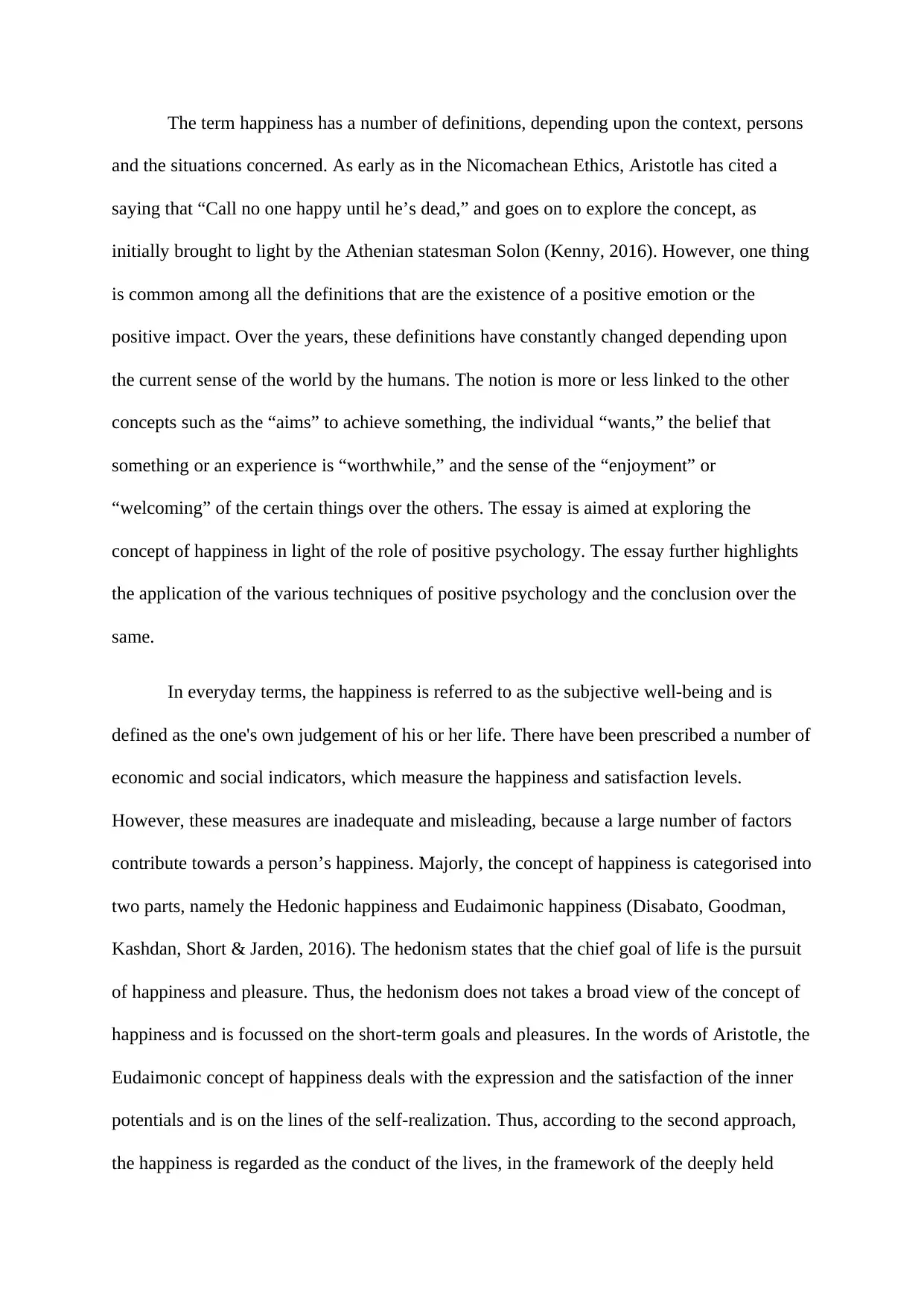
The term happiness has a number of definitions, depending upon the context, persons
and the situations concerned. As early as in the Nicomachean Ethics, Aristotle has cited a
saying that “Call no one happy until he’s dead,” and goes on to explore the concept, as
initially brought to light by the Athenian statesman Solon (Kenny, 2016). However, one thing
is common among all the definitions that are the existence of a positive emotion or the
positive impact. Over the years, these definitions have constantly changed depending upon
the current sense of the world by the humans. The notion is more or less linked to the other
concepts such as the “aims” to achieve something, the individual “wants,” the belief that
something or an experience is “worthwhile,” and the sense of the “enjoyment” or
“welcoming” of the certain things over the others. The essay is aimed at exploring the
concept of happiness in light of the role of positive psychology. The essay further highlights
the application of the various techniques of positive psychology and the conclusion over the
same.
In everyday terms, the happiness is referred to as the subjective well-being and is
defined as the one's own judgement of his or her life. There have been prescribed a number of
economic and social indicators, which measure the happiness and satisfaction levels.
However, these measures are inadequate and misleading, because a large number of factors
contribute towards a person’s happiness. Majorly, the concept of happiness is categorised into
two parts, namely the Hedonic happiness and Eudaimonic happiness (Disabato, Goodman,
Kashdan, Short & Jarden, 2016). The hedonism states that the chief goal of life is the pursuit
of happiness and pleasure. Thus, the hedonism does not takes a broad view of the concept of
happiness and is focussed on the short-term goals and pleasures. In the words of Aristotle, the
Eudaimonic concept of happiness deals with the expression and the satisfaction of the inner
potentials and is on the lines of the self-realization. Thus, according to the second approach,
the happiness is regarded as the conduct of the lives, in the framework of the deeply held
Document Page
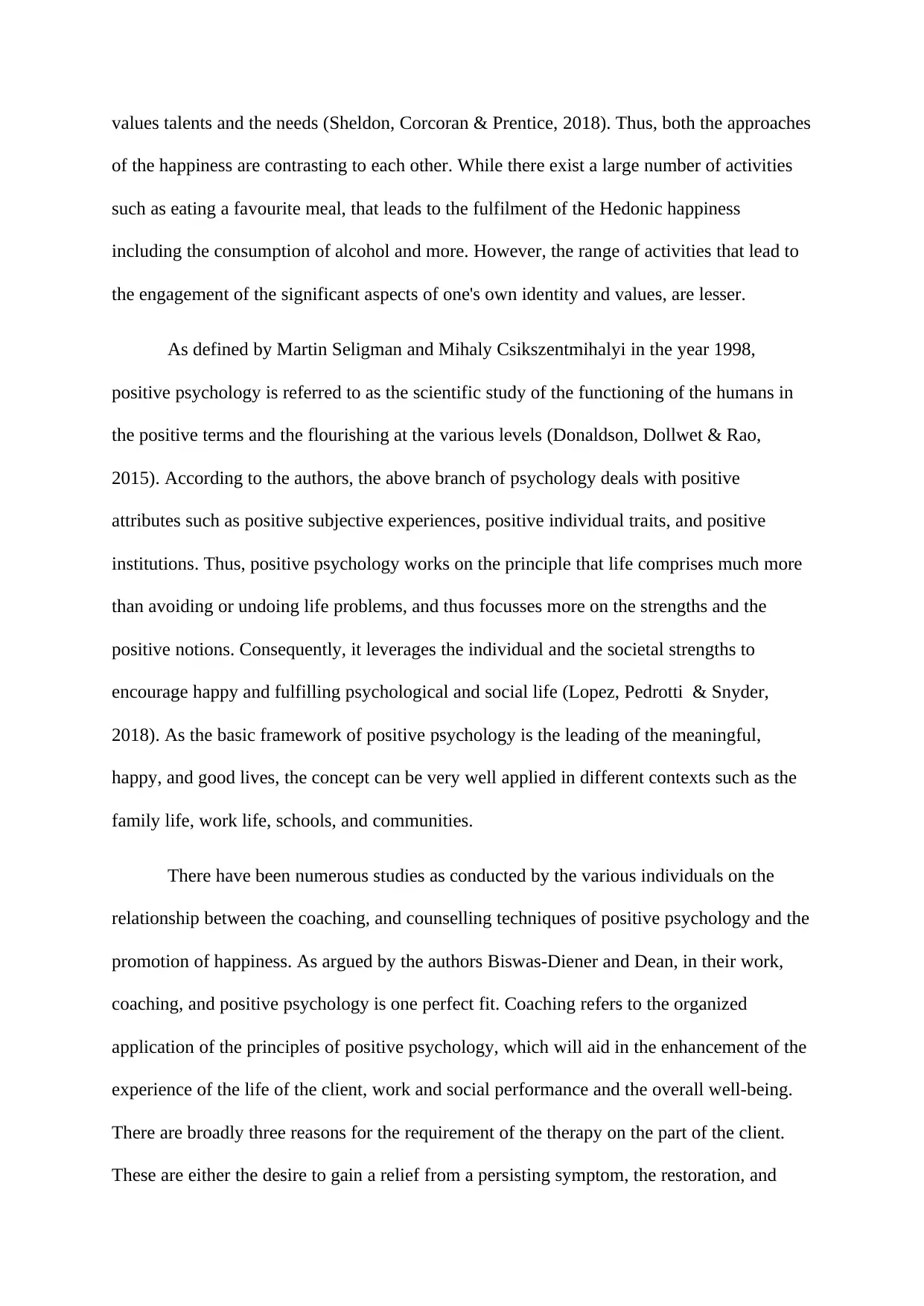
values talents and the needs (Sheldon, Corcoran & Prentice, 2018). Thus, both the approaches
of the happiness are contrasting to each other. While there exist a large number of activities
such as eating a favourite meal, that leads to the fulfilment of the Hedonic happiness
including the consumption of alcohol and more. However, the range of activities that lead to
the engagement of the significant aspects of one's own identity and values, are lesser.
As defined by Martin Seligman and Mihaly Csikszentmihalyi in the year 1998,
positive psychology is referred to as the scientific study of the functioning of the humans in
the positive terms and the flourishing at the various levels (Donaldson, Dollwet & Rao,
2015). According to the authors, the above branch of psychology deals with positive
attributes such as positive subjective experiences, positive individual traits, and positive
institutions. Thus, positive psychology works on the principle that life comprises much more
than avoiding or undoing life problems, and thus focusses more on the strengths and the
positive notions. Consequently, it leverages the individual and the societal strengths to
encourage happy and fulfilling psychological and social life (Lopez, Pedrotti & Snyder,
2018). As the basic framework of positive psychology is the leading of the meaningful,
happy, and good lives, the concept can be very well applied in different contexts such as the
family life, work life, schools, and communities.
There have been numerous studies as conducted by the various individuals on the
relationship between the coaching, and counselling techniques of positive psychology and the
promotion of happiness. As argued by the authors Biswas-Diener and Dean, in their work,
coaching, and positive psychology is one perfect fit. Coaching refers to the organized
application of the principles of positive psychology, which will aid in the enhancement of the
experience of the life of the client, work and social performance and the overall well-being.
There are broadly three reasons for the requirement of the therapy on the part of the client.
These are either the desire to gain a relief from a persisting symptom, the restoration, and
Document Page
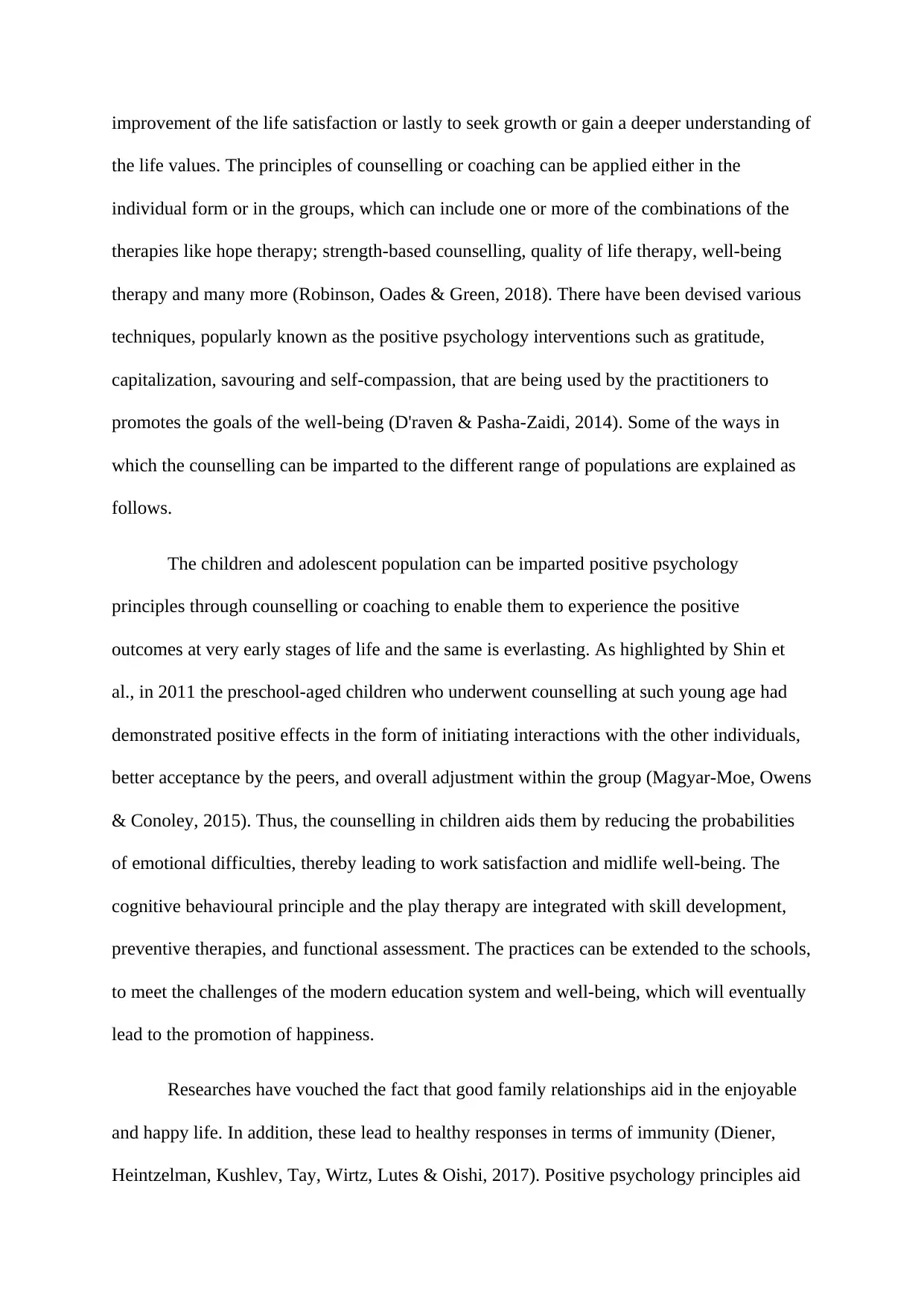
improvement of the life satisfaction or lastly to seek growth or gain a deeper understanding of
the life values. The principles of counselling or coaching can be applied either in the
individual form or in the groups, which can include one or more of the combinations of the
therapies like hope therapy; strength-based counselling, quality of life therapy, well-being
therapy and many more (Robinson, Oades & Green, 2018). There have been devised various
techniques, popularly known as the positive psychology interventions such as gratitude,
capitalization, savouring and self-compassion, that are being used by the practitioners to
promotes the goals of the well-being (D'raven & Pasha-Zaidi, 2014). Some of the ways in
which the counselling can be imparted to the different range of populations are explained as
follows.
The children and adolescent population can be imparted positive psychology
principles through counselling or coaching to enable them to experience the positive
outcomes at very early stages of life and the same is everlasting. As highlighted by Shin et
al., in 2011 the preschool-aged children who underwent counselling at such young age had
demonstrated positive effects in the form of initiating interactions with the other individuals,
better acceptance by the peers, and overall adjustment within the group (Magyar-Moe, Owens
& Conoley, 2015). Thus, the counselling in children aids them by reducing the probabilities
of emotional difficulties, thereby leading to work satisfaction and midlife well-being. The
cognitive behavioural principle and the play therapy are integrated with skill development,
preventive therapies, and functional assessment. The practices can be extended to the schools,
to meet the challenges of the modern education system and well-being, which will eventually
lead to the promotion of happiness.
Researches have vouched the fact that good family relationships aid in the enjoyable
and happy life. In addition, these lead to healthy responses in terms of immunity (Diener,
Heintzelman, Kushlev, Tay, Wirtz, Lutes & Oishi, 2017). Positive psychology principles aid
tabler-icon-diamond-filled.svg

Paraphrase This Document

Need a fresh take? Get an instant paraphrase of this document with our AI Paraphraser
Document Page
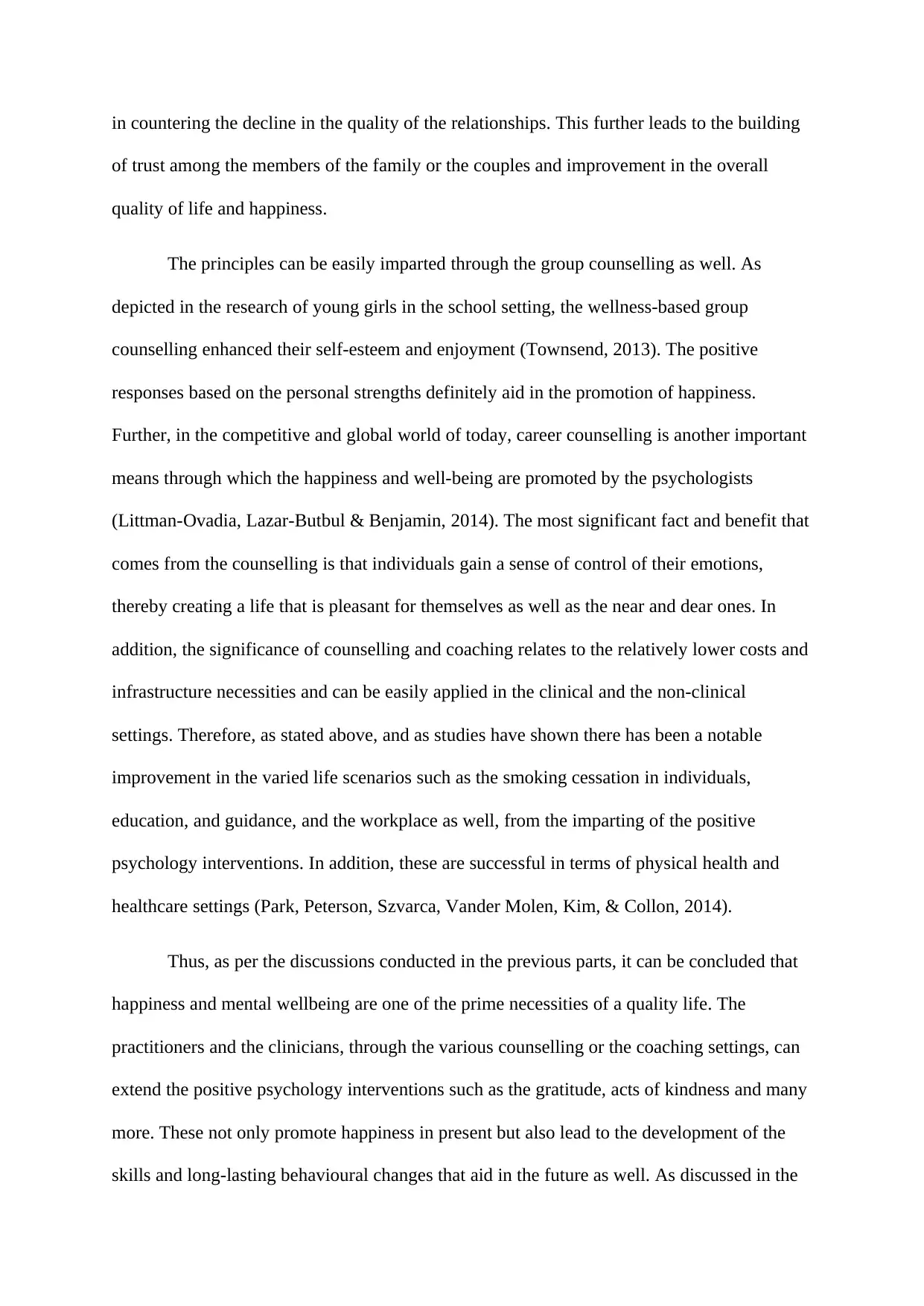
in countering the decline in the quality of the relationships. This further leads to the building
of trust among the members of the family or the couples and improvement in the overall
quality of life and happiness.
The principles can be easily imparted through the group counselling as well. As
depicted in the research of young girls in the school setting, the wellness-based group
counselling enhanced their self-esteem and enjoyment (Townsend, 2013). The positive
responses based on the personal strengths definitely aid in the promotion of happiness.
Further, in the competitive and global world of today, career counselling is another important
means through which the happiness and well-being are promoted by the psychologists
(Littman-Ovadia, Lazar-Butbul & Benjamin, 2014). The most significant fact and benefit that
comes from the counselling is that individuals gain a sense of control of their emotions,
thereby creating a life that is pleasant for themselves as well as the near and dear ones. In
addition, the significance of counselling and coaching relates to the relatively lower costs and
infrastructure necessities and can be easily applied in the clinical and the non-clinical
settings. Therefore, as stated above, and as studies have shown there has been a notable
improvement in the varied life scenarios such as the smoking cessation in individuals,
education, and guidance, and the workplace as well, from the imparting of the positive
psychology interventions. In addition, these are successful in terms of physical health and
healthcare settings (Park, Peterson, Szvarca, Vander Molen, Kim, & Collon, 2014).
Thus, as per the discussions conducted in the previous parts, it can be concluded that
happiness and mental wellbeing are one of the prime necessities of a quality life. The
practitioners and the clinicians, through the various counselling or the coaching settings, can
extend the positive psychology interventions such as the gratitude, acts of kindness and many
more. These not only promote happiness in present but also lead to the development of the
skills and long-lasting behavioural changes that aid in the future as well. As discussed in the
Document Page
previous parts, the positive psychology principles can be applied through individual, group,
couple, family, and child counselling means. Thus, it can be stated that the counselling or
coaching is an important means of promotion of happiness and satisfaction to the individuals.
These add to the satisfaction levels of the practitioners as well, as they add value to the lives
of their clients. It can also be stated that there lies a vast area of further development of the
principles, of the underlying science.
Document Page
References
Diener, E., Heintzelman, S. J., Kushlev, K., Tay, L., Wirtz, D., Lutes, L. D., & Oishi, S.
(2017). Findings all psychologists should know from the new science on subjective
well-being. Canadian Psychology, 58(2), 87.
Disabato, D. J., Goodman, F. R., Kashdan, T. B., Short, J. L., & Jarden, A. (2016). Different
types of well-being? A cross-cultural examination of hedonic and eudaimonic well-
being. Psychological assessment, 28(5), 471.
Donaldson, S. I., Dollwet, M., & Rao, M. A. (2015). Happiness, excellence, and optimal
human functioning revisited: Examining the peer-reviewed literature linked to
positive psychology. The Journal of Positive Psychology, 10(3), 185-195.
D'raven, L. L., & Pasha-Zaidi, N. (2014). Positive psychology interventions: A review for
counselling practitioners. Canadian Journal of Counselling and Psychotherapy,
48(4).
Kenny, A. (2016). The Aristotelian Ethics: A study of the relationship between the Eudemian
and Nicomachean ethics of Aristotle. UK: Oxford University Press.
Littman-Ovadia, H., Lazar-Butbul, V., & Benjamin, B. A. (2014). Strengths-based career
counseling: Overview and initial evaluation. Journal of Career Assessment, 22(3),
403-419.
Lopez, S. J., Pedrotti, J. T., & Snyder, C. R. (2018). Positive psychology: The scientific and
practical explorations of human strengths. (4th ed.). USA: Sage Publications.
Magyar-Moe, J., Owens, R., & Conoley, C. (2015). Positive Psychological Interventions in
Counseling: What every counseling psychologist should know. The Counseling
Psychologist, 43(4), 508-557. doi: 10.1177/0011000015573776
tabler-icon-diamond-filled.svg

Paraphrase This Document

Need a fresh take? Get an instant paraphrase of this document with our AI Paraphraser
Document Page
Park, N., Peterson, C., Szvarca, D., Vander Molen, R. J., Kim, E. S., & Collon, K. (2014).
Positive Psychology and Physical Health: Research and Applications. American
journal of lifestyle medicine, 10(3), 200-206. doi:10.1177/1559827614550277
Robinson, P. L., Oades, L. G., & Green, L. S. (2018). Positive education programmes:
integrating coaching and positive psychology in schools. In Coaching in Education
Oxon: Routledge, 115-132.
Sheldon, K. M., Corcoran, M., & Prentice, M. (2018). Pursuing Eudaimonic Functioning
Versus Pursuing Hedonic Well-Being: The First Goal Succeeds in Its Aim, Whereas
the Second Does Not. Journal of Happiness Studies, 1-15.
Townsend, E. (2013). The Effectiveness of Group Counseling on the Self-Esteem of
Adolescent Girls. Retrieved from
https://digitalcommons.brockport.edu/cgi/viewcontent.cgi?
article=1141&context=edc_theses
chevron_up_icon
1 out of 8
circle_padding
hide_on_mobile
zoom_out_icon
[object Object]