Analysis of HIPAA Compliance Rules and Data Security Requirements

Verified

Added on  2023/01/18

|4
|849
|75
Report
AI Summary
This report analyzes HIPAA compliance rules and their significance in healthcare, emphasizing data security, confidentiality, data availability, and integrity of patient information. It highlights the obligation of physicians to secure electronic medical information using procedures and mechanisms to maintain confidentiality, availability, and integrity. The report discusses the four categories of penalties for violations, emphasizing the importance of adhering to simple data and database security rules. It details the three essential HIPAA security requirements: confidentiality, ensuring patient information is kept private; data availability, guaranteeing access to data when needed; and data integrity, preventing unauthorized alterations to patient information. The conclusion stresses the importance of advising physicians on proper standards to ensure compliance with HIPAA requirements for successful medical practice.
Document Page
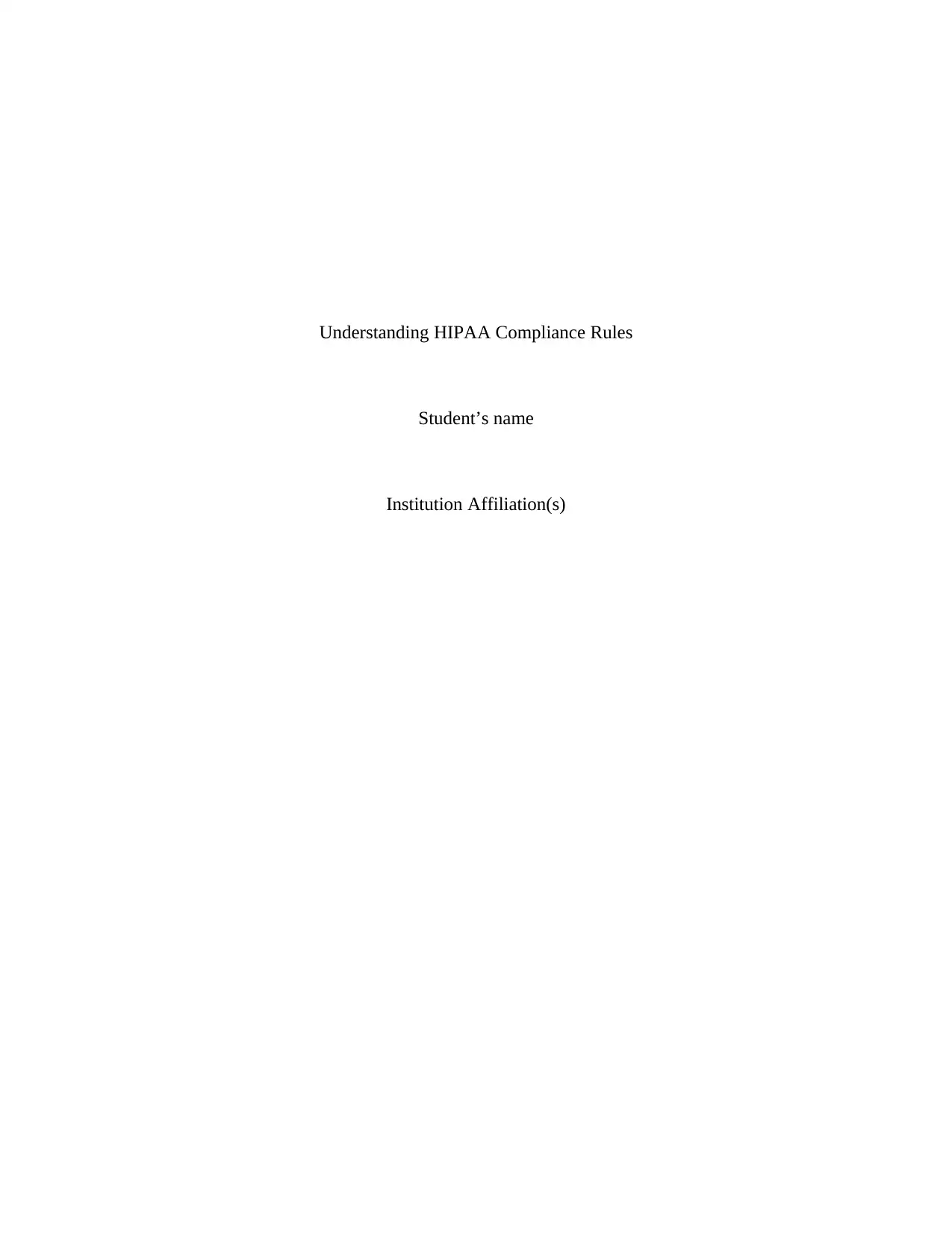
Understanding HIPAA Compliance Rules
Student’s name
Institution Affiliation(s)
tabler-icon-diamond-filled.svg

Paraphrase This Document

Need a fresh take? Get an instant paraphrase of this document with our AI Paraphraser
Document Page
Understanding HIPAA compliance rules
In order to ensure compliance, physicians should understand the security standards of
HIPAA. HIPAA rules demand that physicians have the obligation of securing the patient
electronic medical information (Luxton, Kayl, & Mishkind, 2012). It should be done by using a
series of procedures and mechanisms that aim at restoring the confidentiality, availability, and
integrity of the information and database security. That is to say, that the physician is
accountable for the medical information about the patient. In a case of any irregularity, the
physician will be held responsible. Medical practice location should be in a place that has enough
physical security that will provide ample protection for the electronic media, the database and
other documents (Anthony, Appari, & Johnson, 2014). The data is collected, maintained, used
and transmitted by the physician using a database. HIPAA controls the manner in which a
physician can use and disclose health information.
I feel that the HIPAA rules for data and database security and the penalties for violations
are reasonable. The penalties are grouped into four categories and fines effected effectively.
Most of what constitutes a HIPAA violation can be easily avoided by following simple data and
database security rules and regulations that have been put in place. As mentioned above, HIPAA
is a collection of security rules that aim at protecting the patient’s information. One of the
essential HIPAA database security requirements is confidentiality (Shaw, 2013). HIPAA
demands that a patient's information is kept confidential. The rule requires physicians not to
disclose medical information about the patient unless they are required to. That is to say,
adherence to the procedures and the law ensure that the information may be or may not be
disclosed. The policy is important because it helps in building trust and confidence between the
patient and the health facility.
Document Page
The second vital database security requirement is data availability. The regulation seeks
to ensure the availability of data when needed. According to HIPAA, it is the sole mandate of the
medical facility to receive and store data in their database properly. The data stored is crucial for
future reference. Besides, the data can be used to justify transparency and accountability of the
health facility. Access to data, whenever required, is only possible if the organization adheres to
HIPAA regulations on database security (Drolet et al., 2017).
The third vital security requirement of HIPAA is the integrity of the stored medical
information or data in the facility. HIPAA requires any health service to ensure that the stored
patient's information is not distorted, corrupted or changed without authorization. Information
with utmost integrity ensures that future treatments or consultations carried out by the patient are
relevant. The policy is important because it eradicates incidents of transmission of wrong
information (Chen & Benusa, 2017). For instance, a safe harbor is a technique that is used to do
HIPAA compliance through the de-identification of patient data.
In conclusion, ensuring proper standards and advising the physician is crucial for the
compliance of the medical practice with the HIPAA requirements. The three essential HIPAA
security policy requirements are critical to the success of the medical practice, which is only
possible if the physician adheres to the HIPAA rules discussed in the paper.
Document Page
References
Anthony, D. L., Appari, A., & Johnson, M. E. (2014). Institutionalizing HIPAA Compliance:
Organizations and Competing Logics in U.S. Health Care. Journal of Health and Social
Behavior, 55(1), 108–124. https://doi.org/10.1177/0022146513520431
Chen, J. Q., & Benusa, A. (2017). HIPAA security compliance challenges: The case for small
healthcare providers. International Journal of Healthcare Management, 10(2), 135–146.
https://doi.org/10.1080/20479700.2016.1270875
Drolet, B. C., Marwaha, J. S., Hyatt, B., Blazar, P. E., & Lifchez, S. D. (2017). Electronic
Communication of Protected Health Information: Privacy, Security, and HIPAA
Compliance. The Journal of Hand Surgery, 42(6), 411–416.
https://doi.org/10.1016/j.jhsa.2017.03.023
Luxton, D. D., Kayl, R. A., & Mishkind, M. C. (2012). mHealth Data Security: The Need for
HIPAA-Compliant Standardization. Telemedicine and E-Health, 18(4), 284–288.
https://doi.org/10.1089/tmj.2011.0180
Shaw, G. (2013). Cover Story: HIPAA Compliance Holds Keys to Keeping Patient Data Safe.
The Hearing Journal, 66(3), 28. https://doi.org/10.1097/01.HJ.0000427531.86334.ed
chevron_up_icon
1 out of 4
circle_padding
hide_on_mobile
zoom_out_icon
[object Object]