The Rise of Hybrid Regimes: A Political Science Essay

Verified

Added on  2023/01/17

|3
|594
|44
Essay
AI Summary
This essay examines the prevalence of hybrid regimes, particularly in developing nations after the Cold War. It explores the combination of democratic and autocratic features, such as elections and political repression, and the resulting institutional ambiguities. The essay discusses typologies used to understand these regimes and their divergence from pure democracies or autocracies. It references the 'third wave' of democratization and the challenges faced by nations transitioning to democracy. The essay highlights the instability and unpredictability often associated with hybrid regimes and their classification as defective democracies or competitive authoritarian regimes. It concludes by emphasizing the complexities of these regimes and the need for a nuanced understanding of their functionality and characteristics.
Document Page
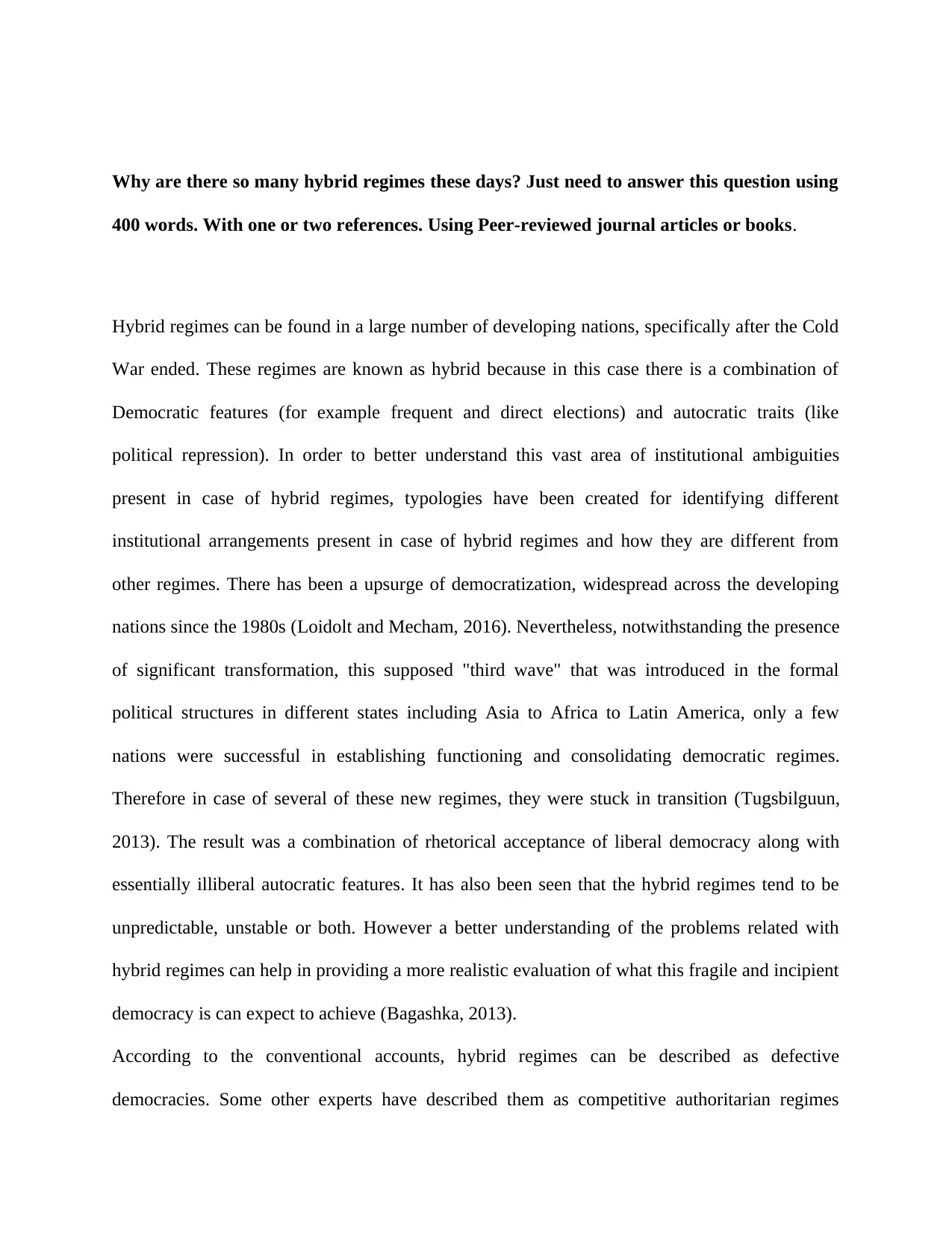
Why are there so many hybrid regimes these days? Just need to answer this question using
400 words. With one or two references. Using Peer-reviewed journal articles or books.
Hybrid regimes can be found in a large number of developing nations, specifically after the Cold
War ended. These regimes are known as hybrid because in this case there is a combination of
Democratic features (for example frequent and direct elections) and autocratic traits (like
political repression). In order to better understand this vast area of institutional ambiguities
present in case of hybrid regimes, typologies have been created for identifying different
institutional arrangements present in case of hybrid regimes and how they are different from
other regimes. There has been a upsurge of democratization, widespread across the developing
nations since the 1980s (Loidolt and Mecham, 2016). Nevertheless, notwithstanding the presence
of significant transformation, this supposed "third wave" that was introduced in the formal
political structures in different states including Asia to Africa to Latin America, only a few
nations were successful in establishing functioning and consolidating democratic regimes.
Therefore in case of several of these new regimes, they were stuck in transition (Tugsbilguun,
2013). The result was a combination of rhetorical acceptance of liberal democracy along with
essentially illiberal autocratic features. It has also been seen that the hybrid regimes tend to be
unpredictable, unstable or both. However a better understanding of the problems related with
hybrid regimes can help in providing a more realistic evaluation of what this fragile and incipient
democracy is can expect to achieve (Bagashka, 2013).
According to the conventional accounts, hybrid regimes can be described as defective
democracies. Some other experts have described them as competitive authoritarian regimes
tabler-icon-diamond-filled.svg

Paraphrase This Document

Need a fresh take? Get an instant paraphrase of this document with our AI Paraphraser
Document Page
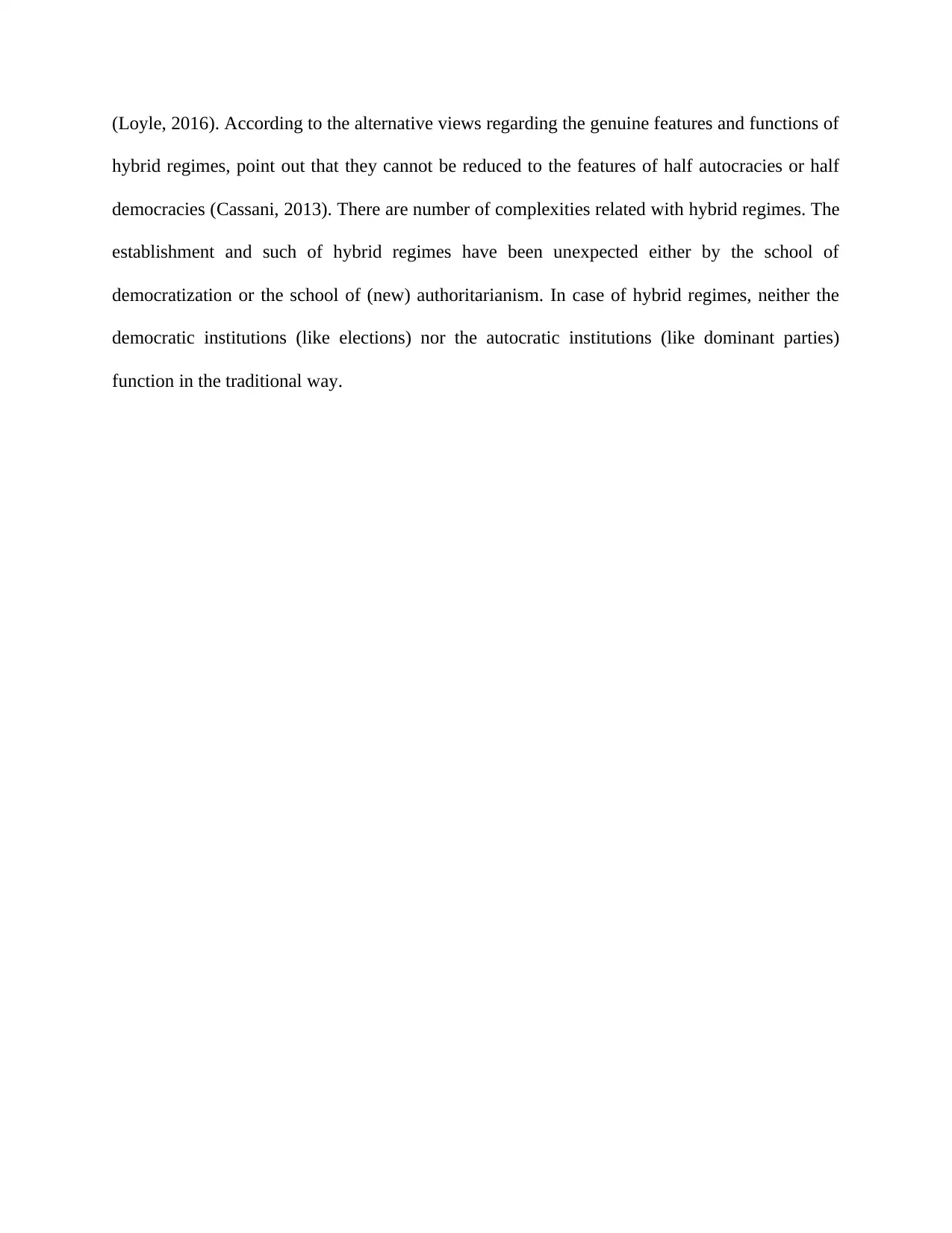
(Loyle, 2016). According to the alternative views regarding the genuine features and functions of
hybrid regimes, point out that they cannot be reduced to the features of half autocracies or half
democracies (Cassani, 2013). There are number of complexities related with hybrid regimes. The
establishment and such of hybrid regimes have been unexpected either by the school of
democratization or the school of (new) authoritarianism. In case of hybrid regimes, neither the
democratic institutions (like elections) nor the autocratic institutions (like dominant parties)
function in the traditional way.
Document Page
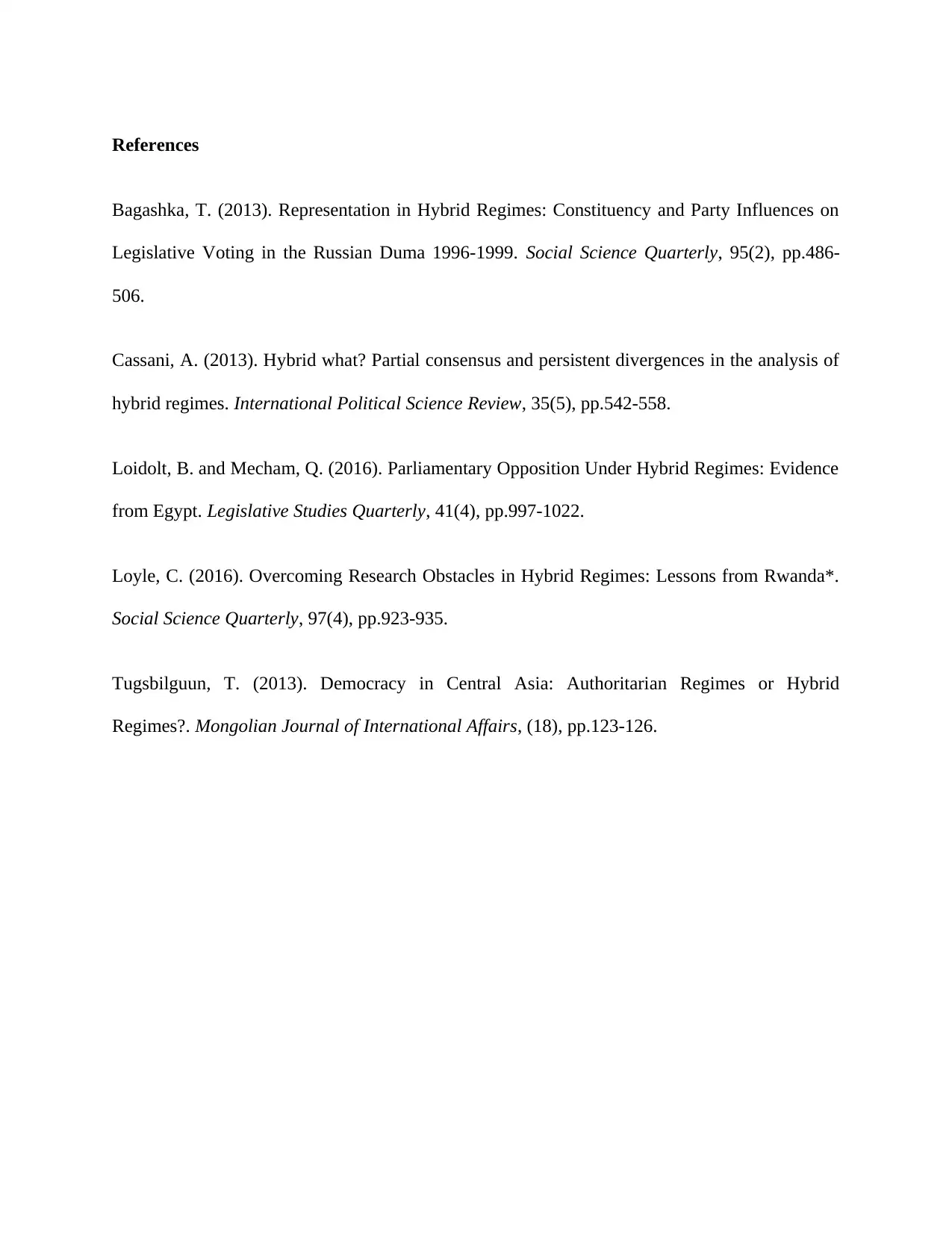
References
Bagashka, T. (2013). Representation in Hybrid Regimes: Constituency and Party Influences on
Legislative Voting in the Russian Duma 1996-1999. Social Science Quarterly, 95(2), pp.486-
506.
Cassani, A. (2013). Hybrid what? Partial consensus and persistent divergences in the analysis of
hybrid regimes. International Political Science Review, 35(5), pp.542-558.
Loidolt, B. and Mecham, Q. (2016). Parliamentary Opposition Under Hybrid Regimes: Evidence
from Egypt. Legislative Studies Quarterly, 41(4), pp.997-1022.
Loyle, C. (2016). Overcoming Research Obstacles in Hybrid Regimes: Lessons from Rwanda*.
Social Science Quarterly, 97(4), pp.923-935.
Tugsbilguun, T. (2013). Democracy in Central Asia: Authoritarian Regimes or Hybrid
Regimes?. Mongolian Journal of International Affairs, (18), pp.123-126.
chevron_up_icon
1 out of 3
circle_padding
hide_on_mobile
zoom_out_icon
[object Object]