Understanding Learning Theories: Belbin, Honey & Mumford, MBTI Report
VerifiedAdded on 2023/01/19
|8
|2417
|72
Report
AI Summary
This coursework portfolio provides a comprehensive exploration of various learning theories. It begins with an introduction to the concept of learning styles and reflection, setting the stage for an in-depth examination of key theories. The main body of the report delves into the Belbin theory of team development, outlining the nine distinct roles within a team and their respective strengths and weaknesses. It then explores the Honey and Mumford learning styles, categorizing learners into Activist, Reflector, Theorist, and Pragmatist, and discussing the characteristics of each style. Finally, the report examines the MBTI theory of learning, discussing its framework for understanding how individuals perceive the world and make decisions. The report provides a conclusion summarizing the findings and offering personal reflections on the discussed theories. References to academic sources are also included, which support the analysis and provide a foundation for understanding the complex topic of learning styles.

Coursework
Portfolio
Portfolio

Paraphrase This Document
Need a fresh take? Get an instant paraphrase of this document with our AI Paraphraser
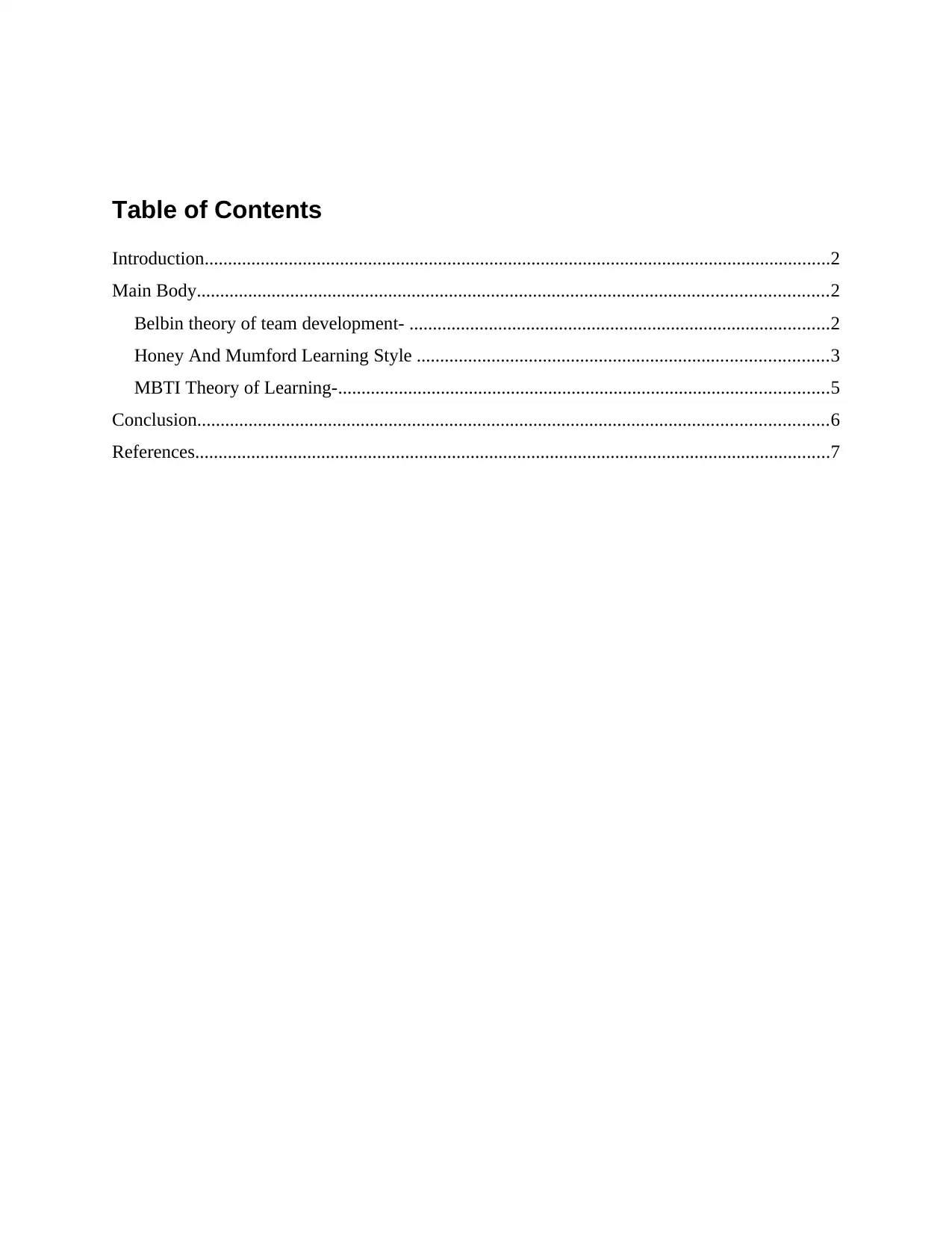
Table of Contents
Introduction......................................................................................................................................2
Main Body.......................................................................................................................................2
Belbin theory of team development- ..........................................................................................2
Honey And Mumford Learning Style ........................................................................................3
MBTI Theory of Learning-.........................................................................................................5
Conclusion.......................................................................................................................................6
References........................................................................................................................................7
Introduction......................................................................................................................................2
Main Body.......................................................................................................................................2
Belbin theory of team development- ..........................................................................................2
Honey And Mumford Learning Style ........................................................................................3
MBTI Theory of Learning-.........................................................................................................5
Conclusion.......................................................................................................................................6
References........................................................................................................................................7
Introduction
Learning styles refer to a range of competing and contested theories that aim to account for
differences in individuals' learning. These theories propose that all people can be classified
according to their 'style' of learning, although the various theories present differing views on how
the styles should be defined and categorized. A common concept is that individuals differ in how
they learn. Reflection is the brief description by someone who has undergone the whole scenario
and gives the information with a brief about what he has learned through this topic and how it
will be helpful, where the concept lacks and where the person and the theory needs
improvement. This report covers the learning theory such as Belbin theory of team development,
Honey And Mumford Learning and MBTI Theory of Learning.
Main Body
Belbin theory of team development-
I learned that there are 9 roles in this theory for developing the team. First role was as a shaper
strength of these type of people is they are dynamic, they accept challenges, they thrives on
pressure they can't work without it. They show their efficiency under pressure, they are the ones
who have the courage to see through and overcome the obstacles. Weaknesses of these type of
people are mostly they are prone to provocation. These people don't care about the feelings of
others they offend the feelings of other people a lot. Then the second role was Implementer these
type of people are those on which company can rely as they are efficient, disciplined and
conservative and they are the ones who turns the idea of the company into practical actions.
Weaknesses of these type of people are they are not flexible they (Mednick, 2017) will work
according to their own timings and own terms and they take more than enough time to respond if
there is a possibility in this area. Third role of this theory is complete finisher which told me that
these type of people are anxious, conscientious, painstaking, they help in searching out the errors
and omissions and deliver the work always in time. Weakness of this type of people are they take
too much and unnecessary stress and they never delegate the work they always want to complete
the work by own. Fourth role I learned by this theory was that these type of people are confident,
mature, they are good chairperson. They clarifies the goal of the organization and helps in
Learning styles refer to a range of competing and contested theories that aim to account for
differences in individuals' learning. These theories propose that all people can be classified
according to their 'style' of learning, although the various theories present differing views on how
the styles should be defined and categorized. A common concept is that individuals differ in how
they learn. Reflection is the brief description by someone who has undergone the whole scenario
and gives the information with a brief about what he has learned through this topic and how it
will be helpful, where the concept lacks and where the person and the theory needs
improvement. This report covers the learning theory such as Belbin theory of team development,
Honey And Mumford Learning and MBTI Theory of Learning.
Main Body
Belbin theory of team development-
I learned that there are 9 roles in this theory for developing the team. First role was as a shaper
strength of these type of people is they are dynamic, they accept challenges, they thrives on
pressure they can't work without it. They show their efficiency under pressure, they are the ones
who have the courage to see through and overcome the obstacles. Weaknesses of these type of
people are mostly they are prone to provocation. These people don't care about the feelings of
others they offend the feelings of other people a lot. Then the second role was Implementer these
type of people are those on which company can rely as they are efficient, disciplined and
conservative and they are the ones who turns the idea of the company into practical actions.
Weaknesses of these type of people are they are not flexible they (Mednick, 2017) will work
according to their own timings and own terms and they take more than enough time to respond if
there is a possibility in this area. Third role of this theory is complete finisher which told me that
these type of people are anxious, conscientious, painstaking, they help in searching out the errors
and omissions and deliver the work always in time. Weakness of this type of people are they take
too much and unnecessary stress and they never delegate the work they always want to complete
the work by own. Fourth role I learned by this theory was that these type of people are confident,
mature, they are good chairperson. They clarifies the goal of the organization and helps in
⊘ This is a preview!⊘
Do you want full access?
Subscribe today to unlock all pages.

Trusted by 1+ million students worldwide
promoting the decision making which also helps in delegating the work well in the organization.
Weaknesses of this people are they are often seen as people who are manipulative and they
always off loads the personal work. Fifth role in this theory I learned was Team worker and these
type of people are mild, cooperative and diplomatic in nature. They always listens to their
superior and averts friction. There is only (Taylor, 2017) one weakness of these people and that
is they are not able to take decisions in crucial decisions. Sixth role of this theory is Resource
Investigator are extrovert in nature, always feel enthusiastic for work and are the most
communicative among all in the team. They explore the opportunities for the company so that
they can excel more in the market and they helps in developing and increasing the contacts of the
company so that they can increase and simplify the work of the organization. Weakness of this
type of people are they tend to be over optimistic for some things, they have a problem with
them and that is they start to loose the interest in project when the beginning stage is crossed.
Seventh role of this model is Plant these type of people are not orthodox at all, they are
imaginative, creative and they come up with ideas for solving the problems which are difficult.
Weakness of them are they ignore the incidents which have happened in the past and it can affect
the company in a very negative way, they are always busy with some work which affect the
channel of communication. Eight role I came across was Monitor Evaluator these type of people
play the role of being sober as in simple in the organization. They implement strategically and by
discerning the work. They see all the option available to them before taking an option and they
judge the situation accordingly. Weakness of this situation is they don't have the ability to inspire
other people and motivate towards work. Ninth and the final role I learned in this theory is how
to become a specialist because these people starts by themselves, they are dedicated towards
work and these people are single minded. They provide knowledge to the employees in the
organization and skills that are rarely found in the chain of supply. Weakness of people who are
specialist they contributes not on a big scale and they always on dwells on the technical stuff.
(Akers and Jennings, 2015)
Honey And Mumford Learning Style
As we know that Learning is a continuous process, it starts in childhood and keep until death.
For example child starts to learn how to eat, how to write, how to speak in its childhood. But
Weaknesses of this people are they are often seen as people who are manipulative and they
always off loads the personal work. Fifth role in this theory I learned was Team worker and these
type of people are mild, cooperative and diplomatic in nature. They always listens to their
superior and averts friction. There is only (Taylor, 2017) one weakness of these people and that
is they are not able to take decisions in crucial decisions. Sixth role of this theory is Resource
Investigator are extrovert in nature, always feel enthusiastic for work and are the most
communicative among all in the team. They explore the opportunities for the company so that
they can excel more in the market and they helps in developing and increasing the contacts of the
company so that they can increase and simplify the work of the organization. Weakness of this
type of people are they tend to be over optimistic for some things, they have a problem with
them and that is they start to loose the interest in project when the beginning stage is crossed.
Seventh role of this model is Plant these type of people are not orthodox at all, they are
imaginative, creative and they come up with ideas for solving the problems which are difficult.
Weakness of them are they ignore the incidents which have happened in the past and it can affect
the company in a very negative way, they are always busy with some work which affect the
channel of communication. Eight role I came across was Monitor Evaluator these type of people
play the role of being sober as in simple in the organization. They implement strategically and by
discerning the work. They see all the option available to them before taking an option and they
judge the situation accordingly. Weakness of this situation is they don't have the ability to inspire
other people and motivate towards work. Ninth and the final role I learned in this theory is how
to become a specialist because these people starts by themselves, they are dedicated towards
work and these people are single minded. They provide knowledge to the employees in the
organization and skills that are rarely found in the chain of supply. Weakness of people who are
specialist they contributes not on a big scale and they always on dwells on the technical stuff.
(Akers and Jennings, 2015)
Honey And Mumford Learning Style
As we know that Learning is a continuous process, it starts in childhood and keep until death.
For example child starts to learn how to eat, how to write, how to speak in its childhood. But
Paraphrase This Document
Need a fresh take? Get an instant paraphrase of this document with our AI Paraphraser
there is difference in its learning approaches, they learn with different styles. Similarly when it
comes to individuals they learn from their past experiences and applies it in present or for taking
future decisions. Individual learn with different styles, in their own different ways. Nobody
learns in a similar way. (Wang and Hill, 2018)
Honey and Mumford Learning Style given by Peter Honey and Alan Mumford for kids, learning
for kids in different approaches is common. So Honey and Mumford categorize the children in
four different groups of learners. Learning style Questionnaire used by Honey and Mumford to
find out the style, how they learn, what style they utilize to learn. Eventually their learning styles
help the kids in learning better and perform good.
Honey and Mumford presented four learning styles. These are Activist, Theorist, Pragmatist,
Reflector. Characteristics of these learning styles are as follows
Activist
The people learn by doing the task by own and learn the things, gains experience are kind of
Activist. They just do the work in once, either the result is negative or positive. They just work
on it and don't think about the result and conclusion. To solve the problems, they don't get
partial, they talk with open mindset, they feel free to do group discussions and then make the
decisions. (Mezirow, 2018)
Reflector
The people learn by observing the things which are happened around them. They observe , think
about the things and give proper thought to that particular situation and then reach to the
conclusion, they don't act instantly without knowing the things. They are Reflector type of kids.
They observe the people and think about them. They collect facts and data about the situation,
investigate properly for making the proper decision. (Goldie, 2016)
comes to individuals they learn from their past experiences and applies it in present or for taking
future decisions. Individual learn with different styles, in their own different ways. Nobody
learns in a similar way. (Wang and Hill, 2018)
Honey and Mumford Learning Style given by Peter Honey and Alan Mumford for kids, learning
for kids in different approaches is common. So Honey and Mumford categorize the children in
four different groups of learners. Learning style Questionnaire used by Honey and Mumford to
find out the style, how they learn, what style they utilize to learn. Eventually their learning styles
help the kids in learning better and perform good.
Honey and Mumford presented four learning styles. These are Activist, Theorist, Pragmatist,
Reflector. Characteristics of these learning styles are as follows
Activist
The people learn by doing the task by own and learn the things, gains experience are kind of
Activist. They just do the work in once, either the result is negative or positive. They just work
on it and don't think about the result and conclusion. To solve the problems, they don't get
partial, they talk with open mindset, they feel free to do group discussions and then make the
decisions. (Mezirow, 2018)
Reflector
The people learn by observing the things which are happened around them. They observe , think
about the things and give proper thought to that particular situation and then reach to the
conclusion, they don't act instantly without knowing the things. They are Reflector type of kids.
They observe the people and think about them. They collect facts and data about the situation,
investigate properly for making the proper decision. (Goldie, 2016)
Theorist
Learners who understand the theory behind any action. Finds the reason, facts, models, concepts
in terms of learning style. They love to read the theoretical concepts, analyse the situation,
synthesize the knowledge from them. They feel uncomfortable when it comes to direct judgment.
They learn best when it comes to learn the concepts and prepare a theory, system for the situation
in a structured way with clear purpose, so they get chance to ask the questions, and get things
corrected on time. (Harasim, 2017)
Pragmatists
These type of learners are very interesting kind of, because they are always excited to try new
things, new ideas, new patterns for solving the problems. These learners take risk in the situation
at a time and find out new way to solve or implement some new idea on it. They are down to
earth people but they are impatient when it comes to discuss in a group. They solve the problems
on practical basis, they also consider feedback from the seniors and learn from it.
With the Honey and Mumford Learning styles , you can say that the different people handle the
similar situation differently or use the different learning style. (Akers and Jennings, 2019)
MBTI Theory of Learning-
It stands for Myers Briggs type indicator. This theory states that how the people sees the world
according to their pointy of view and make decisions according to them. I learned that theory of
Jung was not based on scientific studies which are controlled. It covers issue such as
introspection, clinical observation and anecdotes. This type of methods relates to scientific
psychology on the modern basis. I learned that his theory is consists of four functions which are
feeling, thinking, sensation and intuition. Each of them has two orientations which is polar which
also includes the part of eight functions that are dominant. The theory of MBTI is based on eight
functions and all of them are hypothetical but they are different in expression from the model of
Jung. The model of Jung emphasis on evidence which emphasizes on the evidence which is
empirical for first three dichotomies. On the other side it is unclear to me that the model of
Learners who understand the theory behind any action. Finds the reason, facts, models, concepts
in terms of learning style. They love to read the theoretical concepts, analyse the situation,
synthesize the knowledge from them. They feel uncomfortable when it comes to direct judgment.
They learn best when it comes to learn the concepts and prepare a theory, system for the situation
in a structured way with clear purpose, so they get chance to ask the questions, and get things
corrected on time. (Harasim, 2017)
Pragmatists
These type of learners are very interesting kind of, because they are always excited to try new
things, new ideas, new patterns for solving the problems. These learners take risk in the situation
at a time and find out new way to solve or implement some new idea on it. They are down to
earth people but they are impatient when it comes to discuss in a group. They solve the problems
on practical basis, they also consider feedback from the seniors and learn from it.
With the Honey and Mumford Learning styles , you can say that the different people handle the
similar situation differently or use the different learning style. (Akers and Jennings, 2019)
MBTI Theory of Learning-
It stands for Myers Briggs type indicator. This theory states that how the people sees the world
according to their pointy of view and make decisions according to them. I learned that theory of
Jung was not based on scientific studies which are controlled. It covers issue such as
introspection, clinical observation and anecdotes. This type of methods relates to scientific
psychology on the modern basis. I learned that his theory is consists of four functions which are
feeling, thinking, sensation and intuition. Each of them has two orientations which is polar which
also includes the part of eight functions that are dominant. The theory of MBTI is based on eight
functions and all of them are hypothetical but they are different in expression from the model of
Jung. The model of Jung emphasis on evidence which emphasizes on the evidence which is
empirical for first three dichotomies. On the other side it is unclear to me that the model of
⊘ This is a preview!⊘
Do you want full access?
Subscribe today to unlock all pages.
Trusted by 1+ million students worldwide
Briggs has the preference and evidence of JP. The theory of MBTI is concerned with offering the
assessment of personality which is through a (Szabó and et.al., 2016) structured approach.
Responses are closed of the items which are considered because they are interpreted on the basis
of test constructors theory in scoring. To personally assess the personality and on the contrary by
offering the approach which is projective and it was advocated by the theorists who are known as
psychodynamic such as Carl Jung. He was the one who associated the guidance with his words
and tested it with measuring by a approach that is projective. The responses in the approach are
always open ended and are written in the context of whole person. I also recognized that the
theory and concept was not preconceived which are related to test constructors. His theory has
revealed that how the dispositions are unconscious. The emotions and conflicts which the person
feels internally are always hidden. People who support this theory and the approach which is
projective to assess the personality and the structured approach is critical as the mechanism of
defense may change the response or distort it. So that the items which are closed on the tests that
are structured and the things that are bias from those who made the structure may affect the
result and interpretation. The addition which is the most notable and consists of ideas that are of
Briggs and Myers realtes to the thought of original concept of Jung. The letter J or P is the type
of fourth letter in this theory and which indicates that the person is most extraverted and the
function which is preferred. It is known as the function which is most dominant for the situations
which are extraverted and the functions that are auxiliary for the people who are introvert. (Bada
and Olusegun, 2015)
Conclusion
From the above studies it has been concluded that this theory helps in understanding the learning
theories such as Belbin theory of team development, Honey And Mumford Learning and MBTI
Theory of Learning. With the explanation of this theory reflection is also been done with the fact
that what he has learned from the theories, where does he feel that this theory is suitable or not,
where does it need improvement, where the theory lacks. The person has shared his opinion that
how tough it was for him to understand the theories of learning.
assessment of personality which is through a (Szabó and et.al., 2016) structured approach.
Responses are closed of the items which are considered because they are interpreted on the basis
of test constructors theory in scoring. To personally assess the personality and on the contrary by
offering the approach which is projective and it was advocated by the theorists who are known as
psychodynamic such as Carl Jung. He was the one who associated the guidance with his words
and tested it with measuring by a approach that is projective. The responses in the approach are
always open ended and are written in the context of whole person. I also recognized that the
theory and concept was not preconceived which are related to test constructors. His theory has
revealed that how the dispositions are unconscious. The emotions and conflicts which the person
feels internally are always hidden. People who support this theory and the approach which is
projective to assess the personality and the structured approach is critical as the mechanism of
defense may change the response or distort it. So that the items which are closed on the tests that
are structured and the things that are bias from those who made the structure may affect the
result and interpretation. The addition which is the most notable and consists of ideas that are of
Briggs and Myers realtes to the thought of original concept of Jung. The letter J or P is the type
of fourth letter in this theory and which indicates that the person is most extraverted and the
function which is preferred. It is known as the function which is most dominant for the situations
which are extraverted and the functions that are auxiliary for the people who are introvert. (Bada
and Olusegun, 2015)
Conclusion
From the above studies it has been concluded that this theory helps in understanding the learning
theories such as Belbin theory of team development, Honey And Mumford Learning and MBTI
Theory of Learning. With the explanation of this theory reflection is also been done with the fact
that what he has learned from the theories, where does he feel that this theory is suitable or not,
where does it need improvement, where the theory lacks. The person has shared his opinion that
how tough it was for him to understand the theories of learning.
Paraphrase This Document
Need a fresh take? Get an instant paraphrase of this document with our AI Paraphraser
References
Books and Journal
Akers, R.L. and Jennings, W.G., 2015. Social learning theory. The Handbook of Criminological
Theory. 4. pp.230-240.
Akers, R.L. and Jennings, W.G., 2019. The social learning theory of crime and deviance.
In Handbook on crime and deviance (pp. 113-129). Springer, Cham.
Bada, S.O. and Olusegun, S., 2015. Constructivism learning theory: A paradigm for teaching and
learning. Journal of Research & Method in Education. 5(6). pp.66-70.
Goldie, J.G.S., 2016. Connectivism: A knowledge learning theory for the digital age?. Medical
teacher. 38(10). pp.1064-1069.
Harasim, L., 2017. Learning theory and online technologies. Routledge.
Mednick, S.A., 2017. A learning theory approach to research in schizophrenia.
In Schizophrenia (pp. 76-95). Routledge.
Mezirow, J., 2018. Transformative learning theory. In Contemporary Theories of Learning (pp.
114-128). Routledge.
Szabó, Z et.al., 2016. Learning theory for distribution regression. The Journal of Machine
Learning Research. 17(1). pp.5272-5311.
Taylor, E.W., 2017. Transformative learning theory. In Transformative learning meets
bildung (pp. 17-29). Brill Sense.
Wang, C. and Hill, D.J., 2018. Deterministic learning theory for identification, recognition, and
control. CRC Press.
Books and Journal
Akers, R.L. and Jennings, W.G., 2015. Social learning theory. The Handbook of Criminological
Theory. 4. pp.230-240.
Akers, R.L. and Jennings, W.G., 2019. The social learning theory of crime and deviance.
In Handbook on crime and deviance (pp. 113-129). Springer, Cham.
Bada, S.O. and Olusegun, S., 2015. Constructivism learning theory: A paradigm for teaching and
learning. Journal of Research & Method in Education. 5(6). pp.66-70.
Goldie, J.G.S., 2016. Connectivism: A knowledge learning theory for the digital age?. Medical
teacher. 38(10). pp.1064-1069.
Harasim, L., 2017. Learning theory and online technologies. Routledge.
Mednick, S.A., 2017. A learning theory approach to research in schizophrenia.
In Schizophrenia (pp. 76-95). Routledge.
Mezirow, J., 2018. Transformative learning theory. In Contemporary Theories of Learning (pp.
114-128). Routledge.
Szabó, Z et.al., 2016. Learning theory for distribution regression. The Journal of Machine
Learning Research. 17(1). pp.5272-5311.
Taylor, E.W., 2017. Transformative learning theory. In Transformative learning meets
bildung (pp. 17-29). Brill Sense.
Wang, C. and Hill, D.J., 2018. Deterministic learning theory for identification, recognition, and
control. CRC Press.

1 out of 8


Related Documents


Your All-in-One AI-Powered Toolkit for Academic Success.
+13062052269
info@desklib.com
Available 24*7 on WhatsApp / Email
![[object Object]](/_next/static/media/star-bottom.7253800d.svg)
Unlock your academic potential
Copyright © 2020–2026 A2Z Services. All Rights Reserved. Developed and managed by ZUCOL.