BMP3004 World of Work: Understanding Employee Motivation Report
VerifiedAdded on 2022/11/28
|9
|2125
|390
Report
AI Summary
This report delves into the concept of employee motivation within the context of business management. It defines motivation and explores various theories, including Maslow's hierarchy of needs, to understand the drivers behind employee behavior. The report differentiates between intrinsic and extrinsic motivation, providing examples of each in a workplace setting. It identifies key factors that motivate employees, such as salary, promotion, and a positive work environment, while also examining the positive and negative experiences employees encounter in their job roles. Furthermore, the report outlines strategies to cope with negative factors, including conflict management and employee appreciation policies, to create a more productive and satisfying work environment. The analysis draws on academic sources to support its findings and offers practical insights for business firms seeking to enhance employee motivation and well-being.
BSc (Hons) Business Management with
Foundation
BMP3004
World of Work
Understanding why people work
Submitted by:
Name:
ID:
Foundation
BMP3004
World of Work
Understanding why people work
Submitted by:
Name:
ID:

Paraphrase This Document
Need a fresh take? Get an instant paraphrase of this document with our AI Paraphraser
Contents
Introduction 1
What does Motivation Mean? 1
The various factors which motivate employees to work
2
The positive factors employees experience as a result of their
job roles 3
The negative factors employees experience as a result of their
job roles 3
Strategies to cope with negative factors employees
experience as a result of their job roles 4
Conclusion 6
References 7
Introduction 1
What does Motivation Mean? 1
The various factors which motivate employees to work
2
The positive factors employees experience as a result of their
job roles 3
The negative factors employees experience as a result of their
job roles 3
Strategies to cope with negative factors employees
experience as a result of their job roles 4
Conclusion 6
References 7
Introduction
It is important for business firms to identify factors which promote employee
motivation and add to their positive experience in a business firm. This can help
business film develop strategies to increase employee motivation and deal with
negative or stressful workplace conditions in a way which minimizes harm on
employee well-being (Bastons, Mas and Rey, 2017) . The present report looks at
area of employee motivation and provides description of employee motivation with
suitable theories. Workplace elements which act as employee motivators are also
provided in this report. Workplace elements which add to negative and positive
employee experience are identified in this report along with effective coping
strategies.
What does Motivation Mean?
Motivation is described as the drive that causes employees to take steps to
enhance their performance, acquire new skills and gain knowledge to expand their job
roles in order to move upwards in their career. It is also defined as the internal
enthusiasm of en employee and the drive which influences employees to accomplish
workplace activities.
Maslow’s hierarchy of needs defines various needs in a hierarchical order which
need to be satisfied in order to ensure that each employee attains high motivation level.
The Maslow’s hierarchy of needs is explained below:
Physiological Needs: This includes the fundamental requirements of employees
for survival. Food, water, shelter and sleep are at the basic level of the hierarchy.
Fulfillment of these needs is essential to move up the hierarchy. Enterprises can
fulfill these needs by providing proper remuneration which can be used to
purchase basic needs and arranging for meals at the workplace (Bizzi, 2020).
Health and Safety needs: This needs focuses on gaining stable, orderly and
fearless environment along with healthy lifestyle. Corporations are able to satisfy
this need by providing job security and ensuring mental and physical well-being of
employees ta the workplace.
Belongingness needs: The need to feel as a part of the community and build
interpersonal relationships is at the third level of the hierarchy. Business firm can
1
It is important for business firms to identify factors which promote employee
motivation and add to their positive experience in a business firm. This can help
business film develop strategies to increase employee motivation and deal with
negative or stressful workplace conditions in a way which minimizes harm on
employee well-being (Bastons, Mas and Rey, 2017) . The present report looks at
area of employee motivation and provides description of employee motivation with
suitable theories. Workplace elements which act as employee motivators are also
provided in this report. Workplace elements which add to negative and positive
employee experience are identified in this report along with effective coping
strategies.
What does Motivation Mean?
Motivation is described as the drive that causes employees to take steps to
enhance their performance, acquire new skills and gain knowledge to expand their job
roles in order to move upwards in their career. It is also defined as the internal
enthusiasm of en employee and the drive which influences employees to accomplish
workplace activities.
Maslow’s hierarchy of needs defines various needs in a hierarchical order which
need to be satisfied in order to ensure that each employee attains high motivation level.
The Maslow’s hierarchy of needs is explained below:
Physiological Needs: This includes the fundamental requirements of employees
for survival. Food, water, shelter and sleep are at the basic level of the hierarchy.
Fulfillment of these needs is essential to move up the hierarchy. Enterprises can
fulfill these needs by providing proper remuneration which can be used to
purchase basic needs and arranging for meals at the workplace (Bizzi, 2020).
Health and Safety needs: This needs focuses on gaining stable, orderly and
fearless environment along with healthy lifestyle. Corporations are able to satisfy
this need by providing job security and ensuring mental and physical well-being of
employees ta the workplace.
Belongingness needs: The need to feel as a part of the community and build
interpersonal relationships is at the third level of the hierarchy. Business firm can
1
⊘ This is a preview!⊘
Do you want full access?
Subscribe today to unlock all pages.

Trusted by 1+ million students worldwide
satisfy this need by building strong workplace community and ensuring string
interrelationship between he employee and the employer.
Esteem needs: This level of the hierarchy includes the need for status,
recognition and appreciation. Business firms are able to satisfy this need by
developing fair employee recognition program to identify and reward diligent
workers (Fernando and Dissanayake, 2019).
Self-Actualization needs: This is the last level of the hierarchy and fulfillment of
this need maximizes employee motivation. The attainment of this need is possible
by building a workplace which enables employees to make continuous
development and attain their career goals through guidance and training.
Extrinsic Motivation: This type of motivation is derived from external sources.
Extrinsic motivation influences employees to take action in order to gain reward or avoid
punishment. External motivation does not satisfy psychological needs of the employee
such as competence and autonomy. An example of extrinsic motivation in the workplace
is performance based incentives.
Intrinsic Motivation: This type of motivation is derived from internal enjoyment
gained by doing certain action. There is not direct reward to complete the action but the
individual is motivated towards completing the action because it is interesting. Intrinsic
motivation is often related to personal development and focus on goals. An example of
intrinsic motivation in the workplace is employees participating in development and
training programs in order to gain proficiency in a field in which is their passion.
The various factors which motivate employees to work
Salary: Employees are motivated towards increasing their performance if they gain
remuneration on the basis of their performance measured by various parameters such as
amount of sales gained.
Promotion: Employees are motivated to enhance their performance and learn
new skills in order to expand their job roles in order to gain promotion. This is
because promotion helps them attain their career goals. Promotion also provides
increased remuneration and benefits from securing higher position which
motivates employees to enhance their performance (Haldorai and et. al., 2020).
.
2
interrelationship between he employee and the employer.
Esteem needs: This level of the hierarchy includes the need for status,
recognition and appreciation. Business firms are able to satisfy this need by
developing fair employee recognition program to identify and reward diligent
workers (Fernando and Dissanayake, 2019).
Self-Actualization needs: This is the last level of the hierarchy and fulfillment of
this need maximizes employee motivation. The attainment of this need is possible
by building a workplace which enables employees to make continuous
development and attain their career goals through guidance and training.
Extrinsic Motivation: This type of motivation is derived from external sources.
Extrinsic motivation influences employees to take action in order to gain reward or avoid
punishment. External motivation does not satisfy psychological needs of the employee
such as competence and autonomy. An example of extrinsic motivation in the workplace
is performance based incentives.
Intrinsic Motivation: This type of motivation is derived from internal enjoyment
gained by doing certain action. There is not direct reward to complete the action but the
individual is motivated towards completing the action because it is interesting. Intrinsic
motivation is often related to personal development and focus on goals. An example of
intrinsic motivation in the workplace is employees participating in development and
training programs in order to gain proficiency in a field in which is their passion.
The various factors which motivate employees to work
Salary: Employees are motivated towards increasing their performance if they gain
remuneration on the basis of their performance measured by various parameters such as
amount of sales gained.
Promotion: Employees are motivated to enhance their performance and learn
new skills in order to expand their job roles in order to gain promotion. This is
because promotion helps them attain their career goals. Promotion also provides
increased remuneration and benefits from securing higher position which
motivates employees to enhance their performance (Haldorai and et. al., 2020).
.
2
Paraphrase This Document
Need a fresh take? Get an instant paraphrase of this document with our AI Paraphraser
Work Environment: Employees are motivated to improve their skills and work with
their superiors and colleagues to gain knowledge and new abilities, if the workplace
environment is harmonious and encourages employees to continuously challenge
themselves. Supportive working environment is one of the key motivators in a workplace.
The positive factors employees experience as a result of their
job roles
Growth opportunities: Workplace which provides employees career progression
opportunities by helping them remove their weak areas and gain proficiency in
skills required for professional development is a positive factors employee’s
experience. This factor encourages employees to seek career advancements and
gives them satisfaction as they are able to attain their professional objectives
(Krajcsák, 2019).
Supportive workplace: One of the positive factors which drive satisfactory
employee experience is supportive working environment. Business environment in
which employees are allowed to share knowledge and skills with colleagues
provides positive experience to employees. Employees are able to utilize their
current skills and collaborate with other to make contributions in organizational
success and learn from their co-workers and supervisors to continuously enhance
their skills.
Meaningfulness: This positive factor is gained by employees when they
contribute to attainment of business objective other than profitability which ha
positive impact on society. This can include a business operation which creates
positive impact for the society, environment or a particular community or
participation in CSR imitative which is implemented for societal welfare Matthews,
(Daigle and Houston, 2018). Employee satisfaction is increased with the help of
this factor as employees are able to contribute for development of society through
their job role.
The negative factors employees experience as a result of their
job roles
Disputes with co-workers: This negative factor is experienced by employees
during initial phases of team development in which the team does not fully
3
their superiors and colleagues to gain knowledge and new abilities, if the workplace
environment is harmonious and encourages employees to continuously challenge
themselves. Supportive working environment is one of the key motivators in a workplace.
The positive factors employees experience as a result of their
job roles
Growth opportunities: Workplace which provides employees career progression
opportunities by helping them remove their weak areas and gain proficiency in
skills required for professional development is a positive factors employee’s
experience. This factor encourages employees to seek career advancements and
gives them satisfaction as they are able to attain their professional objectives
(Krajcsák, 2019).
Supportive workplace: One of the positive factors which drive satisfactory
employee experience is supportive working environment. Business environment in
which employees are allowed to share knowledge and skills with colleagues
provides positive experience to employees. Employees are able to utilize their
current skills and collaborate with other to make contributions in organizational
success and learn from their co-workers and supervisors to continuously enhance
their skills.
Meaningfulness: This positive factor is gained by employees when they
contribute to attainment of business objective other than profitability which ha
positive impact on society. This can include a business operation which creates
positive impact for the society, environment or a particular community or
participation in CSR imitative which is implemented for societal welfare Matthews,
(Daigle and Houston, 2018). Employee satisfaction is increased with the help of
this factor as employees are able to contribute for development of society through
their job role.
The negative factors employees experience as a result of their
job roles
Disputes with co-workers: This negative factor is experienced by employees
during initial phases of team development in which the team does not fully
3
understand each other. This increases conflicts between employees .This
leads to creation of a toxic work environment if the further stages of team
development are not carried out and conflicts are left unresolved by
management.
Insufficient recognition: This negative factor arises if the job role of the
employee requires completion of complicated task and it is primary
contributing factor in success of the company but is not recognized for their
efforts and contribution (Muzakki, Eliyana and Muhtadi, 2019). In addition to
this if business firms do not recognize exceptional employees which go
beyond their job role and are dedicated to the firm, this negative factor affects
employee experience.
High Workload: This negative factor is created because off ineffective
management as few employees have to face workload. Employees in critical job
roles have to take extra workload because of various reasons such as
employment gap, ineffective division of labor or ineffective planning. This has
negative impact on their employee experience and the workforce is discouraged to
continue their work as their work life balance is negatively affected.
Strategies to cope with negative factors employees
experience as a result of their job roles
Conflict management and negation strategies
This strategy helps business firm eliminate the negative factor of employee
conflicts which are created as a result of initial stages of team development.
Business firms need to develop effective conflict management and negotiation
strategy in order to predict future conflicts and take actions for their removal. In
addition to this, negotiation strategy of the business firm helps business firm stop
further escalation of the conflict. This can help enterprise ensure that disputes do not
have negative impact on employee experience (Zhang and et. al., 2020).
Employee appreciation policies
Insufficient recognition is one of the main factor which contributes to negative
employee experience and employee appreciation policies are one of the most
effective ways to eliminate this factor and maximize employee satisfaction. This
involves constructing fair reward programs, providing employees’ performance
based incentives and developing company wide recognition programs so that the
4
leads to creation of a toxic work environment if the further stages of team
development are not carried out and conflicts are left unresolved by
management.
Insufficient recognition: This negative factor arises if the job role of the
employee requires completion of complicated task and it is primary
contributing factor in success of the company but is not recognized for their
efforts and contribution (Muzakki, Eliyana and Muhtadi, 2019). In addition to
this if business firms do not recognize exceptional employees which go
beyond their job role and are dedicated to the firm, this negative factor affects
employee experience.
High Workload: This negative factor is created because off ineffective
management as few employees have to face workload. Employees in critical job
roles have to take extra workload because of various reasons such as
employment gap, ineffective division of labor or ineffective planning. This has
negative impact on their employee experience and the workforce is discouraged to
continue their work as their work life balance is negatively affected.
Strategies to cope with negative factors employees
experience as a result of their job roles
Conflict management and negation strategies
This strategy helps business firm eliminate the negative factor of employee
conflicts which are created as a result of initial stages of team development.
Business firms need to develop effective conflict management and negotiation
strategy in order to predict future conflicts and take actions for their removal. In
addition to this, negotiation strategy of the business firm helps business firm stop
further escalation of the conflict. This can help enterprise ensure that disputes do not
have negative impact on employee experience (Zhang and et. al., 2020).
Employee appreciation policies
Insufficient recognition is one of the main factor which contributes to negative
employee experience and employee appreciation policies are one of the most
effective ways to eliminate this factor and maximize employee satisfaction. This
involves constructing fair reward programs, providing employees’ performance
based incentives and developing company wide recognition programs so that the
4
⊘ This is a preview!⊘
Do you want full access?
Subscribe today to unlock all pages.
Trusted by 1+ million students worldwide
contribution of exceptional employees is recognized (Perkins and Jones, 2020). This
will help business firms create a workplace culture which focuses on employee
evaluation on the basis of capability so that contribution of every employee are
recognized.
Effective management
This is simple strategy but can help business enterprises deal with various negative
factors which decrease employee experience. Effective Human resource
management strategy can help business firms fill employment gaps in a timely
manner, divide work on the basis of skills and interests and ensure that every
employee is given tasks according to their capacity. This will not only ensure that
positive employee experience but also every employee provides quality outcome.
This is because every employee will work according to their maximum capacity in
areas for which they are passionate about so that the firm gains the best outcome
and employees gain positive experience.
Conclusion
5
will help business firms create a workplace culture which focuses on employee
evaluation on the basis of capability so that contribution of every employee are
recognized.
Effective management
This is simple strategy but can help business enterprises deal with various negative
factors which decrease employee experience. Effective Human resource
management strategy can help business firms fill employment gaps in a timely
manner, divide work on the basis of skills and interests and ensure that every
employee is given tasks according to their capacity. This will not only ensure that
positive employee experience but also every employee provides quality outcome.
This is because every employee will work according to their maximum capacity in
areas for which they are passionate about so that the firm gains the best outcome
and employees gain positive experience.
Conclusion
5
Paraphrase This Document
Need a fresh take? Get an instant paraphrase of this document with our AI Paraphraser
From the above report it is determined that motivation is the commitment and
drive of employees which encourages them to seek continuous improvement and
engage in development activities. Employee motivation is shaped by various factors
such as salary and promotion. The Maslow’s hierarchy of needs is a tool used to
determine ways to maximize employee motivation. Meaningfulness and growth
opportunities are some of the positive factors experienced by employees due to their
job roles. It is important for business firms to implements strategies such as conflict
management strategies in order to deal with negative factors experienced by
employees due to their job roles.
References
Books and Journals
6
drive of employees which encourages them to seek continuous improvement and
engage in development activities. Employee motivation is shaped by various factors
such as salary and promotion. The Maslow’s hierarchy of needs is a tool used to
determine ways to maximize employee motivation. Meaningfulness and growth
opportunities are some of the positive factors experienced by employees due to their
job roles. It is important for business firms to implements strategies such as conflict
management strategies in order to deal with negative factors experienced by
employees due to their job roles.
References
Books and Journals
6
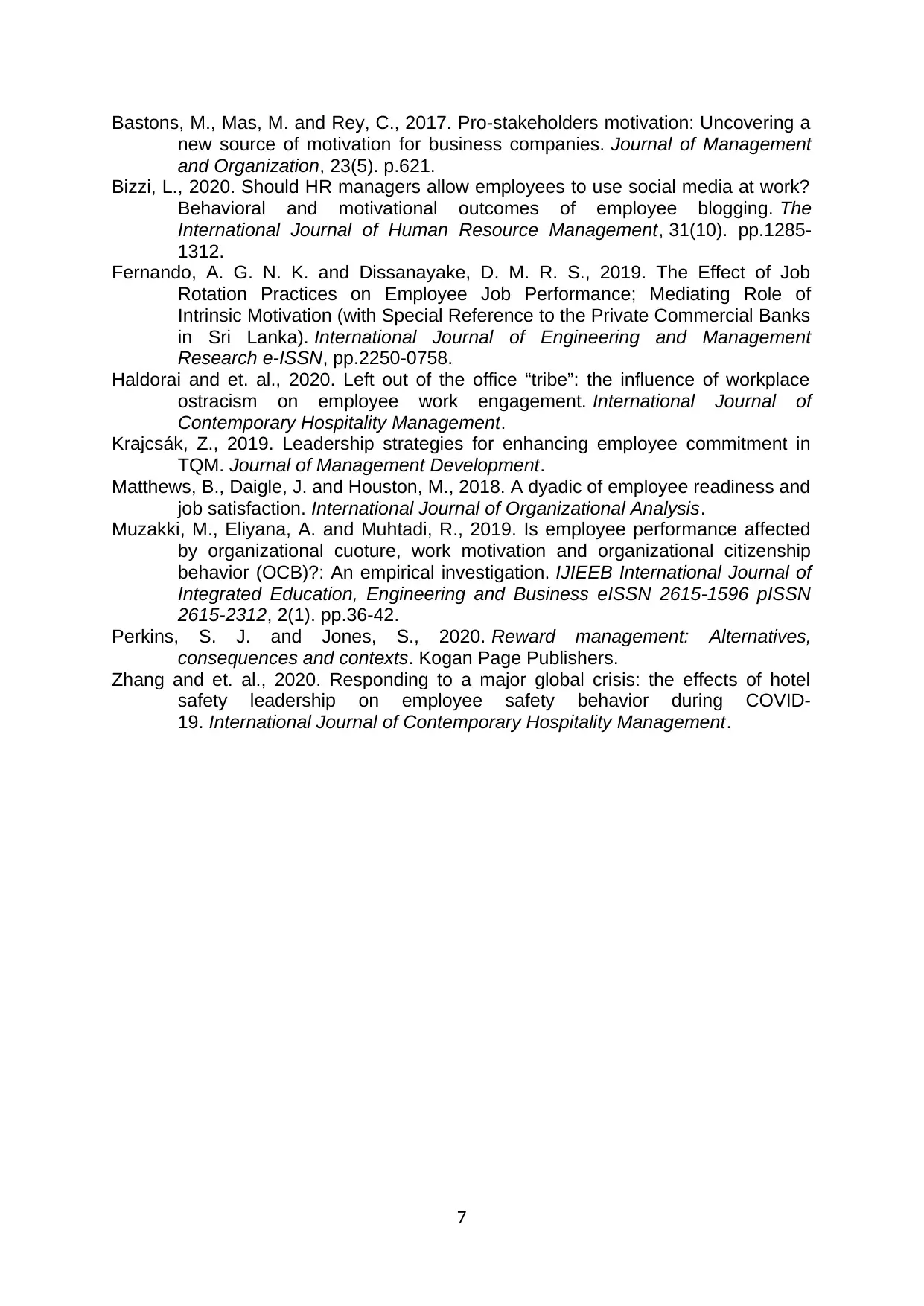
Bastons, M., Mas, M. and Rey, C., 2017. Pro-stakeholders motivation: Uncovering a
new source of motivation for business companies. Journal of Management
and Organization, 23(5). p.621.
Bizzi, L., 2020. Should HR managers allow employees to use social media at work?
Behavioral and motivational outcomes of employee blogging. The
International Journal of Human Resource Management, 31(10). pp.1285-
1312.
Fernando, A. G. N. K. and Dissanayake, D. M. R. S., 2019. The Effect of Job
Rotation Practices on Employee Job Performance; Mediating Role of
Intrinsic Motivation (with Special Reference to the Private Commercial Banks
in Sri Lanka). International Journal of Engineering and Management
Research e-ISSN, pp.2250-0758.
Haldorai and et. al., 2020. Left out of the office “tribe”: the influence of workplace
ostracism on employee work engagement. International Journal of
Contemporary Hospitality Management.
Krajcsák, Z., 2019. Leadership strategies for enhancing employee commitment in
TQM. Journal of Management Development.
Matthews, B., Daigle, J. and Houston, M., 2018. A dyadic of employee readiness and
job satisfaction. International Journal of Organizational Analysis.
Muzakki, M., Eliyana, A. and Muhtadi, R., 2019. Is employee performance affected
by organizational cuoture, work motivation and organizational citizenship
behavior (OCB)?: An empirical investigation. IJIEEB International Journal of
Integrated Education, Engineering and Business eISSN 2615-1596 pISSN
2615-2312, 2(1). pp.36-42.
Perkins, S. J. and Jones, S., 2020. Reward management: Alternatives,
consequences and contexts. Kogan Page Publishers.
Zhang and et. al., 2020. Responding to a major global crisis: the effects of hotel
safety leadership on employee safety behavior during COVID-
19. International Journal of Contemporary Hospitality Management.
7
new source of motivation for business companies. Journal of Management
and Organization, 23(5). p.621.
Bizzi, L., 2020. Should HR managers allow employees to use social media at work?
Behavioral and motivational outcomes of employee blogging. The
International Journal of Human Resource Management, 31(10). pp.1285-
1312.
Fernando, A. G. N. K. and Dissanayake, D. M. R. S., 2019. The Effect of Job
Rotation Practices on Employee Job Performance; Mediating Role of
Intrinsic Motivation (with Special Reference to the Private Commercial Banks
in Sri Lanka). International Journal of Engineering and Management
Research e-ISSN, pp.2250-0758.
Haldorai and et. al., 2020. Left out of the office “tribe”: the influence of workplace
ostracism on employee work engagement. International Journal of
Contemporary Hospitality Management.
Krajcsák, Z., 2019. Leadership strategies for enhancing employee commitment in
TQM. Journal of Management Development.
Matthews, B., Daigle, J. and Houston, M., 2018. A dyadic of employee readiness and
job satisfaction. International Journal of Organizational Analysis.
Muzakki, M., Eliyana, A. and Muhtadi, R., 2019. Is employee performance affected
by organizational cuoture, work motivation and organizational citizenship
behavior (OCB)?: An empirical investigation. IJIEEB International Journal of
Integrated Education, Engineering and Business eISSN 2615-1596 pISSN
2615-2312, 2(1). pp.36-42.
Perkins, S. J. and Jones, S., 2020. Reward management: Alternatives,
consequences and contexts. Kogan Page Publishers.
Zhang and et. al., 2020. Responding to a major global crisis: the effects of hotel
safety leadership on employee safety behavior during COVID-
19. International Journal of Contemporary Hospitality Management.
7
⊘ This is a preview!⊘
Do you want full access?
Subscribe today to unlock all pages.
Trusted by 1+ million students worldwide

1 out of 9


Related Documents


Your All-in-One AI-Powered Toolkit for Academic Success.
+13062052269
info@desklib.com
Available 24*7 on WhatsApp / Email
![[object Object]](/_next/static/media/star-bottom.7253800d.svg)
Unlock your academic potential
Copyright © 2020–2026 A2Z Services. All Rights Reserved. Developed and managed by ZUCOL.