Understanding & Supporting Behaviour: Ecological Systems Perspective

Verified

Added on  2023/06/14

|9
|2223
|273
Essay
AI Summary
This essay explores the understanding and support of student behavior through the lens of Urie Bronfenbrenner's ecological systems theory. It differentiates various behaviors displayed by students, such as aggression, depression, and anxiety, and formulates reasons for these behaviors based on the influence of the environment. The essay argues that children's experiences in school significantly impact their likelihood of experiencing Mental Health Disorders (MHD), while acknowledging the individual nature of these experiences. It evaluates the role of different environments and individuals within those environments in shaping children's behavior. The essay further discusses the implementation of appropriate principles, policies, and practices, including ACECQA's education leader policy and the Australian Curriculum's focus on critical and creative thinking, to maintain a positive learning environment and address challenges related to children's mental health and learning development. The conclusion emphasizes the importance of creating supportive environments and implementing policies that promote positive behavior and well-being among students.
Document Page
0 | P a g e
Understanding and Supporting Behaviour
tabler-icon-diamond-filled.svg

Paraphrase This Document

Need a fresh take? Get an instant paraphrase of this document with our AI Paraphraser
Document Page
1 | P a g e
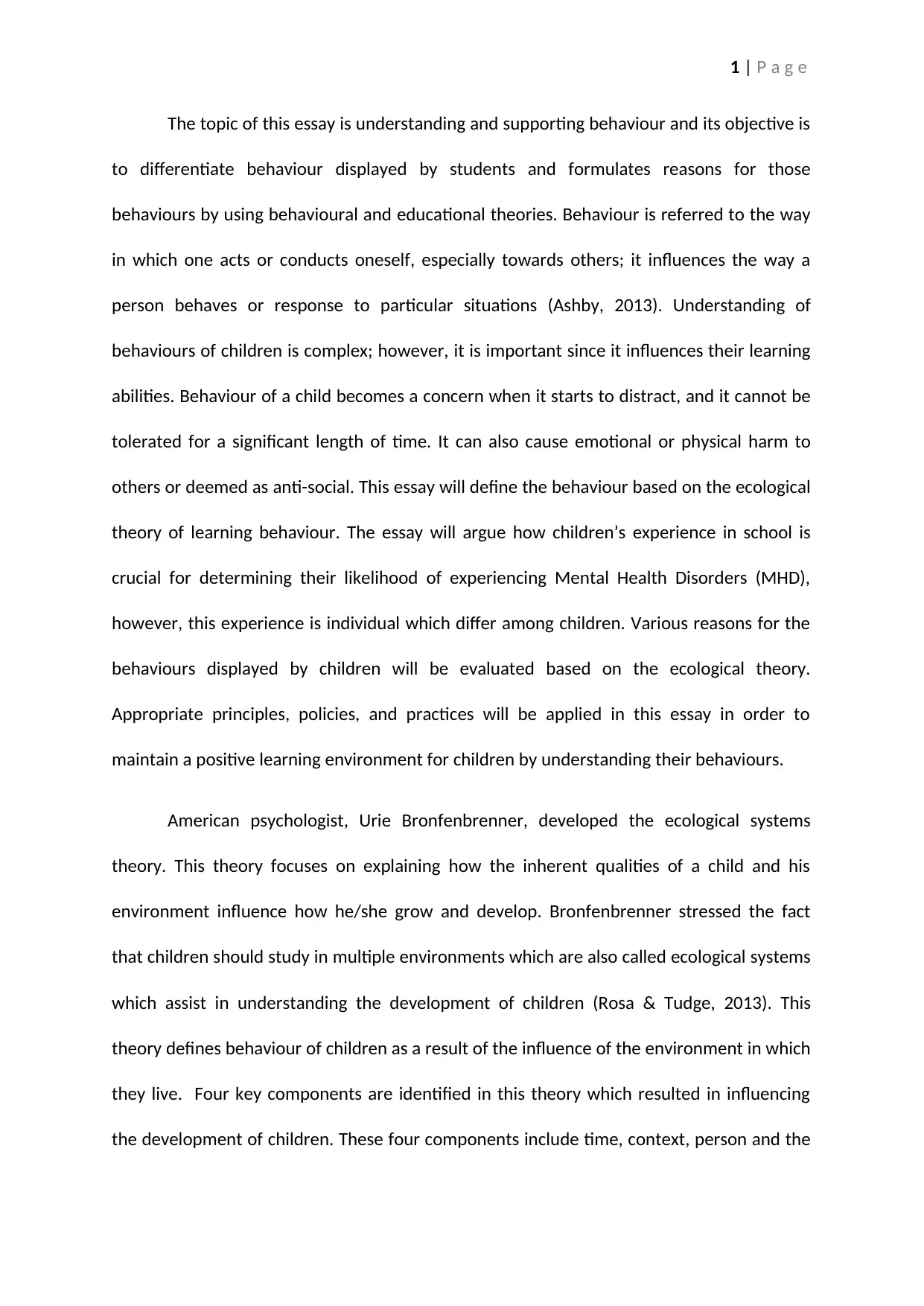
The topic of this essay is understanding and supporting behaviour and its objective is
to differentiate behaviour displayed by students and formulates reasons for those
behaviours by using behavioural and educational theories. Behaviour is referred to the way
in which one acts or conducts oneself, especially towards others; it influences the way a
person behaves or response to particular situations (Ashby, 2013). Understanding of
behaviours of children is complex; however, it is important since it influences their learning
abilities. Behaviour of a child becomes a concern when it starts to distract, and it cannot be
tolerated for a significant length of time. It can also cause emotional or physical harm to
others or deemed as anti-social. This essay will define the behaviour based on the ecological
theory of learning behaviour. The essay will argue how children’s experience in school is
crucial for determining their likelihood of experiencing Mental Health Disorders (MHD),
however, this experience is individual which differ among children. Various reasons for the
behaviours displayed by children will be evaluated based on the ecological theory.
Appropriate principles, policies, and practices will be applied in this essay in order to
maintain a positive learning environment for children by understanding their behaviours.
American psychologist, Urie Bronfenbrenner, developed the ecological systems
theory. This theory focuses on explaining how the inherent qualities of a child and his
environment influence how he/she grow and develop. Bronfenbrenner stressed the fact
that children should study in multiple environments which are also called ecological systems
which assist in understanding the development of children (Rosa & Tudge, 2013). This
theory defines behaviour of children as a result of the influence of the environment in which
they live. Four key components are identified in this theory which resulted in influencing
the development of children. These four components include time, context, person and the
Document Page
2 | P a g e
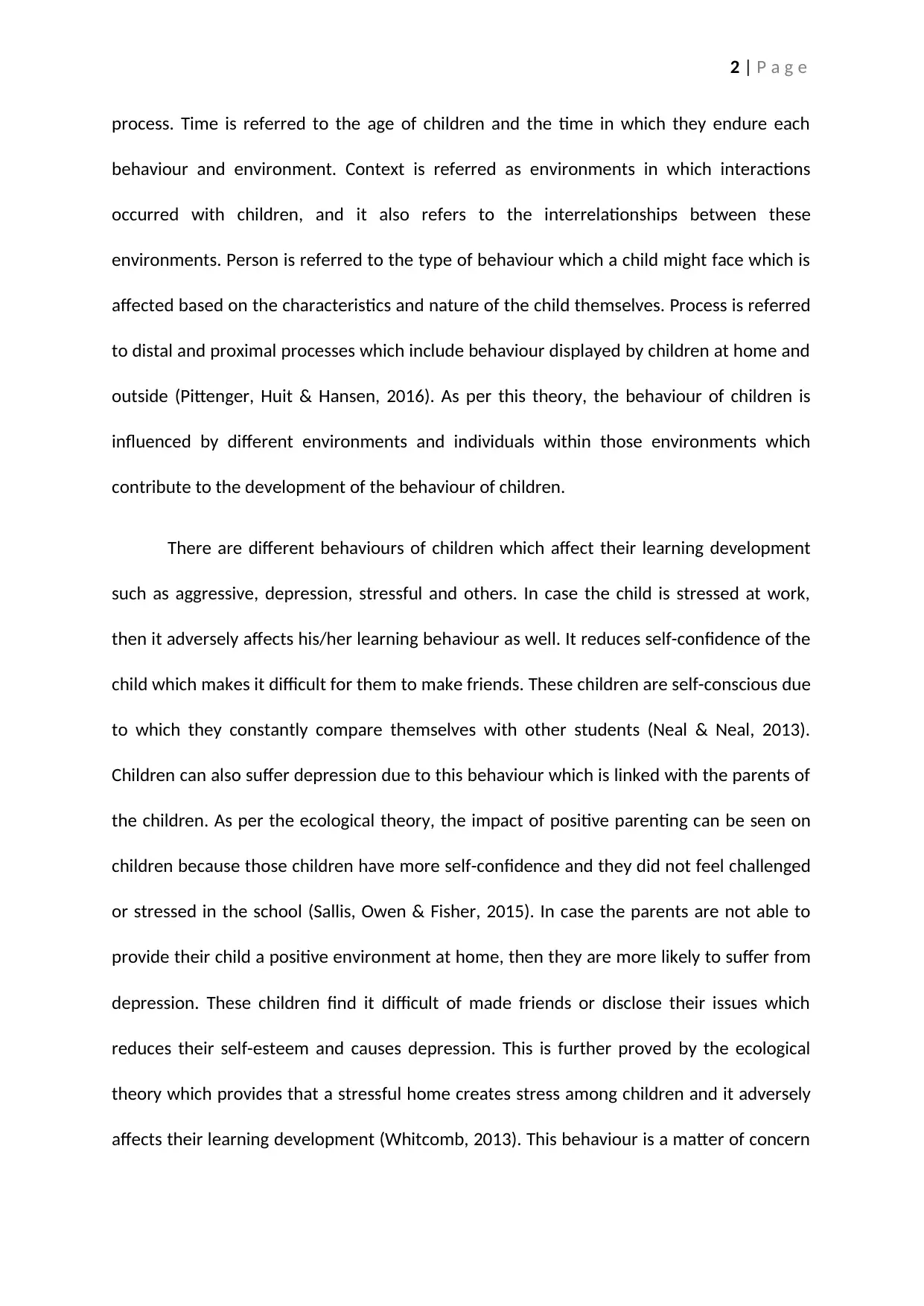
process. Time is referred to the age of children and the time in which they endure each
behaviour and environment. Context is referred as environments in which interactions
occurred with children, and it also refers to the interrelationships between these
environments. Person is referred to the type of behaviour which a child might face which is
affected based on the characteristics and nature of the child themselves. Process is referred
to distal and proximal processes which include behaviour displayed by children at home and
outside (Pittenger, Huit & Hansen, 2016). As per this theory, the behaviour of children is
influenced by different environments and individuals within those environments which
contribute to the development of the behaviour of children.
There are different behaviours of children which affect their learning development
such as aggressive, depression, stressful and others. In case the child is stressed at work,
then it adversely affects his/her learning behaviour as well. It reduces self-confidence of the
child which makes it difficult for them to make friends. These children are self-conscious due
to which they constantly compare themselves with other students (Neal & Neal, 2013).
Children can also suffer depression due to this behaviour which is linked with the parents of
the children. As per the ecological theory, the impact of positive parenting can be seen on
children because those children have more self-confidence and they did not feel challenged
or stressed in the school (Sallis, Owen & Fisher, 2015). In case the parents are not able to
provide their child a positive environment at home, then they are more likely to suffer from
depression. These children find it difficult of made friends or disclose their issues which
reduces their self-esteem and causes depression. This is further proved by the ecological
theory which provides that a stressful home creates stress among children and it adversely
affects their learning development (Whitcomb, 2013). This behaviour is a matter of concern
Document Page
3 | P a g e
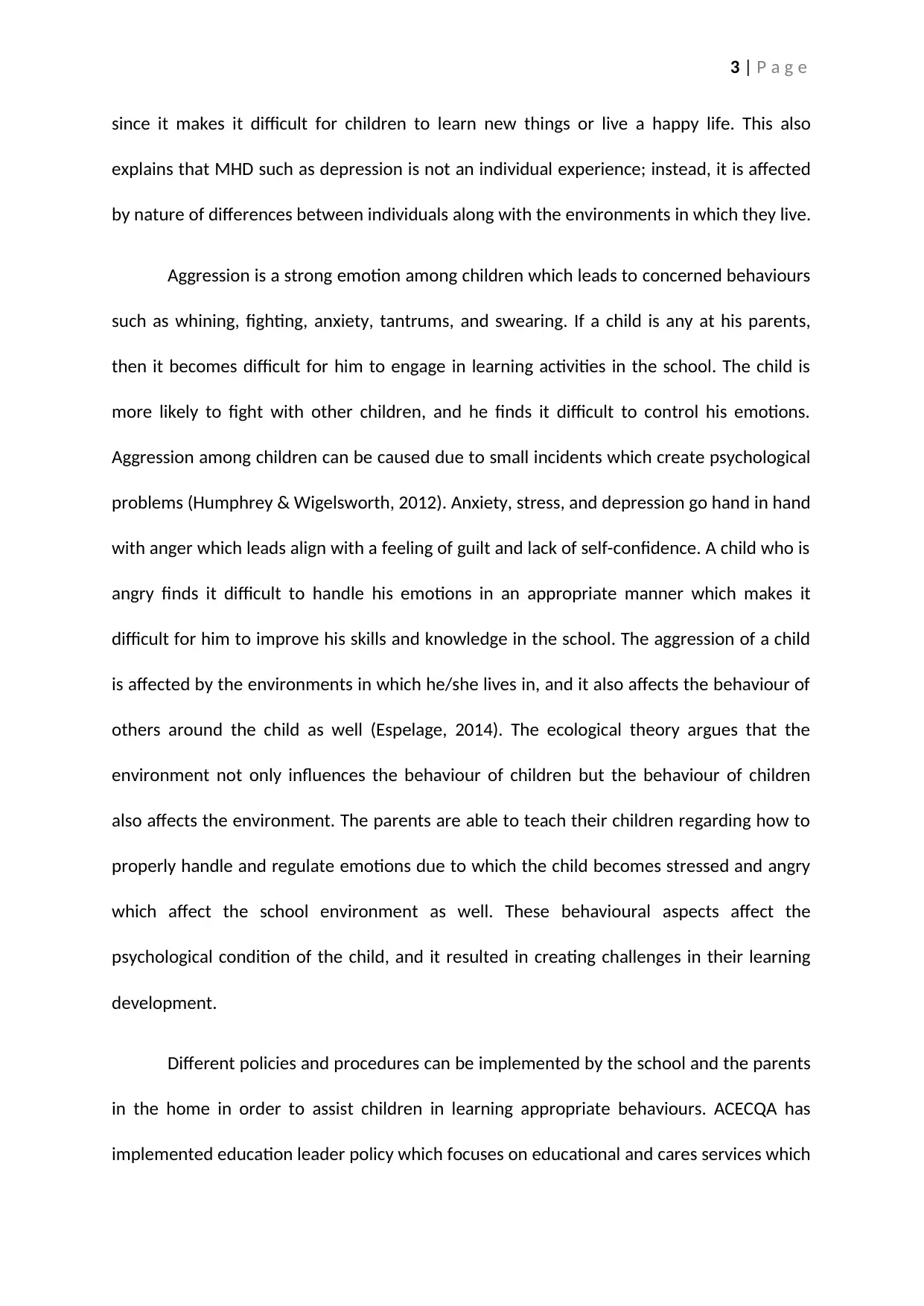
since it makes it difficult for children to learn new things or live a happy life. This also
explains that MHD such as depression is not an individual experience; instead, it is affected
by nature of differences between individuals along with the environments in which they live.
Aggression is a strong emotion among children which leads to concerned behaviours
such as whining, fighting, anxiety, tantrums, and swearing. If a child is any at his parents,
then it becomes difficult for him to engage in learning activities in the school. The child is
more likely to fight with other children, and he finds it difficult to control his emotions.
Aggression among children can be caused due to small incidents which create psychological
problems (Humphrey & Wigelsworth, 2012). Anxiety, stress, and depression go hand in hand
with anger which leads align with a feeling of guilt and lack of self-confidence. A child who is
angry finds it difficult to handle his emotions in an appropriate manner which makes it
difficult for him to improve his skills and knowledge in the school. The aggression of a child
is affected by the environments in which he/she lives in, and it also affects the behaviour of
others around the child as well (Espelage, 2014). The ecological theory argues that the
environment not only influences the behaviour of children but the behaviour of children
also affects the environment. The parents are able to teach their children regarding how to
properly handle and regulate emotions due to which the child becomes stressed and angry
which affect the school environment as well. These behavioural aspects affect the
psychological condition of the child, and it resulted in creating challenges in their learning
development.
Different policies and procedures can be implemented by the school and the parents
in the home in order to assist children in learning appropriate behaviours. ACECQA has
implemented education leader policy which focuses on educational and cares services which
tabler-icon-diamond-filled.svg

Paraphrase This Document

Need a fresh take? Get an instant paraphrase of this document with our AI Paraphraser
Document Page
4 | P a g e
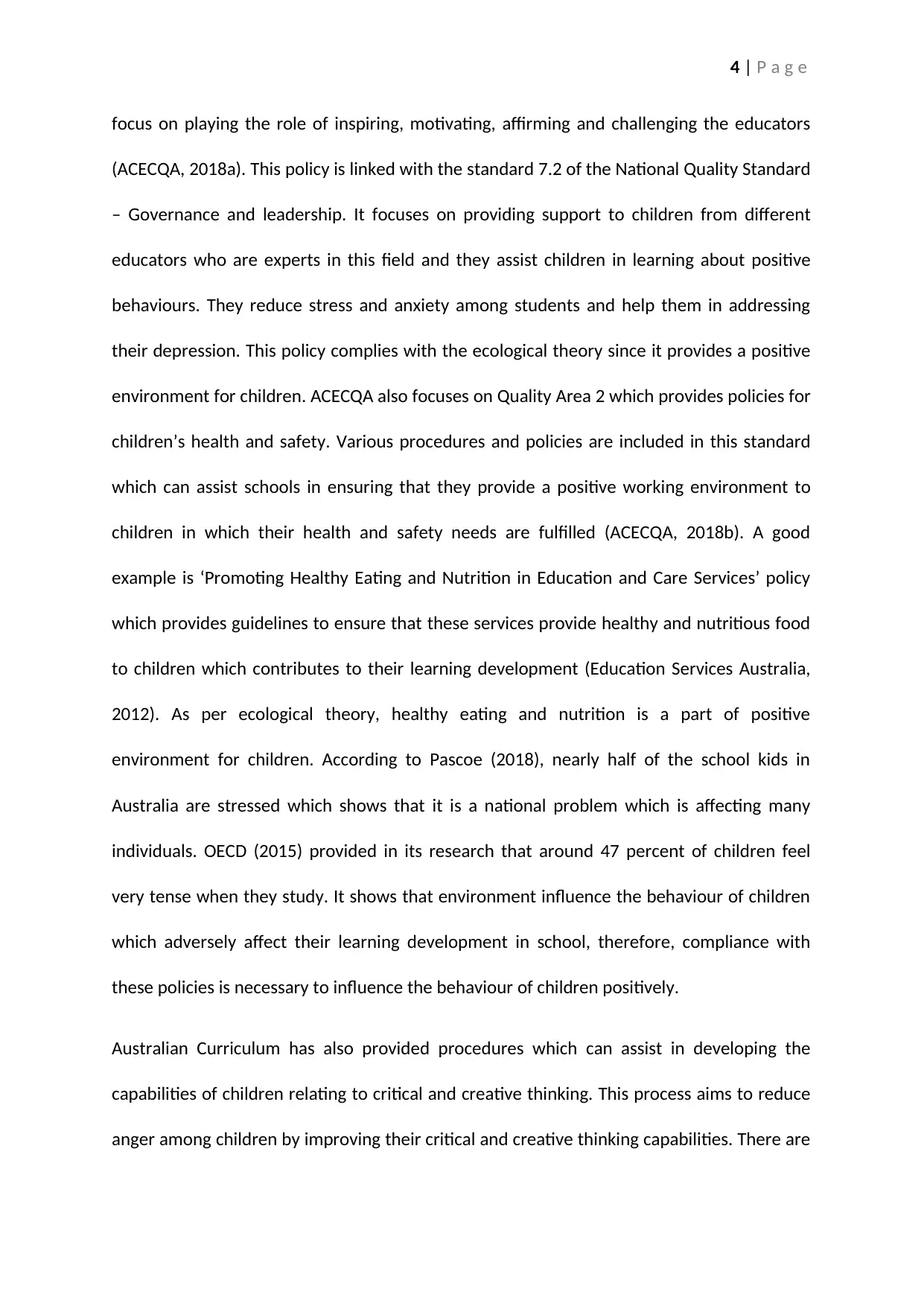
focus on playing the role of inspiring, motivating, affirming and challenging the educators
(ACECQA, 2018a). This policy is linked with the standard 7.2 of the National Quality Standard
– Governance and leadership. It focuses on providing support to children from different
educators who are experts in this field and they assist children in learning about positive
behaviours. They reduce stress and anxiety among students and help them in addressing
their depression. This policy complies with the ecological theory since it provides a positive
environment for children. ACECQA also focuses on Quality Area 2 which provides policies for
children’s health and safety. Various procedures and policies are included in this standard
which can assist schools in ensuring that they provide a positive working environment to
children in which their health and safety needs are fulfilled (ACECQA, 2018b). A good
example is ‘Promoting Healthy Eating and Nutrition in Education and Care Services’ policy
which provides guidelines to ensure that these services provide healthy and nutritious food
to children which contributes to their learning development (Education Services Australia,
2012). As per ecological theory, healthy eating and nutrition is a part of positive
environment for children. According to Pascoe (2018), nearly half of the school kids in
Australia are stressed which shows that it is a national problem which is affecting many
individuals. OECD (2015) provided in its research that around 47 percent of children feel
very tense when they study. It shows that environment influence the behaviour of children
which adversely affect their learning development in school, therefore, compliance with
these policies is necessary to influence the behaviour of children positively.
Australian Curriculum has also provided procedures which can assist in developing the
capabilities of children relating to critical and creative thinking. This process aims to reduce
anger among children by improving their critical and creative thinking capabilities. There are
Document Page
5 | P a g e
four elements of this policy which assist setting an environment which is suitable for
children (Australian Curriculum, 2018). The first factor is reflection of thinking and other
processes by parents and educators to understand the behaviour of children. The second
element is inquiring in which they focus on identifying, exploring and organising information
and ideas for children. The third element is generating ideas to engage children in possibility
and actions. The fourth element is analysing, synthesising and evaluating various reasoning
and procedures which develops critical and creative thinking capabilities among children.
Children who live in problematic homes should have access to positive classroom
environment where they feel safe, and the educators should focus on removing key
elements from their negative behaviour. Bullying also contributes to increased stress among
children and causes anger issues, therefore, policies should be implemented to strictly
prohibit bullying in schools (Humphrey & Wigelsworth, 2012). Schools can also implement
policies for increasing interaction between children through verbal and non-verbal mediums
which builds strong relationships among students, and it helps them in reduce their stress
and anger which positively reflect on their behaviour (Education, n.d.). This policy complies
with ecological theory since it focuses on setting a positive environment to positively
influence the behaviour of children.
In conclusion, the experience of children increases their likelihood of experiencing
MHD, however, it is individual in nature due to which children living in similar environment
can experience different level of well-being. The ecological theory is evaluated in this essay
in order to support this argument by understanding how behaviour of children is influenced
by their environment. Behaviours such as stress, anxiety, and anger create challenges
relating to the mental health of children, and it negatively affects their learning
Document Page
6 | P a g e
development. However, these challenges can be resolved through implementation of
various policies and procedures such as education leader policy to provide support to
children, policy for access to healthy and nutritious food, positive classroom environment,
prohibiting bullying, and developing critical and creative thinking.
tabler-icon-diamond-filled.svg

Paraphrase This Document

Need a fresh take? Get an instant paraphrase of this document with our AI Paraphraser
Document Page
7 | P a g e
References
ACECQA. (2018a). What is Educational Leader?. Retrieved from
https://www.acecqa.gov.au/resources/educational-leadership
ACECQA. (2018b). Quality Area 2 Children's health and safety. Retrieved from
https://www.acecqa.gov.au/nqf/national-quality-standard/quality-area-2-childrens-
health-and-safety
Ashby, W. (2013). Design for a brain: The origin of adaptive behaviour. New York: Springer
Science & Business Media.
Australian Curriculum. (2018). Critical and Creative Thinking. Retrieved from
https://www.australiancurriculum.edu.au/f-10-curriculum/general-capabilities/
critical-and-creative-thinking/
Education Services Australia. (2012). Promoting Healthy Eating and Nutrition In Education
and Care Services. Retrieved from
https://www.ecrh.edu.au/docs/default-source/resources/ipsp/promoting-healthy-
eating-in-education-and-care-services.pdf?sfvrsn=12
Education. (n.d.). BELONGING, BEING & BECOMING The Early Years Learning Framework for
Australia. Retrieved from
https://docs.education.gov.au/system/files/doc/other/belonging_being_and_becom
ing_the_early_years_learning_framework_for_australia._v5_docx.pdf
Espelage, D. L. (2014). Ecological theory: Preventing youth bullying, aggression, and
victimization. Theory into Practice, 53(4), 257-264.
Humphrey, N. & Wigelsworth, M. (2012). Modelling the factors associated with children's
mental health difficulties in Primary school: A multilevel study. School Psychology
Review, 41(3), 326-341.
Document Page
8 | P a g e
Neal, J. W., & Neal, Z. P. (2013). Nested or networked? Future directions for ecological
systems theory. Social Development, 22(4), 722-737.
OECD. (2015). Are students happy? PISA 2015 Results: Students’ Well-Being. Retrieved from
https://read.oecd-ilibrary.org/education/are-students-happy_3512d7ae-en#page1
Pascoe, M. (2018). Nearly half of Australian school kids are stressed. Here's how to fix it..
Retrieved from https://www.smh.com.au/lifestyle/health-and-wellness/nearly-half-
of-australian-school-kids-are-stressed-heres-how-to-fix-it-20180126-h0omvq.html
Pittenger, S. L., Huit, T. Z., & Hansen, D. J. (2016). Applying ecological systems theory to
sexual revictimization of youth: A review with implications for research and
practice. Aggression and violent behavior, 26, 35-45.
Rosa, E. M., & Tudge, J. (2013). Urie Bronfenbrenner's theory of human development: Its
evolution from ecology to bioecology. Journal of Family Theory & Review, 5(4), 243-
258.
Sallis, J. F., Owen, N., & Fisher, E. (2015). Ecological models of health behavior. Health
behavior: Theory, research, and practice, 5, 43-64.
Whitcomb, S. A. (2013). Behavioral, social, and emotional assessment of children and
adolescents. Abingdon: Routledge.
chevron_up_icon
1 out of 9
circle_padding
hide_on_mobile
zoom_out_icon
[object Object]