Exploring Unemployment: Rate, Causes, and Solutions in Myanmar

Verified

Added on  2023/06/14

|5
|897
|382
Essay
AI Summary
This essay examines the unemployment rate in Myanmar, highlighting its measurement, causes, and potential solutions. The unemployment rate in Myanmar was reported at 4.7% in 2016, influenced by excessive labor supply and limited factors of production. The essay notes discrepancies in unemployment statistics due to the exclusion of underemployment in rural agricultural sectors and the acceptance of below-subsistence-level jobs due to poverty. Factors contributing to unemployment include local preferences for public sector jobs, skills gaps between workers and industry needs, and economic downturns. The essay suggests that the Myanmar government should implement training programs aligned with employer requirements and integrate workers into the public sector to provide relevant experience. It also acknowledges the existence of frictional unemployment as workers transition from agricultural to industrial sectors. The essay concludes by referencing theories related to labor productivity and efficient wages.
Document Page
Running head: UNEMPLOYMENT 1
Unemployment
Student’s Name
Institution
tabler-icon-diamond-filled.svg

Paraphrase This Document

Need a fresh take? Get an instant paraphrase of this document with our AI Paraphraser
Document Page
UNEMPLOYMENT 2
Unemployment
The unemployment rate in Myanmar is measured as a percentage of the unemployed
persons to the total labour force in the country. Unemployment can be described as a situation in
which an individual of working age would like to be in full employment but is not getting a job
(World, 2003). Precisely, the unemployment rate measures the number of persons that are
actively seeking a job as a percentage of the total labour force. According to “Labour Market
Profile 2016” the rate of unemployment in Myanmar was 4.7% in 2016. Whereby, a person of
working age can either be employed, Unemployed or not in labour force which is 30.9 million.
According to World Bank data, the average rate of unemployment from 1991 to 2017 is 0.80%.
The prevalent cause of unemployment in Myanmar is the excessive labour supply in the
country whereas the factors of production are limited (Lim, 2001). Another reason for the
unemployment is the increasing number of labour force beyond the country’s ability to create
jobs. The long-run unemployment rate has been at 4.04% in Myanmar for the past twenty years
from 1994 to 2014. The long-run unemployment rate has not very different from the short run
unemployment rates. For example, the unemployment rate in 2014 was at 4.10% compared to the
unemployment rate in 2013 which was 4.02% unlike the unemployment rate of 4.7% in 2016
“Labour market Profile 2016”. Furthermore, the unemployment arises in Myanmar due to the
reduction in demand for products which makes the industries to reduce their supply thus
reducing the number of employees.
The unemployment rate in Myanmar is not measured correctly. The reasons being that
the unemployment statistics do not include the figures for the underemployment in the rural areas
for the people who work in the agricultural sector in Myanmar (Lim, 2001). Moreover, the
poverty level in Myanmar makes people find employment opportunities despite having a
Document Page
UNEMPLOYMENT 3
remuneration that is below the subsistence level. Therefore, the unemployment rate could be
higher if the above factors are considered. The unemployed stay without work for different
periods. Most of the unemployment experienced at a point in time is long term. However, many
unemployment spells are short term. Hence it can be observed that the unemployment is for a
few people who remain unemployed for extended periods.
There are reasons for the existence of the unemployment in Myanmar. Firstly
unemployment exists because some of the local people in Myanmar refuse to take up jobs in the
private sector in view that the public sector has better pay for similar jobs (Lim, 2001). Another
reason is the gap that exists between the skills that workers have and the actual skills that
industries are looking for in Myanmar (Arnold, 2008). For example, the plantation sector in
Myanmar was looking for employees but could not find them because they did not have skills in
the plantation sector. Additionally, Economic downturns in Myanmar lead to unemployment as
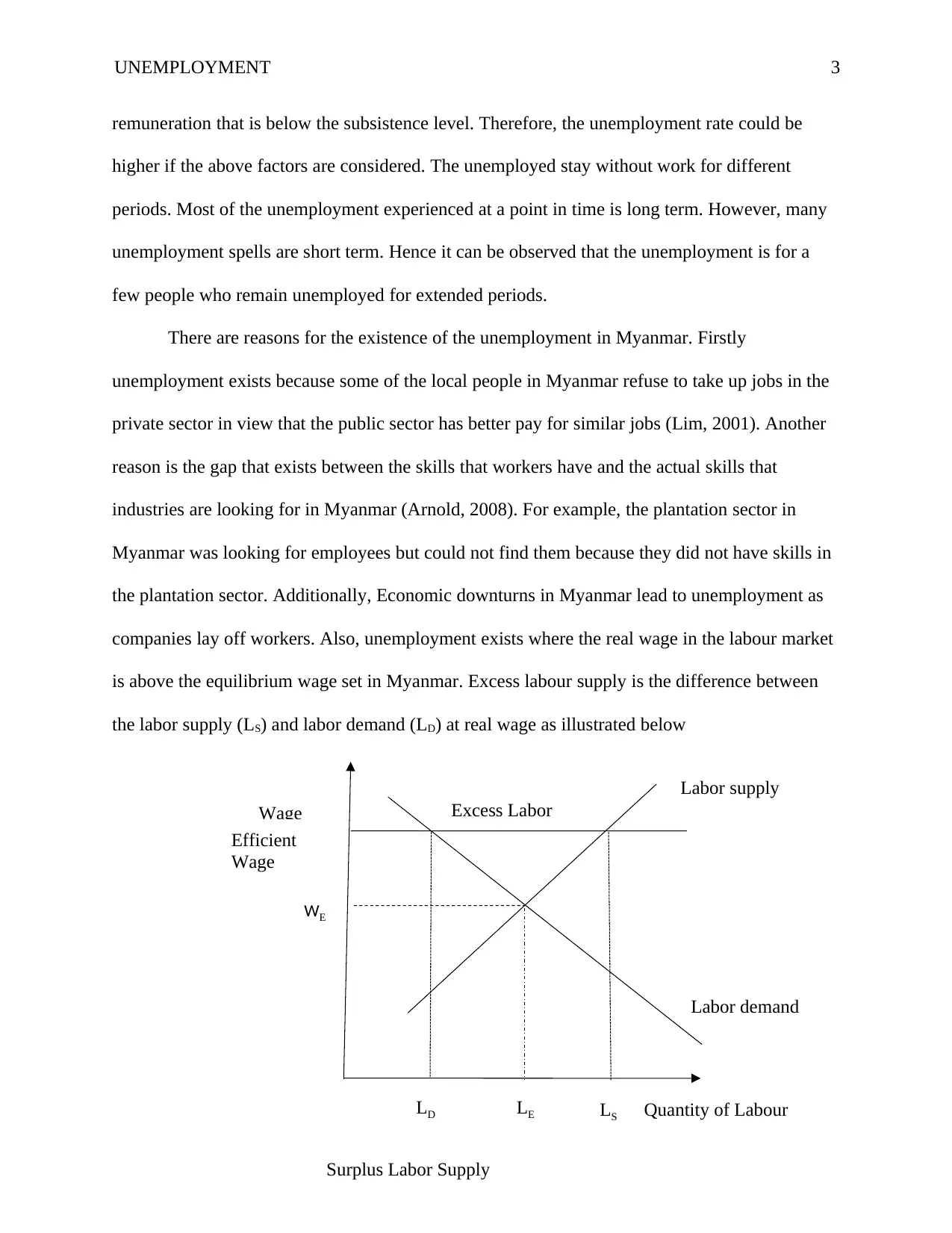
companies lay off workers. Also, unemployment exists where the real wage in the labour market
is above the equilibrium wage set in Myanmar. Excess labour supply is the difference between
the labor supply (LS) and labor demand (LD) at real wage as illustrated below
WE
Wage
Efficient
Wage
LD LE LS
Excess Labor
Labor supply
Labor demand
Quantity of Labour
Surplus Labor Supply
Document Page
UNEMPLOYMENT 4
Myanmar government should work out the solution for the unemployment. It ought to
plan training that matches the employer’s requirements. The government can also plan
workshops to train workers and equip them with the necessary skills. Furthermore, the
government can induct the workers in its public sector to give them the experience that will
enable them to match the skills required.
Frictional unemployment exists in Myanmar. It happens as people move from one job to
the other especially when people in Myanmar shift away from agricultural activities in rural
areas to the industrial employment in the urban areas. The Labour Market Profile 2016” shows
that labor productivity has increased in Myanmar since the 1990s. The theories include worker
health, worker quality, worker effect and worker turnover. Workers are prevented from shirking
and improve the quality of their work through efficient wages.
tabler-icon-diamond-filled.svg

Paraphrase This Document

Need a fresh take? Get an instant paraphrase of this document with our AI Paraphraser
Document Page
UNEMPLOYMENT 5
References
Arnold, R. A. (2008). Economics. Mason, OH, USA: Thomson South-Western.
Free, R. C. (2010). 21st century economics: A reference handbook. Thousand Oaks, Calif:
SAGE.
“Labour Market Profile 2016”. Retrieved from
http://www.ulandssekretariatet.dk/sites/default/files/uploads/publ
ic/PDF/LMP/lmp_myanmar_2016.pdf Accessed 29 March 2018.
Lim, C.-Y. (2001). Southeast Asia: The long road ahead. Singapore [u.a.: World Scientific.
World, B. S. (2003). World Development Indicators 2003.
chevron_up_icon
1 out of 5
circle_padding
hide_on_mobile
zoom_out_icon
[object Object]