Unilever PLC: PESTLE, Marketing Mix, and Strategic Analysis Report
VerifiedAdded on 2020/10/22
|16
|5577
|443
Report
AI Summary
This report provides a comprehensive analysis of Unilever PLC's business environment, focusing on the impact of Brexit. It begins with an introduction to Unilever, its strategic objectives, and marketing focus. The main body delves into a situation analysis, emphasizing the increased importance of environmental scanning in the context of Brexit and utilizes PESTLE analysis to examine political, economic, social, technological, legal, and environmental factors affecting the company. The report further explores internal analysis using the marketing mix (7Ps), segmentation, targeting, and positioning (STP), and the 4Ps of the marketing mix. The report concludes with recommendations for action and control, including SAFe criteria, along with a summary of findings and conclusions. The report highlights the importance of environmental scanning and strategic adaptation in response to external factors such as Brexit and changing market conditions. The analysis provides insights into Unilever's operations, strategic objectives, and marketing strategies in the context of a dynamic business environment.
TASK

Paraphrase This Document
Need a fresh take? Get an instant paraphrase of this document with our AI Paraphraser

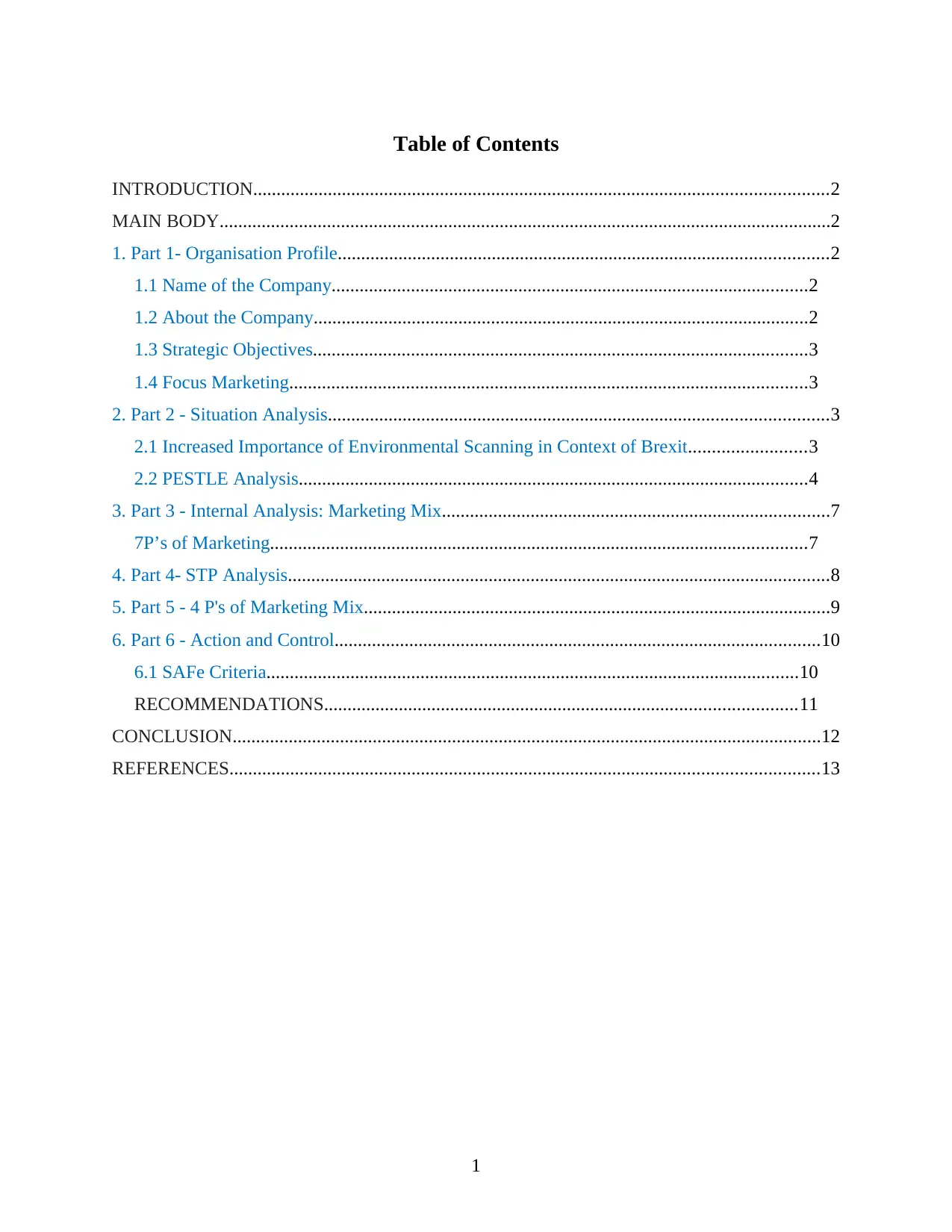
Table of Contents
INTRODUCTION...........................................................................................................................2
MAIN BODY...................................................................................................................................2
1. Part 1- Organisation Profile.........................................................................................................2
1.1 Name of the Company......................................................................................................2
1.2 About the Company..........................................................................................................2
1.3 Strategic Objectives..........................................................................................................3
1.4 Focus Marketing...............................................................................................................3
2. Part 2 - Situation Analysis...........................................................................................................3
2.1 Increased Importance of Environmental Scanning in Context of Brexit.........................3
2.2 PESTLE Analysis.............................................................................................................4
3. Part 3 - Internal Analysis: Marketing Mix...................................................................................7
7P’s of Marketing...................................................................................................................7
4. Part 4- STP Analysis....................................................................................................................8
5. Part 5 - 4 P's of Marketing Mix....................................................................................................9
6. Part 6 - Action and Control........................................................................................................10
6.1 SAFe Criteria..................................................................................................................10
RECOMMENDATIONS.....................................................................................................11
CONCLUSION..............................................................................................................................12
REFERENCES..............................................................................................................................13
1
INTRODUCTION...........................................................................................................................2
MAIN BODY...................................................................................................................................2
1. Part 1- Organisation Profile.........................................................................................................2
1.1 Name of the Company......................................................................................................2
1.2 About the Company..........................................................................................................2
1.3 Strategic Objectives..........................................................................................................3
1.4 Focus Marketing...............................................................................................................3
2. Part 2 - Situation Analysis...........................................................................................................3
2.1 Increased Importance of Environmental Scanning in Context of Brexit.........................3
2.2 PESTLE Analysis.............................................................................................................4
3. Part 3 - Internal Analysis: Marketing Mix...................................................................................7
7P’s of Marketing...................................................................................................................7
4. Part 4- STP Analysis....................................................................................................................8
5. Part 5 - 4 P's of Marketing Mix....................................................................................................9
6. Part 6 - Action and Control........................................................................................................10
6.1 SAFe Criteria..................................................................................................................10
RECOMMENDATIONS.....................................................................................................11
CONCLUSION..............................................................................................................................12
REFERENCES..............................................................................................................................13
1
⊘ This is a preview!⊘
Do you want full access?
Subscribe today to unlock all pages.

Trusted by 1+ million students worldwide
INTRODUCTION
Business Environment can be defined as the sum of all the internal and external factors
that impacts upon the working of an organisation whether in a positive or negative way (business
environment, 2019). An organisation is effected from various factors such as the internal factors
including employees, customers, suppliers, managers, Board of Directors, Owners, etc. and in
the external factors innovation in technology, government intervention, economic changes,
market trends, supply and demand of products in the market all are included in the external
factors which impacts on the organisation. For the completion of this assignment, the company
chosen in Unilever Limited which is a UK based company. It was founded in the year 1929 and
is headquartered in London. The company is providing various products to their customers which
are food, beverages, cleaning agents and beauty and personal care products. Brexit impacted
upon the value creation as this incident lead to move away all the opportunities and created a
situation of recession for the businesses outside UK. So the value of the businesses moved down
due to low financial condition. The following assignment will provide an understanding about
the impact of macro environmental factors and about the increased importance of environmental
scanning in Brexit context with the help of PESTLE Analysis and Porter's Five Forces Model. In
addition to this, the assignment will also do the internal analysis by making use of BCG Matrix
of Unilever Limited Company.
MAIN BODY
1. Part 1- Organisation Profile
1.1 Name of the Company
Unilever PLC
1.2 About the Company
The following company was formed in 2 September, 1929 by merger of two different
companies which were “UNIE” and “LEVER”. The company is providing its services all over
the world and the Chairman of this company is Marijin Dekkers. The company's first product
was Sunlight Soap and later diversified to other products which were Pears Soap and Wall's.
Unilever is headquartered in London and is currently employing 1,55,000 employees
approximately. The company has also increased the variety of products it is providing to their
2
Business Environment can be defined as the sum of all the internal and external factors
that impacts upon the working of an organisation whether in a positive or negative way (business
environment, 2019). An organisation is effected from various factors such as the internal factors
including employees, customers, suppliers, managers, Board of Directors, Owners, etc. and in
the external factors innovation in technology, government intervention, economic changes,
market trends, supply and demand of products in the market all are included in the external
factors which impacts on the organisation. For the completion of this assignment, the company
chosen in Unilever Limited which is a UK based company. It was founded in the year 1929 and
is headquartered in London. The company is providing various products to their customers which
are food, beverages, cleaning agents and beauty and personal care products. Brexit impacted
upon the value creation as this incident lead to move away all the opportunities and created a
situation of recession for the businesses outside UK. So the value of the businesses moved down
due to low financial condition. The following assignment will provide an understanding about
the impact of macro environmental factors and about the increased importance of environmental
scanning in Brexit context with the help of PESTLE Analysis and Porter's Five Forces Model. In
addition to this, the assignment will also do the internal analysis by making use of BCG Matrix
of Unilever Limited Company.
MAIN BODY
1. Part 1- Organisation Profile
1.1 Name of the Company
Unilever PLC
1.2 About the Company
The following company was formed in 2 September, 1929 by merger of two different
companies which were “UNIE” and “LEVER”. The company is providing its services all over
the world and the Chairman of this company is Marijin Dekkers. The company's first product
was Sunlight Soap and later diversified to other products which were Pears Soap and Wall's.
Unilever is headquartered in London and is currently employing 1,55,000 employees
approximately. The company has also increased the variety of products it is providing to their
2
Paraphrase This Document
Need a fresh take? Get an instant paraphrase of this document with our AI Paraphraser
customers as now it is dealing in food and beverages, cleaning agents and beauty & personal care
products for their customers (Vandenbussche, Connell Garcia and Simons, 2019). The revenue
of the company in the year 2018 was about € 50.982 billion.
1.3 Strategic Objectives
To make improvement in Health and Well Being of People by 2020.
To reduce the bad impact on the environment of organisation's working by 2030.
To improve the livelihoods of millions of people with the growth in business by 2020.
1.4 Focus Marketing
It is a part of Marketing Strategies. The company's main focus is on Focus Strategy as the
company is clear with all the segments of the market in which the products and services of this
company are dealing (Japutra, Nguyen and Melewar, 2019). With the help of this strategy the
company is able to capture sufficient market share and also has made possible the successful
expansion of the business all over the world.
2. Part 2 - Situation Analysis
It can be defined as the proper and systematic collection and evaluation of past and
present factors which are political, economical, social, technological, environmental and legal
factors which are impacting whether positively or negatively on the working of an organisation.
It is also aims at identifying the internal and external forces which influences the performance of
an organisation.
2.1 Increased Importance of Environmental Scanning in Context of Brexit
Environmental Analysis will help the company in knowing about the inside and outside
conditions of the company. This analysis is conducted by the Manager of Unilever Plc. The
importance of this analysis and evaluation in context of Unilever is that it provides assistance to
enterprise in gaining knowledge about the probable internal and external factors which may act
as opportunity or threat for the entity and have a significant impact upon its overall functioning.
If the condition is not so good than it will also provide the company with the ways to increase the
profitability of the organisation by making improvement in their strategies and policies and
better deployment of these strategies and policies will clearly reflected from the environment of
the organisation after the application.
3
products for their customers (Vandenbussche, Connell Garcia and Simons, 2019). The revenue
of the company in the year 2018 was about € 50.982 billion.
1.3 Strategic Objectives
To make improvement in Health and Well Being of People by 2020.
To reduce the bad impact on the environment of organisation's working by 2030.
To improve the livelihoods of millions of people with the growth in business by 2020.
1.4 Focus Marketing
It is a part of Marketing Strategies. The company's main focus is on Focus Strategy as the
company is clear with all the segments of the market in which the products and services of this
company are dealing (Japutra, Nguyen and Melewar, 2019). With the help of this strategy the
company is able to capture sufficient market share and also has made possible the successful
expansion of the business all over the world.
2. Part 2 - Situation Analysis
It can be defined as the proper and systematic collection and evaluation of past and
present factors which are political, economical, social, technological, environmental and legal
factors which are impacting whether positively or negatively on the working of an organisation.
It is also aims at identifying the internal and external forces which influences the performance of
an organisation.
2.1 Increased Importance of Environmental Scanning in Context of Brexit
Environmental Analysis will help the company in knowing about the inside and outside
conditions of the company. This analysis is conducted by the Manager of Unilever Plc. The
importance of this analysis and evaluation in context of Unilever is that it provides assistance to
enterprise in gaining knowledge about the probable internal and external factors which may act
as opportunity or threat for the entity and have a significant impact upon its overall functioning.
If the condition is not so good than it will also provide the company with the ways to increase the
profitability of the organisation by making improvement in their strategies and policies and
better deployment of these strategies and policies will clearly reflected from the environment of
the organisation after the application.
3
Furthermore environmental scanning is also of great importance in order to know and
deal with the rapid changes taking place in the environment which impacts greatly on the
working of an organisation. Environmental scanning helps the company to know about the
strengths, weaknesses, opportunities and threats to the company (Morgan and et. al., 2019).
The incident when United Kingdom left European Union is treated as Brexit. It has
impacted a lot on the both the internal as well as external environment of the company. Internally
for the organisations it was very crucial to take into consideration the bad impacts of this incident
on the organisations. It is so because the due to this incident the overall exports of UK were
going to take a hit of € 4.5 billion per year.
Another reason behind doing the environmental scanning was because of effect of Brexit
on employment and labour. As UK left EU, so the number of migrants looking for jobs also left
UK in search of jobs in other countries and could adversely impact upon the survival of
companies like Unilever in UK (Driffield and Karoglou, 2019).
Another impact was on the market of UK which was passing from a period of recession
where the purchasing power of the buyers of the country become very low. This happened due to
low level of production and unavailability of labours to carry out the production process of
companies. As the individuals of the country were leaving the country in search of jobs because
Brexit removed most of the employment opportunities from the country. So due to the following
reasons it become crucial for the companies to make an evaluation of their strategies, policies
and analyse the internal as well as `external factors and their impact on the working of an
organisation (Niemann-Struweg, 2014). The economical environment was the most important
environment at the time of incident because the impact of Brexit was on the economy of the
country and similarly on the companies also such as the situation of low employment
opportunities, low level of production, recession, etc. denoted the need to focus on the
economical environment.
2.2 PESTLE Analysis
In order to understand about the impact of macro environmental factors on the
working of Unilever Limited, the use of PESTLE Analysis is done which is described as under:
The following tool or framework is used in order to analyse and monitor the macro
environmental factors that can impact upon the working of an organisation (Moroni, Arruda and
Araujo, 2015) on the company. The impact these factors on Unilever is describes as under:
4
deal with the rapid changes taking place in the environment which impacts greatly on the
working of an organisation. Environmental scanning helps the company to know about the
strengths, weaknesses, opportunities and threats to the company (Morgan and et. al., 2019).
The incident when United Kingdom left European Union is treated as Brexit. It has
impacted a lot on the both the internal as well as external environment of the company. Internally
for the organisations it was very crucial to take into consideration the bad impacts of this incident
on the organisations. It is so because the due to this incident the overall exports of UK were
going to take a hit of € 4.5 billion per year.
Another reason behind doing the environmental scanning was because of effect of Brexit
on employment and labour. As UK left EU, so the number of migrants looking for jobs also left
UK in search of jobs in other countries and could adversely impact upon the survival of
companies like Unilever in UK (Driffield and Karoglou, 2019).
Another impact was on the market of UK which was passing from a period of recession
where the purchasing power of the buyers of the country become very low. This happened due to
low level of production and unavailability of labours to carry out the production process of
companies. As the individuals of the country were leaving the country in search of jobs because
Brexit removed most of the employment opportunities from the country. So due to the following
reasons it become crucial for the companies to make an evaluation of their strategies, policies
and analyse the internal as well as `external factors and their impact on the working of an
organisation (Niemann-Struweg, 2014). The economical environment was the most important
environment at the time of incident because the impact of Brexit was on the economy of the
country and similarly on the companies also such as the situation of low employment
opportunities, low level of production, recession, etc. denoted the need to focus on the
economical environment.
2.2 PESTLE Analysis
In order to understand about the impact of macro environmental factors on the
working of Unilever Limited, the use of PESTLE Analysis is done which is described as under:
The following tool or framework is used in order to analyse and monitor the macro
environmental factors that can impact upon the working of an organisation (Moroni, Arruda and
Araujo, 2015) on the company. The impact these factors on Unilever is describes as under:
4
⊘ This is a preview!⊘
Do you want full access?
Subscribe today to unlock all pages.
Trusted by 1+ million students worldwide
Political Factors:
These are the factors whose impact is determined by the intervention of government in
the working of an organisation It includes government policies, political stability and instability,
foreign trade policy, labour law, environmental policy, trade restrictions and so on (Lawless and
Morgenroth, 2019). There are a number of political ideologies which persist and need to be
considered by an enterprise such as socialist, capitalist theories etc. Socialism is an ideology
which consists of a variety of social as well as economic systems which are characterised by
social proprietorship along with democratic control over means of production and political
beliefs which aim at their creation. Further, capitalism can be referred to as an economic system
which is based upon the private ownership of means of production as well as their operations and
functioning for profit. For example, it is a threat to the company which was about non fulfilment
of regulatory restrictions and guidelines provided by the European Commission.
If the company will be unable to comply with these regulations and guidelines in their
working than the company will face legal and criminal issues and fines. The firm was also made
liable to all local and international laws to take into consideration to the places where the
company is operating their businesses. So the non-fulfilment of the rules and regulations is a
threat to the company.
There is also an opportunity for the company to make use of its experience, goodwill and
contacts to make the bargain with the government to make changes in their rules and regulations.
It is also possible in some countries that the government may agree upon it because of its good
and health products provided to the customers. For example, it is a threat to the company to deal
in a situation as the competition in EU has become so strong because of which Unilever is facing
so much difficulties in doing the business. So it is necessary for the company to make suitable
policies by which the company will be able to recover and eradicate the effect of this situation.
Further there is also an opportunity for the company to make ensure the profitability of the
company is driven as sustained. It can be done by making suitable policies and adopting suitable
strategy by which the company can deal with the situation of political instability in the country.
The government of a nation is responsible for creating and enforcing various laws, rules
and legislations which can collectively assist in relevant running of companies as well as
country. In this regard, a politically stable country has constant and consistent set of policies and
procedures over years which assist companies in adequately functioning in an effective manner
5
These are the factors whose impact is determined by the intervention of government in
the working of an organisation It includes government policies, political stability and instability,
foreign trade policy, labour law, environmental policy, trade restrictions and so on (Lawless and
Morgenroth, 2019). There are a number of political ideologies which persist and need to be
considered by an enterprise such as socialist, capitalist theories etc. Socialism is an ideology
which consists of a variety of social as well as economic systems which are characterised by
social proprietorship along with democratic control over means of production and political
beliefs which aim at their creation. Further, capitalism can be referred to as an economic system
which is based upon the private ownership of means of production as well as their operations and
functioning for profit. For example, it is a threat to the company which was about non fulfilment
of regulatory restrictions and guidelines provided by the European Commission.
If the company will be unable to comply with these regulations and guidelines in their
working than the company will face legal and criminal issues and fines. The firm was also made
liable to all local and international laws to take into consideration to the places where the
company is operating their businesses. So the non-fulfilment of the rules and regulations is a
threat to the company.
There is also an opportunity for the company to make use of its experience, goodwill and
contacts to make the bargain with the government to make changes in their rules and regulations.
It is also possible in some countries that the government may agree upon it because of its good
and health products provided to the customers. For example, it is a threat to the company to deal
in a situation as the competition in EU has become so strong because of which Unilever is facing
so much difficulties in doing the business. So it is necessary for the company to make suitable
policies by which the company will be able to recover and eradicate the effect of this situation.
Further there is also an opportunity for the company to make ensure the profitability of the
company is driven as sustained. It can be done by making suitable policies and adopting suitable
strategy by which the company can deal with the situation of political instability in the country.
The government of a nation is responsible for creating and enforcing various laws, rules
and legislations which can collectively assist in relevant running of companies as well as
country. In this regard, a politically stable country has constant and consistent set of policies and
procedures over years which assist companies in adequately functioning in an effective manner
5
Paraphrase This Document
Need a fresh take? Get an instant paraphrase of this document with our AI Paraphraser
(Brooks, Heffner and Henderson, 2014). Further stability of a nation tends to promote exclusivity
and undertaken initiatives to come upon with rapid innovation.
Economical Factors:
These are the factors which impact on the business of an organisation and its profitability.
These factors include changes in interest rates, economic growth, exchanges rates, inflation,
deflation, disposable income of consumers and so on (Widya Yudha and Tjahjono, 2019). As in
case of inflation in the country, the prices of the products will go up at very fast rate, so it will
become difficult for the customers to buy the products and it is a loss to the company. The
following factor also impacted negatively on Unilever as the situation which were faced by other
companies are also confronted by this company such as low availability of employees, low
availability of finance, recession period, etc. which impacted negatively on the businesses of
Unilever as well as on the other companies also.
Social Factors:
These are those factors which affect the working of an organisation because of the
beliefs, attitudes, cultures, population, age, health consciousness and so on. For example, the
people of some area do not like to make use of beauty care products due to their thinking that it
will harm their skin, so it will adversely effect on the revenue of the organisation. This is threat
to the company (Maula and Murray, 2017). For example, Vaseline customers in Indonesia had
been distracted from the company's message earlier which impacted negatively on the sales of
company. The issue was related to health consciousness of the products which decreased the
sales and revenue of Unilever.
Technological Factors:
These are the factors which impacts upon the working of an organisation due to changes
in the technology. The changes in technology includes new ways of producing goods and
services, new ways of distributing goods and services and new ways of communicating target
markets. It is an opportunity for Unilever to improve its technology so that this could impact
positively on the working of the company as their per unit cost of production will go down and
hence the company will be able to provide their goods to customers at a relatively lower prices
which will increase the market share of the company. The company is also having a higher level
of automation in comparison to the competitors so that the products are quickly supplied to the
outlet stores otherwise, it will become a threat to the company and can cause heavy loss.
6
and undertaken initiatives to come upon with rapid innovation.
Economical Factors:
These are the factors which impact on the business of an organisation and its profitability.
These factors include changes in interest rates, economic growth, exchanges rates, inflation,
deflation, disposable income of consumers and so on (Widya Yudha and Tjahjono, 2019). As in
case of inflation in the country, the prices of the products will go up at very fast rate, so it will
become difficult for the customers to buy the products and it is a loss to the company. The
following factor also impacted negatively on Unilever as the situation which were faced by other
companies are also confronted by this company such as low availability of employees, low
availability of finance, recession period, etc. which impacted negatively on the businesses of
Unilever as well as on the other companies also.
Social Factors:
These are those factors which affect the working of an organisation because of the
beliefs, attitudes, cultures, population, age, health consciousness and so on. For example, the
people of some area do not like to make use of beauty care products due to their thinking that it
will harm their skin, so it will adversely effect on the revenue of the organisation. This is threat
to the company (Maula and Murray, 2017). For example, Vaseline customers in Indonesia had
been distracted from the company's message earlier which impacted negatively on the sales of
company. The issue was related to health consciousness of the products which decreased the
sales and revenue of Unilever.
Technological Factors:
These are the factors which impacts upon the working of an organisation due to changes
in the technology. The changes in technology includes new ways of producing goods and
services, new ways of distributing goods and services and new ways of communicating target
markets. It is an opportunity for Unilever to improve its technology so that this could impact
positively on the working of the company as their per unit cost of production will go down and
hence the company will be able to provide their goods to customers at a relatively lower prices
which will increase the market share of the company. The company is also having a higher level
of automation in comparison to the competitors so that the products are quickly supplied to the
outlet stores otherwise, it will become a threat to the company and can cause heavy loss.
6
Legal Factors:
These are the factors which impacts upon the working of an organisation due to some
specific rules and regulations formed by the government of a country. These includes health and
safety, equal opportunities, advertising standards, consumer rights and laws, product labelling
and safety. The non fulfilment of these laws will increase the government intervention in the
working of the company. For example, the company is dealing in consumer oriented goods so
there are many laws and regulations made in order to make the customers safe to use. So it is an
opportunity for the company to work in accordance with these laws and the non fulfilment will
convert the opportunity into a threat to Unilever (Grosanu and et. al., 2015).
Environmental Factors:
These are the factors which impacts upon the working of an organisation due to creation
of bad effects on the environment (Tsangas and et. al., 2019). These factors include increasing
scarcity of raw materials, pollution targets, doing businesses as an ethical and sustainable way,
emission of harmful gases and so on. For example, it is an opportunity for the company to make
use of renewable and sustainable resources in order to create good image in the market of the
company. This will not only increase goodwill and create good brand image but will also provide
some other benefits such as increase in brand awareness, support from local communities, lower
per unit cost of production. The following incident made liable to the company to adhere more
innovated business processes and to reduce business environmental impact.
3. Part 3 - Internal Analysis: Marketing Mix
It can be defined as the combination of marketing variables that the firms combine and
controls, to influence customers to buy the product. It is significant for marketing tool that it
must comprise of all the elements which are necessary to influence the demand in a positive way.
For doing the internal analysis of Unilever Company, the use of 7 P's of marketing is done which
is explained as under:
7P’s of Marketing
Price Mix: It can be defined as the amount which the company fixes for their products to
sell the products and services to customers (Grosanu and et. al., 2015). The company due to its
various brands is maintaining a wide variety of price points. In this section, the pricing strategies
by which the company fixes price for its products for the customers are determined. For
7
These are the factors which impacts upon the working of an organisation due to some
specific rules and regulations formed by the government of a country. These includes health and
safety, equal opportunities, advertising standards, consumer rights and laws, product labelling
and safety. The non fulfilment of these laws will increase the government intervention in the
working of the company. For example, the company is dealing in consumer oriented goods so
there are many laws and regulations made in order to make the customers safe to use. So it is an
opportunity for the company to work in accordance with these laws and the non fulfilment will
convert the opportunity into a threat to Unilever (Grosanu and et. al., 2015).
Environmental Factors:
These are the factors which impacts upon the working of an organisation due to creation
of bad effects on the environment (Tsangas and et. al., 2019). These factors include increasing
scarcity of raw materials, pollution targets, doing businesses as an ethical and sustainable way,
emission of harmful gases and so on. For example, it is an opportunity for the company to make
use of renewable and sustainable resources in order to create good image in the market of the
company. This will not only increase goodwill and create good brand image but will also provide
some other benefits such as increase in brand awareness, support from local communities, lower
per unit cost of production. The following incident made liable to the company to adhere more
innovated business processes and to reduce business environmental impact.
3. Part 3 - Internal Analysis: Marketing Mix
It can be defined as the combination of marketing variables that the firms combine and
controls, to influence customers to buy the product. It is significant for marketing tool that it
must comprise of all the elements which are necessary to influence the demand in a positive way.
For doing the internal analysis of Unilever Company, the use of 7 P's of marketing is done which
is explained as under:
7P’s of Marketing
Price Mix: It can be defined as the amount which the company fixes for their products to
sell the products and services to customers (Grosanu and et. al., 2015). The company due to its
various brands is maintaining a wide variety of price points. In this section, the pricing strategies
by which the company fixes price for its products for the customers are determined. For
7
⊘ This is a preview!⊘
Do you want full access?
Subscribe today to unlock all pages.
Trusted by 1+ million students worldwide
example, the company is making use of Economy Pricing Strategy for their Vaseline Health Care
Products, under this pricing strategy, Unilever charges economical or normal prices from their
customers for their products he following pricing strategy is effected by Monopolistic
Competition Market as the competitors of Unilever are also producing these kind of beauty
products in the market and the company also needs to have a price for their products which is
nearby the prices of their competitors (Grosanu and et. al., 2015). As such in this market there is
a little bit differentiation in the products occur which can be in taste, size, packaging, colour,
design, quality, etc. which makes possible for the sellers to have a little bit control over the price
but not the whole. In this way the pricing strategy is affected by the type of market.
Process: It refers to the complete process and procedure and the flow of activities
through which the product reaches to their final customer. For example, Vaseline products of
Unilever have customer care telephone line and mail address so that any related question or
query could be put by customers. It focuses on providing the benefits to the customers by the
processes used by the company and also keep their customers informed with every fact related to
their processes. As the Vaseline product of the company is dealing in Monopolistic Competition
Market, so the level of competition is very high and there process helps the company in making
the product in accordance with the ned and demand of the customers and also solve their queries.
4. Part 4- STP Analysis
It is an important concept in the study and application of marketing. The following three
words stands for Segmentation, Targeting and Positioning.
Segmentation: It can be defined as the process of dividing the complete market in parts
or segments which are accessible, profitable and have a growth potential (Ingram and et. al.,
2015). As the product Lux sold under Unilever, has segmented its market into two parts which
are demographic segmentation and geographic segmentation. In demographic segmentation, the
company has chosen females as their target for the products.
Targeting: It can be defined as the proactive selection of a suitable market to sell the
products and services of a company and is mainly focused on the marketing offers and activities
towards the group of their related customers. Lux soaps are targeting females of age in between
16 to 35 and it is seen mainly to attract the customers who fall in this age group (Khan and
Quaddus, 2015). For continuing their attraction towards the product the company is regular
improvement in the products offered by it to their customers.
8
Products, under this pricing strategy, Unilever charges economical or normal prices from their
customers for their products he following pricing strategy is effected by Monopolistic
Competition Market as the competitors of Unilever are also producing these kind of beauty
products in the market and the company also needs to have a price for their products which is
nearby the prices of their competitors (Grosanu and et. al., 2015). As such in this market there is
a little bit differentiation in the products occur which can be in taste, size, packaging, colour,
design, quality, etc. which makes possible for the sellers to have a little bit control over the price
but not the whole. In this way the pricing strategy is affected by the type of market.
Process: It refers to the complete process and procedure and the flow of activities
through which the product reaches to their final customer. For example, Vaseline products of
Unilever have customer care telephone line and mail address so that any related question or
query could be put by customers. It focuses on providing the benefits to the customers by the
processes used by the company and also keep their customers informed with every fact related to
their processes. As the Vaseline product of the company is dealing in Monopolistic Competition
Market, so the level of competition is very high and there process helps the company in making
the product in accordance with the ned and demand of the customers and also solve their queries.
4. Part 4- STP Analysis
It is an important concept in the study and application of marketing. The following three
words stands for Segmentation, Targeting and Positioning.
Segmentation: It can be defined as the process of dividing the complete market in parts
or segments which are accessible, profitable and have a growth potential (Ingram and et. al.,
2015). As the product Lux sold under Unilever, has segmented its market into two parts which
are demographic segmentation and geographic segmentation. In demographic segmentation, the
company has chosen females as their target for the products.
Targeting: It can be defined as the proactive selection of a suitable market to sell the
products and services of a company and is mainly focused on the marketing offers and activities
towards the group of their related customers. Lux soaps are targeting females of age in between
16 to 35 and it is seen mainly to attract the customers who fall in this age group (Khan and
Quaddus, 2015). For continuing their attraction towards the product the company is regular
improvement in the products offered by it to their customers.
8
Paraphrase This Document
Need a fresh take? Get an instant paraphrase of this document with our AI Paraphraser
Positioning: It can be defined as the perception of the target market in relation to the
products benefits as compared to the other products in the market. Lux, with the help of their
brand ambassadors had created a good image in the minds of customers. Extending the soap cake
to a range of smothery gels, liquids soaps and moisturising bars has helped a lot in keeping the
customers excited and attracted towards the products.
5. Part 5 - 4 P's of Marketing Mix
Product Mix: It refers to the range of products and services offered by a company to
their individuals. In product mix differentiation is the key that creates brand value of a company
in the market. Decisions related to quality, design, size, quantity of the products are decided
under this category of marketing mix (Driffield and Karoglou, 2019). Unilever expands its
consumer goods business over a mix of around 400brands. In this following section of marketing
mix identifies the company's outputs, collectively known as the product mix. The categories in
which Unilever deals are Food, Refreshment, Home Care and Personal Care.
The competition in the market also helps in deciding the prices of a product whether to
keep high or not. As in the case of severe competition it is not good to keep the prices higher
because this action will shift the customers from their product to other products because
customers prefer high quality good in lower prices. In case of monopolistic competition, the
company do have a limit of control to the prices but not full control. The little bit control is
provided to them because of some distinction in colour, size, packaging, etc. which provides the
company a little bit control over prices. In monopoly market, the company have full control over
the price as there are no substitutes available to the customers. At that time, it becomes necessary
for customers to buy at the prevailing prices but if the company wants to earn more profit and
increase their sales than it has to set a fair price which will increase the sales and revenue of the
company (Fleisher and Bensoussan, 2015). In case of oligopoly market, price is rigid and the
companies do not prefer to change them because a relative change in the price will lead to more
change done by the competitors in the prices of their product which will benefit no one. So the
companies under this market are very rigid to their prices to avoid losses.
Promotion Mix: It can be defined as communication done to the consumers in order to
make them aware about the features and qualities of their product so that demand could be
created. The promotional tools which are used in order to catch attention of customers are
Advertising, Personal Selling, Sales, Promotion, Direct Marketing, etc.
9
products benefits as compared to the other products in the market. Lux, with the help of their
brand ambassadors had created a good image in the minds of customers. Extending the soap cake
to a range of smothery gels, liquids soaps and moisturising bars has helped a lot in keeping the
customers excited and attracted towards the products.
5. Part 5 - 4 P's of Marketing Mix
Product Mix: It refers to the range of products and services offered by a company to
their individuals. In product mix differentiation is the key that creates brand value of a company
in the market. Decisions related to quality, design, size, quantity of the products are decided
under this category of marketing mix (Driffield and Karoglou, 2019). Unilever expands its
consumer goods business over a mix of around 400brands. In this following section of marketing
mix identifies the company's outputs, collectively known as the product mix. The categories in
which Unilever deals are Food, Refreshment, Home Care and Personal Care.
The competition in the market also helps in deciding the prices of a product whether to
keep high or not. As in the case of severe competition it is not good to keep the prices higher
because this action will shift the customers from their product to other products because
customers prefer high quality good in lower prices. In case of monopolistic competition, the
company do have a limit of control to the prices but not full control. The little bit control is
provided to them because of some distinction in colour, size, packaging, etc. which provides the
company a little bit control over prices. In monopoly market, the company have full control over
the price as there are no substitutes available to the customers. At that time, it becomes necessary
for customers to buy at the prevailing prices but if the company wants to earn more profit and
increase their sales than it has to set a fair price which will increase the sales and revenue of the
company (Fleisher and Bensoussan, 2015). In case of oligopoly market, price is rigid and the
companies do not prefer to change them because a relative change in the price will lead to more
change done by the competitors in the prices of their product which will benefit no one. So the
companies under this market are very rigid to their prices to avoid losses.
Promotion Mix: It can be defined as communication done to the consumers in order to
make them aware about the features and qualities of their product so that demand could be
created. The promotional tools which are used in order to catch attention of customers are
Advertising, Personal Selling, Sales, Promotion, Direct Marketing, etc.
9
The method of completing the promotion process used by Unilever is Advertising which
it gives in Televisions and also on the social media. These two methods serve as the base of
making promotion of the products and services provided by Unilever (DeFusco and et. al., 2015).
Occasionally, the company also makes use of Sales Promotional techniques to promote the good
and services by providing products to their customers on discounted rates or product bundles.
People: It refers to those people who are involved in offering the products to the end
customers and also involves those people of whom the needs are to be fulfilled by the
companies. The company spend heavily on their staff as with trained and motivated staff it will
become easy for the company to attain their goals and objectives effectively. Moreover, the
company is also providing training to their employees from time to time so that they may easily
become known the changes and innovation can be done in the work process (Paul, Yeates and
Cadle, 2014).
Place Mix: It is also known as distribution which relates with the easy availability of the
product in target market. It implies to choosing an appropriate channel in order to make easy the
reach of products and services to the customers. The worldwide operations of Unilever are a
reflection on the wide reach of the products and services of the company. The distribution
process of the products of Unilever company is carried out by many channels such as Retailers,
Kiosks and Stores. For example, Walmart is one of the biggest retailers which makes process of
distributing the consumer goods.
6. Part 6 - Action and Control
In order to eradicate the negative impacts of macro environmental factors on the working
of an organisation, Unilever needs to develop some actions and put continuous control over
them. So that their results can be assessed and needed rectifications can be done (Aithal, 2016).
For example, due to sudden change in the trade rules in the country may lead to impact
negatively on the working of an organisation. So there comes a need for Unilever to make
changes in their policies and also put an eye on the performance of actions taken. Controlling is
helpful as it will help in rectifying the issues impacting on the performance of the company.
6.1 SAFe Criteria
In order to deal with the rising competition within the industry and significantly tackle
aspects such as substitution, competitive rivalry etc., company can make use of market
10
it gives in Televisions and also on the social media. These two methods serve as the base of
making promotion of the products and services provided by Unilever (DeFusco and et. al., 2015).
Occasionally, the company also makes use of Sales Promotional techniques to promote the good
and services by providing products to their customers on discounted rates or product bundles.
People: It refers to those people who are involved in offering the products to the end
customers and also involves those people of whom the needs are to be fulfilled by the
companies. The company spend heavily on their staff as with trained and motivated staff it will
become easy for the company to attain their goals and objectives effectively. Moreover, the
company is also providing training to their employees from time to time so that they may easily
become known the changes and innovation can be done in the work process (Paul, Yeates and
Cadle, 2014).
Place Mix: It is also known as distribution which relates with the easy availability of the
product in target market. It implies to choosing an appropriate channel in order to make easy the
reach of products and services to the customers. The worldwide operations of Unilever are a
reflection on the wide reach of the products and services of the company. The distribution
process of the products of Unilever company is carried out by many channels such as Retailers,
Kiosks and Stores. For example, Walmart is one of the biggest retailers which makes process of
distributing the consumer goods.
6. Part 6 - Action and Control
In order to eradicate the negative impacts of macro environmental factors on the working
of an organisation, Unilever needs to develop some actions and put continuous control over
them. So that their results can be assessed and needed rectifications can be done (Aithal, 2016).
For example, due to sudden change in the trade rules in the country may lead to impact
negatively on the working of an organisation. So there comes a need for Unilever to make
changes in their policies and also put an eye on the performance of actions taken. Controlling is
helpful as it will help in rectifying the issues impacting on the performance of the company.
6.1 SAFe Criteria
In order to deal with the rising competition within the industry and significantly tackle
aspects such as substitution, competitive rivalry etc., company can make use of market
10
⊘ This is a preview!⊘
Do you want full access?
Subscribe today to unlock all pages.
Trusted by 1+ million students worldwide

1 out of 16


Related Documents


Your All-in-One AI-Powered Toolkit for Academic Success.
+13062052269
info@desklib.com
Available 24*7 on WhatsApp / Email
![[object Object]](/_next/static/media/star-bottom.7253800d.svg)
Unlock your academic potential
Copyright © 2020–2026 A2Z Services. All Rights Reserved. Developed and managed by ZUCOL.