Unilever's Business Analysis: Change Management Models KMGT 673
VerifiedAdded on 2023/04/23
|7
|1123
|61
Report
AI Summary
This report provides a comprehensive analysis of Unilever's business operations, focusing on its business model and key change drivers. It identifies the company's reliance on plastic materials as a significant issue impacting the environment. The report recommends that Unilever reduce its use of plastic in packaging and suggests alternative materials like jute. It also highlights the importance of stakeholder involvement, particularly the general public, in driving these changes. The analysis concludes that adopting sustainable practices is crucial for Unilever to maintain its consumer base and contribute to environmental conservation. Desklib provides access to similar solved assignments and past papers for students.
Running head: ANALYSIS OF UNILEVER
Analysis of Unilever
Name of the Student
Name of the University
Author Note
Analysis of Unilever
Name of the Student
Name of the University
Author Note
Paraphrase This Document
Need a fresh take? Get an instant paraphrase of this document with our AI Paraphraser

1ANALYSIS OF UNILEVER
Executive Summary
The main purpose of the paper is to analyze the business organization of Unilever. The company
uses plastic components in its products and in its packaging materials. This needs to be
eliminated for the purposes of protecting the environment.
Executive Summary
The main purpose of the paper is to analyze the business organization of Unilever. The company
uses plastic components in its products and in its packaging materials. This needs to be
eliminated for the purposes of protecting the environment.

2ANALYSIS OF UNILEVER
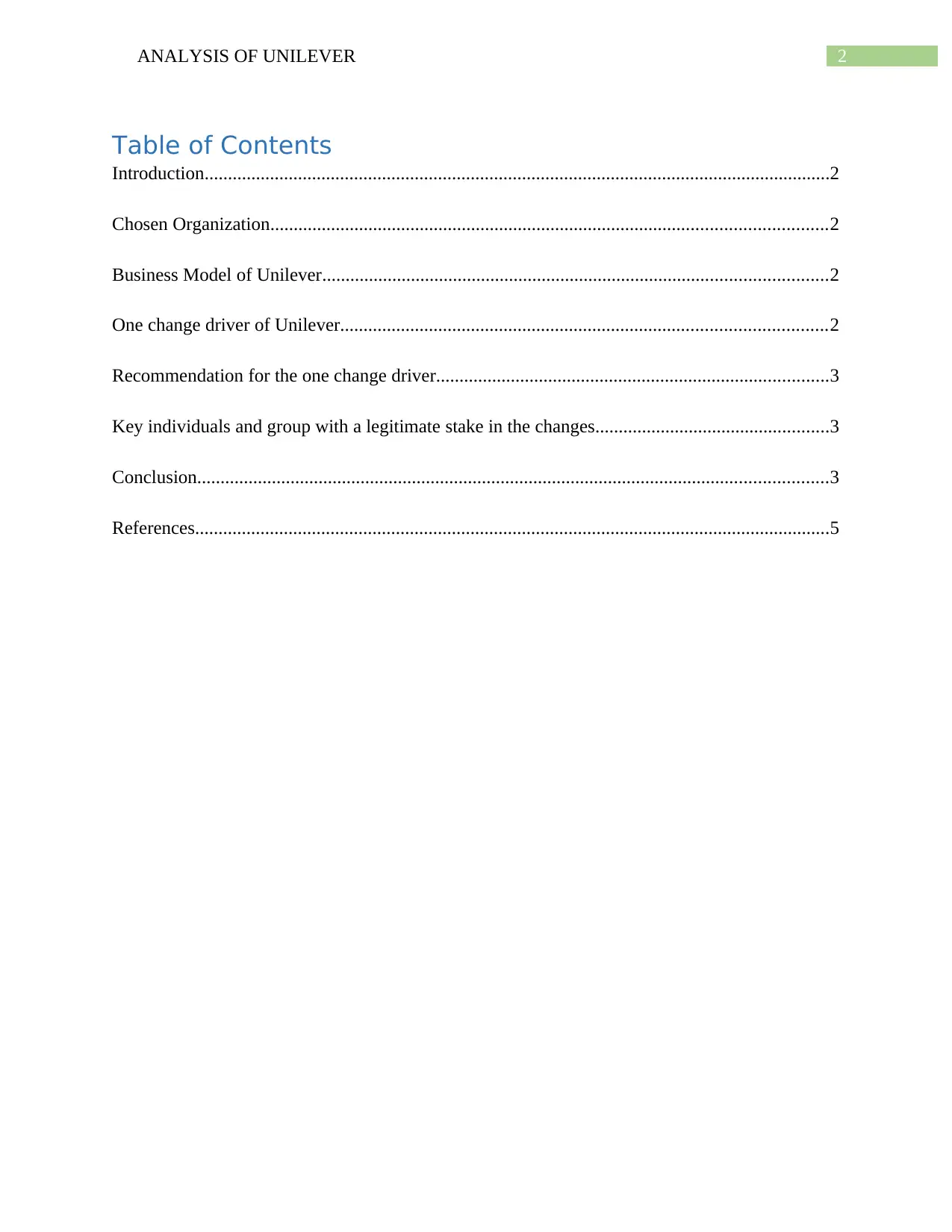
Table of Contents
Introduction......................................................................................................................................2
Chosen Organization.......................................................................................................................2
Business Model of Unilever............................................................................................................2
One change driver of Unilever........................................................................................................2
Recommendation for the one change driver....................................................................................3
Key individuals and group with a legitimate stake in the changes..................................................3
Conclusion.......................................................................................................................................3
References........................................................................................................................................5
Table of Contents
Introduction......................................................................................................................................2
Chosen Organization.......................................................................................................................2
Business Model of Unilever............................................................................................................2
One change driver of Unilever........................................................................................................2
Recommendation for the one change driver....................................................................................3
Key individuals and group with a legitimate stake in the changes..................................................3
Conclusion.......................................................................................................................................3
References........................................................................................................................................5
⊘ This is a preview!⊘
Do you want full access?
Subscribe today to unlock all pages.

Trusted by 1+ million students worldwide

3ANALYSIS OF UNILEVER
Introduction
The main objective of all the private players of the world is to earn a higher margin of
profit. However, such activities have an adverse impact on the environment and the society
because in their drive to earn higher profits, the private players end up exploiting the natural
resources of the Earth (Bockenet al. 2016). This paper seeks to discuss the business of Unilever
and its problem with the usage of plastic materials which is severely impacting the environment.
Chosen Organization
The company of Unilever was founded in the year 1930 and has its base in the United
Kingdom and Netherlands (Unilever.com. 2018). It has now expanded its base of operation to
almost all the countries of the world and has a staff of around 170,000 as of the year 2017
(Unilever.com. 2018). Operating under the guidance of AlanJope, the company of Unilever is a
consumer friendly organization. The products manufactures by it are used by almost half the
population of the Earth.
Business Model of Unilever
The Business Model of Unilever is based on direct to consumer model. The management
of this private company believes that all the products manufactured by the company should be
directly sold to the consumers (Whelan-Berry and Somerville 2010). This ensures control of
quality delivered to the consumers as well as also reduces the impact of the middlemen in
between. The direct consumer model can help Unilever to increase its profitability as it can make
deals with the customers based on the marked price stated for the product. This can also help in
establishing a proper relationship with the customers and ensure the loyalty is maintained.
Introduction
The main objective of all the private players of the world is to earn a higher margin of
profit. However, such activities have an adverse impact on the environment and the society
because in their drive to earn higher profits, the private players end up exploiting the natural
resources of the Earth (Bockenet al. 2016). This paper seeks to discuss the business of Unilever
and its problem with the usage of plastic materials which is severely impacting the environment.
Chosen Organization
The company of Unilever was founded in the year 1930 and has its base in the United
Kingdom and Netherlands (Unilever.com. 2018). It has now expanded its base of operation to
almost all the countries of the world and has a staff of around 170,000 as of the year 2017
(Unilever.com. 2018). Operating under the guidance of AlanJope, the company of Unilever is a
consumer friendly organization. The products manufactures by it are used by almost half the
population of the Earth.
Business Model of Unilever
The Business Model of Unilever is based on direct to consumer model. The management
of this private company believes that all the products manufactured by the company should be
directly sold to the consumers (Whelan-Berry and Somerville 2010). This ensures control of
quality delivered to the consumers as well as also reduces the impact of the middlemen in
between. The direct consumer model can help Unilever to increase its profitability as it can make
deals with the customers based on the marked price stated for the product. This can also help in
establishing a proper relationship with the customers and ensure the loyalty is maintained.
Paraphrase This Document
Need a fresh take? Get an instant paraphrase of this document with our AI Paraphraser

4ANALYSIS OF UNILEVER
One change driver of Unilever
Unilever is a private company whose main objective is to provide consumer goods to the
people. In this sense, it has been trying to expand its business of operation in to the different
sectors of consumer goods (Graetz and Smith 2010). It initially started with the manufacturing of
beauty products and care products such as cosmetics. Later, it started to manufacture other goods
also such as notebooks, detergent powder among a few others. All of these goods seek to satisfy
the needs of the consumer (Mayfield 2014). The one change driver of Unilever is thus in the
expansion of the business in its objective of trying to satisfy maximum demands of the
consumers. In this sense, it has been trying to keep up with the advent of new technologies
(Cavalcante 2014).
Recommendation for the one change driver
In its quest of trying to manufacture more consumer products for the consumer market
the imminent threat faced by the company is the excessive use of plastic materials (Hasan 2015).
The cosmetics manufactured by the business of Unilever are packaged in plastic materials which
poses a severe threat to the environment (Yamin and Mavondo 2015). This is so because certain
components of plastic cannot be recycled. Moreover, these plastics do not decompose in the
environment, creating harm to the species of nature. As a result, it is recommended that the
company should stop using plastic in their packaging materials instead the company can provide
customers products by using disposal bags such as those made out of jute.
One change driver of Unilever
Unilever is a private company whose main objective is to provide consumer goods to the
people. In this sense, it has been trying to expand its business of operation in to the different
sectors of consumer goods (Graetz and Smith 2010). It initially started with the manufacturing of
beauty products and care products such as cosmetics. Later, it started to manufacture other goods
also such as notebooks, detergent powder among a few others. All of these goods seek to satisfy
the needs of the consumer (Mayfield 2014). The one change driver of Unilever is thus in the
expansion of the business in its objective of trying to satisfy maximum demands of the
consumers. In this sense, it has been trying to keep up with the advent of new technologies
(Cavalcante 2014).
Recommendation for the one change driver
In its quest of trying to manufacture more consumer products for the consumer market
the imminent threat faced by the company is the excessive use of plastic materials (Hasan 2015).
The cosmetics manufactured by the business of Unilever are packaged in plastic materials which
poses a severe threat to the environment (Yamin and Mavondo 2015). This is so because certain
components of plastic cannot be recycled. Moreover, these plastics do not decompose in the
environment, creating harm to the species of nature. As a result, it is recommended that the
company should stop using plastic in their packaging materials instead the company can provide
customers products by using disposal bags such as those made out of jute.

5ANALYSIS OF UNILEVER
Key individuals and group with a legitimate stake in the changes
The key stakeholders in the changes where plastic materials would not be used are the
common public of the world who use the products of Unilever (Kotler 2015). Plastic is not only
harmful for the environment but also harmful for the human skin and human health.
Conclusion
In conclusion it is observed that in order to continue earning higher profits, the
organization of Unilever should under take measures to stop the usage of plastic materials. This
would be beneficial for them to retain their consumer base as well as help in the conservation of
the environment.
Key individuals and group with a legitimate stake in the changes
The key stakeholders in the changes where plastic materials would not be used are the
common public of the world who use the products of Unilever (Kotler 2015). Plastic is not only
harmful for the environment but also harmful for the human skin and human health.
Conclusion
In conclusion it is observed that in order to continue earning higher profits, the
organization of Unilever should under take measures to stop the usage of plastic materials. This
would be beneficial for them to retain their consumer base as well as help in the conservation of
the environment.
⊘ This is a preview!⊘
Do you want full access?
Subscribe today to unlock all pages.

Trusted by 1+ million students worldwide

6ANALYSIS OF UNILEVER
References:
Bocken, N.M., de Pauw, I., Bakker, C. and van der Grinten, B., 2016. Product design and
business model strategies for a circular economy. Journal of Industrial and Production
Engineering, 33(5), pp.308-320.
Cavalcante, S.A. 2014 ‘Designing business model change’, International Journal of Innovation
Management, 18 (2), pp. 1-22.
Graetz, F. and Smith, A.C.T. 2010 ‘Managing organizational change: a philosophies of change
approach’, Journal of Change Management, 10 (2), pp. 135-154.
Hasan, M.M., 2015. Marketing Analysis of Unilever. Total Quality Management, 11, p.13.
Kotler, P., 2015. Framework for marketing management. Pearson Education.
Mayfield, P. 2014 ‘Engaging with stakeholders is critical when leading change’, Industrial and
Commercial Training, 46 (2), pp. 68-72.
Unilever.com. 2018. Unilever global company website | Unilever Global. [online] Available at:
https://www.unilever.com/ [Accessed 30 Jan. 2019].
Whelan-Berry, K.S. and Somerville, K.A. 2010 ‘Linking change drivers and the organizational
change process – a review and synthesis’, Journal of Change Management, 10 (2), pp. 175-193.
Yamin, S. and Mavondo, F.T., 2015. Organizational innovation: Relationship with functional
strategies and organizational performance. In Proceedings of the 2000 Academy of Marketing
Science (AMS) Annual Conference (pp. 296-301). Springer, Cham.
References:
Bocken, N.M., de Pauw, I., Bakker, C. and van der Grinten, B., 2016. Product design and
business model strategies for a circular economy. Journal of Industrial and Production
Engineering, 33(5), pp.308-320.
Cavalcante, S.A. 2014 ‘Designing business model change’, International Journal of Innovation
Management, 18 (2), pp. 1-22.
Graetz, F. and Smith, A.C.T. 2010 ‘Managing organizational change: a philosophies of change
approach’, Journal of Change Management, 10 (2), pp. 135-154.
Hasan, M.M., 2015. Marketing Analysis of Unilever. Total Quality Management, 11, p.13.
Kotler, P., 2015. Framework for marketing management. Pearson Education.
Mayfield, P. 2014 ‘Engaging with stakeholders is critical when leading change’, Industrial and
Commercial Training, 46 (2), pp. 68-72.
Unilever.com. 2018. Unilever global company website | Unilever Global. [online] Available at:
https://www.unilever.com/ [Accessed 30 Jan. 2019].
Whelan-Berry, K.S. and Somerville, K.A. 2010 ‘Linking change drivers and the organizational
change process – a review and synthesis’, Journal of Change Management, 10 (2), pp. 175-193.
Yamin, S. and Mavondo, F.T., 2015. Organizational innovation: Relationship with functional
strategies and organizational performance. In Proceedings of the 2000 Academy of Marketing
Science (AMS) Annual Conference (pp. 296-301). Springer, Cham.
1 out of 7
Related Documents
Your All-in-One AI-Powered Toolkit for Academic Success.
+13062052269
info@desklib.com
Available 24*7 on WhatsApp / Email
Unlock your academic potential
Copyright © 2020–2026 A2Z Services. All Rights Reserved. Developed and managed by ZUCOL.