Unilever: Detailed Analysis of Organization Profile and SWOT Factors
VerifiedAdded on 2020/06/03
|9
|2145
|35
Report
AI Summary
This research report provides a comprehensive analysis of the Unilever organization. It begins with an introduction outlining the research's aim to understand Unilever's profile and internal working environment, emphasizing the importance of internal analysis for improvement. The main body delves into Unilever's organization profile, including its mission and vision, highlighting its commitment to providing quality products and adapting to market demands. The report examines Unilever's organizational structure, discussing its product division and geographical divisions. A SWOT analysis is conducted, detailing the company's strengths, weaknesses, opportunities, and threats, providing a balanced view of Unilever's position in the competitive market. The report concludes with a list of references, providing a foundation for further research.
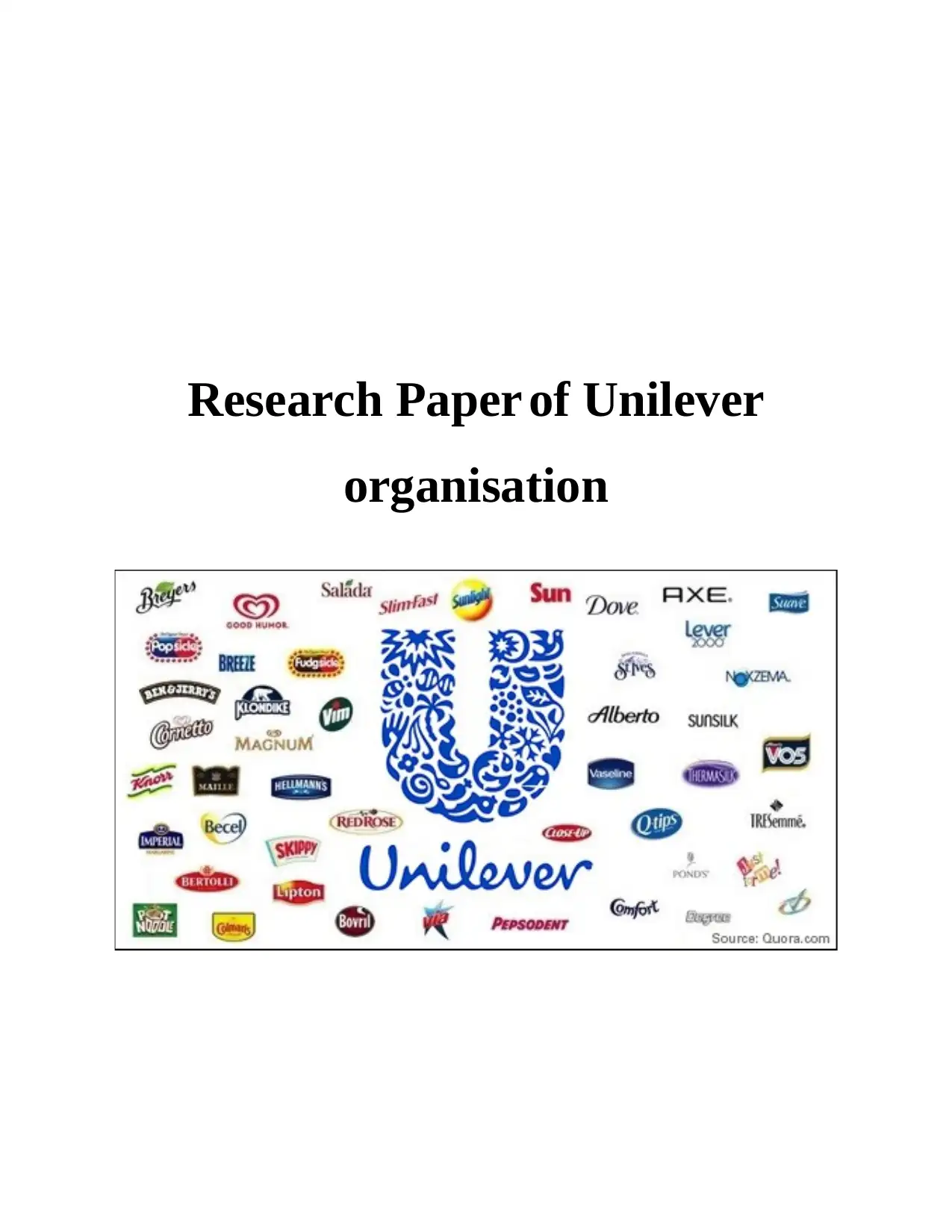
Research Paper of Unilever
organisation
organisation

Paraphrase This Document
Need a fresh take? Get an instant paraphrase of this document with our AI Paraphraser
Table of Contents
INTRODUCTION...........................................................................................................................1
MAIN BODY ..................................................................................................................................1
1. ORGANIZATION PROFILE INCULCATED MISSION AND VISION........................1
2. ORGANIZATION STRUCTURE AND PRESENCE ......................................................2
3. SWOT ANALYSES...........................................................................................................3
REFERENCE ..................................................................................................................................5
INTRODUCTION...........................................................................................................................1
MAIN BODY ..................................................................................................................................1
1. ORGANIZATION PROFILE INCULCATED MISSION AND VISION........................1
2. ORGANIZATION STRUCTURE AND PRESENCE ......................................................2
3. SWOT ANALYSES...........................................................................................................3
REFERENCE ..................................................................................................................................5
INTRODUCTION
The aim of this research work is to understand the profile of UNILEVER organisation
and their internal working environment. This organisation basically located in American food,
beverages and personal care products company. On the other hand, internal analyse am most
important part and help meliorate internal temporary environment (Austen-Smith and et.al
2017). Further, it covered mission, vision and organisational structure. All such three factors are
most essential and research paper is based on it.
MAIN BODY
1. ORGANISATION PROFILE INCULCATED MISSION AND VISION
Research work is based on organisation structure and mission to be followed for future
development. This company's vision is to be leading lifestyle, entertainment and provide the
delivery of unique or quality products for improvement. Something new is the most important
part to achieve the maturation rate in the market. The research paper is based on organisation
growth and future development in market top increase number of customers.(Mosey and
Kirkham 2017). The UNILEVER organization profile is decided overall physical process in
future market and make some changes as per the need of market demand. The profile of the
organisation is American food, beverages and personal care products company for last many
years. Their supervisor's all the aspect of operations management are finance, marketing, sale,
distribution and production. UNILEVER products are Lifebuoy, Surf etc.
Make some changes as per the need of market growth and make some changes as per the
need of internal and external working environment. In this research paper is organisation is to be
focus on local and domestic level. Some mission and vision is more important part and make
some as per the need of marketing environment.
1
The aim of this research work is to understand the profile of UNILEVER organisation
and their internal working environment. This organisation basically located in American food,
beverages and personal care products company. On the other hand, internal analyse am most
important part and help meliorate internal temporary environment (Austen-Smith and et.al
2017). Further, it covered mission, vision and organisational structure. All such three factors are
most essential and research paper is based on it.
MAIN BODY
1. ORGANISATION PROFILE INCULCATED MISSION AND VISION
Research work is based on organisation structure and mission to be followed for future
development. This company's vision is to be leading lifestyle, entertainment and provide the
delivery of unique or quality products for improvement. Something new is the most important
part to achieve the maturation rate in the market. The research paper is based on organisation
growth and future development in market top increase number of customers.(Mosey and
Kirkham 2017). The UNILEVER organization profile is decided overall physical process in
future market and make some changes as per the need of market demand. The profile of the
organisation is American food, beverages and personal care products company for last many
years. Their supervisor's all the aspect of operations management are finance, marketing, sale,
distribution and production. UNILEVER products are Lifebuoy, Surf etc.
Make some changes as per the need of market growth and make some changes as per the
need of internal and external working environment. In this research paper is organisation is to be
focus on local and domestic level. Some mission and vision is more important part and make
some as per the need of marketing environment.
1
⊘ This is a preview!⊘
Do you want full access?
Subscribe today to unlock all pages.

Trusted by 1+ million students worldwide
Unique quality of product :- In research paper is find out the same mission of the
organisation and make some changes as per the need of market value (Cook, 2016).
On the other side, the mission is modifying the number of customer is most important
nowadays for achieve more and more development rate in activity.
To be carry through each and every need of the day-after-day customer to alteration
marketplace share and some modification in overall improvement and change of state in
overall growth rate. Unilever’s mission statement and vision argument remain relevant
and befitting to global activity conditions.
The house mission-al post also specifies the facet of life where such verve is added. For
example, Unilever’s food commodity address go through’ verve needs in terms of
organic process.
This structure is to be property on assist people and fill good to better market share and
make some change in overall betterment in marketplace.
There is vision of the organisation to achieve in future time (Lambe, 2014.). Make some changes
and research work are doing in market is most essential and guide them for need and want of the
customer in market.
Develop product and services ;- The most of the essence mission is the development of
product and services in useful for company (Melton and et.al 2017). To set a mission as
per the need of market share and indefinite quantity in the interior as well as extraneous
working environment. Research work is the most crucial part to improvise in product and
future development in the market.
Social responsibility ;- To achieve social responsibility is the aim of each and every
organisation. With the help of research work find that social responsibility doing by
organisation for improving the market share and increase the number of customers
(O’Grady and Lowe 2016). To support for Thai people in having the good life.
The Best long-term way :- In this context UNILEVER organisation is focus to improve
market share. Best long way is decided extended term goal and make some plan of action
must be used to better marketplace share.
Unilever’s vision statement broadly presents what the constitution needs to do to come
through in the long term. To be focus on evolution direction and make some alteration in
overall development in market share.
2
organisation and make some changes as per the need of market value (Cook, 2016).
On the other side, the mission is modifying the number of customer is most important
nowadays for achieve more and more development rate in activity.
To be carry through each and every need of the day-after-day customer to alteration
marketplace share and some modification in overall improvement and change of state in
overall growth rate. Unilever’s mission statement and vision argument remain relevant
and befitting to global activity conditions.
The house mission-al post also specifies the facet of life where such verve is added. For
example, Unilever’s food commodity address go through’ verve needs in terms of
organic process.
This structure is to be property on assist people and fill good to better market share and
make some change in overall betterment in marketplace.
There is vision of the organisation to achieve in future time (Lambe, 2014.). Make some changes
and research work are doing in market is most essential and guide them for need and want of the
customer in market.
Develop product and services ;- The most of the essence mission is the development of
product and services in useful for company (Melton and et.al 2017). To set a mission as
per the need of market share and indefinite quantity in the interior as well as extraneous
working environment. Research work is the most crucial part to improvise in product and
future development in the market.
Social responsibility ;- To achieve social responsibility is the aim of each and every
organisation. With the help of research work find that social responsibility doing by
organisation for improving the market share and increase the number of customers
(O’Grady and Lowe 2016). To support for Thai people in having the good life.
The Best long-term way :- In this context UNILEVER organisation is focus to improve
market share. Best long way is decided extended term goal and make some plan of action
must be used to better marketplace share.
Unilever’s vision statement broadly presents what the constitution needs to do to come
through in the long term. To be focus on evolution direction and make some alteration in
overall development in market share.
2
Paraphrase This Document
Need a fresh take? Get an instant paraphrase of this document with our AI Paraphraser
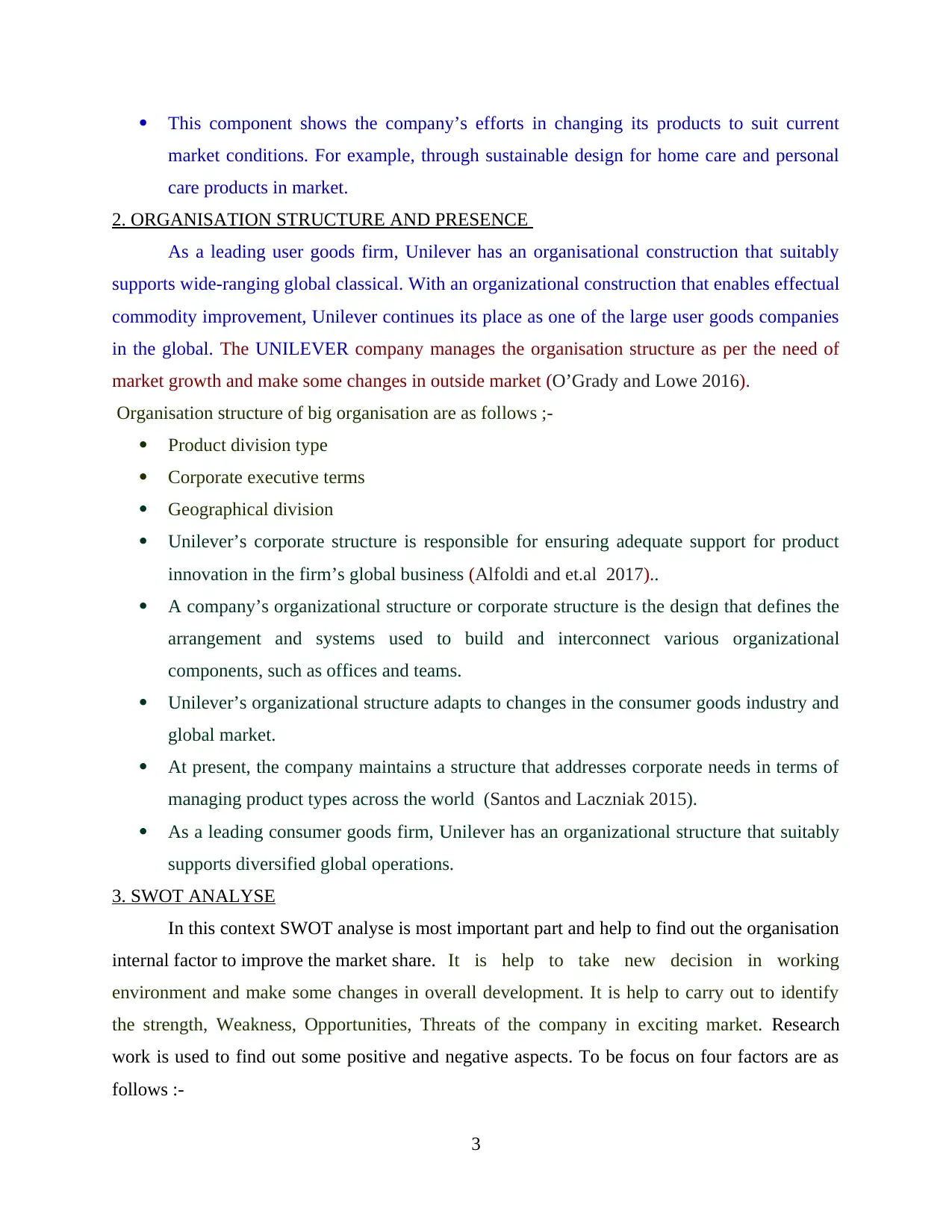
This component shows the company’s efforts in changing its products to suit current
market conditions. For example, through sustainable design for home care and personal
care products in market.
2. ORGANISATION STRUCTURE AND PRESENCE
As a leading user goods firm, Unilever has an organisational construction that suitably
supports wide-ranging global classical. With an organizational construction that enables effectual
commodity improvement, Unilever continues its place as one of the large user goods companies
in the global. The UNILEVER company manages the organisation structure as per the need of
market growth and make some changes in outside market (O’Grady and Lowe 2016).
Organisation structure of big organisation are as follows ;-
Product division type
Corporate executive terms
Geographical division
Unilever’s corporate structure is responsible for ensuring adequate support for product
innovation in the firm’s global business (Alfoldi and et.al 2017)..
A company’s organizational structure or corporate structure is the design that defines the
arrangement and systems used to build and interconnect various organizational
components, such as offices and teams.
Unilever’s organizational structure adapts to changes in the consumer goods industry and
global market.
At present, the company maintains a structure that addresses corporate needs in terms of
managing product types across the world (Santos and Laczniak 2015).
As a leading consumer goods firm, Unilever has an organizational structure that suitably
supports diversified global operations.
3. SWOT ANALYSE
In this context SWOT analyse is most important part and help to find out the organisation
internal factor to improve the market share. It is help to take new decision in working
environment and make some changes in overall development. It is help to carry out to identify
the strength, Weakness, Opportunities, Threats of the company in exciting market. Research
work is used to find out some positive and negative aspects. To be focus on four factors are as
follows :-
3
market conditions. For example, through sustainable design for home care and personal
care products in market.
2. ORGANISATION STRUCTURE AND PRESENCE
As a leading user goods firm, Unilever has an organisational construction that suitably
supports wide-ranging global classical. With an organizational construction that enables effectual
commodity improvement, Unilever continues its place as one of the large user goods companies
in the global. The UNILEVER company manages the organisation structure as per the need of
market growth and make some changes in outside market (O’Grady and Lowe 2016).
Organisation structure of big organisation are as follows ;-
Product division type
Corporate executive terms
Geographical division
Unilever’s corporate structure is responsible for ensuring adequate support for product
innovation in the firm’s global business (Alfoldi and et.al 2017)..
A company’s organizational structure or corporate structure is the design that defines the
arrangement and systems used to build and interconnect various organizational
components, such as offices and teams.
Unilever’s organizational structure adapts to changes in the consumer goods industry and
global market.
At present, the company maintains a structure that addresses corporate needs in terms of
managing product types across the world (Santos and Laczniak 2015).
As a leading consumer goods firm, Unilever has an organizational structure that suitably
supports diversified global operations.
3. SWOT ANALYSE
In this context SWOT analyse is most important part and help to find out the organisation
internal factor to improve the market share. It is help to take new decision in working
environment and make some changes in overall development. It is help to carry out to identify
the strength, Weakness, Opportunities, Threats of the company in exciting market. Research
work is used to find out some positive and negative aspects. To be focus on four factors are as
follows :-
3
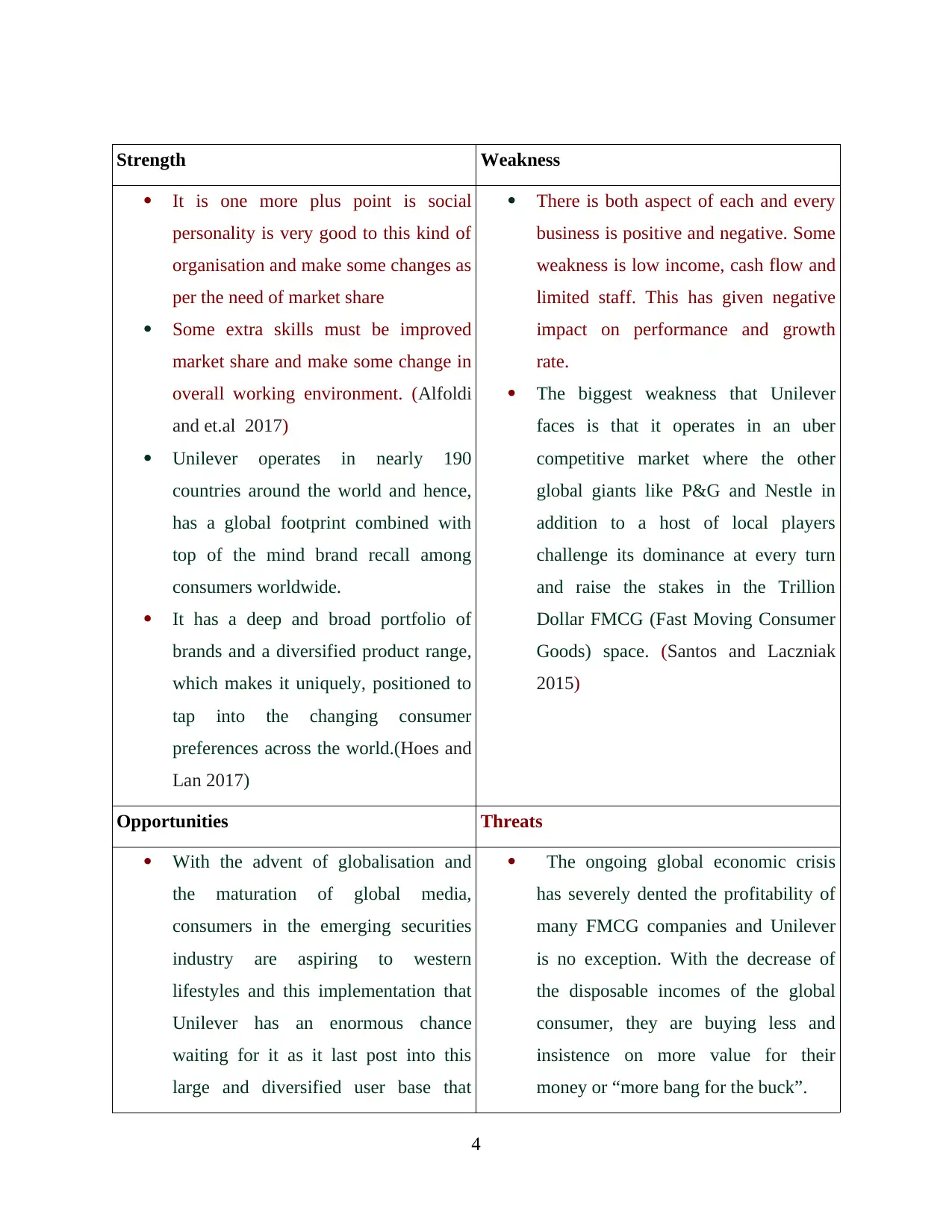
Strength Weakness
It is one more plus point is social
personality is very good to this kind of
organisation and make some changes as
per the need of market share
Some extra skills must be improved
market share and make some change in
overall working environment. (Alfoldi
and et.al 2017)
Unilever operates in nearly 190
countries around the world and hence,
has a global footprint combined with
top of the mind brand recall among
consumers worldwide.
It has a deep and broad portfolio of
brands and a diversified product range,
which makes it uniquely, positioned to
tap into the changing consumer
preferences across the world.(Hoes and
Lan 2017)
There is both aspect of each and every
business is positive and negative. Some
weakness is low income, cash flow and
limited staff. This has given negative
impact on performance and growth
rate.
The biggest weakness that Unilever
faces is that it operates in an uber
competitive market where the other
global giants like P&G and Nestle in
addition to a host of local players
challenge its dominance at every turn
and raise the stakes in the Trillion
Dollar FMCG (Fast Moving Consumer
Goods) space. (Santos and Laczniak
2015)
Opportunities Threats
With the advent of globalisation and
the maturation of global media,
consumers in the emerging securities
industry are aspiring to western
lifestyles and this implementation that
Unilever has an enormous chance
waiting for it as it last post into this
large and diversified user base that
The ongoing global economic crisis
has severely dented the profitability of
many FMCG companies and Unilever
is no exception. With the decrease of
the disposable incomes of the global
consumer, they are buying less and
insistence on more value for their
money or “more bang for the buck”.
4
It is one more plus point is social
personality is very good to this kind of
organisation and make some changes as
per the need of market share
Some extra skills must be improved
market share and make some change in
overall working environment. (Alfoldi
and et.al 2017)
Unilever operates in nearly 190
countries around the world and hence,
has a global footprint combined with
top of the mind brand recall among
consumers worldwide.
It has a deep and broad portfolio of
brands and a diversified product range,
which makes it uniquely, positioned to
tap into the changing consumer
preferences across the world.(Hoes and
Lan 2017)
There is both aspect of each and every
business is positive and negative. Some
weakness is low income, cash flow and
limited staff. This has given negative
impact on performance and growth
rate.
The biggest weakness that Unilever
faces is that it operates in an uber
competitive market where the other
global giants like P&G and Nestle in
addition to a host of local players
challenge its dominance at every turn
and raise the stakes in the Trillion
Dollar FMCG (Fast Moving Consumer
Goods) space. (Santos and Laczniak
2015)
Opportunities Threats
With the advent of globalisation and
the maturation of global media,
consumers in the emerging securities
industry are aspiring to western
lifestyles and this implementation that
Unilever has an enormous chance
waiting for it as it last post into this
large and diversified user base that
The ongoing global economic crisis
has severely dented the profitability of
many FMCG companies and Unilever
is no exception. With the decrease of
the disposable incomes of the global
consumer, they are buying less and
insistence on more value for their
money or “more bang for the buck”.
4
⊘ This is a preview!⊘
Do you want full access?
Subscribe today to unlock all pages.
Trusted by 1+ million students worldwide
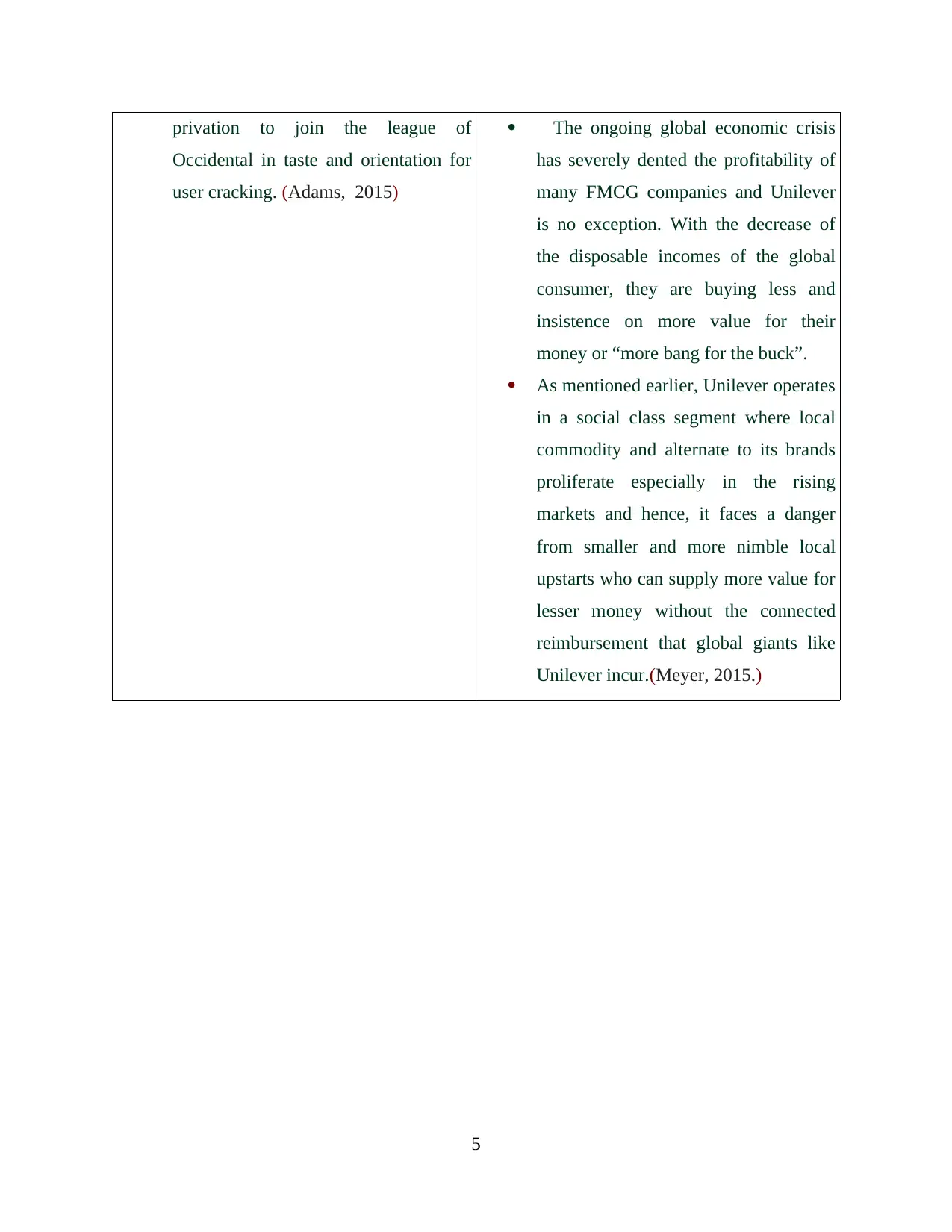
privation to join the league of
Occidental in taste and orientation for
user cracking. (Adams, 2015)
The ongoing global economic crisis
has severely dented the profitability of
many FMCG companies and Unilever
is no exception. With the decrease of
the disposable incomes of the global
consumer, they are buying less and
insistence on more value for their
money or “more bang for the buck”.
As mentioned earlier, Unilever operates
in a social class segment where local
commodity and alternate to its brands
proliferate especially in the rising
markets and hence, it faces a danger
from smaller and more nimble local
upstarts who can supply more value for
lesser money without the connected
reimbursement that global giants like
Unilever incur.(Meyer, 2015.)
5
Occidental in taste and orientation for
user cracking. (Adams, 2015)
The ongoing global economic crisis
has severely dented the profitability of
many FMCG companies and Unilever
is no exception. With the decrease of
the disposable incomes of the global
consumer, they are buying less and
insistence on more value for their
money or “more bang for the buck”.
As mentioned earlier, Unilever operates
in a social class segment where local
commodity and alternate to its brands
proliferate especially in the rising
markets and hence, it faces a danger
from smaller and more nimble local
upstarts who can supply more value for
lesser money without the connected
reimbursement that global giants like
Unilever incur.(Meyer, 2015.)
5
Paraphrase This Document
Need a fresh take? Get an instant paraphrase of this document with our AI Paraphraser
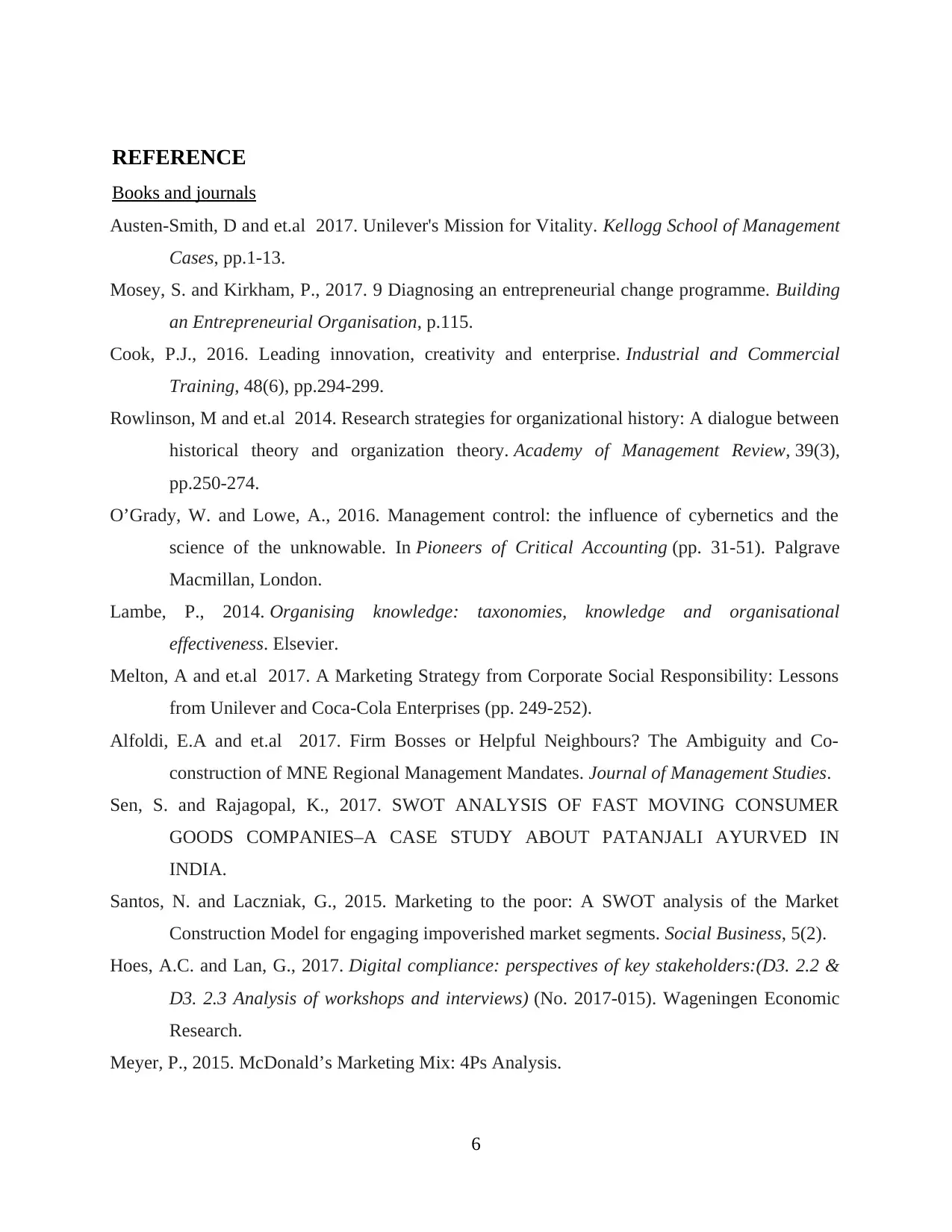
REFERENCE
Books and journals
Austen-Smith, D and et.al 2017. Unilever's Mission for Vitality. Kellogg School of Management
Cases, pp.1-13.
Mosey, S. and Kirkham, P., 2017. 9 Diagnosing an entrepreneurial change programme. Building
an Entrepreneurial Organisation, p.115.
Cook, P.J., 2016. Leading innovation, creativity and enterprise. Industrial and Commercial
Training, 48(6), pp.294-299.
Rowlinson, M and et.al 2014. Research strategies for organizational history: A dialogue between
historical theory and organization theory. Academy of Management Review, 39(3),
pp.250-274.
O’Grady, W. and Lowe, A., 2016. Management control: the influence of cybernetics and the
science of the unknowable. In Pioneers of Critical Accounting (pp. 31-51). Palgrave
Macmillan, London.
Lambe, P., 2014. Organising knowledge: taxonomies, knowledge and organisational
effectiveness. Elsevier.
Melton, A and et.al 2017. A Marketing Strategy from Corporate Social Responsibility: Lessons
from Unilever and Coca-Cola Enterprises (pp. 249-252).
Alfoldi, E.A and et.al 2017. Firm Bosses or Helpful Neighbours? The Ambiguity and Co‐
construction of MNE Regional Management Mandates. Journal of Management Studies.
Sen, S. and Rajagopal, K., 2017. SWOT ANALYSIS OF FAST MOVING CONSUMER
GOODS COMPANIES–A CASE STUDY ABOUT PATANJALI AYURVED IN
INDIA.
Santos, N. and Laczniak, G., 2015. Marketing to the poor: A SWOT analysis of the Market
Construction Model for engaging impoverished market segments. Social Business, 5(2).
Hoes, A.C. and Lan, G., 2017. Digital compliance: perspectives of key stakeholders:(D3. 2.2 &
D3. 2.3 Analysis of workshops and interviews) (No. 2017-015). Wageningen Economic
Research.
Meyer, P., 2015. McDonald’s Marketing Mix: 4Ps Analysis.
6
Books and journals
Austen-Smith, D and et.al 2017. Unilever's Mission for Vitality. Kellogg School of Management
Cases, pp.1-13.
Mosey, S. and Kirkham, P., 2017. 9 Diagnosing an entrepreneurial change programme. Building
an Entrepreneurial Organisation, p.115.
Cook, P.J., 2016. Leading innovation, creativity and enterprise. Industrial and Commercial
Training, 48(6), pp.294-299.
Rowlinson, M and et.al 2014. Research strategies for organizational history: A dialogue between
historical theory and organization theory. Academy of Management Review, 39(3),
pp.250-274.
O’Grady, W. and Lowe, A., 2016. Management control: the influence of cybernetics and the
science of the unknowable. In Pioneers of Critical Accounting (pp. 31-51). Palgrave
Macmillan, London.
Lambe, P., 2014. Organising knowledge: taxonomies, knowledge and organisational
effectiveness. Elsevier.
Melton, A and et.al 2017. A Marketing Strategy from Corporate Social Responsibility: Lessons
from Unilever and Coca-Cola Enterprises (pp. 249-252).
Alfoldi, E.A and et.al 2017. Firm Bosses or Helpful Neighbours? The Ambiguity and Co‐
construction of MNE Regional Management Mandates. Journal of Management Studies.
Sen, S. and Rajagopal, K., 2017. SWOT ANALYSIS OF FAST MOVING CONSUMER
GOODS COMPANIES–A CASE STUDY ABOUT PATANJALI AYURVED IN
INDIA.
Santos, N. and Laczniak, G., 2015. Marketing to the poor: A SWOT analysis of the Market
Construction Model for engaging impoverished market segments. Social Business, 5(2).
Hoes, A.C. and Lan, G., 2017. Digital compliance: perspectives of key stakeholders:(D3. 2.2 &
D3. 2.3 Analysis of workshops and interviews) (No. 2017-015). Wageningen Economic
Research.
Meyer, P., 2015. McDonald’s Marketing Mix: 4Ps Analysis.
6
Waddock, S., 2017. Leaders as Shamans: Working to Heal a Troubled World. Journal of
Management for Global Sustainability, 4(1), pp.57-73.
Lawrence, J and et.al 2019. Sustainability as Opportunity: Unilever’s Sustainable Living Plan.
In Managing Sustainable Business (pp. 439-459). Springer, Dordrecht.
Hasan, M.M., 2015. Marketing Analysis of Unilever. Total Quality Management, 11, p.13.
Adams, C., 2015. Understanding integrated reporting: The concise guide to integrated thinking
and the future of corporate reporting. Do Sustainability.
Transparency, E.R., 2018. Unilever and Its Supply Chain.
Murphy, P.E and et.al 2018. Sustainable Living: Unilever. In Progressive Business Models (pp.
263-286). Palgrave Macmillan, Cham.
Farhana, S., 2016. Working experience at Unilever Bangladesh Ltd.
7
Management for Global Sustainability, 4(1), pp.57-73.
Lawrence, J and et.al 2019. Sustainability as Opportunity: Unilever’s Sustainable Living Plan.
In Managing Sustainable Business (pp. 439-459). Springer, Dordrecht.
Hasan, M.M., 2015. Marketing Analysis of Unilever. Total Quality Management, 11, p.13.
Adams, C., 2015. Understanding integrated reporting: The concise guide to integrated thinking
and the future of corporate reporting. Do Sustainability.
Transparency, E.R., 2018. Unilever and Its Supply Chain.
Murphy, P.E and et.al 2018. Sustainable Living: Unilever. In Progressive Business Models (pp.
263-286). Palgrave Macmillan, Cham.
Farhana, S., 2016. Working experience at Unilever Bangladesh Ltd.
7
⊘ This is a preview!⊘
Do you want full access?
Subscribe today to unlock all pages.
Trusted by 1+ million students worldwide

1 out of 9


Related Documents


Your All-in-One AI-Powered Toolkit for Academic Success.
+13062052269
info@desklib.com
Available 24*7 on WhatsApp / Email
![[object Object]](/_next/static/media/star-bottom.7253800d.svg)
Unlock your academic potential
Copyright © 2020–2025 A2Z Services. All Rights Reserved. Developed and managed by ZUCOL.