Unilever's Competitive Position Analysis, Global Trading & Business
VerifiedAdded on 2023/06/18
|16
|5506
|367
Report
AI Summary
This report provides a comprehensive analysis of Unilever's competitive position and the challenges it faces when trading across borders. It begins with a comparative analysis of Unilever's position in various markets, utilizing Porter's Five Forces and the VRIO framework to assess its strengths and weaknesses. The report identifies key factors such as supplier power, buyer power, competitive rivalry, threat of substitution, and threat of new entry that impact Unilever's market position. It also examines Unilever's resources and capabilities, including financial resources, distribution networks, and patents, to determine its competitive advantages. Furthermore, the report explores the challenges Unilever encounters in global trading, stemming from its diversification and expansion efforts. Finally, the report suggests theoretical tools and strategies that Unilever can consider to enhance its business in the global market. Desklib provides access to this and many other solved assignments for students.
Business Project
1
1

Paraphrase This Document
Need a fresh take? Get an instant paraphrase of this document with our AI Paraphraser
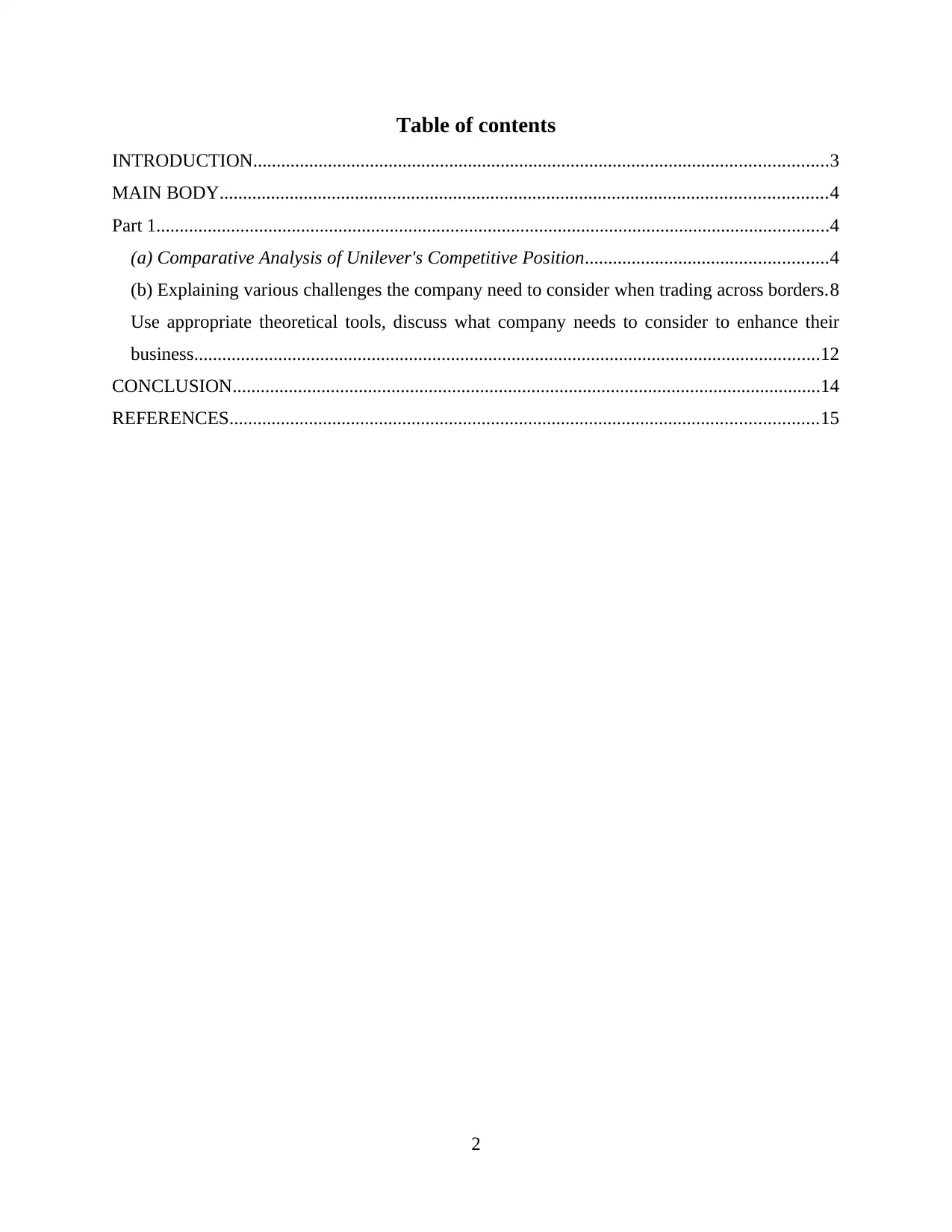
Table of contents
INTRODUCTION...........................................................................................................................3
MAIN BODY..................................................................................................................................4
Part 1................................................................................................................................................4
(a) Comparative Analysis of Unilever's Competitive Position....................................................4
(b) Explaining various challenges the company need to consider when trading across borders.8
Use appropriate theoretical tools, discuss what company needs to consider to enhance their
business......................................................................................................................................12
CONCLUSION..............................................................................................................................14
REFERENCES..............................................................................................................................15
2
INTRODUCTION...........................................................................................................................3
MAIN BODY..................................................................................................................................4
Part 1................................................................................................................................................4
(a) Comparative Analysis of Unilever's Competitive Position....................................................4
(b) Explaining various challenges the company need to consider when trading across borders.8
Use appropriate theoretical tools, discuss what company needs to consider to enhance their
business......................................................................................................................................12
CONCLUSION..............................................................................................................................14
REFERENCES..............................................................................................................................15
2
INTRODUCTION
UNILEVER is a public limited company of consumer goods which was founded on the 2nd
September in 1929. It operates is business from London, England and serve its offering of
product and services worldwide. This British multinational company is the largest producer of
soaps around the globe and its products are available in around 190 countries. It owned 400
brands and organised into home-care, beauty, personal care, foods and refreshments. Nestle and
Procter and Gamble are the UNILEVER's largest and the international competitors.
UNILEVER's ranking compared to other organisations in which it has competitive advantage
over its competitors.
Earlier in 1930s business grew with new ventures and launched in Africa and Latin
America by acquiring United Africa Company. Margarine Unie which is a Dutch margarine
producer and the British soap maker Lever Brothers are the merger in UNILEVER and divested
its speciality with chemical business in 1997. UNILEVER has made numerous of corporate
acquisitions such as Lipton, Chesebrough-Ponds, ben & Jerry's. Paul Polman was the leader of
the company in 2010 that gradually shifted the focus of company towards health and beauty
brands. UNILEVER has been primarily listed on the London Stock exchange and now also in
London Stock Exchange.
Business Project are aligned with a company's business strategy and intended to achieve
the objectives of business which are defined. It requires designing portfolio management, law
enforcements and investment logic mapping for major business change in Business Projects.
This projects aims to find all the answers, solutions and helps to find new opportunities related to
the business. Specifically, analysis for these projects gives access to the all major factors which
affects businesses internally as well as externally. Purpose of the business project is to evolve
skills related to manage an organization to stating business goals, establishing pathways to
achieve them on required time.
The report will describe comparative analysis of the company's competitive position in it
various markets. In addition, study will shed light on the company's business activity result in
gaining competitive advantage for expanding its business globally. Further, report will explain
various challenges which the company need to consider for smooth functioning, when trading
across borders. In the end, report will elaborate theoretical tools and discussing the company
needs to consider for enhancing their business in the global market.
3
UNILEVER is a public limited company of consumer goods which was founded on the 2nd
September in 1929. It operates is business from London, England and serve its offering of
product and services worldwide. This British multinational company is the largest producer of
soaps around the globe and its products are available in around 190 countries. It owned 400
brands and organised into home-care, beauty, personal care, foods and refreshments. Nestle and
Procter and Gamble are the UNILEVER's largest and the international competitors.
UNILEVER's ranking compared to other organisations in which it has competitive advantage
over its competitors.
Earlier in 1930s business grew with new ventures and launched in Africa and Latin
America by acquiring United Africa Company. Margarine Unie which is a Dutch margarine
producer and the British soap maker Lever Brothers are the merger in UNILEVER and divested
its speciality with chemical business in 1997. UNILEVER has made numerous of corporate
acquisitions such as Lipton, Chesebrough-Ponds, ben & Jerry's. Paul Polman was the leader of
the company in 2010 that gradually shifted the focus of company towards health and beauty
brands. UNILEVER has been primarily listed on the London Stock exchange and now also in
London Stock Exchange.
Business Project are aligned with a company's business strategy and intended to achieve
the objectives of business which are defined. It requires designing portfolio management, law
enforcements and investment logic mapping for major business change in Business Projects.
This projects aims to find all the answers, solutions and helps to find new opportunities related to
the business. Specifically, analysis for these projects gives access to the all major factors which
affects businesses internally as well as externally. Purpose of the business project is to evolve
skills related to manage an organization to stating business goals, establishing pathways to
achieve them on required time.
The report will describe comparative analysis of the company's competitive position in it
various markets. In addition, study will shed light on the company's business activity result in
gaining competitive advantage for expanding its business globally. Further, report will explain
various challenges which the company need to consider for smooth functioning, when trading
across borders. In the end, report will elaborate theoretical tools and discussing the company
needs to consider for enhancing their business in the global market.
3
⊘ This is a preview!⊘
Do you want full access?
Subscribe today to unlock all pages.

Trusted by 1+ million students worldwide
MAIN BODY
Part 1
(a) Comparative Analysis of Unilever's Competitive Position
Comparative Analysis
A comparative analysis is a strategy through which company can identify the major
competitors. This analysis also helps company to research the products, sales and their strategies
for marketing (Li and et.al., 2020). By taking comparative analysis into consideration Unilever
can also create new business strategies. There are different methods of analysing competitive
position these are as follows:
Porter's Five Forces of Analysing Competitive Position
Porter's Five forces of analysis is a simple framework for evaluating and assessing the
strengths and position of any organization (Porter’s Five Forces of Competitive Position
Analysis, 2021). This analysis is based on the concept that explains, there are five factors which
determine the competition in the market (Bruijl, 2018). Also it can be used to find the areas of
strength and weaknesses.
Unilever is competing in the consumer goods market very effectively. Consumer and
competitors are the major forces that impact the positions of the company. The five forces that
are affecting Unilever:
1. Suppliers Power: Unilever has huge chain of suppliers that impacts the environment of
the industry by affecting the level of supply available to firms. This is an external factor
and imposes a moderate intensity force on the consumer goods industry. Any change in
production level by supplier tends to change in availability of raw material used by
Unilever. In similar ways it affects other companies as well. However Unilever is
managing their suppliers very well and giving them a competitive advantage.
2. Buyers Power: Unilever must consider the factors such as low switching cost, high
quality of information and small size of buyers. This contributes to strong bargaining
power of consumers. The consumers have access to compare products based on the
information present online. This also gives tough competition to Unilever as there are
other companies that are selling the same products. Buyer's bargaining power is major
aspect that needs to consider this plays a major role to have good position in the market.
4
Part 1
(a) Comparative Analysis of Unilever's Competitive Position
Comparative Analysis
A comparative analysis is a strategy through which company can identify the major
competitors. This analysis also helps company to research the products, sales and their strategies
for marketing (Li and et.al., 2020). By taking comparative analysis into consideration Unilever
can also create new business strategies. There are different methods of analysing competitive
position these are as follows:
Porter's Five Forces of Analysing Competitive Position
Porter's Five forces of analysis is a simple framework for evaluating and assessing the
strengths and position of any organization (Porter’s Five Forces of Competitive Position
Analysis, 2021). This analysis is based on the concept that explains, there are five factors which
determine the competition in the market (Bruijl, 2018). Also it can be used to find the areas of
strength and weaknesses.
Unilever is competing in the consumer goods market very effectively. Consumer and
competitors are the major forces that impact the positions of the company. The five forces that
are affecting Unilever:
1. Suppliers Power: Unilever has huge chain of suppliers that impacts the environment of
the industry by affecting the level of supply available to firms. This is an external factor
and imposes a moderate intensity force on the consumer goods industry. Any change in
production level by supplier tends to change in availability of raw material used by
Unilever. In similar ways it affects other companies as well. However Unilever is
managing their suppliers very well and giving them a competitive advantage.
2. Buyers Power: Unilever must consider the factors such as low switching cost, high
quality of information and small size of buyers. This contributes to strong bargaining
power of consumers. The consumers have access to compare products based on the
information present online. This also gives tough competition to Unilever as there are
other companies that are selling the same products. Buyer's bargaining power is major
aspect that needs to consider this plays a major role to have good position in the market.
4
Paraphrase This Document
Need a fresh take? Get an instant paraphrase of this document with our AI Paraphraser
3. Competitive Rivalry: Competitive rivalry is important force for Unilever that impacts
competitive position in the market. There are many firms that are operating in the
consumer goods industry which has major influence on competitive position of Unilever
in the market. It is easy for consumers to switch from Unilever to the other firms, thus
high level of competition can influence the company's environment.
4. Threat of substitution: Substitutes of Unilever can reduce the strength of firm and the
revenues in the consumer goods industry. The customers can switch to other alternatives
when there is hike in the prices or any other factors that customer feel most suitable to
buy. However the overall impact of substitute is very less on Unilever as their products
are more attractive and easily available in the market. The threat of substitute is a minor
issue for Unilever.
5. Threat of new entry: Unilever is competing with established firms as well as the new
companies in the consumer good market. This can be threat for company as buyers can
decide to buy new products from the new firms. However it is difficult for new
companies to build brand like Unilever, this weakens the threat of new entries. Unilever
also has advantage of higher economical stage that supports competitive pricing and
higher efficiencies. In result threat of new entry is a weak force to impact the market
position of Unilever.
VRIO analysis for competitive position
VRIO framework is a strategic tool which is designed to help the organizations to protect
the resources and capabilities, also it gives a sustainable competitive advantages to the company
(Indartono and Wibowo, 2017). VRIO is a frame work that focuses on value, rarity, imitable and
organization (Explaining The VRIO Framework (With A Real-Life Example), 2021). VRIO
analysis of Unilever is as follows:
1. Valuable: The VRIO analysis of Unilever shows that financial resources, local
food products, employees, Unilever's distribution network are valuable resources
of the organization. This is ensuring the greater revenues for Unilever and helping
in translating into grater values for end consumers of Unilever's product and
giving competitive advantage. The cost structure is a competitive disadvantage
and it needs proper strategies to improve it. This is not a valuable resource
5
competitive position in the market. There are many firms that are operating in the
consumer goods industry which has major influence on competitive position of Unilever
in the market. It is easy for consumers to switch from Unilever to the other firms, thus
high level of competition can influence the company's environment.
4. Threat of substitution: Substitutes of Unilever can reduce the strength of firm and the
revenues in the consumer goods industry. The customers can switch to other alternatives
when there is hike in the prices or any other factors that customer feel most suitable to
buy. However the overall impact of substitute is very less on Unilever as their products
are more attractive and easily available in the market. The threat of substitute is a minor
issue for Unilever.
5. Threat of new entry: Unilever is competing with established firms as well as the new
companies in the consumer good market. This can be threat for company as buyers can
decide to buy new products from the new firms. However it is difficult for new
companies to build brand like Unilever, this weakens the threat of new entries. Unilever
also has advantage of higher economical stage that supports competitive pricing and
higher efficiencies. In result threat of new entry is a weak force to impact the market
position of Unilever.
VRIO analysis for competitive position
VRIO framework is a strategic tool which is designed to help the organizations to protect
the resources and capabilities, also it gives a sustainable competitive advantages to the company
(Indartono and Wibowo, 2017). VRIO is a frame work that focuses on value, rarity, imitable and
organization (Explaining The VRIO Framework (With A Real-Life Example), 2021). VRIO
analysis of Unilever is as follows:
1. Valuable: The VRIO analysis of Unilever shows that financial resources, local
food products, employees, Unilever's distribution network are valuable resources
of the organization. This is ensuring the greater revenues for Unilever and helping
in translating into grater values for end consumers of Unilever's product and
giving competitive advantage. The cost structure is a competitive disadvantage
and it needs proper strategies to improve it. This is not a valuable resource
5
because the production cost is higher than that of competition. The research and
development is also not a valuable resource.
2. Rare: The VRIO analysis identifies that financial resources, employees, their
patents and the distribution networks are rare resources for Unilever. These
resources are either not easily available for the competitors or they require lot of
investment and time to match with Unilever. This gives competitive advantage to
organization. The local food products are not rare for Unilever; these products are
easily available by other competitors. Contemporary companies are also using the
same resources and resulting in competitive parity for Unilever.
3. Imitable: The distribution networks, financial resources and patents are the
resources for Unilever that are not easily imitable by the contemporaries. These
are costly to be imitated by other companies and gives competitive advantage to
the company. The products can be acquired by the competitors also it does not
need year long experience to imitate it. Therefore, these products by Unilever give
temporary competitive advantage. The employees also provide temporary
competitive advantage as the contemporary can hire employees from Unilever by
offering them better packages and growth opportunities.
4. Organization: Financial resources are well organized to capture value; this
provides sustained competitive advantages for Unilever. Patents are unused
competitive advantage that exists in Unilever and can be changed into sustainable
competitive advantage. The distribution network is properly organized and proved
to be sources of sustained competitive advantage for Unilever.
VRIO Analysis of Unilever
Valuable? Rare? Costly to imitate? Organized?
Yes Yes Yes Yes
Competitive Advantage
There are different activities within the business that is used for deriving the competitive
advantage. Different business activities takes place to grow the business in different areas when
there are opportunities (GS and et.al., 2019). Competitive advantage is the major aspect for the
6
development is also not a valuable resource.
2. Rare: The VRIO analysis identifies that financial resources, employees, their
patents and the distribution networks are rare resources for Unilever. These
resources are either not easily available for the competitors or they require lot of
investment and time to match with Unilever. This gives competitive advantage to
organization. The local food products are not rare for Unilever; these products are
easily available by other competitors. Contemporary companies are also using the
same resources and resulting in competitive parity for Unilever.
3. Imitable: The distribution networks, financial resources and patents are the
resources for Unilever that are not easily imitable by the contemporaries. These
are costly to be imitated by other companies and gives competitive advantage to
the company. The products can be acquired by the competitors also it does not
need year long experience to imitate it. Therefore, these products by Unilever give
temporary competitive advantage. The employees also provide temporary
competitive advantage as the contemporary can hire employees from Unilever by
offering them better packages and growth opportunities.
4. Organization: Financial resources are well organized to capture value; this
provides sustained competitive advantages for Unilever. Patents are unused
competitive advantage that exists in Unilever and can be changed into sustainable
competitive advantage. The distribution network is properly organized and proved
to be sources of sustained competitive advantage for Unilever.
VRIO Analysis of Unilever
Valuable? Rare? Costly to imitate? Organized?
Yes Yes Yes Yes
Competitive Advantage
There are different activities within the business that is used for deriving the competitive
advantage. Different business activities takes place to grow the business in different areas when
there are opportunities (GS and et.al., 2019). Competitive advantage is the major aspect for the
6
⊘ This is a preview!⊘
Do you want full access?
Subscribe today to unlock all pages.
Trusted by 1+ million students worldwide
growth of the business, through which the company performs better and earn better than the
contemporary businesses.
The competitive advantage is created by using resources and capabilities to achieve low
cost structure and differential products. A firm like Unilever positions itself in the industry
through choices of low cost and differentiating the product from the other companies.
Unilever is gaining competitive advantage through different ways: By differentiating the product: Unilever is giving value to their customers by providing
unique characteristics and features in their products. They are also providing high quality,
good services, advanced products, innovative products etc. Unilever is deriving the
competitive advantages by differentiating the product characteristics from the
contemporary companies. They are creating value of their product among the consumers
by lowering the buying cost with increased quality of the product. This is helping
Unilever in gaining the competitive advantage.
Cost leadership: By producing on large scale, Unilever can become the low cost
producer. If a company is able to utilize economies of scale and produce products at costs
that are lower than their competitors the company will be able to have a competitive
advantage. As Unilever will establish a selling price, that the contemporary companies
will be unable to replicate. So Unilever adopts a cost leadership strategy and is able to
extract profit better than the competitors.
Unilever's competitive advantages depend upon the cost leadership. As it is able to offer the
products at lower prices through economies of scale.
Resources and capabilities
For developing competitive advantages the resources and capabilities of the firm must be
greater than the competitors otherwise the competitors can replicate what Unilever is doing and
the advantage of uniqueness will disappear.
Resources: These are the assets useful in creating cost leadership or differentiation advantage
and this can be acquired by the competitors (Khan, Yang and Waheed, 2019). The patents and
trademarks, customer base and reputation are few examples of the resources in Unilever that
cannot be obtained by competitors and provides them competitive advantage.
Capabilities: It is the ability to utilize the resources effectively. Unilever brings the product into
the market before the competitor brings it to the market. Such capabilities are not documented as
7
contemporary businesses.
The competitive advantage is created by using resources and capabilities to achieve low
cost structure and differential products. A firm like Unilever positions itself in the industry
through choices of low cost and differentiating the product from the other companies.
Unilever is gaining competitive advantage through different ways: By differentiating the product: Unilever is giving value to their customers by providing
unique characteristics and features in their products. They are also providing high quality,
good services, advanced products, innovative products etc. Unilever is deriving the
competitive advantages by differentiating the product characteristics from the
contemporary companies. They are creating value of their product among the consumers
by lowering the buying cost with increased quality of the product. This is helping
Unilever in gaining the competitive advantage.
Cost leadership: By producing on large scale, Unilever can become the low cost
producer. If a company is able to utilize economies of scale and produce products at costs
that are lower than their competitors the company will be able to have a competitive
advantage. As Unilever will establish a selling price, that the contemporary companies
will be unable to replicate. So Unilever adopts a cost leadership strategy and is able to
extract profit better than the competitors.
Unilever's competitive advantages depend upon the cost leadership. As it is able to offer the
products at lower prices through economies of scale.
Resources and capabilities
For developing competitive advantages the resources and capabilities of the firm must be
greater than the competitors otherwise the competitors can replicate what Unilever is doing and
the advantage of uniqueness will disappear.
Resources: These are the assets useful in creating cost leadership or differentiation advantage
and this can be acquired by the competitors (Khan, Yang and Waheed, 2019). The patents and
trademarks, customer base and reputation are few examples of the resources in Unilever that
cannot be obtained by competitors and provides them competitive advantage.
Capabilities: It is the ability to utilize the resources effectively. Unilever brings the product into
the market before the competitor brings it to the market. Such capabilities are not documented as
7
Paraphrase This Document
Need a fresh take? Get an instant paraphrase of this document with our AI Paraphraser
procedures and this is difficult for competitors to copy and gives competitive advantage to
Unilever.
(b) Explaining various challenges the company need to consider when trading across borders
For the business project UNILEVER has been selected because it is a well-known
consumer goods brand offering its services in around 190 countries. UNILEVER increasingly
diversifying its business from being a maker of products and expanding its operation worldwide.
Background
On 2nd September 1929 an agreement has been signed by Margarine Unie and Lever
Brothers with UNILEVER. Company initially aimed to negotiate an agreement to keep out of
principle interest of margarine and soaps productions, than ultimately decided on amalgamation.
Business grew in 1930s with new ideas and this venture launched in Latin Africa and America
by acquiring United Africa Company (UNILEVER, 2021). This famous soap maker divested its
speciality in 1997 with chemical business. Corporate acquisitions such as Lipton, Chesebrough-
Ponds, Ben & Jerry's. Paul Polman was made by UNILEVER. In 2010, UNILEVER gradually
shifted its focus upon health and beauty brands such as Dove, Lifebuoy Sunsilk and Sunlight. It
has been listed on the London Stock exchange primarily and now also in London Stock
Exchange.
There are various challenges that UNILEVER company needs to consider in terms of trading
across borders. Here, examining a number of areas which UNILEVER need to consider:
Lack of local market expertise- UNILEVER strengthen its networks through
improvising the shipping & logistic of business to offer its product and services which
will require access to distribution (Bretos, Diaz-Foncea and Marcuello, 2020). Company
will use global logistic by managing the flow of goods in different countries and improve
On-time delivery. UNILEVER will introduce its own supply chain as unknown supply
contains risk factors.
Vicinity of product and services where product and services are produced are the local market,
this market is important for fresh products as well as perishable products. UNILEVER is dealing
which variety of products such as foods, tea, coffee cleaning agent, pet food, personal care,
8
Unilever.
(b) Explaining various challenges the company need to consider when trading across borders
For the business project UNILEVER has been selected because it is a well-known
consumer goods brand offering its services in around 190 countries. UNILEVER increasingly
diversifying its business from being a maker of products and expanding its operation worldwide.
Background
On 2nd September 1929 an agreement has been signed by Margarine Unie and Lever
Brothers with UNILEVER. Company initially aimed to negotiate an agreement to keep out of
principle interest of margarine and soaps productions, than ultimately decided on amalgamation.
Business grew in 1930s with new ideas and this venture launched in Latin Africa and America
by acquiring United Africa Company (UNILEVER, 2021). This famous soap maker divested its
speciality in 1997 with chemical business. Corporate acquisitions such as Lipton, Chesebrough-
Ponds, Ben & Jerry's. Paul Polman was made by UNILEVER. In 2010, UNILEVER gradually
shifted its focus upon health and beauty brands such as Dove, Lifebuoy Sunsilk and Sunlight. It
has been listed on the London Stock exchange primarily and now also in London Stock
Exchange.
There are various challenges that UNILEVER company needs to consider in terms of trading
across borders. Here, examining a number of areas which UNILEVER need to consider:
Lack of local market expertise- UNILEVER strengthen its networks through
improvising the shipping & logistic of business to offer its product and services which
will require access to distribution (Bretos, Diaz-Foncea and Marcuello, 2020). Company
will use global logistic by managing the flow of goods in different countries and improve
On-time delivery. UNILEVER will introduce its own supply chain as unknown supply
contains risk factors.
Vicinity of product and services where product and services are produced are the local market,
this market is important for fresh products as well as perishable products. UNILEVER is dealing
which variety of products such as foods, tea, coffee cleaning agent, pet food, personal care,
8
beauty products, water purifiers, ice-cream, minerals and supplements. Among these products
range there are list of perishable goods in the range of food and beverages.
Shipping & Logistic- There are Major hurdles of shipping & logistic when company
plan to expand their businesses multinational. This multinational company planning to
expand its business in more than 190 countries, in the areas which are untapped. This
consumer goods company will improvise the shipping & logistic to serve its product in
various countries for moving its shipment from the point of origin to the point of
destination. UNILEVER will strategically improve its supply chain which includes the
activities such as ordering, purchasing, forwarding and warehousing among various
countries where company needs to expand its business (Bretos, Errasti and Soetens,
2021).
Additional & Overhead Cost- UNILEVER has to build the budget with strong legal
entity up as expansion of business in most overseas market requires additional and
overhead cost which increase cost of product and services (Nicolosi and et.al., 2019). To
increase business growth company needs to bear risk as sales and marketing in global
market will rise. Additional and overhead cost cause high start-up cost and other
obstacles such as lack of local market expertise prevents business to expand their offering
of products and services in the global market.
Payment Methods-In different region people prefer different payment modes such as
cash payments, electronic bank transfers, credit card payments and debit card payments.
For expanding business globally with smooth functioning (Barata, 2021). UNILEVER
needs to allow all payment methods such as mobile payments are in trend. For example:
UK's payment methods are different from other areas of, as people are using Visa,
master-cards and digital wallet.
Local Promotions & marketing- While providing services to the global market
company need to initiate expertise into other countries as well. As local market allows
brands to capture and target the relevant audience that will be interested in the product
and services of UNILEVER. This specifically interested audience helps businesses to
reach their business objective so, company will establish its expertises in another
countries also for expanding the business globally.
9
range there are list of perishable goods in the range of food and beverages.
Shipping & Logistic- There are Major hurdles of shipping & logistic when company
plan to expand their businesses multinational. This multinational company planning to
expand its business in more than 190 countries, in the areas which are untapped. This
consumer goods company will improvise the shipping & logistic to serve its product in
various countries for moving its shipment from the point of origin to the point of
destination. UNILEVER will strategically improve its supply chain which includes the
activities such as ordering, purchasing, forwarding and warehousing among various
countries where company needs to expand its business (Bretos, Errasti and Soetens,
2021).
Additional & Overhead Cost- UNILEVER has to build the budget with strong legal
entity up as expansion of business in most overseas market requires additional and
overhead cost which increase cost of product and services (Nicolosi and et.al., 2019). To
increase business growth company needs to bear risk as sales and marketing in global
market will rise. Additional and overhead cost cause high start-up cost and other
obstacles such as lack of local market expertise prevents business to expand their offering
of products and services in the global market.
Payment Methods-In different region people prefer different payment modes such as
cash payments, electronic bank transfers, credit card payments and debit card payments.
For expanding business globally with smooth functioning (Barata, 2021). UNILEVER
needs to allow all payment methods such as mobile payments are in trend. For example:
UK's payment methods are different from other areas of, as people are using Visa,
master-cards and digital wallet.
Local Promotions & marketing- While providing services to the global market
company need to initiate expertise into other countries as well. As local market allows
brands to capture and target the relevant audience that will be interested in the product
and services of UNILEVER. This specifically interested audience helps businesses to
reach their business objective so, company will establish its expertises in another
countries also for expanding the business globally.
9
⊘ This is a preview!⊘
Do you want full access?
Subscribe today to unlock all pages.
Trusted by 1+ million students worldwide
Global expansion of business add real estate brokerage cost for which UNILEVER will require
new capital investments for the business (Al Adwan, Aladwan and Al-Adwan, 2019).
UNILEVER will strategically raise it funds to expand its business in the different countries
through local promotions and marketing.
INTERNATIONAL MARKETING KEY FACTORS
Cultural Factors- Cultural Factors in business influence of religious, education, family and
social system on people of different countries. Cultural value helps to establish goals for the
businesses (Tur-Porcar, Roig-Tierno and Llorca Mestre, 2018). UNILEVER will deal with high-
quality product and services which are in the demand of global market by considering cultural
factors which majorly includes: Language- Language varies country to country which need to be considered by
UNILEVER in the marketing strategies because for sharing information about product
and Services Company need to establish strong communication with consumers. Taste- To gain potential customers UNILEVER needs to know different taste preferences
of customers of different countries. Analysing right consumer preferences helps
UNILEVER to reach business objective. Regional values- Different countries have various regional values which are based on
culture factor. UNILEVER need to do intensive research about regions which will
provide data to increase the promotional strategy and the effectiveness of business. Consumer Habits- To conduct production planning, cost forecasting and logistic
scheduling for expanding its business as supply and demand depends upon consumer
habits. The analytics of consumer habits will help company to set demand and supply
forecast for different markets by which UNILEVER will create its promotional strategies
for expanding business globally.
Age/Demographics- Demographics research include age which influence demand of
product and services in the market (Kushwaha, Ubeja and Chatterjee, 2017). UNILEVER
will consider all age group as a target market to expand business globally.
Economic Factors- UNILEVER produce goods and services in the grater quality in compare to
its competitor for same cost, it will help company to be present in global market. Process of
10
new capital investments for the business (Al Adwan, Aladwan and Al-Adwan, 2019).
UNILEVER will strategically raise it funds to expand its business in the different countries
through local promotions and marketing.
INTERNATIONAL MARKETING KEY FACTORS
Cultural Factors- Cultural Factors in business influence of religious, education, family and
social system on people of different countries. Cultural value helps to establish goals for the
businesses (Tur-Porcar, Roig-Tierno and Llorca Mestre, 2018). UNILEVER will deal with high-
quality product and services which are in the demand of global market by considering cultural
factors which majorly includes: Language- Language varies country to country which need to be considered by
UNILEVER in the marketing strategies because for sharing information about product
and Services Company need to establish strong communication with consumers. Taste- To gain potential customers UNILEVER needs to know different taste preferences
of customers of different countries. Analysing right consumer preferences helps
UNILEVER to reach business objective. Regional values- Different countries have various regional values which are based on
culture factor. UNILEVER need to do intensive research about regions which will
provide data to increase the promotional strategy and the effectiveness of business. Consumer Habits- To conduct production planning, cost forecasting and logistic
scheduling for expanding its business as supply and demand depends upon consumer
habits. The analytics of consumer habits will help company to set demand and supply
forecast for different markets by which UNILEVER will create its promotional strategies
for expanding business globally.
Age/Demographics- Demographics research include age which influence demand of
product and services in the market (Kushwaha, Ubeja and Chatterjee, 2017). UNILEVER
will consider all age group as a target market to expand business globally.
Economic Factors- UNILEVER produce goods and services in the grater quality in compare to
its competitor for same cost, it will help company to be present in global market. Process of
10
Paraphrase This Document
Need a fresh take? Get an instant paraphrase of this document with our AI Paraphraser
product differentiation helps business to distinguish their products and services from the
competitors in the market. Economies and marketing includes designing, packaging and pricing
of the products and services Per Capita Income- To achieve defined business objective UNILEVER will deal with the
country population having high per capita income. Countries with High per capita income
will help to generate high revenues in the business. Relevant Class Structure- Global geographic structure of UNILEVER will set new global
operations which will be organized on the basis of different regions (Tallman, Luo and
Buckley, 2018). This relevant class structure will be effective and it will allow business
to share resources.
Supply and Demand- The supply and demand affects the price of foreign made goods and
services, government of different countries acts to restrict trade such as tariffs.
UNILEVER will establish strong economic forces to reduce the impact of these barriers
(Bilan and et.al., 2020).
Political and legal factors- International marketing key factors for corporate operations will
consider political and legal factors. Countries must be free from political issues with growing
free trade relations which includes: Laws- Government interventions and pressure from existing firms create hurdles in
expanding business. UNILEVER using code of business principles and code policies for
expanding its business in global market. Licensing and Permits- Existing companies such as 'Nestle' and 'Procter & Gamble' have
licensing and permits to continuing their business, they can make large investments in the
market with these licensing and permits. Taxes- UNILEVER is a responsible taxpayer and it generates considerable tax income for
the governments which will help company to expand business in other countries with
smooth establishments (Zvarikova and Kacerauskas, 2017). Tariffs- Countries impose tariff which create difficulties in selling products by foreign
exporters which increases the price of them. When price of product and services
increases, domestic companies enter into market which increase competition for business
in foreign market.
11
competitors in the market. Economies and marketing includes designing, packaging and pricing
of the products and services Per Capita Income- To achieve defined business objective UNILEVER will deal with the
country population having high per capita income. Countries with High per capita income
will help to generate high revenues in the business. Relevant Class Structure- Global geographic structure of UNILEVER will set new global
operations which will be organized on the basis of different regions (Tallman, Luo and
Buckley, 2018). This relevant class structure will be effective and it will allow business
to share resources.
Supply and Demand- The supply and demand affects the price of foreign made goods and
services, government of different countries acts to restrict trade such as tariffs.
UNILEVER will establish strong economic forces to reduce the impact of these barriers
(Bilan and et.al., 2020).
Political and legal factors- International marketing key factors for corporate operations will
consider political and legal factors. Countries must be free from political issues with growing
free trade relations which includes: Laws- Government interventions and pressure from existing firms create hurdles in
expanding business. UNILEVER using code of business principles and code policies for
expanding its business in global market. Licensing and Permits- Existing companies such as 'Nestle' and 'Procter & Gamble' have
licensing and permits to continuing their business, they can make large investments in the
market with these licensing and permits. Taxes- UNILEVER is a responsible taxpayer and it generates considerable tax income for
the governments which will help company to expand business in other countries with
smooth establishments (Zvarikova and Kacerauskas, 2017). Tariffs- Countries impose tariff which create difficulties in selling products by foreign
exporters which increases the price of them. When price of product and services
increases, domestic companies enter into market which increase competition for business
in foreign market.
11
Currency risks-There is huge risk involve in trade product and services globally because
of the fluctuation change in the rate of currency UNILEVER will make sure pre-planned
backups which reduces the risk factors by these external factors such as currency
exchange.
Stability-Political stability is necessary to deals in global markets because any change in
policy or government can cause huge losses to the business. UNILEVER will ensure
Political and legal stability in the countries before investing huge amount for expansion.
Part 2
Use appropriate theoretical tools, discuss what company needs to consider to enhance their
business
For Unilever, the company needs to consider many tools among which two of the tools will help
to enhance the business at large scale. This helps in creating value to the business of how
Unilever is working towards the growth and development of company. The theoretical tools
which will help the company in growing its business along with its enhancement is described as
follows –
Competitor Analysis - With the help of competitor analysis framework, the business of
Unilever is analysed and evaluated (Pandey, 2020). There are some major steps which helps in
analyzing the competitive analysis factor for the Unilever company and will helps business in
achieving the scale through which all the perspectives of how business will seek growth and
development at large scale. The steps for analyzing competitive analysis is described as follows
–
Identifying Competitors – Identification of competitors is very important to be known for the
scale of analysing what are strategies which are to be made in against the competitors and this
helps in evaluating the basic and major forms through Unilever is able to comply with the
marketing norms and trends which are being followed at large scale (Aarikka-Stenroos and et.al.,
2017). It is very important to know and identify the competitors in market as this helps in
knowing that what are the strategies which can be framed so that Unilever seeks growth and is
able to defend competitors in market.
Assessing Competitors – It is very important to assess what are strengths and weaknesses of the
competitors within the market so that all the possible aspects of having the concern through
12
of the fluctuation change in the rate of currency UNILEVER will make sure pre-planned
backups which reduces the risk factors by these external factors such as currency
exchange.
Stability-Political stability is necessary to deals in global markets because any change in
policy or government can cause huge losses to the business. UNILEVER will ensure
Political and legal stability in the countries before investing huge amount for expansion.
Part 2
Use appropriate theoretical tools, discuss what company needs to consider to enhance their
business
For Unilever, the company needs to consider many tools among which two of the tools will help
to enhance the business at large scale. This helps in creating value to the business of how
Unilever is working towards the growth and development of company. The theoretical tools
which will help the company in growing its business along with its enhancement is described as
follows –
Competitor Analysis - With the help of competitor analysis framework, the business of
Unilever is analysed and evaluated (Pandey, 2020). There are some major steps which helps in
analyzing the competitive analysis factor for the Unilever company and will helps business in
achieving the scale through which all the perspectives of how business will seek growth and
development at large scale. The steps for analyzing competitive analysis is described as follows
–
Identifying Competitors – Identification of competitors is very important to be known for the
scale of analysing what are strategies which are to be made in against the competitors and this
helps in evaluating the basic and major forms through Unilever is able to comply with the
marketing norms and trends which are being followed at large scale (Aarikka-Stenroos and et.al.,
2017). It is very important to know and identify the competitors in market as this helps in
knowing that what are the strategies which can be framed so that Unilever seeks growth and is
able to defend competitors in market.
Assessing Competitors – It is very important to assess what are strengths and weaknesses of the
competitors within the market so that all the possible aspects of having the concern through
12
⊘ This is a preview!⊘
Do you want full access?
Subscribe today to unlock all pages.
Trusted by 1+ million students worldwide

1 out of 16


Related Documents


Your All-in-One AI-Powered Toolkit for Academic Success.
+13062052269
info@desklib.com
Available 24*7 on WhatsApp / Email
![[object Object]](/_next/static/media/star-bottom.7253800d.svg)
Unlock your academic potential
Copyright © 2020–2026 A2Z Services. All Rights Reserved. Developed and managed by ZUCOL.