Analysis of Marketing Management Strategies for Unilever Food Division
VerifiedAdded on 2023/06/15
|15
|4570
|425
Report
AI Summary
This report provides a comprehensive assessment of Unilever's marketing management strategies within its food department, focusing on the analysis of various marketing tools and their application to enhance the company's growth. It explores Unilever's competitive environment through SWOT and PESTLE analyses, examines the existing marketing mix, and offers recommendations for improvement, particularly in branding. The report identifies challenges and opportunities, positioning Unilever in the competitive market and highlighting the potential impact of strategic changes on sales and operational efficiency. Ultimately, the analysis aims to provide actionable insights for Unilever's management to optimize decision-making and drive productivity in routine activities, contributing to the company's overall growth and market leadership.
Marketing Management

Paraphrase This Document
Need a fresh take? Get an instant paraphrase of this document with our AI Paraphraser
Extract Summary
The given report is an assessment exploring the elements of Marketing management of a
chosen organisation and its regulation for the respective organisation's food department. This
report will be an analysis of several marketing strategies and choosing the most suitable and
efficient strategy to enhance Company's growth. Recommendations are provided for revamping
strategies for various marketing elements to improve the sales of a particular product or product
line. The given report analyses and determines the competition and other challenges that
concludes positioning of the company in the competitive market. Impact of recommended
changes are depicted furthermore in the assessment. This report has provided clear perceptions in
decision making of the management of company to enhance efficiency in its operations. For
instance, when the marketing for a commodity has been done efficiently then sales for that
commodity is definitely going to rise. Aim of the report was to increase productivity in
company's routine activities and practices. Hence, these efforts will result in accelerating growth
of the respective company.
The given report is an assessment exploring the elements of Marketing management of a
chosen organisation and its regulation for the respective organisation's food department. This
report will be an analysis of several marketing strategies and choosing the most suitable and
efficient strategy to enhance Company's growth. Recommendations are provided for revamping
strategies for various marketing elements to improve the sales of a particular product or product
line. The given report analyses and determines the competition and other challenges that
concludes positioning of the company in the competitive market. Impact of recommended
changes are depicted furthermore in the assessment. This report has provided clear perceptions in
decision making of the management of company to enhance efficiency in its operations. For
instance, when the marketing for a commodity has been done efficiently then sales for that
commodity is definitely going to rise. Aim of the report was to increase productivity in
company's routine activities and practices. Hence, these efforts will result in accelerating growth
of the respective company.
Table of Contents
Extract Summary ............................................................................................................................2
Introduction......................................................................................................................................4
Main Body.......................................................................................................................................4
Overview of the company......................................................................................................4
Exploring competitive organisational working environment through the use of various tools. .5
Marketing mix of Unilever.....................................................................................................9
Recommendation of how to improve marketing mix...........................................................10
Various ways to improve the branding ................................................................................11
CONCLUSION..............................................................................................................................12
References .....................................................................................................................................13
Extract Summary ............................................................................................................................2
Introduction......................................................................................................................................4
Main Body.......................................................................................................................................4
Overview of the company......................................................................................................4
Exploring competitive organisational working environment through the use of various tools. .5
Marketing mix of Unilever.....................................................................................................9
Recommendation of how to improve marketing mix...........................................................10
Various ways to improve the branding ................................................................................11
CONCLUSION..............................................................................................................................12
References .....................................................................................................................................13
⊘ This is a preview!⊘
Do you want full access?
Subscribe today to unlock all pages.

Trusted by 1+ million students worldwide
Introduction
Marketing is defined as activities regulated by a company for promoting the buying and
selling of its products and services. Marketing is essential for a company as it increases
awareness among customers and provide assistance in targeting the desired customer base.
Marketing management is considered as the management process of controlling and enhancing a
smooth flow of these marketing activities. This management is aimed at creating a high
reputation of the company and attracting new customers for the company's products and services.
Marketing is costly but also an efficient source of promoting and advertising. This process
consists of four components which are termed as strategic market analysis, marketing control,
marketing-mix, and market implementation(Abutaleb and El-Bassiouny, 2020). The chosen
company “Unilever” is the most diversified company with over 400 brands serving worldwide.
These brands are serving products and services with three major divisions as Foods, Home Care,
and Personal and Beauty care. The Food department of Unilever is comprised of one fourth part
of the company. This assessment will be an evaluation of knowledge and understanding of
marketing theories and models. Further, this report will provide a guidance to develop and
execute upgraded marketing theories for the food products with a low performance portfolio.
Main Body
Overview of the company
Unilever Plc is a multinational company producing consumer goods. The company was
established in 1929 in United Kingdom by Antonius Johannes Jurgens, Samuel van den Bergh,
and Georg Schicht. The company operates worldwide with a mission “to add vitality to life”.
Unilever is the parent company to over 400 brands which involves Marmite, Vaseline, Knorr,
Brut, Lipton, PG Tips, etc. The company is headquartered in London, United Kingdom. More
than 1,50,000 people are employed by Unilever all around the globe. It was listed in 2019 one of
the largest FMCG company is total sales perspective. For instance, many brands of the company
achieves annual sales of over 1billion euros. The management of the company designs strategies
to achieve extraordinary standards and quality performance both regulating together in the
company's operations. The Food and refreshments line of Unilever offers Ice cream, savoury,
tea, coffee, etc. Unilever is holding a strong competitive position in the market with a positive
and massive brand image in its customer base (Thomas, 2021). For instance, Unilever provides
Marketing is defined as activities regulated by a company for promoting the buying and
selling of its products and services. Marketing is essential for a company as it increases
awareness among customers and provide assistance in targeting the desired customer base.
Marketing management is considered as the management process of controlling and enhancing a
smooth flow of these marketing activities. This management is aimed at creating a high
reputation of the company and attracting new customers for the company's products and services.
Marketing is costly but also an efficient source of promoting and advertising. This process
consists of four components which are termed as strategic market analysis, marketing control,
marketing-mix, and market implementation(Abutaleb and El-Bassiouny, 2020). The chosen
company “Unilever” is the most diversified company with over 400 brands serving worldwide.
These brands are serving products and services with three major divisions as Foods, Home Care,
and Personal and Beauty care. The Food department of Unilever is comprised of one fourth part
of the company. This assessment will be an evaluation of knowledge and understanding of
marketing theories and models. Further, this report will provide a guidance to develop and
execute upgraded marketing theories for the food products with a low performance portfolio.
Main Body
Overview of the company
Unilever Plc is a multinational company producing consumer goods. The company was
established in 1929 in United Kingdom by Antonius Johannes Jurgens, Samuel van den Bergh,
and Georg Schicht. The company operates worldwide with a mission “to add vitality to life”.
Unilever is the parent company to over 400 brands which involves Marmite, Vaseline, Knorr,
Brut, Lipton, PG Tips, etc. The company is headquartered in London, United Kingdom. More
than 1,50,000 people are employed by Unilever all around the globe. It was listed in 2019 one of
the largest FMCG company is total sales perspective. For instance, many brands of the company
achieves annual sales of over 1billion euros. The management of the company designs strategies
to achieve extraordinary standards and quality performance both regulating together in the
company's operations. The Food and refreshments line of Unilever offers Ice cream, savoury,
tea, coffee, etc. Unilever is holding a strong competitive position in the market with a positive
and massive brand image in its customer base (Thomas, 2021). For instance, Unilever provides
Paraphrase This Document
Need a fresh take? Get an instant paraphrase of this document with our AI Paraphraser
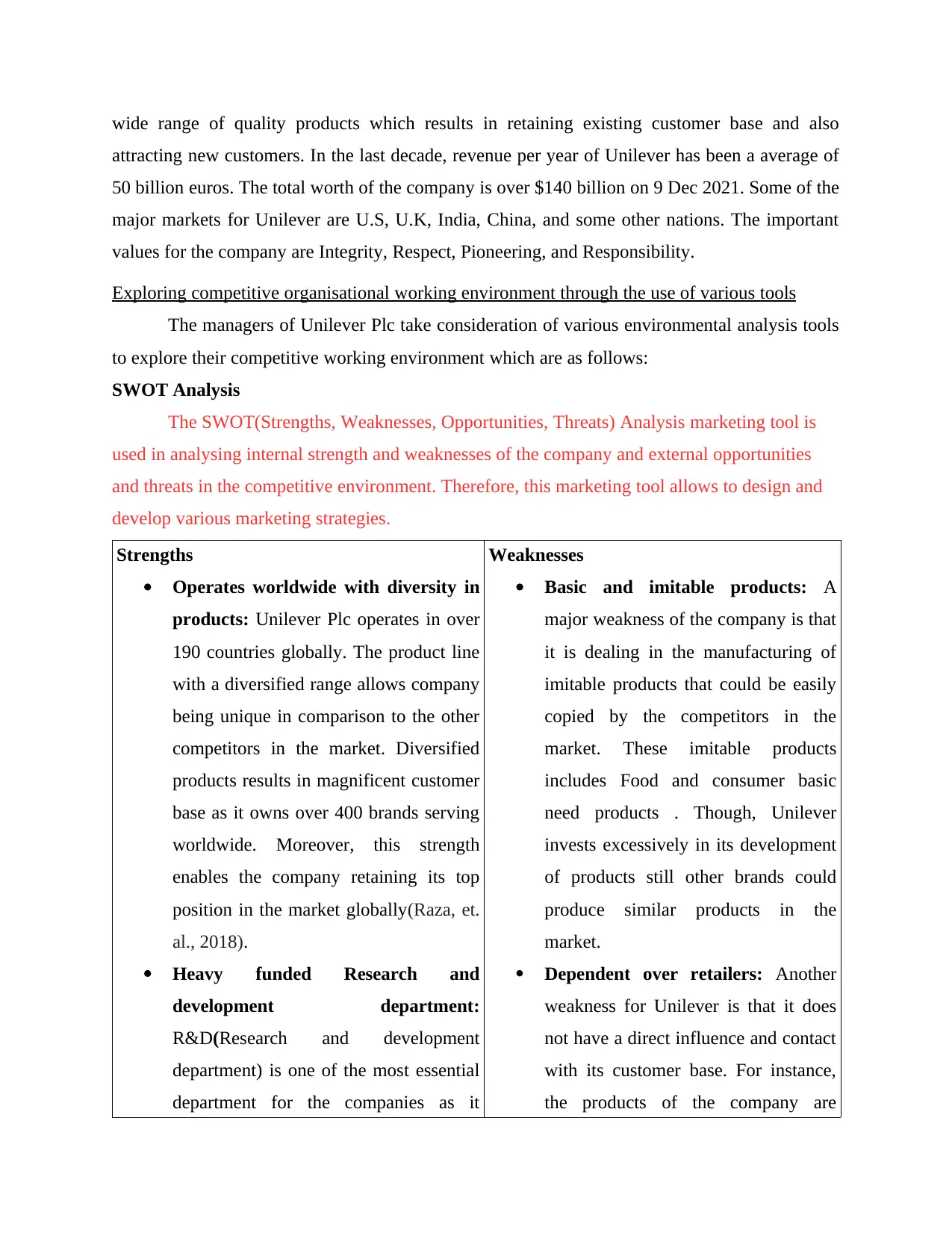
wide range of quality products which results in retaining existing customer base and also
attracting new customers. In the last decade, revenue per year of Unilever has been a average of
50 billion euros. The total worth of the company is over $140 billion on 9 Dec 2021. Some of the
major markets for Unilever are U.S, U.K, India, China, and some other nations. The important
values for the company are Integrity, Respect, Pioneering, and Responsibility.
Exploring competitive organisational working environment through the use of various tools
The managers of Unilever Plc take consideration of various environmental analysis tools
to explore their competitive working environment which are as follows:
SWOT Analysis
The SWOT(Strengths, Weaknesses, Opportunities, Threats) Analysis marketing tool is
used in analysing internal strength and weaknesses of the company and external opportunities
and threats in the competitive environment. Therefore, this marketing tool allows to design and
develop various marketing strategies.
Strengths
Operates worldwide with diversity in
products: Unilever Plc operates in over
190 countries globally. The product line
with a diversified range allows company
being unique in comparison to the other
competitors in the market. Diversified
products results in magnificent customer
base as it owns over 400 brands serving
worldwide. Moreover, this strength
enables the company retaining its top
position in the market globally(Raza, et.
al., 2018).
Heavy funded Research and
development department:
R&D(Research and development
department) is one of the most essential
department for the companies as it
Weaknesses
Basic and imitable products: A
major weakness of the company is that
it is dealing in the manufacturing of
imitable products that could be easily
copied by the competitors in the
market. These imitable products
includes Food and consumer basic
need products . Though, Unilever
invests excessively in its development
of products still other brands could
produce similar products in the
market.
Dependent over retailers: Another
weakness for Unilever is that it does
not have a direct influence and contact
with its customer base. For instance,
the products of the company are
attracting new customers. In the last decade, revenue per year of Unilever has been a average of
50 billion euros. The total worth of the company is over $140 billion on 9 Dec 2021. Some of the
major markets for Unilever are U.S, U.K, India, China, and some other nations. The important
values for the company are Integrity, Respect, Pioneering, and Responsibility.
Exploring competitive organisational working environment through the use of various tools
The managers of Unilever Plc take consideration of various environmental analysis tools
to explore their competitive working environment which are as follows:
SWOT Analysis
The SWOT(Strengths, Weaknesses, Opportunities, Threats) Analysis marketing tool is
used in analysing internal strength and weaknesses of the company and external opportunities
and threats in the competitive environment. Therefore, this marketing tool allows to design and
develop various marketing strategies.
Strengths
Operates worldwide with diversity in
products: Unilever Plc operates in over
190 countries globally. The product line
with a diversified range allows company
being unique in comparison to the other
competitors in the market. Diversified
products results in magnificent customer
base as it owns over 400 brands serving
worldwide. Moreover, this strength
enables the company retaining its top
position in the market globally(Raza, et.
al., 2018).
Heavy funded Research and
development department:
R&D(Research and development
department) is one of the most essential
department for the companies as it
Weaknesses
Basic and imitable products: A
major weakness of the company is that
it is dealing in the manufacturing of
imitable products that could be easily
copied by the competitors in the
market. These imitable products
includes Food and consumer basic
need products . Though, Unilever
invests excessively in its development
of products still other brands could
produce similar products in the
market.
Dependent over retailers: Another
weakness for Unilever is that it does
not have a direct influence and contact
with its customer base. For instance,
the products of the company are
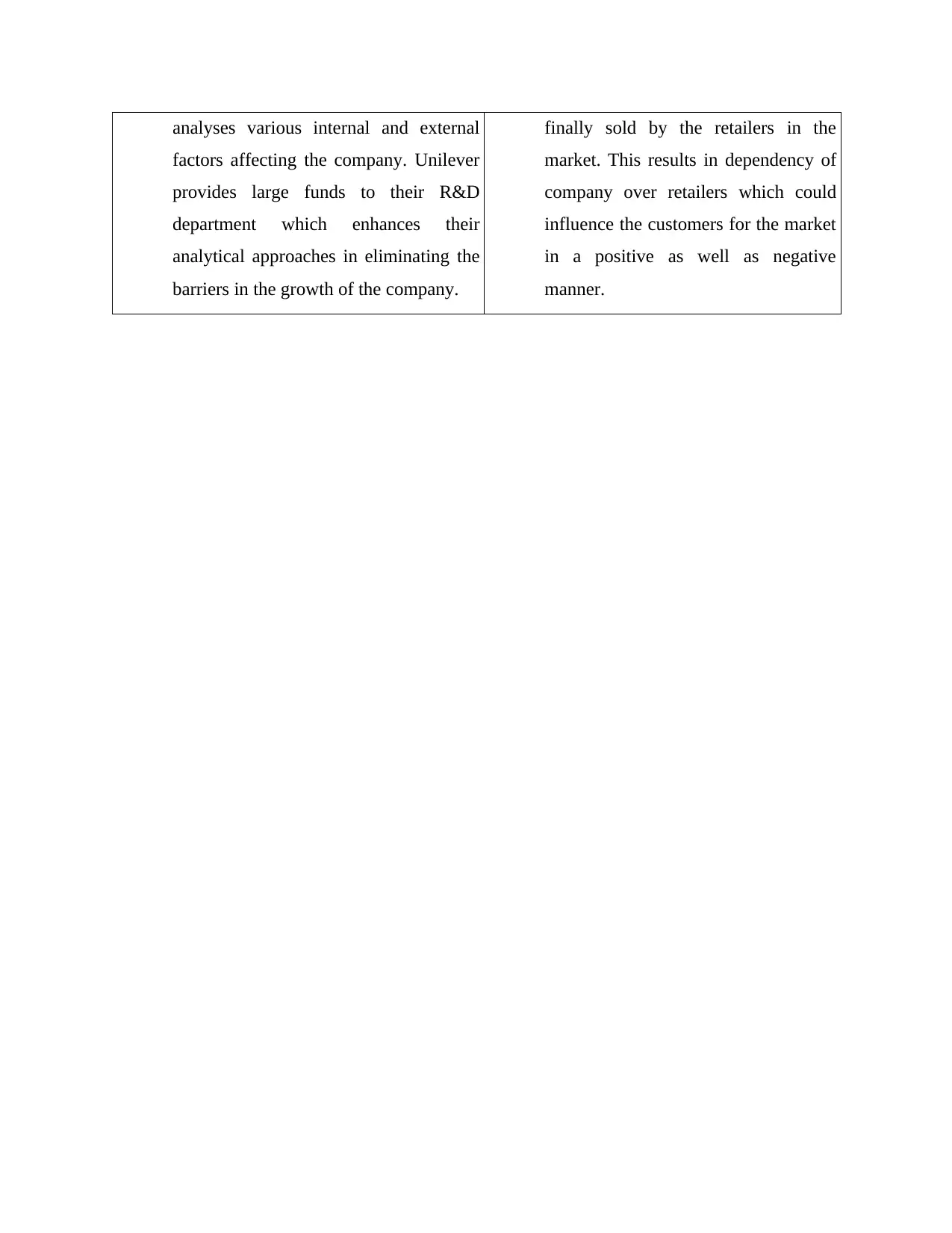
analyses various internal and external
factors affecting the company. Unilever
provides large funds to their R&D
department which enhances their
analytical approaches in eliminating the
barriers in the growth of the company.
finally sold by the retailers in the
market. This results in dependency of
company over retailers which could
influence the customers for the market
in a positive as well as negative
manner.
factors affecting the company. Unilever
provides large funds to their R&D
department which enhances their
analytical approaches in eliminating the
barriers in the growth of the company.
finally sold by the retailers in the
market. This results in dependency of
company over retailers which could
influence the customers for the market
in a positive as well as negative
manner.
⊘ This is a preview!⊘
Do you want full access?
Subscribe today to unlock all pages.
Trusted by 1+ million students worldwide
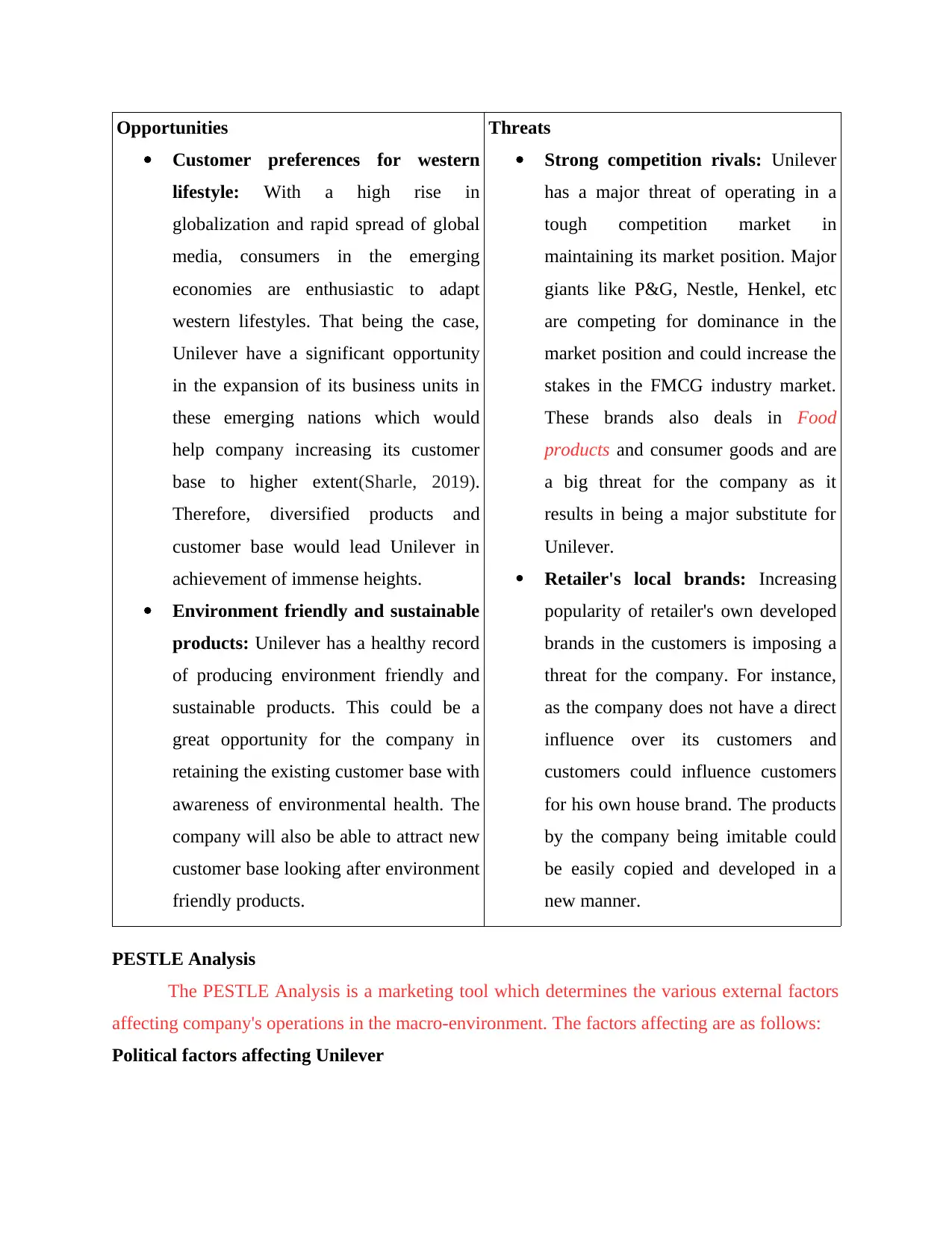
Opportunities
Customer preferences for western
lifestyle: With a high rise in
globalization and rapid spread of global
media, consumers in the emerging
economies are enthusiastic to adapt
western lifestyles. That being the case,
Unilever have a significant opportunity
in the expansion of its business units in
these emerging nations which would
help company increasing its customer
base to higher extent(Sharle, 2019).
Therefore, diversified products and
customer base would lead Unilever in
achievement of immense heights.
Environment friendly and sustainable
products: Unilever has a healthy record
of producing environment friendly and
sustainable products. This could be a
great opportunity for the company in
retaining the existing customer base with
awareness of environmental health. The
company will also be able to attract new
customer base looking after environment
friendly products.
Threats
Strong competition rivals: Unilever
has a major threat of operating in a
tough competition market in
maintaining its market position. Major
giants like P&G, Nestle, Henkel, etc
are competing for dominance in the
market position and could increase the
stakes in the FMCG industry market.
These brands also deals in Food
products and consumer goods and are
a big threat for the company as it
results in being a major substitute for
Unilever.
Retailer's local brands: Increasing
popularity of retailer's own developed
brands in the customers is imposing a
threat for the company. For instance,
as the company does not have a direct
influence over its customers and
customers could influence customers
for his own house brand. The products
by the company being imitable could
be easily copied and developed in a
new manner.
PESTLE Analysis
The PESTLE Analysis is a marketing tool which determines the various external factors
affecting company's operations in the macro-environment. The factors affecting are as follows:
Political factors affecting Unilever
Customer preferences for western
lifestyle: With a high rise in
globalization and rapid spread of global
media, consumers in the emerging
economies are enthusiastic to adapt
western lifestyles. That being the case,
Unilever have a significant opportunity
in the expansion of its business units in
these emerging nations which would
help company increasing its customer
base to higher extent(Sharle, 2019).
Therefore, diversified products and
customer base would lead Unilever in
achievement of immense heights.
Environment friendly and sustainable
products: Unilever has a healthy record
of producing environment friendly and
sustainable products. This could be a
great opportunity for the company in
retaining the existing customer base with
awareness of environmental health. The
company will also be able to attract new
customer base looking after environment
friendly products.
Threats
Strong competition rivals: Unilever
has a major threat of operating in a
tough competition market in
maintaining its market position. Major
giants like P&G, Nestle, Henkel, etc
are competing for dominance in the
market position and could increase the
stakes in the FMCG industry market.
These brands also deals in Food
products and consumer goods and are
a big threat for the company as it
results in being a major substitute for
Unilever.
Retailer's local brands: Increasing
popularity of retailer's own developed
brands in the customers is imposing a
threat for the company. For instance,
as the company does not have a direct
influence over its customers and
customers could influence customers
for his own house brand. The products
by the company being imitable could
be easily copied and developed in a
new manner.
PESTLE Analysis
The PESTLE Analysis is a marketing tool which determines the various external factors
affecting company's operations in the macro-environment. The factors affecting are as follows:
Political factors affecting Unilever
Paraphrase This Document
Need a fresh take? Get an instant paraphrase of this document with our AI Paraphraser
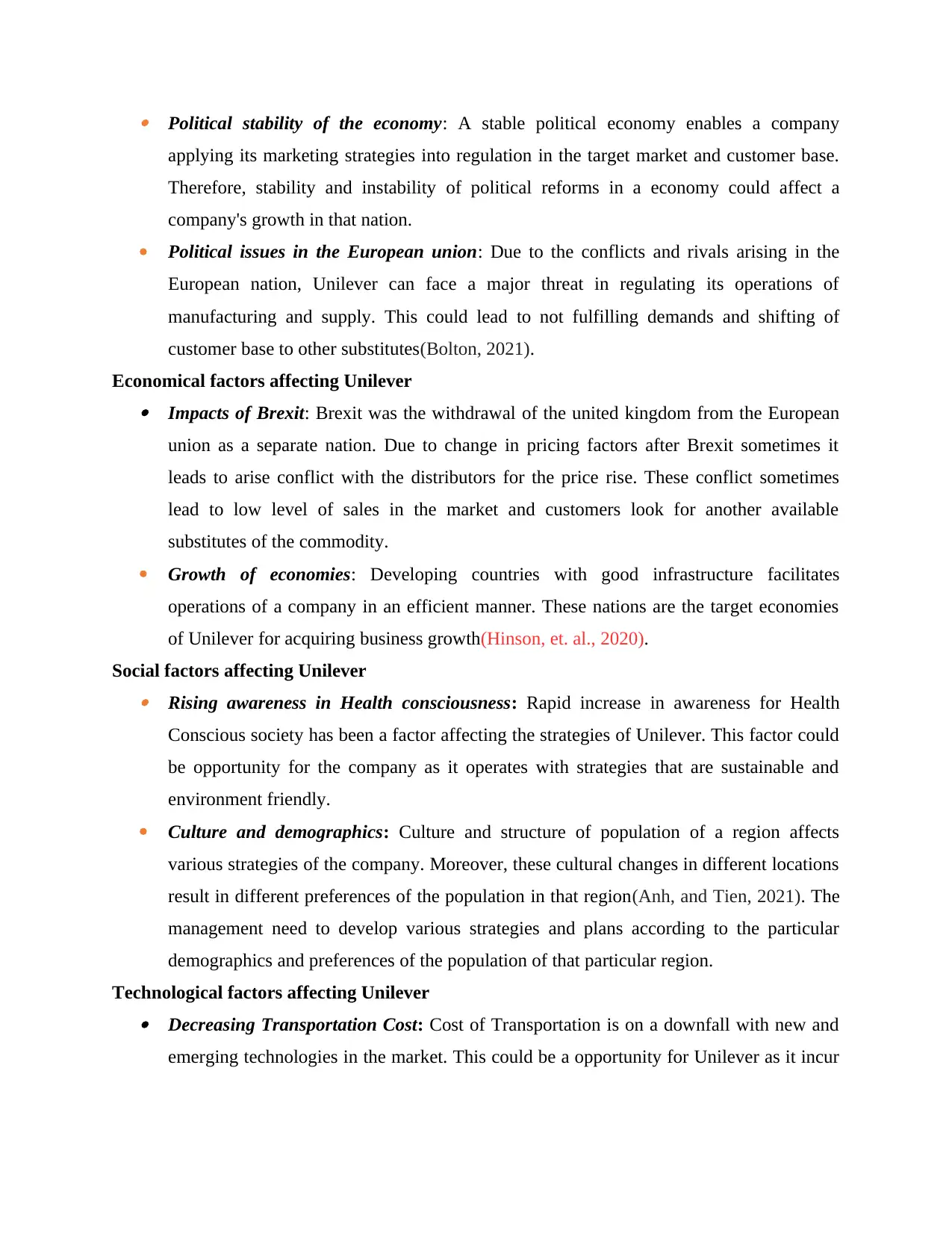
Political stability of the economy: A stable political economy enables a company
applying its marketing strategies into regulation in the target market and customer base.
Therefore, stability and instability of political reforms in a economy could affect a
company's growth in that nation.
Political issues in the European union: Due to the conflicts and rivals arising in the
European nation, Unilever can face a major threat in regulating its operations of
manufacturing and supply. This could lead to not fulfilling demands and shifting of
customer base to other substitutes(Bolton, 2021).
Economical factors affecting Unilever Impacts of Brexit: Brexit was the withdrawal of the united kingdom from the European
union as a separate nation. Due to change in pricing factors after Brexit sometimes it
leads to arise conflict with the distributors for the price rise. These conflict sometimes
lead to low level of sales in the market and customers look for another available
substitutes of the commodity.
Growth of economies: Developing countries with good infrastructure facilitates
operations of a company in an efficient manner. These nations are the target economies
of Unilever for acquiring business growth(Hinson, et. al., 2020).
Social factors affecting Unilever Rising awareness in Health consciousness: Rapid increase in awareness for Health
Conscious society has been a factor affecting the strategies of Unilever. This factor could
be opportunity for the company as it operates with strategies that are sustainable and
environment friendly.
Culture and demographics: Culture and structure of population of a region affects
various strategies of the company. Moreover, these cultural changes in different locations
result in different preferences of the population in that region(Anh, and Tien, 2021). The
management need to develop various strategies and plans according to the particular
demographics and preferences of the population of that particular region.
Technological factors affecting Unilever Decreasing Transportation Cost: Cost of Transportation is on a downfall with new and
emerging technologies in the market. This could be a opportunity for Unilever as it incur
applying its marketing strategies into regulation in the target market and customer base.
Therefore, stability and instability of political reforms in a economy could affect a
company's growth in that nation.
Political issues in the European union: Due to the conflicts and rivals arising in the
European nation, Unilever can face a major threat in regulating its operations of
manufacturing and supply. This could lead to not fulfilling demands and shifting of
customer base to other substitutes(Bolton, 2021).
Economical factors affecting Unilever Impacts of Brexit: Brexit was the withdrawal of the united kingdom from the European
union as a separate nation. Due to change in pricing factors after Brexit sometimes it
leads to arise conflict with the distributors for the price rise. These conflict sometimes
lead to low level of sales in the market and customers look for another available
substitutes of the commodity.
Growth of economies: Developing countries with good infrastructure facilitates
operations of a company in an efficient manner. These nations are the target economies
of Unilever for acquiring business growth(Hinson, et. al., 2020).
Social factors affecting Unilever Rising awareness in Health consciousness: Rapid increase in awareness for Health
Conscious society has been a factor affecting the strategies of Unilever. This factor could
be opportunity for the company as it operates with strategies that are sustainable and
environment friendly.
Culture and demographics: Culture and structure of population of a region affects
various strategies of the company. Moreover, these cultural changes in different locations
result in different preferences of the population in that region(Anh, and Tien, 2021). The
management need to develop various strategies and plans according to the particular
demographics and preferences of the population of that particular region.
Technological factors affecting Unilever Decreasing Transportation Cost: Cost of Transportation is on a downfall with new and
emerging technologies in the market. This could be a opportunity for Unilever as it incur
lesser cost but also can turn out to be a threat as it is imitable and competitors can expand
their business with lesser cost(Hoenen, et. al., 2018).
Technology as a marketing platform: Technology has provided various platforms for
promoting and advertising a commodity or product such as Social Media, Search engines,
Online shopping apps, etc. Therefore, a technology friendly society will be an
opportunity for Unilever to attract new customers.
Legal factors affecting Unilever Changes in government policies over tax: Every economy has different rules and laws
implemented by government over tax and subsidies for the business sector. These
changes affects company's cost of production in manufacturing its products and selling
them into the market(Ajayi and Mmutle, 2021).
Consumer right laws: These laws are implemented in an economy to protect a
consumers rights. This legal factor affects company in forcing the company in enhancing
its products quality served and providing efficient customer service. These positive
efforts results in an opportunity in attracting new customers for its products served.
Environmental factors affecting Unilever Weather and Climate: Weather conditions of a particular region affects a company's
operations in that particular location. Extreme climate conditions incur higher costs as
compared to suitable climate conditions. Locations with suitable climate conditions
produces a smooth flow of operations and higher profit margin due to lesser cost of
production(Morgan, Feng and Whitler, 2018).
Environment sustainability: This is a major environmental factor affecting operations of
Unilever in the production phase as well as marketing phase. Due to the rise in awareness
of environment sustainability in society, people look after environment friendly products.
This could be a opportunity for Unilever as producing sustainable and environment
friendly products.
Marketing mix of Unilever
Marketing-mix is a set of strategies used by a company to promote the brand and its
products in the market. Being a leading company in the Consumer Food market the management
of Unilever performs marketing mix to analyse Competition and other key challenges in the
their business with lesser cost(Hoenen, et. al., 2018).
Technology as a marketing platform: Technology has provided various platforms for
promoting and advertising a commodity or product such as Social Media, Search engines,
Online shopping apps, etc. Therefore, a technology friendly society will be an
opportunity for Unilever to attract new customers.
Legal factors affecting Unilever Changes in government policies over tax: Every economy has different rules and laws
implemented by government over tax and subsidies for the business sector. These
changes affects company's cost of production in manufacturing its products and selling
them into the market(Ajayi and Mmutle, 2021).
Consumer right laws: These laws are implemented in an economy to protect a
consumers rights. This legal factor affects company in forcing the company in enhancing
its products quality served and providing efficient customer service. These positive
efforts results in an opportunity in attracting new customers for its products served.
Environmental factors affecting Unilever Weather and Climate: Weather conditions of a particular region affects a company's
operations in that particular location. Extreme climate conditions incur higher costs as
compared to suitable climate conditions. Locations with suitable climate conditions
produces a smooth flow of operations and higher profit margin due to lesser cost of
production(Morgan, Feng and Whitler, 2018).
Environment sustainability: This is a major environmental factor affecting operations of
Unilever in the production phase as well as marketing phase. Due to the rise in awareness
of environment sustainability in society, people look after environment friendly products.
This could be a opportunity for Unilever as producing sustainable and environment
friendly products.
Marketing mix of Unilever
Marketing-mix is a set of strategies used by a company to promote the brand and its
products in the market. Being a leading company in the Consumer Food market the management
of Unilever performs marketing mix to analyse Competition and other key challenges in the
⊘ This is a preview!⊘
Do you want full access?
Subscribe today to unlock all pages.
Trusted by 1+ million students worldwide
market(Berndt, Altobelli and Sander, 2020). The marketing mix of Unilever involves 4 elements
which are as follows:
Price
The pricing strategy regulated by Unilever is Market Penetration. Furthermore, Market
Penetration is meant by providing high quality products at low price to create demand for their
products. Low price factor is adopted by the company to attract additional customer base for the
Food products offered by Unilever. The company also uses competitive pricing strategies to take
advantage over major competitors in the market(Turker, 2018). These price strategies changes
according to various factors such as demographics, government policies, cost incurred in
production, substitutes available in the market. Unilever also offers a premium line of Food
products with finest quality and higher prices than its competitors for the rich section of society.
Product
Unilever offers a diversified product line in its Food category. The major brands in this
category are Magnum, Hellman's, Knorr, Ben & Jerry's, Kwality Wall's, etc. Unilever is
comprised of over 400 brands overall serving worldwide to a huge customer base. The
company's focus is upon 13 major brands with annual sales of over 1 billion euros. Food
category is accounted for one fourth of company's overall revenue of 13 billion euros. Unilever
develops its products for every section of the society from low price products for affordability to
higher price products for maintaining status symbol. The company considers preferences of all
the customers and designs their products accordingly(Taghizadeh, Rahman and Marimuthu,
2019).
Place
Place is marketing-mix is meant by location of markets where the company sells its
products and services. Unilever is operating in around 200 nations worldwide. Places for
distribution of Unilever's food products are Retail shops, Kiosk booth, departmental stores, etc.
Unilever does not have a direct contact with its customers, it uses retail shops and stores for the
sales of its products(Girsang, 2021).
Promotion
Promotion refers to advertise and aware the society for the products and services offered
by the particular company. The objective of promotion is to spread awarenss, attract customers,
bring about sales and developing brand image. Marketing tactics used by Unilever are
which are as follows:
Price
The pricing strategy regulated by Unilever is Market Penetration. Furthermore, Market
Penetration is meant by providing high quality products at low price to create demand for their
products. Low price factor is adopted by the company to attract additional customer base for the
Food products offered by Unilever. The company also uses competitive pricing strategies to take
advantage over major competitors in the market(Turker, 2018). These price strategies changes
according to various factors such as demographics, government policies, cost incurred in
production, substitutes available in the market. Unilever also offers a premium line of Food
products with finest quality and higher prices than its competitors for the rich section of society.
Product
Unilever offers a diversified product line in its Food category. The major brands in this
category are Magnum, Hellman's, Knorr, Ben & Jerry's, Kwality Wall's, etc. Unilever is
comprised of over 400 brands overall serving worldwide to a huge customer base. The
company's focus is upon 13 major brands with annual sales of over 1 billion euros. Food
category is accounted for one fourth of company's overall revenue of 13 billion euros. Unilever
develops its products for every section of the society from low price products for affordability to
higher price products for maintaining status symbol. The company considers preferences of all
the customers and designs their products accordingly(Taghizadeh, Rahman and Marimuthu,
2019).
Place
Place is marketing-mix is meant by location of markets where the company sells its
products and services. Unilever is operating in around 200 nations worldwide. Places for
distribution of Unilever's food products are Retail shops, Kiosk booth, departmental stores, etc.
Unilever does not have a direct contact with its customers, it uses retail shops and stores for the
sales of its products(Girsang, 2021).
Promotion
Promotion refers to advertise and aware the society for the products and services offered
by the particular company. The objective of promotion is to spread awarenss, attract customers,
bring about sales and developing brand image. Marketing tactics used by Unilever are
Paraphrase This Document
Need a fresh take? Get an instant paraphrase of this document with our AI Paraphraser
Advertising, Sales Promotion, Public Relations, Personal Selling, and Direct Marketing.
Advertising its products is the primary marketing activity of the company(Trivedi, Trivedi and
Goswami, 2018). Maintaining healthy public relations with customer satisfaction, Selling
products personally to knowns or door to door, spreading awareness directly to people, etc. are
activities also regulated by company.
Recommendation of how to improve marketing mix.
There are several ways through which Unilever can improve its marketing mix in order to
perform better in market are as follows:
Make clear goals and objectives- For improving marketing mix it is very important for
business to clearly set its goals and objectives. In order to improve its marketing mix in
market, management of company now should put focus of brand awareness that how can
they can advertise their brand to more customers in market. Effective marketing
strategies helps to gain large number of customers in market therefore it will help to
increase sales of company too (Sheth, 2021).
Make changes in product- Adding unique features in product in necessary to keep
products popular among customer in market. Therefore management of given company
should add some more changes in product. Several changes can be made in terms of
quantity, varieties and many more. Hence by making changes customer will attract to
products of Unilever again which will increase the sales and lead to rise its profitability.
Make proper budget- Proper allocation of finance is very necessary for successful
operations of business. Therefore management of company should make appropriate
budget for each and every department of company. This would help them to know that
how much they should spend money so that they can avoid wastage of resources and can
achieve organisational goal in effective and efficient manner (Thakur, 2021).
Sell products at lower price- Sometimes high price of products can negatively affect the
sales of company because customer do not prefer to spend so much on purchasing
products that have higher cost. Therefore manager of Unilever should consider their price
very well and if they are finding it high then they should lower down it in order to attract
more customer.
Advertising its products is the primary marketing activity of the company(Trivedi, Trivedi and
Goswami, 2018). Maintaining healthy public relations with customer satisfaction, Selling
products personally to knowns or door to door, spreading awareness directly to people, etc. are
activities also regulated by company.
Recommendation of how to improve marketing mix.
There are several ways through which Unilever can improve its marketing mix in order to
perform better in market are as follows:
Make clear goals and objectives- For improving marketing mix it is very important for
business to clearly set its goals and objectives. In order to improve its marketing mix in
market, management of company now should put focus of brand awareness that how can
they can advertise their brand to more customers in market. Effective marketing
strategies helps to gain large number of customers in market therefore it will help to
increase sales of company too (Sheth, 2021).
Make changes in product- Adding unique features in product in necessary to keep
products popular among customer in market. Therefore management of given company
should add some more changes in product. Several changes can be made in terms of
quantity, varieties and many more. Hence by making changes customer will attract to
products of Unilever again which will increase the sales and lead to rise its profitability.
Make proper budget- Proper allocation of finance is very necessary for successful
operations of business. Therefore management of company should make appropriate
budget for each and every department of company. This would help them to know that
how much they should spend money so that they can avoid wastage of resources and can
achieve organisational goal in effective and efficient manner (Thakur, 2021).
Sell products at lower price- Sometimes high price of products can negatively affect the
sales of company because customer do not prefer to spend so much on purchasing
products that have higher cost. Therefore manager of Unilever should consider their price
very well and if they are finding it high then they should lower down it in order to attract
more customer.
Can ask for feedback from customer- It is very important for business to know that
how customer is feeling after using their product in market. Getting response from
customer help business to know that how they are performing, whether they are selling
their products as per customer requirement or not. For getting response from customer,
management of mentioned company can add feedback column in their website if they are
selling online and can ask customer to write a chit and drop in box if they are selling in
offline manner. This would help management to know feedback of products in better way
so that they can make changes accordingly (Shafiee, Haghighizade and Rahimzadeh,
2019).
Make improvement in distribution channel- In most cases it has been seen that
improper distribution of goods in market can reduce the demand of products among
customer because they are getting late supply and can negatively impact the performance
of company. Therefore management of mentioned organisation should improve its
distribution channel if they are lately delivering the products in market.
Various ways to improve the branding
Branding is the main process of creating a positive image of the company. Proper way of
branding helps the companies to differentiate themselves from their competitors to build a loyal
customer base. Branding in store can be different when compared to online branding. If the
company has unique image of branding that can cause a huge impact on the customers of market.
It can be a complex process which requires a lot of planning and techniques. A strong brand is
related to the values that resonate properly with the targeted audience. There are various ways to
improve the branding of the company which are as follows-
Social media- It is a valuable tool for sharing information regarding the industry to
interact with customers of the field. Nowadays, customers like to use social media to buy
products so, company can connect with customers. Social media is a good platform for
improving the brand of company. As the social media presence of the company
increases the website traffic and enhance the overall image with both new and existing
customers (Trivedi, Trivedi and Goswami, 2018).
Website- Company's online presence matters a lot and website can be the main tool
while improving the image and reputation. If the company wants to stand out then the
website should reflect the identity of the brand. Website is used as representation of the
how customer is feeling after using their product in market. Getting response from
customer help business to know that how they are performing, whether they are selling
their products as per customer requirement or not. For getting response from customer,
management of mentioned company can add feedback column in their website if they are
selling online and can ask customer to write a chit and drop in box if they are selling in
offline manner. This would help management to know feedback of products in better way
so that they can make changes accordingly (Shafiee, Haghighizade and Rahimzadeh,
2019).
Make improvement in distribution channel- In most cases it has been seen that
improper distribution of goods in market can reduce the demand of products among
customer because they are getting late supply and can negatively impact the performance
of company. Therefore management of mentioned organisation should improve its
distribution channel if they are lately delivering the products in market.
Various ways to improve the branding
Branding is the main process of creating a positive image of the company. Proper way of
branding helps the companies to differentiate themselves from their competitors to build a loyal
customer base. Branding in store can be different when compared to online branding. If the
company has unique image of branding that can cause a huge impact on the customers of market.
It can be a complex process which requires a lot of planning and techniques. A strong brand is
related to the values that resonate properly with the targeted audience. There are various ways to
improve the branding of the company which are as follows-
Social media- It is a valuable tool for sharing information regarding the industry to
interact with customers of the field. Nowadays, customers like to use social media to buy
products so, company can connect with customers. Social media is a good platform for
improving the brand of company. As the social media presence of the company
increases the website traffic and enhance the overall image with both new and existing
customers (Trivedi, Trivedi and Goswami, 2018).
Website- Company's online presence matters a lot and website can be the main tool
while improving the image and reputation. If the company wants to stand out then the
website should reflect the identity of the brand. Website is used as representation of the
⊘ This is a preview!⊘
Do you want full access?
Subscribe today to unlock all pages.
Trusted by 1+ million students worldwide

1 out of 15


Related Documents


Your All-in-One AI-Powered Toolkit for Academic Success.
+13062052269
info@desklib.com
Available 24*7 on WhatsApp / Email
![[object Object]](/_next/static/media/star-bottom.7253800d.svg)
Unlock your academic potential
Copyright © 2020–2026 A2Z Services. All Rights Reserved. Developed and managed by ZUCOL.