Compensation and Benefits at Unilever: An HRM Analysis Report
VerifiedAdded on 2023/05/30
|18
|4173
|121
Report
AI Summary
This report offers a comprehensive analysis of Unilever's employee compensation and benefits programs. It begins with an overview of Unilever's business model, organizational structure, and global operations. The report then delves into the company's approach to determining pay rates for new hires, ensuring internal equity, and aligning compensation with the market. It examines Unilever's "Fair Compensation" framework, including elements like "Fair and liveable compensation," "market based compensation," and "performance focused compensation". The report also details the types of benefits offered to employees and assesses the overall effectiveness of the compensation program using a Likert scale. Finally, it provides recommendations for improving the compensation system, emphasizing the importance of factors like open communication and market competitiveness. The report references various academic sources and Unilever's internal documents to support its findings.
Running head: HUMAN RESOURCE MANAGEMENT
Human Resource Management
Name of the Student
Name of the University
Author Note
Human Resource Management
Name of the Student
Name of the University
Author Note

Paraphrase This Document
Need a fresh take? Get an instant paraphrase of this document with our AI Paraphraser
1HUMAN RESOURCE MANAGEMENT
Table of Content
1 Introduction.............................................................................................................................2
2 Background to the organization-.............................................................................................2
3. Rate of pays for new hires determined and aligned with existing employee ensure internal
equity..........................................................................................................................................3
4. Processes Unilever uses to ensure their compensation is aligned with market place............7
5. Type of benefits do employees receive for working with Unilever.......................................9
6. Compensation program presented with Likart scale............................................................10
7. Recommendation..................................................................................................................11
References................................................................................................................................14
Table of Content
1 Introduction.............................................................................................................................2
2 Background to the organization-.............................................................................................2
3. Rate of pays for new hires determined and aligned with existing employee ensure internal
equity..........................................................................................................................................3
4. Processes Unilever uses to ensure their compensation is aligned with market place............7
5. Type of benefits do employees receive for working with Unilever.......................................9
6. Compensation program presented with Likart scale............................................................10
7. Recommendation..................................................................................................................11
References................................................................................................................................14
2HUMAN RESOURCE MANAGEMENT
1 Introduction
This assignment provides an in-depth understanding on the compensation and benefits
for employees that an organization design. In order to perform the analysis with real world
facts and findings, assignment considers compensation and employee benefits structure of
Unilever- an FMCG firm running operation in global environment. The major purpose of the
report is derive a comprehensible understanding about employee benefits and compensation
strategies that industry or the organization designs for the workforce. The importance of
employee compensation and benefits lies in the fact that in order to hire and retain skilled and
talented people, employer or the organization must provide required benefits or leverage
employee benefit package to attract and retain the best candidates. However, due to market
dynamics and changing demands, this compensation package could differ on the basis of the
industry and organization’s size and structure. Thus, taking this fact into the consideration,
this report discusses employee compensation and benefits packages of Unilever. Report
proceeds with providing a detailed background on Unilever and then rates of pays of new
hires are discussed to learn how it is aligned with existing employees to ensure internal
equity. Likewise, the report also discusses the techniques that Unilever uses to ensure its
compensation is aligned with the market place or the industry.
2 Background to the organization-
Unilever is a globally leading fast moving consumer goods organization producing
more than 400 brands with highest impact on people’s life (Unilever 2018). The fundamental
of Unilever’s business model is that it believes profitable growth need to be responsible
growth. Unilever developed a broad team for its extending business functions. The
organization mainly manufactures FMCG products but to run its fundamental operation, its
team is divided into different functions namely marketing, customer development, human
1 Introduction
This assignment provides an in-depth understanding on the compensation and benefits
for employees that an organization design. In order to perform the analysis with real world
facts and findings, assignment considers compensation and employee benefits structure of
Unilever- an FMCG firm running operation in global environment. The major purpose of the
report is derive a comprehensible understanding about employee benefits and compensation
strategies that industry or the organization designs for the workforce. The importance of
employee compensation and benefits lies in the fact that in order to hire and retain skilled and
talented people, employer or the organization must provide required benefits or leverage
employee benefit package to attract and retain the best candidates. However, due to market
dynamics and changing demands, this compensation package could differ on the basis of the
industry and organization’s size and structure. Thus, taking this fact into the consideration,
this report discusses employee compensation and benefits packages of Unilever. Report
proceeds with providing a detailed background on Unilever and then rates of pays of new
hires are discussed to learn how it is aligned with existing employees to ensure internal
equity. Likewise, the report also discusses the techniques that Unilever uses to ensure its
compensation is aligned with the market place or the industry.
2 Background to the organization-
Unilever is a globally leading fast moving consumer goods organization producing
more than 400 brands with highest impact on people’s life (Unilever 2018). The fundamental
of Unilever’s business model is that it believes profitable growth need to be responsible
growth. Unilever developed a broad team for its extending business functions. The
organization mainly manufactures FMCG products but to run its fundamental operation, its
team is divided into different functions namely marketing, customer development, human
⊘ This is a preview!⊘
Do you want full access?
Subscribe today to unlock all pages.

Trusted by 1+ million students worldwide
3HUMAN RESOURCE MANAGEMENT
resource, research and development, finance, information technology and several other
functional department.
Human resource team contributes to development of a better workforce by attracting new
talents, developing and retaining skilled candidates as well as partnering with highly
experienced professionals having knowledge about open economy. Nazarova (2015)
commented that corporate structure of Unilever helps its business to ensure proper support
for the innovation of product and global exposure of the business. It is particularly noted that
Unilever has a product type divisional organisational structure which is divided into three
basic components namely personal care products as well as home care products.
As discussed above, since Unilever has a variety of departments for running its core
operation, types of employees could differ on the basis of the department the individuals are
working in. For example, individuals having skills regarding the information technology are
working in IT department, while people having the skills of people management are working
under Human Resource department. According to the annual report published in the last, the
total number of employees presently working in the organisation is 16,500 (Unilever 2018)
Unilever is performing its operation in multiple global locations with the inclusion of Europe,
America and Asia but it has a growing dominance over Asian market due to limited number
of competitors and their size of business. The overall employee data figure indicates that
almost 47% of its managers are female employees.
3. Rate of pays for new hires determined and aligned with existing
employee ensure internal equity
As put forward by Tepic et al. (2013) motivated and engaged workforce is mandatory
workforce requirement which would help to achieve Unilever’s growth ambition. So, fair
compensation framework of Unilever remain crucial to its business. Pant & Ramachandran
resource, research and development, finance, information technology and several other
functional department.
Human resource team contributes to development of a better workforce by attracting new
talents, developing and retaining skilled candidates as well as partnering with highly
experienced professionals having knowledge about open economy. Nazarova (2015)
commented that corporate structure of Unilever helps its business to ensure proper support
for the innovation of product and global exposure of the business. It is particularly noted that
Unilever has a product type divisional organisational structure which is divided into three
basic components namely personal care products as well as home care products.
As discussed above, since Unilever has a variety of departments for running its core
operation, types of employees could differ on the basis of the department the individuals are
working in. For example, individuals having skills regarding the information technology are
working in IT department, while people having the skills of people management are working
under Human Resource department. According to the annual report published in the last, the
total number of employees presently working in the organisation is 16,500 (Unilever 2018)
Unilever is performing its operation in multiple global locations with the inclusion of Europe,
America and Asia but it has a growing dominance over Asian market due to limited number
of competitors and their size of business. The overall employee data figure indicates that
almost 47% of its managers are female employees.
3. Rate of pays for new hires determined and aligned with existing
employee ensure internal equity
As put forward by Tepic et al. (2013) motivated and engaged workforce is mandatory
workforce requirement which would help to achieve Unilever’s growth ambition. So, fair
compensation framework of Unilever remain crucial to its business. Pant & Ramachandran
Paraphrase This Document
Need a fresh take? Get an instant paraphrase of this document with our AI Paraphraser
4HUMAN RESOURCE MANAGEMENT
(2017) mentioned that if there is inclusive and sustainable economic growth; then it is certain
that employees should receive fair compensation. Thus, as a significant aspect of Unilever
“Sustainable Living Plan 2014”, the firm has set a particular target of developing a structured
way to define and evaluate how the elements or the compensation package as a whole
provides fair compensation to workers. According to “Faire Compensation” framework of
Unilever, it is just the process of ensuring that pay rates of employees are designed to the
degree which remains fair and liveable for all because the process provides equal pay for
equal amount or hours of work. So, when it comes to ensuring internal equity considering the
pays of new hires and existing employees, Unilever creates the framework in which pay
benefits are aligned by several variables such as “Fair and liveable compensation”, “market
based compensation”, “no- discrimination” in compensation”, “performance focused
compensation” and “open and explainable compensation”.
For example, full time employees falling under a lowest grade in any nation is entitled
to receive at least a fixed compensation which includes both cash amounts and non-cash
benefits which must be sufficient for the needs. For both new and existing employees,
amount of fixed compensation will be achievable without the requirement of excessive work
hours. On the other side, the compensation of part-time employees are based on full time
compensation pro-rated for hours worked. Lombardi (2014) mentioned about another
division in the framework of fair compensation, which is market based compensation. For
example, compensation could be market based and it fairly reflect an employee’s skills, talent
and experience and education.
This means an individual employed at Unilever and is working for two years, his/ her
pay will be based on educational qualification, experience and skills, while a new candidate
with equal skills and industry experience will receive market based compensation but not
equal to individual served two years in Unilever with similar skills and experience. In
(2017) mentioned that if there is inclusive and sustainable economic growth; then it is certain
that employees should receive fair compensation. Thus, as a significant aspect of Unilever
“Sustainable Living Plan 2014”, the firm has set a particular target of developing a structured
way to define and evaluate how the elements or the compensation package as a whole
provides fair compensation to workers. According to “Faire Compensation” framework of
Unilever, it is just the process of ensuring that pay rates of employees are designed to the
degree which remains fair and liveable for all because the process provides equal pay for
equal amount or hours of work. So, when it comes to ensuring internal equity considering the
pays of new hires and existing employees, Unilever creates the framework in which pay
benefits are aligned by several variables such as “Fair and liveable compensation”, “market
based compensation”, “no- discrimination” in compensation”, “performance focused
compensation” and “open and explainable compensation”.
For example, full time employees falling under a lowest grade in any nation is entitled
to receive at least a fixed compensation which includes both cash amounts and non-cash
benefits which must be sufficient for the needs. For both new and existing employees,
amount of fixed compensation will be achievable without the requirement of excessive work
hours. On the other side, the compensation of part-time employees are based on full time
compensation pro-rated for hours worked. Lombardi (2014) mentioned about another
division in the framework of fair compensation, which is market based compensation. For
example, compensation could be market based and it fairly reflect an employee’s skills, talent
and experience and education.
This means an individual employed at Unilever and is working for two years, his/ her
pay will be based on educational qualification, experience and skills, while a new candidate
with equal skills and industry experience will receive market based compensation but not
equal to individual served two years in Unilever with similar skills and experience. In
5HUMAN RESOURCE MANAGEMENT
addition, fixed compensations policy in the frame is set to meet or exceed any legal minimum
standards which could prevail the industry standards. In order to maintain internal equity,
Unilever has also developed the polices of “No Discrimination” under which equal
compensation is provided for equal amount of effort for the work excluding the
discrimination on race, gender and sexual orientation, etc (Dirisu, Iyiola & Ibidunni, 2013).).
Nonetheless, it has also been identified that both new hires and existing employees
have the opportunity for gaining benefits from enhanced performance through the
participation in effective business performance which is linked to bonus plans. The division
of performance focus compensation clarifies the fact that both new but confirmed candidates
and the existing employees can take the opportunity to take a financial interest in Unilever by
acquiring shares. Conversely, Sim, King and Price (2016) mentioned that the division of open
and explainable compensation is more significant than other variable when it comes to
creating internal equity. This means when the employees are given or provided with certain
benefits, they should learn how the entire process is designed and mapped out. For example,
employees should have proper information to understand how the compensation package is
designed, what amounts to be expected. Employees should know how they are supposed to
receive these amounts.
The Fair Compensation framework of Unilever designs explainable compensation in
which if the employee are chosen to be represented by Trade Union, then the organization
will look at the collective bargaining as primary mechanism for pay reviews to the degree
appropriate. All employees are entitled to learn about their compensation queries.
Furthermore, it has also been identified that Unilever has developed a “Fair Wage Network”
which guides people that for fair and liveable wage compensation purpose designed for new
hires, part-time and full-time employees, the organisation should compare the fixe
addition, fixed compensations policy in the frame is set to meet or exceed any legal minimum
standards which could prevail the industry standards. In order to maintain internal equity,
Unilever has also developed the polices of “No Discrimination” under which equal
compensation is provided for equal amount of effort for the work excluding the
discrimination on race, gender and sexual orientation, etc (Dirisu, Iyiola & Ibidunni, 2013).).
Nonetheless, it has also been identified that both new hires and existing employees
have the opportunity for gaining benefits from enhanced performance through the
participation in effective business performance which is linked to bonus plans. The division
of performance focus compensation clarifies the fact that both new but confirmed candidates
and the existing employees can take the opportunity to take a financial interest in Unilever by
acquiring shares. Conversely, Sim, King and Price (2016) mentioned that the division of open
and explainable compensation is more significant than other variable when it comes to
creating internal equity. This means when the employees are given or provided with certain
benefits, they should learn how the entire process is designed and mapped out. For example,
employees should have proper information to understand how the compensation package is
designed, what amounts to be expected. Employees should know how they are supposed to
receive these amounts.
The Fair Compensation framework of Unilever designs explainable compensation in
which if the employee are chosen to be represented by Trade Union, then the organization
will look at the collective bargaining as primary mechanism for pay reviews to the degree
appropriate. All employees are entitled to learn about their compensation queries.
Furthermore, it has also been identified that Unilever has developed a “Fair Wage Network”
which guides people that for fair and liveable wage compensation purpose designed for new
hires, part-time and full-time employees, the organisation should compare the fixe
⊘ This is a preview!⊘
Do you want full access?
Subscribe today to unlock all pages.
Trusted by 1+ million students worldwide
6HUMAN RESOURCE MANAGEMENT
compensation among of the lowest grade of employees in a nation to Living Wage in its
online database (Davids, 2016).
The following structure shows how pay rates are determined between existing employees and
new hires
As employees in general belong to different degree of experience and education, Unilever
uses quartiles to calculate and determine where an individual need to be placed in the salary
range
Minimum
range
1st Quartile 2nd Quartile Midpoint
of Range
3rd Quartile 4th
Quartile
Max
of
range
Meets
minimum
qualification
Previous
related
experience
Meet
preferred
qualification
Subject
Matter
Expert
Has least or
no existing
experience
Demonstrated
ability to
perform
duties
Demonstrated
ability to
perform
duties
independently
Holds
broad and
intense
knowledge
of the job
related
areas
Need
additional
training to
develop
May require
additional
training to
perform
Consistently
demonstrates
core
competencies
Senior-
level job
experience
compensation among of the lowest grade of employees in a nation to Living Wage in its
online database (Davids, 2016).
The following structure shows how pay rates are determined between existing employees and
new hires
As employees in general belong to different degree of experience and education, Unilever
uses quartiles to calculate and determine where an individual need to be placed in the salary
range
Minimum
range
1st Quartile 2nd Quartile Midpoint
of Range
3rd Quartile 4th
Quartile
Max
of
range
Meets
minimum
qualification
Previous
related
experience
Meet
preferred
qualification
Subject
Matter
Expert
Has least or
no existing
experience
Demonstrated
ability to
perform
duties
Demonstrated
ability to
perform
duties
independently
Holds
broad and
intense
knowledge
of the job
related
areas
Need
additional
training to
develop
May require
additional
training to
perform
Consistently
demonstrates
core
competencies
Senior-
level job
experience
Paraphrase This Document
Need a fresh take? Get an instant paraphrase of this document with our AI Paraphraser
7HUMAN RESOURCE MANAGEMENT
knowledge
and
expertise
duties
independently
Entry Level Seasoned
Professional/
Mid-Career
Table 1: Employee range of level of experience in Unilever
(Source: Lombardi, 2014)
4. Processes Unilever uses to ensure their compensation is aligned with
market place
Unilever’s Fair Compensation Framework is aligned with the market place through its
“Sustainable Living Plan” which determines how the organization should create the target
and build a structured way to define and assess how the elements of compensation package
deliver fair compensation aligned to market place (Unilever, 2018). The sustainable plan of
the organisation aims to contribute to a number of UN’s sustainable development goals such
as –Good health and wellbeing, decent work and economic growth and, reduced
inequalities. In addition to this, in order to become fair with market based compensation, the
organization implements the practice of reviewing “Pay Equity and Market Compensation”.
Compensation management team under Human Resource takes the responsibility of ensuring
fair and equitable compensation practices by keeping a competitive edge in the salaries. Dewi
and Kiswara (2013) performed a case study on Unilever and found that the organization
performs a review of pay equity and market compensation on quarterly basis to identify
inequities in the pay structure. Hence, the major objective of this review is to assist managers
knowledge
and
expertise
duties
independently
Entry Level Seasoned
Professional/
Mid-Career
Table 1: Employee range of level of experience in Unilever
(Source: Lombardi, 2014)
4. Processes Unilever uses to ensure their compensation is aligned with
market place
Unilever’s Fair Compensation Framework is aligned with the market place through its
“Sustainable Living Plan” which determines how the organization should create the target
and build a structured way to define and assess how the elements of compensation package
deliver fair compensation aligned to market place (Unilever, 2018). The sustainable plan of
the organisation aims to contribute to a number of UN’s sustainable development goals such
as –Good health and wellbeing, decent work and economic growth and, reduced
inequalities. In addition to this, in order to become fair with market based compensation, the
organization implements the practice of reviewing “Pay Equity and Market Compensation”.
Compensation management team under Human Resource takes the responsibility of ensuring
fair and equitable compensation practices by keeping a competitive edge in the salaries. Dewi
and Kiswara (2013) performed a case study on Unilever and found that the organization
performs a review of pay equity and market compensation on quarterly basis to identify
inequities in the pay structure. Hence, the major objective of this review is to assist managers
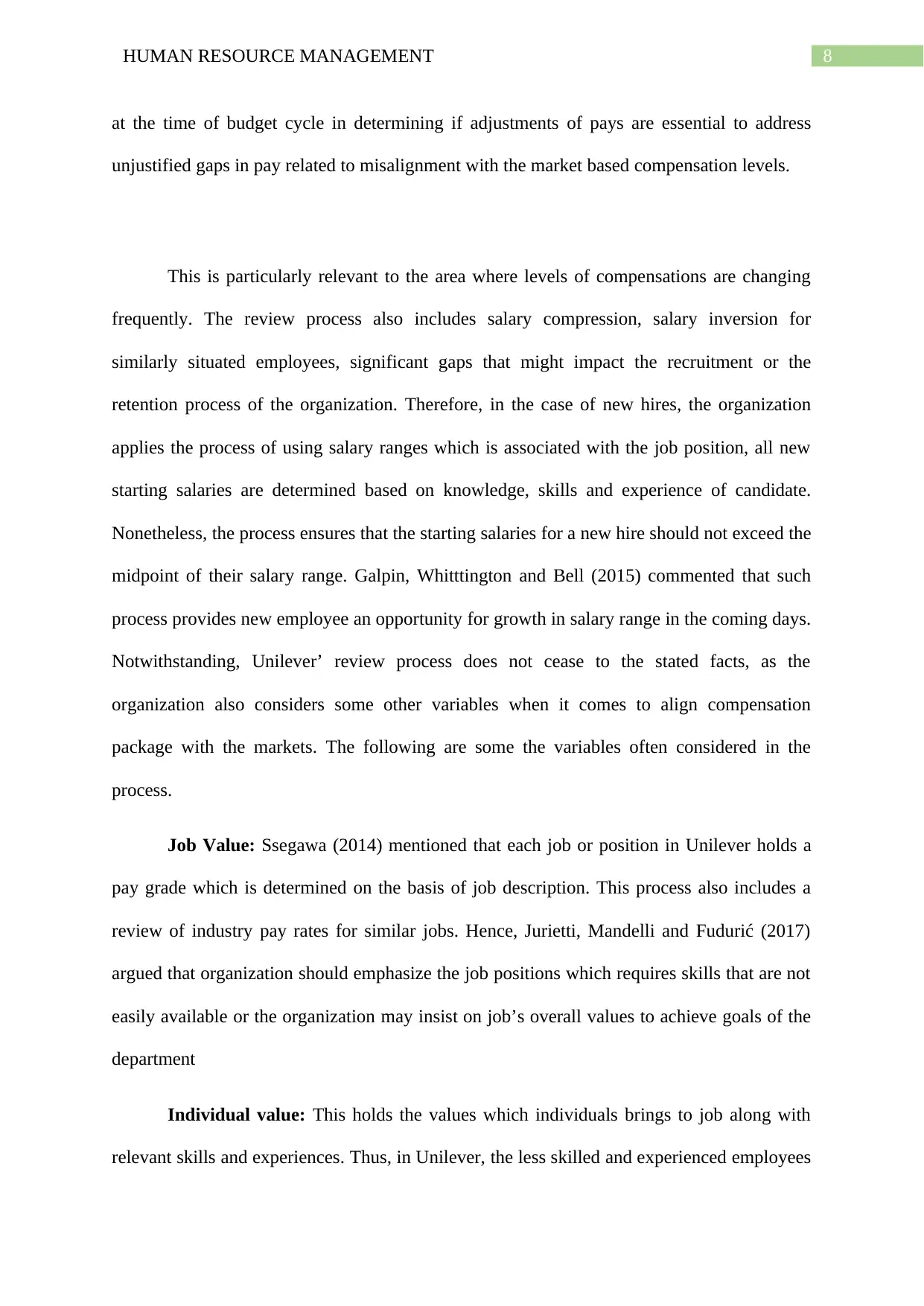
8HUMAN RESOURCE MANAGEMENT
at the time of budget cycle in determining if adjustments of pays are essential to address
unjustified gaps in pay related to misalignment with the market based compensation levels.
This is particularly relevant to the area where levels of compensations are changing
frequently. The review process also includes salary compression, salary inversion for
similarly situated employees, significant gaps that might impact the recruitment or the
retention process of the organization. Therefore, in the case of new hires, the organization
applies the process of using salary ranges which is associated with the job position, all new
starting salaries are determined based on knowledge, skills and experience of candidate.
Nonetheless, the process ensures that the starting salaries for a new hire should not exceed the
midpoint of their salary range. Galpin, Whitttington and Bell (2015) commented that such
process provides new employee an opportunity for growth in salary range in the coming days.
Notwithstanding, Unilever’ review process does not cease to the stated facts, as the
organization also considers some other variables when it comes to align compensation
package with the markets. The following are some the variables often considered in the
process.
Job Value: Ssegawa (2014) mentioned that each job or position in Unilever holds a
pay grade which is determined on the basis of job description. This process also includes a
review of industry pay rates for similar jobs. Hence, Jurietti, Mandelli and Fudurić (2017)
argued that organization should emphasize the job positions which requires skills that are not
easily available or the organization may insist on job’s overall values to achieve goals of the
department
Individual value: This holds the values which individuals brings to job along with
relevant skills and experiences. Thus, in Unilever, the less skilled and experienced employees
at the time of budget cycle in determining if adjustments of pays are essential to address
unjustified gaps in pay related to misalignment with the market based compensation levels.
This is particularly relevant to the area where levels of compensations are changing
frequently. The review process also includes salary compression, salary inversion for
similarly situated employees, significant gaps that might impact the recruitment or the
retention process of the organization. Therefore, in the case of new hires, the organization
applies the process of using salary ranges which is associated with the job position, all new
starting salaries are determined based on knowledge, skills and experience of candidate.
Nonetheless, the process ensures that the starting salaries for a new hire should not exceed the
midpoint of their salary range. Galpin, Whitttington and Bell (2015) commented that such
process provides new employee an opportunity for growth in salary range in the coming days.
Notwithstanding, Unilever’ review process does not cease to the stated facts, as the
organization also considers some other variables when it comes to align compensation
package with the markets. The following are some the variables often considered in the
process.
Job Value: Ssegawa (2014) mentioned that each job or position in Unilever holds a
pay grade which is determined on the basis of job description. This process also includes a
review of industry pay rates for similar jobs. Hence, Jurietti, Mandelli and Fudurić (2017)
argued that organization should emphasize the job positions which requires skills that are not
easily available or the organization may insist on job’s overall values to achieve goals of the
department
Individual value: This holds the values which individuals brings to job along with
relevant skills and experiences. Thus, in Unilever, the less skilled and experienced employees
⊘ This is a preview!⊘
Do you want full access?
Subscribe today to unlock all pages.
Trusted by 1+ million students worldwide
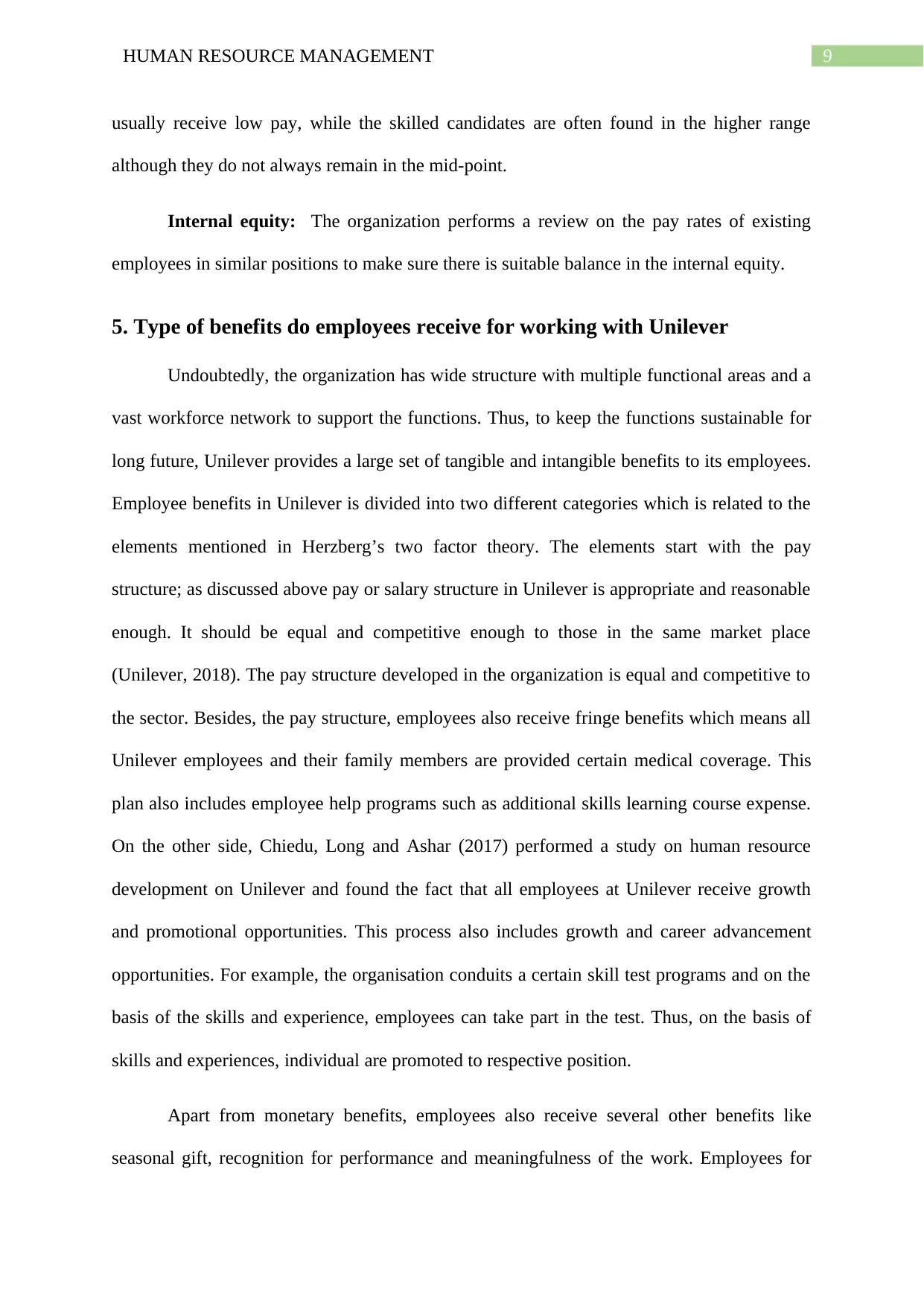
9HUMAN RESOURCE MANAGEMENT
usually receive low pay, while the skilled candidates are often found in the higher range
although they do not always remain in the mid-point.
Internal equity: The organization performs a review on the pay rates of existing
employees in similar positions to make sure there is suitable balance in the internal equity.
5. Type of benefits do employees receive for working with Unilever
Undoubtedly, the organization has wide structure with multiple functional areas and a
vast workforce network to support the functions. Thus, to keep the functions sustainable for
long future, Unilever provides a large set of tangible and intangible benefits to its employees.
Employee benefits in Unilever is divided into two different categories which is related to the
elements mentioned in Herzberg’s two factor theory. The elements start with the pay
structure; as discussed above pay or salary structure in Unilever is appropriate and reasonable
enough. It should be equal and competitive enough to those in the same market place
(Unilever, 2018). The pay structure developed in the organization is equal and competitive to
the sector. Besides, the pay structure, employees also receive fringe benefits which means all
Unilever employees and their family members are provided certain medical coverage. This
plan also includes employee help programs such as additional skills learning course expense.
On the other side, Chiedu, Long and Ashar (2017) performed a study on human resource
development on Unilever and found the fact that all employees at Unilever receive growth
and promotional opportunities. This process also includes growth and career advancement
opportunities. For example, the organisation conduits a certain skill test programs and on the
basis of the skills and experience, employees can take part in the test. Thus, on the basis of
skills and experiences, individual are promoted to respective position.
Apart from monetary benefits, employees also receive several other benefits like
seasonal gift, recognition for performance and meaningfulness of the work. Employees for
usually receive low pay, while the skilled candidates are often found in the higher range
although they do not always remain in the mid-point.
Internal equity: The organization performs a review on the pay rates of existing
employees in similar positions to make sure there is suitable balance in the internal equity.
5. Type of benefits do employees receive for working with Unilever
Undoubtedly, the organization has wide structure with multiple functional areas and a
vast workforce network to support the functions. Thus, to keep the functions sustainable for
long future, Unilever provides a large set of tangible and intangible benefits to its employees.
Employee benefits in Unilever is divided into two different categories which is related to the
elements mentioned in Herzberg’s two factor theory. The elements start with the pay
structure; as discussed above pay or salary structure in Unilever is appropriate and reasonable
enough. It should be equal and competitive enough to those in the same market place
(Unilever, 2018). The pay structure developed in the organization is equal and competitive to
the sector. Besides, the pay structure, employees also receive fringe benefits which means all
Unilever employees and their family members are provided certain medical coverage. This
plan also includes employee help programs such as additional skills learning course expense.
On the other side, Chiedu, Long and Ashar (2017) performed a study on human resource
development on Unilever and found the fact that all employees at Unilever receive growth
and promotional opportunities. This process also includes growth and career advancement
opportunities. For example, the organisation conduits a certain skill test programs and on the
basis of the skills and experience, employees can take part in the test. Thus, on the basis of
skills and experiences, individual are promoted to respective position.
Apart from monetary benefits, employees also receive several other benefits like
seasonal gift, recognition for performance and meaningfulness of the work. Employees for
Paraphrase This Document
Need a fresh take? Get an instant paraphrase of this document with our AI Paraphraser
10HUMAN RESOURCE MANAGEMENT
their outstanding performance are recognized by supervisors and managers while Egwu
(2017) commented that there should be a sense of achievement which depends on the job. At
Unilever, when it comes to seasonal benefits, employees are provided with certain gifts. For
example in the winter season, all employees are given warm clothes, blankets and
arrangement for lunch for employee family members as well. However, in the field of
employee benefit, Yanadori (2014) commented that employee benefits should not cease to
the monetary arrangement. This means the employer should also provide suitable physical
working condition. Hence, suitable working conditions refer to clean, safe and hygienic
environment where employees remain free from occupational hazards, accidents and other
health injuries. Besides this fact, Bornmai (2015) performed a study on the chosen context
and mentioned the fact that employee benefits should also cover intangible variables; this
means the relationship of the employees with his peers, superiors and subordinates should be
appropriate as well as acceptable in all spheres. The element of job conflict or humiliation
should not be there in the benefit package. The author of this the study has also mentioned the
fact that besides specified employee benefits, the organization also needs to provide proper
job security to its employees.
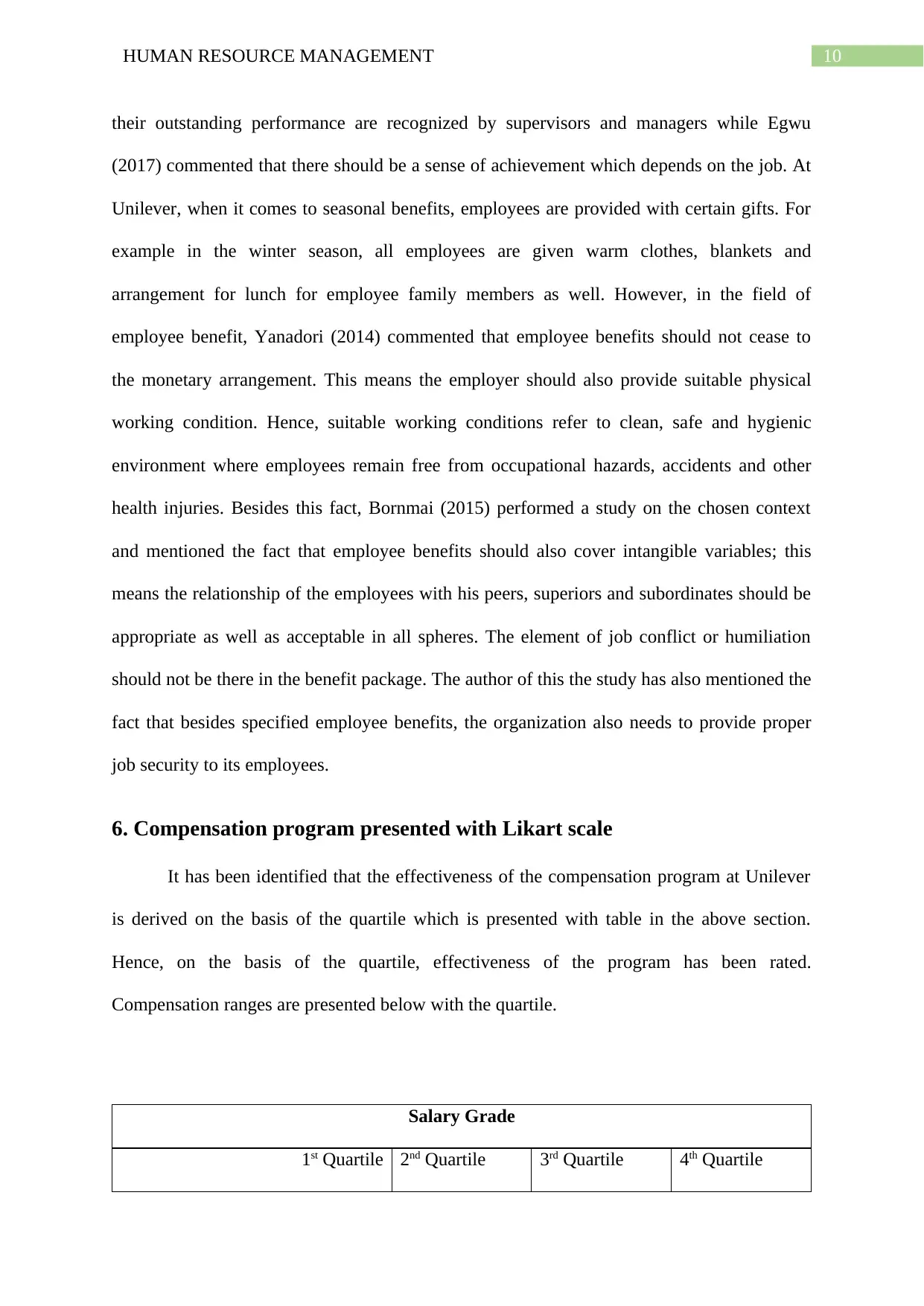
6. Compensation program presented with Likart scale
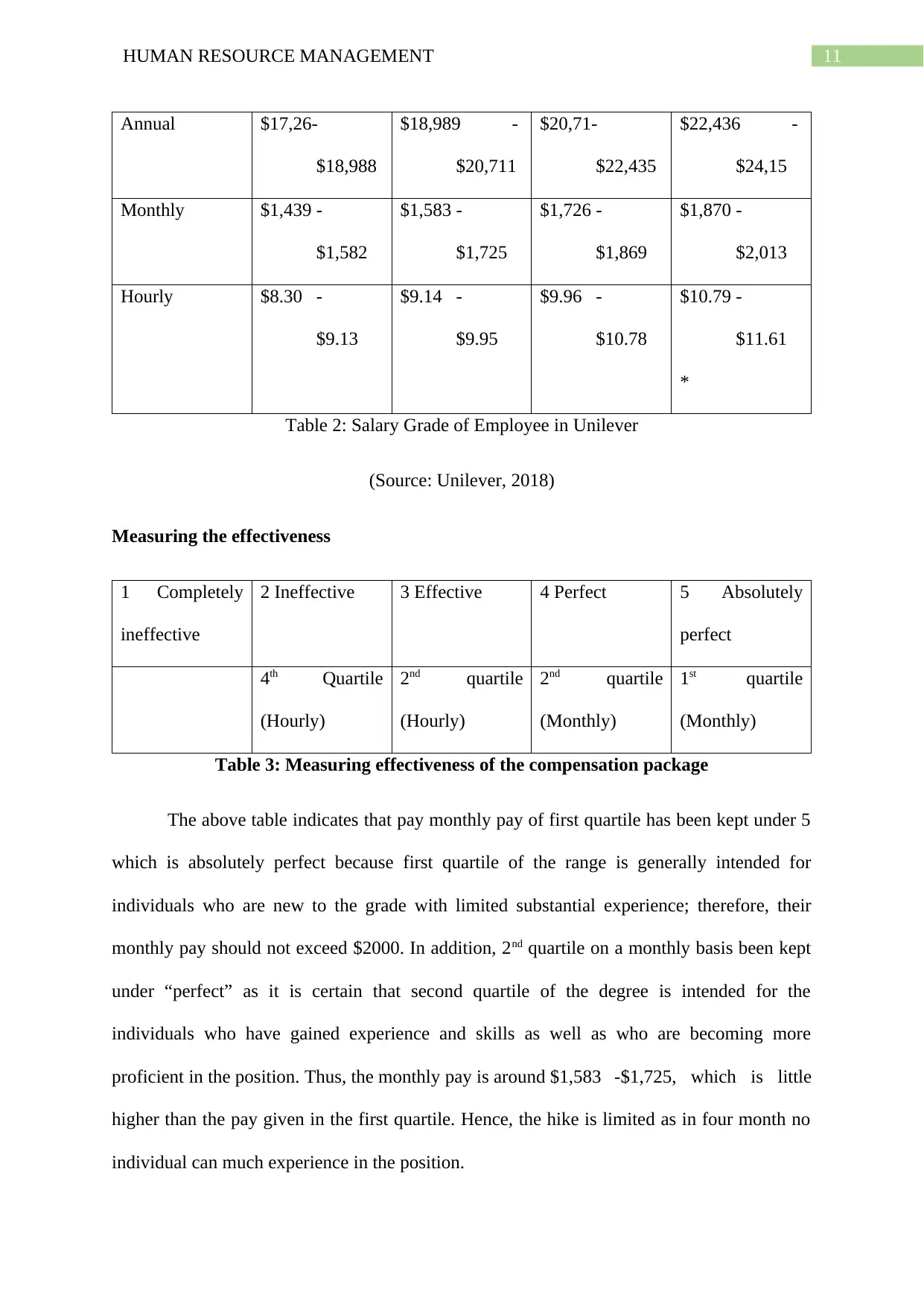
It has been identified that the effectiveness of the compensation program at Unilever
is derived on the basis of the quartile which is presented with table in the above section.
Hence, on the basis of the quartile, effectiveness of the program has been rated.
Compensation ranges are presented below with the quartile.
Salary Grade
1st Quartile 2nd Quartile 3rd Quartile 4th Quartile
their outstanding performance are recognized by supervisors and managers while Egwu
(2017) commented that there should be a sense of achievement which depends on the job. At
Unilever, when it comes to seasonal benefits, employees are provided with certain gifts. For
example in the winter season, all employees are given warm clothes, blankets and
arrangement for lunch for employee family members as well. However, in the field of
employee benefit, Yanadori (2014) commented that employee benefits should not cease to
the monetary arrangement. This means the employer should also provide suitable physical
working condition. Hence, suitable working conditions refer to clean, safe and hygienic
environment where employees remain free from occupational hazards, accidents and other
health injuries. Besides this fact, Bornmai (2015) performed a study on the chosen context
and mentioned the fact that employee benefits should also cover intangible variables; this
means the relationship of the employees with his peers, superiors and subordinates should be
appropriate as well as acceptable in all spheres. The element of job conflict or humiliation
should not be there in the benefit package. The author of this the study has also mentioned the
fact that besides specified employee benefits, the organization also needs to provide proper
job security to its employees.
6. Compensation program presented with Likart scale
It has been identified that the effectiveness of the compensation program at Unilever
is derived on the basis of the quartile which is presented with table in the above section.
Hence, on the basis of the quartile, effectiveness of the program has been rated.
Compensation ranges are presented below with the quartile.
Salary Grade
1st Quartile 2nd Quartile 3rd Quartile 4th Quartile
11HUMAN RESOURCE MANAGEMENT
Annual $17,26-
$18,988
$18,989 -
$20,711
$20,71-
$22,435
$22,436 -
$24,15
Monthly $1,439 -
$1,582
$1,583 -
$1,725
$1,726 -
$1,869
$1,870 -
$2,013
Hourly $8.30 -
$9.13
$9.14 -
$9.95
$9.96 -
$10.78
$10.79 -
$11.61
*
Table 2: Salary Grade of Employee in Unilever
(Source: Unilever, 2018)
Measuring the effectiveness
1 Completely
ineffective
2 Ineffective 3 Effective 4 Perfect 5 Absolutely
perfect
4th Quartile
(Hourly)
2nd quartile
(Hourly)
2nd quartile
(Monthly)
1st quartile
(Monthly)
Table 3: Measuring effectiveness of the compensation package
The above table indicates that pay monthly pay of first quartile has been kept under 5
which is absolutely perfect because first quartile of the range is generally intended for
individuals who are new to the grade with limited substantial experience; therefore, their
monthly pay should not exceed $2000. In addition, 2nd quartile on a monthly basis been kept
under “perfect” as it is certain that second quartile of the degree is intended for the
individuals who have gained experience and skills as well as who are becoming more
proficient in the position. Thus, the monthly pay is around $1,583 -$1,725, which is little
higher than the pay given in the first quartile. Hence, the hike is limited as in four month no
individual can much experience in the position.
Annual $17,26-
$18,988
$18,989 -
$20,711
$20,71-
$22,435
$22,436 -
$24,15
Monthly $1,439 -
$1,582
$1,583 -
$1,725
$1,726 -
$1,869
$1,870 -
$2,013
Hourly $8.30 -
$9.13
$9.14 -
$9.95
$9.96 -
$10.78
$10.79 -
$11.61
*
Table 2: Salary Grade of Employee in Unilever
(Source: Unilever, 2018)
Measuring the effectiveness
1 Completely
ineffective
2 Ineffective 3 Effective 4 Perfect 5 Absolutely
perfect
4th Quartile
(Hourly)
2nd quartile
(Hourly)
2nd quartile
(Monthly)
1st quartile
(Monthly)
Table 3: Measuring effectiveness of the compensation package
The above table indicates that pay monthly pay of first quartile has been kept under 5
which is absolutely perfect because first quartile of the range is generally intended for
individuals who are new to the grade with limited substantial experience; therefore, their
monthly pay should not exceed $2000. In addition, 2nd quartile on a monthly basis been kept
under “perfect” as it is certain that second quartile of the degree is intended for the
individuals who have gained experience and skills as well as who are becoming more
proficient in the position. Thus, the monthly pay is around $1,583 -$1,725, which is little
higher than the pay given in the first quartile. Hence, the hike is limited as in four month no
individual can much experience in the position.
⊘ This is a preview!⊘
Do you want full access?
Subscribe today to unlock all pages.
Trusted by 1+ million students worldwide

1 out of 18


Related Documents


Your All-in-One AI-Powered Toolkit for Academic Success.
+13062052269
info@desklib.com
Available 24*7 on WhatsApp / Email
![[object Object]](/_next/static/media/star-bottom.7253800d.svg)
Unlock your academic potential
Copyright © 2020–2026 A2Z Services. All Rights Reserved. Developed and managed by ZUCOL.