HRM Strategies, Culture, and Job Design in Unilever: An Analysis
VerifiedAdded on 2023/06/13
|11
|3562
|53
Report
AI Summary
This report provides an in-depth analysis of Human Resources Management (HRM) practices at Unilever, focusing on strategic HRM models, the impact of national and corporate culture on staff management, organizational levers for sustainable competitive advantage, and job design strategies. It discusses the Harvard, Fombrum, Guest, and Warwick models, highlighting their relevance to Unilever's HRM practices. The report also examines the differences between HRM and personnel management, emphasizing strategic functions and employee valuation. Furthermore, it evaluates how national and corporate cultures influence managerial decision-making and HR practices, addressing challenges related to communication, legal policies, and employee training. The analysis extends to organizational levers, such as personnel quantity and quality, which contribute to Unilever's competitive edge. The report concludes with recommendations for HRM practices to maintain organizational performance, emphasizing talent retention, employee security, and continuous development, making it a valuable resource for understanding HRM in a global context. Desklib provides access to this and many other solved assignments for students.
Human resources
management
management

Paraphrase This Document
Need a fresh take? Get an instant paraphrase of this document with our AI Paraphraser
Table of Contents
INTRODUCTION...........................................................................................................................1
MAIN BODY...................................................................................................................................1
A) Discussing strategic HRM models and concepts along with difference between HRM and
personnel management and HR strategies..................................................................................1
B) Analysing the impact of national and corporate culture on staff management......................3
C) Evaluating organisational levers available in managing HR that contributes in sustainable
competitive advantage.................................................................................................................4
D) Analysing job design strategies ............................................................................................5
E) Illustrating good HR practices by using Corporate example.................................................6
F) Recommendations on HRM practices for maintaining organisational performance..............7
CONCLUSION................................................................................................................................7
References:.......................................................................................................................................9
INTRODUCTION...........................................................................................................................1
MAIN BODY...................................................................................................................................1
A) Discussing strategic HRM models and concepts along with difference between HRM and
personnel management and HR strategies..................................................................................1
B) Analysing the impact of national and corporate culture on staff management......................3
C) Evaluating organisational levers available in managing HR that contributes in sustainable
competitive advantage.................................................................................................................4
D) Analysing job design strategies ............................................................................................5
E) Illustrating good HR practices by using Corporate example.................................................6
F) Recommendations on HRM practices for maintaining organisational performance..............7
CONCLUSION................................................................................................................................7
References:.......................................................................................................................................9
INTRODUCTION
The human resources management defines to practices which an organisation use for
managing and controlling of the working and performance in order to attain high success. This is
an strategic approach which helps in managing of different business functions and operations
with its perfection and effectiveness. The HRM, is an integral part of management that performs
different actions of planning, organising, directing, controlling and implementing different
actions in order to achieve desirable results on timely basis (Aquino and et.al., 2022) . This
report is based on Unilever which is established in 1929 headquarter in London, UK dealing in
the products of health items, beauty goods and personal care. the report will cover the HRM
models and concepts long with di8fferenbec between HR and personnel management. This
report will also involve the impact of national and corporate culture of staff. Further, it will
discuss the evaluation of levers in management of HR contributing in competitive edge along
with Job design strategies. The good HR practices is demonstrated by using corporate example
of transitional and local management. It last commendation is provided for increasing managerial
performance.
MAIN BODY
A) Discussing strategic HRM models and concepts along with difference between HRM and
personnel management and HR strategies.
The human resources management framework deals with the skills, knowledge and
aspects of HR in organisation. The management attain goals by making functions effective and
control behavioural actions in business along with enhances employee performance. The several
models in context to Unilever helps in studying human resource management and establishes
relationships. Following are the models-
The Harvard model- This model is comprehensive which involves the six crucial
components of HRM which involves stakeholders, interest, situational factor, HRM
policy choices, HR outcomes, and feedback. There is direct outflow of outcomes in
organisation and stakeholders. In context to Unilever this framework helps in making
strategic decision in framework to stakeholders and situational components like labours
marketplace, technology, social values and rules (Balogun, 2021).
1
The human resources management defines to practices which an organisation use for
managing and controlling of the working and performance in order to attain high success. This is
an strategic approach which helps in managing of different business functions and operations
with its perfection and effectiveness. The HRM, is an integral part of management that performs
different actions of planning, organising, directing, controlling and implementing different
actions in order to achieve desirable results on timely basis (Aquino and et.al., 2022) . This
report is based on Unilever which is established in 1929 headquarter in London, UK dealing in
the products of health items, beauty goods and personal care. the report will cover the HRM
models and concepts long with di8fferenbec between HR and personnel management. This
report will also involve the impact of national and corporate culture of staff. Further, it will
discuss the evaluation of levers in management of HR contributing in competitive edge along
with Job design strategies. The good HR practices is demonstrated by using corporate example
of transitional and local management. It last commendation is provided for increasing managerial
performance.
MAIN BODY
A) Discussing strategic HRM models and concepts along with difference between HRM and
personnel management and HR strategies.
The human resources management framework deals with the skills, knowledge and
aspects of HR in organisation. The management attain goals by making functions effective and
control behavioural actions in business along with enhances employee performance. The several
models in context to Unilever helps in studying human resource management and establishes
relationships. Following are the models-
The Harvard model- This model is comprehensive which involves the six crucial
components of HRM which involves stakeholders, interest, situational factor, HRM
policy choices, HR outcomes, and feedback. There is direct outflow of outcomes in
organisation and stakeholders. In context to Unilever this framework helps in making
strategic decision in framework to stakeholders and situational components like labours
marketplace, technology, social values and rules (Balogun, 2021).
1
⊘ This is a preview!⊘
Do you want full access?
Subscribe today to unlock all pages.

Trusted by 1+ million students worldwide
The Fombrum model- This model emphasizes on four functions and their
interrelatedness which involves selection, appraisal, development and reward. It states
that HR system and organisational structure needs to be managed in such way that is
appropriate with organisational strategy. The use of this framework in Unilever helps in
performing better functions of HR and focuses on actions.
The Guest model- In 1997 this model was developed that claims manager of HR have
specific strategies to start with, which demand certain practices when executed resulting
in outcomes. The outcomes involves behavioural, performance and financial related. It
puts the emphasises on six factors HR strategy, HR practices, HR outcomes, behavioural
outcomes, performance results, and financial consequences. The manager of Unilever
concentrates on such actions for increasing presentation of workers which offers
financial advantage to staff members and management (Cloutier, . and Robert‐Huot,
2021).
The Warwick model- It was developed by two researchers, Hendry and pettigrew which
involves five elements such as outer context, inner context, business strategy content
HRM context and HRM content. The use of this model in Unilever will help managers
identifying and classifying important environmental influences on HRM and maps
connection between external and environmental factors.
Difference between HRM and personnel management
Basis Human resource management Personnel management
Meaning It refers to branch of management
which have focus on effectively using
manpower of organisation in order to
attain organisational goals.
This refers to the aspect of
management which is associated with
the workforces and their relationship
with business organisation is called as
personnel management (Fan, and et.al.,
2021).
Approach There is use of modern approach It take use of traditional approaches
Type of
function
The strategic functions are performed In this routine functions are performed.
Communicat There is follow-up of direct The indirect communication take place.
2
interrelatedness which involves selection, appraisal, development and reward. It states
that HR system and organisational structure needs to be managed in such way that is
appropriate with organisational strategy. The use of this framework in Unilever helps in
performing better functions of HR and focuses on actions.
The Guest model- In 1997 this model was developed that claims manager of HR have
specific strategies to start with, which demand certain practices when executed resulting
in outcomes. The outcomes involves behavioural, performance and financial related. It
puts the emphasises on six factors HR strategy, HR practices, HR outcomes, behavioural
outcomes, performance results, and financial consequences. The manager of Unilever
concentrates on such actions for increasing presentation of workers which offers
financial advantage to staff members and management (Cloutier, . and Robert‐Huot,
2021).
The Warwick model- It was developed by two researchers, Hendry and pettigrew which
involves five elements such as outer context, inner context, business strategy content
HRM context and HRM content. The use of this model in Unilever will help managers
identifying and classifying important environmental influences on HRM and maps
connection between external and environmental factors.
Difference between HRM and personnel management
Basis Human resource management Personnel management
Meaning It refers to branch of management
which have focus on effectively using
manpower of organisation in order to
attain organisational goals.
This refers to the aspect of
management which is associated with
the workforces and their relationship
with business organisation is called as
personnel management (Fan, and et.al.,
2021).
Approach There is use of modern approach It take use of traditional approaches
Type of
function
The strategic functions are performed In this routine functions are performed.
Communicat There is follow-up of direct The indirect communication take place.
2
Paraphrase This Document
Need a fresh take? Get an instant paraphrase of this document with our AI Paraphraser
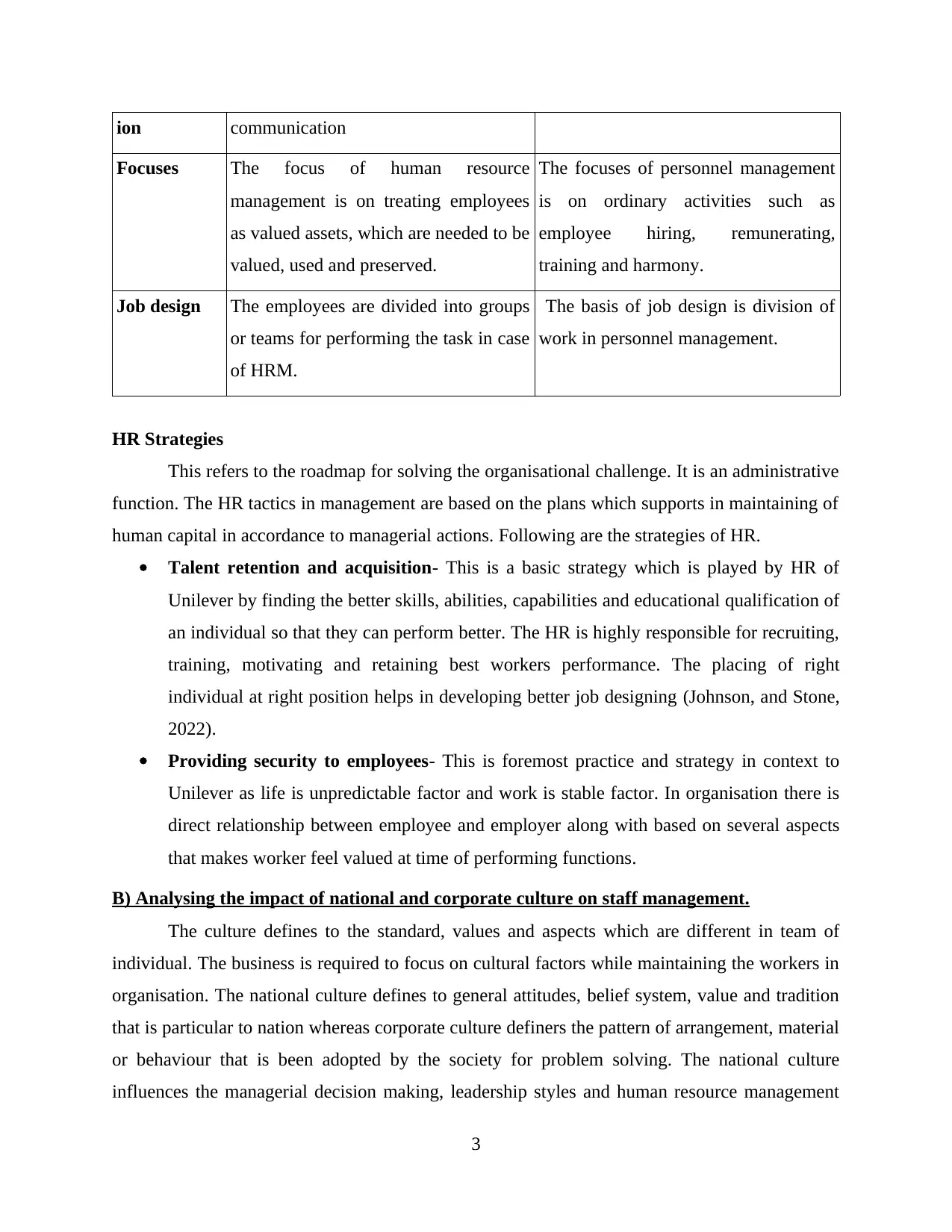
ion communication
Focuses The focus of human resource
management is on treating employees
as valued assets, which are needed to be
valued, used and preserved.
The focuses of personnel management
is on ordinary activities such as
employee hiring, remunerating,
training and harmony.
Job design The employees are divided into groups
or teams for performing the task in case
of HRM.
The basis of job design is division of
work in personnel management.
HR Strategies
This refers to the roadmap for solving the organisational challenge. It is an administrative
function. The HR tactics in management are based on the plans which supports in maintaining of
human capital in accordance to managerial actions. Following are the strategies of HR.
Talent retention and acquisition- This is a basic strategy which is played by HR of
Unilever by finding the better skills, abilities, capabilities and educational qualification of
an individual so that they can perform better. The HR is highly responsible for recruiting,
training, motivating and retaining best workers performance. The placing of right
individual at right position helps in developing better job designing (Johnson, and Stone,
2022).
Providing security to employees- This is foremost practice and strategy in context to
Unilever as life is unpredictable factor and work is stable factor. In organisation there is
direct relationship between employee and employer along with based on several aspects
that makes worker feel valued at time of performing functions.
B) Analysing the impact of national and corporate culture on staff management.
The culture defines to the standard, values and aspects which are different in team of
individual. The business is required to focus on cultural factors while maintaining the workers in
organisation. The national culture defines to general attitudes, belief system, value and tradition
that is particular to nation whereas corporate culture definers the pattern of arrangement, material
or behaviour that is been adopted by the society for problem solving. The national culture
influences the managerial decision making, leadership styles and human resource management
3
Focuses The focus of human resource
management is on treating employees
as valued assets, which are needed to be
valued, used and preserved.
The focuses of personnel management
is on ordinary activities such as
employee hiring, remunerating,
training and harmony.
Job design The employees are divided into groups
or teams for performing the task in case
of HRM.
The basis of job design is division of
work in personnel management.
HR Strategies
This refers to the roadmap for solving the organisational challenge. It is an administrative
function. The HR tactics in management are based on the plans which supports in maintaining of
human capital in accordance to managerial actions. Following are the strategies of HR.
Talent retention and acquisition- This is a basic strategy which is played by HR of
Unilever by finding the better skills, abilities, capabilities and educational qualification of
an individual so that they can perform better. The HR is highly responsible for recruiting,
training, motivating and retaining best workers performance. The placing of right
individual at right position helps in developing better job designing (Johnson, and Stone,
2022).
Providing security to employees- This is foremost practice and strategy in context to
Unilever as life is unpredictable factor and work is stable factor. In organisation there is
direct relationship between employee and employer along with based on several aspects
that makes worker feel valued at time of performing functions.
B) Analysing the impact of national and corporate culture on staff management.
The culture defines to the standard, values and aspects which are different in team of
individual. The business is required to focus on cultural factors while maintaining the workers in
organisation. The national culture defines to general attitudes, belief system, value and tradition
that is particular to nation whereas corporate culture definers the pattern of arrangement, material
or behaviour that is been adopted by the society for problem solving. The national culture
influences the managerial decision making, leadership styles and human resource management
3
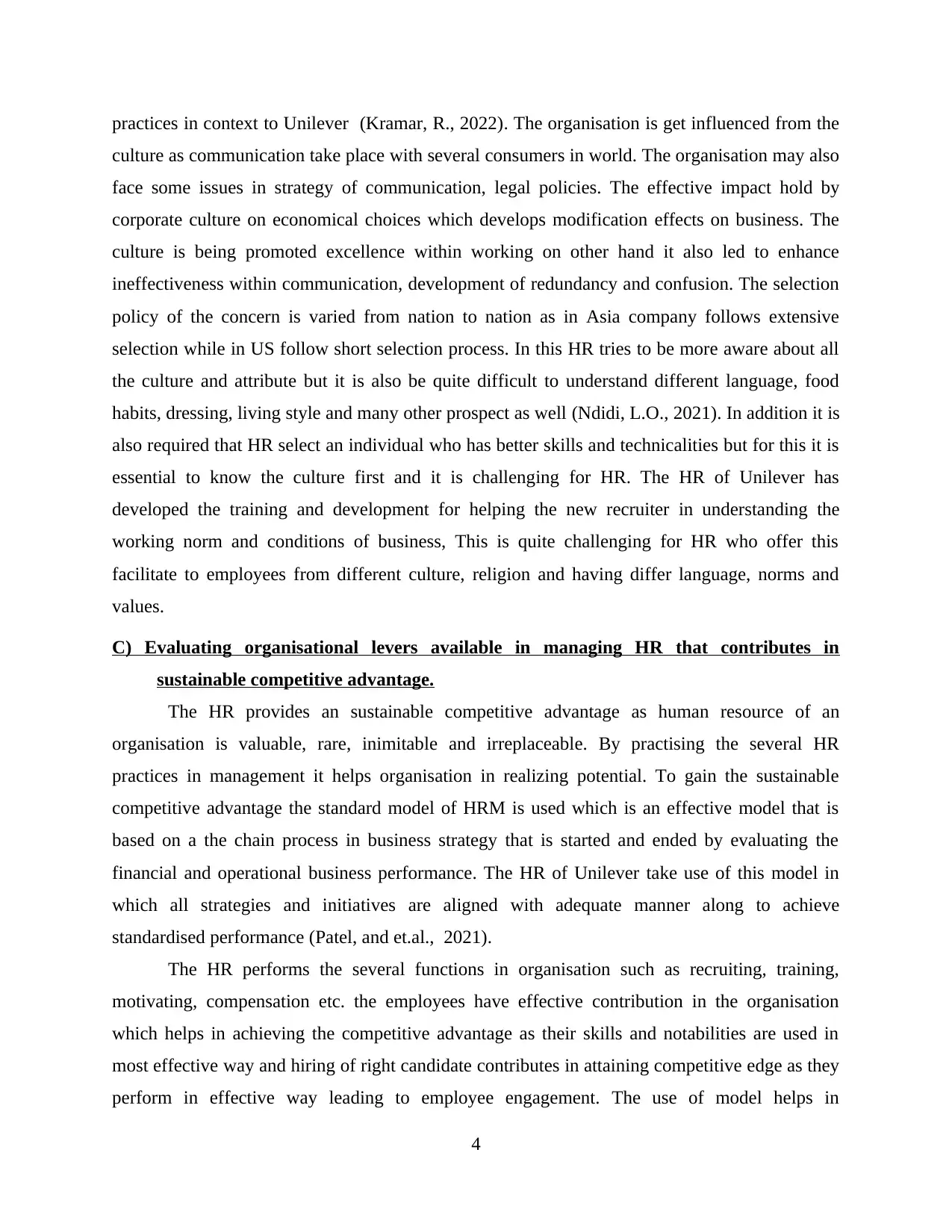
practices in context to Unilever (Kramar, R., 2022). The organisation is get influenced from the
culture as communication take place with several consumers in world. The organisation may also
face some issues in strategy of communication, legal policies. The effective impact hold by
corporate culture on economical choices which develops modification effects on business. The
culture is being promoted excellence within working on other hand it also led to enhance
ineffectiveness within communication, development of redundancy and confusion. The selection
policy of the concern is varied from nation to nation as in Asia company follows extensive
selection while in US follow short selection process. In this HR tries to be more aware about all
the culture and attribute but it is also be quite difficult to understand different language, food
habits, dressing, living style and many other prospect as well (Ndidi, L.O., 2021). In addition it is
also required that HR select an individual who has better skills and technicalities but for this it is
essential to know the culture first and it is challenging for HR. The HR of Unilever has
developed the training and development for helping the new recruiter in understanding the
working norm and conditions of business, This is quite challenging for HR who offer this
facilitate to employees from different culture, religion and having differ language, norms and
values.
C) Evaluating organisational levers available in managing HR that contributes in
sustainable competitive advantage.
The HR provides an sustainable competitive advantage as human resource of an
organisation is valuable, rare, inimitable and irreplaceable. By practising the several HR
practices in management it helps organisation in realizing potential. To gain the sustainable
competitive advantage the standard model of HRM is used which is an effective model that is
based on a the chain process in business strategy that is started and ended by evaluating the
financial and operational business performance. The HR of Unilever take use of this model in
which all strategies and initiatives are aligned with adequate manner along to achieve
standardised performance (Patel, and et.al., 2021).
The HR performs the several functions in organisation such as recruiting, training,
motivating, compensation etc. the employees have effective contribution in the organisation
which helps in achieving the competitive advantage as their skills and notabilities are used in
most effective way and hiring of right candidate contributes in attaining competitive edge as they
perform in effective way leading to employee engagement. The use of model helps in
4
culture as communication take place with several consumers in world. The organisation may also
face some issues in strategy of communication, legal policies. The effective impact hold by
corporate culture on economical choices which develops modification effects on business. The
culture is being promoted excellence within working on other hand it also led to enhance
ineffectiveness within communication, development of redundancy and confusion. The selection
policy of the concern is varied from nation to nation as in Asia company follows extensive
selection while in US follow short selection process. In this HR tries to be more aware about all
the culture and attribute but it is also be quite difficult to understand different language, food
habits, dressing, living style and many other prospect as well (Ndidi, L.O., 2021). In addition it is
also required that HR select an individual who has better skills and technicalities but for this it is
essential to know the culture first and it is challenging for HR. The HR of Unilever has
developed the training and development for helping the new recruiter in understanding the
working norm and conditions of business, This is quite challenging for HR who offer this
facilitate to employees from different culture, religion and having differ language, norms and
values.
C) Evaluating organisational levers available in managing HR that contributes in
sustainable competitive advantage.
The HR provides an sustainable competitive advantage as human resource of an
organisation is valuable, rare, inimitable and irreplaceable. By practising the several HR
practices in management it helps organisation in realizing potential. To gain the sustainable
competitive advantage the standard model of HRM is used which is an effective model that is
based on a the chain process in business strategy that is started and ended by evaluating the
financial and operational business performance. The HR of Unilever take use of this model in
which all strategies and initiatives are aligned with adequate manner along to achieve
standardised performance (Patel, and et.al., 2021).
The HR performs the several functions in organisation such as recruiting, training,
motivating, compensation etc. the employees have effective contribution in the organisation
which helps in achieving the competitive advantage as their skills and notabilities are used in
most effective way and hiring of right candidate contributes in attaining competitive edge as they
perform in effective way leading to employee engagement. The use of model helps in
4
⊘ This is a preview!⊘
Do you want full access?
Subscribe today to unlock all pages.
Trusted by 1+ million students worldwide
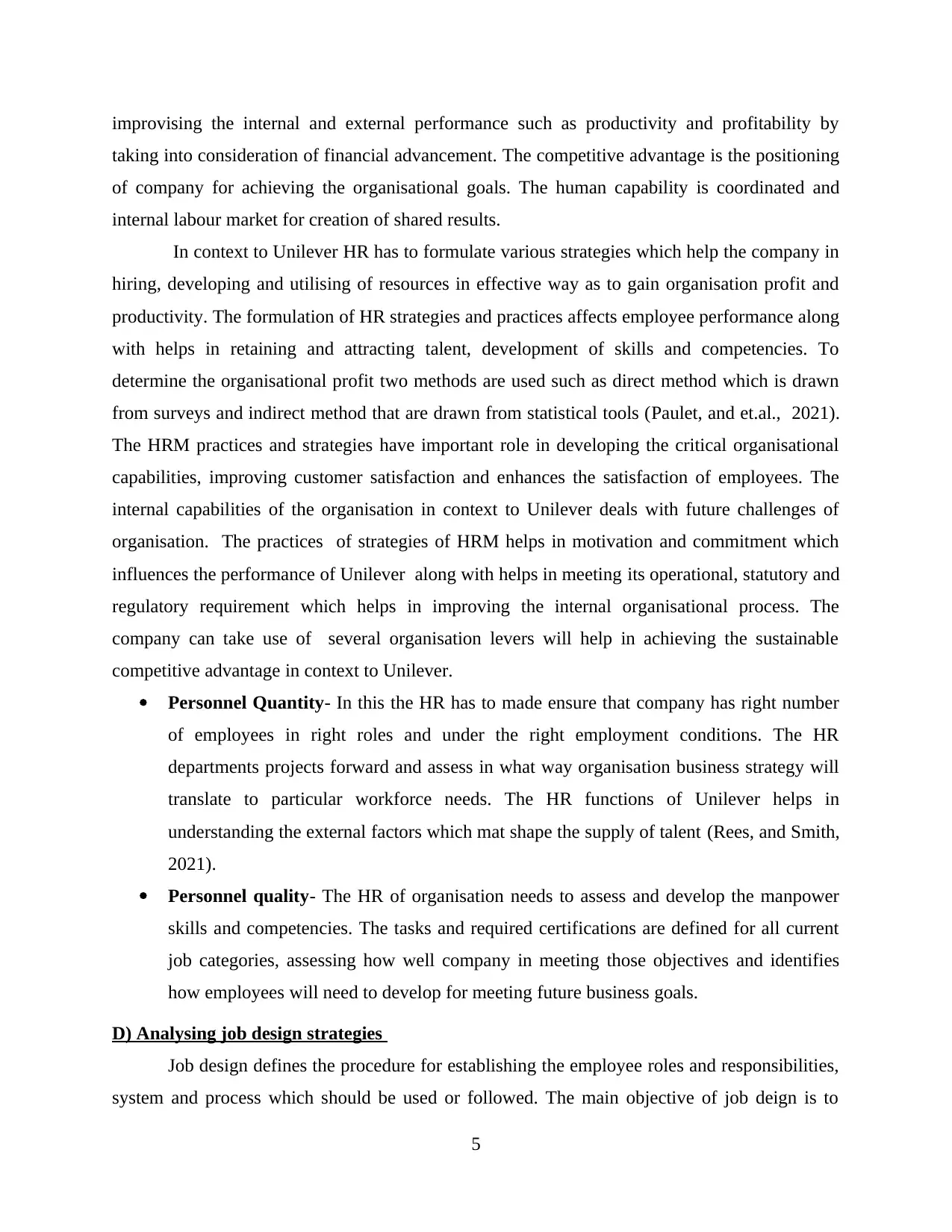
improvising the internal and external performance such as productivity and profitability by
taking into consideration of financial advancement. The competitive advantage is the positioning
of company for achieving the organisational goals. The human capability is coordinated and
internal labour market for creation of shared results.
In context to Unilever HR has to formulate various strategies which help the company in
hiring, developing and utilising of resources in effective way as to gain organisation profit and
productivity. The formulation of HR strategies and practices affects employee performance along
with helps in retaining and attracting talent, development of skills and competencies. To
determine the organisational profit two methods are used such as direct method which is drawn
from surveys and indirect method that are drawn from statistical tools (Paulet, and et.al., 2021).
The HRM practices and strategies have important role in developing the critical organisational
capabilities, improving customer satisfaction and enhances the satisfaction of employees. The
internal capabilities of the organisation in context to Unilever deals with future challenges of
organisation. The practices of strategies of HRM helps in motivation and commitment which
influences the performance of Unilever along with helps in meeting its operational, statutory and
regulatory requirement which helps in improving the internal organisational process. The
company can take use of several organisation levers will help in achieving the sustainable
competitive advantage in context to Unilever.
Personnel Quantity- In this the HR has to made ensure that company has right number
of employees in right roles and under the right employment conditions. The HR
departments projects forward and assess in what way organisation business strategy will
translate to particular workforce needs. The HR functions of Unilever helps in
understanding the external factors which mat shape the supply of talent (Rees, and Smith,
2021).
Personnel quality- The HR of organisation needs to assess and develop the manpower
skills and competencies. The tasks and required certifications are defined for all current
job categories, assessing how well company in meeting those objectives and identifies
how employees will need to develop for meeting future business goals.
D) Analysing job design strategies
Job design defines the procedure for establishing the employee roles and responsibilities,
system and process which should be used or followed. The main objective of job deign is to
5
taking into consideration of financial advancement. The competitive advantage is the positioning
of company for achieving the organisational goals. The human capability is coordinated and
internal labour market for creation of shared results.
In context to Unilever HR has to formulate various strategies which help the company in
hiring, developing and utilising of resources in effective way as to gain organisation profit and
productivity. The formulation of HR strategies and practices affects employee performance along
with helps in retaining and attracting talent, development of skills and competencies. To
determine the organisational profit two methods are used such as direct method which is drawn
from surveys and indirect method that are drawn from statistical tools (Paulet, and et.al., 2021).
The HRM practices and strategies have important role in developing the critical organisational
capabilities, improving customer satisfaction and enhances the satisfaction of employees. The
internal capabilities of the organisation in context to Unilever deals with future challenges of
organisation. The practices of strategies of HRM helps in motivation and commitment which
influences the performance of Unilever along with helps in meeting its operational, statutory and
regulatory requirement which helps in improving the internal organisational process. The
company can take use of several organisation levers will help in achieving the sustainable
competitive advantage in context to Unilever.
Personnel Quantity- In this the HR has to made ensure that company has right number
of employees in right roles and under the right employment conditions. The HR
departments projects forward and assess in what way organisation business strategy will
translate to particular workforce needs. The HR functions of Unilever helps in
understanding the external factors which mat shape the supply of talent (Rees, and Smith,
2021).
Personnel quality- The HR of organisation needs to assess and develop the manpower
skills and competencies. The tasks and required certifications are defined for all current
job categories, assessing how well company in meeting those objectives and identifies
how employees will need to develop for meeting future business goals.
D) Analysing job design strategies
Job design defines the procedure for establishing the employee roles and responsibilities,
system and process which should be used or followed. The main objective of job deign is to
5
Paraphrase This Document
Need a fresh take? Get an instant paraphrase of this document with our AI Paraphraser
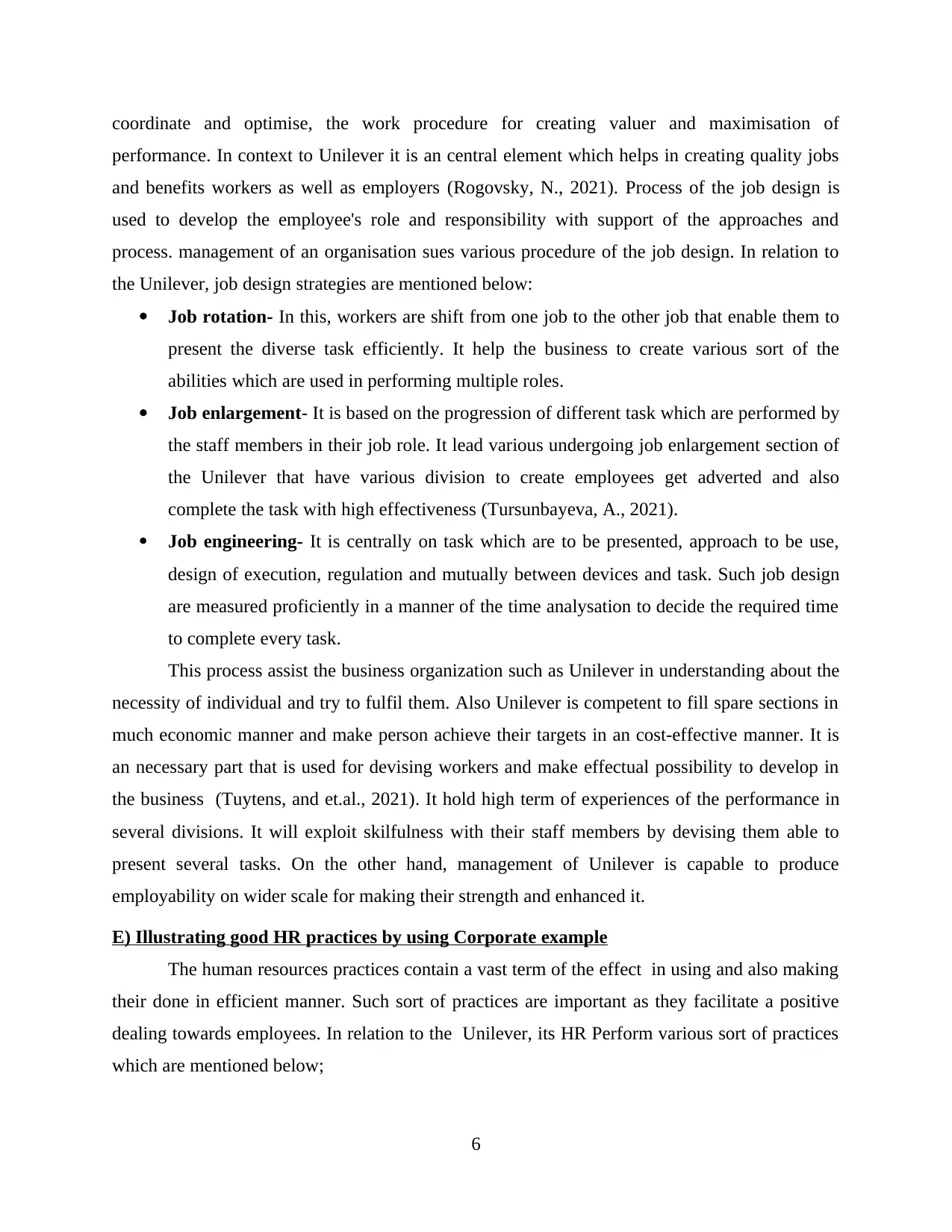
coordinate and optimise, the work procedure for creating valuer and maximisation of
performance. In context to Unilever it is an central element which helps in creating quality jobs
and benefits workers as well as employers (Rogovsky, N., 2021). Process of the job design is
used to develop the employee's role and responsibility with support of the approaches and
process. management of an organisation sues various procedure of the job design. In relation to
the Unilever, job design strategies are mentioned below:
Job rotation- In this, workers are shift from one job to the other job that enable them to
present the diverse task efficiently. It help the business to create various sort of the
abilities which are used in performing multiple roles.
Job enlargement- It is based on the progression of different task which are performed by
the staff members in their job role. It lead various undergoing job enlargement section of
the Unilever that have various division to create employees get adverted and also
complete the task with high effectiveness (Tursunbayeva, A., 2021).
Job engineering- It is centrally on task which are to be presented, approach to be use,
design of execution, regulation and mutually between devices and task. Such job design
are measured proficiently in a manner of the time analysation to decide the required time
to complete every task.
This process assist the business organization such as Unilever in understanding about the
necessity of individual and try to fulfil them. Also Unilever is competent to fill spare sections in
much economic manner and make person achieve their targets in an cost-effective manner. It is
an necessary part that is used for devising workers and make effectual possibility to develop in
the business (Tuytens, and et.al., 2021). It hold high term of experiences of the performance in
several divisions. It will exploit skilfulness with their staff members by devising them able to
present several tasks. On the other hand, management of Unilever is capable to produce
employability on wider scale for making their strength and enhanced it.
E) Illustrating good HR practices by using Corporate example
The human resources practices contain a vast term of the effect in using and also making
their done in efficient manner. Such sort of practices are important as they facilitate a positive
dealing towards employees. In relation to the Unilever, its HR Perform various sort of practices
which are mentioned below;
6
performance. In context to Unilever it is an central element which helps in creating quality jobs
and benefits workers as well as employers (Rogovsky, N., 2021). Process of the job design is
used to develop the employee's role and responsibility with support of the approaches and
process. management of an organisation sues various procedure of the job design. In relation to
the Unilever, job design strategies are mentioned below:
Job rotation- In this, workers are shift from one job to the other job that enable them to
present the diverse task efficiently. It help the business to create various sort of the
abilities which are used in performing multiple roles.
Job enlargement- It is based on the progression of different task which are performed by
the staff members in their job role. It lead various undergoing job enlargement section of
the Unilever that have various division to create employees get adverted and also
complete the task with high effectiveness (Tursunbayeva, A., 2021).
Job engineering- It is centrally on task which are to be presented, approach to be use,
design of execution, regulation and mutually between devices and task. Such job design
are measured proficiently in a manner of the time analysation to decide the required time
to complete every task.
This process assist the business organization such as Unilever in understanding about the
necessity of individual and try to fulfil them. Also Unilever is competent to fill spare sections in
much economic manner and make person achieve their targets in an cost-effective manner. It is
an necessary part that is used for devising workers and make effectual possibility to develop in
the business (Tuytens, and et.al., 2021). It hold high term of experiences of the performance in
several divisions. It will exploit skilfulness with their staff members by devising them able to
present several tasks. On the other hand, management of Unilever is capable to produce
employability on wider scale for making their strength and enhanced it.
E) Illustrating good HR practices by using Corporate example
The human resources practices contain a vast term of the effect in using and also making
their done in efficient manner. Such sort of practices are important as they facilitate a positive
dealing towards employees. In relation to the Unilever, its HR Perform various sort of practices
which are mentioned below;
6
Training in relevant skills- this practices is used for the training and budget for their
employees. It create suitable and effective strategies which are implement in the Unilever's
management in order to make their employees more efficient and effective. It also include
employee with suitable abilities that create effective job orientation in efficient and effective
way.
Create egalitarian and flat organisation- HR perform some effective strategies which
are used by business to perform efficiently. It will be based on the setting communication in
more efficient term in order to reaches on final summary. It is beneficial for Unilever in such a
manner in which ITS HRM become capable to present various orientation in efficient manner.
Therefore, it is an essential part of the respective company (Verhulst, and DeCenzo, 2021).
Justification
The human resource has manage and control the organisation working with efficiency.
For the company employees are biggest assets that helps in gaining better competitive advantage
systematically. This becomes essential for attracting and retaining employees by encouraging HR
and motivating employees so that business vision and mission can be attained. The employment
and manpower planning is managed as in this recruitment, selection, exist and orientation is
possessed with improved quality. HR must have give suitable rewards to worker and it is wholly
dependent on its performance and fruitfulness. In framework to Unilever several strategies is
developed by HR on basis of requirements and demand of condition for promoting effective
working conditions.
F) Recommendations on HRM practices for maintaining organisational performance.
The recommendation is provide from the HRM operations which is been created in business and
supporting others for increase of sustainability presentation of business. It helps in enhancing the
operations of business in effective manner. The HRM practices represent the development of
policies and better system which have influence on the individual behaviour, performance and
attitude in sustained manner. The recommendation is provided in context to Unilever is that high
performance is manage and controlled by HR leads to consistent and coherent which can be easy
in developing profitable advantage from the competitive market place (Zhang, and et.al., 2022).
There is increase of skill and knowledge in employees by having their better commitment and
motivation within the business for promoting in effective manner. It is also recommended to
increase the employee capital employer develops efficiency within working prospect and
7
employees. It create suitable and effective strategies which are implement in the Unilever's
management in order to make their employees more efficient and effective. It also include
employee with suitable abilities that create effective job orientation in efficient and effective
way.
Create egalitarian and flat organisation- HR perform some effective strategies which
are used by business to perform efficiently. It will be based on the setting communication in
more efficient term in order to reaches on final summary. It is beneficial for Unilever in such a
manner in which ITS HRM become capable to present various orientation in efficient manner.
Therefore, it is an essential part of the respective company (Verhulst, and DeCenzo, 2021).
Justification
The human resource has manage and control the organisation working with efficiency.
For the company employees are biggest assets that helps in gaining better competitive advantage
systematically. This becomes essential for attracting and retaining employees by encouraging HR
and motivating employees so that business vision and mission can be attained. The employment
and manpower planning is managed as in this recruitment, selection, exist and orientation is
possessed with improved quality. HR must have give suitable rewards to worker and it is wholly
dependent on its performance and fruitfulness. In framework to Unilever several strategies is
developed by HR on basis of requirements and demand of condition for promoting effective
working conditions.
F) Recommendations on HRM practices for maintaining organisational performance.
The recommendation is provide from the HRM operations which is been created in business and
supporting others for increase of sustainability presentation of business. It helps in enhancing the
operations of business in effective manner. The HRM practices represent the development of
policies and better system which have influence on the individual behaviour, performance and
attitude in sustained manner. The recommendation is provided in context to Unilever is that high
performance is manage and controlled by HR leads to consistent and coherent which can be easy
in developing profitable advantage from the competitive market place (Zhang, and et.al., 2022).
There is increase of skill and knowledge in employees by having their better commitment and
motivation within the business for promoting in effective manner. It is also recommended to
increase the employee capital employer develops efficiency within working prospect and
7
⊘ This is a preview!⊘
Do you want full access?
Subscribe today to unlock all pages.
Trusted by 1+ million students worldwide
including substantial investment. This is used for empower the ability through which more
opportunity can be developed in workplace. Further, the HR is also recommended to take
balanced decision which brings security among employee involvement.
CONCLUSION
From the above it is been concluded that for attaining the better performance in
organisation the HR is practice of managing people and focusing on policies & systems. This
involves procedure of recruiting, selection, training & development etc. It involves the
contribution of workers in effective way for achieving goals. Human resources management is
termed s that procedure which support the management to create an efficient working system.
Strategies of HRM make enable the company to perform with different orientation perspective
on the basis of various models and plans. Human management resource management and
personal management are different form each other as personal management focus on the
ordinary activities while human resources management focus on the treating workers as an
valued assets. HRM perform various job designs that include several aspect. They help the
company to bring better talent so that organisation can accomplish their goals effectively.
Therefore, its is essential or the HRM department that they should formulate such practices
which are beneficial for the company and help them to remain competitive in market efficiently.
8
opportunity can be developed in workplace. Further, the HR is also recommended to take
balanced decision which brings security among employee involvement.
CONCLUSION
From the above it is been concluded that for attaining the better performance in
organisation the HR is practice of managing people and focusing on policies & systems. This
involves procedure of recruiting, selection, training & development etc. It involves the
contribution of workers in effective way for achieving goals. Human resources management is
termed s that procedure which support the management to create an efficient working system.
Strategies of HRM make enable the company to perform with different orientation perspective
on the basis of various models and plans. Human management resource management and
personal management are different form each other as personal management focus on the
ordinary activities while human resources management focus on the treating workers as an
valued assets. HRM perform various job designs that include several aspect. They help the
company to bring better talent so that organisation can accomplish their goals effectively.
Therefore, its is essential or the HRM department that they should formulate such practices
which are beneficial for the company and help them to remain competitive in market efficiently.
8
Paraphrase This Document
Need a fresh take? Get an instant paraphrase of this document with our AI Paraphraser
References:
Books and Journals
Aquino and et.al., 2022. Navigating the New Normal of Business With Enhanced Human
Resource Management Strategies. IGI Global.
Balogun, 2021. Human Resource Management for School Effectiveness. International Journal of
Educational Management, 19(2).
Cloutier, . and Robert‐Huot, 2021. How organizations adapt their HR practices to a changing
environment: 11 theoretical dimensions to inform human resource management. Canadian
Journal of Administrative Sciences/Revue Canadienne des Sciences de
l'Administration, 38(3), pp.288-302.
Fan, and et.al., 2021. RETRACTED ARTICLE: Groundwater pollution detection and power grid
enterprise human resource management based on Markov chain. Arabian Journal of
Geosciences, 14(15), pp.1-16.
Johnson, and Stone, 2022. Design considerations for conducting artificial intelligence research
in human resource management. In Handbook of Research on Artificial Intelligence in
Human Resource Management. Edward Elgar Publishing.
Kramar, R., 2022. Sustainable human resource management: six defining characteristics. Asia
Pacific Journal of Human Resources.
Ndidi, L.O., 2021. Human Resource Management Practices for Teachers'
Wellbeing. International Journal of Educational Management, 19(1).
Patel, and et.al., 2021. Introduction to human resource management process. In Handbook on
HR process research. Edward Elgar Publishing.
Paulet, and et.al., 2021. A meta‐review of 10 years of green human resource management: is
Green HRM headed towards a roadblock or a revitalisation?. Asia Pacific Journal of Human
Resources, 59(2), pp.159-183.
Rees, and Smith, 2021. Strategic human resource management: An international perspective.
Sage.
Rogovsky, N., 2021. Towards a Human-Centred Agenda: Human Resource Management in
BRICS Countries in Times of Global Challenges.
Tursunbayeva, A., 2021. Human resource management-related responses of health organizations
to Covid-19. Strategic HR Review.
Tuytens, and et.al., 2021. Strategic human resource management in primary and secondary
schools. An explorative study in Flanders (Belgium). Educational Management
Administration & Leadership, p.1741143221998706.
Verhulst, and DeCenzo, 2021. Fundamentals of Human Resource Management. John Wiley &
Sons.
Zhang, and et.al., 2022. Multilevel examination of how and when socially responsible human
resource management improves the well-being of employees. Journal of Business
Ethics, 176(1), pp.55-71.
9
Books and Journals
Aquino and et.al., 2022. Navigating the New Normal of Business With Enhanced Human
Resource Management Strategies. IGI Global.
Balogun, 2021. Human Resource Management for School Effectiveness. International Journal of
Educational Management, 19(2).
Cloutier, . and Robert‐Huot, 2021. How organizations adapt their HR practices to a changing
environment: 11 theoretical dimensions to inform human resource management. Canadian
Journal of Administrative Sciences/Revue Canadienne des Sciences de
l'Administration, 38(3), pp.288-302.
Fan, and et.al., 2021. RETRACTED ARTICLE: Groundwater pollution detection and power grid
enterprise human resource management based on Markov chain. Arabian Journal of
Geosciences, 14(15), pp.1-16.
Johnson, and Stone, 2022. Design considerations for conducting artificial intelligence research
in human resource management. In Handbook of Research on Artificial Intelligence in
Human Resource Management. Edward Elgar Publishing.
Kramar, R., 2022. Sustainable human resource management: six defining characteristics. Asia
Pacific Journal of Human Resources.
Ndidi, L.O., 2021. Human Resource Management Practices for Teachers'
Wellbeing. International Journal of Educational Management, 19(1).
Patel, and et.al., 2021. Introduction to human resource management process. In Handbook on
HR process research. Edward Elgar Publishing.
Paulet, and et.al., 2021. A meta‐review of 10 years of green human resource management: is
Green HRM headed towards a roadblock or a revitalisation?. Asia Pacific Journal of Human
Resources, 59(2), pp.159-183.
Rees, and Smith, 2021. Strategic human resource management: An international perspective.
Sage.
Rogovsky, N., 2021. Towards a Human-Centred Agenda: Human Resource Management in
BRICS Countries in Times of Global Challenges.
Tursunbayeva, A., 2021. Human resource management-related responses of health organizations
to Covid-19. Strategic HR Review.
Tuytens, and et.al., 2021. Strategic human resource management in primary and secondary
schools. An explorative study in Flanders (Belgium). Educational Management
Administration & Leadership, p.1741143221998706.
Verhulst, and DeCenzo, 2021. Fundamentals of Human Resource Management. John Wiley &
Sons.
Zhang, and et.al., 2022. Multilevel examination of how and when socially responsible human
resource management improves the well-being of employees. Journal of Business
Ethics, 176(1), pp.55-71.
9

1 out of 11


Related Documents


Your All-in-One AI-Powered Toolkit for Academic Success.
+13062052269
info@desklib.com
Available 24*7 on WhatsApp / Email
![[object Object]](/_next/static/media/star-bottom.7253800d.svg)
Unlock your academic potential
Copyright © 2020–2026 A2Z Services. All Rights Reserved. Developed and managed by ZUCOL.