Knowledge Management in Unilever: A Strategic Case Analysis
VerifiedAdded on  2023/06/04
|10
|1884
|351
Case Study
AI Summary
This case study provides an analysis of knowledge management activities within Unilever, focusing on issues identified during a review meeting led by the Head of Knowledge Management. Key problems include misalignment of knowledge management strategy with organizational objectives, underutilization of employee knowledge, challenges in maintaining the intranet portal, and reluctance of retiring employees to share their expertise. The report suggests implementing single-loop and double-loop learning processes to align knowledge management with organizational goals, and fostering a task or role-based organizational culture to encourage knowledge sharing among employees, particularly from senior staff. Objectives include aligning knowledge management activities and involving senior employees in the learning process. An action plan is proposed, involving action learning and technical learning sessions, with the aim of making senior employees feel valued and encouraging them to share their knowledge.
Running head: KNOWLEDGE MANAGEMENT IN UNILEVER
KNOWLEDGE MANAGEMENT IN UNILEVER
Name of the Student
Name of the University
Author Note
KNOWLEDGE MANAGEMENT IN UNILEVER
Name of the Student
Name of the University
Author Note
Paraphrase This Document
Need a fresh take? Get an instant paraphrase of this document with our AI Paraphraser

1KNOWLEDGE MANAGEMENT IN UNILEVER
Table of Contents
Introduction....................................................................................................................2
Background to the case..................................................................................................2
Issues and problems.......................................................................................................2
Key issues faced.............................................................................................................4
Theories implemented to address the issues..................................................................4
Objectives based on problem solving............................................................................5
Implementation plan or action plan................................................................................6
References......................................................................................................................7
Table of Contents
Introduction....................................................................................................................2
Background to the case..................................................................................................2
Issues and problems.......................................................................................................2
Key issues faced.............................................................................................................4
Theories implemented to address the issues..................................................................4
Objectives based on problem solving............................................................................5
Implementation plan or action plan................................................................................6
References......................................................................................................................7

2KNOWLEDGE MANAGEMENT IN UNILEVER
Introduction
The report will be based on the analysis of the case study based on Unilever in which
the knowledge management activities of the organization will be analysed. The analysis will
also help in providing recommendations related to the issues which are being faced by the
company. The recommendations which will be provided in the report will thereby be based
on the amount of time which is required for solving the issues and further implementing the
plan as well. The effective implementation of the plan is thereby important for the ways by
which the company is able to operate in the competitive environment based on the knowledge
which is gained by the employees (Becerra-Fernandez & Sabherwal, 2014).
Background to the case
The case study is related to the review meeting which had taken place in Unilever
based on the knowledge management based group of the organization. The meeting was held
with the Head of Knowledge Management Group of Unilever, Cathy Bautista under the
newly appointed CEO of the organization, Paul Polman. The major factors related to the
discussion in the meeting was based on the alignment of the knowledge management based
activities of Unilever with the strategies and objectives (Unilever.com., 2018). Unilever has
acquired the position of the biggest consumer goods based organization in the industry. The
organization thereby employs more than 200,000 people in different operations. The main
aim behind the meeting was to analyse the knowledge management group of the company
based on a strategic perspective.
Issues and problems
Unilever is operating in the FMCG industry with the help of its huge employee base
and the products and services which are offered to the consumers. The organization and the
Introduction
The report will be based on the analysis of the case study based on Unilever in which
the knowledge management activities of the organization will be analysed. The analysis will
also help in providing recommendations related to the issues which are being faced by the
company. The recommendations which will be provided in the report will thereby be based
on the amount of time which is required for solving the issues and further implementing the
plan as well. The effective implementation of the plan is thereby important for the ways by
which the company is able to operate in the competitive environment based on the knowledge
which is gained by the employees (Becerra-Fernandez & Sabherwal, 2014).
Background to the case
The case study is related to the review meeting which had taken place in Unilever
based on the knowledge management based group of the organization. The meeting was held
with the Head of Knowledge Management Group of Unilever, Cathy Bautista under the
newly appointed CEO of the organization, Paul Polman. The major factors related to the
discussion in the meeting was based on the alignment of the knowledge management based
activities of Unilever with the strategies and objectives (Unilever.com., 2018). Unilever has
acquired the position of the biggest consumer goods based organization in the industry. The
organization thereby employs more than 200,000 people in different operations. The main
aim behind the meeting was to analyse the knowledge management group of the company
based on a strategic perspective.
Issues and problems
Unilever is operating in the FMCG industry with the help of its huge employee base
and the products and services which are offered to the consumers. The organization and the
⊘ This is a preview!⊘
Do you want full access?
Subscribe today to unlock all pages.

Trusted by 1+ million students worldwide

3KNOWLEDGE MANAGEMENT IN UNILEVER
Head of Knowledge Management Group has understood the importance of the ways by
which knowledge and learning levels can be used for the purpose of maintaining the
competitive position in the industry. The main ambition of the organization is thereby to
become multi-local with the help of proper understanding of different issues (Becerra-
Fernandez, Leidner & Leidner, 2014). The major aim of the knowledge management group of
the organization is thereby to deliver the learning organization based vision which has been
developed by the management. The company has however faced some major issues based on
the ways by which knowledge levels have been managed in an effective manner (Dayan,
Heisig & Matos, 2017). The major issues which have been faced by the organization are as
follows,
 The strategy which is currently followed by the company has not been aligned
with the strategy developed by then CEO. The major suggestion which is
thereby provided to the Knowledge Management Group is to re-evaluate the
strategy.
 The major fear of the CEO is based on the huge levels of knowledge and
learning within the company which is not focussed sufficiently on delivery of
the better services and products (Del Giudice & Maggioni, 2014).
 The main objective of the intranet portal was related to the help which can be
provided for effective levels of knowledge sharing. The main challenge which
is however faced by the database was the allotment of experts so that the
profiles can be maintained and updated on a regular basis (Donate & de Pablo,
2015).
 The employees who have reached the retiring stage may not be comfortable in
sharing the levels of knowledge which have been gained in the organizational
operations. The younger generation will thereby not be able to tackle the
Head of Knowledge Management Group has understood the importance of the ways by
which knowledge and learning levels can be used for the purpose of maintaining the
competitive position in the industry. The main ambition of the organization is thereby to
become multi-local with the help of proper understanding of different issues (Becerra-
Fernandez, Leidner & Leidner, 2014). The major aim of the knowledge management group of
the organization is thereby to deliver the learning organization based vision which has been
developed by the management. The company has however faced some major issues based on
the ways by which knowledge levels have been managed in an effective manner (Dayan,
Heisig & Matos, 2017). The major issues which have been faced by the organization are as
follows,
 The strategy which is currently followed by the company has not been aligned
with the strategy developed by then CEO. The major suggestion which is
thereby provided to the Knowledge Management Group is to re-evaluate the
strategy.
 The major fear of the CEO is based on the huge levels of knowledge and
learning within the company which is not focussed sufficiently on delivery of
the better services and products (Del Giudice & Maggioni, 2014).
 The main objective of the intranet portal was related to the help which can be
provided for effective levels of knowledge sharing. The main challenge which
is however faced by the database was the allotment of experts so that the
profiles can be maintained and updated on a regular basis (Donate & de Pablo,
2015).
 The employees who have reached the retiring stage may not be comfortable in
sharing the levels of knowledge which have been gained in the organizational
operations. The younger generation will thereby not be able to tackle the
Paraphrase This Document
Need a fresh take? Get an instant paraphrase of this document with our AI Paraphraser

4KNOWLEDGE MANAGEMENT IN UNILEVER
issues which are faced by the younger generation (Fidel, Schlesinger &
Cervera, 2015).
The issues discussed above are able to affect the operations of Unilever and the ways
by which the company aims at becoming a learning organization. The proper usage of
knowledge will also not be possible due to the lack of proper alignment.
Key issues faced
The four issues which have been highlighted in the case study can play a major role in
the operations of Unilever in the FMCG industry. However, there are two major issues that
can affect the knowledge levels of Unilever in the industry are,
The lack of alignment of the current strategy of the organization with the
knowledge management related activities. This can cause huge levels of
mismanagement within the organization. The knowledge management
department will not be able to provide the levels of services which are
expected from them (Geisler & Wickramasinghe, 2015).
Another major issue which can affect the knowledge management system of
the company in a huge way is the reluctance of the retiring employees to share
the knowledge which has gained by them. The knowledge and experience
which has thereby been gained by the senior employees can be helpful for the
future operations. The sharing of knowledge is thereby highly important in this
case (Hislop, Bosua & Helms, 2018).
Theories implemented to address the issues
According to North and Kumta (2018), the issues which have been faced by the
company can be solved with the help of single-loop learning and double-loop learning based
process. Single-loop learning is implemented when goals, frameworks and values have been
issues which are faced by the younger generation (Fidel, Schlesinger &
Cervera, 2015).
The issues discussed above are able to affect the operations of Unilever and the ways
by which the company aims at becoming a learning organization. The proper usage of
knowledge will also not be possible due to the lack of proper alignment.
Key issues faced
The four issues which have been highlighted in the case study can play a major role in
the operations of Unilever in the FMCG industry. However, there are two major issues that
can affect the knowledge levels of Unilever in the industry are,
The lack of alignment of the current strategy of the organization with the
knowledge management related activities. This can cause huge levels of
mismanagement within the organization. The knowledge management
department will not be able to provide the levels of services which are
expected from them (Geisler & Wickramasinghe, 2015).
Another major issue which can affect the knowledge management system of
the company in a huge way is the reluctance of the retiring employees to share
the knowledge which has gained by them. The knowledge and experience
which has thereby been gained by the senior employees can be helpful for the
future operations. The sharing of knowledge is thereby highly important in this
case (Hislop, Bosua & Helms, 2018).
Theories implemented to address the issues
According to North and Kumta (2018), the issues which have been faced by the
company can be solved with the help of single-loop learning and double-loop learning based
process. Single-loop learning is implemented when goals, frameworks and values have been

5KNOWLEDGE MANAGEMENT IN UNILEVER
taken for granted. On the other hand, the process of double loop learning can be implemented
if a major error has been detected and further has been corrected with the modification of the
norms, objectives and policies of the organization.
These two processes are considered to be a major part of the organizational learning
process. The process of organizational learning can be implemented in order to align the
goals and the objectives of Unilever with the knowledge management activities. The three
level hierarchy process will be implemented in order to manage the knowledge management
system with the strategies of the organization (Hislop, Bosua & Helms, 2018).
According to Del Giudice and Maggioni (2014), The organizational culture can play a
major role in solving the second issue which is being faced by Unilever based on the
reluctance of senior employees to share their knowledge. The attitudes, beliefs and values
which exist in the organization are considered to be a part of the culture. The two major types
of organizational culture which can be considered in order to solve the issues which are faced
by Unilever include, task culture and role culture.
The task culture is based on placing the right type of people together and further
provide them with a task. The role culture can be defined as the type of culture where
different employees can be provided with different types of duties which together help in
achieving the organizational goals. The senior employees need to be provided with the
position of a coach so that they are able to provide technical learning based opportunities to
the employees who are new in the organizational processes (Dayan, Heisig & Matos, 2017).
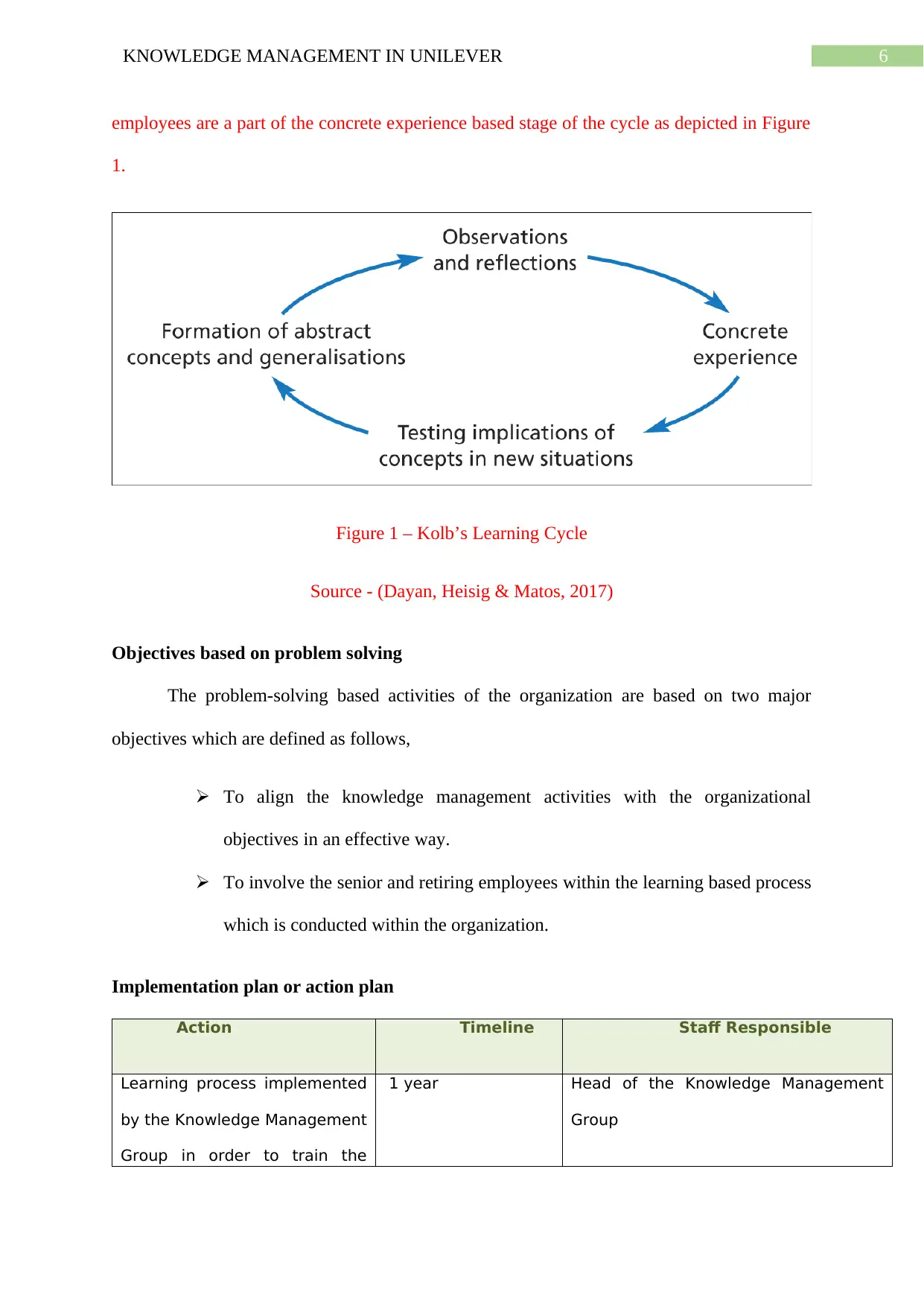
The senior employees can be considered as a part of the intellectual capital which is held by
the organization and can increase the value of the organization as well. The employees who
are about to retire can be considered to be a part of the Kolb’s learning cycle. These
taken for granted. On the other hand, the process of double loop learning can be implemented
if a major error has been detected and further has been corrected with the modification of the
norms, objectives and policies of the organization.
These two processes are considered to be a major part of the organizational learning
process. The process of organizational learning can be implemented in order to align the
goals and the objectives of Unilever with the knowledge management activities. The three
level hierarchy process will be implemented in order to manage the knowledge management
system with the strategies of the organization (Hislop, Bosua & Helms, 2018).
According to Del Giudice and Maggioni (2014), The organizational culture can play a
major role in solving the second issue which is being faced by Unilever based on the
reluctance of senior employees to share their knowledge. The attitudes, beliefs and values
which exist in the organization are considered to be a part of the culture. The two major types
of organizational culture which can be considered in order to solve the issues which are faced
by Unilever include, task culture and role culture.
The task culture is based on placing the right type of people together and further
provide them with a task. The role culture can be defined as the type of culture where
different employees can be provided with different types of duties which together help in
achieving the organizational goals. The senior employees need to be provided with the
position of a coach so that they are able to provide technical learning based opportunities to
the employees who are new in the organizational processes (Dayan, Heisig & Matos, 2017).
The senior employees can be considered as a part of the intellectual capital which is held by
the organization and can increase the value of the organization as well. The employees who
are about to retire can be considered to be a part of the Kolb’s learning cycle. These
⊘ This is a preview!⊘
Do you want full access?
Subscribe today to unlock all pages.

Trusted by 1+ million students worldwide

6KNOWLEDGE MANAGEMENT IN UNILEVER
employees are a part of the concrete experience based stage of the cycle as depicted in Figure
1.
Figure 1 – Kolb’s Learning Cycle
Source - (Dayan, Heisig & Matos, 2017)
Objectives based on problem solving
The problem-solving based activities of the organization are based on two major
objectives which are defined as follows,
 To align the knowledge management activities with the organizational
objectives in an effective way.
 To involve the senior and retiring employees within the learning based process
which is conducted within the organization.
Implementation plan or action plan
Action Timeline Staff Responsible
Learning process implemented
by the Knowledge Management
Group in order to train the
1 year Head of the Knowledge Management
Group
employees are a part of the concrete experience based stage of the cycle as depicted in Figure
1.
Figure 1 – Kolb’s Learning Cycle
Source - (Dayan, Heisig & Matos, 2017)
Objectives based on problem solving
The problem-solving based activities of the organization are based on two major
objectives which are defined as follows,
 To align the knowledge management activities with the organizational
objectives in an effective way.
 To involve the senior and retiring employees within the learning based process
which is conducted within the organization.
Implementation plan or action plan
Action Timeline Staff Responsible
Learning process implemented
by the Knowledge Management
Group in order to train the
1 year Head of the Knowledge Management
Group
Paraphrase This Document
Need a fresh take? Get an instant paraphrase of this document with our AI Paraphraser

7KNOWLEDGE MANAGEMENT IN UNILEVER
employees. The organizational
objectives will be aligned with
the learning process of
employees.
Technical learning sessions
held in the organization. The
senior employees will feel
valued and will share their
knowledge eagerly.
Every month Senior employees
employees. The organizational
objectives will be aligned with
the learning process of
employees.
Technical learning sessions
held in the organization. The
senior employees will feel
valued and will share their
knowledge eagerly.
Every month Senior employees

8KNOWLEDGE MANAGEMENT IN UNILEVER
References
Becerra-Fernandez, I., & Sabherwal, R. (2014). Knowledge management: Systems and
processes. Routledge.
Becerra-Fernandez, I., Leidner, D. E., & Leidner, D. (2014). Individual, group, and
organizational learning: A knowledge management perspective. In Knowledge
Management (pp. 27-53). Routledge.
Dayan, R., Heisig, P., & Matos, F. (2017). Knowledge management as a factor for the
formulation and implementation of organization strategy. Journal of Knowledge
Management, 21(2), 308-329.
Del Giudice, M., & Maggioni, V. (2014). Managerial practices and operative directions of
knowledge management within inter-firm networks: a global view. Journal of
Knowledge Management, 18(5), 841-846.
Donate, M. J., & de Pablo, J. D. S. (2015). The role of knowledge-oriented leadership in
knowledge management practices and innovation. Journal of Business
Research, 68(2), 360-370.
Fidel, P., Schlesinger, W., & Cervera, A. (2015). Collaborating to innovate: Effects on
customer knowledge management and performance. Journal of business
research, 68(7), 1426-1428.
Geisler, E., & Wickramasinghe, N. (2015). Principles of Knowledge Management: Theory,
Practice, and Cases: Theory, Practice, and Cases. Routledge.
Hislop, D., Bosua, R., & Helms, R. (2018). Knowledge management in organizations: A
critical introduction. Oxford University Press.
References
Becerra-Fernandez, I., & Sabherwal, R. (2014). Knowledge management: Systems and
processes. Routledge.
Becerra-Fernandez, I., Leidner, D. E., & Leidner, D. (2014). Individual, group, and
organizational learning: A knowledge management perspective. In Knowledge
Management (pp. 27-53). Routledge.
Dayan, R., Heisig, P., & Matos, F. (2017). Knowledge management as a factor for the
formulation and implementation of organization strategy. Journal of Knowledge
Management, 21(2), 308-329.
Del Giudice, M., & Maggioni, V. (2014). Managerial practices and operative directions of
knowledge management within inter-firm networks: a global view. Journal of
Knowledge Management, 18(5), 841-846.
Donate, M. J., & de Pablo, J. D. S. (2015). The role of knowledge-oriented leadership in
knowledge management practices and innovation. Journal of Business
Research, 68(2), 360-370.
Fidel, P., Schlesinger, W., & Cervera, A. (2015). Collaborating to innovate: Effects on
customer knowledge management and performance. Journal of business
research, 68(7), 1426-1428.
Geisler, E., & Wickramasinghe, N. (2015). Principles of Knowledge Management: Theory,
Practice, and Cases: Theory, Practice, and Cases. Routledge.
Hislop, D., Bosua, R., & Helms, R. (2018). Knowledge management in organizations: A
critical introduction. Oxford University Press.
⊘ This is a preview!⊘
Do you want full access?
Subscribe today to unlock all pages.

Trusted by 1+ million students worldwide

9KNOWLEDGE MANAGEMENT IN UNILEVER
North, K., & Kumta, G. (2018). Knowledge management: Value creation through
organizational learning. Springer.
Unilever.com. (2018). Unilever global company website | Unilever Global. Retrieved from
https://www.unilever.com/
North, K., & Kumta, G. (2018). Knowledge management: Value creation through
organizational learning. Springer.
Unilever.com. (2018). Unilever global company website | Unilever Global. Retrieved from
https://www.unilever.com/
1 out of 10
Related Documents
Your All-in-One AI-Powered Toolkit for Academic Success.
 +13062052269
info@desklib.com
Available 24*7 on WhatsApp / Email
Unlock your academic potential
Copyright © 2020–2026 A2Z Services. All Rights Reserved. Developed and managed by ZUCOL.