Marketing Plan: Unilever's Strategy for Beauty Brand Acquisition
VerifiedAdded on 2021/02/19
|10
|2614
|72
Report
AI Summary
This marketing plan analyzes Unilever's strategy for expanding its online presence, particularly through the acquisition of beauty brands. The plan outlines Unilever's mission, vision, and marketing objectives, including increasing sales and market share. It includes a SWOT analysis, assessing strengths like a strong brand image and strategic investments, and weaknesses such as a competitive environment and retailer dependence. The PESTEL analysis evaluates the political, economic, social, technological, environmental, and legal factors influencing Unilever's operations. The plan also details the STP (Segmentation, Targeting, Positioning) strategy, marketing mix (Product, Promotion, Place, Price), and competitor analysis, highlighting L'Oreal and P&G. The report emphasizes the importance of internet marketing, social media, and adapting to evolving consumer preferences and market trends to achieve its goals. The plan aims to guide Unilever in achieving its business objectives and gaining a competitive advantage in the beauty and personal care market. It also addresses the threats of growing Ayurveda products and product imitation.
Creation of marketing plan

Paraphrase This Document
Need a fresh take? Get an instant paraphrase of this document with our AI Paraphraser
TABLE OF CONTENTS
MARKETING PLAN......................................................................................................................1
Executive summary......................................................................................................................1
Mission.........................................................................................................................................1
Vision...........................................................................................................................................1
Marketing objectives....................................................................................................................1
SWOT..........................................................................................................................................1
PESTEL.......................................................................................................................................2
STP...............................................................................................................................................4
Marketing mix..............................................................................................................................5
Competitors analysis....................................................................................................................6
REFERENCES................................................................................................................................8
MARKETING PLAN......................................................................................................................1
Executive summary......................................................................................................................1
Mission.........................................................................................................................................1
Vision...........................................................................................................................................1
Marketing objectives....................................................................................................................1
SWOT..........................................................................................................................................1
PESTEL.......................................................................................................................................2
STP...............................................................................................................................................4
Marketing mix..............................................................................................................................5
Competitors analysis....................................................................................................................6
REFERENCES................................................................................................................................8
MARKETING PLAN
Executive summary
Marketing plan is the outline or blueprint which includes the advertisement and
promotion plans. It deals with the business activities in order to achieve business objectives by
choosing different strategies. Marketing plan is important for a company as it gives a market
analysis and on the basis of the research firm is able to meet its goals. Unilever is acquiring
beauty brands in order to increase its online presence in the market for which company need a
marketing plan. The plan will include mission, marketing objectives, vision, marketing
strategies, SWOT, PESTEL, STP, marketing mix and competitors analysis. The marketing plan
will benefit company in achieving business objectives and increase its online presence in the
market against its competitors.
Mission
To make life viable in order to meet everyday need such as hygiene, nutrition and
personal care with the help of brands which enhance an individual's life, make them feel and
look good.
Vision
To sustain in the market for long term and grow business by satisfying customers by
providing products as per the needs of customers and to be a leading competitor in the market.
Marketing objectives
To increase the sales by 20% in the year 2019-2020.
To increase market share by 5% in 2019-2020.
To increase its online presence by investing in internet marketing.
SWOT
Strengths: Strong brand image: Unilever has strong brand image because of its wide range of
products. Company is able to acquire top beauty brands such as Dermalogica, Kate
Somerville, Living proof etc. (Unilever acquires beauty brands to grow its online
business, 2019) and will increase its online presence by gaining market share. Strategic investment: As Unilever is having strong financial performance thus, company
is able to invest in internet marketing in order to increase its sales and market share.
1
Executive summary
Marketing plan is the outline or blueprint which includes the advertisement and
promotion plans. It deals with the business activities in order to achieve business objectives by
choosing different strategies. Marketing plan is important for a company as it gives a market
analysis and on the basis of the research firm is able to meet its goals. Unilever is acquiring
beauty brands in order to increase its online presence in the market for which company need a
marketing plan. The plan will include mission, marketing objectives, vision, marketing
strategies, SWOT, PESTEL, STP, marketing mix and competitors analysis. The marketing plan
will benefit company in achieving business objectives and increase its online presence in the
market against its competitors.
Mission
To make life viable in order to meet everyday need such as hygiene, nutrition and
personal care with the help of brands which enhance an individual's life, make them feel and
look good.
Vision
To sustain in the market for long term and grow business by satisfying customers by
providing products as per the needs of customers and to be a leading competitor in the market.
Marketing objectives
To increase the sales by 20% in the year 2019-2020.
To increase market share by 5% in 2019-2020.
To increase its online presence by investing in internet marketing.
SWOT
Strengths: Strong brand image: Unilever has strong brand image because of its wide range of
products. Company is able to acquire top beauty brands such as Dermalogica, Kate
Somerville, Living proof etc. (Unilever acquires beauty brands to grow its online
business, 2019) and will increase its online presence by gaining market share. Strategic investment: As Unilever is having strong financial performance thus, company
is able to invest in internet marketing in order to increase its sales and market share.
1
⊘ This is a preview!⊘
Do you want full access?
Subscribe today to unlock all pages.

Trusted by 1+ million students worldwide
Unilever will benefit by leveraging in different economies of scale and acquiring top
beauty brands and increase its online presence (Sarsby, 2016).
Weakness: Competitive environment: Unilever is operating its business in competitive market where
it is challenging for company to compete with the global players like P&G etc. Increasing
competition in the market also replace products with substitute products. It creates
difficulty to sustain in the market. Dependent on retailers: Customers are directly influenced by the retailers in the industry
as there is a shortcoming in influencing customers directly. Customers are affected by the
behaviour of retailers which creates weakness for the company (Hasan, 2015).
Opportunities:
Internet marketing or social media marketing: Company has new opportunities to market
its products through social media and increase its online presence as most of the
population is spending their time on using social media and is highly influenced by it.
Unilever can reduce its marketing cost and increase sales by attracting customers through
online marketing. Growing economies: Company also has an opportunity to expand its business in new
economies as the standards of living is increasing thus, company can offer right products
to right customers at right place (Agarwal and Shaikh, 2016).
Threats: Growing awareness of Ayurveda products: There is a recent growth in Ayurveda
products creating threat for commercial companies. Unilever is also affected by the
launch of Ayush lever, as customers are preferring Ayurveda products instead of
commercial products.
Product imitation: It is one of the major threat faced by the company as local brands can
copy the brands and sell their products under their own name. Thus, it is a threat as
Unilever depends on the retailers. Retailers are trying to increase house brands and
compete against Unilever which can reduce the competitive advantage (Kwarteng, 2015).
PESTEL
Political environment:
2
beauty brands and increase its online presence (Sarsby, 2016).
Weakness: Competitive environment: Unilever is operating its business in competitive market where
it is challenging for company to compete with the global players like P&G etc. Increasing
competition in the market also replace products with substitute products. It creates
difficulty to sustain in the market. Dependent on retailers: Customers are directly influenced by the retailers in the industry
as there is a shortcoming in influencing customers directly. Customers are affected by the
behaviour of retailers which creates weakness for the company (Hasan, 2015).
Opportunities:
Internet marketing or social media marketing: Company has new opportunities to market
its products through social media and increase its online presence as most of the
population is spending their time on using social media and is highly influenced by it.
Unilever can reduce its marketing cost and increase sales by attracting customers through
online marketing. Growing economies: Company also has an opportunity to expand its business in new
economies as the standards of living is increasing thus, company can offer right products
to right customers at right place (Agarwal and Shaikh, 2016).
Threats: Growing awareness of Ayurveda products: There is a recent growth in Ayurveda
products creating threat for commercial companies. Unilever is also affected by the
launch of Ayush lever, as customers are preferring Ayurveda products instead of
commercial products.
Product imitation: It is one of the major threat faced by the company as local brands can
copy the brands and sell their products under their own name. Thus, it is a threat as
Unilever depends on the retailers. Retailers are trying to increase house brands and
compete against Unilever which can reduce the competitive advantage (Kwarteng, 2015).
PESTEL
Political environment:
2
Paraphrase This Document
Need a fresh take? Get an instant paraphrase of this document with our AI Paraphraser
Political stability of most of the country affect Unilever business operations and helps
company to grow in the market. Political stability can help company in minimizing various
challenges and implement different strategies. Company can also expand free trade relations in
developing countries which will be beneficial for Unilever in increasing market share (Lancaster
and Massingham, 2017).
Economical environment:
Unilever has a wide range of beauty and personal care products globally and it
continuously acquiring companies to increase its inline presence as well as market share.
Economic growth various country will be beneficial for company to expand its share and
diversify its business in beauty and personal care. Company has an opportunity in expanding
geographically where purchasing power of customers is high. Increase in the wage rate of the
country can create threat for the company by increasing cost of the product (Kahungu, 2018).
Social environment:
Unilever launched “Shakti” program for rural women in order to increase personal
awareness and importance of cleanliness. This program has helped women in gaining
employment and live their life in better way. Company is continuously enhancing society and
working for the welfare of them. Unilever can increase its sales by providing employment as
well as empowering women worldwide.
Technological environment:
Unilever depends upon the availability of technology which supports consumer goods
business. There is rising business automation which gives opportunity to company to enhance its
business operations to improve efficiency. Technology increase competition, there is a threat of
investing in research and development in order to gain competitive advantage but Unilever has
strong financial position which benefits company in investing in R&D and gaining competitive
advantage (Helsen, 2018).
Environmental environment:
There is an opportunity for Unilever to generate interest in the business environmentalism
and improve the environment by introducing campaigns and attract consumers who are
concerned with the environment. Company can also implement some CSR activities which will
bring product innovation and reduce waste and its impact on business. Company can also change
their packaging to eco-friendly design to protect environment.
3
company to grow in the market. Political stability can help company in minimizing various
challenges and implement different strategies. Company can also expand free trade relations in
developing countries which will be beneficial for Unilever in increasing market share (Lancaster
and Massingham, 2017).
Economical environment:
Unilever has a wide range of beauty and personal care products globally and it
continuously acquiring companies to increase its inline presence as well as market share.
Economic growth various country will be beneficial for company to expand its share and
diversify its business in beauty and personal care. Company has an opportunity in expanding
geographically where purchasing power of customers is high. Increase in the wage rate of the
country can create threat for the company by increasing cost of the product (Kahungu, 2018).
Social environment:
Unilever launched “Shakti” program for rural women in order to increase personal
awareness and importance of cleanliness. This program has helped women in gaining
employment and live their life in better way. Company is continuously enhancing society and
working for the welfare of them. Unilever can increase its sales by providing employment as
well as empowering women worldwide.
Technological environment:
Unilever depends upon the availability of technology which supports consumer goods
business. There is rising business automation which gives opportunity to company to enhance its
business operations to improve efficiency. Technology increase competition, there is a threat of
investing in research and development in order to gain competitive advantage but Unilever has
strong financial position which benefits company in investing in R&D and gaining competitive
advantage (Helsen, 2018).
Environmental environment:
There is an opportunity for Unilever to generate interest in the business environmentalism
and improve the environment by introducing campaigns and attract consumers who are
concerned with the environment. Company can also implement some CSR activities which will
bring product innovation and reduce waste and its impact on business. Company can also change
their packaging to eco-friendly design to protect environment.
3
Legal environment:
Unilever is a global brand ans has over 400 brands of health, food and personal care
under it. Thus, it is necessary to follow some rules and regulations related to product safety, law
of health and safety and copyright (Sarsby, 2016). Company need to match these standards to
sustain in the market and protect the rights of consumers as well as strengthen international
patent laws.
STP
Segmentation:
Segmentation is a set of characteristics or variable used to assign potential customers to
different groups. It is a factor used to differentiate customers into different market segments.
Segmentation can be done on 4 bases such as geographical, demographic, psycho-graphic and
behavioural segmentation (Agarwal and Shaikh, 2016). This basis of segmentation differentiate
customers on the basis of region, area, age, personal characteristics, opinions, interest,
occupation, city or loyalty towards brand. Unilever has grouped customers on the basis of
demographic and behavioural segmentation. As company is expanding its business in beauty and
personal care, company is offering products in the basis of age, occupation, marital status, brand
and loyal customers. It will be beneficial for company to offer products as per the needs of
customers.
Targeting:
It is a process of selecting potential customers to whom product will be sold. Targeting
involves segmenting the right market and determining what product will be offered to each
segment. In order to target a specific market. Unilever uses differentiated target market strategy
where specific marketing mix is designed for each segment so that products is affordable and
available to each customer (Lancaster and Massingham, 2017). As company will target 2
segments, for loyal or potential customers company will design products, promotion, pricing
strategies according to their capability and for people having same age or gender organization
will offer products and price according to the segment.
Positioning:
Positioning refers to communicating the product in such a way that it creates a positive
brand image in the minds of customers. Organisation identifies strengths, weakness, customers
needs, market trends and positioning of competitors product and then formulates positioning
4
Unilever is a global brand ans has over 400 brands of health, food and personal care
under it. Thus, it is necessary to follow some rules and regulations related to product safety, law
of health and safety and copyright (Sarsby, 2016). Company need to match these standards to
sustain in the market and protect the rights of consumers as well as strengthen international
patent laws.
STP
Segmentation:
Segmentation is a set of characteristics or variable used to assign potential customers to
different groups. It is a factor used to differentiate customers into different market segments.
Segmentation can be done on 4 bases such as geographical, demographic, psycho-graphic and
behavioural segmentation (Agarwal and Shaikh, 2016). This basis of segmentation differentiate
customers on the basis of region, area, age, personal characteristics, opinions, interest,
occupation, city or loyalty towards brand. Unilever has grouped customers on the basis of
demographic and behavioural segmentation. As company is expanding its business in beauty and
personal care, company is offering products in the basis of age, occupation, marital status, brand
and loyal customers. It will be beneficial for company to offer products as per the needs of
customers.
Targeting:
It is a process of selecting potential customers to whom product will be sold. Targeting
involves segmenting the right market and determining what product will be offered to each
segment. In order to target a specific market. Unilever uses differentiated target market strategy
where specific marketing mix is designed for each segment so that products is affordable and
available to each customer (Lancaster and Massingham, 2017). As company will target 2
segments, for loyal or potential customers company will design products, promotion, pricing
strategies according to their capability and for people having same age or gender organization
will offer products and price according to the segment.
Positioning:
Positioning refers to communicating the product in such a way that it creates a positive
brand image in the minds of customers. Organisation identifies strengths, weakness, customers
needs, market trends and positioning of competitors product and then formulates positioning
4
⊘ This is a preview!⊘
Do you want full access?
Subscribe today to unlock all pages.
Trusted by 1+ million students worldwide
strategies. Unilever highlights features and benefits of a product in order to promote its products
and compete in the market. Company uses benefit positioning strategy where marketers
communicate unique features and benefits of a product to create strong brand image and compete
in the market by gaining competitive advantage (Helsen, 2018).
Marketing mix
Product:
Unilever is continuously expanding its business in consumer goods and has 4 categories
such as food, personal care, refreshment and home care. Company is expanding its personal care
by acquiring top companies and growing its online presence. Company is leveraging in beauty
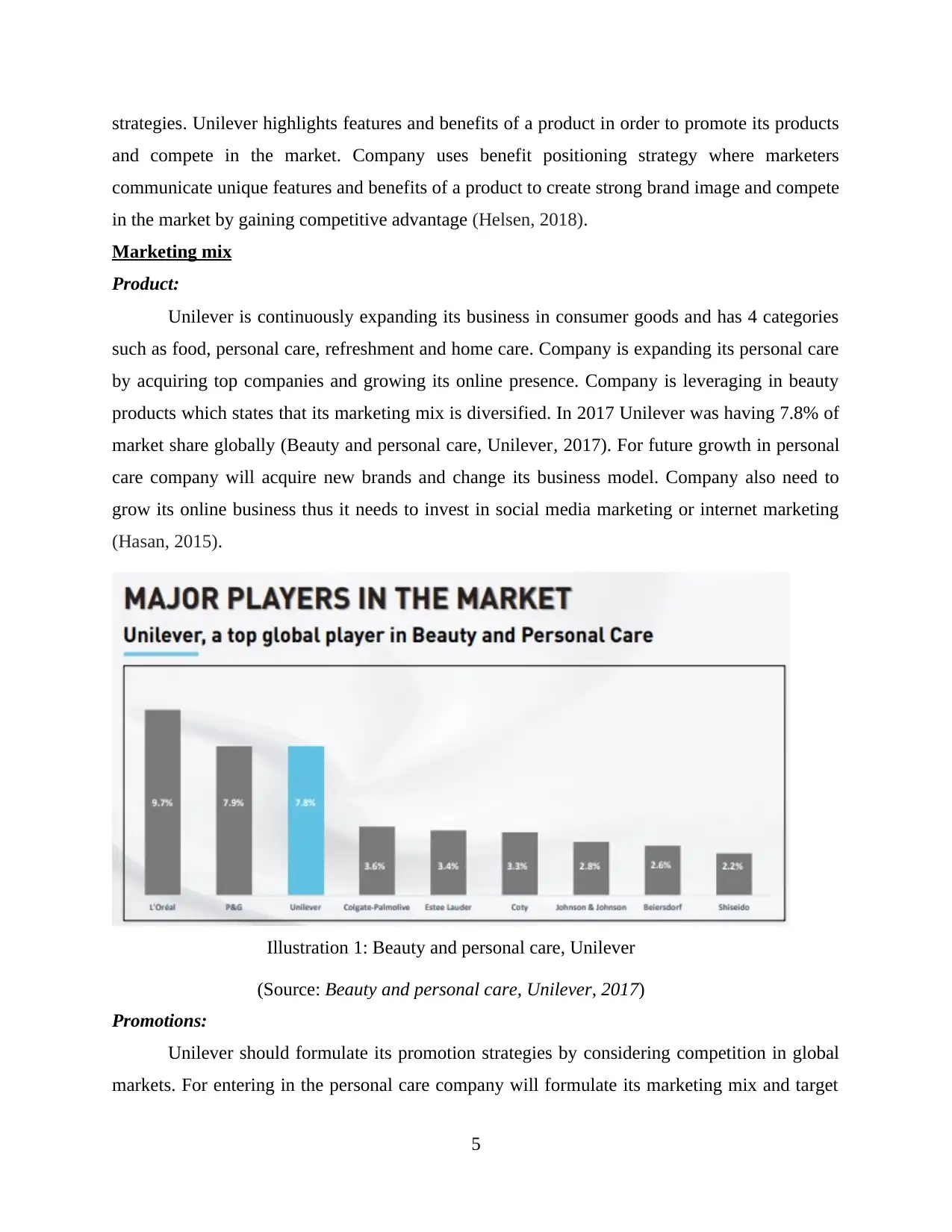
products which states that its marketing mix is diversified. In 2017 Unilever was having 7.8% of
market share globally (Beauty and personal care, Unilever, 2017). For future growth in personal
care company will acquire new brands and change its business model. Company also need to
grow its online business thus it needs to invest in social media marketing or internet marketing
(Hasan, 2015).
Illustration 1: Beauty and personal care, Unilever
(Source: Beauty and personal care, Unilever, 2017)
Promotions:
Unilever should formulate its promotion strategies by considering competition in global
markets. For entering in the personal care company will formulate its marketing mix and target
5
and compete in the market. Company uses benefit positioning strategy where marketers
communicate unique features and benefits of a product to create strong brand image and compete
in the market by gaining competitive advantage (Helsen, 2018).
Marketing mix
Product:
Unilever is continuously expanding its business in consumer goods and has 4 categories
such as food, personal care, refreshment and home care. Company is expanding its personal care
by acquiring top companies and growing its online presence. Company is leveraging in beauty
products which states that its marketing mix is diversified. In 2017 Unilever was having 7.8% of
market share globally (Beauty and personal care, Unilever, 2017). For future growth in personal
care company will acquire new brands and change its business model. Company also need to
grow its online business thus it needs to invest in social media marketing or internet marketing
(Hasan, 2015).
Illustration 1: Beauty and personal care, Unilever
(Source: Beauty and personal care, Unilever, 2017)
Promotions:
Unilever should formulate its promotion strategies by considering competition in global
markets. For entering in the personal care company will formulate its marketing mix and target
5
Paraphrase This Document
Need a fresh take? Get an instant paraphrase of this document with our AI Paraphraser
audience through social media marketing. Nowadays most of the people are using social media
and are getting influenced by it, thus it will be beneficial for company to promote its products
through online marketing and increase its online business. It will help company in reducing the
cost of marketing and increasing market share (Kahungu, 2018).
Place:
Unilever want to make its beauty and personal care products available online so that it is
easy for company to reach large area. Products of company are available in stores, retailers
kiosks etc. but now Unilever want to increase its online presence and offer products online. In
order to do so company need to maintain relations with suppliers so that their products are
available at every part of world. By doing this company will be able to increase its sales and
market share in the year 2019-2020.
Price:
Company will different pricing strategies by considering the level of product
diversification. Company formulates different pricing strategies and attract customers. For
example for selling beauty and personal care company set pricing strategies according to the
target segments. If the target segments are potential and loyal customers then Unilever will use
competitors pricing strategy in order to gain competitive advantage and if the target are
segmented on the basis of demographics then company will use penetration pricing strategy to
attract customers. The brands like dove company keeps the price moderately high because of the
quality of the product (Agarwal and Shaikh, 2016).
Competitors analysis
Basis L'Oreal Unilever P&G
Strength Company is
continuously investing
in research and
development to
improve its quality of
product. The cream
affect differently in
hot and cool
conditions which need
Company has strong
financial position and
brand image in the
market which is a
strength for company
in diversifying its
business by acquiring
different companies.
With the help of this
Company is having
strong distribution
network in rural and
urban areas. It gives
company competitive
advantage as it
delivers products in
many locations. If its
products are not
6
and are getting influenced by it, thus it will be beneficial for company to promote its products
through online marketing and increase its online business. It will help company in reducing the
cost of marketing and increasing market share (Kahungu, 2018).
Place:
Unilever want to make its beauty and personal care products available online so that it is
easy for company to reach large area. Products of company are available in stores, retailers
kiosks etc. but now Unilever want to increase its online presence and offer products online. In
order to do so company need to maintain relations with suppliers so that their products are
available at every part of world. By doing this company will be able to increase its sales and
market share in the year 2019-2020.
Price:
Company will different pricing strategies by considering the level of product
diversification. Company formulates different pricing strategies and attract customers. For
example for selling beauty and personal care company set pricing strategies according to the
target segments. If the target segments are potential and loyal customers then Unilever will use
competitors pricing strategy in order to gain competitive advantage and if the target are
segmented on the basis of demographics then company will use penetration pricing strategy to
attract customers. The brands like dove company keeps the price moderately high because of the
quality of the product (Agarwal and Shaikh, 2016).
Competitors analysis
Basis L'Oreal Unilever P&G
Strength Company is
continuously investing
in research and
development to
improve its quality of
product. The cream
affect differently in
hot and cool
conditions which need
Company has strong
financial position and
brand image in the
market which is a
strength for company
in diversifying its
business by acquiring
different companies.
With the help of this
Company is having
strong distribution
network in rural and
urban areas. It gives
company competitive
advantage as it
delivers products in
many locations. If its
products are not
6
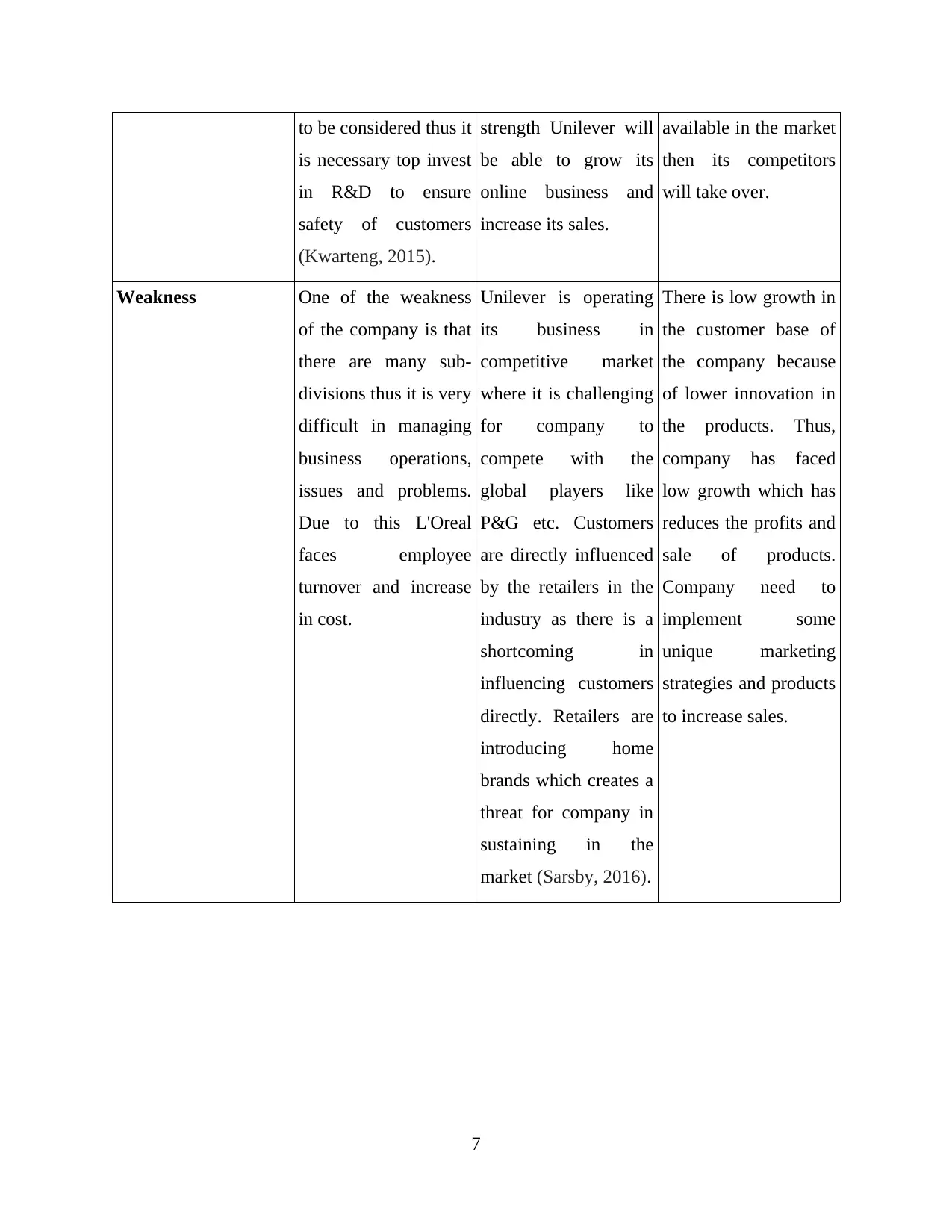
to be considered thus it
is necessary top invest
in R&D to ensure
safety of customers
(Kwarteng, 2015).
strength Unilever will
be able to grow its
online business and
increase its sales.
available in the market
then its competitors
will take over.
Weakness One of the weakness
of the company is that
there are many sub-
divisions thus it is very
difficult in managing
business operations,
issues and problems.
Due to this L'Oreal
faces employee
turnover and increase
in cost.
Unilever is operating
its business in
competitive market
where it is challenging
for company to
compete with the
global players like
P&G etc. Customers
are directly influenced
by the retailers in the
industry as there is a
shortcoming in
influencing customers
directly. Retailers are
introducing home
brands which creates a
threat for company in
sustaining in the
market (Sarsby, 2016).
There is low growth in
the customer base of
the company because
of lower innovation in
the products. Thus,
company has faced
low growth which has
reduces the profits and
sale of products.
Company need to
implement some
unique marketing
strategies and products
to increase sales.
7
is necessary top invest
in R&D to ensure
safety of customers
(Kwarteng, 2015).
strength Unilever will
be able to grow its
online business and
increase its sales.
available in the market
then its competitors
will take over.
Weakness One of the weakness
of the company is that
there are many sub-
divisions thus it is very
difficult in managing
business operations,
issues and problems.
Due to this L'Oreal
faces employee
turnover and increase
in cost.
Unilever is operating
its business in
competitive market
where it is challenging
for company to
compete with the
global players like
P&G etc. Customers
are directly influenced
by the retailers in the
industry as there is a
shortcoming in
influencing customers
directly. Retailers are
introducing home
brands which creates a
threat for company in
sustaining in the
market (Sarsby, 2016).
There is low growth in
the customer base of
the company because
of lower innovation in
the products. Thus,
company has faced
low growth which has
reduces the profits and
sale of products.
Company need to
implement some
unique marketing
strategies and products
to increase sales.
7
⊘ This is a preview!⊘
Do you want full access?
Subscribe today to unlock all pages.
Trusted by 1+ million students worldwide
REFERENCES
Books and Journals
Agarwal, S. and Shaikh, I., 2016. Comparative advertising: case analysis of Colgate Palmolive v.
Hindustan Unilever Ltd. In Law and Economics in India (pp. 364-386). Routledge India.
Hasan, M. M., 2015. Marketing Analysis of Unilever. Total Quality Management. 11. p.13.
Helsen, K., 2018. Sustainable Marketing Strategies: Overview.
Kahungu, L., 2018. Unilever Company Case Study. GRIN Verlag.
Kwarteng, M .A., 2015. Projekt e-marketingové strategie pro firmu Unilever Ghana.
Lancaster, G. and Massingham, L., 2017. The development of a strategic approach to marketing:
Its culture; internal macro-and external micro-environmental issues. In Essentials of
Marketing Management (pp. 1-32). Routledge.
Sarsby, A., 2016. SWOT analysis. Lulu. Com.
Online
Beauty and personal care, Unilever. 2017. [online]. Available through
<https://www.unilever.com/Images/investor-event-2018-alan-jope---sandeep-kohli-
beauty---personal-care_tcm244-529119_1_en.pdf >
Unilever acquires beauty brands to grow its online business. 2019. [Online]. Available through :
<https://digiday.com/retail/unilever-looks-acquire-premium-beauty-brands-seeks-grow-
online-business/ >.
8
Books and Journals
Agarwal, S. and Shaikh, I., 2016. Comparative advertising: case analysis of Colgate Palmolive v.
Hindustan Unilever Ltd. In Law and Economics in India (pp. 364-386). Routledge India.
Hasan, M. M., 2015. Marketing Analysis of Unilever. Total Quality Management. 11. p.13.
Helsen, K., 2018. Sustainable Marketing Strategies: Overview.
Kahungu, L., 2018. Unilever Company Case Study. GRIN Verlag.
Kwarteng, M .A., 2015. Projekt e-marketingové strategie pro firmu Unilever Ghana.
Lancaster, G. and Massingham, L., 2017. The development of a strategic approach to marketing:
Its culture; internal macro-and external micro-environmental issues. In Essentials of
Marketing Management (pp. 1-32). Routledge.
Sarsby, A., 2016. SWOT analysis. Lulu. Com.
Online
Beauty and personal care, Unilever. 2017. [online]. Available through
<https://www.unilever.com/Images/investor-event-2018-alan-jope---sandeep-kohli-
beauty---personal-care_tcm244-529119_1_en.pdf >
Unilever acquires beauty brands to grow its online business. 2019. [Online]. Available through :
<https://digiday.com/retail/unilever-looks-acquire-premium-beauty-brands-seeks-grow-
online-business/ >.
8

1 out of 10


Related Documents


Your All-in-One AI-Powered Toolkit for Academic Success.
+13062052269
info@desklib.com
Available 24*7 on WhatsApp / Email
![[object Object]](/_next/static/media/star-bottom.7253800d.svg)
Unlock your academic potential
Copyright © 2020–2026 A2Z Services. All Rights Reserved. Developed and managed by ZUCOL.