Unilever's Marketing Strategies: Segmentation, Targeting & Objectives
VerifiedAdded on 2022/12/26
|13
|4059
|352
Report
AI Summary
This report provides a comprehensive analysis of Unilever's marketing strategies, examining both the external and internal business environments. It utilizes PESTLE and SWOT analyses to assess the factors influencing Unilever's operations, including political, social, economic, technological, legal, and environmental aspects, as well as the company's strengths, weaknesses, opportunities, and threats. The report also explores Unilever's market position, competitive advantages, and current marketing strategies, including segmentation, targeting, and positioning. Furthermore, it outlines SMART objectives and goals, discusses the marketing mix, and offers recommendations for improving Unilever's marketing strategies. The analysis considers the impact of factors such as the coronavirus pandemic and Brexit on the company's performance.
MARKETING
STRATEGIES
STRATEGIES

Paraphrase This Document
Need a fresh take? Get an instant paraphrase of this document with our AI Paraphraser
EXECUTIVE SUMMARY
In this, the marketing's strategies is used to define as the plan which is essential for the
organisation. This help to formulate new cope of development of idea and plan which is
beneficial for any firm. As per this, the proper implementation of the strategies for the firm
create more and more profitability and productivity. There are number of model and framework
are used to show the factor which may affect the function and operation of any organisation. This
provide significant role in this for making smooth function and operation of enterprise.
In this, the marketing's strategies is used to define as the plan which is essential for the
organisation. This help to formulate new cope of development of idea and plan which is
beneficial for any firm. As per this, the proper implementation of the strategies for the firm
create more and more profitability and productivity. There are number of model and framework
are used to show the factor which may affect the function and operation of any organisation. This
provide significant role in this for making smooth function and operation of enterprise.
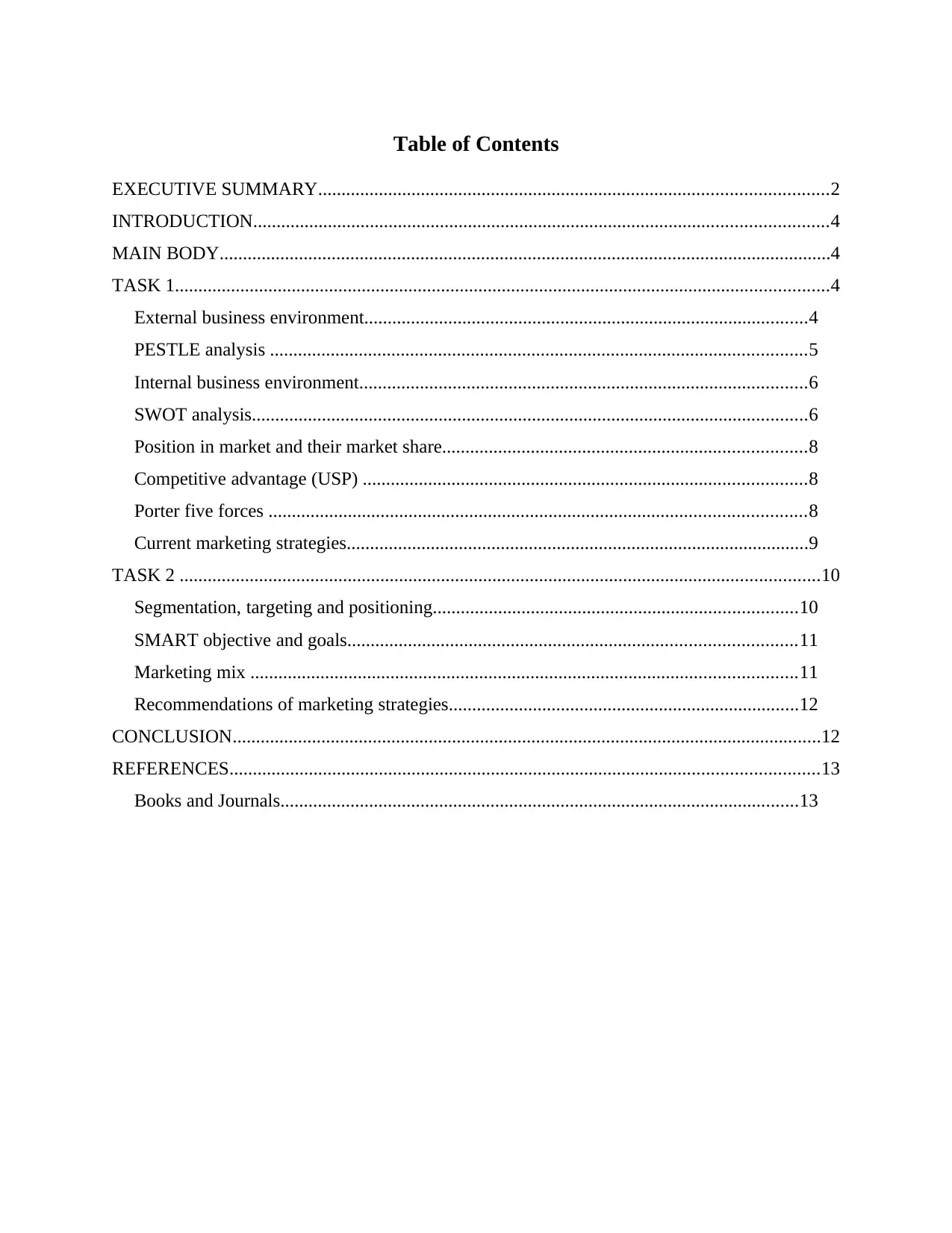
Table of Contents
EXECUTIVE SUMMARY.............................................................................................................2
INTRODUCTION...........................................................................................................................4
MAIN BODY...................................................................................................................................4
TASK 1............................................................................................................................................4
External business environment...............................................................................................4
PESTLE analysis ...................................................................................................................5
Internal business environment................................................................................................6
SWOT analysis.......................................................................................................................6
Position in market and their market share..............................................................................8
Competitive advantage (USP) ...............................................................................................8
Porter five forces ...................................................................................................................8
Current marketing strategies...................................................................................................9
TASK 2 .........................................................................................................................................10
Segmentation, targeting and positioning..............................................................................10
SMART objective and goals................................................................................................11
Marketing mix .....................................................................................................................11
Recommendations of marketing strategies...........................................................................12
CONCLUSION..............................................................................................................................12
REFERENCES..............................................................................................................................13
Books and Journals...............................................................................................................13
EXECUTIVE SUMMARY.............................................................................................................2
INTRODUCTION...........................................................................................................................4
MAIN BODY...................................................................................................................................4
TASK 1............................................................................................................................................4
External business environment...............................................................................................4
PESTLE analysis ...................................................................................................................5
Internal business environment................................................................................................6
SWOT analysis.......................................................................................................................6
Position in market and their market share..............................................................................8
Competitive advantage (USP) ...............................................................................................8
Porter five forces ...................................................................................................................8
Current marketing strategies...................................................................................................9
TASK 2 .........................................................................................................................................10
Segmentation, targeting and positioning..............................................................................10
SMART objective and goals................................................................................................11
Marketing mix .....................................................................................................................11
Recommendations of marketing strategies...........................................................................12
CONCLUSION..............................................................................................................................12
REFERENCES..............................................................................................................................13
Books and Journals...............................................................................................................13
⊘ This is a preview!⊘
Do you want full access?
Subscribe today to unlock all pages.

Trusted by 1+ million students worldwide
INTRODUCTION
Marketing strategies is defined as the business plan or strategy in order to enhance the
overall performance of an organisation. This is also referring as a plan which help to reaching
prospective customer and change their decision and turning them as customer for their product or
services. As per this, the marketing strategies include number of things such as it contains value
of proposition, key management of branding and messaging, data on target customer
demography and other high level of component. In this, the marketing strategies should help to
revolve around the value of proposition that create scenario to communicate with consumer
behalf from organisation. This all provide and completed by marketing team with a proper
template which inform the in activities within the organisation behalf with product and services.
In this report, Unilever is chosen (Abu-Rayash and et. al., 2021). Unilever plc is a British
multinational consumer good and company in London, they have various aspect of product such
as food, energy drink, baby food and cheese. This reports cover their strength, weakness,
opportunities and threat, with their unique selling proposition and also in this, the new market
strategies are practice which is based on proper objective. The competitive advantage and
competition rivalry is well analysing in order to know the various consequence which decrease
the firm productivity rather enhance it.
MAIN BODY
TASK 1
External business environment
An external environment is defined as the factor which is external or outside in nature
which influence the business by creating impact on the process and operation of organisation.
The firm must act or react to keep up its flow of process in term of their operation and various
audit process. The external environment which can be broken down in order to know that is
collectively has two types. They micro environment and macro environment. The micro
environment is defined as which affect the business directly and create impact on operation of
organisation. Macro environment are those which consist normal factor which affect business
that have no control over. As per this, the success of the organisation in depend on their
flexibility and adaptability. In context with selected firm, they also faced various of factor which
may affect the diversity and operation of firm. As per this they analyse briefly by situational
Marketing strategies is defined as the business plan or strategy in order to enhance the
overall performance of an organisation. This is also referring as a plan which help to reaching
prospective customer and change their decision and turning them as customer for their product or
services. As per this, the marketing strategies include number of things such as it contains value
of proposition, key management of branding and messaging, data on target customer
demography and other high level of component. In this, the marketing strategies should help to
revolve around the value of proposition that create scenario to communicate with consumer
behalf from organisation. This all provide and completed by marketing team with a proper
template which inform the in activities within the organisation behalf with product and services.
In this report, Unilever is chosen (Abu-Rayash and et. al., 2021). Unilever plc is a British
multinational consumer good and company in London, they have various aspect of product such
as food, energy drink, baby food and cheese. This reports cover their strength, weakness,
opportunities and threat, with their unique selling proposition and also in this, the new market
strategies are practice which is based on proper objective. The competitive advantage and
competition rivalry is well analysing in order to know the various consequence which decrease
the firm productivity rather enhance it.
MAIN BODY
TASK 1
External business environment
An external environment is defined as the factor which is external or outside in nature
which influence the business by creating impact on the process and operation of organisation.
The firm must act or react to keep up its flow of process in term of their operation and various
audit process. The external environment which can be broken down in order to know that is
collectively has two types. They micro environment and macro environment. The micro
environment is defined as which affect the business directly and create impact on operation of
organisation. Macro environment are those which consist normal factor which affect business
that have no control over. As per this, the success of the organisation in depend on their
flexibility and adaptability. In context with selected firm, they also faced various of factor which
may affect the diversity and operation of firm. As per this they analyse briefly by situational
Paraphrase This Document
Need a fresh take? Get an instant paraphrase of this document with our AI Paraphraser
analysis such as by using proper model such as PESTLE analyse. The effect which affect the
firm operation include corona virus and Brexit.
PESTLE analysis
PESTLE analysis is defined as the effective tool which is used for the business to create
an overall analysis of factor which affect the operation of firm. The PESTLE analysis of
Unilever organisation are mentioned below:
Political factor: Unilever is process and run their business in various countries. As per
this, they face various political factor due to this. The different countries have their political
satire which create several stabilities which create an impact on the business operation of
Unilever. The selected firm have huge political stability to business strategy of business.
Social factor: The social factor includes various of thing which is related with culture
and other reform which create instability in firm production and their profitability. As per s
company the main target customer is people who is living in home called as house hold people
who is regularly using their product. The present change in the structure of social culture and
demographic framework of the country. The change in pattern of income and expenditure level
of the people can make further effect on the productivity of the firm. The chosen firm provide a
way of lifestyle to their respected customer and formulating their new strategies while making
aspect to their customer. In addition to this, the people of UK focus on their health, so they are
conscious to live healthy life which Unilever can adapt to create numerous of profitable
strategies for the firm.
Economical factor: As per this, it is analysing that the selected firm have various factor
which affect the business strategies of the firm in their local area and international marketplaces.
There are number of economic factor such as tax, VAT makes an impact in operation of selected
firm. The recent European union of the UK making a huge factor which affect the firm in their
market place. Moreover, the organisation which can came to the opportunities from the good and
survey economic condition which elaborate the condition of the country (Astuti and et. al.,
2019).
Technological factor: In the era of advance technology, there are number of organisation
adopted the latest technology to enhance their businesses. As per this, they also use in such a
way to create new product and using it for effective research and development. In addition to
this, the chosen firm use new technology in order to create new product by investing huge
firm operation include corona virus and Brexit.
PESTLE analysis
PESTLE analysis is defined as the effective tool which is used for the business to create
an overall analysis of factor which affect the operation of firm. The PESTLE analysis of
Unilever organisation are mentioned below:
Political factor: Unilever is process and run their business in various countries. As per
this, they face various political factor due to this. The different countries have their political
satire which create several stabilities which create an impact on the business operation of
Unilever. The selected firm have huge political stability to business strategy of business.
Social factor: The social factor includes various of thing which is related with culture
and other reform which create instability in firm production and their profitability. As per s
company the main target customer is people who is living in home called as house hold people
who is regularly using their product. The present change in the structure of social culture and
demographic framework of the country. The change in pattern of income and expenditure level
of the people can make further effect on the productivity of the firm. The chosen firm provide a
way of lifestyle to their respected customer and formulating their new strategies while making
aspect to their customer. In addition to this, the people of UK focus on their health, so they are
conscious to live healthy life which Unilever can adapt to create numerous of profitable
strategies for the firm.
Economical factor: As per this, it is analysing that the selected firm have various factor
which affect the business strategies of the firm in their local area and international marketplaces.
There are number of economic factor such as tax, VAT makes an impact in operation of selected
firm. The recent European union of the UK making a huge factor which affect the firm in their
market place. Moreover, the organisation which can came to the opportunities from the good and
survey economic condition which elaborate the condition of the country (Astuti and et. al.,
2019).
Technological factor: In the era of advance technology, there are number of organisation
adopted the latest technology to enhance their businesses. As per this, they also use in such a
way to create new product and using it for effective research and development. In addition to
this, the chosen firm use new technology in order to create new product by investing huge
amount in department of research and development by using latest technology. In this recent
time, the using advance technology can lead to help the business by utilising their time and
overhead cost which create and extra burden to department. Reduce paperwork and other old
method.
Legal factor: The Unilever dealing with their product and service in number of countries
which meant have different rule and regulation. They have their several law which create the
legal factor in this. The different organisation follows this legal structure where they run their
business. As per this, the framework which create impact on the business. Not allowing the legal
factor which create an impact in the firm because the selected chosen firm ensure their business
by acquiring the law and regulation of countries where they dealing.
Environmental factor: In this kind of factor they create minor deviation the operation of
firm. This factor impacts the business in order to change the policy which create harm to
environment such by producing excessive carbon and many more. But in case of they used to
pass guidelines in such a way to reduce the chemical substance. Because the excessive chemical
can harm the clothes and create unnecessary irritation to body and while production they can
create issue with environment (Gladka and et. al., 2019).
Internal business environment
The internal environment is defined as the culture, member and various events which is
create factor within an organisation that create the capabilities in order to influence the decision
of organisation, especially the behaviour of its human resource and their allocation. As per this,
the member refers as those people which they can direct or indirect related with organisation
such as owner, shareholder and managing director which play vital role in this. In context to
Unilever, they also have proper strength and weakness. They have available sources for their
opportunities and threat.
SWOT analysis
SWOT analysis is defined as the strength, weakness, opportunities and threat. In context
with Unilever they have some unique strength and opportunities and also have some weakness
and threat which may have better to improve.
Strength: The Unilever is having a number of major strength which acquire by
organisation which name as Henkel. Brand recognition among developed countries and emerging
countries which used to create huge customer base. The dimension which is used to follow in
time, the using advance technology can lead to help the business by utilising their time and
overhead cost which create and extra burden to department. Reduce paperwork and other old
method.
Legal factor: The Unilever dealing with their product and service in number of countries
which meant have different rule and regulation. They have their several law which create the
legal factor in this. The different organisation follows this legal structure where they run their
business. As per this, the framework which create impact on the business. Not allowing the legal
factor which create an impact in the firm because the selected chosen firm ensure their business
by acquiring the law and regulation of countries where they dealing.
Environmental factor: In this kind of factor they create minor deviation the operation of
firm. This factor impacts the business in order to change the policy which create harm to
environment such by producing excessive carbon and many more. But in case of they used to
pass guidelines in such a way to reduce the chemical substance. Because the excessive chemical
can harm the clothes and create unnecessary irritation to body and while production they can
create issue with environment (Gladka and et. al., 2019).
Internal business environment
The internal environment is defined as the culture, member and various events which is
create factor within an organisation that create the capabilities in order to influence the decision
of organisation, especially the behaviour of its human resource and their allocation. As per this,
the member refers as those people which they can direct or indirect related with organisation
such as owner, shareholder and managing director which play vital role in this. In context to
Unilever, they also have proper strength and weakness. They have available sources for their
opportunities and threat.
SWOT analysis
SWOT analysis is defined as the strength, weakness, opportunities and threat. In context
with Unilever they have some unique strength and opportunities and also have some weakness
and threat which may have better to improve.
Strength: The Unilever is having a number of major strength which acquire by
organisation which name as Henkel. Brand recognition among developed countries and emerging
countries which used to create huge customer base. The dimension which is used to follow in
⊘ This is a preview!⊘
Do you want full access?
Subscribe today to unlock all pages.
Trusted by 1+ million students worldwide
term of this is their geographical spread. This is a major concern of the brand which have been
providing strength to the selected firm.
High brand awareness within global market, Alliance with the Henkel provides the brand
determination and an identification which is going to launch in various countries, Emotional
connection with customer via product and service that is, There is high engagement of the staff
and technical expertise and adding innovation which is based on team of production, They have
high range of product line which is attract the customer and provide attention towards the brand.
Strong brand image in foreign consumer, Market penetration which is make thing aboard,
Company reduce brand portfolio from the 1000 to 400 and this help to enhance the revenue up to
50 percent and profit margin up to 100 percent.
Weakness: The board portfolio is a weakness of the firm in order to reduce the
productivity. The longer range are shifting which essentially focus on the individual product
effectively and from the marketing (Ma and et. al., 2017). As per this, the price is higher in
comparison to competitor on similar product where the consumer is most nation which is
recommend as a rival brand over the Unilever The price are higher and in context with they are
offering quality of product to their respected customer. Associated with two huge firm is giving
them competition in domestic and foreign market, Focus over the emerging which has been
shifting the various loop focus from the established marketplace, Current loss in the domestic
visualisation can cause negative impact over the business, More over the technology which has
been shifting their focus from the relevant product which have higher supply in market.
Opportunities:
Increase the interest over the eco-friendly product which is providing the ability of
leverage to the strength, There is chance to introduce new line of product and service in order to
get attention of strength. They usually create to be niche marketing in way to get more
productivity and profitability, They must have needed the best technological improvement in
various different production department and maintain the quality of product and manage the
distribution channel.
Threats: Slump growth rate in the economy of global market, Rising price of business
expense minimise the profit of organisation, Rise in the cost of fuel can impact the channel of
distribution and the organisation budget, Higher competition rate in the market and they follow
same strategy in market.
providing strength to the selected firm.
High brand awareness within global market, Alliance with the Henkel provides the brand
determination and an identification which is going to launch in various countries, Emotional
connection with customer via product and service that is, There is high engagement of the staff
and technical expertise and adding innovation which is based on team of production, They have
high range of product line which is attract the customer and provide attention towards the brand.
Strong brand image in foreign consumer, Market penetration which is make thing aboard,
Company reduce brand portfolio from the 1000 to 400 and this help to enhance the revenue up to
50 percent and profit margin up to 100 percent.
Weakness: The board portfolio is a weakness of the firm in order to reduce the
productivity. The longer range are shifting which essentially focus on the individual product
effectively and from the marketing (Ma and et. al., 2017). As per this, the price is higher in
comparison to competitor on similar product where the consumer is most nation which is
recommend as a rival brand over the Unilever The price are higher and in context with they are
offering quality of product to their respected customer. Associated with two huge firm is giving
them competition in domestic and foreign market, Focus over the emerging which has been
shifting the various loop focus from the established marketplace, Current loss in the domestic
visualisation can cause negative impact over the business, More over the technology which has
been shifting their focus from the relevant product which have higher supply in market.
Opportunities:
Increase the interest over the eco-friendly product which is providing the ability of
leverage to the strength, There is chance to introduce new line of product and service in order to
get attention of strength. They usually create to be niche marketing in way to get more
productivity and profitability, They must have needed the best technological improvement in
various different production department and maintain the quality of product and manage the
distribution channel.
Threats: Slump growth rate in the economy of global market, Rising price of business
expense minimise the profit of organisation, Rise in the cost of fuel can impact the channel of
distribution and the organisation budget, Higher competition rate in the market and they follow
same strategy in market.
Paraphrase This Document
Need a fresh take? Get an instant paraphrase of this document with our AI Paraphraser
Position in market and their market share
In addition to this, the average value of share for levers product in all over Europe is rise
up to 22% from the year 1998 from 21% in 1997s. The five per cent share growth equates to
some 50 m of extra sales. As per this the Unilever lever tablet of which hold about 60 percent as
per the market of European that is compiled by market research company in various information
sources.
Competitive advantage (USP)
Unilever is having strong string within the competitive market. As per this, the
organisation which they are try achieve better position in market for the future growth. The
competitive advantage can be gained through the competitive strategy which include various
focus, differentiation and cost leadership. The leadership within a market can be approach
through the cost leadership or differentiation of the product.
USP: Unilever has unique selling proposition for the competitive advantage in market. The
unique selling proposition is an important factor which is used by differentiating the product and
from the similar product in term of this. Due to rivalry lowest cost, highest quality or uniqueness.
So as per this, the unique selling proposition is a form of marketing which is used to adapted by
the brand to manage the customer. This is an automated strategy in order to know effective
selling by presenting the uniqueness of brand within the homogeneous nature of competition.
USP: Unilever using the USP strategy in order to know the two phases of market research and
creativity. Through various market research the gaining of acknowledge of the market. The
market research the company has been carefully analysing other homogeneous organisation. This
analysis has been able to knowledge that the firm are distinguishing between them. They
promote the product and services the product unique quality ability to provide hygiene better
than other competitor (Morgan and et. al., 2019).
Porter five forces
Porter five forces defined as the factor which determined the competitive positioning and
provide knowledge about the strength of business organisation.
Threat of new entrant:
Entry in the requires capital and resource investment. This force also the strength product
differentiation is high and customer place high importance, The Unilever will face very low fear
of new entrant to the existing regulatory framework which imposes various challenges to the new
In addition to this, the average value of share for levers product in all over Europe is rise
up to 22% from the year 1998 from 21% in 1997s. The five per cent share growth equates to
some 50 m of extra sales. As per this the Unilever lever tablet of which hold about 60 percent as
per the market of European that is compiled by market research company in various information
sources.
Competitive advantage (USP)
Unilever is having strong string within the competitive market. As per this, the
organisation which they are try achieve better position in market for the future growth. The
competitive advantage can be gained through the competitive strategy which include various
focus, differentiation and cost leadership. The leadership within a market can be approach
through the cost leadership or differentiation of the product.
USP: Unilever has unique selling proposition for the competitive advantage in market. The
unique selling proposition is an important factor which is used by differentiating the product and
from the similar product in term of this. Due to rivalry lowest cost, highest quality or uniqueness.
So as per this, the unique selling proposition is a form of marketing which is used to adapted by
the brand to manage the customer. This is an automated strategy in order to know effective
selling by presenting the uniqueness of brand within the homogeneous nature of competition.
USP: Unilever using the USP strategy in order to know the two phases of market research and
creativity. Through various market research the gaining of acknowledge of the market. The
market research the company has been carefully analysing other homogeneous organisation. This
analysis has been able to knowledge that the firm are distinguishing between them. They
promote the product and services the product unique quality ability to provide hygiene better
than other competitor (Morgan and et. al., 2019).
Porter five forces
Porter five forces defined as the factor which determined the competitive positioning and
provide knowledge about the strength of business organisation.
Threat of new entrant:
Entry in the requires capital and resource investment. This force also the strength product
differentiation is high and customer place high importance, The Unilever will face very low fear
of new entrant to the existing regulatory framework which imposes various challenges to the new

firm which they used to enter in market, In this, the threat is low because of the product
reliability, to change or switch from one product to another the proper psychological need is
required.
Threat of substitute:
A cheaper substitute product and service which is available from another industry this
called as substitute, The psychological cost which is essential to switch from one industry to
other for a product are low, The Unilever product offer various offer and promotion in order to
maintain the superior quality in order to enhance sell and reduce the other substitute, The
switching of the cost during the substitute product is reliability is higher from other.
Competition rivalry:
There are only some of the competitor in market, The organisation is growing at the fast
rate, They have proper market leader.
Bargaining power of supplier:
Supplier usually focus on specific region and their concentration which is higher than the
buyers, These forces are strong when the cost to switch from one supplier to other in high
compared to other, Supplier forward integration weakens the Unilever s position as they become
the competitor of that particular area (Najmaei and et. al., 2017).
Bargaining power of buyers:
They are more concentrated and focused to increase the base of power against Unilever s,
Low switching cost which may be economic and psychological which tend to increase the buyers
bargaining power, Consumer price is usually sensitive and have a high market knowledge and
skill to examine the standard of product. This may be in large volume that tend to enhance the
buyers bargaining power.
Current marketing strategies
Marketing objectives: As per this, the objective of Unilever is to attract the potential customer,
engage social customer and create various social network platform. In addition to this, the recent
market plan which is established. The main objective is Increased and enhance brand awareness
among customer, Upgrade the sale of organisation, While manufacturing tries to reduce the
carbon footprint.
reliability, to change or switch from one product to another the proper psychological need is
required.
Threat of substitute:
A cheaper substitute product and service which is available from another industry this
called as substitute, The psychological cost which is essential to switch from one industry to
other for a product are low, The Unilever product offer various offer and promotion in order to
maintain the superior quality in order to enhance sell and reduce the other substitute, The
switching of the cost during the substitute product is reliability is higher from other.
Competition rivalry:
There are only some of the competitor in market, The organisation is growing at the fast
rate, They have proper market leader.
Bargaining power of supplier:
Supplier usually focus on specific region and their concentration which is higher than the
buyers, These forces are strong when the cost to switch from one supplier to other in high
compared to other, Supplier forward integration weakens the Unilever s position as they become
the competitor of that particular area (Najmaei and et. al., 2017).
Bargaining power of buyers:
They are more concentrated and focused to increase the base of power against Unilever s,
Low switching cost which may be economic and psychological which tend to increase the buyers
bargaining power, Consumer price is usually sensitive and have a high market knowledge and
skill to examine the standard of product. This may be in large volume that tend to enhance the
buyers bargaining power.
Current marketing strategies
Marketing objectives: As per this, the objective of Unilever is to attract the potential customer,
engage social customer and create various social network platform. In addition to this, the recent
market plan which is established. The main objective is Increased and enhance brand awareness
among customer, Upgrade the sale of organisation, While manufacturing tries to reduce the
carbon footprint.
⊘ This is a preview!⊘
Do you want full access?
Subscribe today to unlock all pages.
Trusted by 1+ million students worldwide
Mission: The main mission is to influence the customer through putting the quality which
ultimately create the value and trust for organisation. As per this organisation create true
relationship with customer.
Strategies: The main strategies are to create brand awareness in order to increase the brand
awareness among the foreign market. As per this, current strategies are help to seek to provide
appropriate message to the huge base of customer. In addition, the different marketing strategies
are online activities which is used in order to know that the current time is global digital
marketing. This is implemented by Unilever for the promotion of Unilever product which is
more than ten times to international market. This is also creating a huge base through social
media platform and online digital marketing. This approach is useful for the Unilever to create
better and effective brand awareness.
Customer relationship management: This is also an effective strategy for Unilever. They used
to develop the basis of customer relationship management. In this, the recent activity which tend
to create strategies is increasing the customer relationship approaches by placing and going
through various online transaction method, customer review and their feedback (Nandonde
2019).
TASK 2
Segmentation, targeting and positioning
Segmentation: This is properly done in large scale of market. Segmentation of the market done
properly which is divided in various criteria such as behavioural, segmentation, geographical
segmentation. As per applying these strategies the customer is divided into subset of the market.
Targeting: This is defined as the market in which the product is place in various place with
efficient manner. There is various customer which is choose over the preferences over product
which is must analysed by Unilever for the targeting and segmenting of market product. As per
the segmentation the consumer can be target effectively.
Positioning of the product: Positioning the product in the market include three prime strategies
which associated with the brand, product and price. As per this, positioning is the marketing's
strategies which is used for making a brand which is necessary in the position of competitive
market.
ultimately create the value and trust for organisation. As per this organisation create true
relationship with customer.
Strategies: The main strategies are to create brand awareness in order to increase the brand
awareness among the foreign market. As per this, current strategies are help to seek to provide
appropriate message to the huge base of customer. In addition, the different marketing strategies
are online activities which is used in order to know that the current time is global digital
marketing. This is implemented by Unilever for the promotion of Unilever product which is
more than ten times to international market. This is also creating a huge base through social
media platform and online digital marketing. This approach is useful for the Unilever to create
better and effective brand awareness.
Customer relationship management: This is also an effective strategy for Unilever. They used
to develop the basis of customer relationship management. In this, the recent activity which tend
to create strategies is increasing the customer relationship approaches by placing and going
through various online transaction method, customer review and their feedback (Nandonde
2019).
TASK 2
Segmentation, targeting and positioning
Segmentation: This is properly done in large scale of market. Segmentation of the market done
properly which is divided in various criteria such as behavioural, segmentation, geographical
segmentation. As per applying these strategies the customer is divided into subset of the market.
Targeting: This is defined as the market in which the product is place in various place with
efficient manner. There is various customer which is choose over the preferences over product
which is must analysed by Unilever for the targeting and segmenting of market product. As per
the segmentation the consumer can be target effectively.
Positioning of the product: Positioning the product in the market include three prime strategies
which associated with the brand, product and price. As per this, positioning is the marketing's
strategies which is used for making a brand which is necessary in the position of competitive
market.
Paraphrase This Document
Need a fresh take? Get an instant paraphrase of this document with our AI Paraphraser
SMART objective and goals
Goal and objective: The goal is usually related with the plan and strategy. The main purpose of
this is to attempt is directed. On the other hand, the objective is related with the objective that is
measurable and accomplish the purpose which is defined in goals (Su 2020).
SMART framework: For marketing strategy which have proper goal and objective that is formed
by various activities. For specifying the various objective which is used to create the SMART
objective.
Specific: The objective that is created for the Unilever marketing strategy which is
specific in nature. The objective should be measure that is full of trouble and opportunities.
Measurable: The main objective and goal of this can place a metric adding which is
qualitative and quantitative in nature.
Actionable: The time frame which help to provide the objective are required for the
improving action and performance of the organisation.
Time bound: This is defined as the objective and goal which help in achieving the goal
within proper duration.
By taking the SMART objective and goal of the Unilever which is creating the marketing
strategies that is conducted over customer acquisition, retention and conversion (Ni and Paul,
2019).
Marketing mix
Product: The product is useful for the customer need. The product of Unilever which is
consisting of environment measure which is non biological. As per this, the product includes
proper packaging and branding which is included in the product of Unilever. The labelling
section of the product include of Unilever usually show the various number of suggestion
section.
Price: The price of the Unilever is higher than the market price of s. For attracting the
customer and create more customer base for the firm. They use penetration pricing strategy.
After this, they are use measurable pricing as per enhances demand and with increased focus
over the close competitor and their prices.
Place: Place is defined as the region where product is selling. The supply chain and
distribution channel which help in the placement of product.
Goal and objective: The goal is usually related with the plan and strategy. The main purpose of
this is to attempt is directed. On the other hand, the objective is related with the objective that is
measurable and accomplish the purpose which is defined in goals (Su 2020).
SMART framework: For marketing strategy which have proper goal and objective that is formed
by various activities. For specifying the various objective which is used to create the SMART
objective.
Specific: The objective that is created for the Unilever marketing strategy which is
specific in nature. The objective should be measure that is full of trouble and opportunities.
Measurable: The main objective and goal of this can place a metric adding which is
qualitative and quantitative in nature.
Actionable: The time frame which help to provide the objective are required for the
improving action and performance of the organisation.
Time bound: This is defined as the objective and goal which help in achieving the goal
within proper duration.
By taking the SMART objective and goal of the Unilever which is creating the marketing
strategies that is conducted over customer acquisition, retention and conversion (Ni and Paul,
2019).
Marketing mix
Product: The product is useful for the customer need. The product of Unilever which is
consisting of environment measure which is non biological. As per this, the product includes
proper packaging and branding which is included in the product of Unilever. The labelling
section of the product include of Unilever usually show the various number of suggestion
section.
Price: The price of the Unilever is higher than the market price of s. For attracting the
customer and create more customer base for the firm. They use penetration pricing strategy.
After this, they are use measurable pricing as per enhances demand and with increased focus
over the close competitor and their prices.
Place: Place is defined as the region where product is selling. The supply chain and
distribution channel which help in the placement of product.
Promotion: As per this, Unilever use higher range of promotional activity in which they
use proper promotional plan by making discount, price cut off and other thing which is
associated with promotional tool.
Recommendations of marketing strategies
Mission: They focus to provide highest quality and better implementation of the standards which
is highest values that can be offered to the reliable customer.
Vision and values of Unilever: The vision and value of Unilever which help to employee and
staff to make various strategies that is successful.
Competitor analysis: As per this, in order to formulate various strategies for the competitor
within the market. P&G is a major competitor of Unilever which create number of hurdle for the
organisation (Preiss and et. al., 2018).
CONCLUSION
As per the above discussion, the marketing strategies is very essential component in order
to enhance the sale and productivity of organisation. As per this, the proper plan and
implementation is needed to increase the revenue. Competition is also faced by various of
competitor so in this the appropriate framework is design to achieve the overall objective of
organisation in given period of time.
use proper promotional plan by making discount, price cut off and other thing which is
associated with promotional tool.
Recommendations of marketing strategies
Mission: They focus to provide highest quality and better implementation of the standards which
is highest values that can be offered to the reliable customer.
Vision and values of Unilever: The vision and value of Unilever which help to employee and
staff to make various strategies that is successful.
Competitor analysis: As per this, in order to formulate various strategies for the competitor
within the market. P&G is a major competitor of Unilever which create number of hurdle for the
organisation (Preiss and et. al., 2018).
CONCLUSION
As per the above discussion, the marketing strategies is very essential component in order
to enhance the sale and productivity of organisation. As per this, the proper plan and
implementation is needed to increase the revenue. Competition is also faced by various of
competitor so in this the appropriate framework is design to achieve the overall objective of
organisation in given period of time.
⊘ This is a preview!⊘
Do you want full access?
Subscribe today to unlock all pages.
Trusted by 1+ million students worldwide

1 out of 13


Related Documents


Your All-in-One AI-Powered Toolkit for Academic Success.
+13062052269
info@desklib.com
Available 24*7 on WhatsApp / Email
![[object Object]](/_next/static/media/star-bottom.7253800d.svg)
Unlock your academic potential
Copyright © 2020–2025 A2Z Services. All Rights Reserved. Developed and managed by ZUCOL.