Unilever's Marketing Plan: Analyzing Expansion in Sao Tome & Principe

Verified

Added on  2023/01/20

|12
|407
|25
Report
AI Summary
This report outlines a marketing plan for Unilever's potential expansion into Sao Tome and Principe, focusing on strategic analysis and planning. It employs a PESTLE analysis to assess the political, economic, social, technological, environmental, and legal factors impacting the business environment. The report identifies new trends in the sector, such as the demand for healthy, quality, and environmentally friendly products. It emphasizes Unilever's unique selling proposition (USP) as a competitive strategy and examines the organizational culture using Handy's culture model. The strategic management approach is explored through the Mackenzie 7s model, followed by a SWOT analysis highlighting Unilever's strengths, weaknesses, opportunities, and threats. The Ansoff Matrix is suggested as a tool for better market coverage. The conclusion summarizes the key aspects of the marketing plan, with references to relevant books and journals.

Document Page
MARKETING
PLANNING
tabler-icon-diamond-filled.svg

Paraphrase This Document

Need a fresh take? Get an instant paraphrase of this document with our AI Paraphraser
Document Page
Table of Contents
INTRODUCTION
MAIN BODY
PESTLE
New Trend in the Sector
Competitive strategy
Organizational culture in the Unilever
Unilever Strategic management.
SWOT ANALYSIS
Ansoff's Matrix
CONCLUSION
REFERENCES
Document Page
INTRODUCTION
Marketing plan is a report that outlines your marketing strategy for the coming year,
quarter or month. Unilever is looking to expand their business in Sao Tome and
Principe.
Document Page
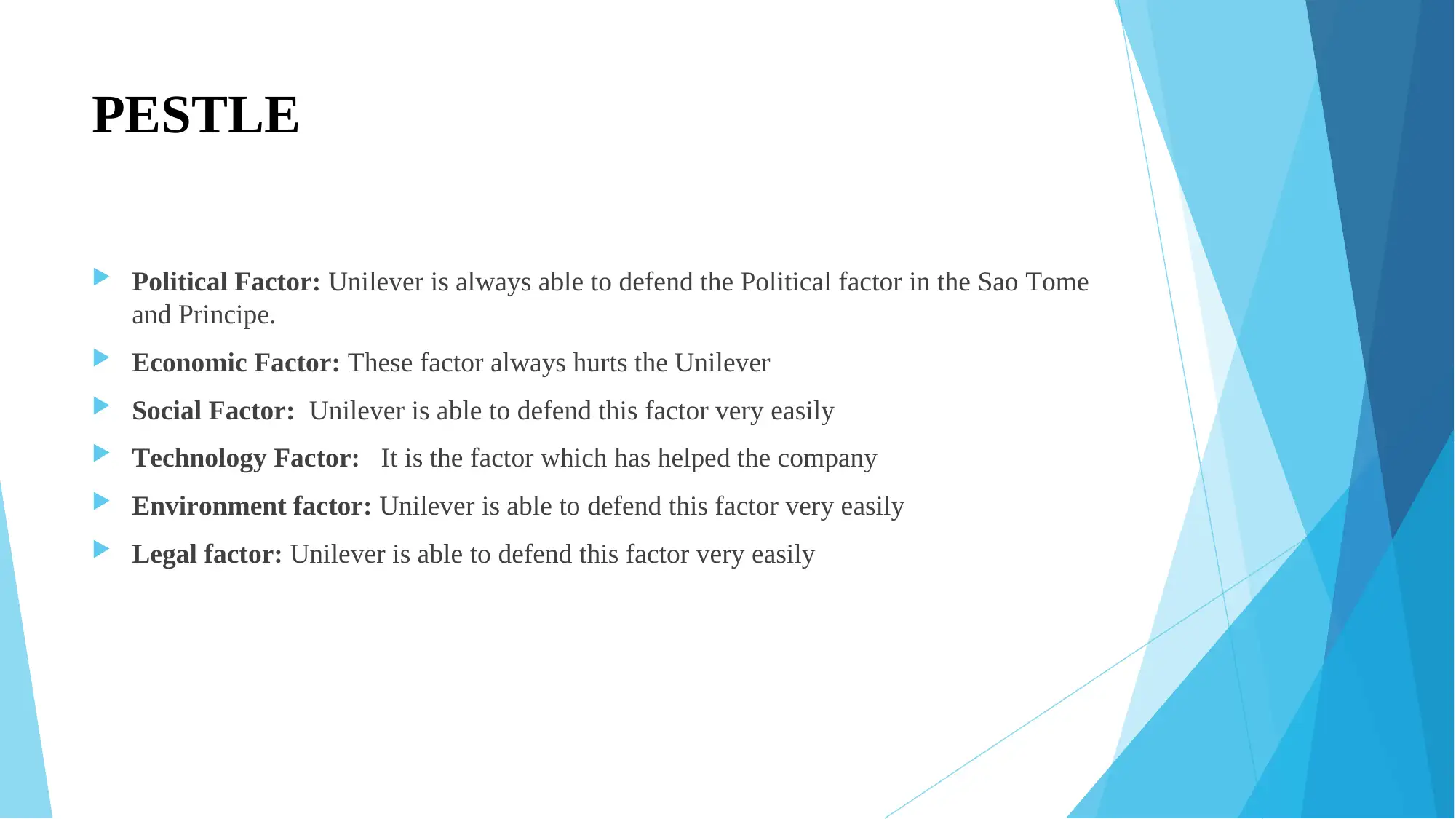
PESTLE
Political Factor: Unilever is always able to defend the Political factor in the Sao Tome
and Principe.
Economic Factor: These factor always hurts the Unilever
Social Factor: Unilever is able to defend this factor very easily
Technology Factor: It is the factor which has helped the company
Environment factor: Unilever is able to defend this factor very easily
Legal factor: Unilever is able to defend this factor very easily
tabler-icon-diamond-filled.svg

Paraphrase This Document

Need a fresh take? Get an instant paraphrase of this document with our AI Paraphraser
Document Page
New Trend in the Sector
Healthy Product
Quality Product
Environment Friendly Product
Document Page
Competitive strategy
USP of the Unilever will be the best way to see the competitive strategy of the
Unilever. USP of the Unilever is as follows:
Document Page
Organizational culture in the Unilever
Handy culture model is the best way by which culture of the organization can be
studied.
Power Culture: Does not used by the Unilever
Role Culture: Used by the Unilever
Task Culture: Does not used by the Unilever
Person Culture: Used by the Unilever
tabler-icon-diamond-filled.svg

Paraphrase This Document

Need a fresh take? Get an instant paraphrase of this document with our AI Paraphraser
Document Page
Unilever Strategic management.
Mackenzie 7s strategy management model of the Unilever is as follows:
Document Page
SWOT ANALYSIS
Strengths: Global footprint, Diversified products, Research and development.
Weaknesses: competitive market, substitutes product
Opportunities: western culture products
Threats: economic crises
Document Page
Ansoff's Matrix
Company can use an Ansoff's matrix to have better area coverage
tabler-icon-diamond-filled.svg

Paraphrase This Document

Need a fresh take? Get an instant paraphrase of this document with our AI Paraphraser
Document Page
CONCLUSION
Globalisation
Document Page
REFERENCES
Books and Journals
Rastogi, N.I.T.A.N.K. and Trivedi, M.K., 2016. PESTLE technique–a tool to identify
external risks in construction projects. International Research Journal of Engineering
and Technology (IRJET). 3(1). pp.384-388.
Bush, T., 2017. PESTLE analysis: everything you need to know (2016). Available in:
http://pestleanalysis. Com.
chevron_up_icon
1 out of 12
circle_padding
hide_on_mobile
zoom_out_icon
[object Object]